Posts Tagged ‘senses’

Gods are a matter of epistemology rather than theology

December 28, 2025

Gods are a matter of epistemology rather than theology 

or Why the boundaries of cognition need the invention of Gods

An essay on a subject which I have addressed many times with my views evolving and getting more nuanced over the years but generally converging over time. I suspect this is now as close to any final convergence I can achieve.


Summary

Human cognition is finite, bounded by sensory and conceptual limitations. When we attempt to comprehend realities that exceed those limits—such as the origin of existence, the nature of infinity, or the essence of consciousness—we inevitably reach a point of cognitive failure. At this boundary, we substitute understanding with “labels” that preserve the appearance of explanation. “God” is one such label, a placeholder for what cannot be conceived or described.

The essay argues that the invention of gods is not primarily a cultural accident or a moral device but a “cognitive necessity”. Any consciousness that seeks to understand its total environment will eventually collide with incomprehensibility. To sustain coherence, the mind must assign meaning to the unknowable—whether through myth, metaphysics, or scientific abstraction. “God” thus emerges as a symbolic bridge over the gap between the knowable and the unknowable.

This tendency manifests in the “discretia/continua” tension which arises from our inability to reconcile the world as composed of both distinct things (particles, identities, numbers) and continuous processes (waves, emotions, time). Different cognitions, human, alien, or animal, would experience different boundaries of comprehension depending on their perceptual structures. Yet each would face some ultimate limit, beyond which only placeholders remain.

The essay further proposes that “God” represents not an active being but the “hypothetical cognition that could perceive the universe in its totality”. For finite minds, such total perception is impossible. Thus, the divine concept is born as a projection of impossible completeness. Even an unconscious entity, such as a rock, is immersed in the continuum but lacks perception, suggesting that only through perception do concepts like “continuity” and “divinity” arise.

In essence, “gods exist because minds are finite”. They are conceptual necessities marking the horizon of understanding. The invention of gods is not weakness but the natural consequence of finite awareness confronting the infinite. Where the finitude of our cognition meets the boundless universe, we raise placeholders—and call them gods. “God” emerges not from revelation, but from the structure and limits of cognition itself.


Human finitude

Human cognition is finite. Our brains are finite, and we do not even have many of the senses that have evolved among other living species on earth. We rely primarily on the five traditional senses (sight, hearing, smell, taste, and touch), plus some others like balance, pain, and body awareness. But living things on earth have evolved many “extra” senses that we do not possess. Unlike other creatures we cannot directly detect magnetic fields, electrical fields, or infrared or ultraviolet radiation. We cannot either detect and use echo location, or polarized light or seismic signals as some other animals can. (See  Senses we lack). And for all those other detectable signals that must exist in the universe, but are unknown on earth, we cannot know what we do not have.  

I take the cognition of any individual to emerge from the particular combination of brain, senses and body making up that individual where the three elements have been tuned to function together by evolution. It is through the cognition available that any observer perceives the surrounding universe. And so it is for humans who find their surroundings to be without bound. No matter where or when we look, we see no edges, no boundaries, no beginnings and no endings. In fact, we can perceive no boundaries of any kind in any part of the space and time (and the spacetime) we perceive ourselves to be embedded in. Our finitude is confronted by boundless surroundings and it follows that each and every observation we make is necessarily partial, imperfect and incomplete. It is inevitable that there are things we cannot know. It is unavoidable that what we do know can only be partial and incomplete. All our observations, our perceptions are subject to the blinkers of our cognition and our finitude can never encompass the totality of the boundless.

It is this finitude of our cognition and the boundless world around us which gives us our three-fold classification of knowledge. There is that which we know, there is that which is knowable but which we do not know, and then there is that which we cannot know. Every act of knowing presupposes both a knower and what is or can be known. Omniscience, knowing everything, is beyond the comprehension of human cognition. To know everything is to remove the very meaning of knowledge. There would be nothing to be known. It is a paradox that as knowledge grows so does the extent of the interface to the unknown and some of that is unknowable. Any mind contained within the universe is a finite mind. Any finite mind faced with a boundless universe is necessarily curtailed in the extent of its perception, processing, representation and understanding.

A key feature of human cognition is that we have the ability to distinguish “things” – things which are discrete, unique, identifiable and countable. We distinguish fundamentally between continua on the one hand, and discrete separate “things” on the other. We classify  air, water, emotions, colours as continua, while we recognize atoms and fruit and living entities and planets and galaxies and even thoughts as “things”. Once a thing exists it has an identity separate from every other thing. It may be part of another thing but yet retains its own identity as long as it remains a thing. To be a thing is to have a unique identity in the human perceived universe. We even dare to talk about all the things in the visible universe (as being the ca. 1080 atoms which exist independently and uniquely). But the same cognitive capability also enjoins us to keep “things” separated from continua. We distinguish, draw boundaries, try to set one thing against another as we seek to define them. Perception itself is an act of discretization within a world we perceive as continuous in space, energy, time, and motion. Where there are flows without clear division, the human mind seeks to impose structure upon that flow, carving reality into things it can identify, name, and manipulate. Without that discretization there could be no comprehension, but because of it, comprehension is always incomplete. As with any enabler (or tool), human cognition both enables inquiry but also limits the field of inquiry. Even when our instruments detect parameters we cannot directly sense (uv, ir, infrasound, etc.) the data must be translated into forms that we can detect (audible sound, visible light, …) so that our brains can deal with data in the allowable forms for interpretation. But humans can never reproduce what a dog experiences with its nose and processed by its brain. Even the same signals sensed by different species are interpreted differently by their separate brains and the experiences cannot be shared.

When finitude meets the boundless, ….

It is not surprising then that the finitude of our understanding is regularly confounded when confronted by one of the many incomprehensibilities of our boundless surroundings. All our metaphysical mysteries originate at these confrontations. At the deepest level, this is inevitable because cognition itself is finite and cannot encompass an unbounded totality. There will always exist unknowable aspects of existence that remain beyond our cognitive horizon. These are not gaps to be filled by further research or better instruments. They are structural boundaries. A finite observer cannot observe the totality it is part of, for to do so it would have to stand outside itself. The limitation is built into the architecture of our thought. Even an omniscient computer would fail if it tried to compute its own complete state. A system cannot wholly contain its own description. So it is with consciousness. The human mind, trying to know all things, ultimately encounters its own limits, of comprehension.

When that point is reached where finitude is confronted by boundlessness, thought divides. One path declares the unknown to be empty and that beyond the horizon there is simply nothing to know. Another declares that beyond the horizon lies the infinite, the absolute. Both stances are responses to the same impasse, and both are constrained by the same cognitive structure. Both are not so much wrong as of providing no additional insight, no extra value. For something we do not know we cannot even imagine if there is a fence surrounding it. Each acknowledges, by affirmation or negation, that there exists a boundary beyond which the mind cannot pass. It is this boundary which limits and shapes our observations (or to be more precise, our perception of our observations).

The human mind perceives “things.” Our logic, our language, and our mathematics depend upon the ability to isolate and identify “things”. An intelligence lacking this faculty could not recognize objects, numbers, or individuality. It would perceive not a world of things, but a perception of a continuum with variations of flux, or as patterns without division. For such a cognition, mathematics would be meaningless, for there would be nothing to count. Reality would appear as a continuum without edges. That difference reveals that mathematics, logic, and even identity are not universal properties of the cosmos but features of the cognitive apparatus that apprehends it. They exist only within cognition. The laws of number and form are not inscribed in the universe; they are inscribed in the way our minds carve the universe into parts. A spider surely senses heat and warmth and light as gradients and density, but it almost certainly has no conception of things like planets and stars.

We find that we are unable to resolve the conflicts which often emerge between the discrete and the continuous, between the countable and the uncountable. This tension underlies all human thought. It is visible in every field we pursue. It appears in particles versus waves, digital versus analogue, fundamental particles versus quantum wave functions, reason versus emotion, discrete things within the spacetime continuum they belong to. It appears in the discrete spark of life as opposed to amorphous, inert matter or as individual consciousnesses contributing to the unending stream of life. It appears even in mathematics as the tension between countable and uncountable, number and continuum. Continua versus “discretia” (to coin a word) is a hallmark of human cognition. This tension or opposition is not a flaw in our understanding; it is the foundation of it. The mind can grasp only what it can distinguish, but all of existence exceeds what can be distinguished.

Where discreteness crashes into continuity, human cognition is unable, and fails, to reconcile the two. The paradox is irreducible. To the senses, the ocean is a continuous expanse, while to the physicist, it resolves into discrete molecules, atoms and quantum states. Both views are correct within their frames, yet neither captures the whole. The experiences of love, pain, or awe are likewise continuous. They cannot be counted or divided or broken down to neural signals without destroying their essence. Consciousness oscillates perpetually between the two modes – either breaking the continuous into parts but then seeking a unifying continuity among the parts. The unresolved tension drives all inquiry, all art, all metaphysics. And wherever the tension reaches its limit, the mind needs a placeholder, a label to mark the place of cognitive discontinuity.  The universe appears unbounded to us, yet we cannot know whether it is infinite or finite. If infinite, the very concept of infinity is only a token for incomprehensibility. If finite, then what lies beyond its bounds is equally beyond our grasp. Either way, the mind meets different facets of the same wall. The horizon of incomprehensibility is shaped by the nature of the cognition that perceives it. A spider meets the limit of its sensory world at one point, a human at another, a hypothetical superintelligence elsewhere. But all must meet it somewhere. For any finite mind, there will always be a place where explanation runs out and symbol begins. These places, where the boundary of comprehension is reached, is where the placeholder-gods are born. “God” is the label – a signpost – we use for the point at which the mind’s discretizing faculty fails.

…… the interface to incomprehension needs a label

The word “God” has always carried great pondus but carries no great precision of meaning. For millennia, it has served as the answer of last resort, the terminus at the end of every chain of “why?” Whenever a question could no longer be pursued, when explanations ran out of anywhere to go, “God” was the placeholder for the incomprehensible. The impulse was not, in the first hand, religious. The need for a marker, for a placeholder to demarcate the incomprehensible, was cognitive. What lies at the root of the use of the word “God” is not faith or doctrine, but the structure of thought itself. The concept arises wherever a finite mind confronts what it cannot encompass. The invention of a placeholder-God, therefore, is not a superstition of primitive people but a structural necessity when a bounded cognition meets unbounded surroundings. It is what minds must do when they meet their own limits. When faced with incomprehensibility, we need to give it a label. “God” will do as well as any other.

Each time the boundary of knowledge moves, the placeholder moves with it. The domain of gods recedes in a landscape which has no bounds. It never vanishes, for new boundaries of incomprehension always arise. As the circle of knowledge expands the boundary separating the known from the unknowable expands as well. Just think of an expanding circle. As the circle of knowledge grows the perimeter to the unknowable also expands. Beyond the line of separation lies a domain that thought can point to but not penetrate.

The mind must first collide with what it cannot grasp. Only then does the placeholder-God emerge as the marker of our cognitive boundary. This is not a deliberate act of imagination but a reflex of cognition itself. The finite mind, unable to leave an unknown unmarked, seals it with a symbol. The placeholder-God is that seal  – not a being, but a boundary. It does not describe reality but it provides a place for thought to rest where explanation collapses. As a placeholder, “God” is just a 3-letter label. The interface with the incomprehensible, and the placeholder it produces, are therefore necessary, but not sufficient, conditions for any God-being to appear in human thought. Without the interface, divinity has no function; a God invented without an underlying mystery would be a mere fantasy, not a sacred concept.

The paradox deepens when one asks what kind of cognition would not require such a placeholder. Only a mind that could know everything without limit would need none –  but such a mind would no longer be finite, and thus no longer a mind in any meaningful sense. To know all is to dissolve the distinction between knower and known. The infinite mind would not think “of” God; it would be what the finite mind calls God, though without the need to name it. Hence, only finite minds invent gods, and they must necessarily do so. The invention is the shadow cast by limitation.

The concept of God, then, is not evidence of divine existence but arises as a consequence of cognitive limitation. It is the sign that the mind has reached the edge of its own design. To invent gods is not a failure of reason but its completion. The placeholder is the punctuation mark at the end of understanding. It acknowledges that thought, to exist at all, must have limits. And within those limits, the impulse to name what cannot be named is inescapable.

The earliest people looked at the sky and asked what moved the sun. The answer “a God” was no explanation but it marked a boundary. It was a placeholder for the inexplicable. The label has changed. It was once Zeus, later Nature, now perhaps the Laws of Physics or even Science, but the function remains the same. Existence, time, causality, matter and energy are still fundamental assumptions in modern science and are all still inexplicabilities needing their placeholder-Gods. Let us not forget that terms assumed ro be very well-known, such as gravity and electric charge, even today are merely placeholder-Gods. We may be able to calculate the effects of gravity to the umpteenth decimal, but we still do not know why gravity is. Electrical charge just is, but why it is, is still just a brute fact in science. Every so-called brute fact invoked by science or philosophy is nothing other than a placeholder-God. Where comprehension ends, a placeholder is needed to prevent thought from collapsing into chaotic incomprehensibility. The idea of a placeholder-God, therefore, is not a primitive explanation but an intellectual necessity. It is the symbol that marks the limits of the cognitive map.

From cognitive placeholder to God-beings

(Note on my use of language. I take supernatural to mean supra-natural – beyond known natural laws – but not unreal. While the unnatural can never be observed, the supernatural is always what has been observed, and is therefore real, but is inexplicable. The rise of the sun and the waning of the moon and the onset of storms and the seasonal growth of plants, all were once considered inexplicable and supernatural. As human knowledge grew, each was gradually absorbed within the gamut of human comprehension. The supernatural is therefore not a denial of reality but a recognition of the incompletely understood. The unnatural is what I take to be unreal and fantastical or invented. The unnatural may be the stuff of fairytales and fantasy but being unreal, can never be observed).

As the placeholder-God gains social form, it must somehow rise above the human condition to retain meaning. A God limited to human capabilities would fail to explain what lies beyond it. Thus, gods become supra-human, but not unnatural, for they remain within the world but “beyond what humans can.”

Under the pressures of imagination, fear, and the need for coherence, the placeholder-God then acquires agency. The divine is invoked. The unknown becomes someone rather than something. A God-being, however, cannot be invented except from first having a placeholder-God. It cannot be created or invented directly, ex nihilo, because invention presupposes a motive, and without the confrontation with incomprehensibility, there is none. The human mind can understand the exercise of power only through will and intent and so the boundary acquires intention. In time, societies institutionalize these projections, turning the abstract placeholder into a God-being  and endowing it with purpose, emotion, and supra-human capacity.

This perspective gives the divine a new and paradoxical definition: “God is that which would perceive the entire universe without limit”. Such perception would not act, judge, or intervene. It would simply encompass. Yet a cognition capable of perceiving all would have no distinction within itself. It would no longer know as we know, for knowledge depends upon differentiation. To perceive all would be to dissolve all boundaries, including the boundary between subject and object. Such a consciousness would be indistinguishable from non-consciousness. The rock that perceives nothing and the god that perceives everything would converge, each beyond cognition, each outside the tension that defines life. Consciousness, poised between them, exists precisely because it knows but does not (cannot) know all.

The necessity of the divine placeholder follows directly from human finitude. The mind cannot tolerate infinite regress or complete ambiguity. It demands closure, even when closure is impossible. To preserve coherence, it must mark the point where coherence breaks down. That mark is the god-concept. It halts the chain of “why” with the only possible answer that does not generate another question. “Because God made it so” and “because that is how the universe is” perform the same function. They end the regress. In this sense, the invention of gods is an act of intellectual hygiene. Without a terminal symbol, thought would never rest; it would dissolve into endless questioning.

Understanding the god-concept in this way does not demean it. It restores its dignity by grounding it in the architecture of cognition rather than in superstition. Theology, stripped of dogma, becomes the study of where understanding fails and symbol takes over  –  a form of cognitive cartography. Each theology is a map of incomprehensibility, tracing the outer borders of thought. Their differences lie in what each places at the edge of their maps and the projections and colours each uses. Yahveh or Indra, Heaven or Hell, Big Bangs and Black Holes, and Nirvana or Nothingness, but their commonality lies in the inevitability of the edge itself.

Modern science has not abolished this pattern; it has merely changed the symbols. The physicist’s equations reach their limit at the singularity, the cosmologist’s model ends before the Big Bang, the biologist’s postulates begin after the spark of life and the neuroscientist’s theory marvel at the mystery of consciousness. Each field encounters an ultimate opacity and introduces a term  –  “quantum fluctuation,” “initial condition,” “emergence”, “random event”  –  that serves the same function the placeholder-God once did. Quantum mechanics has shifted the position of many placeholders but has replaced them with new boundaries to the inexplicable. New concepts such as fields and quantum waves and collapse of these are all new “brute facts”. As labels they provide no explanations since they cannot. They are “brute facts”, declarations that comprehension goes no further, that explanation stops here. Matter, energy, spacetime, and causality remain today’s deepest placeholders and there is no explanation in any field of science which can be made without presupposing them. The structure of thought remains the same even when the vocabulary has changed.

In this sense, the divine arises not from invention but from collision. There must first be an encounter with incomprehensibility  – the interface  – before any god-being can appear. Without such a frontier, divinity has no function. A god invented without an underlying mystery would be a mere fiction, not a sacred idea, because it would answer no cognitive or existential demand.

Thus the sequence when finitude is confronted by boundlessness is inevitable and unidirectional:

incomprehensibility → cognitive discomfort → placeholder → personification → divinity.

The Atheist–Theist Misunderstanding

When gods are understood not as beings but as boundaries of cognition, the quarrel between theist and atheist becomes a shadow-boxing match. Both speak to the same human need  – to name the edges of what we cannot (or cannot yet) know.

The theist affirms that beyond the boundary lies sacred divinity while the atheist denies the personality that has been projected upon that region. Yet both acknowledge, implicitly or explicitly, that the boundary exists. The theist says, “Here is God.” The atheist says, “Here is mystery, but not God.” Each uses a different language to describe the same encounter with incomprehensibility. In that sense, the death of God is only the death of one language of ignorance, soon replaced by another. Every age renames its mysteries. Where one century says “God,” another says “Nature,” or “Chance,” or “Quantum Field.” The placeholders persist and only their symbols change. The Laws of Nature are descriptions of observed patterns but explain nothing and do not contain, within themselves, any explanation as to why they are. All our observations assume causality to give us patterns we call Laws. When patterns are not discernible we invoke random events (which need no cause) or we impose probabilistic events on an unknowing universe.

Theism and atheism, then, are not opposites but reactions to the same human predicament, the finite mind meeting the incomprehensible. One bows before it; the other pretends to measure it. Both, in their own ways, testify to the same condition  – that we live surrounded by the unknowable. If there is a lesson in this, it is not theological but epistemological. Gods are not proofs or explanations of existence. They are confessions of cognitive limitation. They mark the frontier between what can be known and what cannot, yet or ever, be known. To understand them as such is not to destroy them but to restore them to their original role  as signposts for, not explanations of, the boundaries of thought.

Our cognition may evolve but will remain finite for the length of our time in this universe. So long as it remains finite, there will always be gods. Their names will change, their forms will evolve, but their necessity will endure. They must endure for they arise wherever understanding ends and wonder begins.

All the senses we do not have

December 12, 2025

This started as an Appendix to an essay I am writing. However it has grown to stand as a post in its own right. It will now be a citation rather than an Appendix in the essay which I hope to complete soon. “Gods are a matter of epistemology rather than theology”. Cognition, including human cognition, emerges from the interactions between a brain, the senses it has access to and the body they are all housed in. A cognition’s view of the world is as much enabled by its available senses as it is blinkered by the same senses. Senses available to any species are unique to that species’ physiology and the brain which interprests the signals generated. The signals from a spider’s eyes or from a dog’s nose are meaningles and cannot be interpreted by a human brain. Furthermore even within a species each individual cognition has unique features. The experiences of a cognition may be similar to that of another individual of the same species but cannot be truly shared. We have no examples of telepathy in any species. My qualia of experiencing red or pain cannot be shared by any other human – but may be similar to the experiences of others. However a spider’s qualia of experiencing the same red with its eight eyes is something else again.


Introduction

Evolution has no aims, plans, or intended outcomes. It is simply the cumulative result of differential survival and reproduction. Traits persist when organisms carrying them leave more descendants than those without them. Sometimes that happens because a trait spares its bearer from an early death; sometimes it happens because the trait leads to more mating opportunities, or because it helps relatives survive, or simply because there is no better alternative available in the genetic lottery.

The popular idea that evolution “selects” for superior or well-designed features is mostly rhetoric. Natural selection does not favour excellence; it favours whatever works well enough under the conditions at hand. What results in any organism, including humans, is not an optimal design but a set of compromises shaped by history, constraint, and chance. When people speak of evolutionary perfection or elegant fit, they are mistaking local adequacy for intentional design. These traits succeeded because, in a given environment, they did not lose in the competition to leave offspring.

The senses that living organisms possess are no different. Each sensory system that exists today is not the best possible way to perceive the world, but merely one that proved sufficient, in a particular lineage and habitat, to avoid being outcompeted. Evolution leaves us only what has survived, with those traits that were good enough for the conditions of the moment. It contains no foresight, no preparation for what comes next, and any sense of direction we read into it is something we impose after the fact.


Senses Animals Have That Humans Do Not

While humans rely primarily on the five traditional senses (sight, hearing, smell, taste, and touch), plus others like balance (equilibrioception), pain (nociception), and body awareness (proprioception), the living things on earth have evolved many “extra” senses that we do not possess.

  • Magnetoception (Magnetic Field Sense): The ability to detect the Earth’s magnetic field and use it for orientation and navigation. This is found in a wide variety of animals, including migratory birds, sea turtles, sharks, and even honey bees. They use this as an internal compass for long-distance travel.
  • Electroreception (Electric Field Sense): The capacity to sense weak electrical fields generated by other living creatures’ muscle contractions and heartbeats. Sharks and rays use specialized organs called the ampullae of Lorenzini for hunting in murky water, and the platypus uses electroreception in its bill.
  • Infrared (IR) Sensing/Vision (Thermoreception): The ability to sense heat radiation, allowing an animal to “see” the body heat of warm-blooded prey, even in complete darkness. Pit vipers (like rattlesnakes) and pythons have specialized pit organs that detect infrared radiation.
  • Echolocation: A biological sonar system used by bats, dolphins, and toothed whales to navigate and hunt. They emit high-frequency sound pulses and listen to the echoes to create a detailed mental map of their environment.
  • Ultraviolet (UV) Vision: The ability to see light in the ultraviolet spectrum, which is invisible to most humans. Many insects (like bees), birds, and fish use UV vision for finding nectar, recognizing mates, or spotting prey.
  • Polarized Light Detection: The ability to perceive the polarization patterns of light. This is used by many insects (for navigation using the sky) and mantis shrimp (which have the most complex eyes known, seeing forms of polarized light we cannot comprehend) for navigation and communication.
  • Seismic/Vibrational Sensitivity: The ability to detect subtle vibrations traveling through the ground or water over great distances. Elephants use their feet to sense ground tremors, and many snakes and insects use this to detect predators or prey.
  • Ultrasonic and Infrasonic Hearing: Many animals can hear frequencies far outside the human range of 20 Hz to 20,000 Hz. Bats and moths use ultrasound (above 20,000 Hz), while elephants and some whales communicate using infrasound (below 20 Hz).

Senses: Could there be more?

Our current understanding of sensory biology is itself limited by our own human perception. We tend to define a sense based on some physical parameter that can be and is converted into a signal that can then be interpreted by a specialised brain which has evolved together with the sensory organs. If there is some parameter or subtle information in our surroundings that no living thing known to us has evolved to be able to detect, or one that is so subtle and complex that it doesn’t clearly map to a known physical stimulus, we would not even recognize it as a “sense” at all.

  • Subtle Chemical Gradients: While we have smell, some organisms (like bacteria or fungi) may sense complex, long-range chemical fields in ways that defy our simple notions of “smell” or “taste.”
  • Quantum Senses: Some research suggests that the magnetic sense in birds may rely on quantum entanglement within specific proteins. If true, this hints at perception mechanisms on a quantum scale that are difficult for us to even conceptualize fully.
  • Predictive or Internal Senses: Plants, which react to light, gravity, touch, and chemical signals, display complex “behavior” without a nervous system. While we classify these as existing senses, their internal “awareness” of time, nutrient deficiency, or potential nearby threats might constitute forms of interoception or time-perception that function in a fundamentally different way than any human feeling.

Our “awareness” of a sense is often based on the technology we invent to imitate it (like a magnetic compass for magnetoception). It is highly likely that life on Earth has evolved to be able to detect some environmental information in ways that remain outside the scope of our imagination or our measurement tools. We can speculate on senses that could exist in principle but which have no value on earth and therefore have never evolved. Let us take a “sense” to be a structured mapping from external regularities into neural states. Many regularities exist which life-forms on Earth have apparently had no motive or incentive to detect or track.

  • Neutrino detection. Neutrinos pass through a light-year of lead without stopping. Biological tissue could never detect them reliably. Could it be of value to some alien cognition. What would such detection change in a world view?
  • Sense of gravitational gradients at fine spatial scales. Gravity is too weak at the biological scale. A living creature would need to be built of very dense matter to reliably distinguish micro-variations in gravitational fields. But we cannot see any value of this to any conceivable form of life.
  • Hyperspectral gamma-ray “vision”. Gamma rays obliterate earthly biological tissue. A system to detect them without dying would require materials and chemistry alien to Earth. The energy levels are simply incompatible with organic molecules.
  • Direct dark-matter detection. Dark matter barely interacts with baryonic matter. Evolution cannot select traits for a signal that never reaches biology. But could there be alien biology and alien cognition which made use of such detection. Who knows?
  • Time-structure sensing at quantum-coherence timescales. A species that can detect changes occurring over femtoseconds or attoseconds is conceptually possible, but organic molecules are far too slow and thermally noisy. Evolution selects for what biochemistry can sustainbut we cannot know what we cannot know.
  • Sensing vacuum fluctuations (zero-point energy). We are almost entering into nonsense territory but then my nonsense may be basic knowledge to an unimaginable alien.
  • Direct perception of spacetime curvature (not gravity but curvature gradients). Living tissue cannot detect curvature directly. Only masses and accelerations reveal it.

Our reality is that as our knowledge grows so does the perimeter to the unknown grow. We can never know all the senses we do not have.


Hearing came before ears existed (as sight must have come before eyes)

February 12, 2015

Of course all our senses lie in the brain and not in the sensors receiving the input from our surroundings. So while our ears, eyes, skin and taste-buds detect certain physical characteristics and convert them into electrical signals, it is our brains which interpret the electrical signals they receive as being sound or colour or taste or heat. Our sense organs are merely transducers, converting some physical characteristic into an electrical signal. So how did the brain evolve and develop the interpretation “software” for these signals before the sensors had even been developed?

Two new papers show that Lungfish and salamanders can hear, despite not having an outer ear or tympanic middle ear. 

  1. C. B. Christensen, H. Lauridsen, J. Christensen-Dalsgaard, M. Pedersen, P. T. Madsen. Better than fish on land? Hearing across metamorphosis in salamanders. Proceedings of the Royal Society B: Biological Sciences, 2015; 282 (1802): 20141943 DOI: 10.1098/rspb.2014.1943
  2. K. Knight. Lungfish hear air-borne sound. Journal of Experimental Biology, 2015; 218 (3): 329 DOI: 10.1242/%u200Bjeb.119487

Aarhus University Press Release:

Lungfish and salamander ears are good models for different stages of ear development in these early terrestrial vertebrates. Two new studies published in the renowned journals Proceedings of the Royal Society B and The Journal of Experimental Biology show that lungfish and salamanders can hear, despite not having an outer ear or tympanic middle ear. The study therefore indicates that the early terrestrial vertebrates were also able to hear prior to developing the tympanic middle ear. …….

……. However, available palaeontological data indicate that the tympanic middle ear most likely evolved in the Triassic period, approximately 100 million years after the transition of the vertebrates from an aquatic to a terrestrial habitat during the Early Carboniferous. The vertebrates could therefore have been deaf for the first 100 million years on land. ….. 

…… They studied the hearing of lungfish and salamanders by measuring auditory nerve signals and neural signals in the brainstem as a function of sound stimulation at different frequencies and at different levels. Surprisingly, the measurements showed that not only the terrestrial adult salamanders, but also the fully aquatic juvenile salamanders – and even the lungfish, which are completely maladapted to aerial hearing – were able to detect airborne sound despite not having a tympanic middle ear. By studying the animals’ sense of vibration, the researchers were able to demonstrate that both lungfish and salamanders detect sound by sensing the vibrations induced by sound waves. …..

My experience in the engineering world suggests that there must be a connection  – a feedback loop – between the “software” interpreting the signals in a brain and the development of the transducers generating the signals. For example, rotating equipment (turbines, compressors or pumps) are routinely plastered with pressure and temperature and stress (really just pressure) sensors. But the 4 – 20 mA signals they generate have to be interpreted by software in a brain. Over the last 40 years I have observed that simple interpretation software has led to improved (more focused and more accurate) sensors which has in turn given even more sophisticated software.

And so it must have also been with our senses. Primitive brains must have interpreted some “sound waves” picked up incidentally as “sound”. Some feedback loop must have then provided the impetus for the evolution of a “sound detector”. The improved sensor would then have increased the sophistication of the interpretation in the brain and given rise to further development of the sensors. Today our ears detect pressure waves of frequency between 20 and 20,000 Hz and convert them into electrical nerve signals interpreted by the brain as sound. Evolution is really not about pro-active selection of advantageous characteristics but of deselection of those not fit enough to aid survival. Evolution has nothing to do with the selection of the “best” or even of the “fittest” characteristics but is all about deselection of those having an insufficient fit. Of course in a competitive environment between individuals, those with “advantageous characteristics” would surely have helped in the culling – directly or indirectly – of the less fit. But that begs the question as to why we cannot hear ultrasound? Was the ability to hear ultrasound of no survival benefit? Was it too much for the “software”? Or was the audible range just a compromise between range on the one hand and intricacy of the sensor on the other?

There must have been a similar start to the development of sight. The incidental or accidental detection of certain frequencies of electromagnetic radiation must have led to a feedback loop between the interpretation software in the brain and the development of suitable sensors. And now our eyes detect electromagnetic radiation of frequency between 430 and 790 terraherz (TH) and convert them into electric signals which are sent to the brain for interpretation. We find benefit in cameras which can “see” uv and infrared light. But it is not an ability that has evolved in our eyes.

I begin to think that in considering evolution we must distinguish between external forces which direct the death of unfit species (environmental changes mainly) and the internal forces within the individuals of a species which leads to “deficient” individuals being “deselected”. And the feedback loop between the brain and our sensory organs – which is no doubt still operating – is probably one such internal force.

To put it crudely, our ears and our eyes are as good as they are because those individuals who had worse ears or eyes could not survive to reproduction. And our ears and eyes are not any better than they are because being any better does not contribute to any increased survival and reproduction.

Sensory and evolutionary deficiencies

August 18, 2014

What shapes our bodies? We can only sense what our shapes permit but are our shapes a result of the survival advantages of what we can sense? Certainly there is much of the physical world that we cannot sense directly – but which we can sense by the instruments we have crafted.There may be many things we don’t even know about which are outside the range of our senses and our instruments (lumped together as extra-sensory things and the source of much speculation and much fraud). Our view of the world and of physical reality is totally dependent upon our senses and what we can perceive directly or through our instruments. Even what we can imagine is limited (a la Rumsfeld) to areas that we know we don’t know. But we cannot even conceive of – let alone imagine – what we don’t know we don’t know.

But why are the ranges of what can be detected by our senses limited to what they are? As hunter-gatherers surely it would have been of survival advantage to see in the dark at least as well as the big cats that were our predators. We must – before agriculture – have had the ability to track our prey. Did humans have a more acute sense of smell then, in the distant past? Did we once use smell as a communication tool as some animals apparently do? Has our sense of smell deteriorated as we have developed as an agrarian society. We can feel minute changes of heat flow on our skins but we cannot “see” thermal images with our eyes. Is there no survival advantage in seeing further into the ultra-violet or the infra-red? Why is our ability to hear high frequency sounds so much inferior even to animals we have domesticated?

There is also a fundamental difference between our ability to perceive some sensory inputs and our ability to generate such sensory signals. We can make as well as detect sounds. We can see certain wave-lengths of reflected radiation but we are not luminescent. Our olfactory sense can detect some trace chemicals but we cannot generate smells at will. Taste buds taste but cannot generate tastes.

It is now thought that humans have many more than just the five traditional “Aristotelian” senses of sight, hearing, touch, taste and smell. Nowadays some recognise pressure, itch, balance, thermoception, proprioception, pain, magnetoception and perhaps even chronoception (the ability to discern passage of time) as being human senses. We can even perhaps sense the force of gravity. If our inherent senses were powerful enough and varied enough, we would not need any instruments. What we cannot detect because our senses are limited could well be called sensory deficiencies, but whether these are evolutionary deficiencies or not depends upon whether the lack of capability could have provided some survival advantage.We can measure brain waves in a fashion with our instruments but we don’t always know what they mean. The existence of an instrument to measure something is itself evidence of a sensory deficiency. But what an instrument can measure we can also imagine some organ may be able to sense.

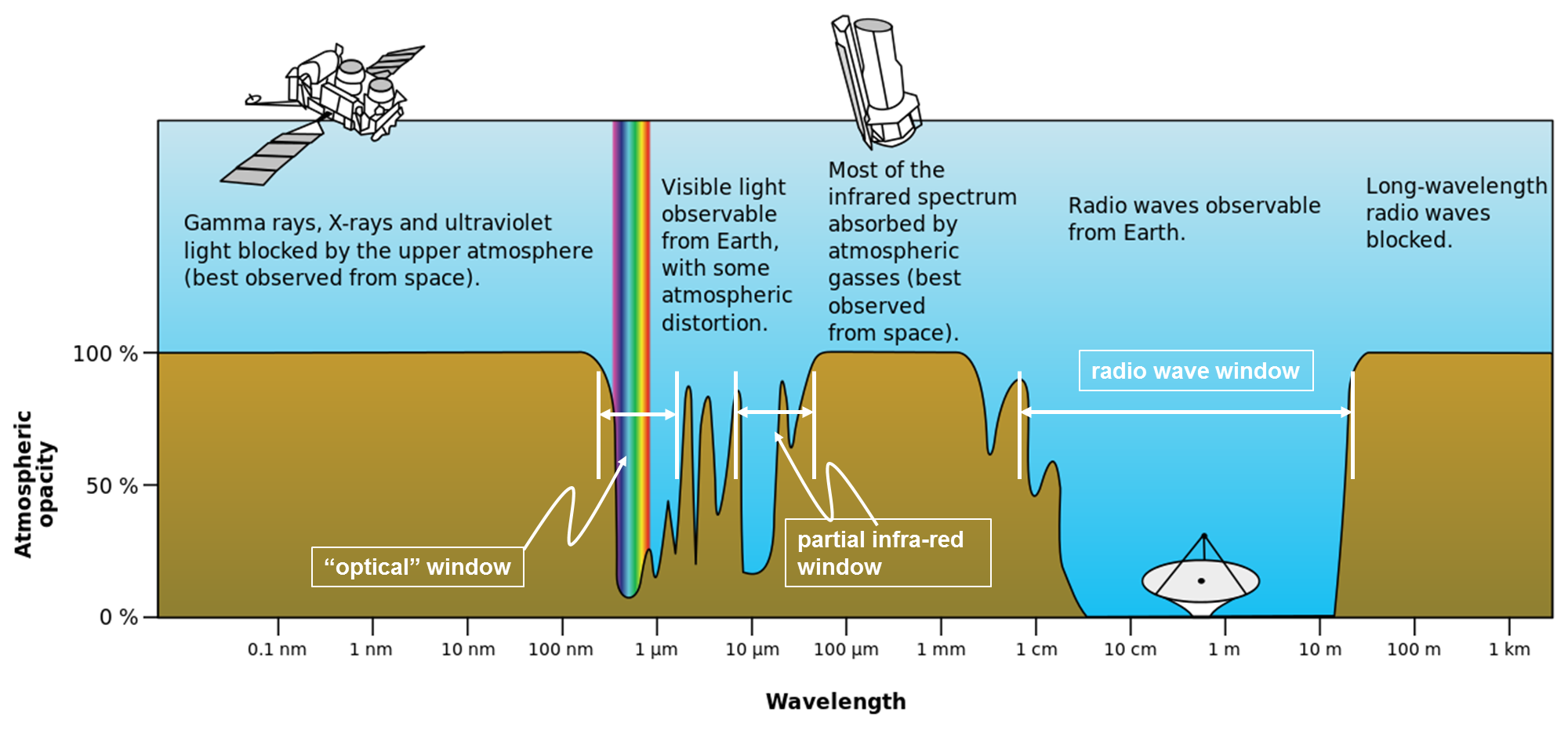
There are some who point to the evolution of the eye as some kind of proof of Intelligent Design. But it is actually the reverse. Human eyes actually see a very small part of the spectrum available to be discerned. Compared to what it could be, vision is a key area of sensory deficiency. Electromagnetic radiation exists in the range from gamma rays having a wavelength of 0.1 Angstrom (10−11 m  corresponding to a wavelength of 1019 Hz) all the way up to long wave radiation with a wave length of about 1,000 m and a frequency of 100,000 Hz. Within this range we find radio waves (wavelength 50 cm – 10 m), microwaves and radar (between 1cm – 10 cm wavelengths), infra-red (between 1 μm and 1 mm), “visible light” (between 360 nm to 720 nm), ultra-violet (20 nm to 100 nm) and X-rays (0.2 nm to 1 nm). The gases in the Earth’s atmosphere prevents much of the electromagnetic radiation from reaching the surface. But the atmosphere is virtually transparent in 3 main bands

  1. an “optical window” including the visible spectrum along with the near uv and near ir regions,
  2. a partial infra-red window, and
  3. a radio wave window

emr windows - based on wikimedia

emr windows – based on wikimedia

There is some reason therefore for life on earth to develop senses which take advantage of these windows to detect the electromagnetic radiation that passes through the atmosphere and bombards the earth. Yet no animal can detect all radiation just in the “optical window”. Some of the infra-red radiation can be detected as warmth on the skin. Bats can both see and emit along the radar bands but not at longer radio wave-lengths. Humans are virtually blind in the top two windows.

daffodil in visible and UV light image Dr. Mccarthy

daffodil in visible and UV light image Dr. Mccarthy

http://drmccarthysciencehgms.blogspot.se/2010/01/how-do-insects-see-flowers.html

Even within the optical window, the range of wave-lengths that are “visible” to humans is much narrower than the range visible to all animal-life. Pollinating creatures (bees and butterflies), for example, see well into the ultra-violet. The colours and patterns on flowers look quite different in ultra-violet light. They appear like landing lights to guide the pollinator “home”.While the picture on the right above is exclusively in uv light, an extended range of human visibility would lead to “seeing” some combination of the two pictures above. And so it would be if we could see further into the infra-red as well. We would need non-existent – but imaginable organs, to sense radiation within the other two windows.

Whether or not an extended range of vision could have helped humans better to survive, it is apparent that human vision is – compared to what is possible in the animal world – deficient. Compared to what is there to be “seen”, we see only a tiny fraction. It is highly unlikely that having an extended range of vision would have been a disadvantage in the survival stakes. It may not have provided a critical advantage but it still remains a sensory and an evolutionary deficiency!

Humans also lack the organs which allow bats to be radar receivers and emitters. A deficiency. We lack the organs that allow sharks to detect electric currents or birds to detect and navigate along magnetic lines of force. Our olfactory senses are far inferior to that of most animals. Dogs may be able to smell cancer cells but we can’t. Our hearing of high frequency sounds is also much inferior to that of most animals. All deficiencies. Humans do very well with low frequency sounds and perhaps only elephants and the largest of whales can generate and hear lower pitched sounds than humans can. We do not have the senses to even discern what some of our instruments measure.

For every human sense, and comparing only with the range exhibited by other life on Earth, our range of detection is deficient. There is no instance where the range of a human sense represents the entire range available within the animal world. Clearly, with a greater sensory range, humans could be much more capable – inherently – of discerning the world around them than they actually are.

Evolution of course is not about excellence. It is not even about the survival of the fittest. It is just the result of the demise of the unfit and therefore represents the minimum required to survive. Evolution is not about being “best” but only about being “good enough”. Evolution therefore sorts out individuals with sensory deficiencies when they are debilitating and prevent survival but evolution does not – except by accident – lead to an increase in a sensory range.

Natural de-selection which has dominated evolution so far is essentially without direction and is not a “selection for excellence”. Now as artificial selection comes into play, it becomes possible for humans – for the first time ever – to consider the direction to be taken for the development of future humans. This is the stuff of Frankenstein and Dr. Moreau and other evil genetic manipulators. Nevertheless I wonder which senses I would want/desire to be improved or enhanced or even created. (Though I would prefer that the deterioration of senses with age be addressed first).

Vision: I would quite like to have a much better night vision sensitivity together with some further range into the infra-red (but perhaps not much further into the uv range). I exclude Superman like X-ray vision as being too far removed from the optical window. To be able to “light-up” whatever I was looking at – say within 1 m – would require some new organ of luminescence which may be asking for too much.

Sound: A slightly larger range of hearing into the high frequency bands is, I think, to be desired. At least so I can hear what a dog hears. This would change human music and musical instruments quite drastically. I don’t think I want a more acute hearing sense (we are surrounded by enough noise as it is) but I would like to be able to hear a greater range of sounds than I can produce.

Magnetoception: It would have been a boon for explorers 500 years ago if they had had an innate sense of magnetic north. As we go out away from earth, humans will be exploring again and being able to discern lines of magnetic force without relying on instruments could well come in useful.

I have no great desire for enhancing the sense of touch or of smell. They are fine as they are and I see no clear benefits in their enhancement. But a new organ of extra-sensory perception (esp) to pick up the brain waves of others could be very handy. In its simplest form it would just detect when somebody was lying or some kind of “empathy” level being broadcast. But in its most evolved form it could be what is so beloved of science fiction writers. An organ that allowed mind-to-mind contact would lead to a profound paradigm shift in communication between humans which would rival the introduction of speech and language.