Posts Tagged ‘Shale gas’

Bio-gas is out, shale gas is in and there is no “peak” gas in sight!

May 6, 2011

Shale gas is abundant and now beginning to undercut the price of other sources of natural gas. It is already cheaper than LNG transported around the world which requires both terminals for liquefaction and receiving stations for evaporation. Gas-fired power plants are relatively cheap and quick to build. In simple-cycle operation gas turbine based power plant provide the economic method of choice for emergency power and peak power. In combined cycle operation they provide the highest efficiency of all types of fossil fired electricity generation (around 60%). The ratio of gas price to coal price determines whether this can be cheaper than coal fired power generation.
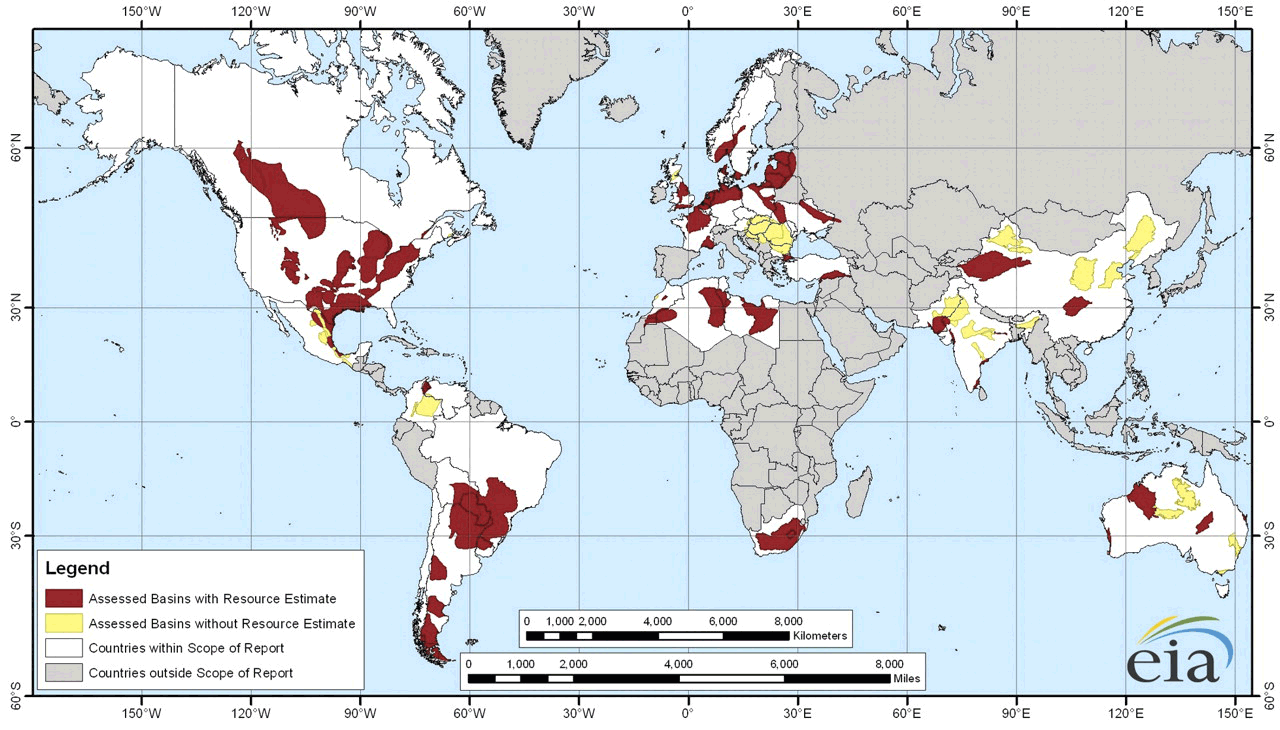
Shale gas is abundant: map via Wikipedia

Total oil, gas and coal resources in the Earth’s crust are estimated at more than 570,000 exajoules. The world will use about 450 exajoules (billion billion joules) of fossil fuel energy this year.

Exajoule

The exajoule (EJ) is equal to 1018 joules. The 2011 Tōhoku earthquake and tsunami in Japan had 1.41 EJ of energy according to its 9.0 on the Richter magnitude scale. Energy in the United States used per year is roughly 94 EJ.

Matt Ridley:

Quantity is not really the point; price is. Most fossil fuels are impossibly hard to extract at a reasonable price. More than half the reserves consist of methane clathrates hydrated gas found mostly on the seabed near the margins of the continents in vast quantities. Nobody knows how to turn them into fuel except at huge cost, although the Japanese are on the case. So the question is not whether we run out of fossil fuels but whether we run out of cheap fossil fuels.

With oil, the answer may be “yes”. A huge amount of oil is still untapped, but most of it is under deep water or in oil sands and is costly to extract. But with gas, the answer is “no”. Most free methane is found in impermeable rocks such as shale, not in permeable “traps” whence it is easiest to extract. Shale gas was thought to be as inaccessible as clathrates, and when it began to be exploited in the 1990s it looked as if it would still come in at the top of the price range. Now technological improvements have brought the price down so far that it undercuts conventional gas. 

The “shale-gas shock” will have far-reaching consequences. It will make gas prices lower and less volatile relative to oil than ever before.

This will cause gas to take market share from coal, nuclear and renewables in electricity generation, and from oil in transport. London buses should follow Washington and Delhi in switching to gas both to save money and to produce less smog.

Shale gas is good news for America and China (which probably has even more of it than America), consumers (cheap fuel means higher standards of living) and farmers (fertiliser is made from gas). It is bad news for Russia and Iran (which hoped to corner the gas market in coming decades), for coal (until now the cheapest fuel for electricity) and for the nuclear and wind industries. The last two had expected to be rescued from dependence on subsidies by rising fossil fuel prices. They may now not be.

The losers are formidable enemies, so there is a movement, whose fans range from Gazprom to Greenpeace, to strangle the shale-gas industry at birth, by claiming that drilling for it contaminates water with carcinogenic and even radioactive chemicals. This turns out to be true only in the sense that coffee is carcinogenic, bananas radioactive and dihydrogen monoxide (water) a chemical.

The use of gas for power generation is perfectly sustainable into the foreseeable future. As the hysteria and alarmism around carbon dioxide causing global warming is debunked and begins to fade away the fashionable and unsustainable focus on bio-gas will also die away. The price of electricity production from gas will be the benchmark for judging whether wind and solar power make any sense. Without artificially imposed penalties on carbon or carbon taxes on fossil fuel, bio-gas can never be more than a marginal fuel of little significance. For bio-gas to have any significance catchment areas become so large that food production is adversely affected. The cost of production is relatively high. Without a carbon dioxide scare and the resulting subsidies, wind and solar power are still not able to compete against any form of fossil fuel power generation or hydro power or nuclear power.

But the success of technologies for the extraction of shale gas ensures availability of significant quantities for a long time to come. These quantities are so large that there is no “peak” in sight and all the alarmist “peak” gas scenarios are rendered meaningless.

Moving peaks: Peak gas will never come

Related: Europe told of potential shale gas bonanza

No “peak” gas in sight as IEA doubles estimates of gas reserves

January 20, 2011
United States shale gas plays

Image via Wikipedia

Known reserves of Natural gas were  thought to be sufficient for 60 to 120 years. Now with shale gas being produced in large quantities, the IEA has revised known reserves upwards to 250 years — and they could be further revised upwards.

Yet another scare scenario of resource depletion bites the dust!!

From the BBC:

The world may have twice as much natural gas than previously thought, according to the rich nations’ think tank the International Energy Agency (IEA). The world may have 250 years of gas usage at current levels thanks to “unconventional gas” from shale and coal beds, Anne-Sophie Corbeau, senior gas expert at the IEA told BBC News.

Estimates may even be revised upwards. Studies are underway into newly-recoverable sources, Ms Corbeau said. But she stressed that the totals were highly uncertain, and depended on price, technology and the accessibility of supplies.

“The gas story is huge,” she told BBC News. “A few years ago the United States was ready to import gas. In 2009 it had become the world’s biggest gas producer. This is phenomenal, unbelievable.” The US achieved the change through a technological breakthrough in which firms found a way of using tiny explosions to free gas previously trapped in a common rock – shale.

Miss Corbeau said other nations were now rushing to replicate the US success by exploiting gas currently trapped in various types of rock where it was thought to be impossible to access.

She said conventional natural gas supplies were assured for 60 years – with maybe a further 60 years if engineers could get to other supplies. She admitted there is great uncertainly about how much unconventional gas is possible to exploit, but said the best estimate is that new sources will stretch gas supplies to 250 years at current levels.

“The resources are really huge,” she said.

“We probably have 920 trillion cubic metres – that is more than 300 times the current annual demand for gas. “Not all of this will be recoverable, but any country that develops new gas supplies will have a global impact on gas availability and price, as gas markets are all inter-connected.”

US shale gas challenges Russian natural gas in Europe

November 12, 2010
Natural gas pipelines from Russia to Europe.

Natural gas pipelines from Russia to Europe: image via Wikipedia

“Peak gas”  like “peak food” and “peak resources” and like all “peak scenarios” keeps getting postponed. The US is awash with shale gas and has started re-exporting LNG it had contracted for to Europe challenging the dominance of Russian supplies of natural gas.

Money control reports:

The United States may play a role this winter in loosening Russia’s grip on the European market for natural gas by shipping liquefied natural gas across the Atlantic. Awash with domestic shale gas and with little need to import extra fuel, the United States has started re-exporting LNG cargoes, which firms had previously imported under contract, to countries where gas prices are much higher.

Such shipments could contribute to a growing pool of cheaper LNG going to Russia’s biggest export market this winter. In the longer term, U.S. plans to build plants to liquefy shale gas could create another rival to Russian pipelines. The first re-export cargo from the United States to Britain — a key access point for LNG into northern Europe via an Interconnector pipeline to Belgium — is set to sail over the weekend. “It is a landmark shipment,” said Zach Allen at NATS LNG analysts in Raleigh North Carolina. “LNG has, through the Interconnector, played a major role in reducing intake of Russian gas into western Europe.”

U.S. shale gas has already forced many LNG producers that had hoped to supply the North American market to find alternative buyers, with many cargoes ending up in Europe and driving spot gas prices below the price of oil-indexed Russian gas.

US re-exports to Europe are the latest sign that increases in shale gas production have transformed the global gas market. The International Energy Agency said on Tuesday that a decade-long period of oversupply was likely to push oil-indexed gas sellers to accept lower prices.

In February, Russian gas export monopoly Gazprom postponed it’s Shtokman LNG project because the United States, its target market, did not need more imports. Major European pipeline gas supplier Statoil has been forced to find alternative markets for LNG it had hoped to send to the United States, often selling it into Europe. Qatar, the world’s largest producer and exporter of LNG, has also pushed into both Norwegian and Russian markets by making large deliveries of cheap LNG into Britain and Belgium. US LNG imports have fallen to contractual minimums as gas prices have sagged, forcing importers whose terminals are sitting idle to change strategy and re-export to make the most of higher prices overseas.

US gas at USD 4.1 per million British thermal units (mmbtu) was about USD 3.3/mmbtu below UK prices on Tuesday and just under half the price of Russian gas in Europe in October, according to International Monetary Fund data. About 20 billion cubic feet of gas has already been re-exported from the United States this year, with some sent to Asia, where buyers have paid nearly USD 10 per mmbtu, and some to Latin America and the Middle East.

More of those US loaded cargoes could head to Britain over coming months, given that winter price increases are sharper in northern Europe than in the United States and that imports by South American and Middle Eastern buyers are usually confined to summer.

“US exports to Europe will remain rather exotic, but they underline once again the big risks for Russia of focusing some of its future projects on US markets,” said Valery Nesterov, energy analyst at Moscow-based Troika Dialog brokerage.

Cheniere Energy, operator of the Sabine Pass import terminal in Louisiana, announced plans in June to build a liquefaction plant at the terminal. It said on Tuesday that US bank Morgan Stanley hoped to secure some of its export capacity. Pending approval, the plant would export US-produced shale gas to markets all over the globe from 2015. It would be the first US LNG export plant in 40 years — following the old Kenai facility which supplies Asia from Alaska — and would be well placed to supply Europe. “LNG supplies from the United States can help lower gas prices in Europe and Asia and ultimately help lift prices in the States,” said Mikhail Korchemkin from Pennsylvania-based East European Gas Analysis.