I get the impression that not only the oil and gas industry but also countries with limited energy resources have not been this energised about prospects for energy independence for a long time ( and perhaps not since the discovery of North Sea Gas). First came Shale gas and then Shale oil and now Fire Ice is catching the imagination. The sheer abundance of methane hydrates around the globe and the thought that much of this gas could soon be economically extractable is almost intoxicating for those involved.
“The worldwide amounts of carbon bound in gas hydrates is conservatively estimated to total twice the amount of carbon to be found in all known fossil fuels on Earth”.
I posted recently about the successful flow test for extracting gas from deep sea methane hydrate conducted in Japan. Of course commercialisation of this technology is still many years away (though Japan hopes this could be as early as 2016). Deposits of methane hydrate are known to be extensive and generally exist either under permafrost or under the sea. The deep sea deposits were laid down under conditions of high pressure (deep sea conditions). India is known to have substantial deposits and this is now getting some people very excited:

Types of methane hydrates deposits
Estimates of global reserves are sketchy, but range from 2,800 trillion to 8 billion trillion cu.metres of natural gas. This is several times higher than global reserves of 440 trillion cu. metres of conventional gas. However, only a small fraction of hydrate reserves will be exploitable.
Methane hydrate is a mixture of natural gas and water that becomes a solid in cold, high-pressure conditions in deep sea-beds (where the temperature falls to 2 degrees centigrade). It is also found in onshore deposits in the permafrost of northern Canada and Russia. Heating the deposits or lowering the pressure (the technique used by JOGMEC) will release gas from the solid. One litre of solid hydrate releases around 165 litres of gas.
India has long been known to have massive deposits of methane hydrate. These are tentatively estimated at 1,890 trillion cu.m. An Indo-US scientific joint venture in 2006 explored four areas: the Kerala-Konkan basin, the Krishna-Godavari basin, the Mahanadi basin and the seas off the Andaman Islands. The deposits in the Krishna Godavari basin turned out to be among the richest and biggest in the world. The Andamans yielded the thickest-ever deposits 600 metres below the seabed in volcanic ash sediments. Hydrates were also found in the Mahanadi basin.
Formidable economic and environmental challenges lie ahead. Nobody has yet found an economic way of extracting gas from hydrates. Industry guesstimates suggest the initial cost may be about $30/ mmBTU, double the spot rate in Asia and nine times higher than the US domestic price. JOGMEC is optimistic that the cost can be cut with new technology and scale economies.
The Indian National Gas Hydrate Program (NGHP) Expedition was conducted together with the US Geological Service
The World’s Largest Potential Energy Resource
Released: 2/7/2008 9:21:21 AMAn international team led by the U.S. Geological Survey (USGS) and the Directorate General of Hydrocarbons, which is under the government of India’s Ministry of Petroleum and Natural Gas, conducted the expedition.
Highlights include:
- gas hydrate was discovered in numerous complex geologic settings, and an unprecedented number of gas hydrate cores and scientific data were collected;
- one of the richest marine gas hydrate accumulations ever discovered was delineated and sampled in the Krishna-Godavari Basin;
- one of the thickest and deepest gas hydrate occurrences yet known was discovered offshore of the Andaman Islands and revealed gas hydrate-bearing volcanic ash layers as deep as 600 meters below the seafloor;
- and for the first time, a fully developed gas hydrate system was established in the Mahanadi Basin of the Bay of Bengal.
“NGHP Expedition 01 marks a monumental step forward in the realization of gas hydrates becoming a viable energy source,” said USGS Director Mark Myers. “This partnership combines the expertise of two organizations dedicated to understanding gas hydrates, and research results provide new and exciting information about this important potential energy resource.”
Directorate General of Hydrocarbons Director General and NGHP Program Coordinator V. K. Sibal said, “The global gas hydrate resources are estimated to be huge. Although the exploration and exploitation of gas hydrates pose significant challenges, the opportunities are unlimited. The combined wisdom of the scientific community from across the world could provide the answers and solutions to many of these challenges. The Indian gas hydrate program has been fortunate in having the benefits of a truly global collaboration in the form of the first gas hydrate expedition in Indian waters. The results of the studies are not only encouraging, but also very exciting. I believe that the time to realize gas hydrate as a critical energy resource has come.”
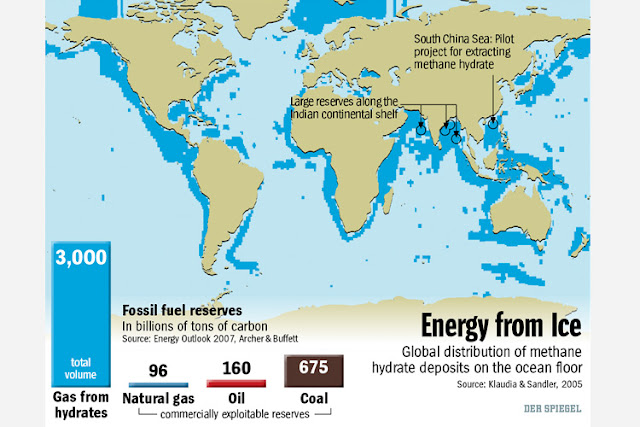
Methane hydrate deposits around the world: Graphic Der Spiegel

 The k2p blog