Posts Tagged ‘Solar System’

Pluto is a planet with moons after all

July 4, 2013

I grew up in a solar system which had nine planets.

And then poor Pluto was stripped of the honour of being a planet and we had only eight.

But then the “dwarf planets” were defined and Pluto joined this group of 5.

… the International Astronomical Union (IAU) defines a dwarf planet as a celestial body in direct orbit of the Sun that is massive enough for its shape to be controlled by gravitation, but that unlike a planet has not cleared its orbital region of other objects.

The IAU currently recognizes five dwarf planets in the Solar System: Ceres, Pluto, Haumea, Makemake, and Eris.

It is suspected that another hundred or so known objects in the Solar System are dwarf planets.

And we now have at least 13 known planets. Pluto is not only a dwarf planet it also has at least 5 moons and the last 2 have just been named. The 5 are Charon, Styx, Nix, Kerberos and Hydra.
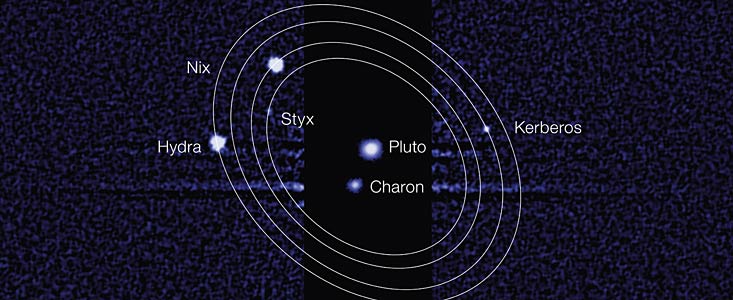
Pluto and its moons: IAU

IAU: 

The International Astronomical Union (IAU) is announcing that the names Kerberos and Styx have officially been recognised for the fourth and fifth moons of Pluto, which were discovered in 2011 and 2012. The names were submitted to the IAU by the leader of the team responsible for the discovery, who had called for the help of the general public in an open contest that attracted a substantial number of participants.

The IAU is pleased to announce that today it has officially recognised the names Kerberos and Styx for the fourth and fifth moons of Pluto respectively (formerly known as P4 and P5). These names were backed by voters in a recently held popular contest, aimed at allowing the public to suggest names for the two recently discovered moons of the most famous dwarf planet in the Solar System.

The new moons were discovered in 2011 and 2012, during observations of the Pluto system made with the NASA/ESA Hubble Space Telescope Wide Field Camera 3, and increasing the number of known Pluto moons to five. Kerberos lies between the orbits of Nix and Hydra, two bigger moons discovered by Hubble in 2005, and Styx lies between Charon, the innermost and biggest moon, and Nix. Both have circular orbits assumed to be in the plane of the other satellites in the system. Kerberos has an estimated diameter of 13 to 34 kilometres, and Styx is thought to be irregular in shape and is 10 to 25 kilometres across.


Comet C/2013 A1 (Siding Spring) could impact Mars on 19th October 2014

March 21, 2013

Comet Shoemaker–Levy 9  broke apart and collided with Jupiter in July 1994, providing the first direct observation of an extraterrestrial collision of Solar System objects.

The collision provided new information about Jupiter and highlighted its role in reducing space debris in the inner Solar System.

But a much closer event could be in the offing for next year. A newly discovered comet has been found to have an orbit which takes it extraordinarily close to Mars in October 2014 and the possibility of an impact is 1 in 600. The size of the comet is still uncertain but some estimates are of the nucleus being 50 km in diameter. An impact crater on Mars – if an impact occurs – could then be about 500 km in diameter.

C/2013 A1 (Siding Spring) is a comet originating from the Oort cloud and was only discovered in January this year by Robert H. McNaught at Siding Spring Observatory in Australia,  using a 0.5-meter  Schmidt telescope. By looking at observations made before the comet was identified as a comet on 3rd January, NASA states “Pre-discovery observations located in the archives have extended the observation interval back to Oct. 4, 2012”.

NASA/JPL Near-Earth Object Program Office 
March 5, 2013

On Oct. 19, 2014, Comet 2013 A1 (Siding Spring) will pass extraordinarily close to Mars, almost certainly within 300,000 km of the planet and possibly much closer. Our current best estimate has it passing about 50,000 km from the surface of Mars. This is about 2.5 times the distance of Mars’ outermost satellite Deimos or less than twice the Earth close approach distance of 2012 DA14 on February 15, 2013. Since the observation span available for orbit determination is still relatively short, the current orbit is quite uncertain and the nominal close approach distance will change as additional observations are included in future orbit estimates. Currently, Mars lies directly within the range of possible paths for the comet and we can’t exclude the possibility that the comet might impact Mars. Our current estimate for the impact probability is less than one in six hundred and we expect that future observations will allow us to completely rule out a Mars impact.

This computer graphic depicts the orbit of comet 2013 A1 (Siding Spring) through the inner solar system. Image credit: NASA/JPL-Caltech

This computer graphic depicts the orbit of comet 2013 A1 (Siding Spring) through the inner solar system. Image credit: NASA/JPL-Caltech

Although the current heliocentric orbit is hyperbolic (i.e., eccentricity greater than one), the orbit is elliptic when expressed in the frame of the solar system’s barycenter. After more than a million year journey, this comet is arriving from our solar system’s distant Oort cloud. It could be complete with the volatile gases that short period comets often lack due to their frequent returns to the sun’s neighborhood.

During the close Mars approach, the comet will likely achieve a total visual magnitude of zero or brighter as seen from Mars-based assets. The attached illustration shows the comet’s approximate, apparent visual magnitude and its solar elongation angle as a function of time as seen from Mars. Because the comet’s apparent magnitude is so uncertain, the brightness curve was cut off at apparent visual magnitude zero. However, the comet may get brighter than magnitude zero as seen from Mars. From Earth, the comet will not likely reach naked eye brightness but it could brighten to visual magnitude 8 as seen from the southern hemisphere in mid-September 2014.

This illustration, prepared by Jon Giorgini, shows the apparent total visual magnitude and solar elongation angle as seen from the center of Mars

This illustration, prepared by Jon Giorgini, shows the apparent total visual magnitude and solar elongation angle as seen from the center of Mars image NASA

One in three Russians believes the sun revolves around the earth!

February 15, 2011

Perhaps humanity as a whole has not come as far as we think from the days of Genghis Khan and the inquisitions of the Catholic Church and witch doctors and shamans.

Reuters reports:

Does the sun revolve around the Earth? One in every three Russians thinks so, a spokeswoman for state pollster VsTIOM said on Friday.

In a survey released this week, 32 percent of Russians believed the Earth was the center of the Solar system; 55 percent that all radioactivity is man-made; and 29 percent that the first humans lived when dinosaurs still roamed the Earth.

The study also found that women were more likely than men to believe the scientific fallacies.

image: crooksandliars.com


New pictures show the return of Jupiter’s lost stripe

November 26, 2010

In May this year one of Jupiter’s characteristic stripes (the South Equatorial Belt) disappeared. Then  two weeks ago a turbulent plume was observed breaking through the giant planet’s cloudtops in the south equatorial zone heralding the possible re-emergence of the stripe.

Now the latest infrared pictures of Jupiter show the turbulent plume developing into a “trail” suggesting that the SEB is re-emerging from under the ammonia clouds. The BBC reports:

Jupiter's returning stripe highlighted (JPL, University of Oxford, UC Berkeley, Gemini Observatory, University of San Carlos)

Jupiter's returning stripe highlighted (JPL, University of Oxford, UC Berkeley, Gemini Observatory, University of San Carlos)

The South Equatorial Belt had blended into surrounding white clouds but an “outbreak” spotted by an amateur astronomer heralds the stripe’s return. The stripe’s disappearing act is due to clouds shifting altitudes, with white ammonia clouds obscuring clouds below. This performance will give astronomers their first chance to study the weather and chemistry behind the phenomenon.

As part of the show, the Great Red Spot has darkened, but astronomers say it will lighten again as the South Equatorial Belt comes back. The stripe has come and gone several times in recent decades but the mechanism by which it returns remains mysterious. The first signs of the return were spotted by Christopher Go of the Philippines and was confirmed by the Infrared Telescope Facility and Gemini and Keck telescopes in Hawaii.

“At infrared wavelengths, images in reflected sunlight show that the spot is a tremendously energetic ‘outburst,’ a vigorous storm that reaches extreme high altitudes,” said Imke de Pater, professor of astronomy at the University of California, Berkeley. “The storms are surrounded by darker areas, bluish-grey in the visible, indicative of ‘clearings’ in the cloud deck.”

Jupiter’s lost stripe may be returning

November 16, 2010

In May this year, one of Jupiter’s characteristic stripes – the South Equatorial Belt (SEB) disappeared.

http://science.nasa.gov/science-news/science-at-nasa/2010/20may_loststripe/

May 20, 2010: In a development that has transformed the appearance of the solar system’s largest planet, one of Jupiter’s two main cloud belts has completely disappeared. Known as the South Equatorial Belt (SEB), the brown cloudy band is twice as wide as Earth and more than twenty times as long. The loss of such an enormous “stripe” can be seen with ease halfway across the solar system.

These side by side images of Jupiter taken by Australian astrophotographer Anthony Wesley show the SEB in August 2009, but not in May 2010.Individual images: Aug. 4, 2009; May 8, 2010.

Anthony Wesley is a veteran observer of Jupiter, famous for his discovery of a comet hitting the planet in 2009. Like many other astronomers, he noticed the belt fading late last year, “but I certainly didn’t expect to see it completely disappear,” he says. “Jupiter continues to surprise.” Planetary scientist Glenn Orton of NASA’s Jet Propulsion Lab thinks the belt is not actually gone, but may be just hiding underneath some higher clouds.

“It’s possible,” he hypothesizes, “that some ‘ammonia cirrus’ has formed on top of the SEB, hiding the SEB from view.” On Earth, white wispy cirrus clouds are made of ice crystals. On Jupiter, the same sort of clouds can form, but the crystals are made of ammonia (NH3) instead of water (H2O).

But now the SEB may be breaking through again.

http://www.spaceweather.com/

Tuesday, Nov. 16, 2010: A turbulent plume is breaking through the giant planet’s cloudtops in the south equatorial zone, heralding the emergence of … what? This Nov. 14th photo from astrophotographer Paul Haese of Glenalta, South Australia shows the plume.

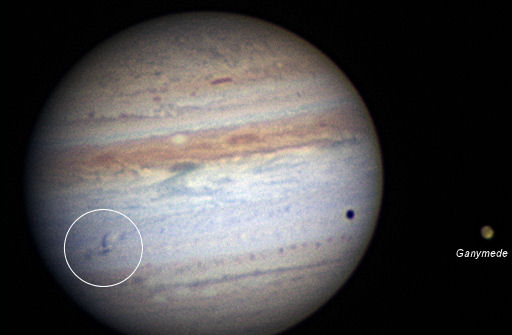
The SEB revival is now underway. Tonight I captured the revival transiting the face of Jupiter. To boot I was lucky enough to include Ganymede with detail and Europa's shadow after a double transit. What a night. Taken with peltier cooled C14 and Skynyx 2-0: Paul Haese

The plume, circled in Haese’s photo and known to astronomers as the “SEB Revival Spot,” is a sign that Jupiter’s South Equatorial Belt (SEB) is about to return. The great brown belt disappeared earlier this year, leaving Jupiter without one of its signature stripes. No one knows where the SEB went, although some researchers have speculated that it sank beneath high altitude clouds and might now be bobbing back to the top.

Christopher Go of the Philippines first noticed the Revival Spot on Nov. 9th. At first it was small and white and required careful astrophotography to detect. Only five days later, it is expanding rapidly and darkening; soon, it could become visible to novices in the eyepieces of backyard telescopes.

“You left spacedock without a tractor beam?”: Mysterious force holds back NASA probes

September 19, 2010

Star Trek Generations

Star Trek Generations:

Kirk: You left spacedock without a tractor beam?
Harriman: It doesn’t arrive until Tuesday.

The Telegraph:

A space probe launched 30 years ago has come under the influence of a mysterious force that has baffled scientists and could rewrite the laws of physics. Researchers say Pioneer 10, which took the first close-up pictures of Jupiter before leaving our solar system in 1983, is being pulled back to the sun by an unknown force. The effect shows no sign of getting weaker as the spacecraft travels deeper into space, and scientists are considering the possibility that the probe has revealed a new force of nature.

Tractorbeam arriving on Tuesday

“If the effect is real, it will have a big impact on cosmology and spacecraft navigation,” said Dr Laing, of the Aerospace Corporation of California. Pioneer 10 was launched by Nasa on March 2 1972, and with Pioneer 11, its twin, revolutionised astronomy with detailed images of Jupiter and Saturn. In June 1983, Pioneer 10 passed Pluto, the most distant planet in our solar system.

pt:Trajectória da sonda Pioneer 10 em Jupiter

Pioneer 10 trajectory

Research to be published shortly in The Physical Review, a leading physics journal, will show that the speed of the two probes is being changed by about 6 mph per century – a barely-perceptible effect about 10 billion times weaker than gravity.

Assertions by some scientists that the force is due to a quirk in the Pioneer probes have also been discounted by the discovery that the effect seems to be affecting Galileo and Ulysses, two other space probes still in the solar system. Data from these two probes suggests the force is of the same strength as that found for the Pioneers.

Dr Duncan Steel, a space scientist at Salford University, says even such a weak force could have huge effects on a cosmic scale. “It might alter the number of comets that come towards us over millions of years, which would have consequences for life on Earth. It also raises the question of whether we know enough about the law of gravity.”