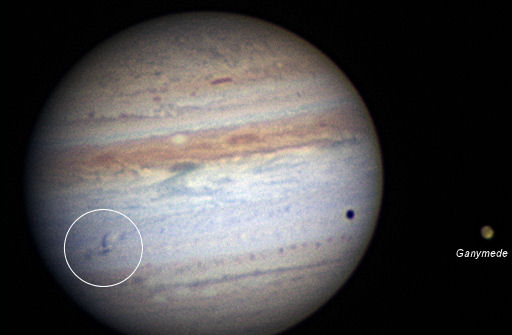
In May this year one of Jupiter’s characteristic stripes (the South Equatorial Belt) disappeared. Then two weeks ago a turbulent plume was observed breaking through the giant planet’s cloudtops in the south equatorial zone heralding the possible re-emergence of the stripe.
Now the latest infrared pictures of Jupiter show the turbulent plume developing into a “trail” suggesting that the SEB is re-emerging from under the ammonia clouds. The BBC reports:

Jupiter's returning stripe highlighted (JPL, University of Oxford, UC Berkeley, Gemini Observatory, University of San Carlos)
The South Equatorial Belt had blended into surrounding white clouds but an “outbreak” spotted by an amateur astronomer heralds the stripe’s return. The stripe’s disappearing act is due to clouds shifting altitudes, with white ammonia clouds obscuring clouds below. This performance will give astronomers their first chance to study the weather and chemistry behind the phenomenon.
As part of the show, the Great Red Spot has darkened, but astronomers say it will lighten again as the South Equatorial Belt comes back. The stripe has come and gone several times in recent decades but the mechanism by which it returns remains mysterious. The first signs of the return were spotted by Christopher Go of the Philippines and was confirmed by the Infrared Telescope Facility and Gemini and Keck telescopes in Hawaii.
“At infrared wavelengths, images in reflected sunlight show that the spot is a tremendously energetic ‘outburst,’ a vigorous storm that reaches extreme high altitudes,” said Imke de Pater, professor of astronomy at the University of California, Berkeley. “The storms are surrounded by darker areas, bluish-grey in the visible, indicative of ‘clearings’ in the cloud deck.”


 The k2p blog