Posts Tagged ‘United States’

Gaddafi sets his sights on Benghazi

March 17, 2011

While the situation in Japan captures the world’s attention, Gaddafi’s troops are ready to attack Benghazi. All the talk about no-fly zones by European countries and NATO have not led to anything – yet. Reuters reports:

Libyan government soldiers battled rebels on the road to the insurgent stronghold of Benghazi on Thursday as the United States raised the possibility of air strikes to stop Muammar Gaddafi’s forces.

The army told people to leave opposition-held locations and arms dumps. But its advance on Benghazi — and the prospect of a decisive battle in the insurrection — was hampered by clashes around Ajbadiyah, a strategic town on the coastal highway.

Slow-paced international efforts to halt the bloodshed moved up a gear when the United States, previously cool on the idea of a foreign military intervention, said the U.N. Security Council should consider actions beyond a no-fly zone over Libya.


Ice in Dallas as super-storm ranges from Texas to Maine

February 2, 2011

Dallas Morning News:

Rain, sleet and snow pushing ahead of the coldest weather in more than 20 years left broad swaths of North Texas virtually impassable Tuesday. And with below-freezing temperatures locked in until at least Friday, conditions won’t improve soon.

Low temperatures Wednesday morning will be in the single digits across much of the Dallas area, and the afternoon will warm only to the low 20s, forecasters said, meaning the snow and ice that paralyzed the region Tuesday will linger, especially along neighborhood streets.

Crews work to clear a wreck involving an 18-wheeler on northbound I-35E at Pleasant Run Road. Photo: Jim Mahoney/Staff Photographer

New York Times:

A paralyzing 2,000-mile swath of winter at its snowy, icy, messy worst pushed eastward across the United States on Tuesday, disrupting the rhythms of everyday life and punctuating this season’s recurring lesson that humankind has no dominion over nature.

Airlines canceled thousands of flights. Governors called out the National Guard. Schools closed early, if they opened at all. Interstate highways became treacherous ribbons of black ice. Top officials from the Department of Homeland Security and the Federal Emergency Management Agencyapprised President Obama of their battle plans for foul weather threatening more than 30 states.

By Tuesday evening, the storm had brought Tulsa to a virtual halt with more than a foot of snow, layered the roadways of St. Louis with an icy sheen, and draped Chicago with a swirling snowfall so thick that the white-gray sky and the gray-white ground blurred into one enveloping test pattern. All the while, the storm was moving inexorably to the Northeast, where many people watched the televised weather reports — of blinding snow and stranded cars — and imagined their Wednesday. …..

The National Weather Service was issuing warnings for certain areas that read like snippets from a disaster-movie screenplay:

“DANGEROUS MULTIFACETED AND LIFE-THREATENING WINTER STORM … BEFORE MAKING DECISION TO TRAVEL … CONSIDER IF GETTING TO YOUR DESTINATION IS WORTH PUTTING YOUR LIFE AT RISK … DO NOT TRAVEL! IF YOU ABSOLUTELY MUST TRAVEL … HAVE A WINTER SURVIVAL KIT WITH YOU.”

Rex Benz of Moline, Ill., did not let conditions stop him from his job search recently. Todd Mizener/The Dispatch, via Associated Press


Snow in all US States except Florida

January 12, 2011

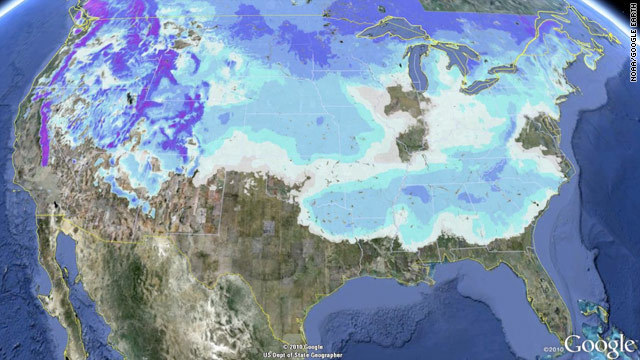
A map of snowfall in the United States is revealing right now: 49 states have snow on this 1/11/11 and only one does not.

From the southern snow storm heading north, which is affecting air travel, to the pending storm in New York City, and flurries out west, there’s plenty of white stuff going around.

The lone state without a flake? It’s the Sunshine State…Florida. Locals are celebrating the fact, though interestingly, parts of the state saw snow just days ago.

Even Hawaii has snow, in Mauna Kea on the Big Island.


US shale gas challenges Russian natural gas in Europe

November 12, 2010
Natural gas pipelines from Russia to Europe.

Natural gas pipelines from Russia to Europe: image via Wikipedia

“Peak gas”  like “peak food” and “peak resources” and like all “peak scenarios” keeps getting postponed. The US is awash with shale gas and has started re-exporting LNG it had contracted for to Europe challenging the dominance of Russian supplies of natural gas.

Money control reports:

The United States may play a role this winter in loosening Russia’s grip on the European market for natural gas by shipping liquefied natural gas across the Atlantic. Awash with domestic shale gas and with little need to import extra fuel, the United States has started re-exporting LNG cargoes, which firms had previously imported under contract, to countries where gas prices are much higher.

Such shipments could contribute to a growing pool of cheaper LNG going to Russia’s biggest export market this winter. In the longer term, U.S. plans to build plants to liquefy shale gas could create another rival to Russian pipelines. The first re-export cargo from the United States to Britain — a key access point for LNG into northern Europe via an Interconnector pipeline to Belgium — is set to sail over the weekend. “It is a landmark shipment,” said Zach Allen at NATS LNG analysts in Raleigh North Carolina. “LNG has, through the Interconnector, played a major role in reducing intake of Russian gas into western Europe.”

U.S. shale gas has already forced many LNG producers that had hoped to supply the North American market to find alternative buyers, with many cargoes ending up in Europe and driving spot gas prices below the price of oil-indexed Russian gas.

US re-exports to Europe are the latest sign that increases in shale gas production have transformed the global gas market. The International Energy Agency said on Tuesday that a decade-long period of oversupply was likely to push oil-indexed gas sellers to accept lower prices.

In February, Russian gas export monopoly Gazprom postponed it’s Shtokman LNG project because the United States, its target market, did not need more imports. Major European pipeline gas supplier Statoil has been forced to find alternative markets for LNG it had hoped to send to the United States, often selling it into Europe. Qatar, the world’s largest producer and exporter of LNG, has also pushed into both Norwegian and Russian markets by making large deliveries of cheap LNG into Britain and Belgium. US LNG imports have fallen to contractual minimums as gas prices have sagged, forcing importers whose terminals are sitting idle to change strategy and re-export to make the most of higher prices overseas.

US gas at USD 4.1 per million British thermal units (mmbtu) was about USD 3.3/mmbtu below UK prices on Tuesday and just under half the price of Russian gas in Europe in October, according to International Monetary Fund data. About 20 billion cubic feet of gas has already been re-exported from the United States this year, with some sent to Asia, where buyers have paid nearly USD 10 per mmbtu, and some to Latin America and the Middle East.

More of those US loaded cargoes could head to Britain over coming months, given that winter price increases are sharper in northern Europe than in the United States and that imports by South American and Middle Eastern buyers are usually confined to summer.

“US exports to Europe will remain rather exotic, but they underline once again the big risks for Russia of focusing some of its future projects on US markets,” said Valery Nesterov, energy analyst at Moscow-based Troika Dialog brokerage.

Cheniere Energy, operator of the Sabine Pass import terminal in Louisiana, announced plans in June to build a liquefaction plant at the terminal. It said on Tuesday that US bank Morgan Stanley hoped to secure some of its export capacity. Pending approval, the plant would export US-produced shale gas to markets all over the globe from 2015. It would be the first US LNG export plant in 40 years — following the old Kenai facility which supplies Asia from Alaska — and would be well placed to supply Europe. “LNG supplies from the United States can help lower gas prices in Europe and Asia and ultimately help lift prices in the States,” said Mikhail Korchemkin from Pennsylvania-based East European Gas Analysis.

Where Science gets done

November 12, 2010

(Reuters) – The United States still leads the world with its scientific clout, armed with highly respected universities and a big war chest of funding, but Europe and Asia are catching up, according to a Thomson Reuters report released on Friday.

But U.S. influence is waning — not because the United States is doing less, but because other countries are doing more, Thomson’s Jonathan Adams and David Pendlebury found. “In 1981, U.S. scientists fielded nearly 40 percent of research papers in the most influential journals,” they wrote.

“By 2009, that figure was down to 29 percent. During the same period, European nations increased their share of research papers from 33 percent to 36 percent, while research contributed by nations in the Asia-Pacific region increased from 13 percent to 31 percent.” China is now the second-largest producer of scientific papers, after the United States, with nearly 11 percent of the world’s total. In 2008, Asian nations as a group passed the United States with $387 billion in research and development spending, compared with $384 billion in the United States and $280 billion in Europe.

Precisely half of U.S. research focuses on the biological sciences “just at the time when Asian nations are focusing on and investing substantial sums in engineering, physical sciences, and technology,” the report notes. In the United States, the Massachusetts Institute of Technology and California Institute of Technology (MIT and Caltech) led in research, the report found. Outside the United States, the Chinese Academy of Sciences and the Russian Academy of Sciences lead.

Earlier this week the United Nations Educational, Scientific and Cultural Organization, or UNESCO, released a report showing similar findings. UNESCO said in 2002, almost 83 percent of research and development was carried out in developed countries but this dropped to 76 percent by 2007. It found China was leading the pack of emerging nations with 1.4 million researchers.

Obama concludes India visit – leaves for Indonesia

November 9, 2010

The Hindu:

U.S. President Barack Obama on Tuesday left here for Indonesia after his three-day visit to India, during which he announced support for New Delhi’s bid for a permanent seat in the UN Security Council and asked Pakistan to bring perpetrators of 26/11 attacks to justice.

Barack Obama with wife

President and Mrs. Obama leaving India

Mr. Obama and his wife Michelle were given a warm send-off by Minister-in-Waiting Salman Khursheed, Foreign Secretary Nirupama Rao and other officials. U.S. Ambassador to India Timothy J Roemer was also present.

The Air Force One carrying the US First Couple took off from the Delhi Airport at 8.54 AM.

BBC:

The Indian media has hailed US President Barack Obama’s trip to India, saying it had helped forge an “enduring partnership” between the two countries. It lauded Mr Obama for backing India’s ambition for permanent membership of the UN Security Council.

In an address to India’s parliament at the end of a three-day visit on Monday, Mr Obama backed India’s bid to gain a permanent seat on the UN Security council and lavished praised on the country. He also said safe havens for militants in Pakistan were “unacceptable”.

The Hindu said that Mr Obama’s support for a permanent UN Security Council seat for India “represents a significant evolution of American policy towards both India and the world body”.

“Even if he has essentially handed the Indians a cheque that cannot be easily cashed, the US President’s words will strengthen India’s hand as it seeks to press for reform in the UN,” the newspaper said.

Obama in India: Day 3: Supports India as permanent member of UNSC, criticises India for being too soft on Burma

November 8, 2010

Sify NewsLauding India’s growing role in global bodies, US President Barack Obama Monday said the US welcomed India as it prepared for a permanent seat in the UN Security Council. ‘We welcome India as it prepares to take a seat at the United Nations Security Council,’ said Obama in an address to members of the two houses of parliament. “That is why I can say today-in the years ahead, I look forward to a reformed UN Security Council that includes India as a permanent member,’ he said to loud applause from over 780 MPs.


Houses of Parliament, Delhi: image indiareport.com


Hindustan Times: ‘Bahut dhanyavad’. This is how US president Barack Obama thanked people of India for the warm welcome and hospitality he and American First Lady Michelle Obama received during their India visit. The ‘thank you’ in Hindi during his 35-minute address at the Central Hall of Parliament was received by thunderous applause by the law makers which included Prime Minister Manmohan Singh, UPA Chairperson Sonia Gandhi and top BJP leader LK Advani.

“At every stop, we have been welcomed with the hospitality for which Indians have always been known.  So to you and the people of India, on behalf of me, Michelle and the American people, please accept our deepest thanks. Bahut dhanyavad,” he said. The American President wound up his speech by saying ‘Jai Hind’ which was also received by the MPs with cheers.

AFP: US President Barack Obama criticised India on Monday for failing to condemn rights abuses in Myanmar, saying democracies with global aspirations could not ignore “gross violations” in other countries. “When peaceful democratic movements are suppressed, as they have been in Burma (Myanmar), then the democracies of the world cannot remain silent,” Obama said in an address to the Indian parliament. “Faced with such gross violations of human rights, it is the responsibility of the international community, especially leaders like the United States and India, to condemn it,” he said. “If I can be frank, in international fora, India has often shied away from these issues,” he added.

Earlier in his speech, Obama had, to sustained applause, given his backing to India’s push for a permanent seat on the United Nations Security Council.

Times of IndiaThe United States and India on Monday signed six agreements besides a plethora of business deals inked separately during US President Barack Obama’s trip to India.

  1. India-US agreement to set up a joint Clean Energy Research and Development Centre. It will be backed by 50 million dollars by both sides over five years and work to complete joint research in solar, biofuels and energy efficiency.
  2. Memorandum of Understanding (MOU) for a Global Centre for Nuclear Energy Partnership. US will cooperate in India’s plans for a nuclear centre, to promote nuclear security and address threats of nuclear terrorism.
  3. MOU to establish an India-US Energy Cooperation Programme. It will mobilise private sector expertise and resources to address clean energy-related issues in India and the US.
  4. Agreement on technical cooperation to study India’s annual monsoon rains. Cooperation on weather forecasting for India’s crucial annual monsoon.
  5. MOU between India and the US on shale gas resources which will see US technology used to assess shale gas resources in India.
  6. MOU on establishing and operating a Global Disease Detection Centre in India, which will set up a laboratory in New Delhi designed to prevent the spread of infectious diseases.

Hindustan TimesIndia and the United States will set up a $10 billion infrastructure debt fund to help develop India’s physical and social infrastructure, Commerce and Industry Minister Anand Sharma said on Monday. “The Governments of India and the United States have agreed in principle to set up the fund on the recommendation of the India-US CEO Forum,” Sharma told reporters on the sidelines of a conference organised by the Confederation of Indian Industry and the US-India Business Council in New Delhi. Sharma said India planned to invest $1 trillion in the infrastructure sector in the next five years and a substantial part of the investment would come from the private sector and overseas investment.

Grizzlies getting fat and lazy – the advantages of interacting with humans

November 8, 2010
Two grizzly bears in a meadow in the Yellowsto...

Grizzlies at Yellowstone: Image via Wikipedia

Grizzly bears in America’s western states are becoming increasingly fat and lazy as a result of increased contact with humans complain some conservationists according to The Telegraph !

But presumably the bears aren’t complaining and don’t have any problems with the good life.

A population boom among the bears has pushed them out of the Rocky Mountains and into the path of humans, where they have found plentiful food without the need for hunting.

Jamie Jonkel, a bear expert at Montana Fish, Wildlife and Parks, said that the grizzlys had learned gluttony and laziness from their human neighbours. He told the Guardian that the bears had “started living the good life”, eating corn and vegetables from fields and quickly getting “fatter and fatter”. The number of bears in Yellowstone national park has leapt to 603 in recent years, almost three times the number during the 1970s. The population boom has created competition over natural food sources, forcing some bears to look elsewhere for sustenance.

But the wild bears don’t always co-exist happily with humans. The number of attacks by bears has also increased, with two people being fatally mauled in Montana and Wyoming. Some 45 bears have also been shot as a result of wandering too close to hunters or wildlife officials, the paper said.

Obama in India: day 1: 10 billion $ of contracts worth 54,000 jobs in US

November 6, 2010

Reuters:

President Barack Obama announced $10 billion in business deals on Saturday as he arrived in India to boost U.S. exports and jobs after a mauling in mid-term polls, but he ran into immediate controversy over Pakistan. Obama flew into Mumbai, India’s financial hub, and announced the United States would also relax export controls over sensitive technology, a demand of India’s that will help deepen U.S. ties with the emerging global power and its trillion dollar economy.

Obama’s first act was to pay tribute to victims of the 2008 Mumbai attacks, but he was criticized for making no reference to India’s traditional foe Pakistan, which New Delhi blames for harboring anti-India militants. Pakistan-based militants killed 166 people in a 60-hour rampage through India’s financial hub, gunning down their victims at luxury hotels, a train station and a Jewish center. India says elements in the Pakistan state were behind the attacks.

But Obama’s trip is also about business, with China now ahead of the United States in trade with India. The $10 billion in deals will support 54,000 jobs in the United States, White House aide Michael Froman said. The White House also announced Obama would support India’s membership of four global non-proliferation organizations, a move that will reassure New Delhi — left out of these groups after its 1998 nuclear tests — that Washington is recognizing its global clout.

He spends the night at the The Taj Hotel and flies to Delhi tomorrow afternoon. I expect a few more contracts to be settled with the 215 strong corporate leaders who make up the accompanying business delegation.

US Recession officially over – but what about the second dip

September 20, 2010

http://economix.blogs.nytimes.com/2010/09/20/the-recession-has-officially-ended/?hp

The recession officially ended in June 2009, according to the Business Cycle Dating Committee of the National Bureau of Economic Research, the official arbiter of such dates.

As many economists had expected, this official end date makes the most recent downturn the longest since World War II. This recent recession, having begun in December 2007, lasted 18 months. Until now the longest postwar recessions were those of 1973-5 and 1981-2, which each lasted 16 months. Recession and expansion dates are based on various economic indicators, including gross domestic product, income, employment, industrial production and wholesale-retail sales. The Business Cycle Dating Committee typically waits to declare that the economy has turned until well after the fact, when it has a longer track record of economic data to confirm a new trend.

But the double-dip remains a distinct possibility even if the OECD believes the US may just escape it.

A graph of the Early 1980s recession in the Un...

Triple-dip in the 1980's

The United States will experience a slow, jobless recovery from its deepest and longest downturn since the 1930s but will avoid a double-dip recession, the Organisation for Economic Co-operation and Development said today. In its annual health check of the world’s biggest economy, the Paris-based OECD said that it expected activity to expand by 2.6% in both 2010 and 2011 without having a marked impact on the country’s near double-digit jobless rate.

But the optimism is speculative and not shared by everybody. Some believe that jobs growth is not happening at a speed sufficient to avoid the double-dip.

The U.S. economy has a “significant likelihood” of entering a double-dip recession if the government doesn’t step in to help the unemployed, economist Robert Shiller told MarketWatch News Break in August. The Yale University professor and author of the best-selling book “Irrational Exuberance” pinned the probability of a double-dip recession at more than a 50-50. Shiller pointed to the nation’s stubbornly-high unemployment as a root cause of lingering economic woes. And with the Federal Reserve running out of bullets to fight a second recession, he urged Congress to join the battle and focus on putting people back to work.