Posts Tagged ‘University of Utah’

Arab – Iranian feuding continues at Utah University’s Middle East Center

September 11, 2011

H/T to reader Ron.

The mud-slinging and back stabbing at the University of Utah’s Middle East Center is less than edifying and continues unabated. Charges and counter-charges include plagiarism, cronyism, sexual harassment, insubordination and even contributing to a student’s suicide. It begins to seem like a B-grade movie with bad actors and a melodramatic script. An Arab- Iranian feud – with under-currents of Shia-Sunni rivalry – being played out in Utah!! And the roots of the feuding go back some 1500 years to the very rapid Arab conquest of Persia in 644 AD. Ever since there has been a feeling of Persian “shame” at not resisting the takeover very strongly and is the root cause of the Persian disdain for Arab culture and influence which continues today. Just to complicate the picture there is much back-biting and intrigue within the Arabists themselves.

The Salt Lake Tribune now reports that officials at University of California, Los Angeles said on Thursday that

..they can find no record of awarding a degree beyond a master’s to Ibrahim Karawan, who led the Middle East Center until 2008, when he was succeeded by Bahman Bakhtiari. 

That would seem to support allegations by Bakhtiari, recently terminated for plagiarism, that Karawan does not hold a doctorate and never was qualified to be a professor, sign off graduate students’ work and seek federal grants. In a lawsuit filed Sept. 2, Bakhtiari alleges a colleague concealed Karawan’s “academic fraud” for at least two decades and orchestrated Bakhtiari’s firing by inciting graduate students to drum up evidence of plagiarism and then publicize what they found.

Bakhtiari is now using the confusion over Karawan’s academic status in his legal fight with former colleagues whom he blames for his expulsion from his tenured faculty appointment. Bakhtiari, whose name also appears in print as “Baktiari,” claims he is guilty of little more than sloppiness with attribution, while alleging Karawan perpetrated a fraud on the university, its students and the federal government, which awarded grants to the MEC on the basis of Karawan’s doctorate.

“The University’s failure to take any action against a proclaimed professor who did not hold the mandatory credentials and, for nearly 25 years, signed his name to graduate degrees and solicitations for public monies through the United States Department of Education as one holding those credentials in violation not only of university policy but also federal law, while conversely seeking the academic death penalty for me based on minimal allegations, is discriminatory at best,” Bakhtiari wrote in an Aug. 17 e-mail to the Tribune.

Bakhtiari’s suit targets history professor Peter Sluglett, who was the center’s director from 1994 until 2000, when Karawan took the reins, as well as several “John Does.” Sluglett, who left this week for a year in Singapore, had a leadership position on the center’s executive committee and worked closely with Karawan over the years. Administrators’ abrupt dismissal of Sluglett and another scholar from the center is what precipitated Karawan’s resignation as director in 2008, setting the stage for Bakhtiari’s hiring from the University of Maine. Sluglett later was reinstated at the center and resumed a central role in its management.

The principal cast of villains consist of Bakhtiari (of Iranian origin – fired as Director), Karawan (an Arab, a former Director and currently acting Director) and Sluglett ( an Arabist, former Director and now in Singapore for a year).
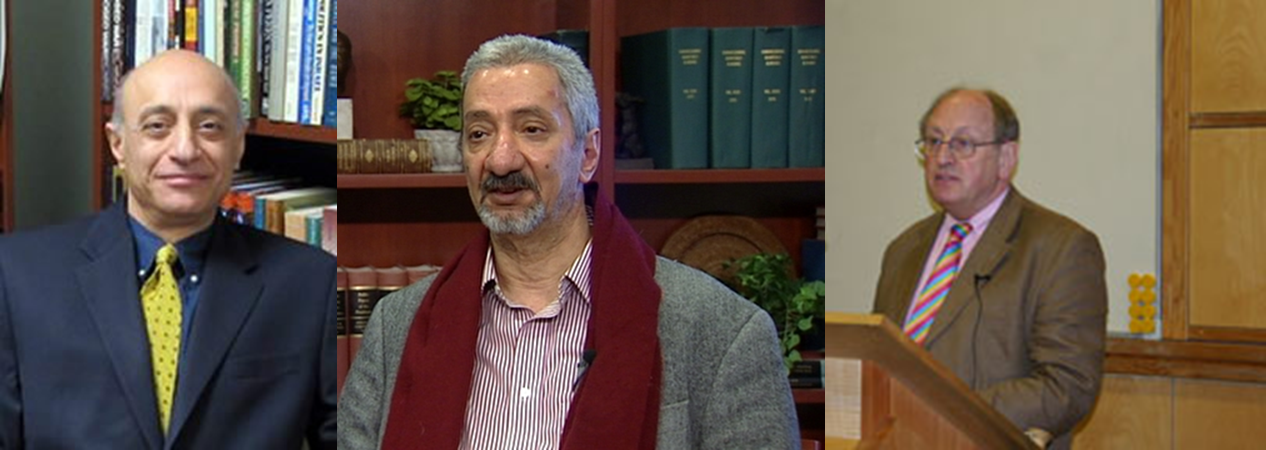
Cast of villains at the Mid-East Center: Bakhtiari-Kerawan-Sluglett

There is a large supporting cast of actors of students and faculty consisting among others of university interim President, Lorris Betz,  and humanities dean Robert Newman.

But this appears to be a movie where the entire cast are bad-guys and there is no hero in sight!

A hotbed of intrigue: Bahman Bakhtiari sues Peter Sluglett after being fired from Utah University’s ME Center

September 8, 2011

Two months ago Bahman Bakhtiari was fired from the University of Utah’s Middle East Center for a pattern of plagiarism. Now he has filed  a suit last Friday in 3rd District Court against Peter Sluglett, the center’s senior-most faculty member and a former Director of the Center himself.

Deseret News:  Bakhtiari alleges that two senior faculty leaders at the center conspired to eliminate him after personality conflicts. He also alleges in the lawsuit that a senior faculty member, who was a former center director, lied about having a Ph.D. from UCLA and that faculty conspired to cover it up.

Bakhtiari served as center director from July 2009 to June 2011. He was brought in from the outside by the Dean of the College of Humanities to replace an existing faculty member. The suit states that from the onset, Bakhtiari was disliked by senior center faculty and that the political science department, which oversees the center, refused to support his tenure. The suit states that the dean of humanities ended up granting him tenure through the department of languages and literature.

Last June, a U. faculty committee investigated complaints of alleged plagiarism against Bakhtiari. In a unanimous vote, the committee found that Bakhtiari committed “a pattern of plagiarism that is harmful to the university’s academic integrity.” …

Although the committee stopped short of termination and revocation of tenure, University of Utah Interim President A. Lorris Betz overrode the decision and terminated Bakhtiari on June 30. ….

Bakhtiari alleges in his suit that center faculty actively dug through his career history to find justification to get rid of him. According to U. documents, evidence of plagiarism was found in six scholarly publications, including Bakhtiari’s 1984 Ph.D. dissertation, an online newsletter and an op-ed piece published in The Salt Lake Tribune. The suit states Bakhtiari is seeking damages for interference with economic relations, invasion of privacy, breach of contract and defamation.

Both Peter Sluglett and the Middle East Center are no strangers to internecine dispute, intrigue and academic “dirty tricks”. Sluglett gets mixed reports as a teacher.

Sluglett is also apparently  a self-anointed expert in recent Iraq history:

February 03, 2006  

Sluglett gets SluggedI noted with some pleasure that Wafaa’ Al-Natheema knocked Peter Sluglett down a peg or two. She posts the full email exchange on her blog. Professor Peter Sluglett considers himself an expert on modern Iraqi history with good reason – he has studies the subject for 30 years. Along with his late wife, Marion Farouk Sluglett, they wrote one of the important books on modern Iraqi history called “Iraq since 1958”. However, he uses that position to stifle any debate on Iraqi history. He considers himself the expert and nobody has the right to contradict him. The problem is that in many cases he is wrong.

The Middle East Center itself is no stranger to controversy where Sluglett was Director before Ibrahim Karawan – who resigned and was then succeeded by Bahman Bakhtiari.

April 4, 2008 

Karawan Resigns over Middle East Center Dismissals  

Ibrahim Karawan, director of the Middle East Center, announced his resignation yesterday before a lecture at the Hinckley Institute of Politics. Karawan said he is resigning because two of his colleagues were forced out of the center by Dean Robert Newman of the College of Humanities. “They were basically moved out of the center, not according to what they wanted, and moved to other departments,” Karawan said.

He questioned whether the action was justified and what the impact will be on the governing structure of the center and its ability to receive funding from the U.S. Department of Education. … Peter Sluglett, a professor of Middle Eastern history, and Harris Lenowitz, a professor in Hebrew, both received letters from Newman informing them that they could continue teaching but would no longer be able to hold leadership positions in the center. Sluglett and Lenowitz both have joint appointments in the center and their departments — history and languages and literature, respectively — and both teach cross-listed courses. ….

On March 13, Lenowitz said he received a letter from Newman that read: “It has come to my attention that you have contributed consistently toward creating an atmosphere in the Middle East Center that lacks collegiality and can no longer be tolerated.” Sluglett said he also received this letter, but he doesn’t think other faculty members have any problems with his behavior…….

Leaving aside the legal positions and claims and counter-claims which will run their course, the Middle East Center and its faculty strike me as being a bunch of  rather petty, uncivilised, amoral and childish group of academics. Petty intrigue, academic dishonesty and scientific misconduct seems to come quite naturally to them.

Playing their games of intrigue appears far more important to them than academic rigour or integrity. Whether they should be getting any funding at all from the US Department of Education ought to be a question being asked.

University of Utah fires tenured Bakhtiari for a “pattern of plagiarism”

August 20, 2011

I  just returned from a few days in Vienna and the Ruhr Valley – a region which is no stranger to political high intrigue and deception and I am just catching up with some of my backlog.

Salt Lake City has had its share of intrigue in the past but the latest is the firing of Utah University’s tenured Director of its Middle East Centre, Dr. Bahman Bakhthiari:

A faculty panel substantiated nine instances of plagiarism by former University of Utah political scientist Bahman Bakhtiari, who directed the Middle East Center from July 2009 until February 2011. The materials include five book chapters, his doctoral dissertation and three opinion commentaries. Bakhtiari says the plagiarism was due to carelessness. The U. administration terminated Bakhtiari against the recommendation of the panel, which proposed lesser sanctions.

Bahman Bakhtiari

Bahman Bakhtiari

The university interim President, Lorris Betz,  overruled the panel recommendations writing in a June 30th letter:

“Plagiarism — holding out the work of another as one’s own — strikes at the very core of academic integrity. …. The only appropriate sanction in this case is dismissal, which is necessary to preserve the academic integrity of the institution and to restore public confidence in the university.” 

I have always wondered why “political scientists” are so-called and the use of the word “artist” – as used in “con-artist” – may be much more appropriate for “scholars” dabbling in the black-arts.

Lorris Betz

Needless to say, Bakhtiari sees a certain level of political connivance against him says the Salt Lake Tribune

Bakhtiari, whose name also appears in print as “Baktiari,” maintains the overlap between his work and that of others was not intentional. He says his firing represents an unwarranted intrusion by administration into faculty governance. The Iranian-born scholar also alleges he is the victim of discrimination perpetrated by a “pro-Arabist faction” within the MEC.

 Bakhtiari defended his integrity, arguing that he has produced 3,500 pages of scholarly material with 14,000 footnotes over the course of his career and the panel found problems with only eight pages. Twelve diplomats and prominent scholars, including Gary Sick and Judith Yaphe, from around the world submitted letters vouching for his character.

“It is not a pattern when you have published 90 articles,” Bakhtiari said.

In a letter to Betz asking him to limit the sanction to a private reprimand, Bakhtiari’s lawyer Christopher Finley said no evidence was presented to suggest the political scientist’s mistakes were motivated by a desire to take credit for others’ original work or that these mistakes harmed the university. 

In fact he may well be right because the case of administrative “clerks” – even if holding high rank – over-ruling an academic finding is rare – but not unknown for political reasons (as with hospital administrators firing doctors from time to time). Nevertheless Bakhtiari was clearly not good enough at the game of political intrigue which – after all – should have been his speciality. He seems to have made elementary errors of money management and political judgement. Exhausting all the money available must have been a red rag to the administrative bulls.

The plagiarism probe focused mostly on materials Bakhtiari submitted to the U. when he applied for a tenured position two years ago, according to the U. documents. At that time he was director of the University of Maine’s School of Policy and International Affairs.

In his defense to the panel, Bakhtiari conceded he made “mistakes” and was “sloppy,” but denied he intentionally copied, despite “convincing evidence” that his work borrowed whole sentences and paragraphs from other sources with no attribution, according to the June 14 CHC report. His defense focused on the history of “internecine strife” plaguing the Middle East Center and the “derelictions” of his former U. colleagues, alleging one professor concealed his lack of a doctorate for decades but was not fired.

The faculty panel acknowledged Bakhtiari faced “extreme hardship” trying to right the center, but pointed out that much of the documented plagiarism occurred long before he arrived in Salt Lake City. Noting it reached its conclusions with “great sadness,” the panel by a 3-2 vote recommended a public reprimand, six-month suspension without pay, transfer out of the College of Humanities and “retraction” of the offending publications. ….

The case against Bakhtiari was based on a March 7 complaint filed by four professors and humanities dean Robert Newman, who hired Bakhtiari with the hope of revitalizing the Middle East Center in the wake of a leadership shake-up. This group was particularly incensed with Bakhtiari for inserting two paragraphs — taken verbatim from a speech delivered by National Endowment for the Humanities Chairman Jim Leach — with no attribution into a conference proposal prepared by students. … 

In February, U. graduate students first uncovered passages in Bakhtiari’s published work, starting with an opinion piece in The Tribune that appeared to contain unattributed material from others’ work. Around that time, an audit revealed that the center had exhausted its financial resources under Bakhtiari’s leadership.

Newman placed Bakhtiari on paid administrative leave in February, took over the center’s fiscal affairs and initiated an investigation. This probe documented 11 instances of suspected plagiarism, including material used in his course syllabus, book chapters, the MEC newsletter and commentaries. It discovered eight pages of Bakhtiari’s 1984 dissertation at the University of Virginia, which awarded his doctorate, contained passages that had been pulled from five other sources without attribution.

The faculty panel substantiated nine of these instances, but concluded sanctions weren’t warranted for the copying apparent in the conference proposal and course syllabus.

Meanwhile, the University of Maine, where Bakhtiari taught when he wrote most of the material found to be plagiarized, will review his work according to spokesman Joseph Carr.

But still cases of tenured staff being fired from US Universities are exceptional and very rare. When it does happen a “resignation” is usually engineered (as in the case of Marc Hauser).