Posts Tagged ‘unknowable’

Boundaries of Knowledge: Natural, Supernatural, and Unnatural

June 14, 2025

Our finite view of a slice of a boundless universe

Every morning, the sun “rises.” It is foundational to all life on earth. It is not just a fundamental part of our daily experience, it defines our days and our lives. Yet it is so expected, so certain that we rarely give it a second thought. For at least as long as we have been Homo sapiens, this inexplicable, regular event used to be imbued with profound mystery and was attributed to divine forces or cosmic beings. The sun’s regular, predictable journey across the sky was a phenomenon where its causes could not be explained by the laws of nature of that time.

Then came Copernicus and Newton and later Einstein and we now claim to understand the Earth’s rotation and its orbit around the sun. The “rising” of the sun every day is just a trick of perspective. We can predict it with incredible precision. It is the common belief that the sun’s daily appearance is entirely “natural” and “fully explained” by the laws of nature revealed to us by the scientific method.

But this widely held belief is wrong and overlooks a deeper truth.

Our brains are finite, and our senses, while remarkable, are but a few of the many evolved on Earth. We perceive only a narrow band of the electromagnetic spectrum, hear only certain frequencies, and are blind to magnetic fields, sonar, or infrared vision that other creatures can detect. We have no idea of what senses we do not have. Wherever we look in time and space we see no bounds, we see no edge. This application of a finite cognition to a boundless universe is inherently limited. It means our true observations are always incomplete, partial, and imperfect perceptions. It is inevitable that there are things we know, things knowable which we do not know, and, most importantly, things we simply cannot know. (I have described the the tripartite classification of knowledge elsewhere: known, unknown but knowable, and unknowable)

This leads me to what I believe is a crucial skeleton on which to hang the flesh of reality:

  1. Everything observed or experienced is real and natural.
  2. Nothing unnatural is real and thus the unnatural can never be, or have been, observed.
  3. The supernatural (supra-natural) is that which is observed but cannot be explained by the known laws of nature. The inexplicability could be temporary or it could be permanent if the explanation lies in the region beyond human cognition.

My foundational premise is that anything truly observed exists within the fabric of our reality, and it is real and it is natural. Often people refer to the supernatural when they mean the unnatural but this is just being sloppy with language. The distinction is that the supernatural has to be first observed and then determined to be inexplicable based on the known laws of nature. The unnatural can never be observed and is always fiction (no matter how entertaining).

The enduring supernatural in knowledge (and science)

Let’s revisit the sun. While we can calculate the effects of gravity with breathtaking accuracy, we still haven’t a clue as to why gravity exists, or what it fundamentally is. We describe its behavior, but its intrinsic nature remains an enigma. The very concept of “gravity,” while allowing for precise calculations of its effects, is a placeholder for a phenomenon that we observe and measure, yet cannot explain. Therefore, gravity itself is a supernatural phenomenon.
This pattern repeats across the frontiers of modern science, showing how “scientific explanations” often only shift us to new supernatural things. The state of knowledge and knowledge seeking today reveals that the foundational assumptions and boundary conditions for all knowledge seeking – including the scientific method, reasoning, and logical discourse – are themselves supernatural.
The Stuff of All Matter and Quantum Waves: We describe particles and waves, their interactions, and the quantum fields from which they arise. Yet, what is the fundamental ‘stuff’ that constitutes a quantum field or a fundamental particle? Why these particular properties? Why does quantum mechanics work the way it does? This fundamental substratum of reality remains profoundly supernatural.
The Big Bang Singularity: As science traces the universe back to its very beginning, we arrive at the Big Bang singularity – a point where known physics breaks down. What happened before the Big Bang? What caused it? These questions extend beyond the reach of our current physical laws, pushing the Big Bang itself into the supernatural realm of observed phenomena that are currently inexplicable.
Black Holes: These extreme gravitational wells are predicted by Einstein’s relativity, yet their singularities represent another boundary where our laws break down. What is inside a black hole beyond our conceptual and physical ability to observe or calculate? The singularity at their heart, and indeed the event horizon’s fundamental nature, remains supernatural.
Dark Energy and Dark Matter: Constituting the vast majority of the universe’s mass and energy, these entities influence cosmic structure and expansion. We observe their gravitational effects, but their identity, composition, and underlying ‘why’ remain a profound mystery, pushing them firmly into the supernatural category of observed phenomena that resist explanation.
The Nature of Truth, Causality, Time, Space, Life, and Consciousness: These are not just scientific puzzles, but the very boundary conditions upon which all our inquiries are built. We observe and experience them directly, yet their ultimate nature and “why” remain fundamentally inexplicable, thus rendering them supernatural.

This constant shifting of explanations, where solving one mystery often reveals deeper, more fundamental ones that remain inexplicable, underscores my main thesis that as our knowledge progresses, it inevitably encounters phenomena that, while observed and real, may forever remain in the realm of the supernatural. Whenever a cosmologist or physicist invokes random events they are invoking – by definition – events without cause and such events lie outside the laws of nature. Truly random (causeless) events are always supernatural. The scientific method often uses placeholders (like “dark energy” or “Big Bang”) when it reaches these supernatural stops, in the hope that their inexplicability is merely temporary. But we can never know if an inexplicability is temporary or permanent. (When it is claimed that “we don’t know but we know it isn’t that”, sloppy language has extended to sloppy thinking).

The unobservable unnatural

In contrast to the natural and supernatural, the unnatural represents that which cannot be observed. It is the realm of fiction, of true impossibility based on the consistent rules of our observed reality. An example would be cows jumping over the moon. While we can imagine it, it fundamentally violates the known physical laws of gravitation and biology, making it unobservable in our natural world. Similarly, a true perpetual motion machine that creates energy from nothing would be unnatural because it fundamentally contradicts the laws of thermodynamics, not merely because it’s currently unexplained. Such things cannot exist or be observed. “Supernatural beings” is really sloppy language since they cannot be observed – ever – and what is meant is unnatural beings.

The enduring quest

Acknowledging these boundaries doesn’t mean we stop seeking. Quite the opposite. It fosters intellectual humility and refines our quest. We continue to unravel the complexities of the knowable natural world, pushing the frontiers of science. And in doing so, we gain a deeper appreciation for the profound supernatural mysteries that define the ultimate limits of our understanding – mysteries that, while observed and real, may forever remain beyond our full grasp. This continuous seeking is a dance between discovery and enduring enigma. It is the essence of the human condition. It lies at the core of the scientific method and of all knowledge seeking. It ensures that the universe will always hold more wonders than our finite minds can unravel, keeping our sense of awe forever alive.


Related:

The Great Mysteries: Known, Knowable, and Unknowable Foundations of Philosophy

Knowledge, Truth, and Reality: Attributes of Consciousness in an Anti-Realist Framework


The Great Mysteries: Known, Knowable, and Unknowable Foundations of Philosophy

April 16, 2025

The Great Mysteries: Known, Knowable, and Unknowable Foundations of Philosophy

Humanity’s pursuit of understanding is shaped by enduring questions – the Great Mysteries of existence, time, space, causality, life, consciousness, matter, energy, fields, infinity, purpose, nothingness, and free will. These enigmas, debated from ancient myths to modern laboratories, persist because of the inescapable limits of our cognition and perception. Our brains, with their finite 86 billion neurons, grapple with a universe of unfathomable complexity. Our senses – sight, hearing, touch – perceive only a sliver of reality, blind to ultraviolet light, infrasound, or phenomena beyond our evolutionary design. We cannot know what senses we lack, what dimensions or forces remain invisible to our biology. The universe, spanning an observable 93 billion light-years and 13.8 billion years, appears boundless, hiding truths beyond our reach. Together, these constraints – finite brain, limited senses, unknown missing senses, and an apparently boundless universe – render the unknowable a fundamental fact, not a mere obstacle but a cornerstone of philosophical inquiry.

Knowing itself is subjective, an attribute of consciousness, not a separate mystery. To know – the sky is blue, 2+2=4 – requires a conscious mind to perceive, interpret, and understand. How we know we know is contentious, as reflection on knowledge (am I certain?) loops back to consciousness’s mystery, fraught with doubt and debate. This ties knowing to the unknowable: if consciousness limits what and how we know, some truths remain beyond us. Philosophy’s task is to acknowledge this, setting initial and boundary conditions – assumptions – for endeavors like science or ethics. The unknowable is the philosophy of philosophy, preventing us from chasing mirages or clutching at straws. The mysteries intertwine – existence needs time’s flow, space grounds physical being, causality falters at its first cause, consciousness shapes knowing – luring us with connections that reveal little. We classify knowledge as known (grasped), knowable (graspable), and unknowable (ungraspable), rooted in consciousness’s limits. Ignoring this, philosophers and physicists pursue futile absolutes, misled by the mysteries’ web. This essay explores these enigmas, their links, and the necessity of grounding philosophy in the unknowable.

I. The Tripartite Classification of Knowledge

Knowledge, an expression of consciousness, divides into known, knowable, and unknowable, a framework that reveals the Great Mysteries’ nature. The known includes verified truths – facts like gravity’s pull or DNA’s structure – established through observation and reason. These are humanity’s achievements, from Euclid’s axioms to quantum theory. The knowable encompasses questions within potential reach, given new tools or paradigms. The origin of life or dark energy’s nature may yield to inquiry, though they challenge us now. The unknowable marks where our finite nature – biological, sensory, existential – sets impassable limits.

The unknowable stems from our constraints. Our brains struggle with infinite regress or absolute absence, bound by their finite capacity. Our senses capture visible light, not gamma rays; audible sound, not cosmic vibrations. We lack senses for extra dimensions or unseen forces, ignorant of what we miss. The universe, vast and expanding, hides realms beyond our cosmic horizon or before the Big Bang’s earliest moments (~10^-43 seconds). This reality – finite cognition, limited perception, unknown sensory gaps, boundless cosmos – makes it inevitable that some truths are inaccessible to us. We are embedded in time, space, and existence, unable to view them externally. Philosophy’s task is to recognize these limits, setting assumptions that ground endeavors. Ignoring the unknowable risks mirages – false promises of answers where none exist – leaving us clutching at straws instead of building knowledge.

II. The Great Mysteries: A Catalog of the Unknowable

The Great Mysteries resist resolution, their unknowability shaping the assumptions we must make. Below, I outline each, situating them in the tripartite framework, then explore their interconnected web, which lures yet confounds us.

Existence: Why Is There Something Rather Than Nothing?

Existence’s origin, from Leibniz to Heidegger, remains a foundational enigma. The known includes observable reality – stars, particles, laws – but why anything exists is unclear. Reason tells us that existence must be because it is compelled to be so, but what those compulsions might be defies our comprehension. There must have been some prior condition which made it “easier” for there to be existence than not. The knowable might include quantum fluctuations sparking the Big Bang, yet these assume causality and time. The unknowable is the ultimate “why,” demanding a perspective outside existence, impossible for us. Metaphysicians chasing a final cause risk mirages, assuming an answer lies within reach, when philosophy must set existence as an unprovable starting point.

Time: What Is Its True Nature?

Time governs not only life, but the existence of anything. Yet its essence eludes us. We observe some of its effects – clocks, seasons – and the knowable includes relativity’s spacetime or quantum time’s emergence. But is time linear, cyclic, or illusory? Its subjective “flow” defies capture. To know time, we’d need to transcend it, beyond temporal beings. Ancient eternal gods and block-time models falter, pursuing clarity where philosophy must assume time’s presence, not its essence. The unidirectional arrow of time just is. Brute fact which neither allows nor permits any further penetration.

Space: What Is Its Fundamental Reality?

Space, reality’s stage, seems familiar but confounds. We know its measures – distances, volumes – and the knowable includes curved spacetime or extra dimensions. But what space is – substance, relation, emergent – remains unknowable. Why three dimensions, enabling physical existence (stars, bodies), not two or four? We cannot exit space to see its nature, and Planck-scale probes (~10^-35 meters) elude us. Cosmologies from Aristotle to multiverses assume space’s knowability, risking straw-clutching when philosophy must posit space as a given.

Causality: Does Every Effect Have a Cause?

Causality drives science, yet its scope is unproven. We know cause-effect patterns – stones fall, reactions occur – and the knowable might clarify quantum indeterminacy. But is causality universal or constructed? The first cause – what sparked existence – remains sidestepped, with science starting a little after the Big Bang and philosophy offering untestable gods or regresses. To know causality’s reach, we’d need to observe all events, which is impossible. Thinkers like Hume assume its solvability, ignoring that philosophy must treat causality as an assumption, not a truth.

Life: What Sparks Its Emergence?

Life’s mechanisms – DNA, evolution – are known, and abiogenesis may be knowable via synthetic biology. We search for where the spark of life may have first struck but we don’t know what the spark consists of. Why matter becomes “alive,” or life’s purpose, is unknowable. And as long as we don’t know, those who wish to can speculate about souls. Animists saw spirits, biologists study chemistry, yet both chase a threshold beyond perception. Assuming life’s knowability risks mirages; philosophy grounds biology by positing life as an empirical phenomenon, not explaining its essence.

Consciousness: Why Do We Experience?

Consciousness, where knowing resides, is our core mystery. We know neural correlates; the knowable includes mapping them. But why processes yield experience – the hard problem – is unknowable, as consciousness cannot access others’ qualia or exit itself. How we know we know – certainty, doubt – is contentious, from Plato’s beliefs to Gettier’s challenges, tying knowing’s subjectivity to consciousness’s limits. Seeking universal theories risks mirages; philosophy assumes consciousness as given.

Matter, Energy, Fields: What Are They Fundamentally?

Matter, energy, and fields are known via models—atoms, quanta, waves. Every model uses initial and boundary conditions which, themselves, can not be addressed. The knowable includes quantum gravity. But their essence—what they are—may be unknowable. What is the stuff of the fundamental particles. Are fields real or fictions? Atomists to string theorists chase answers, but Planck-scale realities defy us. Assuming a final ontology risks mirages; philosophy sets these as frameworks, not truths.

Infinity: Can We Grasp the Boundless?

Infinity, the uncountable, defies intuition. It is a placeholder for the incomprehensible. We know mathematical infinities (Cantor’s sets) and use them; the knowable might clarify physical infinity (space’s extent). But infinity’s reality or role is unknowable—our finite minds falter at boundlessness, paradoxes (Zeno’s) persist. Mathematicians seeking proofs assume too much; philosophy posits infinity as a tool, not a fact.

Purpose: Does Existence Have Meaning?

Purpose shapes ethics and religion, yet is unproven. We know human meanings (values); the knowable might include evolutionary drives. But cosmic purpose – existence’s “for” – is unknowable, needing intent we cannot access. Existentialists and theologians project meaning, risking straws; philosophy assumes purpose as human, not universal. What compelled the Big Bang? or the existence of the universe? Was that some deeper Law of Nature? A Law of the Super-Nature?

Nothingness: What Is Absolute Absence?

Nothingness probes “nothing.” We know quantum vacuums fluctuate; the knowable might explore pre-Big Bang states. But true nothingness – absence of all – is unknowable, as we exist in “something.” To have something the framework of existence must be present and if then something is removed do we get to nothingness or are we left with the space of existence? With numbers we cannot derive zero except by subtracting one from one. But without something how do we even conceptualise nothing? Can nothingness only be defined by first having something? Parmenides and physicists assume answers, but philosophy must posit somethingness as our starting point.

Free Will: Are We Truly Free?

Free will grounds morality, yet is unclear. We know brain processes; the knowable includes mapping agency. But freedom versus determinism is unknowable – we cannot isolate uncaused acts or escape causality. Augustine to Dennett chase clarity, but philosophy assumes will as a practical condition, not a truth.

Perplexing Connections: A Web of Mirages

The mysteries intertwine, with knowing, as consciousness’s attribute, weaving through their links luring us toward insight yet leading nowhere. Existence and time are inseparable – being requires change which in turn needs time to flow. But what is the time and what does it flow through? Physical existence demands three-dimensional space – real things (quarks, trees) occupy it, unlike abstractions – yet why three dimensions, not two or four, baffles us. Causality binds these, an empirical fact – events follow causes – but the first cause, existence’s spark, is dodged, leaving a void.

  • Existence and Time: Existence implies dynamism; a timeless “something” feels unreal. Heraclitus tied being to flux, physics links time to entropy. But why existence exists loops to when it began, and time’s flow loops to existence’s cause. Our finite brains grasp sequences, not sources; senses see motion, not time’s essence; the boundless universe hides time’s start, if any. Philosophers like Kant (time as intuition) chase answers, but the link reveals only our limits, demanding we assume both as givens.
  • Space and Existence: Physical things require 3D space – a stone needs place, a star volume. Two dimensions lack depth for matter, four defy perception (a 4D “shadow” needs unimaginable light). Why 3D? Our embeddedness in space blocks an external view, senses miss other dimensions, and the cosmos may conceal alternatives. Descartes (space as extension) assumes knowability, but philosophy must posit 3D space as a condition, not explain it.
  • Causality’s Role: Causality stitches existence, time, space—events unfold in spacetime, caused by priors. Yet, the first cause – what began it? – is sidestepped. Science can only go back to a little after the Big Bang, philosophy offers gods or regresses, neither testable. Our observations halt at Planck scales, logic breaks at uncaused causes. Russell (“universe just is”) assumes closure, but causality’s origin remains an assumption, not a truth. Referring to a brute fact is the sure sign of having reached the unknowable.
  • Consciousness and Knowing: Knowing is consciousness’s act – perceiving, understanding, reflecting. How we know we know – certainty’s test – is debated, as consciousness doubts itself (Gettier, skeptics). This links all mysteries: existence’s why, time’s flow, space’s form depend on conscious knowing, subjective and limited, making their truths elusive.

These connections form a circular web – knowing needs consciousness, existence needs time, time needs space, space needs causality, causality needs existence – each leaning on others without a base we can reach. They tantalize, suggesting unity, but lead to mirages, as our finite minds cannot break the loop, our senses see only 3D, temporal projections, and the universe hides broader contexts. Ignoring this, thinkers pursue the web’s threads, clutching at straws when philosophy’s role is to set boundaries, not chase illusions.

III. The Futility of Overreaching

The Great Mysteries, interwoven, persist as unknowable, yet many refuse to see this. Philosophers debate existence or space’s nature, assuming logic captures them, blind to unprovable foundations. Neuroscientists claim consciousness will yield to scans, ignoring qualia’s gap. Physicists seek a Theory of Everything, presuming space, causality, matter have final forms, despite unreachable scales. The mysteries’ web fuels this folly—links like existence-time or causality-space suggest a solvable puzzle. But chasing these leads to mirages, as circularity traps us—time explains existence, space grounds causality, none stand alone.

This stems from assuming all is knowable. Science’s successes—vaccines, satellites—imply every question yields. Yet, the unknowable is philosophy’s guardrail. Without it, endeavors falter, like metaphysicians seeking existence’s cause or physicists probing causality’s origin, grasping at straws. Ancient skeptics like Pyrrho saw uncertainty’s value, grounding thought in limits, while modern thinkers often reject it, misled by the web’s false promise.

IV. Grounding Philosophy in the Unknowable

Acknowledging the unknowable is philosophy’s practical task, setting assumptions for science, ethics, art. It prevents chasing mirages, ensuring endeavors rest on firm ground:

  • Science: Assume space’s 3D frame, time’s flow, causality’s patterns, pursuing testable models (spacetime’s curve, life’s origin), not essences (space’s being, first causes).
  • Philosophy: Posit consciousness, free will as conditions for ethics, not truths to prove, avoiding loops to existence or causality.
  • Culture: Embrace mysteries in art, myth, as ancients did, using their web – time’s flow, space’s stage –  to inspire, not solve.

For example, DNA’s structure (known) and abiogenesis (knowable) advance biology, while life’s purpose is assumed, not chased. Space’s measures aid cosmology, its 3D necessity a starting point, not an answer.

V. Conclusion

The Great Mysteries – existence, time, space, causality, life, consciousness, matter, energy, fields, infinity, purpose, nothingness, free will – endure because our finite brains, limited senses, unknown missing senses, and boundless universe make the unknowable a fact. Their web – existence flowing with time, space enabling reality, causality faltering at its origin – lures but leads to mirages, circular and unresolvable. Ignoring this, philosophers and physicists chase straws, misled by false clarity. The unknowable is philosophy’s foundation, setting assumptions that ground endeavors. By embracing it, we avoid futile quests, building on the known and knowable while marveling at the mysteries’ depth, our place within their vast, unanswerable weave.


Related:

Knowledge is not finite and some of it is unknowable

https://www.forbes.com/sites/startswithabang/2016/01/17/physicists-must-accept-that-some-things-are-unknowable/#6d2c5834ae1a

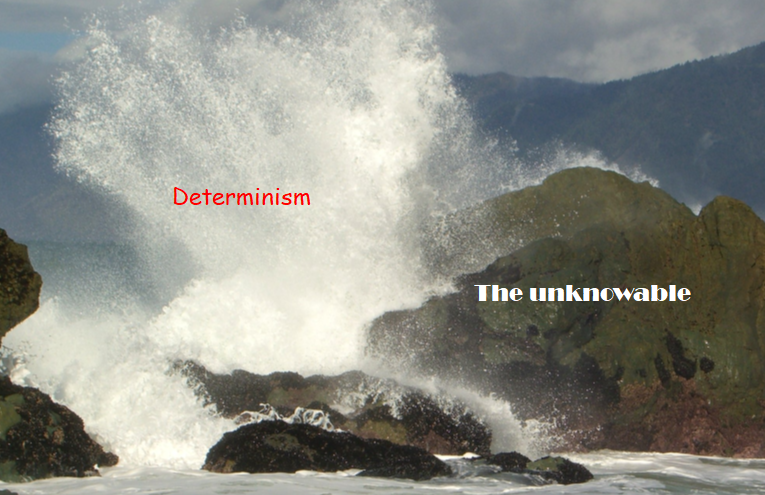
https://ktwop.com/2018/08/21/when-the-waves-of-determinism-break-against-the-rocks-of-the-unknowable/

https://ktwop.com/2017/10/17/the-liar-paradox-can-be-resolved-by-the-unknowable/

Physics cannot deal with nothingness


Physics cannot deal with nothingness

February 19, 2019

Physics (and all science) is about describing what can be observed and elucidating the causal relationships between observations. The process of science presupposes causality.  If causality is not always a fundamental and pervasive truth, the scientific method cannot elucidate anything. No system of reasoning can prove the assumptions the system itself is built upon. Science cannot, therefore, prove the existence of what it presupposes already exists.  Causality also implies the existence and the flow of time. Effect, it is assumed, can never precede cause. The process of science is necessarily blind to whatever may lie outside its suppositions. Which is why physics cannot deal with the non-existence of time (or space-time) where all the elucidated natural laws must be suspended.

Similarly, physics cannot allow of, or deal with, the unknowable. Many physicists merely deny the unknowable with the proposition that all things that have been, that are or that can be, are knowable and can – in principle – be explained by causality. But denying the unknowable leads to a deterministic world which, in turn, leads to the certainty of omniscience. It does not have to be human omniscience, but omniscience or any omniscient being becomes indistinguishable from a god. Determinism’s omniscience is nothing but divinity through the back door.

The unknowable lies outside the realm of science in general and of physics in particular. Unknowability applies not only to the existence of causality and time but also to the non-existence of nothingness. Clearly “empty” space which has dimensions and which allows the operation of natural laws is not nothing. Space which allows the passage of radiation or gravity waves cannot be nothing. Anything which has, or is attributed, any kind of property cannot be nothing. Our universe is expanding, it is said. It is also said that it is expanding into nothingness; where space and time emerge as the universe expands. But if the surroundings of the universe allow the expansion of the universe then such surroundings have a describable property and cannot be nothing. Nothingness is – and must be – unknowable.

Physics and philosophy both find defining nothingness a slippery business – but so they should, as they must for any unknowable thing.

What Is Nothing? Physicists Debate

…… The first, most basic idea of nothing — empty space with nothing in it — was quickly agreed not to be nothing. In our universe, even a dark, empty void of space, absent of all particles, is still something. “It has a topology, it has a shape, it’s a physical object,” philosopher Jim Holt said during the museum’s annual Isaac Asimov Memorial Debate, which this year was focused on the topic of “The Existence of Nothing.”

As moderator Neil deGrasse Tyson, ….. said, “If laws of physics still apply, the laws of physics are not nothing.”  …… But there is a deeper kind of nothing, argued theoretical physicist Lawrence Krauss of Arizona State University, which consists of no space at all, and no time, no particles, no fields, no laws of nature. “That to me is as close to nothing as you can get,” Krauss said.

Holt disagreed. “Is that really nothing?” he asked.”There’s no space and there’s no time. But what about physical laws, what about mathematical entities? What about consciousness? All the things that are non-spatial and non-temporal.”

Other speakers offered different ideas for nothing, such as a mathematical concept of nothing put forward by science journalist Charles Seife, author of “Zero: The Biography of a Dangerous Idea” (Penguin Books, 2000). He proposed starting with a set of numbers that included only the number zero, and then removing zero, leaving what’s called a null set. “It’s almost a Platonic nothing,” Seife said. The theoretical physicist Eva Silverstein of Stanford University suggested a highly technical nothing based on quantum field theory that involved a quantum system lacking degrees of freedom (dimensions). “The ground state of a gapped quantum system is my best answer,” she said.

Holt suggested another idea of nothing. “The only even remotely persuasive defintition of nothing I’ve heard form a physicist came from Alex Vilenkin,” a physicist at Tufts University, Holt said.”Imagine the surface of a ball. It’s a finite space but with no boundary. Then imagine it shrinking down to a point.” That would create a closed space-time with zero radius.

Every creation myth is about something appearing from nothingness. Even articulated by a physicist every theory about how things came to be, is just another creation myth. The Big Bang singularity is unknowable. I find many of the origin theories unconvincing where nothingness at the macro-level is allowed to produce somethings at the micro level, provided that not-somethings are also produced. Matter begets anti-matter and gravity (negative energy) begets positive energy, and the sum is zero. It is all very conveniently contrived except that why a particular something (and its negation) come to be, rather than some other something remains in the unknowable.

The Creation Hymn in the Rig Veda begins:

Then even nothingness was not, nor existence,
There was no air then, nor the heavens beyond it.
What covered it? Where was it? In whose keeping?

Nothingness is perhaps just where consciousness comes from – and where it goes.


Related:

First nothingness was not, then came the Big Bang and the Gods came later

If space is not empty, what is? The ultimate void?

Knowledge is not finite and some of it is unknowable

On the matter of matter (or how something came from nothing)


Knowledge is not finite and some of it is unknowable

September 23, 2018

Knowledge is not finite

Knowledge and truth are intertwined. Take knowledge to be made up of truths and of the relationships between truths which are themselves truths. Of course all truths making up human knowledge are only perceived truths. Human knowledge can then only be made up of partial, as-perceived truths (whether or not absolute truths exist) and then can only be a sub-set of all knowledge. Human knowledge consists of justified true beliefs (JTBs).

In the tripartite analysis of knowledge, a justified true belief exists when

  1. a proposition p is true,
  2. an entity S believes p
  3. S is justified in believing p

Addressing now all of knowledge, is it finite or without limits? Is there a limit to all the truths that are, that were and that will be? All of knowledge must encompass all of space, all of time and all of anything beyond space and time. Some things are then self-evident.

  1. In an infinite universe, knowledge is infinite.
  2. If time had no beginning or has no end then knowledge is infinite.
  3. If the number of universes is infinite, knowledge is infinite.

For knowledge to be finite, we would need a finite universe which had no uncertainties at any level and even at the quantum level. The universe could not be open-ended in time. Even if time is an emergent property of something else, that something else could not be open-ended. There could be no duality between particles and waves. Observations would need to be independent of the observer. Moreover, we would also need to know – as a truth – that there were no further truths beyond the finite universe. Even if causality is merely emergent, a perception and unreal, knowledge would still be infinite. Relativity or quantum mechanics or even loop quantum gravity, all require that knowledge be unbounded.

Furthermore, a universe with only a finite number of fundamental particles could still generate an infinite number of truths.

A large but finite number of nodes (junctions) can generate an infinite number of nodes and an infinite network if

  • each node is connected to every other and
  • where a new node is created whenever a connection crosses another connection

In an infinite space, it would not be necessary for connections to cross – but that would then be an infinite universe.

Even with only a finite number of fundamental particles (or waves), the sum of all knowledge would need not only that every particle be known but also that every interaction between particles be known, and also every interaction between the interactions, and so on ad infinitum. (It is somewhat analagous to the human brain where memory is stored not only at every neuron but also in every pathway between neurons, and then in the pathways generated between pathways and so on). Even a finite universe can (and probably does) give an infinite number of truths.

That all of knowledge is finite seems extremely far-fetched if not absurd.

A brain is a repository of knowledge. Clearly human knowledge is just a tiny sub-set of all knowledge and human knowledge is – most likely – finite. The knowledge of humanity will then be the sum of the knowledge of all the humans around at any given time. But the knowledge of humanity will never encompass even the knowledge of all living things with brains, let alone of all things. It may be that a single human brain could itself generate an infinite network, but all our empirical evidence suggests that the human brain is not – and can never be – infinite in its capacity or its capability.

Of course, the human brain may evolve in time into something wondrous. But it will still not reach omniscience.

Not all of knowledge is knowable.

I am persuaded by Fitch’s Paradox that the unknowable exists and is real.

The paradox of knowability is a logical result suggesting that, necessarily, if all truths are knowable in principle then all truths are in fact known. The contrapositive of the result says, necessarily, if in fact there is an unknown truth, then there is a truth that couldn’t possibly be known. More specifically, if p is a truth that is never known then it is unknowable that p is a truth that is never known. The proof has been used to argue against versions of anti-realism committed to the thesis that all truths are knowable. For clearly there are unknown truths; individually and collectively we are non-omniscient. So, by the main result, it is false that all truths are knowable. 

In my world view knowledge comes in three parts.

  1. what is known,
  2. what is unknown but knowable, and
  3. what is unknowable

The unknowable exists and is real.

Most of the past is unknowable. Past events where the repercussions of that event into the present have dwindled into the “noise” from the past are no longer detectable – by any means – as events. Such events can never be traced back as having taken place. The time it takes for the consequences of an event to dwindle into the noise of undetectable nothingness can vary from the immediate past to billions of years. Once below the threshold of detection, that event joins the unknowable. Causality and all the laws of the universe are of no use when the consequences in the present cannot be distinguished and detected. When the data is undetectable, causality is either undefined or inapplicable. For example I cannot remember some events even from this morning. When did I have my second cup of coffee? (I can remember the first). That event – the second cup – has no detectable consequences remaining in my memory or anywhere in the universe. Even omniscience – if it could exist – will not be able to dig up the knowledge of when I had my second cup of coffee. It did happen but exactly when it happened will remain for ever unknown and is now unknowable. While the existence of Genghis Khan is part of knowledge, pretty much all of the events in his life are now unknowable. Certainly his genes have been passed down through the ages but the causal path to backtrack to the “procreational” events he was involved in are now utterly undetectable and unknowable. It is said that some 110 billion humans have lived since the dawn of Anatomically Modern Humans. Most of the events of their lives are unknowable.

Most of the past is now unknowable. Some few isolated major events still can provide evidence of consequences which can be detected in the present.

There is no branch of science or philosophy or language (including mathematics) which does not begin with assumptions taken to be truths but which are not provable. These in fact are boundary conditions of human knowledge. Beyond these boundaries we enter the realm of the unknowable. Science and the methods of science do not have the means to illuminate the unknowable.


Knowledge is infinite, human knowledge is finite and the unknowable exists.


Related:

https://www.forbes.com/sites/startswithabang/2016/01/17/physicists-must-accept-that-some-things-are-unknowable/#6d2c5834ae1a

https://ktwop.com/2018/08/21/when-the-waves-of-determinism-break-against-the-rocks-of-the-unknowable/

https://ktwop.com/2017/10/17/the-liar-paradox-can-be-resolved-by-the-unknowable/


When the waves of determinism break against the rocks of the unknowable

August 21, 2018

It is physics versus philosophy.

Causal determinism states that every event is necessitated by antecedent events and conditions together with the laws of nature.

Determinism, unlike fatalism, does not require that future events be destined to occur no matter what the past and current events are. It only states that every future event that does occur, is an inevitable consequence of what has gone before and of the natural laws. However inevitability does not mean – and does not need to mean – predictability by the human mind. It should be noted though that the existence of a specific causality does not by itself imply a general determinism extending across all space and all time. A general and absolute determinism is also not a necessary condition for applying the scientific method though it could easily be taken to be so. The scientific method does require determinism but only to the extent that causality applies within the observable range of empirical observations. But it is also therefore unavoidable that the scientific method can only discover causal connections. The scientific method, in itself, rejects the existence of, and is therefore incapable of detecting, non-causal connections.

Most physicists would claim that determinism prevails. (Some of them may concede compatibilism but that is just a subterfuge to allow determinism to coexist with free will). Determinism claims that causality is supreme; that the laws of nature (whether or not they are known to the mind of man) prevail in the universe such that whatever is occurring is caused by, and is a consequence of, what came before. And whatever will happen in the future is caused by what has occurred before and what is occurring now. Absolute determinism allows of no free will. It can not. Clearly determinism allows of no gods or magic either. For determinism to apply it does not require that all knowledge is known or that the natural laws have all been discovered. It does however require that everything is knowable. If the unknowable exists then not everything can be determined. It also requires that all natural laws be self-explanatory in themselves. For the physicist, even the uncertainty at the quantum level does not invalidate determinism because this uncertainty, they say, is not random but is probabilistic. Even the weirdness brought about by quantum loop gravity theories do not, it is thought, invalidate the concept of determinism. Here the laws of nature and time and space themselves are emergent. They emerge from deeper, underlying “laws” and emerge as what we perceive as space and time and the 4 laws of nature. Where those underlying “laws” or rules or random excitations come from, or why, are, however, undefined and – more importantly – undefinable.

The concept that the universe is a zero-sum game, when taking the universe as a whole, does not take us any further. The concept postulates that the universe – taken globally – is a big nothing. Zero energy and zero charge globally but with locally “lumpy” conditions to set off the Big Bang. Some positive energies and some energy consumption such that the total is zero.  I find this unsatisfactory in that the concepts of the universe being homogeneous and isotropic are then a function of scale (space) and of time. Allowing for local lumpiness to exist but which averages to a globally smooth zero, seems far too contrived and convenient.

The problem caused by the acceptance of determinism, and of the consequent denial of the possibility of free will, is that all events are then inevitable and a natural consequence of what happened before. Choice becomes illusory. Behaviour is pre-ordained. In fact all thought and even consciousness itself must be an inevitable consequence of what went before. There can no longer be any moral responsibility attached to any behaviour or any actions (whether by humans or inanimate matter). It is argued that morality is irrelevant for physics. They are different domains. There is no equation for morality because it is not a law of nature. It is merely an emergent thing. Morality, for the physicist, just like consciousness and thought and behaviour, merely emerge from the laws of nature. This is not incorrect in itself, I think, but they are different domains because the laws of nature – as we know them – are incomplete in that they can neither explain themselves or morality.

For the physicist the natural laws apply everywhere and everywhen. Except, they admit, at or before (if there was a before) the Big Bang Singularity. They apply across the universe except that the universe cannot be defined. It is disingenuous to merely claim that the universe expands into nothingness and both creates and defines itself. The natural laws are said to apply across all of time except that time (not to be confused with the passage of time) is not defined. The nature of time is unknown and probably unknowable. What is it that passes? Quantum loop gravity enthusiasts would claim that time is merely a perception and that causality is an illusion. All events throughout space and time, they would say, occur/have occurred simultaneously. We merely connect certain events in our perceptions such that time and causality emerge. But this is no different than invoking magic. It seems to me that the gaping hole in the determinism charter is that there is no reason (known) for the natural laws to exist. Above all, the natural laws cannot explain themselves. I would claim that this lies in the unknowable. Determinism would have us accept that all biological and neural (and therefore cognitive) processes are merely events that are caused by antecedent events and natural law. Except that while natural laws are observed and experienced empirically, they cannot (and probably never will be able to) explain themselves.

And this is where determinism crashes. The four natural laws (gravity, electromagnetism, the strong nuclear force and the weak nuclear force) that we treat as being fundamental are not self-explanatory. They just are. They do not within themselves explain why they must exist. Maybe there is a Theory of Everything capable of explaining itself and everything in the world. Or maybe there isn’t. The natural laws cannot explain why there are 4 fundamental laws and not 5 or 6, or why there are just 12 (or 57) fundamental particles, or why there is a particle/wave duality or why undetectable dark energy or dark matter exist (except as fudge factors).The natural laws, as we know them today, cannot explain why life began (or why life had to begin to satisfy determinism), cannot explain what consciousness is and cannot explain why thoughts and behaviour must be inevitable consequences of antecedent events.  As a practical matter we have no inkling as to which antecedent events cause which cognitive events and following which laws. It is very likely that this is theoretically impossible as well. Some of these explanations may well lie in the realm of the unknowable. I draw the analogy with Gödel’s Incompleteness Theorems:

The first incompleteness theorem states that no consistent system of axioms whose theorems can be listed by an effective procedure (i.e., an algorithm) is capable of proving all truths about the arithmetic of the natural numbers. For any such formal system, there will always be statements about the natural numbers that are true, but that are unprovable within the system.

The second incompleteness theorem, an extension of the first, shows that the system cannot demonstrate its own consistency.

We cannot from within and as part of the universe demonstrate why the axioms used by physics must be. Empiricism gives us what we perceive to be the laws of nature. Empiricism also gives us our perceptions of consciousness and thought and free will. And these contradict one another. The resolution of the contradictions lives in the unknowable.

Empiricism can only go so far. It cannot reach the parts that empiricism cannot reach. Determinism cannot extend to places where the natural laws cannot or do not reach. If the unknowable exists then determinism cannot reach there. For the natural laws may not (or can not) apply there. It is not about whether we know all there is to be known about natural law. Determinism requires that some consistent and self-explanatory natural laws apply everywhere and at all times.

Absolute Determinism requires that Natural Laws be complete. That requires that natural laws be able to:

  1. explain their own existence, and
  2. explain all events (material and immaterial), and
  3. apply within and beyond our perception of the universe, and
  4. apply within and beyond our perception of time,

And the existence of such a set of Natural Laws is unknowable.


Related:

https://ktwop.com/2017/07/22/known-unknown-and-unknowable/

https://ktwop.com/2017/09/22/the-unknowable-is-neither-true-nor-false/

https://whyevolutionistrue.wordpress.com/2016/01/11/plain-talk-about-free-will-from-a-physicist-stop-claiming-you-have-it/

https://en.wikipedia.org/wiki/Determinism

http://physicsandthemind.blogspot.com/2013/10/in-defense-of-libertarian-free-will.html

http://backreaction.blogspot.com/2016/01/free-will-is-dead-lets-bury-it.html?spref=tw

http://archive.boston.com/bostonglobe/ideas/brainiac/2011/06/the_big_nothing.html

https://plato.stanford.edu/entries/determinism-causal/


Even atheists and agnostics (and scientists) believe in Magic

April 3, 2018

I find religions unsatisfactory because they take the easy way out and answer all the fundamental questions by inventing the label of Gods and Divinity and Divine Properties. I find organised religions even less satisfactory since they try and indoctrinate and coerce others into their own invented beliefs. I find atheism and agnosticism unsatisfactory in that they are merely reactions which deny the isms of religion and beliefs in gods. To the question “Is there a god?”, atheism denies the existence of any deities while agnosticism merely claims not to know. A “No” or a ” I don’t know”.

Atheism only denies already existing beliefs and has no philosophy to offer in its own right. The only thought required is in constructing arguments to negate other existing beliefs. Agnosticism can be a little more thoughtful in that it claims a lack of knowledge or that such knowledge is unknowable. But as I have posted earlier, some things are unknowable and the answers to the fundamental questions are outside our ken. They are just Magic. All religions and theologians also believe in Magic though they use different labels.

For the atheist, what time is, or how the universe was created, or how life started all remain unaddressed. For the agnostic the answers to these questions lie in the field of the unknowable. But what is inexplicable, but always is, is just Magic. There is time magic and universe creation magic and spark of life magic. Just labels of course for the inexplicable. But time always flows – by magic – and the universe exists – by magic – and life exists – by magic.

God and The Big Bang are both just labels for Magic

Religion relies on the “inexplicable” to justify the invocation of Gods. God-magic. Atheism relies on the “power of reason” giving the lie to the existence of Gods.  But atheism is merely a rejection of one set of labels and explains nothing. Religions vest their Gods with sufficient attributes to explain away what cannot be explained. Atheism merely ignores the inexplicable or claims the inexplicable to be a consequence of random events. Theologians and physicists alike merely give labels to what they cannot explain – as if the label is in itself an explanation. Anything inexplicable is what Magic is. Of course, Magic itself is just a label. ………. The universe was created by a magical event and dances to magical tunes played by magical instruments. Life was magically created by other magical music within this universe. Atheists and priests and physicists and theologians all actually believe in Magic. God-magic is no different to Big-Bang-magic or origin-of-life-magic. A belief in a God is just as much a belief in Magic as a belief in the Big Bang is.

“Scientists” often disclaim any such beliefs but they fool themselves. All science relies on, and is built upon, foundations of Magic. Why time exists and why time flows is just Magic. Why space exists and space expands is also some other Magic. Scientists may not like the use of the label Magic, but

We can, through the process of science and reason, discover the laws applying to the universe we perceive but, at every step of increased knowledge, we find new “whys” we cannot address. We now believe there are four fundamental forces of nature (gravitation, electromagnetism, strong nuclear, weak nuclear) but have no idea why they should be just four and not five or a thousand. Depending on how you classify them there are 12 or 57 fundamental particles. Why 12 or why 57 is just as much magic as when the universe was considered to consist of just fire, earth, water and air. Gravity and electromagnetism are just as magical now as they ever were. You could as well have a gravity-god or space-time magic. “Why time” is the essence of magic. The Origin of Life is also just a label for a Creation Event. There are weird and wonderful theories about this, ranging from a random event in the primordial soup to extra-terrestrial intervention.

Like it or not, every atheist, agnostic, scientist, philosopher, pope or theologian believes in Magic.


The speed of time (2)

April 1, 2018

The magical speed of an inconstant time (1).

Once upon a time (till about the 15th century) timeless meant badly timed. Since the 16th century it has been used almost exclusively to mean eternal and untimely is now used for badly timed. What puzzles me is that a time period – however measured – is not – and cannot be – time itself. A time period is to distance as time is to length. Time periods are all measured by observing a change which is assumed to be regular. We once thought the length of a day to be unchanging and took the day to be a period of time. We made the second fixed part of an unchanging day. Then we found that the rotation of the earth around its own axis was not regular. The period called a day was not an absolute measure. We have now shifted to the assumed regular frequency of vibration of a caesium atom in a particular state. This frequency is itself a time derivative – a change assumed to be regular (constant over time). But the regularity is an assumption. But even if this frequency eventually decays, and a second becomes longer than it is today, what is it that actually passes?

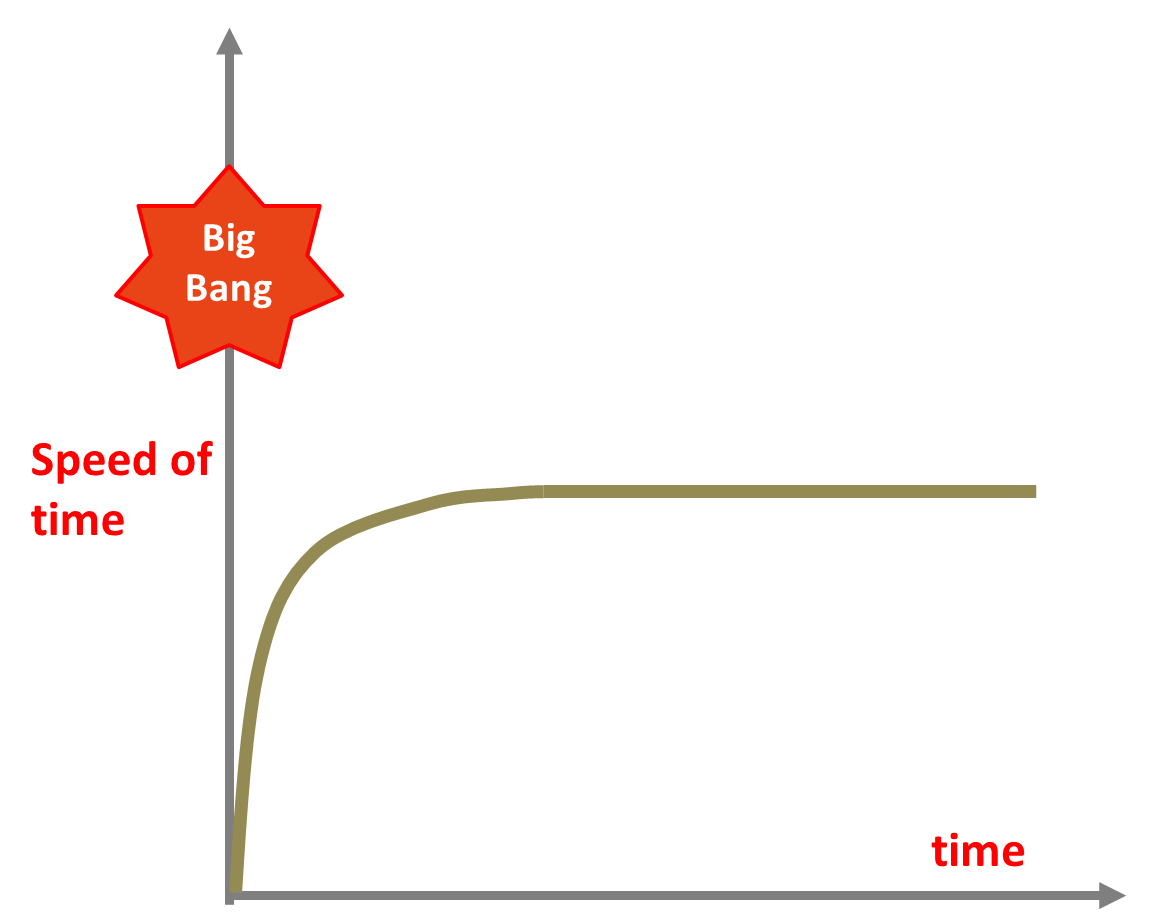
Does time flow? If it does, something called time must flow with respect to something else and it must therefore have a speed (a derivative).  Modern cosmology would have us believe that space and time are inextricably intertwined to make up a continuum – a la Einstein. Before the Big Bang there was no space and there was no time. And then came the Big Bang Singularity and both space and time were created (which is remarkably like a Creation Event). Time began to pass and there was space for the universe to expand into. But if time was not flowing, and then began to flow, it follows that it accelerated from a zero speed to whatever speed it flows at now. If the speed of time changed once, it can change again. It could go negative. In some other universe the omelette would give rise to the egg. But this brings us no closer to what time is.

We have to distinguish between the consequences of the flow of time (duration) and time itself. Without the flow of time there is no change, there is no motion. There is no life without the flow of time. It could be that if no change occurs, then time has not flowed, that the flow of the thing called time is necessary for change to occur. But change and motion are not themselves time. If the postulated space time continuum exists then there is no flow of time without space. If time does not flow there is only stasis. For matter of any kind to exist, even a fundamental particle, time must flow. For energy to exist, time must flow. And even if the wave theory prevails, the flow of time is required. Causality depends upon the flow of time. Not time, but the flow of time, is necessary for before and after and cause and effect.

Whether time is an intrinsic property of the universe or an emerging property it would seem to be a quantity that is unknowable within the dimensional constraints of the human mind. Perhaps the flow of time we observe is merely the shadow cast by something from a higher, unknowable dimension. But there is nothing that requires the flow of time to be constant or regular. As the universe and space expand perhaps the speed of time slows down.

It’s just magic.


The Liar Paradox can be resolved by the unknowable

October 17, 2017

A paradox appears when reasonable assumptions together with apparently valid logic lead to a seeming contradiction. When that happens, then applying the same rules of logic lead to the further conclusion that either

  1. the assumptions were wrong or
  2. that the logic applied was not valid or
  3. that the seeming contradiction was not a contradiction.

Where a paradox lies in wrongly identifying a contradiction, it is just an error. If the paradox is due to an error of applying the rules of logic it is also just a mistake. However sometimes the paradox shows that the logic itself is flawed or inconsistent. That can lead to a fundamental revision of the assumptions or rules of the logic itself. Paradoxes have contributed to whole realm of the philosophy of knowledge (and of the unknowable). Many paradoxes can only be resolved if perfectly reasonable assumptions can be shown to be wrong. Many scientific advances can be traced back to the confrontation of the starting assumptions.

Confronting paradoxes has led to many advances in knowledge. Niels Bohr once wrote, “How wonderful that we have met with a paradox. Now we have some hope of making progress.” A paradox is just an invitation to think again. 

Classical Logic is digital. It allows no grey zone between true and false. What is not true is false and what is not false must be true. This requirement of logic is built into the fabric of language itself. Classical Logic does not allow a statement to be, true and false simultaneously, or neither false nor true. Yet this logic gives rise to the Liar Paradox in its many formulations. The paradox dates back to antiquity and in its simplest forms are the statements

“I am lying”, or

“This statement is false”

There are many proposed ways out of this paradox but they all require some change to the rules of Classical Logic. Some require a term “meaningless” being introduced which requires that a proposition may be neither true nor false. Others merely evade the paradox by claiming that the statement is not a proposition. Bertrand Russel took the radical step of excluding all self reference from the playing field.

Experts in the field of philosophical logic have never agreed on the way out of the trouble despite 2,300 years of attention. Here is the trouble—a sketch of the paradox, the argument that reveals the contradiction:

Let L be the Classical Liar Sentence. If L is true, then L is false. But we can also establish the converse, as follows. Assume L is false. Because the Liar Sentence is just the sentence “L is false,” the Liar Sentence is therefore true, so L is true. We have now shown that L is true if, and only if, it is false. Since L must be one or the other, it is both.

That contradictory result apparently throws us into the lion’s den of semantic incoherence. The incoherence is due to the fact that, according to the rules of classical logic, anything follows from a contradiction, even “1 + 1 = 3.” 

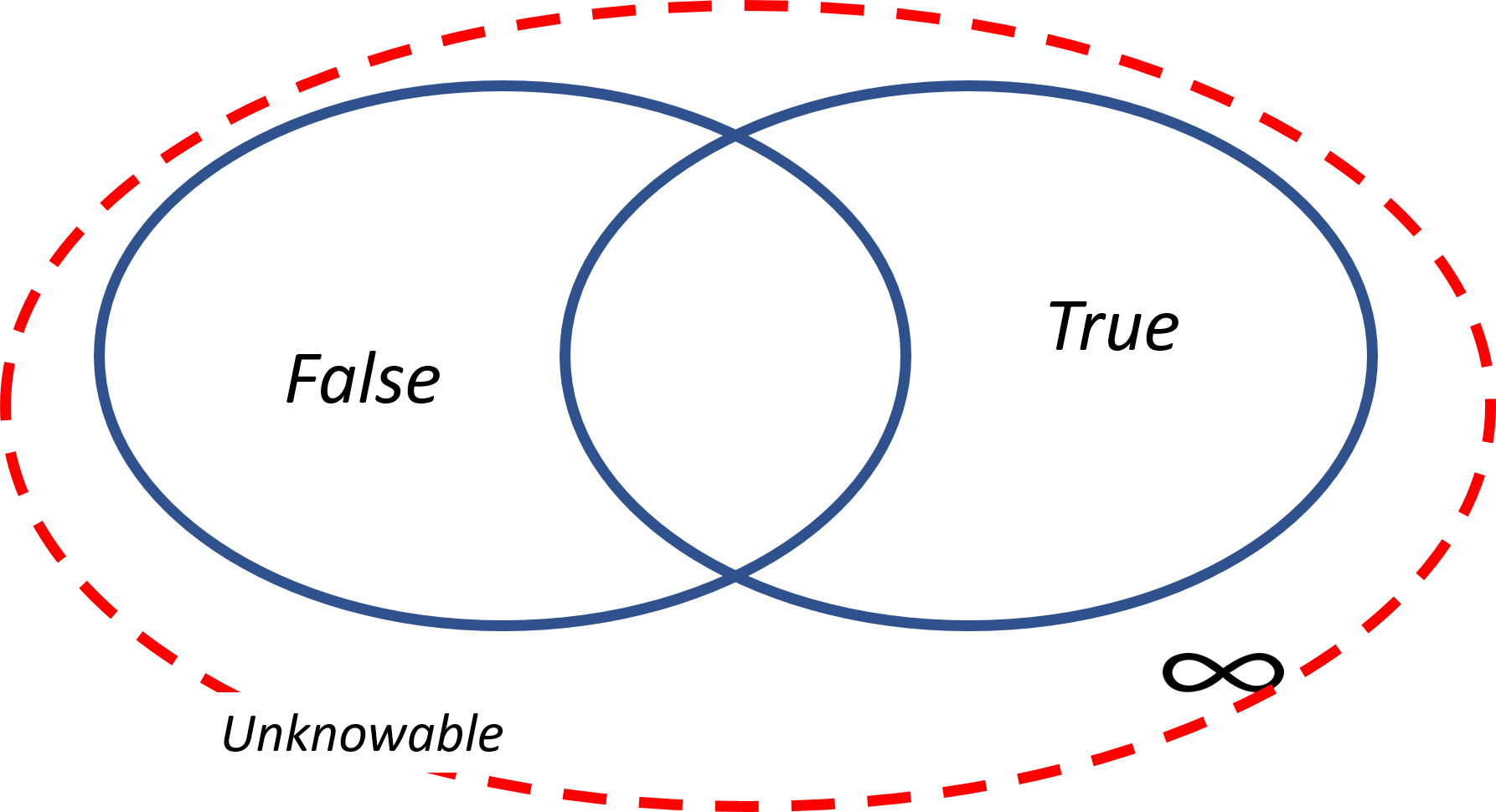
It seems to me that the paradox vanishes if we allow that what is not true is not necessarily false, and what is not false is not necessarily true. The fault lies in our self-determined assumption of the absence of a continuum between true and false. We can as well create a grey zone – some undefined state between and outside the realms of true and false – which would be an unknown state. Perhaps even an unknowable state. It is a strong indication – even if not a proof – that the unknowable exists and that logic needs to be fuzzy rather than digital.

The Liar Paradox is connected to the Fitch Paradox of Knowability

The paradox of knowability is a logical result suggesting that, necessarily, if all truths are knowable in principle then all truths are in fact known. The contrapositive of the result says, necessarily, if in fact there is an unknown truth, then there is a truth that couldn’t possibly be known.

More specifically, if p is a truth that is never known then it is unknowable that p is a truth that is never known. The proof has been used to argue against versions of anti-realism committed to the thesis that all truths are knowable. For clearly there are unknown truths; individually and collectively we are non-omniscient. So, by the main result, it is false that all truths are knowable. The result has also been used to draw more general lessons about the limits of human knowledge. 

Language is invented. Both words and the rules of grammar are invented – not discovered. We are forced to define words such as “infinite” and “endless” and “timeless” attempting to describe concepts which we cannot encompass with our finite brains and our limited physical senses. It is not possible to measure an endless line with a finite ruler.

The unknowable exists and it is therefore that we need the word “unknowable” .


Related:

Known, unknown and unknowable

The unknowable is neither true nor false

Gödel’s Incompleteness Theorems


The unknowable is neither true nor false

September 22, 2017

Some things are unknowable (Known, unknown and unknowable).

In epistemology (study of knowledge and justified belief), unknowable is to be distinguished from not known.

Fitch’s Paradox of Knowability (Stanford Encyclopedia of Philosophy)

The paradox of knowability is a logical result suggesting that, necessarily, if all truths are knowable in principle then all truths are in fact known. The contrapositive of the result says, necessarily, if in fact there is an unknown truth, then there is a truth that couldn’t possibly be known. More specifically, if p is a truth that is never known then it is unknowable that p is a truth that is never known.

Some believe that everything in the universe can be known through the process of science. Everything that is not known today will be known eventually. I do not quite agree. Some things are, I think, unfathomable, unthinkable – which one can not know. My reasoning is quite simple. The capacity of our brains is limited. That seems undisputed. It is because of our cognitive limitations, we have found it necessary in our invented languages to invent the concept of infinity – for things that are beyond observable. If brain capacity was unlimited there would be no need for the concept of infinity or for words such as “incomprehensible”. Even in mathematics, which, after all, is another language for describing the universe, we also have the concept of infinity. Infinitely large and infinitely small. We can find finite limits for some convergent infinite series, but we can never get to infinity by making finite operations on finite numbers. We cannot fill an infinite volume with a finite bucket or measure an infinitely long line with a finite ruler.

To my layman’s understanding, Cantor’s Continuum Hypothesis (which still cannot be proved), and Gödel’s Incompleteness Theorems (which prove that it cannot be proved in an axiom based mathematics), only confirms for me that:

  1. even our most fundamental axioms in philosophy and mathematics are assumed “true” but cannot be proven to be so, and
  2. there are areas of Kant’s “noumena” which are not capable of being known

It is not just that we do not know what we do not know. We cannot know anything of what is unknowable. In the universe of the knowable, the unknowable lies in the black holes of the current universe and in the time before time began.

I find Kant’s descriptions persuasive

Brittanica.com

Noumenon, (plural Noumena), in the philosophy of Immanuel Kant, the thing-in-itself (das Ding an sich) as opposed to what Kant called the phenomenon—the thing as it appears to an observer. Though the noumenal holds the contents of the intelligible world, Kant claimed that man’s speculative reason can only know phenomena and can never penetrate to the noumenon.

All human logic and all human reasoning are based on the assumption that what is not true is false, and what is not false must be true. But why is it that there cannot be a state where something is neither true nor false? Why not both false and true at the same time? In fact, it is the logic inherent in our own language that prohibits this state. It is a limitation of language which we cannot avoid. But language is not discovered, it is invented. That “what is not true must be false” is just an assumption – a very basic and deep assumption but still just an assumption.

Following Fitch

in fact there are unknown truths, therefore there must be truths that couldn’t possibly be known.

Therefore,

“Truth” and “that which is not true is false” are assumptions and are definitions inbuilt in our languages. Truth and Falsity are not necessarily mutually exclusive quantum states. They may instead form part of a continuum which is unknowable.  Maybe a truth-time continuum?

(image Forbes)


Known, unknown and unknowable

July 22, 2017

Donald Rumsfeld was often the butt of cheap jokes after this quote. In reality, Rumsfeld was absolutely spot on and close to philosophic.

Starting from where Rumsfeld left off we come to the distinction between the knowable and the unknowable

These are things we don’t know that we don’t know. There are knowable unknowns. That is to say, there are things that we could know but we don’t know which we don’t know. But there are also unknowable unknowns. There are things we cannot know that we don’t know that we can never know. 

a la Rumsfeld

I am coming to the conclusion that the sum of all human cognition lacks some of the dimensions of the universe. It may be increasing with time, but human cognition is limited. The expanding universe may be infinite or it may be boundless. For human cognition to grasp the universe is then like trying to measure an infinite length with a ruler of finite length, or of trying to measure some unknown parameter with a ruler marked in inches. Those measurements will never reach a conclusion.