Archive for August, 2011
August 30, 2011
I started this blog in April 2010 but I was still occupied completing my book and did not really start posting until the summer vacations in June 2010.
This is now my 1000th post.
Since then I have averaged between 2 and 3 posts a day though there have been periods for a week or two with very light posting and some long winter nights with many posts. Some things are however becoming clear to me:
- I post primarily for myself as a way of expressing whatever might be engaging or attracting or disturbing me at that moment. Just putting a post together is a little exercise which itself forces feelings or emotions into expressible text.
- Having posted on a particular subject functions as a form of catharsis. Sometimes I may never return to a subject for a long while or even at all.
- I cannot judge – and no longer concern myself greatly – which posts will get read and which will not. Old posts which had very few readers when initially posted may suddenly attract readers for no discernible reason. Posts I felt were not very well written can attract many more readers than others which I thought were well expressed.
- I find that some sense of achievement occurs at the time when I complete the post and not – surprisingly – when the views of the post become high. (Just as the main sense of achievement was when I completed my book manuscript and not when I found a publisher!)
- The structure of my web reading has changed as a consequence of posting. I find I look for different viewpoints and not just supporting viewpoints much more regularly. I am continuously amazed at the amount of quality writing available on the web. There is a great deal of utter rubbish also. But it does not seem to be too difficult – or too onerous – to separate the wheat from the chaff. In fact some of the rubbish – if well written – can be quite entertaining.
- I seem to straddle all political labels of every persuasion. On some subjects I would be labelled a fascist, and on others a socialist. I appear to be conservative and liberal simultaneously. Sometimes I find I support some views which would be considered environmentalist views and on many others I find I am totally opposed to what would fit that label. Some left-wing and some right wing causes attract me as often as others which repel. But I am quite comfortable in not finding any label which fits me. Being politically correct was not and is not of any relevance.
- A natural cynicism I have had about all politicians and all “do-gooders” is now I think a little more nuanced and analytic under the heading of “behaviour”.
- Blogging is a wonderful way of venting indignation.
In essence blogging functions as therapy for myself. It helps in sorting out my disjointed and chaotic thoughts. It forces me to read opposing views. I have even been forced to change my initial view as I have read more. It functions as a means of expressing indignation and a vent for letting off steam. It enforces some self-discipline. It creates some identity markers. It helps me to continue writing though it does take some time away from my next manuscripts. Whether it improves my writing is uncertain but it is certainly addictive.
It is – without doubt -therapeutic.
Some notes to myself for future posts include:
- It is perfectly OK to write for myself and not for any specific reader
- Avoid preaching
- Use fewer extracts from others and let the link do the work
- Don’t pretend to be a reporter
- Resist posting a link without comment
- Resist the temptation to “slander” which can be very strong but does not add much literary merit
The simple truth is that I shall continue blogging primarily for myself and I have no agenda other than to feel better in my own mind. It is an extension of my personal space; entirely under my control, my responsibility and for which I alone am accountable. But I am well aware that this space is also in the public domain. But this is precisely why – because it allows public scrutiny- I think it is therapeutic.
If in addition some people read what I write and if some few find it readable or provoking or just interesting then that is a bonus. But what readers – if any -may think is entirely secondary.
Tags:1000th blog post, Blog, Blogging as therapy, Writing
Posted in Behaviour, Media | 1 Comment »
August 30, 2011
Sometime soon the world’s population will exceed 7 billion. No one knows exactly when. According to the UN Population Reference Bureau, this will happen on 31st October in India or in China. The world’s 6 billionth living person was “suppposedly” born just 11 years ago in Bosnia, and world population is expected to reach 9 billion by 2050.
Monsters&Critics
The billion mark was reached only after 1800. As many as a billion have been added in the eleven years of the 21st century alone, and predictions on future population growth are now treated with the same caution and scepticism as long-range weather forecasts. David Bloom of the Harvard School of Public Health says that the multitude of unpredictable factors means that taking a global view is problematic. ‘Among them are infectious diseases, war, scientific progress, political change and our capacity for global cooperation,’ he says.
The general expectation is, however, that population growth will tail off, with UN predictions for 2050 ranging from 8.0 to 10.5 billion.
Interactive UN map is here

source: UN (via Time)
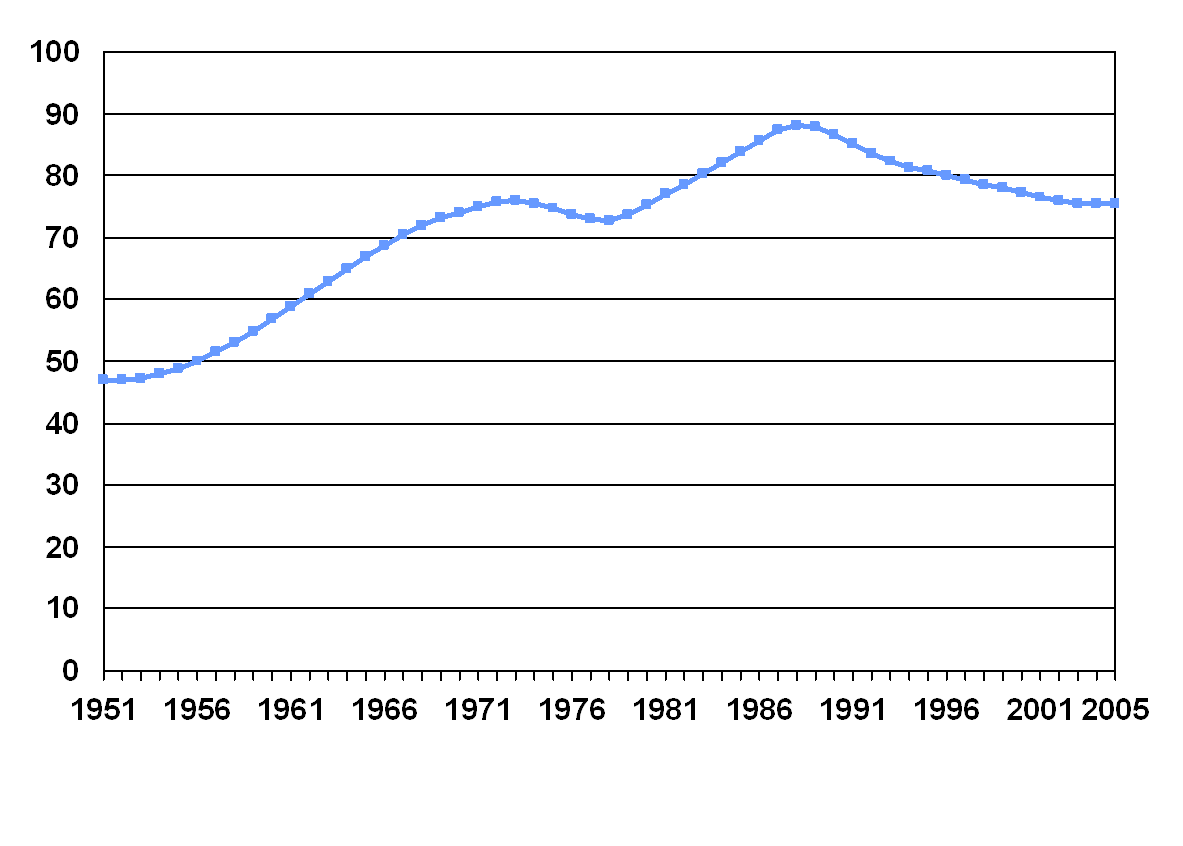
The annual rate of increase seems to have peaked around 1988 and is decreasing slowly. The UN medium scenario seems to be close to the actual development.

Annual increase of world population: Source United Nations, World Population Prospects: The 2004 Revision, 2005.
But I am no Malthusian and have a strong belief that the catastrophe theories are fundamentally misguided. Peak gas will never happen. Peak oil is a long way away and will be mitigated by new ways of creating oil substitutes as oil price increases. All the dismal forecasts of food production not being able to cope with population have not transpired. In my own lifetime I have only seen human ingenuity increase. Every doomsday scenario has had to give way before human ingenuity responding to human needs. I also believe that our children and our grandchildren will be considerably “smarter” than we are and will have (or will develop) technologies and tools that we cannot even dream of. I am not very convinced or impressed by those who would ban things today “for the sake of our children and our grandchildren”.
Even by the wildest stretch of his imagination my grandfather – who died around 1918 – would not have been able to imagine the technologies available today. Even my father – an engineer – who died in 1988 would not have been able to forecast the technologies we have at our command today.
With the definition below I would have no problem to be labelled a cornucopian.
A cornucopian is a futurist who believes that continued progress and provision of material items for mankind can be met by similarly continued advances in technology, and the abundance of matter and energy in space would appear to give humanity almost unlimited room for growth.
What population problem? More brains and hands could well cater for the extra mouths to feed
Tags:7 billlion, cornucopian, demographics, Population growth, Thomas Robert Malthus, United Nations, World population
Posted in Demographics | 3 Comments »
August 30, 2011
The Vice-Chancellor of the University of Peshawar, Dr Azmat Hayat Khan was found guilty of plagiarism by a three-member committee of the Higher Education Commission that was constituted to probe the matter. The Higher Education Commission had submitted its report to the Governor of Khyber-Pakhtunkhwa who is also the Chancellor of the university.
The Vice Chancellor has now put forward his story publicly and explained the plagiarism claims are not justified:
The News
Speaking out for the first time since he was accused of plagiarism, Vice-Chancellor of the University of Peshawar Prof Dr Azmat Hayat Khan Sunday rejected the allegations against him as baseless. A pressure group in the university is politicising the issue for its personal gains, he told The News in an exclusive interview.
… He said that the case was in the court and he could not comment much about it. However, I have challenged the jurisdiction of the Higher Education Commission. The letter of the HEC was written on malafide intention to the Khyber Pakhunkhwa governor in May 2011, he argued….
The Vice-Chancellor said that he had done his PhD in 1990 on the Durand Line and his thesis were challenged after 21 years, which was self-explanatory of the malafide intent behind the issue. He said that the Indian Office Library was the primary source of files for him. If you see my book you will come to know that I have quoted the original sources of information which is the same that Mst Kulwant Kaur has done. I mean both the authors have quoted original sources with different citations, he argued. In my book on several occasions I have mentioned in the footnotes that for further details see Kulwant Kaur’s book, Pak Afghan Relations. Now if I wanted to steal somebody’s work, I would not have referred to his or her book, he added.
Regarding the letters of a faculty member of the university to various quarters accusing him of giving life threats to him and his family members, Dr Azmat Hayat said he was an academician and believed in the sanctity of pen and book. ìAlso, I belong to a well-reputed family of Peshawar. People know me and my family very well. I cannot even think about such mean practices, he stated.
Read whole interview
Tags:Dr Azmat Hayat Khan, Governor of Khyber Pakhtunkhwa, Higher Education Commission of Pakistan, Peshawar, Plagiarism, University of Peshawar
Posted in Education, Ethics, scientific misconduct | 1 Comment »
August 29, 2011
A welcome paper after last weeks nonsense where a new “scientific field” was created to study the effects of climate on human conflict. This paper claimed – by playing rather silly numbers games – that conflict was linked to the El Niño cycles. “What passes for science: Mindless number games show El Niño correlates with civil war!“ Correlations do not necessarily indicate causality. It is not difficult to find correlations between entirely unrelated parameters. The El Niño – civil war correlation fulfils all the requirements of a pseudoscience.
The “Climate Wars” pseudoscience is clearly shown up by Dr. Bruno Tertrais in a new paper in The Washington Quarterly • 34:3 pp. 17�29, The Climate Wars Myth, DOI: 10.1080/0163660X.2011.587951.
He writes:
The first decade of the 21st century was the hottest since the beginning of the Industrial Revolution….. Think tanks have enthusiastically embraced this new field of research, and militaries around the world are now actively studying the possible impact of a warming planet on global security. Books with titles such as Climate Wars predict a bleak future.
A well-known French consultant claims that a five degree Celsius increase in average global temperature would generate no less than a ‘‘bloodbath.’’ Former World Bank economist Lord Nicholas Stern �the author of the 2006 ‘‘Stern Report’’ on the possible economic impact of climate change� even declares that failing to deal with climate change decisively would lead to ‘‘an extended world war.’’
However, there is every reason to be more than circumspect regarding such dire predictions. History shows that ‘‘warm’’ periods are more peaceful than ‘‘cold’’ ones. In the modern era, the evolution of the climate is not an essential factor to explain collective violence. Nothing indicates that ‘‘water wars’’ or floods of ‘‘climate refugees’’ are on the horizon. And to claim that climate change may have an impact on security is to state the obvious�but it does not make it meaningful for defense planning.
… if there was any significant link between warfare and warming, the number of conflicts should have been rising in the past two decades. It has not� quite the contrary. Since the end of the Cold War, the total number of wars, after having steadily increased since 1945, has diminished. Statistics published by the Stockholm International Peace Research Institute (SIPRI), which come from work done at the Uppsala University, clearly show such a decrease.
Some of the most catastrophic scenarios of climate change-induced conflict just do not stand up to scrutiny. …
He concludes:
There are indeed, it seems, some causal links between climate and warfare. But they are of a seasonal nature: ‘‘nations address seasonal climate change in terms of where they fight, rather than through when or whether disputes occur. . . . Fighting moves to higher latitudes in the summer, and lower latitudes during the cooler months of the year.’’
The stakes of climate change are important �and that is why this area should not be the object of intellectual fantasies or fashions. It is appropriate for defense and security planners to monitor the evolution of the scientific and political debate on its possible consequences. But there is no objective reason today to list climate change as a key issue for defense and security planning.
Read the whole paper
Tags:Bruno Tertrais, climate, climate change, climate change and war, Climate wars myth, El Niño-Southern Oscillation, global warming, pseudoscience, stern report
Posted in Alarmism, Climate, Non-Science | Comments Off on The pseudoscience of climate wars: climate does not control human violence
August 29, 2011
The much-hyped Hurricane Irene fizzled to a tropical storm and failed to deliver the massive devastation that the media was hoping for.
The wall-to-wall coverage of the expected destruction has now left the media desperately trying to show that apocalypse was only narrowly averted. But they cannot hide their terrible disappointment. Politicians are implying that “crying wolf” was not only the right thing to do but might actually have dampened the storm. Millions lost electricity as areas were shut down as a precaution against flooded sub-stations. But the 20 – 30 foot storm surges expected only managed to reach some 2 or 3 feet.
But water and gas and batteries and candles all sold very well.
The muted headlines on the day after cannot hide the disappointment –
Telegraph – Perfect Storm of Hype: US politicians, the media and the Hurricane Irene apocalypse that never was
New York Times – ‘Some Hurricane,’ New Yorkers Grumble as Danger Passes
Boston Globe – Tired Irene slaps N.E.
Washington Post – Hurricane Irene was not the powerhouse most expected
According to my son – “Well it was windy and quite wet”. Oh well!
Tags:Hurricane Irene, media, media alarmism, New Jersey, New York, tropical storm
Posted in Alarmism, Media, US, Weather | Comments Off on “The Irene show” bombs – media disappointment high
August 28, 2011
It seems that a Petrobras geologist – Dr. Jorge Figueiredo – does not like all the attention that Hamza and Pimental are getting. He may well have a point but there seems to be a touch of “sour grapes” about his carping. The data was Petrobras data available to their own geologists after all. Perhaps if the river had been named after him Dr. Figueiredo would not be quite so petulant.
If the flow is regular and serves to drain the Amazon then I think it can be called a river even if it is only a tiny seepage through the pores in rocks. The key is that the flow should be regular. Continuity of flow or the velocity of flow cannot be the arbiter. Even surface rivers can be seasonal and discontinuous, can completely dry up at times but they all regularly return from the same source to the same sink.
BBC:
…. Valiya Hamza and Elizabeth Tavares Pimentel, from the Brazilian National Observatory, deduced the existence of the “river” by using temperature data from boreholes across the Amazon region. The holes were dug by the Brazilian oil company Petrobras in the search for new oil and gas fields, and Petrobras has since released its data to the scientific community.
Using mathematical models relating temperature differences to water movement, the scientists inferred that water must be moving downwards through the ground around the holes, and then flowing horizontally at a depth of several km.
They concluded that this movement had to be from West to East, mimicking the mighty Amazon itself. A true underground river on this scale – 6,000km (4,000 miles) long – would be the longest of its kind in the world by far. But Professor Hamza told BBC News that it was not a river in the conventional sense. “We have used the term ‘river’ in a more generic sense than the popular notion,” he said.
In the Amazon, he said, water was transported by three kinds of “river” – the Amazon itself, as water vapour in atmospheric circulation, and as moving groundwater. “According to the lithologic sequences representative of Amazon [underground sedimentary] basins, the medium is permeable and the flow is through pores… we assume that the medium has enough permeability to allow for significant subsurface flows.”
The total calculated volume of the flow – about 4,000 cubic metres per second – is significant, although just a few percent of the amount of water transported by the Amazon proper. The underground flow could be confirmed with coastal measurements, scientists suggest. But the speed of movement is even slower than glaciers usually display, never mind rivers.
And whether water really is transported right across the region in this way is disputed by Jorge Figueiredo, a geologist with Petrobras. “First of all, the word ‘river’ should be burned from the work – it’s not a river whatsoever,” he told BBC News.
Water and other fluids could indeed flow through the porous sedimentary rock, he said, but would be unlikely to reach the Atlantic Ocean because the sedimentary basins containing the porous rock were separated by older rock deposits that would form an impermeable barrier. “But the main problem is that at depths of 4,000m, there is no possibility that we have fresh water – we have direct data that this water is saline,” said Dr Figueiredo. “My colleagues and I think this work is very arguable – we have a high level of criticism.” …
The research – Indications of an Underground “River” beneath the Amazon River: Inferences from Results of Geothermal Studies – was presented at the 12th International Congress of the Brazilian Geophysical Society in Rio de Janeiro, and has not been published in a peer-reviewed scientific journal.
The team has named the underground flow the “Hamza River”.
Tags:Amazon river, Elizabeth Tavares Pimentel, Hamza river, Jorge Figueiredo, Petrobras, Subterranean river, Valiya Hamza
Posted in Behaviour, Brazil, Geosciences, Natural Phenomena, Science | Comments Off on Hamza subterranean “river” criticised by Petrobras geologist – a case of “sour grapes”?
August 28, 2011
That it was a storm and caused some damage – as storms are wont to do – seems clear.
But was all the fuss really justified? Emergencies declared, mass evacuations, whole cities shut down!!
Perhaps I am missing something but the reports of wind speeds for New York city that are forecast here are stormy but they do not seem all that remarkable (perhaps upto about 80km/h (50 mph) for an hour or two.
New York City forecast Sunday
| Hourly Forecast |
6AM |
12 Noon |
6PM |
12 Midnight |
| Temp. | Dew Point |
22 | 21 |
22 | 20 |
22 | 15 |
18 | 12 |
| Wind |
73 km/h East |
78 km/h North |
44 km/h WNW |
27 km/h West |
| Humidity |
94% |
88% |
65% |
70% |
| Chance of Precip. |
100% |
100% |
100% |
10% |
| Cloud Cover |
100% |
100% |
85% |
35% |
| Conditions |
Thunderstorm |
Thunderstorm |
Chance of Rain |
Partly Cloudy |
| Sunrise & Sunset |
|
New York seems to have faced (or is facing) a severe tropical storm — but this is no hurricane.
The New York Times story goes over the top. Maybe this is the precautionary principle at work but it seems like alarmism to me and the so-called “fury” seems to have been somewhat muted!!
Tags:Alarmism, Hurricane Irene, hurricane Irene loses its fury, New York City, tropical storm
Posted in Alarmism, Natural Phenomena, Weather | 1 Comment »
August 28, 2011
This an arbitrary listing / ranking of examples of academic dishonesty at US colleges and secondary schools put together by Online Colleges. I am sure there are many other candidates for the list but I have no doubt that it is only by exposing such cases that change can occur. The internet provides an unprecedented medium for the exposure of cases which would otherwise be swept under carpets and never get any attention. The cases of plagiarism being revealed in Germany is a case in point.
The downside of the internet is, of course, that mere allegations may be taken as being confirmed fact and that it also allows personal feuds and partisan opinions to be presented without much rigorous scrutiny.
11 Most Egregious Examples of Academic Dishonesty
Academic dishonesty is a serious concern on college campuses and secondary schools around the U.S., as it seriously undermines the entire purpose of education. Not only does it reflect poorly on students, but the institutions to which they are enrolled as well. While cheating and lying in the classroom is nothing new, in recent years the lengths to which many college kids (and their teachers) are willing to go has shocked and surprised many. This often leads to a call for stricter penalties levied on those violating academic honor codes.
No matter where you stand on cheating or how you feel it should be combated in a school setting, there is no doubt that these cases we’ve collected here are some of the most outrageous examples in recent history. We’d like to hope these eventually mark a turning point in student behavior, but as education becomes even more competitive and expensive, cheating isn’t likely to stop anytime soon.
Tags:Academic Dishonesty, Colleges and Universities, Education, High school, United States
Posted in Education, Ethics | Comments Off on “Top 11 examples” of US academic dishonesty
August 27, 2011
Jatinder Ahluwalia’s career of scientific misconduct has cut a swathe through academia over the last 15 years but is now approaching its end-game as Imperial College reviews the award of his PhD.
At Cambridge University he lost his studentship funding from the Engineering and Physical Sciences Research Council at the end of 1997, and was dismissed from the graduate studies program in 1998. He then went on to “earn” his PhD at Imperial College after which he was employed at University College London. An investigation at UCL found that not only had he faked experimental results but also that he had sabotaged the experiments of some of his colleagues. He resigned or was dismissed by UCL in 2009 but then turned up as a senior lecturer at the University of East London. As retractions of his papers and allegations by co-workers mounted, UEL also investigated and Imperial College started checking the experiments which had led to the award of his PhD. Earlier this year he “left” UEL. Retraction Watch has documented the entire, sorry story.
This week another paper of his was retracted and Imperial College announced that the results on which his PhD were based could not be replicated. Imperial will now set up a committee to review the award of his doctorate.
The academics asked to independently re-run the experiments were unable to replicate the findings published in the paper Activation of capsaicin-sensitive primary sensory neurones induces anandamide production and release and so the authors decided to withdraw this from the Journal of Neurochemistry. The findings also formed the basis of Dr Ahluwalia’s PhD. The College has therefore written to Dr Ahluwalia to notify him that it believes it has grounds to investigate the validity of the data in his PhD. It will be convening a panel to review the award in accordance with its policy for investigating allegations of research misconduct.
I find it an incredible waste that in so many cases of scientific misconduct there is such a great deal of misplaced creativity and ingenuity – and even hard work – which goes into the misconduct and in then covering it up.
Tags:Cambridge University, Imperial College London, Jatinder Ahluwalia, Retraction Watch, Scientific misconduct, University College London, University of East London
Posted in Science, scientific misconduct | 2 Comments »
August 26, 2011
When plagiarism is not plagiarism
The Vice-Chancellor of the University of Peshawar, Dr Azmat Hayat Khan was found guilty of plagiarism by a three-member committee of the Higher Education Commission that was constituted to probe the matter. The Higher Education Commission had submitted its report to the Governor of Khyber-Pakhtunkhwa who is also the Chancellor of the university.
For apparently political reasons, no action has so far been taken against the Vice Chancellor. Instead the University went on the attack. First they attacked the complainant, Mohammad Zubair, an assistant professor at the UoP Law College. They suspended him and have now dismissed him and are going through a paper exercise to strip him of his law degree. Now they have attacked the Higher Education Commission for finding their beloved Vice Chancellor guilty. The defence of the Vice Chancellor is ingenious. First they have objected to the procedures followed by the Commission in not interrogating the Vice Chancellor. Since they felt this argument was probably a little weak they then redefined plagiarism so that the Vice Chancellor’s plagiarism was no longer plagiarism!!
The University has effectively created a Cheaters Charter. It has reinvented and redefined a plagiarism “threshold” of allowable copying as being 19% for scholarly articles and 25% for theses. And since – they claim – the Vice Chancellor only cheated to the extent of copying 18% of his book from others – what he did was not plagiarism!!
From being a case of the Vice Chancellor’s plagiarism this has now escalated to become a case of blatant corruption at the highest levels of the University and not excluding the Chancellor – who is of course merely taking a political position as the Governor of Khyber-Pakhtunkhwa.
The ethical standards of the University of Peshawar are beginning to stink.
Pakistan Today reports:
The University of Peshawar issued a clarification on a news item pertaining to plagiarism stating certain elements from a political group were involved. ….
The HEC thus already had jumped to conclusions without inquiring into the matter which shows a partial approach and mala fide intentions. This in fact was the only inquiry in history in which the author under investigation was not called before the committee. The plagiarism policy of HEC point number eight section“E“ clearly reads that the author under investigation must be provided opportunity to justify the originality of their concepts. …..
The HEC Plagiarism policy states plagiarism cases be dealt by respective universities and the threshold is setup by the concerned University in light of the Quality Assurance guidelines of HEC. The percentage of allowed threshold decided by meeting of the Advance Studies and Research Board of University of Peshawar in light of HEC Quality Assurance guidelines, in its meeting held on 25/11/2009 was 19% allowed matching (threshold) for published research articles and 25% for thesis.
The plagiarism allegations against the Vice Chancellor were looked in HEC recommended software and the result was shown to be 18%. This is the same software which is being used all over the country and by HEC. The same document was checked manually and the matching percentage of Kulwant Kaur Book “Pak Afghan relations” to that of Dr Azmat Hayat Khan book was 17%. …….
The press release stated the case was in court and an unbiased decision would be issued because the author would get a chance to explain his point of view and the facts of the matter. It said the University of Peshawar considered the HEC’s recommendation of a penalty and the press conference organized by them as contempt of court (against PHC decision) and will take the case to legal corners. It claims that the victimizing campaign is spear-headed by Zubair Mehsud. The press release denied Zubair was being targeted, as claimed by a newsreport, for raising his voice against the VC.
The press release said ex-Law College faculty member Zubair had been terminated for engaging in political activities against the VC’s directives and the used of defamatory language when issued show cause notice to explain his position on the matter.
But the demands on the Governor to replace the tainted Vice Chancellor are continuing to grow.
Tags:Azmat Hayat Khan, Cheaters Charter, Higher Education Commission of Pakistan, Khyber-Pakhtunkhwa, Mohammad Zubair, Plagiarism, University of Peshawar
Posted in Corruption, Education, Ethics, Pakistan, Politics, scientific misconduct | 2 Comments »

 The k2p blog