Archive for October, 2013

In India religion is more destructive than natural “disasters”

October 14, 2013

The headlines tell the tale.

Religion and caste and all that follows from them are more debilitating in Modern India than any “natural disaster”.

It is time to do away with the majority of temples and mosques and churches and shrines – and it would not be wrong to replace them with toilets!

1. 113 dead in Madhya Pradesh temple stampede, toll likely to rise

Hindustan Times  – ‎12 minutes ago‎
At least 113 people were killed and more than 100 injured in a stampede on a crowded bridge across Sindh river leading to Ratangarh temple in Datia district of northern Madhya Pradesh on Sunday.

2. Death toll rises to 21, floods affect thousands in Odisha

Firstpost  – ‎7 minutes ago‎
The death toll due to pre and post cyclone Phailin devastations has gone up to 21. One more death was reported late Sunday night, a senior government official told IANS. “The latest death took place in Balasore, where two people were drowning in flood …

3. Sexual assault case: Asaram to be taken to Ahmedabad today

IBNLive  – ‎1 hour ago‎
Jodhpur: Self-styled godman Asaram will be brought to Ahmedabad on Monday for questioning in another sexual assault case. The Jodhpur court has given permission to the Gujarat police to take him in custody for interrogation in the case filed by two sisters …

4. UP govt suspends senior IAS officer Mishra

indiatvnews.com  – ‎12 hours ago‎
Lucknow: A day after his transfer, senior IAS officer Sarvesh Chandra Mishra was today suspended and a departmental probe initiated against him over a controversial letter convening a meeting to discuss “reconstruction of Ram Temple in Ayodhya on lines …
 

5. No untouchability in politics, says Pawar

Indian Express  – ‎1 hour ago‎
NCP chief and Union Agriculture Minister Sharad Pawar, speaking at a programme organised by BJP leader Nitin Gadkari’s Purti Group here on Saturday, said “there should be no untouchability in social and political spheres of life”.

Are leaves redder this year? A sign of a hard winter to come?

October 13, 2013

Autumn in this part of the world (Sweden at 58.7000° N) is always a riot of colour. A kaleidescope with every possible shade of yellow and brown with a small splash of red. Never quite the dominating reds of New England but glorious in the late autumn sunlight. But this year I felt that there was much more red around than “usual”. A purely subjective perception of course and one which I put aside as being just the vagaries of visual memory.

Autumn October 13, 2013

Autumn October 13, 2013

But yesterday the local paper reported that this was a perception being shared by many others. Trees and bushes did seem to be redder than usual. And “reds”were  varying from deep rusts and maroons to bright scarlets and bleeding crimsons. But science did not really know why the colours might vary from year to year – just that they did vary.

Is it due just to how the weather has been through the summer?

Or is it because of the weather anticipated for the winter?

The three main pigments that color leaves are, chlorophyll (green), carotenoid (yellow, orange, and brown), and anthocyanin (red). Chlorophyll and carotenoid are always present in leaf cells. More sunlight means more chlorophyll and green summers. The reducing sunlight in autumn reduces the chlorophyll allowing the yellows and browns of carotenoid to show through more strongly. But high levels of sunlight may lead to an increase of anthocyanins.

In photosynthetic tissues (such as leaves and sometimes stems), anthocyanins have been shown to act as a “sunscreen”, protecting cells from high-light damage by absorbing blue-green and ultraviolet light, thereby protecting the tissues from photoinhibition, or high-light stress.

This summer of 2013 started late after a long winter and a very late spring. The number of sunshine hours have not been unusually high nor the amount of rain unusually low. Temperatures have not been particularly noteworthy. So just the number of sunshine hours seems inadequate as an explanation of the greater levels of red I perceive.

The Daily Green: Unlike the ever-present yellows that simply become unmasked when chlorophyll recedes, red pigments are actually created as a tree is going dormant. But why would a tree expend energy to produce a new pigment just as it’s hunkering down for the winter? And why do some trees make red pigments, when others don’t? Further, the reds of New England are so famous in part because they are unique to the new world. Why are European autumns so predominantly yellow? 

…… yellow trees are those that colonize open land first – so-called pioneer species that are tolerant of direct sunlight. Those that turn red are species that follow in the succession of species that come to dominate a landscape, and they tend to benefit from more protection from the sun. It’s not that the red leaves lack the yellow pigment; the red pigment is an addition, and in fall it is so intense that it masks the yellow, just as green does in summer. Those pioneer species are less susceptible to light damage, 

But why are European trees more yellow? It could be that falls there tend to be warmer and cloudier, so there was never any selective advantage for trees to evolve red pigments that would be protective of the sun.

According to the U.S. Forest Service:

A succession of warm, sunny days and cool, crisp but not freezing nights seems to bring about the most spectacular color displays. During these days, lots of sugars are produced in the leaf but the cool nights and the gradual closing of veins going into the leaf prevent these sugars from moving out. These conditions-lots of sugar and lots of light-spur production of the brilliant anthocyanin pigments, which tint reds, purples, and crimson. Because carotenoids are always present in leaves, the yellow and gold colors remain fairly constant from year to year.

So I don’t really know why the leaves look redder this autumn.  But I think trees may be better predictors of weather than we give them credit for. There are some signs that Europe may be in for another hard, long winter this year. Perhaps the trees already know this and are busy storing nutrients in their roots. Therefore they need more anthocyanin to allow them to do this.

The trees already know what to expect this winter. At least, that’s what I would like to think!

Phailin came and Phailin went: Alarmists and Warmists disappointed

October 13, 2013

Cyclone Phaelin came and it has now gone.

The Greens around the world are somewhat disappointed that many thousands have not died.

It was a very severe cyclone when it hit (windspeed 200km/h) but it did not reach the classification as a Super Cyclone (>220km/h windspeed).

It was a massive evacuation and that itself was somethiing of an achievement. More than 600,000 (and maybe as many as 1 million) moved or were moved out of harms way. 7 are known to have died in cyclone related events (falling trees in the main). Damage reports have yet to be assessed. Some fishermen are known to be stranded. The military is mobilised and stands ready for rescue and rehabilitation.

The Indian Meteorological community got it about right. But there were those who predicted that it would not only be a Super Cyclone at 220km/h but would be a Super Dooper Cyclone with winds up to 315km/h.

The US Navy’s Joint Typhoon Warning Center (JTWC) in Pearl Harbor, Hawaii, on Friday said Phailin is now expected to break the Indian Ocean intensity record set by the 1999 Cyclone in which at least 9,000 people were killed in Odisha.

Alarmists started criticising the preparations and the evacuations and suggested it would be worse than 1999 where at least 15,000 (unofficially 45,000) died. The Global Warmists at Huffington Post almost seemed to want the loss of life to be as high as possible so that they could blame Global warming (but note that they manage to blame any untoward weather event on Global Warming)

India should rename this meaningless obfuscation and call attention to global warming immediately. .. The anthropogenic global warming caused by accumulation of greenhouse gases is making the oceans warmer, which in turn is causing more frequent and more intense cyclones/hurricanes and floods.

Needless to say the Environ-Mentalists at Greenpeace were also hoping for a major disaster

Intense and destructive storms are likely to occur more frequently as global warming intensifies, Greenpeace said Saturday. “Such intense and destructive storms are likely to become more frequent in the future as global warming intensifies.  India member Biswajit Mohanty. According to the organisation, cyclone Phailin which is expected to hit the coastal areas of Odisha and Andhra Pradesh is likely to be the strongest such to affect India in 14 years, since the 1999 Odisha cyclone.

The Green Brigade conveniently forget that a Super Cyclone is generated in the Bay of Bengal every 10-20 years. It is a natural phenomenon known for at least the last 200 years. The super Cyclone of 1970 killed over 500,000 people. And the lessons learned since 1999, the major evacuation and the other preparations made seem to have achieved their objective and minimised the loss of life.

It was a severe storm and has surely caused some significant damage. But it is something which happens regularly and not anything unprecedented. It was not a Super Cyclone.

And it was nowhere near the major disaster that Alarmists, Greenpeace, Global Warmists and Environ-Mentalists were hoping for.

Cyclone Phaelin makes landfall – Severe storm but not a Super Cyclone

October 12, 2013

UPDATE!

Saturday: 11:30pm IST: It has been some 3 hours since Phaelin made landfall as a Severe Cyclone but without the wind-speed to be classified as a Super Cyclone. The full effects will now not be known till morning but it would seem that up to 1 million people may have moved – or been moved – out of harms way.

It is too early to give way to optimism. But fingers are crossed that the evacuations and advance preparations have been successful and that fatalities will be orders of magnitude lower than in 1999 or 1991.

==============================================

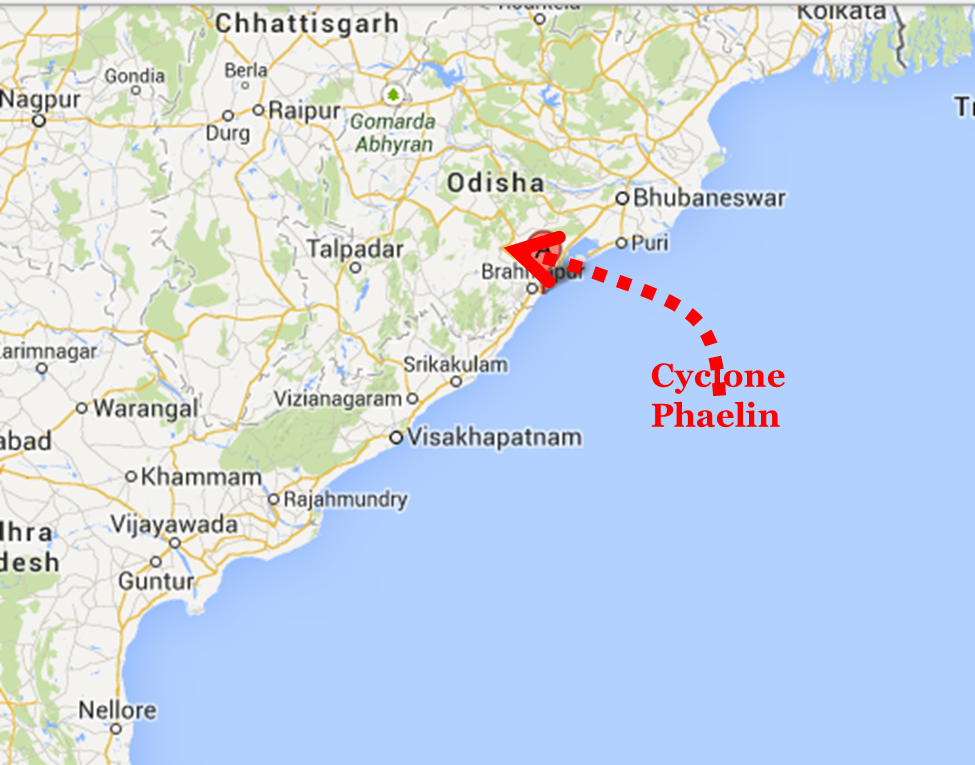
Phaelin made landfall at about 8:20pm local time just south of Gopalpur, Odisha. The cyclone has slowed down and has veered a little Westwards. Windspeeds at landfall were reported to be around 200km/h.

Apart from 7 reported killed due to falling trees in the high winds, damage reports are not yet available.

Phaelin Landfall Googlemaps

Phaelin Landfall Googlemaps

The Mediterranean is the graveyard of the Château d’EU

October 12, 2013

Washington PostDozens were feared dead after a boat filled with migrants capsized in the Mediterranean Sea about 70 miles south of the Italian island of Lampedusa, just a week after more than 300 migrants died when their boat sank near the same island south of Sicily.

At least 50 are known to have died yesterday including at least 3 small children.

Map of migrants routes

Europe’s Graveyard

The EU – we should not forget –  won the Nobel Peace Prize last year.

Which only goes to show how ridiculous the Nobel Peace Prize and the Norwegian Nobel Committee has become. And while the EU rests on its laurels, the Mediterranean is fast becoming the graveyard of the Château d’EU (with apologies to Alexandre Dumas).

lampedusa-map.jpg

A ship carrying migrants capsized Friday near the Italian island of Lampedusa. (GoogleMaps)

It is not that I am advocating open borders for the EU (though there will be a time in the distant future when nation states and national boundaries will become obsolete). But nearly all the countries of the EU need – in the long-term – to improve the ratio of their working population to their supported populations (notwithstanding the short-term high unemployment that currently reigns in some countries). It was the EU which supported the overthrow of the old regime in Tunisia. It was the EU itself which was so keen to bomb Libya and cannot now escape from the consequences. It is the EU which is supporting Al Qaida in Syria by supporting the “rebels” and that too will have long term consequences. When Assad’s regime prevails – as it seems to be doing – where will all the “rebel” Syrians turn? The EU was all too quick to support the overthrow of Mubarak without realising what the Muslim Brotherhood would bring.

It is in the EU’s long-term self interest to develop a pro-active – and therefore orderly –  immigration policy in the countries outside its borders. It is politicians in the ruling parties across Europe who have to stop pandering to nationalistic, short-term populism and have the courage to lead their countries to face up to the long term demographic challenges. And that cannot happen with a Fortress Europe policy.

With a Château d’EU surrounded by watery graveyards.

BBC: 

Maltese PM Joseph Muscat has said European waters close to Africa are turning into a cemetery, after another boat laden with migrants capsized. Mr Muscat said Malta felt “abandoned” by the rest of Europe and insisted that the EU had to take action.

Malta and Italy launched a rescue operation after a boat capsized on Friday, leaving up to 50 people dead. It happened 120km (70 miles) off Lampedusa, the Italian island where at least 300 migrants drowned last week.

The loss of life has renewed the debate within EU member states on migration rules.

In the latest incident, the vessel carrying more than 200 migrants is believed to have encountered difficulties in Maltese waters just before sunset on Friday. The migrants used a satellite phone to raise the alarm but the boat capsized when passengers crowded to one side as they tried to get the attention of a passing aircraft, the Maltese navy said.

…. Also on Friday, a separate boat accident off the Egyptian port of Alexandria claimed the lives of at least 12 migrants.

Cyclone Phailin will test Indian preparedness

October 12, 2013

UPDATE!

Saturday 12th, 6:30pm Indian Standard Time: Landfall is expected at any time now. So far some 600,000 people have been evacuated or have moved out of harms way. It has been the largest evacuation in India for 23 years.

______

The Bay of Bengal is no stranger to severe weather and severe cyclonic storms occur almost annually. However super cyclones (corresponding to an Atlantic Category 5 Hurricane) occur every 10 -20 years. Fatalities (direct and indirect by subsequent disease) have been huge in this heavily populated area. Super cyclones are defined as having wind speeds in excess of 220km/h and the current Cyclone Phailin is on the edge of that level with winds currently at about 210km/h. The Indian Meteorological Depratment expects the wind speeds to stay at the 210-220 km/h level.

ToI: Foreign agencies claimed Indian authorities are underestimating Phailin, quoting London-based Tropical Storm and US Navy’s joint typhoon warning centre as forecasting winds up to 315 kmph. Indian agencies, however, said wind speeds are much lower.

Super or Severe Cyclone Phailin is expected to make landfall this evening (about 6pm local time Saturday 12th October) somewhere along the Odisha coast. Warnings have been issued and about 200,000 have been asked to evacuate their coastal homes. Relief personnel and police are on alert. The Army has been deployed in some areas. Some 200 tourists have been assisted to leave the area and tourist bookings have been cancelled for upto a week.

Large improvements in the early warning and relief infrastructure have taken place since the catastrophic death toll in the super cyclone of November 1970. But Cyclone Phailin could be the biggest test for Indian preparedness since 1999.

Major super cyclones the region have been:

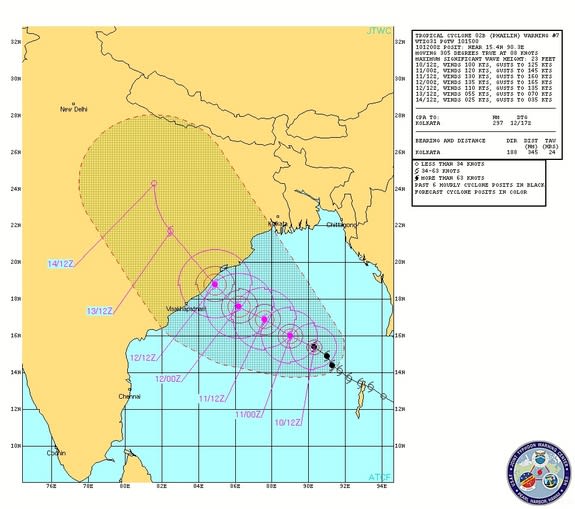
The projected path of Tropical Cyclone Phailin towards India as of 11:30 a.m. ET on Oct. 10, 2013.

Yahoo News: Experts say that the enormous and powerful storm, with maximum sustained winds of more than 160 mph (260 km/h), will bring a “catastrophic” storm surge, the water that a storm’s winds push in front of it and that inundate a coastline as the storm makes landfall, said Hal Needham, a climatologist at Louisiana State University. The storm surge is expected to reach heights of 20 feet (6 meters), Needham told LiveScience. The storm is likely to be “as bad or worse” than a cyclone that followed a similar trajectory in 1999, called Odisha cyclone for the area it hit.

Times of India: Touching wind speeds of 210-220 km an hour, Cyclone Phailin is set to hit the Odisha coast between Paradip and Kalingapatnam with full fury on Saturday evening, whipping up a storm surge up to 10 feet above the tide level posing a threat to low-lying villages.

Anticipating the cyclone’s fury, the state government began Odisha’s biggest ever evacuation of shifting more than three lakh (300,000) people out of harm’s way as chief minister Naveen Patnaik promised there would be zero casualties. The evacuation is expected to be complete by Saturday morning.

Met sources said the cyclone’s exact landfall is likely to be around the popular beach destination of Gopalpur and coastal Odisha as well as inland areas are expected to receive heavy rainfall likely to last till Sunday.

Although the Met is not categorizing Phailin as a “super cyclone” as it is yet to cross the 220 kmph barrier, there is little doubt that Odisha was bracing for a battering with the storm reported just 400 km south east of Gopalpur at 9pm on Friday. ….

….. Ganjam district is likely to be worst-hit. Other coastal districts falling within 75 km radius of the eye of the storm would also be impacted. “The exact landfall destination of the cyclone can be known once it comes nearly 200 km from the coast. Phailin’s movement however indicates that the situation would not be like the 1999 super cyclone during which the storm lay stationery over the coastal areas for nearly 24 hours and caused a sea surge of about 30 ft. This time 10 ft high wave is expected. More so, the expected landfall area being hilly, the impact of the cyclone would be less and weaken quickly,” IMD Bhubaneswar centre director Sarat Sahu said.

Not leaving anything to chance, the state government began evacuating people from coastal districts of Ganjam, Khurda, Puri, Jagatsinghpur and Kendrapada. Those who refused to leave their homes were forcibly taken to safer places. “There are 247 cyclone shelters and 10,000 concrete schools identified to house the villagers. We want to complete the evacuation by Saturday morning, particularly in Ganjam district which is likely to bear the brunt of the cyclone,” special relief commissioner P K Mohapatra said.

The central government has dispatched 10 helicopters, four Cheetah helicopters and two MI-17 and AN-32 planes to help the state government in rescue and relief operations. The government’s measures notwithstanding, thousands of people from the coastal region were rushing to railway stations and bus stops to escape the cyclone.

Europe increasingly adopting English for higher education

October 11, 2013

Competition for international students is leading to Universities in continental Europe increasingly offering higher education courses in English. There has been a ten-fold increase in the number of English courses offered since 2002.

Times Higher Education reports:

Thousands of international students may be shunning the UK in favour of continental Europe, where a growing number of courses are being offered in English, a study suggests.

A total of 6,407 taught master’s programmes in the language were offered on the Continent in June this year – a 38 per cent rise on the 4,644 courses available just 18 months earlier, according to a report by the New York-based not-for-profit organisation the Institute of International Education.

That total was 10 times higher than the overall number offered in 2002, says the report, titled English-Taught Master’s Programs in Europe: A 2013 Update.

The new briefing paper published by IIE’s Center for Academic Mobility Research suggests that the number of English-taught Master’s Programs in Europe has increased significantly since 2011. The paper, English-Taught Master’s Programs in Europe: A 2013 Update”, is an update of a report published by IIE in June 2011, and provides a data-driven look at the continued growth of master’s programs in Europe taught entirely or partially in English.

Growth of English courses in Europe

Growth of English courses in Europe

In recent years, European countries in which English is not the primary language of instruction have developed an increasing number of programs taught either fully or partly in English in order to serve domestic demand for higher education in English and to attract students from around the world. …..  The authors examine the growth of English-taught master’s programs in Europe, including the total number of programs offered by country and academic discipline, their duration, and data on prospective students.

According to the report, as of June 2013 the total number of English-taught programs in Europe was 6,609, a 42 percent increase since 2011. The top host countries for English-taught Master’s programs are: Netherlands, Germany, Sweden, France, and Spain.

Growth of English courses by country and year

Growth of English courses by country and year

Oktoberfest is hardly over and snow arrives in Bavaria

October 11, 2013

Oktoberfest only ended last week and 20cm of snow has already fallen in Southern Germany. A few weeks earlier than “normal”. But not to worry. Global Warming is here. Climate models cannot be fooled by little things like local weather and reality.

snow in Bavaria, 11th October 2013 photo DPA

Snow in Bavaria, 11th October 2013 photo DPA

The Local: Winter has arrived in southern Germany with the first heavy snowfall hitting Bavaria on Thursday night and Friday morning. 

The snow caused traffic chaos in the Garmisch-Partenkirchen area – a popular ski resort. Schools and kindergartens were closed, a police spokesman said on Friday, while authorities advised people to stay indoors.

Trees which have collapsed under the weight of the snow are also posing a danger for drivers and pedestrians. On one stretch of road out of Garmisch-Partenkirchen, 15 trees blocked traffic. 

But the early winter weather also brought happier scenes with the first snowmen being built. Snow has also fallen in the southern state of Baden-Württemberg.

NoTricksZone reports:

Meteorologists warned us that snow was on the way and would fall below the 500 m elevation in southern Germany and elsewhere. Moreover, they warned us that this winter could be one of the worst in 100 years for Central Europe. ….. 

Online Die Welt here writes:

‘It began to snow in the Bavarian capital of Munich yesterday evening at about 6 p.m. Many of my meteorologist colleagues had believed this to be improbable,’ said meteorologist Dominik Jung: ‘This year winter has struck early and unusually severely. South of Munich up to 20 centimeters of snow was able to pile up.’”

Die Welt adds that schools have been closed in some localities, 22,000 households in Austria have lost power, trains have come to a standstill, and traffic has been in chaos.

Frost is expected to spread across southern and middle Germany this weekend, reports www.wetter.net,Temperatures down to -4°C are expected under clear skies in some local areas.


Publish to Retract: A new paradigm for research?

October 11, 2013

Retraction Watch has a story about a retraction accompanied by a blog post by the senior author – who requested the retraction. The senior author receives great credit for her transparency and integrity – no doubt well deserved.

Pamela Ronald does the right thing again, retracting a Science paper

But this is not the first time that a senior author has found a “mistake” in a publication and has then initiated a retraction. I observe that a paper retracted at the request of the author(s) usually leads to the general and admiring approval of the Journal and of peers. It has none of the stigma attached to a paper retracted by the Journal for plagiarism or data falsification or some other wrongdoing.

But looking through my jaundiced and cynical eyes, I wonder if this is just the start of a new paradigm in a brave new transparent world of research publication and retraction. Publish or Perish then gives way to Publish to Retract (or more accurately Publish quickly – to Retract if bad) which is then the name of the game.

  1. Dispense with time consuming data replication and other quality checks
  2. Rush to publication (but keep the retraction request ready)
  3. If any mistakes are subsequently suspected, warn the learned journal  that something is untoward and which is being investigated (best for the senior author to raise the suspicion about a potential mistake)
  4. Maximise citations of the work in question
  5. Find the mistake and request a retraction
  6. Retract in a blaze of publicity and gain brownie points for transparency and integrity

Junior authors – especially post-docs – are of course to be thrown under the proverbial bus. They only represent an acceptable level of collateral damage. Lists of publications may continue to include the retracted paper as long as it is done in the proper form

Author1, author 2….,Senior author x, Journal, Vol., page, date (retracted on date at the request of Senior author x)

Publication can then be very much faster and the potential downsides of mistakes or faulty analysis getting through to publication can be converted into the perceived benefits of transparency and integrity if the failings are ever discovered.

A hundred or so years ago it was not unknown for applicants to the Indian Civil Service to include something like this in their CV’s.

BA, Aligarh University, 1909, (fail)

It was of value for the applicant then to show that he had been accepted to sit for the exam. Having successfully run the gauntlet of peer-review in getting a paper accepted for publication (even if later retracted) could similarly be of some value.

Yet another meaningless Peace Prize

October 11, 2013

The Norwegian Nobel Committee has decided that the Nobel Peace Prize for 2013 is to be awarded to the Organization for the Prohibition of Chemical Weapons (OPCW) for its extensive efforts to eliminate chemical weapons.

It came into force in 1997. Since then the OPCW has, through inspections, destruction and by other means, sought the implementation of the convention. 189 states have acceded to the convention to date.

This comes just weeks after the deaths in Syria from Sarin gas and whether it was 400 or 1400 who died, the OPCW was irrelevant. And what – in any theatre of conflict – have they actually achieved for Peace? They merely seek to implement policies made by others. 

A deplorable and meaningless award carrying on the less than impressive tradition of the Norwegian Nobel Committee!

  • A politically correct award
  • to an organisation recently in the headlines
  •  an “anonymous” organisation
  • which has made no significant contribution to Peace
  • Non-members are Israel and Myanmar, which are signatory states that have not ratified the Chemical Weapons Convention. 
  • Angola, Egypt, North Korea and South Sudan have neither signed nor acceded to the Chemical Weapons Convention. 
  • Syria was the most recent state to submit its instrument of accession to the treaty.
  • The US and Russia have not destroyed their stocks of chemical weapons by April 2012 as members were required to.