Archive for April, 2015

Death toll in Nepal still rising as aftershocks put rescue efforts on hold

April 26, 2015

A strong 6.7 magnitude aftershock hit Nepal this morning, 25 hours after the primary quake, as the death toll continues to climb. At least 30 shocks of magnitude greater than 4.0 have been felt. Kathmandu airport which was open has been closed till 4pm local time because of the aftershocks. Rescue efforts have been put on hold while the aftershocks continue. Air Traffic Control staff have been evacuated from the airport for now.

Indian Air Force Mi-17 helicopters reached Mount Everest and began ferrying injured back to Kathmandu with the first relief flights reaching this morning. So far the IAF has deployed 5 helicopters and another 6 are on their way. It is feared that 65 mountaineers on Mt. Everest may have been killed at the base camp and in the avalanche yesterday. The aftershocks have caused at least 3 further avalanches on Everest today.

Tremors from the aftershocks have been felt in Delhi, UP, Bihar, W.Bengal, and Assam. The final toll may exceed 2,000 as rescuers reach more remote regions.

USGS:

  1. Aftershock: 6.7 magnitude, 17km S of Kodari, Nepal2015-04-26,  07:09:08 UTC, 10.0 km deep
  2. Secondary quake: 6.6 magnitude, 49km E of Lamjung, Nepal2015-04-25, 06:45:21 UTC, 14.6 km deep
  3. Primary quake: 7.8 magnitude, 34km ESE of Lamjung, Nepal, 2015-04-25, 06:11:26 UTC, 15.0 km deep

Both India and China see Nepal as being within their natural “sphere of influence” and a hint of that competition is visible as the two countries now lead the international rescue efforts. In addition to a Chinese medical team that was already in Nepal, three further medical teams from neighboring Sichuan, Chongqing and Yunnan have gone to Tibet.

Xinhua:A 62-strong China International Search & Rescue Team left for Nepal early Sunday. With six sniffer dogs and relevant rescue and medical equipment, the team is expected to arrive in Kathmandu midday Sunday on a chartered plane, according to the China Earthquake Administration.

India sent two relief planes of air force to disaster-struck zones hours after the quake took place. Indian Prime Minister Narendra Modi called up his Nepalese counterpart Sushil Koirala, and assured him of all help. Two military aircraft, a C-130 Hercules and a C17 Globemaster, took off from the Hindon air base in Delhi to Kathmandu with relief workers, medicines and blankets, said Press Trust of India.

Disaster teams from the UK, US and Israel are already on their way as well and many other countries have offered assistance.

Adjusted (fiddled) data showing global warming to be investigated

April 26, 2015

“Global” temperature is necessarily a construct. It is “calculated” by taking raw temperature data as measured at particular locations, massaging this data according to algorithms devised by those calculating the “global temperature, applied to areas where there are no measurements by some other algorithms (oceans, poles, forests and deserts), adjusting past data and then coming up with a “global” temperature.

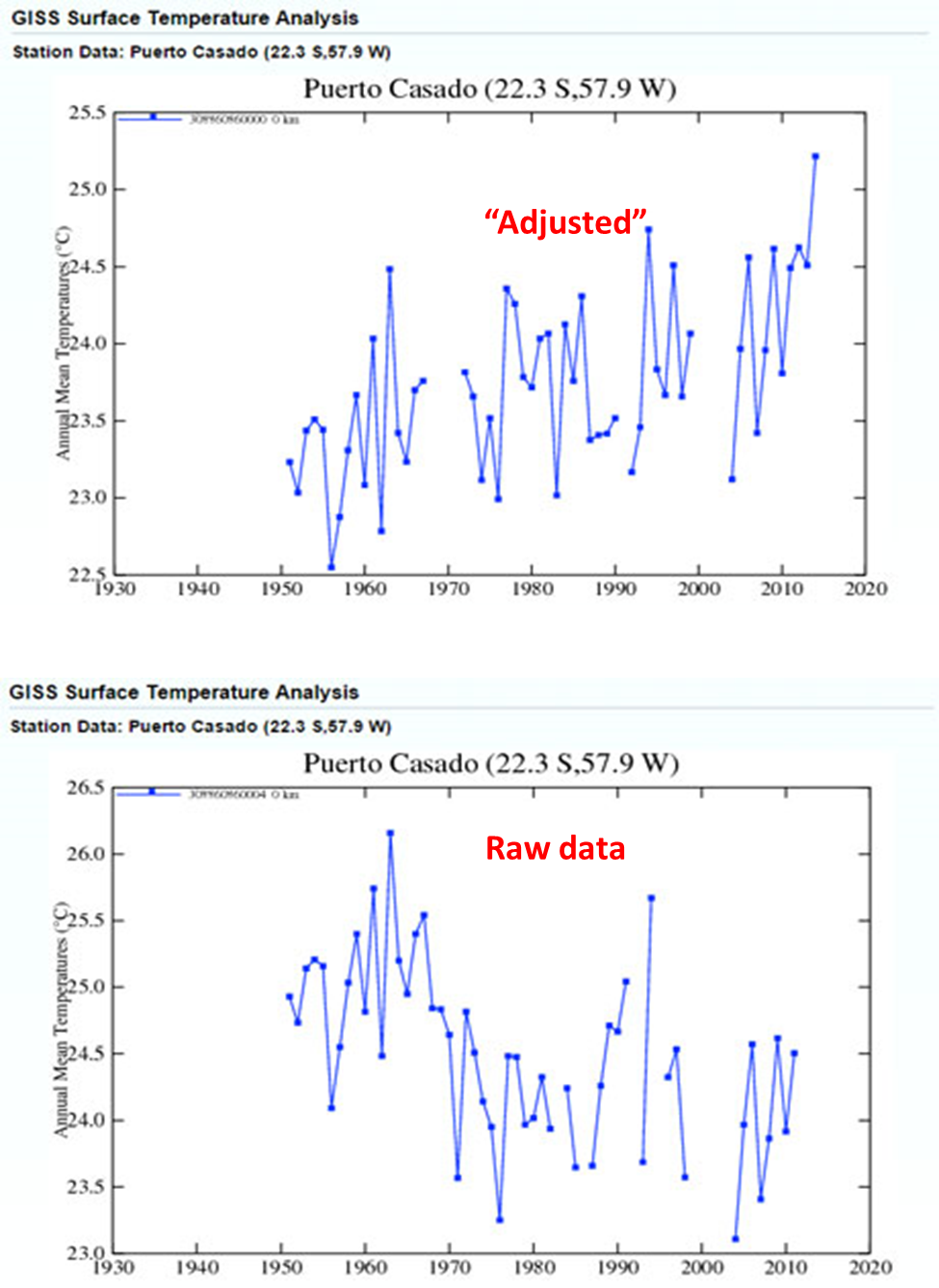
Raw data is never used without “adjustment”. Remarkably the adjustments invariably cool the past. Every year, data from the past is further adjusted! The trends and results presented represent more the adjustment algorithms used rather than the parameters themselves. As this example of “adjustment” of raw data from Puerto Casada to convert an actually measured cooling trend into an adjusted warming trend illustrates

Cooling the past: Puerto Casada From raw to adjusted data

Cooling the past: Puerto Casada From raw to adjusted data

Studies have already shown that, in the US, Australia, New Zealand, the Arctic and South America, in far too many cases, temperatures have been adjusted to show a stronger and clearer warming trend than is justified by the raw data.

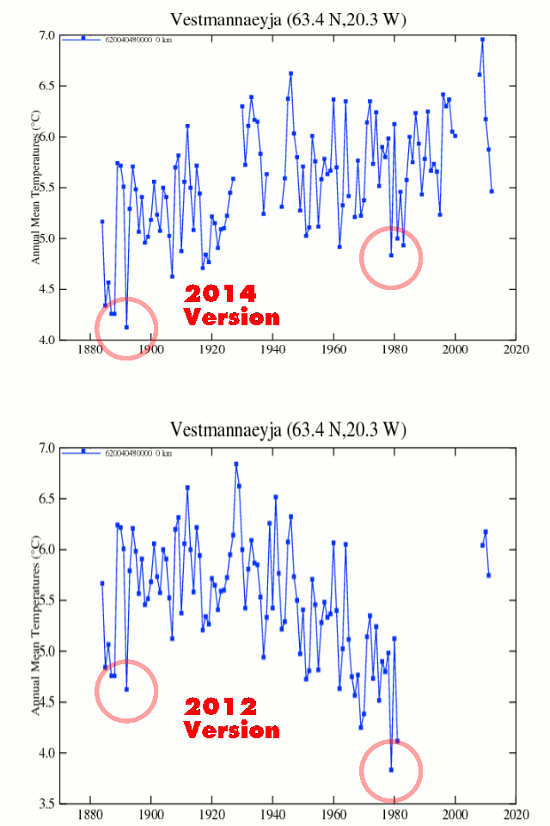
As RealScience shows with this more dramatic example from Vestmanneyja

vestmannaeyja

https://stevengoddard.files.wordpress.com/2015/01/vestmannaeyja.gif?w=640

An investigation now to be carried out by an international team is to establish a full and accurate picture of just how much of the published record has been adjusted in a way which gives the impression that temperatures have been rising faster and further than was indicated by the raw measured data.

Christopher Booker writes in the Daily Telegraph:

…. something very odd has been going on with those official surface temperature records, all of which ultimately rely on data compiled by NOAA’s GHCN. Careful analysts have come up with hundreds of examples of how the original data recorded by 3,000-odd weather stations has been “adjusted”, to exaggerate the degree to which the Earth has actually been warming. Figures from earlier decades have repeatedly been adjusted downwards and more recent data adjusted upwards, to show the Earth having warmed much more dramatically than the original data justified.

So strong is the evidence that all this calls for proper investigation ………  The Global Warming Policy Foundation (GWPF) has enlisted an international team of five distinguished scientists to carry out a full inquiry into just how far these manipulations of the data may have distorted our picture of what is really happening to global temperatures. 

The panel is chaired by Terence Kealey, until recently vice-chancellor of the University of Buckingham. His team, all respected experts in their field with many peer-reviewed papers to their name, includes Dr Peter Chylek, a physicist from the National Los Alamos Laboratory; Richard McNider, an emeritus professor who founded the Atmospheric Sciences Programme at the University of Alabama; Professor Roman Mureika from Canada, an expert in identifying errors in statistical methodology; Professor Roger Pielke Sr, a noted climatologist from the University of Colorado, and Professor William van Wijngaarden, a physicist whose many papers on climatology have included studies in the use of “homogenisation” in data records.

Their inquiry’s central aim will be to establish a comprehensive view of just how far the original data has been “adjusted” by the three main surface records: those published by the Goddard Institute for Space Studies (Giss), the US National Climate Data Center and Hadcrut, that compiled by the East Anglia Climatic Research Unit (Cru), in conjunction with the UK Met Office’s Hadley Centre for Climate Prediction. All of them are run by committed believers in man-made global warming.

Since “global” temperature – by definition – is a calculated construct it is inevitable that data must be “applied” in some way to make this calculation.

But no matter what the calculation method, rewriting history is suspect. When the data of the past keeps being adjusted, and adjusted again, and always systematically downwards, and when all the adjustments invariably cool the past more than the present, then the apparent trend in global temperature has little to do with any definition of global temperature and is merely a trend of the adjustments.

Nepal earthquake toll near 1500 with casualties also in India and Tibet

April 25, 2015

The Indian Tectonic Plate is being subducted under the Eurasian Plate. The collision is still going on with the Indian Plate moving North East at about 6 -7 cm per year while the Eurasian Plate is moving Northwards at about 2 cm per year. The subduction occurs in fits and starts and relies on earthquakes to release the slip pressure. The likelihood of a single Himalayan earthquake of magnitude 8 or a series of magnitude 7 quakes was discussed a few years ago

If a great earthquake has not occurred on a specific segment in the Himalaya for 200 years, that segment will slip 4m because the convergence rate between India and Tibet is roughly 2cm each year. If it has not occurred for 500 years the segment would slip 10m, enough for an event that would measure 8, or Magnitude Eight on the Richter Scale. The time interval between great earthquakes thus determines the amount of slip that will occur in the next one.

…. A large segment of the Himalaya between Kathmandu and Dehradun has a record of several earthquakes but only two large ones: an event in 1803 and another in 1833. If these were great earthquakes then there is now roughly 3m of slip ready to go. However, if they were magnitude 7 earthquakes, then there may be more than 20m of slips availabIe for a future great earthquake.

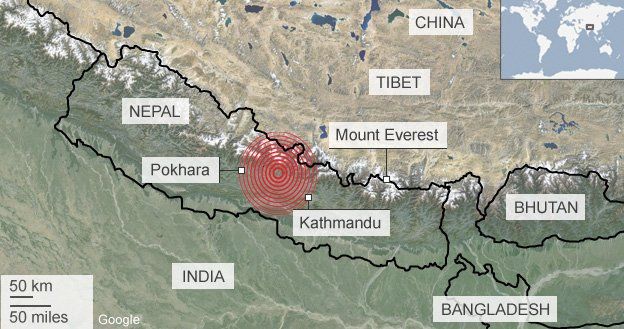
Nepal earthquake map

graphic: BBC

It would seem that this earthquake near Kathmandu was a large one (7.8 magnitude) and may have released around 5 – 8 m of slip but as has been pointed out there may be a total of around 20m of slip waiting to occur. The current quake has so far seen some 16 aftershocks of magnitude 4.5 or greater. Deaths in India are over 40 and the Indian government is mounting a large rescue effort in support of the Nepali government, “Fifty doctors have arrived from India to provide emergency services. India dispatched as many as four aircraft including a C-130 plane carrying three tonnes of relief supplies and a 40-member rescue team to Nepal.” Three more planes are to follow carrying a mobile hospital and medical supplies.

FirstPost: The quake measuring 7.9 on Richter scale, which was followed by 16 aftershocks of magnitude 4.5 or greater, striking heavy casualties in Kathmandu and injuring thousand others. Hundreds were feared missing across the country. “Army estimates death toll as much as 1457 so far,” Nepal’s Finance Minister Ram Sharan Mahat tweeted. …….

The earthquake around 11:56 am with epicentre at Lamjung, around 80 kilometers northwest of Kathmandu, had its impact in several cities in Bihar, West Bengal and Uttar Pradesh and tremors were felt across vast stretches of east and North East India. It was also felt in Southern and Western parts of India, China, Bhutan and as far as Pakistan and Bangladesh.

The US Geological Survey reports:

The April 25, 2015 M 7.8 Nepal earthquake occurred as the result of thrust faulting on or near the main frontal thrust between the subducting India plate and the overriding Eurasia plate to the north. At the location of this earthquake, approximately 80 km to the northwest of the Nepalese capital of Kathmandu, the India plate is converging with Eurasia at a rate of 45 mm/yr towards the north-northeast, driving the uplift of the Himalayan mountain range. The preliminary location, size and focal mechanism of the April 25 earthquake are consistent with its occurrence on the main subduction thrust interface between the India and Eurasia plates.

Although a major plate boundary with a history of large-to-great sized earthquakes, large earthquakes on the Himalayan thrust are rare in the documented historical era. Just four events of M6 or larger have occurred within 250 km of the April 25, 2015 earthquake over the past century. One, a M 6.9 earthquake in August 1988, 240 km to the southeast of the April 25 event, caused close to 1500 fatalities. The largest, an M 8.0 event known as the 1934 Nepal-Bihar earthquake, occurred in a similar location to the 1988 event. It severely damaged Kathmandu, and is thought to have caused around 10,600 fatalities.

Was this the big earthquake that was predicted in the Himalayas?

In an interview to The Hindu in May 2013, Vinod Kumar Gaur, seismologist with the Centre for Mathematical Modelling and Computer Simulation, had said: “Calculations show that there is sufficient accumulated energy [in the MFT], now to produce an 8 magnitude earthquake. I cannot say when. It may not happen tomorrow, but it could possibly happen sometime this century, or wait longer to produce a much larger one.”

In a study published in the journal Nature Geoscience in December 2012, a research team led by Nanyang Technological University (NTU) discovered that massive earthquakes in the range of 8 to 8.5 magnitudes on the Richter scale had left clear ground scars in the central Himalayas

High resolution imagery and dating techniques showed that in 1255 and 1934, two great earthquakes ruptured the surface of the Earth in the Himalayas. The 1934 earthquake broke the surface over a length of more than 150 km.

India (finally) puts Ford Foundation and Greenpeace on watch list

April 25, 2015

The Indian government has put the Ford Foundation and Greenpeace on their “watch” list. It was about time. The Ford Foundation serves as an instrument of the CIA and the US government in prosecuting foreign policy and Greenpeace has degenerated into a home for the far-left and the communists who have been left homeless since the collapse of Marxist (and Maoist) ideologies.

NGOs, “not for profit” organisations and charities often take advantage of the misperception of an implied objectivity or impartiality or of being apolitical. A very few such organisations may come close to being so but the vast majority exist to promote a particular view or support a particular group of people or to carry out particular kinds of projects. In every instance they are deeply – and inevitably – political. Nothing wrong with that of course but it is a common misperception to think that being non-profit they are somehow above politics. They are sometimes funded by governments, sometimes used by governments and sometimes used by opposition to governments. They are sometimes used as a cover for espionage (industrial and by states) and sometimes to “promote democracy” by undermining some other view. They sometimes provide much needed education and health care. And sometimes they use education or health services as a cover for carrying out political or religious indoctrination. Madrasas funded from Saudi Arabia as being educational are purely religious and political. The ostensible reason for the existence of the organisation is often used to cloak a hidden agenda. So-called charity workers and others in the field may not even be aware of the hidden agenda they are promoting.

In most cases these organisations enjoy tax breaks. When they receive government funding it is often to enable governments to covertly act in a manner they can not as a government. They are sometimes used for money laundering and sometimes are just a scam for extracting funds from donors. Even so-called charities may actually donate to others less than 10% of the money they raise. Sometimes they do good and often they don’t.

But the bottom line is that they are all – without exception – political. The political standpoint may be implicit or it may be explicit but it is always there. There is no “human rights” charity or NGO which does not have a political agenda. There is no “centre for democracy” which does not have some political agenda which – perforce – is in conflict with the prevailing “authority” or “government”. ISIS, after all, would qualify as a “not for profit” NGO. There is no “wildlife protection” NGO which does not promote a political agenda which may be as simple as preventing poor farmers from clearing forests to grow more crops, or the development of a highway.

I have no doubt that some NGOs – and usually those without the backing of Big Funds – bring attention to and take action in areas that are desperately necessary but which fall between the cracks of government or public policy. But when an NGO is funded by the Ford Foundation or the Bill & Melinda Gates Foundation, I am automatically suspicious about the hidden agenda in that organisation’s objectives.

Many organisations – Greenpeace, the WWF and the FoE as examples – which once had some worthy aims and even did some good work have -since 1991 – been hijacked by the far-left and communists who had no place else to go. In India it is not surprising that the Maoists and the Naxals and other “dissenting and seditious” groups have become the beneficiaries of such NGOs. During my time in the Indian corporate world (2000 -2007) I met with many NGOs seeking corporate funds – but I was not too impressed. Even less so when I found that at remote sites where we were executing projects, the protection money (sometimes even ransom money for our engineers) being demanded by local mafiosos were to be channeled through some ostensibly do-gooding NGO.

The Ford Foundation has for long been used and is still used by the CIA (and the US government) as a vehicle for promoting US policy.

Global Research: The CIA uses philanthropic foundations as the most effective conduit to channel large sums of money to Agency projects without alerting the recipients to their source. From the early 1950s to the present the CIA’s intrusion into the foundation field was and is huge. A U.S. Congressional investigation in 1976 revealed that nearly 50% of the 700 grants in the field of international activities by the principal foundations were funded by the CIA (Who Paid the Piper? The CIA and the Cultural Cold War, Frances Stonor Saunders, Granta Books, 1999, pp. 134-135). The CIA considers foundations such as Ford “The best and most plausible kind of funding cover” (Ibid, p. 135). The collaboration of respectable and prestigious foundations, according to one former CIA operative, allowed the Agency to fund “a seemingly limitless range of covert action programs affecting youth groups, labor unions, universities, publishing houses and other private institutions” (p. 135). The latter included “human rights” groups beginning in the 1950s to the present. One of the most important “private foundations” collaborating with the CIA over a significant span of time in major projects in the cultural Cold War is the Ford Foundation.

….. History and contemporary experience tells us a different story. At a time when government over-funding of cultural activities by Washington is suspect, the FF fulfills a very important role in projecting U.S. cultural policies as an apparently “private” non-political philanthropic organization. The ties between the top officials of the FF and the U.S. government are explicit and continuing. A review of recently funded projects reveals that the FF has never funded any major project that contravenes U.S. policy.

So I was not too surprised to read that the Ford Foundation and Greenpeace India have been put on the Indian government’s watch list.  My surprise is that the Ford Foundation with its CIA connections has been allowed to fund – albeit indirectly – dissension and sedition within India for so long.

Zee News (PTI): The United States on Friday expressed concern over India’s crackdown on Ford Foundation and Greenpeace, and said it is seeking “clarification” on the action.

“We are aware that the (Indian) Ministry of Home Affairs suspended the registration of Greenpeace India and has placed the Ford Foundation on a prior permission watch list,” State Department Deputy Acting Spokesperson, Marie Harf, told reporters at her daily news conference.

“We remain concerned about the difficulties caused to civil society organisations by the manner in which the Foreign Contributions Regulations Act has been applied,” she said in response to a question.

“We are concerned that this recent ruling limits the necessary and critical debate within Indian society and we are seeking a clarification on this issue with the appropriate Indian authorities,” Harf said.

In a crackdown on foreign funding to NGOs, the Union Home Ministry has put the Ford Foundation of the US on its “watch list” and ordered that all funds coming from the international organisation have to be routed only with its nod due to “national security concerns”.

The Home Ministry said it has decided to keep a watch on all activities funded by Ford Foundation and by exercising the powers conferred under Section 46 of Foreign Contribution Regulation Act 2010, directed Reserve Bank of India to ensure that funds coming from it be brought to the notice of the Home Ministry.

The Ministry said it wanted to ensure that funds coming from Ford Foundation is utilised for “bonafide welfare activities without compromising on concerns of national interest and security”.

The move came after Gujarat government asked the Home Ministry to take action against Ford Foundation as it alleged that the US-based organisation was “interfering in the internal affairs” of the country and also “abetting communal disharmony” through an NGO run by social activist Teesta Setalvad.

Early this month, the Home Ministry had frozen seven bank accounts of Greenpeace India and barred it from receiving foreign funds for allegedly violating FCRA and “prejudicially” affecting the country’s public and economic interests.

Non-profit does not mean non-partisan or apolitical.

For me NGOs is a dirty word.
The silence of an owl

April 24, 2015

Soundless flight


New moon gives higher blood pressure in children

April 24, 2015

Once upon a time, Astrology was the only science. It then became pseudo-science as the age of rational science took off. In the modern world it is considered a belief system and the stuff of charlatans. Tests of astrological predictions have shown that their forecasts are no better than would be expected by chance (here and here). It is generally considered absurd that distant celestial objects can have any impact on human life or behaviour.

But in recent times it has become clear that the near celestial objects (the Sun, the moon and even Jupiter) do interact with the earth sufficiently to give correlations between their relative motion and some aspects of human life and behaviour. Our internal body clocks not only reflect the 24 hour cycle of the earth’s rotation, but even have an “annual” component seemingly related to the earth’s period of rotation around the Sun and may even have a lunar monthly component. The season of birth has been linked to personality and that begins to sound like astrology. There are now also correlations showing other possible connections to the period of rotation of the moon around the earth:

That the moon may have effects on the results of cardiac surgery is apparently not just rubbish.

It seems that the lunar nodal cycle (18.6 years) is also reflected in happenings on earth:

The lunar nodal cycle does seem to correlate with happenings on Earth. The mechanisms leading to most lunar effects on tides and sedimentation and geologic accumulations and tidal flows and sea surface temperatures and climate can be put down to some interplay of gravitational forces.

It is not such a long stretch to think that the gravitational effects of the larger planets may have some quite unlooked for effects on life on Earth.

The Sun and the moon do affect us it seems  – even if not the stars. And now it is reported from Denmark that “the lunar cycle seems to have an effect on children’s health and activity levels, but scientists are at a loss when it comes to finding an explanation for this”. The effects are small but clearly significant.

Nordic Science reports:

Just a few decades ago, it was still widely believed that the full moon held special powers and could make people act strange or even go mad. This has long since been dismissed as unscientific superstition. However, it might be time to revise that notion.

A new study, published in the scientific journal Clinical Obesity, shows that the lunar cycle is associated with a negative effect on children’s levels of physical activity, blood pressure, and blood sugar levels.

“It’s a very mysterious finding.  We actually have no idea what the reason could be for these changes in children’s behaviour during the course of the lunar cycle. It’s the first time anyone has studied children’s health in relation to the lunar cycle,” says Mads Fiil Hjorth, postdoc at the Department of Nutrition, Exercise, and Sports at the University of Copenhagen.

“Perhaps the explanation is hidden far back in evolutionary history, when moonlight could influence chances of survival and reproduction among animals and small organisms,” he says.

Hjorth is the main author of the new research article that has been written in collaboration with a team of scientists from the research centre OPUS at University of Copenhagen.

During the study, the scientists collected data from 795 children aged 8-11, taking blood samples and measuring blood pressure, sleep, and activity levels. The information was gathered over the course of nine lunar cycles – i.e. months – and then analysed.

The results revealed that on the days around a full moon the children were on average 3.2 minutes less moderately to very physically active than at new moon; equivalent to roughly 8 percent lower activity levels.

Moreover, the children’s blood pressure was 0.8 mmHg higher – equivalent to an increase of roughly 1 percent – and had an average of 0.12 mmol/L higher blood sugar levels – equivalent to an increase of just over 2 percent. Finally, the children slept 4.1 minutes more on average at full moon. ……

…….. Sleep scientist Birgitte Kornum, PhD and senior researcher at the Molecular Sleep Laboratory at Glostrup Hospital’s Research Institute, is optimistic about the results.

“This is very exciting. At this stage there is good evidence to suggest that we all have a monthly cycle inside that influences our sleep and perhaps other areas, too,” she says.

“The question is whether it’s a coincidence that the cycle follows the amount of moonlight that shines down on us, or whether the human cycle is an innate part of our biology, like the female menstrual cycle.” ….. 

Hardly any Indian Hindu wedding today takes place without first checking with astrologers that the couples’ horoscopes are not in conflict and that the day and time of the wedding is auspicious. The astrologers may well be charlatans and their various calculations are clearly just so much mumbo-jumbo, but I would not be so quick to dismiss the social and psychological importance of getting their “stamp of approval”. Astrology is still just a system of belief and astrological approval then has the importance of any religious rite.

Spring and the elk are feisty

April 23, 2015

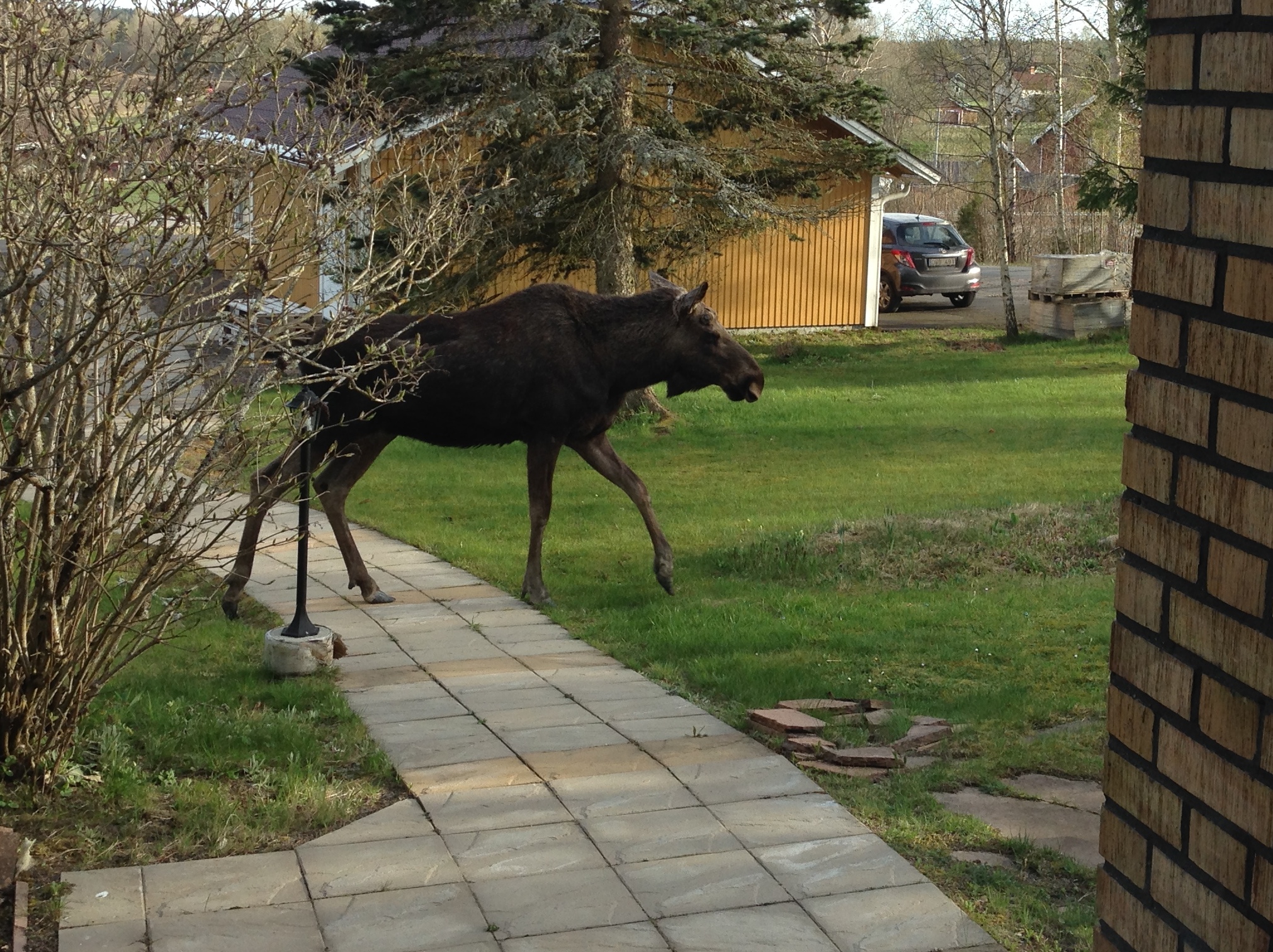
It has been a lovely spring day and the elk are getting bold. Though why this one seemed more interested in old branches from last year rather than the fresh spring buds is a mystery to me.

elk in the garden 20150423

elk in the garden 20150423

Wild Sweden. Is it an elk? Is it a moose? If you’re in Sweden, the answer is “BOTH”! The iconic, majestic forest dweller Alces alces is known as a moose in North America (actually the sub-species Alces alces americana) and an elk in Europe. The word elk, like the Swedish word älg (pronounced /elj/), is taken from the Latin alces. To make matters even more confusing, elk in North America is used for an entirely different animal – a kind of deer, Cervus elaphus, otherwise known as a Wapiti.

Mass extinctions correct for evolution’s greater than 99% failure rate

April 23, 2015

There are said to have been 5 great mass extinctions in the last 540 million years (the Phanerozoic) and a new paper claims  – without carrying much conviction – that it was really six (with two being very close together). The Alarmists claim that humans are causing a new great mass extinction (the 6th or the 7th) and that this threatens a catastrophic collapse of biodiversity. This contradicts the fact that there are more species alive today than ever before. Moreover, why this high level of biodiversity is necessary or a “good thing” remains a mystery.

The mass extinctions of the past are generally put down to various external events which provided a sharp shock to the environment in which highly stressed species existed. Nearby supernovas, asteroid impacts, sudden tectonic plate shifts, glaciation, and super-dooper-volcanic eruptions are among the “shocks” suggested.

But I would argue instead that mass extinctions are necessary and unavoidable. They are necessitated by the ineffectiveness of the process of evolution itself. They provide the self-correction necessary to cope with the mass of “rubbish” species created by the hit-and-miss process of evolution. The external shock is only incidental and acts as the trigger for the extinction of the highly-stressed “rubbish” species. None of the historical mass extinctions ever posed any threat to the continuation of life. Instead they have served to muck out the dung from the evolutionary stables.

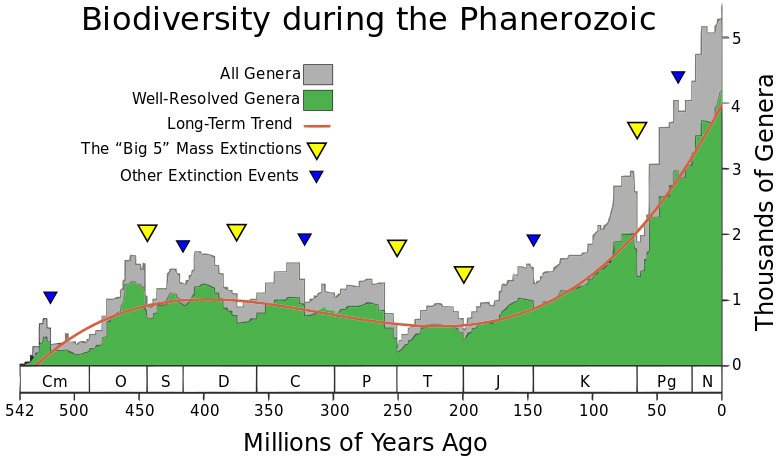
The fossil record shows that biodiversity in the world has been increasing dramatically for 200 million years and is likely to continue. The two mass extinctions in that period (at 201 million and 66 million years ago) slowed the trend only temporarily. Genera are the next taxonomic level up from species and are easier to detect in fossils. The Phanerozoic is the 540-million-year period in which animal life has proliferated. Chart created by and courtesy of University of Chicago paleontologists J. John Sepkoski, Jr. and David M. Raup.

The fossil record shows that biodiversity in the world has been increasing dramatically for 200 million years and is likely to continue. The two mass extinctions in that period (at 201 million and 66 million years ago) slowed the trend only temporarily. Genera are the next taxonomic level up from species and are easier to detect in fossils. The Phanerozoic is the 540-million-year period in which animal life has proliferated. Chart created by and courtesy of University of Chicago paleontologists J. John Sepkoski, Jr. and David M. Raup.

The clue lies here:

Wikipedia: Although there are 10–14 million species of life currently on the Earth, more than 99 percent of all species that ever lived on the planet are estimated to be extinct.

Evolution fails in over 99% of its attempts to create species that can survive. The 1%  of species that do and have survived may seem to be perfectly tailored for the prevailing conditions but that is putting the cart before the horse. Evolution has no direction and does not seek excellence. It only throws up a plethora of species where just 1% of those species happen to suit the prevailing conditions. One round peg out of a 100 different shapes may happen to fit a round hole but the round peg itself was not designed to fit – it happened to be the only one of many which did. For every species which is just good enough to survive, evolution gives another 99 which are not. As a process it is a remarkably ineffective one. Humans are not the result of “intelligent design”. They are just the 1% of all the species created by evolution which happened to fit the round hole of the prevailing environment.

Stewart Brand writes in Aeon that “the idea that we are edging up to a mass extinction is not just wrong – it’s a recipe for panic and paralysis”

Aeon: Many now assume that we are in the midst of a human-caused ‘Sixth Mass Extinction’ to rival the one that killed off the dinosaurs 66 million years ago. But we’re not. The five historic mass extinctions eliminated 70 per cent or more of all species in a relatively short time. That is not going on now. ‘If all currently threatened species were to go extinct in a few centuries and that rate continued,’ began a recent Nature magazine introduction to a survey of wildlife losses, ‘the sixth mass extinction could come in a couple of centuries or a few millennia.’

The range of dates in that statement reflects profound uncertainty about the current rate of extinction. Estimates vary a hundred-fold – from 0.01 per cent to 1 per cent of species being lost per decade. The phrase ‘all currently threatened species’ comes from the indispensable IUCN (International Union for Conservation of Nature), which maintains the Red List of endangered species. Its most recent report shows that of the 1.5 million identified species, and 76,199 studied by IUCN scientists, some 23,214 are deemed threatened with extinction. So, if all of those went extinct in the next few centuries, and the rate of extinction that killed them kept right on for hundreds or thousands of years more, then we might be at the beginning of a human-caused Sixth Mass Extinction.

Worrying about whether the 6th mass extinction has started or not is moot. A 6th mass extinction is needed.

A failure rate of 99% creates a terrible lot of dross. Over time, all the “rubbish” species produced by evolution accumulate and clutter the available environment. They restrict the space available for more suitable (worthy) species. The analogy with my desk fits perfectly. Only one of every hundred pieces of paper needs to be kept. Every once in a while – usually triggered by the shock of having to make my tax declaration – I clear out the rubbish. Mass extinctions are then due to the accumulation of too many “rubbish” species which are highly stressed – because they are not quite good enough to survive – and then which end up being susceptible to any external shock which tips them over into the dustbin of extinction – where they belong. It is mass extinctions which provides room for the “good enough” species to grow and even thrive. Mass extinctions provide the clean-up mechanism for a very sloppy and inefficient evolution process. A rather drastic clean-up method perhaps but no more drastic than diverting the Alpheus and Peneus rivers to muck out the Augean stables!

If it is in fact true that we have more species alive today than ever before then the number of “rubbish” species around is also probably at an all-time high. A new, 6th, mass extinction is probably necessary to clean up the mess. It is clearly overdue.

And that is really the problem with the alarmist conservationists who are wasting resources in trying to protect some of the “rubbish” species which are merely examples of the failures of evolution and which deserve to be consigned to the dustbin of extinction. Species which do not adapt to the dominating presence of humans are among the “rubbish”. It may be regrettable that tigers and elephants are on the “rubbish” list but the reality is that they are failed species unable to cope with their environments and which are now restricting the dominant species. It only emphasises that true conservation would not try to freeze these species into failed patterns but to genetically adapt them to be neo-tigers or neo-elephants which would no longer just be “rubbish”.

Earth Alarmism Day today celebrates human cowardice

April 22, 2015

This started in 1970 and not one of the many catastrophes predicted has come to pass. 22nd April 1970 is when environmentalism buried its frightened head and started humans down the path of subordinating their actions to the fear of imagined, future catastrophes.

“It is already too late to avoid mass starvation.”  Denis Hayes, chief organizer for Earth Day, 1970

“If present trends continue, the world will be … eleven degrees colder by the year 2000. This is about twice what it would take to put us in an ice age.” Kenneth E.F. Watt, in “Earth Day,” 1970.

“By the year 2000 the United Kingdom will be simply a small group of impoverished islands, inhabited by some 70 million hungry people … If I were a gambler, I would take even money that England will not exist in the year 2000.” Paul Ehrlich, Speech at British Institute For Biology, September 1971.

“In ten years all important animal life in the sea will be extinct. Large areas of coastline will have to be evacuated because of the stench of dead fish.” Ehrlich, speech during Earth Day, 1970

“Demographers agree almost unanimously on the following grim timetable: by 1975 widespread famines will begin in India; these will spread by 1990 to include all of India, Pakistan, China and the Near East, Africa. By the year 2000, or conceivably sooner, South and Central America will exist under famine conditions….By the year 2000, thirty years from now, the entire world, with the exception of Western Europe, North America, and Australia, will be in famine.”  Peter Gunter, professor, North Texas State University, Earth Day 1970

Every year since has been the “last chance” to do something about some imagined, looming disaster. Each pending disaster has been based on some belief and the forecast is always for some future time such that no indicating parameters can be measured. Yet doomsayers and their predictions (which all fail) remain the darlings of the media looking for a sensational headline. For “scientists”, doomsaying which cannot be checked in their lifetimes is a certain way to get funding. Acid rain never did threaten the Black Forest. The ozone hole was not caused by man and healed itself. The ice age predicted in the 1970s did not happen. World-wide starvation did not occur. There are more species alive today than ever before (though it is not clear as to why that is a good thing).

Global warming has been absent for 2 decades while carbon dioxide emissions have almost doubled. Most of the global warming that has occurred falls within the bounds of natural variability (as a new paper recently showed). Most predictions about global warming have failed and none has ever been proven. The fantasised link between carbon dioxide in the atmosphere and significant global warming is well and truly broken. Even the link between man-made carbon dioxide emissions and carbon dioxide concentration in the atmosphere is tenuous at best. Sea levels are not increasing any faster than since the end of the last ice age. Global ice coverage is currently at the highest for many years and all the variations in ice extent in modern times are within the bounds of natural variability. The acidity of the oceans is not showing any change beyond that of natural variability. Coral reefs are not dying out.

Population – sans immigration – is already in decline in China and most Western countries. By 2050 population will be in decline in India and by 2100 in the whole world.  In the 4 decades since 1970, world population has doubled from 3.5 billion to 7 billion and fewer people are dying of starvation. More people are being fed today than ever before. Fewer people are dying of disease (but more are dying in wars). In spite of industrial activity and its growth, longevity is increasing all over the world. Gene modified crops are feeding the world. Peak oil did not happen and neither did peak gas. With shale discoveries and the potential of methane hydrates, fossil fuels will be available to humankind for the best part of the next 1,000 years.

Here are some more of the alarmist predictions of that first Earth Day of Cowards in 1970. Paul Ehrlich sticks out as being one of the chief proponents of cowardice:

“At the present rate of nitrogen buildup, it’s only a matter of time before light will be filtered out of the atmosphere and none of our land will be usable.” Kenneth Watt, Ecologist

“Civilization will end within 15 or 30 years unless immediate action is taken against problems facing mankind.”  George Wald, Harvard Biologist

“Population will inevitably and completely outstrip whatever small increases in food supplies we make. The death rate will increase until at least 100-200 million people per year will be starving to death during the next ten years.” Paul Ehrlich, Stanford University biologist

“Scientists have solid experimental and theoretical evidence to support…the following predictions: In a decade, urban dwellers will have to wear gas masks to survive air pollution…by 1985 air pollution will have reduced the amount of sunlight reaching earth by one half….” Life Magazine, January 1970

“By the year 2000, if present trends continue, we will be using up crude oil at such a rate…that there won’t be any more crude oil. You’ll drive up to the pump and say, `Fill ‘er up, buddy,’ and he’ll say, `I am very sorry, there isn’t any.’” Kenneth Watt, Ecologist

“Dr. S. Dillon Ripley, secretary of the Smithsonian Institute, believes that in 25 years, somewhere between 75 and 80 percent of all the species of living animals will be extinct.” Sen. Gaylord Nelson

And all the headlines today read just the same. A celebration of cowardice. My faith is not in catastrophe but in human ingenuity to cope – and thrive – in whatever conditions may prevail. We will manage whether sea level is 100 m lower than today in another ice age or if it rises another 2 m. We will even survive a VEI 8 volcano eruption whenever it comes – and come it will. Primitive man thrived through a number of glacial periods and many greenings of the Sahara. I would prefer an Earth Day which celebrated the ingenuity of man – but that is not the stuff of headlines.

Without scepticism there is no science – only religious belief.

Swedish health care provides inferior treatment of prostate cancer to elderly men

April 21, 2015

The Swedish health care system is often cited as an example. And in general that is probably justified. But there is little doubt that care is denied when the physician – for whatever reason – believes it is not worthwhile. The patient’s life expectancy plays a key part in this judgement. And that automatically leads to the elderly being denied treatment in some cases. After all, the common good requires that resources not be wasted! Perhaps it would be best to simply withhold all care for people over 70 – or should we say 75?

The Swedish health system does provide inferior treatment to men with prostate cancer if they are over 70 years old. A report from Lund University exposes yet another example of the age discrimination that is endemic in Sweden. And as the country ages, we can expect such denial of care to increase.

Until the over 70s start to exercise their political power.

Aftonbladet:

Many older men are not getting the cancer treatment they need. New Swedish research shows that men between 70 and 80 years are often under-treated despite having a high risk of prostate cancer. According to the national guidelines men should  have surgery or radiation treatment, but many are denied access to these treatments. The doctors believe that patients are too old, says Associate Professor Ola Bratt at Lund University in the research report that was presented at an international urology meeting in Madrid.

Prof. Ola Bratt has examined all the 19 000 men especially at risk and treated for prostate cancer  in Sweden between 2001 and 2012. He notes that doctors often misjudged the patient’s expected lifetime. The doctors have simply ignored vital treatment because they mistakenly believed that the patients would die soon.

“Such an old-fashioned and rather jaundiced view of today’s 70 year olds can have devastating consequences. It can not be the intention that Swedish men should die prematurely”.

Ola Bratt notes that there are large differences between different parts of Sweden. Between 2001 and 2012, the proportion of men over 70 years who received curative treatment was 15-38 percent, but the proportion varies greatly between counties – from 13 percent in Örebro County to 85 percent in Kronoberg County, according to the National Prostate Cancer Register. Many men are thus losers in the great cancer lottery. Those who want to survive, should stay in the right county and go to the right doctor.

There is a shortage of urologists and many of them are available in small clinics that may not keep up with the latest developments. Choice of care has also contributed to more private clinics taking responsibility for severe disease and the patient is then challenged to find the right treatment in a jungle of offers.