
I only saw this yesterday but this You Tube video was posted by Tom Berry in 2010, so it’s been around for a while.
Dolly Parton must be one of the only singers around whose voice could undergo such extreme manipulation and sound not sadly distorted but, rather, beautifully remade. Her baby-high soprano has always seemed slightly unreal anyway, a record played a little too fast. As it happens, one of her longtime stage stunts is mimicking a 45 r.p.m. record played at 78 r.p.m.: she goes into full Chipmunk mode, not missing a syllable or a wave of vibrato—an offhand joke at the expense of her own voice, as well as a flourishing exhibition of her impressive control of her instrument.
Parton, slowed to a speed at which most people would sound like gloopy, slothlike creatures, comes down to a reasonable alto range, sounding like a soulful male ballad singer.
Dolly Parton was born in 1946 so here’s an image of her at 33 in 1979.

Dolly Parton by Ed Caraeff-1979 (The Red List)
The UN can only mirror its member countries. While the UN (and for example the EU) are supposed to try and “level up” they very often “level down”. When that happens they disseminate “worst practices” rather than spread “best practices”. The UN’s executive and officers and bureaucrats are not either immune to the corruptions of being in privileged and protected positions. They also disseminate lies when advocating for their pet projects or causes. The problem is that when lies are sanctioned by the UN they take on a sanctity which is downright harmful.
Professor Hans Rosling and Helena Nordenstedt take the UN to task for spreading lies in a new comment to The Lancet. But they also point out the lie was first created in The Lancet itself and suggest that The Lancet should not publish advocacy articles without peer review.
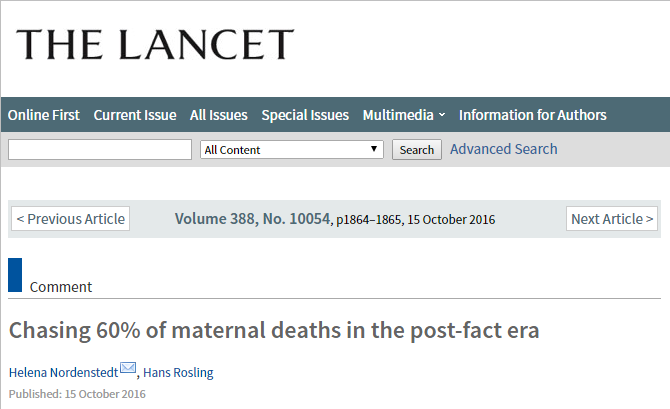
They write
In September, 2016, at the UN General Assembly, the Independent Accountability Panel (IAP) of the UN’s Global Strategy for Women’s, Children’s and Adolescents’ Health presented their first report. The IAP report states that 60% of maternal deaths today take place in humanitarian settings, specified as “conflict, displacement and natural disaster”. The “60%” has been trending in development aid advocacy ever since late 2015 when UNFPA stated that 60% of maternal deaths happen in “humanitarian situations like refugee camps”. The 60% has even made its way into policy documents and discourse. The only health data mentioned in the proposed policy framework for Sweden’s future international development cooperation are: “60% of maternal deaths take place in humanitarian emergencies”. We chased the origin of this seemingly incorrect percentage. We found it to be a Comment published in The Lancet, referring to the published underlying data sources and to a grey publication describing the crude calculation that yielded the 60%.
……..
We conclude that the “60%” is a fourfold inaccuracy. It is surprising that, in just 1 year, the false percentage made its way to a highly qualified panel at the UN. Global health seems to have entered into a post-fact era, where the labelling of numerators is incorrectly tweaked for advocacy purposes. The reproductive health needs in humanitarian settings should be reported without hiding that most maternal deaths still occur in extreme poverty. As recently noted in The Lancet, Nigeria’s Minister of Health, Isaac Adewole, spoke the truth when stating that the real causes of maternal and child deaths are poverty, inequality, lack of financing, and poor governance. The use of inaccurate numbers in global health advocacy can misguide where investments are most needed to achieve the Sustainable Development Goals. We, therefore, suggest The Lancet should only publish advocacy material after due referee procedures.
“Statistical significance” is “a mathematical machine for turning baloney into breakthroughs, and flukes into funding” – Robert Matthews.
Tests for statistical significance generating the p value are supposed to give the probability of the null hypothesis (that the observations are not a real effect and fall within the bounds of randomness). So a low p value only indicates that the null hypothesis has a low probability and therefore it is considered “statistically significant” that the observations do, in fact, describe a real effect. Quite arbitrarily it has become the custom to use 0.05 (5%) as the threshold p-value to distinguish between “statistically significant” or not. Why 5% has become the “holy number” which separates acceptance for publication and rejection, or success from failure is a little irrational. Actually what “statistically significant” means is that “the observations may or may not be a real effect but there is a low probability that they are entirely due to chance”.
Even when some observations are considered just “statistically significant” there is a 1:20 chance that they are not. Moreover it is conveniently forgotten that statistical significance is called for only when we don’t know. In a coin toss there is certainty (100% probability) that the outcome will be a heads or a tail or a “lands on its edge”. Thereafter to assign a probability to one of the only 3 outcomes possible can be helpful – but it is a probability constrained within the 100% certainty of the 3 outcomes. If a million people take part in a lottery, then the 1: 1,000,000 probability of a particular individual winning has significance because there is 100% certainty that one of them will win. But when conducting clinical tests for a new drug, it is often so that there is no certainty anywhere to provide a framework and a boundary within which to apply a probability.
A new article in Aeon by David Colquhoun, Professor of pharmacology at University College London and a Fellow of the Royal Society, addresses The Problem with p-values.
In 2005, the epidemiologist John Ioannidis at Stanford caused a storm when he wrote the paper ‘Why Most Published Research Findings Are False’,focusing on results in certain areas of biomedicine. He’s been vindicated by subsequent investigations. For example, a recent article found that repeating 100 different results in experimental psychology confirmed the original conclusions in only 38 per cent of cases. It’s probably at least as bad for brain-imaging studies and cognitive neuroscience. How can this happen?
The problem of how to distinguish a genuine observation from random chance is a very old one. It’s been debated for centuries by philosophers and, more fruitfully, by statisticians. It turns on the distinction between induction and deduction. Science is an exercise in inductive reasoning: we are making observations and trying to infer general rules from them. Induction can never be certain. In contrast, deductive reasoning is easier: you deduce what you would expect to observe if some general rule were true and then compare it with what you actually see. The problem is that, for a scientist, deductive arguments don’t directly answer the question that you want to ask.
What matters to a scientific observer is how often you’ll be wrong if you claim that an effect is real, rather than being merely random. That’s a question of induction, so it’s hard. In the early 20th century, it became the custom to avoid induction, by changing the question into one that used only deductive reasoning. In the 1920s, the statistician Ronald Fisher did this by advocating tests of statistical significance. These are wholly deductive and so sidestep the philosophical problems of induction.
Tests of statistical significance proceed by calculating the probability of making our observations (or the more extreme ones) if there were no real effect. This isn’t an assertion that there is no real effect, but rather a calculation of what wouldbe expected if there were no real effect. The postulate that there is no real effect is called the null hypothesis, and the probability is called the p-value. Clearly the smaller the p-value, the less plausible the null hypothesis, so the more likely it is that there is, in fact, a real effect. All you have to do is to decide how small the p-value must be before you declare that you’ve made a discovery. But that turns out to be very difficult.
The problem is that the p-value gives the right answer to the wrong question. What we really want to know is not the probability of the observations given a hypothesis about the existence of a real effect, but rather the probability that there is a real effect – that the hypothesis is true – given the observations. And that is a problem of induction.
Confusion between these two quite different probabilities lies at the heart of why p-values are so often misinterpreted. It’s called the error of the transposed conditional. Even quite respectable sources will tell you that the p-value is the probability that your observations occurred by chance. And that is plain wrong. …….
……. The problem of induction was solved, in principle, by the Reverend Thomas Bayes in the middle of the 18th century. He showed how to convert the probability of the observations given a hypothesis (the deductive problem) to what we actually want, the probability that the hypothesis is true given some observations (the inductive problem). But how to use his famous theorem in practice has been the subject of heated debate ever since. …….
……. For a start, it’s high time that we abandoned the well-worn term ‘statistically significant’. The cut-off of P < 0.05 that’s almost universal in biomedical sciences is entirely arbitrary – and, as we’ve seen, it’s quite inadequate as evidence for a real effect. Although it’s common to blame Fisher for the magic value of 0.05, in fact Fisher said, in 1926, that P= 0.05 was a ‘low standard of significance’ and that a scientific fact should be regarded as experimentally established only if repeating the experiment ‘rarely fails to give this level of significance’.
The ‘rarely fails’ bit, emphasised by Fisher 90 years ago, has been forgotten. A single experiment that gives P = 0.045 will get a ‘discovery’ published in the most glamorous journals. So it’s not fair to blame Fisher, but nonetheless there’s an uncomfortable amount of truth in what the physicist Robert Matthews at Aston University in Birmingham had to say in 1998: ‘The plain fact is that 70 years ago Ronald Fisher gave scientists a mathematical machine for turning baloney into breakthroughs, and flukes into funding. It is time to pull the plug.’ ………
Related: Demystifying the p-value
All through the primaries the worst GOP nightmare was of Donald Trump standing as an independent 3rd party candidate. That fear was one of the factors which led to his winning the nomination against massive “establishment” opposition. They feared an official Republican candidate being humiliated by a rampant, populist, independent Trump. And they were afraid that a presidential annihilation would have a knock-on effect on Republican chances in the House.
But they are feeling queasy about being identified with Trump’s crude populism. Now, as the Republican establishment distance themselves from Trump they have effectively brought their own nightmare scenario into play. Paul Ryan is going down a lose-lose road. Trump no longer has to be restrained from castigating the Bush legacy and the ineffective republican leaders in the House and in the Senate.
Really Trump should no longer have a chance in November. But something strange is abroad and he refuses to be buried. But whatever the result may be in November, the GOP will have to face its nightmare scenario.
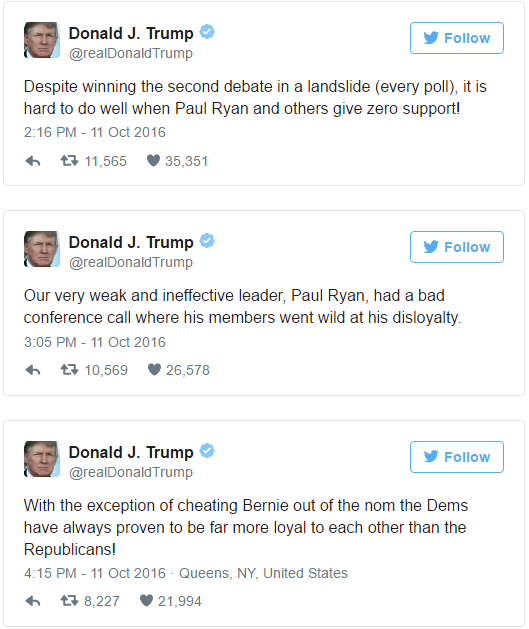
Though Trump should – by all accounts – lose to Hillary Clinton, he probably has a better chance being labelled as an independent. As an “independent” he might be able to mobilise parts of the electorate that “other beers cannot reach”
It is no longer about Clinton versus Trump. It is stop-Clinton versus stop-Trump.
It is more than a little sad that an election for the most influential position in the world is reduced to avoiding the one of two candidates you hate more.
It still amazes me that a country of some 325 million people can throw up no candidates not only no better than, but also as bad as, Donald Trump and Hillary Clinton. On the one hand we have a loud, lewd, crude, successful businessman, and on the other a sick, selfish, greedy, establishment politician.
After the latest negatives about both candidates it seems to me that this election will be decided by the mobilisation of voters against rather than voters for.

You get what you vote for and a fundamental weakness in any democracy is that the ability to capture votes (or more accurately, in this case, to repel voters) says little about any other abilities.
With either of these two candidates the US position in global affairs has a bleak 4 years ahead. Trump will withdraw while Clinton will appease. In both cases Russia wins. In domestic matters, Trump will alienate minorities and Clinton will appease. In both cases racial tensions will increase. In economic matters, Trump will use “trickle-down” and Clinton will increase public debt. In both cases, wealth production will decrease.
This is not a choice I would like to be stuck with.
Correction! “major hurricanes” rather than “hurricanes” as pointed out by a reader.
The devastation that Hurricane Matthew has wrought in Haiti was real and the death toll is approaching 500. However it has moved away and Florida has escaped landfall. It has now been over 4,000 days since Hurricane Wilma made landfall in Florida as a major hurricane with category 3 winds (wind speeds of categories 1 and 2 are considered storms and not hurricanes still hurricanes but not “major hurricanes”) in October 2005. “Hurricane Sandy” in 2012 had category 1 winds at landfall.
Florida has surely suffered damage from Matthew passing by – but it was not by the landfall of a major hurricane. Matthew’s winds are now at category 3 and are expected to reduce to strength 2 later today. The US major hurricane drought continues. Could that possibly be due to “global warming”? I would put any “hurricane season” down to weather and not to climate. That there is a hurricane season at all is surely a climate characteristic.
I am reproducing Dr. Roy Spencer’s post on his blog which says it all:
4,001 Days: The Major Hurricane Drought Continues
October 7th, 2016 by Roy W. Spencer, Ph. D.
Also, The Hurricane Center Doesn’t Overestimate…But It Does Over-warn
Today marks 4,001 days since the last major hurricane (Wilma in 2005) made landfall in the United States. A major hurricane (Category 3 to 5) has maximum sustained winds of at least 111 mph, and “landfall” means the center of the hurricane eye crosses the coastline.
This morning it looks like Matthew will probably not make landfall along the northeast coast of Florida. Even if it does, its intensity is forecast to fall below Cat 3 strength this evening. The National Hurricane Center reported at 7 a.m. EDT that Cape Canaveral in the western eyewall of Matthew experienced a wind gust of 107 mph.
(And pleeeze stop pestering me about The Storm Formerly Known as Hurricane Sandy, it was Category 1 at landfall. Ike was Cat 2.)
While coastal residents grow weary of “false alarms” when it comes to hurricane warnings, the National Weather Service has little choice when it comes to warning of severe weather events like tornadoes and hurricanes. Because of forecast uncertainty, the other option (under-warning) would inevitably lead to a catastrophic event that was not warned.
This would be unacceptable to the public. Most of us who live in “tornado alley” have experienced dozens if not hundreds of tornado warnings without ever seeing an actual tornado. I would wager that hurricane conditions are, on average, experienced a small fraction of the time that hurricane warnings are issued for any given location.
The “maximum sustained winds” problem
Another issue that is not new is the concern that the “maximum sustained winds” reported for hurricanes are overestimated. I doubt this is the case. But there is a very real problem that the area of maximum winds usually covers an extremely small portion of the hurricane. As a result, seldom does an actual anemometer (wind measuring device) on a tower measure anything close to what is reported as the maximum sustained winds. This is because there aren’t many anemometers with good exposure and the chances of the small patch of highest winds hitting an instrumented tower are pretty small.
It also raises the legitimate question of whether maximum sustained winds should be focused on so much when hurricane intensity is reported.
Media hype also exaggerates the problem. Even if the maximum sustained wind estimate was totally accurate, the area affected by it is typically quite small, yet most of the warned population is under the impression they, personally, are going to experience such extreme conditions.
How are maximum sustained winds estimated?
Research airplanes fly into western Atlantic hurricanes and measure winds at flight level in the regions most likely to have the highest winds, and then surface winds are estimated from average statistical relationships. Also, dropsonde probes are dropped into high wind regions and GPS tracking allows near-surface winds to be measured pretty accurately. Finally, a Stepped Frequency Microwave Radiometer (SFMR) on board the aircraft measures the roughness of the sea surface to estimate wind speed.
As the hurricane approaches the U.S. coastline, doppler radar also provides some ability to measure wind speeds from the speed of movement of precipitation blowing toward or away from the radar.
I don’t think we will solve the over-warning problem of severe weather events any time soon.
And it looks like the major hurricane drought for the U.S. is probably going to continue.
UPDATE:
Well the Norwegian committee has done it again.
The President of Colombia has got the award for a deal with FARC which has been rejected by a Colombian referendum. No doubt the President has good intentions but it is a deal which the Colombian opposition thinks is too soft and which rewards terrorism.
The Peace prize – and which would have been much too Alfred Nobel’s undoubted disgust – has little moral credibility as a consequence of a supine committee.
This years Peace Prize will be announced today and I don’t expect anything very sensible.
Extract from Nobel’s will: to the person who shall have done the most or the best work for fraternity between nations, for the abolition or reduction of standing armies and for the holding and promotion of peace congresses.
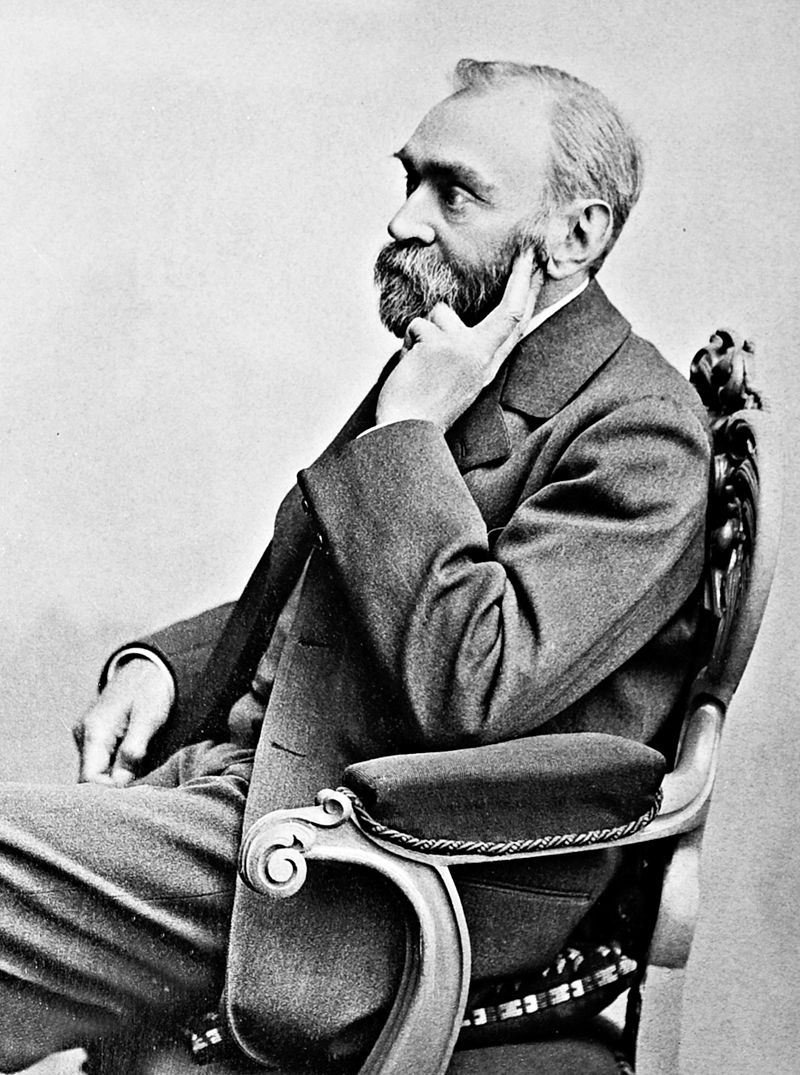
portrait of Alfred Nobel by Gösta Florman
The Norwegian committee which chooses the award winners has allowed itself to be dominated by “political correctness” and hopes and anticipations rather than on actual achievements. Neither the letter nor the spirit of Nobel’s will has been followed. Though the choice of Nobel peace laureates has always been controversial, in recent times these choices have become downright stupid. Gandhi was nominated four times but never chosen. My ire is not against the laureates but the stupidity of the committee and the manner in which Nobel’s intentions have been denigrated and discarded.
Some of the most blatant recent examples of idiocy have been:
Barack Obama receiving the award when he was just 9 months into his presidency was a travesty. If the award was based on wishful thinking of what he might achieve, then the following seven years have shown how wrong the committee could be. (History may well record Obama as a “war president” and as someone who helped caused chaos in the Middle East and nurtured and nourished ISIS). Menachem Begin, and even though he became an accomplished statesman in his later years, was perhaps the first modern world leader who used and legitimized terror as a tool of diplomacy. The European Union may have prevented major war in the heartlands of Europe but was (and is) heavily complicit in the Balkans conflict, in creating regime change and the chaos in North Africa, in fooling Ukraine into false hopes and provoking the Russian annexation of the Crimea and (with the US) in nurturing and nourishing ISIS.
The Norwegian committee has now started awarding the prize to organisations (IPCC, TNDQ, EU, OPCW). This is not only directly against Nobel’s wishes that it be awarded to “the person who shall have done the most or the best work…”, it also dilutes the award into nothingness (homeopathy of peace awards) and is meaningless.
Alfred Nobel in his grave must feel like a whirling dervish.
Putin takes risks but Obama does not. But whereas Russia’s risk taking is based on some hard calculation of the probability of success, Obama and Kerry are obsessed with risk avoidance. So much so that US policy in Syria and against ISIS could be said to be “paralysis by analysis”. But the Russian risk-taking seems to be paying off.
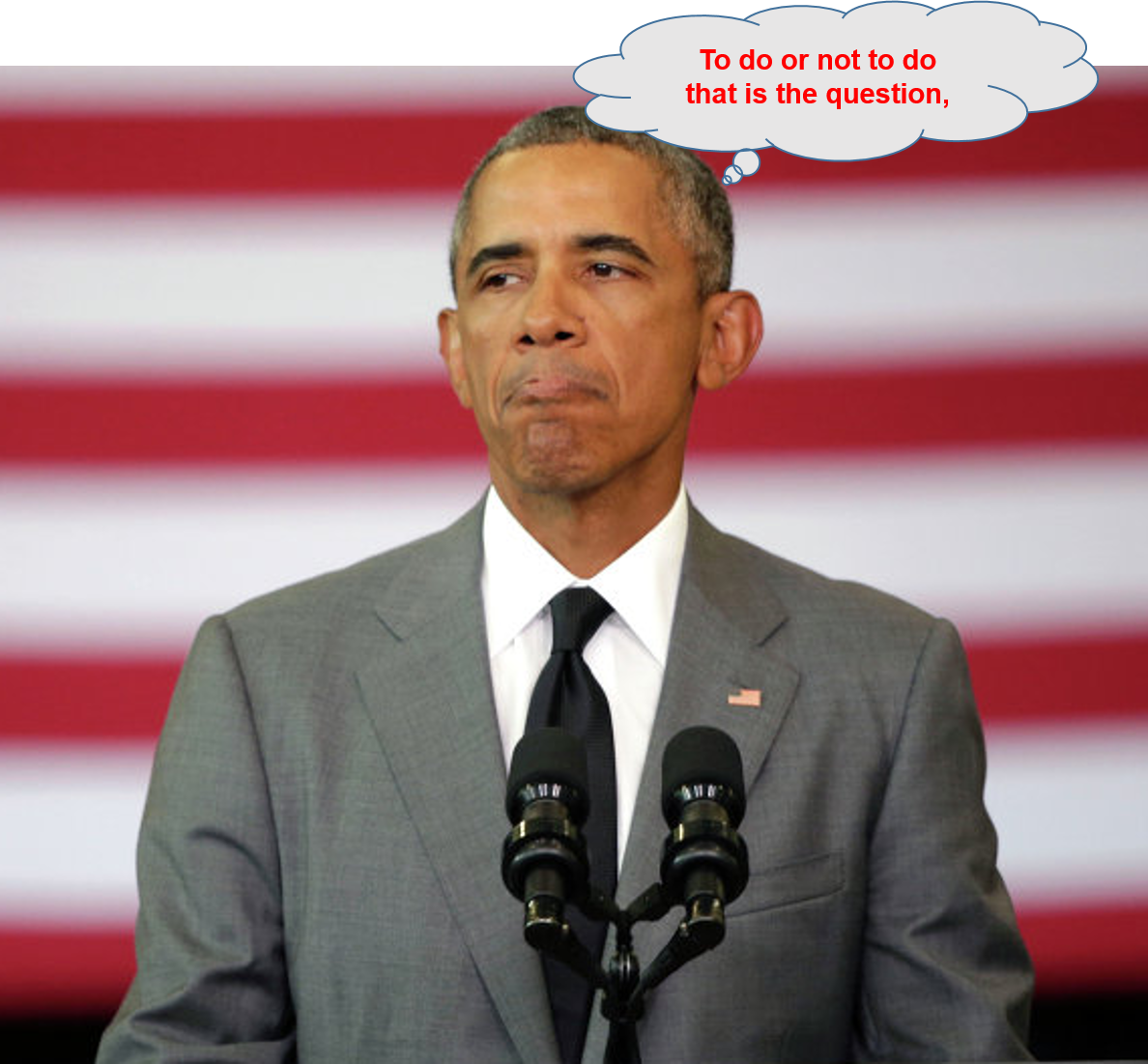
analysis-paralysis
An insightful commentary in Reuters:
Putin’s Middle East gamble is paying dividends
Vladimir Putin has made an art of turning weakness into strength. As Russian and Syrian forces pound Aleppo in the biggest assault of Syria’s five-year civil war, the Russian president clearly has emerged as a dominant force in the Middle East. ……..
…….. Over the last year, Putin has inserted Russia into the Syrian conflict and shored up the regime of President Bashar al-Assad as it was on the verge of collapse. The Russian leader has forged a quasi-military alliance with Iran that has allowed him to project power in the Persian Gulf – something that has evaded Moscow since the end of World War Two.
If that wasn’t enough, Putin’s relationship with Turkey, which seemed to be on a collision course after Ankara downed a Russian fighter jet last year, has now warmed to the point where Putin and Turkish President Tayyip Erdogan are about to restore full diplomatic relations. All the while Putin has maintained a close and productive relationship with Israeli Prime Minister Benyamin Netanyahu.
………….
Since the 1979 Islamic Revolution in Iran, the United States has aligned its interest in the Persian Gulf with Sunni monarchies such as Saudi Arabia, Kuwait and Qatar. In turn, these countries have invested heavily in the United States – from buying U.S. debt, to investing in real estate and buying billions of dollars in American military hardware.
Arab states have also invested heavily in Washington, buying influence in the corridors of power, funding think tanks and hiring public relations firms to help spread a narrative about why their countries are essential to America’s interest in the Middle East. The relationship between Riyadh and Washington remains particularly strong even as the American public questions the logic behind an alliance with a country whose actions often run counter to Washington’s interests.
These countries feel that Washington is obligated to share their view of the Middle East, which means backing them regardless of whether any conflict they engage in is against the interest of the United States. They have no such influence in Moscow. Even as Moscow backs Shi’ite powerhouse Iran and the Assad regime in Syria, Sunni Arab leaders continue to court Putin and look for ways to collaborate with him. Saudi Arabia, for example is currently trying to coordinate with Moscow on how best to stabilize oil markets and want Putin to pressure Iran to do the same.
Russia’s partnerships are based on cold, hard realism. Putin’s sole aim is to further Moscow’s interest. He’s unburdened by a legacy of alliances that do not serve Russia’s strategic aims. He supports Damascus, Tehran and the Shi’ite government of Iraq because he views Sunni extremism as a long-term threat that has destabilized countries in the Middle East, and which he fears could wreak havoc in countries close to Russia’s borders. Yet this coordination and collaboration with Shi’ite Iran doesn’t preclude him from working with Sunni Arab states to promote trade for Russian industry and its atomic energy program.
Putin is doing all of this while remaining close to Netanyahu. Even though Putin is working with Syria and Iran – Israel’s mortal enemies – he has convinced Netanyahu that these alliances are not meant to threaten Israel’s existence, but rather serve a larger purpose of defeating Sunni extremism. Russia continues to cooperate with Israel in diverse fields such as energy, agriculture and arms. Russia and Israel also maintain close military contacts and Putin is careful not to transfer offensive weapons to Israel’s foes.
Juxtapose this with how Netanyahu treated Obama and interferes in U.S. domestic politics. In the run-up to the Iran deal, Netanyahu used the influence of AIPAC and other pro-Israel lobbying organizations to try and undermine a sitting president and scuttle his signature foreign policy achievement.
If Israel or another U.S. ally tried to interfere or challenge Putin in such a manner, it’s difficult to imagine that he would reward them with $38 billion in aid for ten years, as Obama has done with Israel, or continue to support them militarily with advanced weapons and intelligence – as Washington has done with Saudi Arabia. …….
……….

First a new paper to be published in the American Economic Journal:
Edelman et al, Racial Discrimination in the Sharing Economy: Evidence from a Field Experiment
PDF airbnb-guest-discrimination-2016-09-16
In an experiment on Airbnb, we find that applications from guests with distinctively African-American names are 16% less likely to be accepted relative to identical guests with distinctively White names. Discrimination occurs among landlords of all sizes, including small landlords sharing the property and larger landlords with multiple properties. It is most pronounced among hosts who have never had an African-American guest, suggesting only a subset of hosts discriminate. While rental markets have achieved significant reductions in discrimination in recent decades, our results suggest that Airbnb’s current design choices facilitate discrimination and raise the possibility of erasing some of these civil rights gains.
The same story is repeated in Sweden.
Rental service Airbnb – which provides private rooms and apartments for guests all over the world – has problems with discrimination.
Tim Davis from New York tried to book an apartment through the service in Stockholm last summer, but was denied by the 15 hosts. He believes that it has something to do with that he is black. “I sent out 15 different requests and they all said no, but I also noted that the dates were still on the site”, said Tim Davis from New York.
After having contacted 15 hosts on Airbnb in Stockholm but had been rejected by everyone, Tim Davis, who himself is an Airbnb host in New York, started to suspect that the reason that all the hosts denied him to hire his skin color. “I’ve never been in Sweden, so I began to investigate. Is it okay to go there? Will there be problems? Will there be a big problem for me to be there as the black man?”
In the US, this issue has received much attention this year, partly due to a scientific study by Harvard University showed that it is easier to get rental accommodations through Airbnb, if you have a name that is common among white Americans than if you have a name that is common among African Americans.
But we wanted to know if this is also a problem in Sweden and made our own small survey where we borrowed several black and white people’s Airbnb accounts. With the help of the black persons’ accounts, we asked 200 Airbnb hosts in Stockholm, Gothenburg and Malmö about their places were vacant on specific dates. More than half of the respondents said yes. But when we asked those who had said no again from an account that belongs to one of the white test subjects, nearly one in three hosts said instead that the apartment was vacant.
So here are what some of the hosts said when a black person asked:
“No sorry, friends are coming to visit”.
“Unfortunately, we will not be home on these dates”
“No, unfortunately, the accommodation is not available, we had forgotten to change the dates. “
And this is how the hosts responded when we let a white person repeat the question:
“-You are more than welcome!”
“We will arrange that, what time are you coming on Friday?”
“Absolutely, it works well. Welcome!”
Process Manager Martin Dark at the Equality Ombudsman’s Office said about the test: “It’s difficult to say something about the individual cases but as it looks there appears to be a problem. Typically, private behaviour is protected from discrimination legislation, but in this case when you have advertised on a commercial site with the purpose of making money, these people may be guilty of discrimination.”
– As anti-discrimination law stands today, it is values that are responsible for it. …….
……. Airbnb declined to participate in an interview …… but says that discrimination is unacceptable and that it will take action if guests report that they encountered discrimination.
Discriminate is what homo sapiens do. To discriminate is the automatic consequence of thought.
This kind of discrimination may be “deplorable” but I am not sure that forcing people – by legal coercion – to disregard or abandon their own values is not equally deplorable. You may not agree with someone’s values but to force them to adopt yours is either oppression of the individual or it is brainwashing.


 The k2p blog