Archive for October, 2016

Monsoon season is over but the rain continues as withdrawal lags

October 3, 2016

The monsoon season “officially” runs through June, July, August and September. This year it was about a week late in being established and now, at the end of the season, total rainfall has been about 3% lower than the long-term average and it counts as a normal monsoon (just).

Predictions of a better than average monsoon have been proven wrong . But have they?

The monsoon does not much care about calendar dates and the withdrawal of the monsoon is running about 2 weeks behind its “average” schedule.

graphic imd

graphic imd

It looks like monsoon rains will continue sporadically over the next 15 – 20 days. Currently the rains stretch across central India from Gujarat to Bihar. The total rainfall – though not conforming to the official calendar – may well be slightly above average.

Once it has finally withdrawn the verdict is likely to be that the 2016 monsoon was “good”.


To pay tax you don’t owe is just incompetence

October 2, 2016

I note that the NY Times is busy attacking Trump for offsetting tax on profits against past losses. Which of course is something the NY Times is itself very quick to do when it can. As Forbes reported in January this year:

New York Times Hypocrisy On Corporate Taxes Reaches Record High

……. More recently, for tax year 2014, The New York Times paid no taxes and got an income tax refund of $3.5 million even though they had a pre-tax profit of $29.9 million in 2014. In other words, their post-tax profit was higher than their pre-tax profit. The explanation in their 2014 annual report is, “The effective tax rate for 2014 was favorably affected by approximately $21.1 million for the reversal of reserves for uncertain tax positions due to the lapse of applicable statutes of limitations.” If you don’t think it took fancy accountants and tax lawyers to make that happen, read the statement again. …….

There is much hypocrisy about taxes and tax-paying. To pay more tax than the tax code demands is all about incompetence – not about ethics.

I wrote in December 2015;

Tax avoidance is a measure of the incompetence of the lawmaker and the competence of the taxpayer

…. As law-abiding individuals and companies, we calculate and pay our taxes according to the rules that prevail. We use all available rules of allowable deductions and off-sets and deferred taxes and tax-breaks to minimise the amount of personal assets that are to be confiscated by the State. We use accountants and experts to navigate the complexities and intricacies of tax legislation. No individual is ever expected to pay more than the prevailing rules require. Any individual who does pay more than required, and assuming his perfectly rational objective is to minimise the tax to be payed, is fundamentally incompetent. Any company which pays more tax than it should also demonstrates incompetence and is not demonstrating due care of its investors’ assets.

Individuals and corporations are not required or expected to pay more than what is due under the rules prevailing. The issue of ethics is in play when the rules are formulated and is also involved in the following of the rules. The act of payment is an ethical issue but minimisation of tax due is a matter of competence, not of ethics. Paying more taxes than are due demonstrates incompetence and gains no ethical credits. So when there is criticism of companies for “not paying enough tax”, the real failure is with the politicians who have made the deficient rules – not with the individuals or companies who have followed the prevailing rules to their own best advantage.

Back in January 2015 I was also exercised about the sanctimonious clap-trap that wealth inequality gives rise to:

Wealth inequality: The poor are not poor “because” the rich are rich

Most people on the left of the political divide want more to be taken from the rich to be “given” to the poor. The Robin Hood syndrome. Note that when the intention is to “give to the poor” and not for “making the poor greater creators of wealth”, the driving force is mainly envy. It is when the desire to deprive the rich is more important than any desire to improve the lot of the poor. Concern is over-ridden by envy. Sometimes it seems to me that the real difference between left and right is that the left wants to spread the consumption of existing wealth (and hope that total wealth increases), while the right want to focus on creating wealth (and hope that it trickles down and gets equitably distributed).

But there is a fundamental fallacy in the view that the poor are poor because the rich are rich. There may well be some of the rich who are exploiting some of the poor and where the poor are not getting a just opportunity to be creators of wealth. There may well be members of the rich who create no wealth but remain rich because of inherited wealth. But by far the greatest majority of the rich are rich because they created more wealth than others. The real question is whether each individual gets an equitable opportunity to create wealth and then gets to retain an equitable portion of the wealth he has created. (It is a different matter but I still do not understand why it is the creation and the retention of wealth that attracts more penalties in the form of taxation than the destruction or consumption of wealth).

I incline to the view that taxation as it is practiced today by most states is fundamentally immoral. It is in fact an act of confiscation. This I wrote in February 2015.

On the legitimacy and morality of taxation

I am persuaded that the concept of taxation as practised today is immoral. It is fundamentally a coercion of an individual by a larger (stronger) society. It is an enforced confiscation (by threat of legal action) of an individual’s property or wealth. It cannot be seen as a membership fee for being a member of the society because leaving (or being expelled from) the society is not an option. It is closer to the extortion of “protection money” than to the membership dues for a golf club. The use to which the funds are put is irrelevant. The key point is whether the payment is voluntary or coerced. When early Christians paid a “tithe” to the Church voluntarily it was not immoral. But when the payment was coerced and no longer voluntary, the system became immoral. Similarly Islam requires the payment of zakat on individual wealth over the minimum nisab and this also shifted from a quite unexceptionable and moral voluntary payment to become an obligatory and immoral coercive confiscation.

I don’t quarrel with the need for any society to generate “common funds” to improve the well being of that society. But the legitimacy of appropriating the funds lies only in that the society (state) is stronger than the individual. Might becomes right. I come to the conclusion that a tax code by which the amount a “good citizen”should contribute to society is calculated is quite moral as long as the payment is then voluntary. There would be no moral issue if all taxation was voluntary. The immorality lies in the use of threat or force to confiscate the payment. It is the oppression of the minority by the majority which is immoral. (I observe that all democracies use the very fact of being a “democracy” as being a justification for the oppression of minorities when that is the will of the majority. As if being in the majority – by and of itself – ensures proper behaviour). But, the good socialist will argue, compulsory payment of tax is necessary to ensure the funds for the common good. Without coercion society as a whole would suffer. The common good – as seen by the majority – is worth the oppression of the minority who do not pay their dues.

And so we come full circle. The end justifies the means. Oppression of the minority by a majority is acceptable for the good of the majority. A society must be able to use force and coercion against its own minorities for the greater good. Taxation is made legitimate only because the state is stronger than the individual.


 

The Obama legacy: Syrian chaos abroad and a failed Obamacare at home

October 2, 2016

History may remember Barack Hussein Obama mainly for being the first half-black President. The successes and failures of today which loom so large at the moment may not be of any great significance from the distance of another century or two. Just looking back over the last 8 years, the dominating story about the world would be the financial crisis which started in 2008 and which we have not yet recovered from. In that picture there is nothing that Obama has done which stands out. History will only record that Obama’s efforts to first stop and then recover from the crisis were not particularly noteworthy – neither catastrophic nor very successful. It will surely be recorded that this period was extremely violent in the middle east and saw heavy intervention by the US and Europe to try and effect regime change in a number of countries. History will also record that the interventions in Iraq, Syria and Libya, in particular, in support of rebel groups to the existing regimes caused the rise and explosive growth – and success – of the Islamic State terrorists. It will be recorded that the reluctance of the US to challenge Saudi Arabia allowed easy financing of Sunni terrorist groups. Syria and the Middle East will go down as a spectacular failure of US foreign policy under Barack Obama (aided and abetted by Hillary Clinton and John Kerry). Right now it is the visible face of inept US foreign policy. Depending on what happens in the next year or two, this failure may become something that history will recall and connect with Obama. Or it may just get lost in the continuing maelstrom of the middle east’s bloody and barbarous politics.

When Obama was elected there was an expectation that he would improve the lot of US blacks. That has not happened. If anything it has become somewhat worse. There was a huge expectation of job creation but that has dawdled along in the wake of the financial crisis. During his term the introduction of “health care for all” and the Affordable Care Act was hyped to an extraordinary degree. Obamacare was going to revolutionise health care and make it affordable and available to all. This was going to be his primary domestic legacy.

But it seems that Obamacare has already failed. It does not seem that it could be the kind of success that would be remembered by history. For now it seems to be the most important domestic failure of Obama’s term in office. Whether the failure will be big enough to be remembered by history remains to be seen – but probably not.

obama-7-years-on-image-time

obama-7-years-on-image-time

Chicago Tribune:

  1. Obamacare failed because it flunked Economics 101 and Human Nature 101. It straitjacketed insurers into providing overly expensive, soup-to-nuts policies. It wasn’t flexible enough so that people could buy as much coverage as they wanted and could afford — not what the government dictated. Many healthy people primarily want catastrophic coverage. Obamacare couldn’t lure them in, couldn’t persuade them to buy on the chance they’d get sick. 
  2. Obamacare failed because the penalties for going uncovered are too low when stacked against its skyrocketing premium costs. Next year, the penalty for staying uninsured is $695 per adult, or perhaps 2.5 percent of a family’s taxable household income. That’s far less than many Americans would pay for coverage. Financial incentive: Skip Obamacare.
  3. Obamacare failed because insurance is based on risk pools — that is, the lucky subsidize the unlucky. The unlucky who have big health problems (and big medical bills) reap much greater benefits than those who remain healthy and out of the doctors’ office. But Obamacare’s rules hamstring insurers. They can’t exclude people for pre-existing conditions, and can’t charge older customers more than three times as much as the young. Those are good goals, but they skew the market in ways Obamacare didn’t figure out how to offset. Result: Young and healthy consumers pay far more in premiums than their claims (probably) would justify in order to subsidize the unexpectedly large influx of older, sicker customers who require expensive care. Too many unlucky people, too few lucky people: That will collapse any insurance scheme. 
  4. Obamacare failed because it allowed Americans to sign up after they got sick and needed help paying all those medical bills. Insurance should be structured so that, although you don’t know if you’ll need it, you pay for it anyway, just in case; your alternative is financial doom. But if you can game the system and, for example, buy auto coverage after you crash into your garage, then you have no incentive to buy insurance beforehand. 
  5. Obamacare failed because it hasn’t tamed U.S. medical costs. Health care is about supply and demand: People who get coverage use it, especially if the law mandates free preventive care. Iron law of economics: Nothing is free; someone pays. To pretend otherwise was folly. Those forces combined to spike the costs of care, and thus insurance costs. 
  6. Obamacare failed because too many carriers simply can’t cover expenses, let alone turn a profit, in this rigidly controlled system. Take Blue Cross and Blue Shield of Illinois, the state’s dominant Obamacare insurer. Last year, for every dollar the carrier collected, it spent $1.32 buying care and providing services for customers, according to BCBS President Maurice Smith. No wonder BCBS is proposing rate increases from 23 percent to 45 percent for its individual plans.

So while the failures of Syria and Obamacare will be the immediately remembered heritage of Obama’s presidency, neither may be of great significance in historical terms.

And then all that remains is that Barack Hussein Obama was the first half-black president of the United States.


Man smart – woman smarter

October 1, 2016

i was 34 when my son was born. My father was 37 when I was born and his father was 41 when he was born. However my mother was 22 when I was born and her mother was 25 when she was born. My great grandmother was 19 when my grandmother was born.

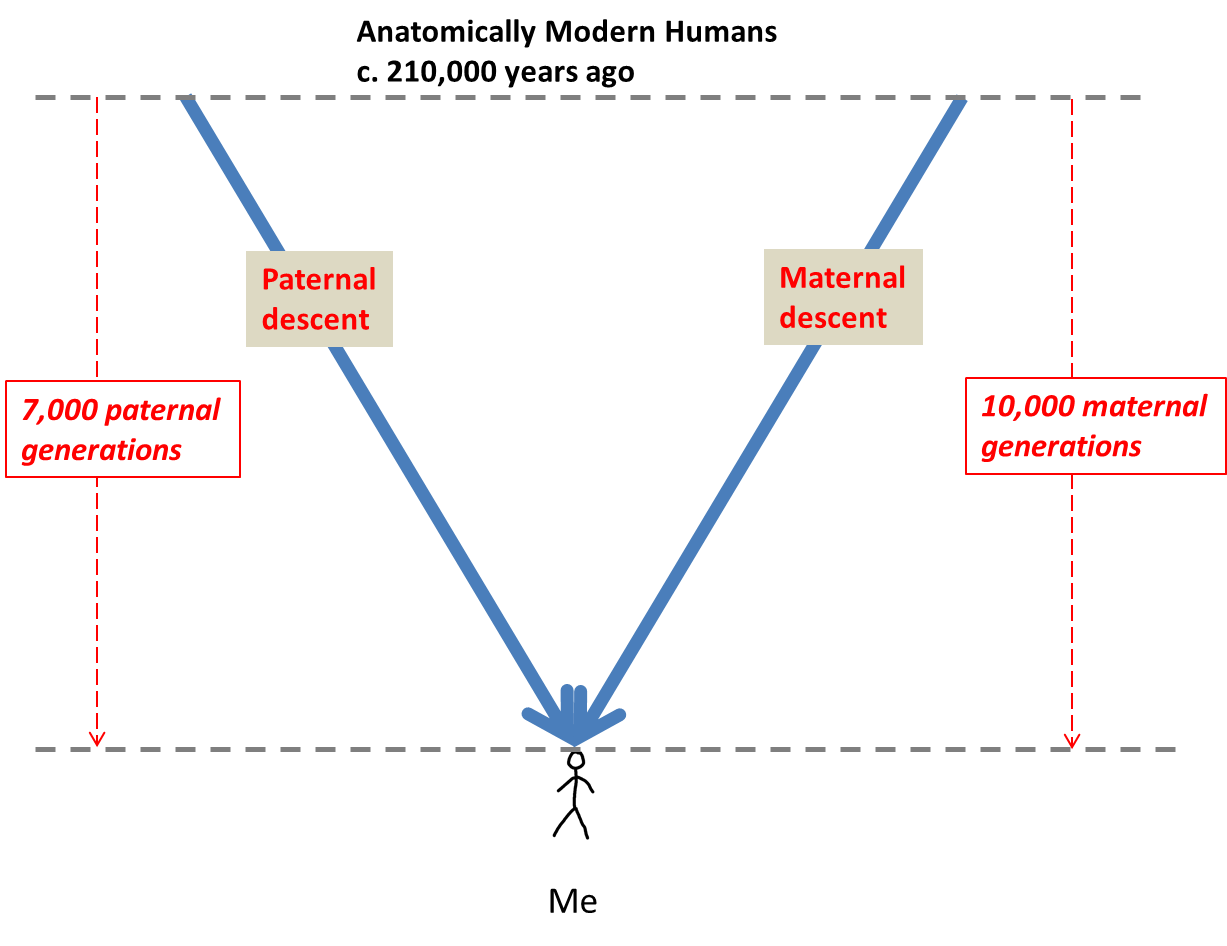
So my grandfather’s grandfather was born at about the same time as my grandmother’s, grandmother’s grandmother. From just about 1860, I am the product of 4 generations on my paternal line but of 6 generations on my maternal line. The same pattern is reproduced all the way back to when Anatomically Modern Humans began some 210,000 years ago and possibly even before that. But that means that everybody living today, for any given time period going back, has a maternal line of descent containing around 40% more generations than the paternal line of descent.

The conclusion is simply that the maternal line, generationally (and therefore also in evolutionary terms), is almost half as long again and therefore, that much more advanced than the paternal line.

Woman smarter (by 3,000 generations)

Woman smarter (by 3,000 generations)

Since the “start” of modern humans we have 3,000 more generations on the line of all our mothers than the line of all our fathers (7,000 fathers of fathers and 10,000 mothers of mothers).

Much is explained.

Remember the Harry Belafonte song, “Man smart – women smarter”.

I say let us put man and a woman together
To find out which one is smarter
Some say man but I say no
The woman got the man de day should know

And not me but the people they say
That de man are leading de women astray
But I say, that the women of today
Smarter than the man in every way

………..

Garden of Eden was very nice
Adam never work in Paradise
Eve meet snake, Paradise gone
She make Adam work from that day on

Methusaleh spent all his life in tears
Lived without a woman for 900 years
One day he decided to have some fun
The poor man never lived to see 900 and one

……