No comments needed.
No comments needed.
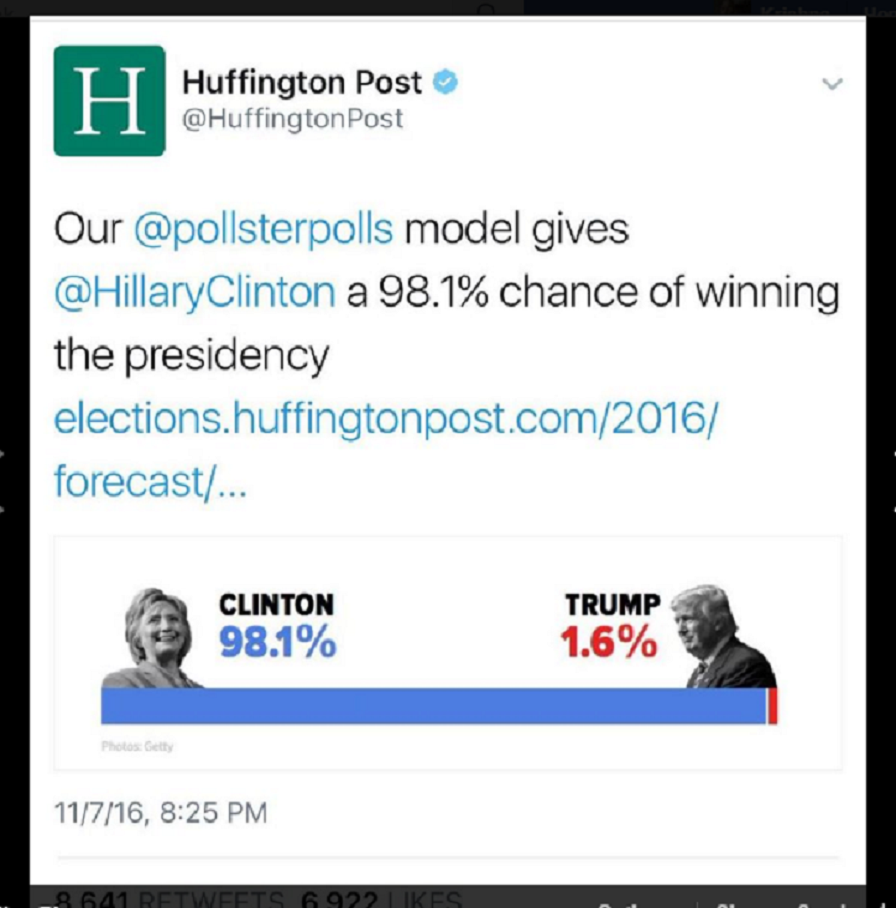
It is a potent mixture when sanctimonious arrogance meets blind ignorance. And it is difficult to get more sanctimonious than, or be as blind as, the HuffPo.
I note that they are still in denial about the result and are instigating mayhem and revolt.
From Paul Joseph Watson
Judith Curry’s guide to climate models.
Well worth reading.
Though written for lawyers, it might even be tough for many lawyers. However politicians should get their “science” aides to read, digest and summarise it for them (it would be far too ambitious to expect the politicians to be able to read so much, understand it or to digest so much in one go).
For me, the real issue with GCM’s is not that the modelling is done but that they are used for policy making. Assumed sensitivities are effectively used to fit the results for the immediate past. The forced fit is then taken as proof that the assumptions are true and are then projected into the future. The claimed objective of the resultant policies can neither be monitored nor measured.
Climate models for lawyers
by Judith Curry
I have been asked to write an Expert Report on climate models.
No, I can’t tell you the context for this request (at this time, anyways). But the audience is lawyers.
Here are the specific questions I have been asked to respond to:
- What is a Global Climate Model (GCM)?
- What is the reliability of climate models?
- What are the failings of climate models?
- Are GCM’s are a reliable tool for predicting climate change?
I’ve appended my draft Report below. I tried to avoid giving a ‘science lesson’, and focus on what climate models can and can’t do, focusing on policy relevant applications of climate models. I’ve tried write an essay that would be approved by most climate modelers; at the same time, it has to be understandable by lawyers. I would greatly appreciate your feedback on:
- whether you think lawyers will understand this
- whether the arguments I’ve made are the appropriate ones
- whether I’m missing anything
- anything that could be left out (its a bit long).
——–
What is a Global Climate Model (GCM)?
Global climate models (GCMs) simulate the Earth’s climate system, with modules that simulate the atmosphere, ocean, land surface, sea ice and glaciers. The atmospheric module simulates evolution of the winds, temperature, humidity and atmospheric pressure using complex mathematical equations that can only be solved using computers. These equations are based on fundamental physical principles, such as Newton’s Laws of Motion and the First Law of Thermodynamics.
GCMs also include mathematical equations describing the three-dimensional oceanic circulation, how it transports heat, and how the ocean exchanges heat and moisture with the atmosphere. Climate models include a land surface model that describes how vegetation, soil, and snow or ice cover exchange energy and moisture with the atmosphere. GCMs also include models of sea ice and glacier ice.
To solve these equations on a computer, GCMs divide the atmosphere, oceans, and land into a 3-dimensional grid system (see Figure 1). The equations and are then calculated for each cell in the grid repeatedly for successive time steps that march forward in time throughout the simulation period.
Figure 1. Schematic of a global climate model.
The number of cells in the grid system determines the model ‘resolution.’ Common resolutions for a GCM include a horizontal resolution of about 100-200 km, a vertical resolution of about 1 km, and a time stepping resolution that is typically about 30 minutes. While GCMs represent processes more realistically at higher resolution, the computing time required to do the calculations increases substantially at higher resolutions. The coarseness of the model resolution is driven by the available computer resources, and tradeoffs between model resolution, model complexity and the length and number of simulations to be conducted.
Because of the relatively coarse spatial and temporal resolutions of the models, there are many important processes that occur on scales that are smaller than the model resolution (such as clouds and rainfall; see inset in Figure 1). These subgrid-scale processes are represented using ‘parameterizations.’ Parameterizations of subgrid-scale processes are simple formulas based on observations or derivations from more detailed process models. These parameterizations are ‘calibrated’ or ‘tuned’ so that the climate models perform adequately when compared with historical observations.
The actual equations used in the GCM computer codes are only approximations of the physical processes that occur in the climate system. While some of these approximations are highly accurate, others are unavoidably crude. This is because the real processes they represent are either poorly understood or too complex to include in the model given the constraints of the computer system. Of the processes that are most important for climate change, parameterizations related to clouds and precipitation remain the most challenging, and are the greatest source of disagreement among different GCMs.
GCMs are used for the following purposes:
- Simulation of present and past climate states to understand planetary energetics and other complex interactions
- Numerical experiments to understand how the climate system works. Sensitivity experiments are used to turn off, constrain or enhance certain physical processes or external forcings (e.g. CO2, volcanoes, solar output) to see how the system responds.
- Understanding the causes of past climate variability and change (e.g. how much of the change can be attributed to human causes such as CO2, versus natural causes such as solar variations, volcanic eruptions, and slow circulations in the ocean).
- Simulation of future climate states, from decades to centuries, e.g. simulations of future climate states under different emissions scenarios.
- Prediction and attribution of the statistics extreme weather events (e.g. heat waves, droughts, hurricanes)
- Projections of future regional climate variations to support decision making related adaptation to climate change
- Guidance for emissions reduction policies
- Projections of future risks of black swan events (e.g. climate surprises)
The specific objectives of a GCM vary with purpose of the simulation. Generally, when simulating the past climate using a GCM, the objective is to correctly simulate the spatial variation of climate conditions in some average sense. When predicting future climate, the aim is not to simulate conditions in the climate system on any particular day, but to simulate conditions over a longer period—typically decades or more—in such a way that the statistics of the simulated climate will match the statistics of the actual future climate.
There are more than 20 climate modeling groups internationally, that contribute climate model simulations to the IPCC Assessment Reports. Further, many of the individual climate modeling groups contribute simulations from multiple different models. Why are there so many different climate models? Is it possible to pick a ‘best’ climate model?
There are literally thousands of different choices made in the construction of a climate model (e.g. resolution, complexity of the submodels, parameterizations). Each different set of choices produces a different model having different sensitivities. Further, different modeling groups have different focal interests, e.g. long paleoclimate simulations, details of ocean circulations, nuances of the interactions between aerosol particles and clouds, the carbon cycle. These different interests focus computational resources on a particular aspect of simulating the climate system, at the expense of others.
Is it possible to select a ‘best’ model? Well, several models generally show a poorer performance overall when compared with observations. However, the best model depends on how you define ‘best’, and no single model is the best at everything. The more germane issue is to assess model’s ‘fitness for purpose’, which is addressed in Sections 2-4.
The reliability of climate models ……
The price for politically correct idiocy has to be paid. A year ago the Red/green coalition that rules Stockholm city introduced what they called “gender-equal snow clearance”. With the first, early, albeit heavy, snowfall of November the clearance system was a fiasco as it degenerated into a farce.
(The Red/Green coalition is notorious for its lack of common sense and known for a very warped sense of right and wrong. They inevitably prioritise what is wrong. They believe victims of crime have only themselves to blame and that criminals are victims. They believe that returning jihadists from Iraq and Syria need to be cared for and treated for the trauma of having killed so many others. They believe that biology can be legislated away).
But even after the fiasco (and I experienced it myself when a journey which normally took a little over 2 hours, took over 3 going and about 5 hours returning), the only real change will be a new report. In my opinion and from what I experienced the snow clearing was extremely careless but more importantly, was incompetent. It was the unevenness of the clearance, followed by freezing, which created vicious pot-holes. Driving through Stockholm last Thursday reminded me of driving along the pot-hole strewn death-trap from Calcutta to Durgapur just after the monsoons.
When winter comes, the roads have generally been plowed first, but last winter Stockholm introduced something called “gender-equal” snow removal in the city. It meant that the bike paths, sidewalks and roads with heavy public transport have been given priority.
But when the snow struck Stockholm earlier this week the new snow removal was a flop. Vice Mayor of Stockholm, Daniel Helldén (MP), is self-critical. In an interview with the Daily News, he admits that pedestrian and bicycle paths have not been cleared as intended.“I have requested an emergency report to know what has happened these past few days. If it failed somewhere and we’ll correct it. With this report, we hope to be able to do it better next time,” he told DN.
Daniel Helldén is ultimately responsible for the snow removal work and he regrets that many were stuck on the roads or in public transport and could not get through.
“I will do my utmost so that we do not have to experience this kind of chaos again. Large snowstorms always means trouble. But it should not be like it was now,” he says.

Foto: Pär Brandt/auto motor & sport
It should be fairly obvious that I am not overly impressed by the main-stream (mainly liberal) media in the US. It is my contention that their blindness to the anti-establishment wave that was abroad, and then their sanctimonious stupidity, was no small contributor to the anger against the perceived establishment.
Now the analysis starts.
But some few liberals do see – at least in hindsight – what I thought I saw back in May.
Maybe it’s time to consider whether there’s something about shrill self-righteousness, shouted from a position of high social status, that turns people away.
This is Thomas Frank in The Guardian: (my bold)
Clinton’s supporters among the media didn’t help much, either. It always struck me as strange that such an unpopular candidate enjoyed such robust and unanimous endorsements from the editorial and opinion pages of the nation’s papers, but it was the quality of the media’s enthusiasm that really harmed her. With the same arguments repeated over and over, two or three times a day, with nuance and contrary views all deleted, the act of opening the newspaper started to feel like tuning in to a Cold War propaganda station. Here’s what it consisted of:
- Hillary was virtually without flaws. She was a peerless leader clad in saintly white, a super-lawyer, a caring benefactor of women and children, a warrior for social justice.
- Her scandals weren’t real.
- The economy was doing well / America was already great.
- Working-class people weren’t supporting Trump.
- And if they were, it was only because they were botched humans. Racism was the only conceivable reason for lining up with the Republican candidate.
How did the journalists’ crusade fail? The fourth estate came together in an unprecedented professional consensus. They chose insulting the other side over trying to understand what motivated them. They transformed opinion writing into a vehicle for high moral boasting. What could possibly have gone wrong with such an approach?

Image from Truth Feed
Dagens Nyheter is one of the most “politically correct” newspapers in Sweden. It believes – not in mono-cultural, multi-ethnicity (which works) – but in fractured multi-culturalist societies (which don’t). It believes people should get what they desire and not what they deserve.
And it believes in the religion of global warming being due to man-made emissions of carbon dioxide.
No doubt the record snowfall in Stockholm will also prove “global warming”.

snow in Stockholm 9th November 2016 — photo TT (via DN)
The worst snowfalls in Stockholm in 111 years.
It has not snowed in Stockholm this early in the winter since SMHI statistics started in 1905.“It’s about record levels, which, on Thursday morning, will be official”, says Stina Kihlgren, meteorologist at SMHI. A formal measurement of snow depth is made only once a day in Stockholm, 07:00 each morning at the Observatory. When Stockholm woke up on Wednesday ,SMHI measured 21 centimeters of snow. At midday there was an unofficial listing that showed 30 centimeters. “And then the snow continued to fall. It has been between 30 and 40 centimeters in total. The probability is very high that there will be a new record”, says Stina Kihlgren.
She refers to the measured snow depth in Stockholm in November, where the previous peak was in 1985 at 29 centimeters. “The snow has fallen for several days, it has been very intense.”
But not to worry. As global temperature numbers continue to be fiddled with new algorithms every year, the snow will, no doubt, disappear.
It is deja vu.
It is not that I am expert enough to have predicted a Trump victory. But in May this year when Trump won the Republican nomination I posted:
I have made this point before. Attacking Trump head on only fuels his anti-establishment support. It is only by occupying the ground he occupies that some of his support can be captured.
Attacking Trump – from any direction – only seems to strengthen his support. That suggests that his support is coming from those who feel that their fears are completely unrepresented by any of the other candidates. The 2016 election is dominated, I think, by the avoidance of worst fears and not by the meeting of aspirations. It could well be that nobody will be able to take away from Trump’s support unless they can articulate the same disdain for establishment politics and political correctness that he does and address the worst fears that exist.
The current headlines in the US media are now about how and why Clinton will trounce Trump. It all sounds exactly like the reasons given over the last year for why Trump couldn’t win the Republican nomination. Some of it – especially in the left leaning media – HuffingtonPost, Slate, Politico and Washington Post – are more like wishful thinking rather than analysis. They have not learned from their past mistakes and still haven’t understood the strength of the anti-establishment wave. Bernie Sanders is the only other candidate from either party who has begun to understand the mood abroad. To take away the “politically incorrect” territory from Donald Trump may be beyond Hillary Clinton.
My prediction for November is that Clinton support is more likely to collapse than that Trump’s campaign will implode. And therefore I will not be at all surprised at a very close run election and even if Trump wins.
And from the results it is pretty clear that the entire main stream media missed it and are still missing it. They are also still missing the point that they have themselves contributed to the resentment and anger that the Trump voters have now demonstrated with stunning effect. They (WaPo, HuffPo, LATimes, BostonGlobe, Politico, CNN and even the NYT) have been living in their own little bubble of virtuosity and sanctimonious blather that their vituperative attacks on Trump have been entirely counter-productive and have only cemented his support. Looking at the editorials today, they are still living in their bubble. They are still in denial about their own role in their own defeat. They have imbued political correctness with such a halo that Trump supporters have been invisible to the pollsters. Election models have been discredited soundly.
(As I have written elsewhere, election models are like climate models. They
I don’t expect even Trump the buffoon to be all bad. There are many silver linings to his dark cloud. But one thing is sure. President Trump is, at least partly, a reaction to Obama’s failures. His failure to let the US economy to be the engine for global growth, his failure to curb profligacy in government, his failure with Obamacare and his many failures with foreign policy. To that extent it is Obama’s fears of action which have enabled Donald Trump.
A different world?
Only one US newspaper endorsed Trump.
And it certainly wasn’t the Washington Post or the New York Times (and in this case it was the NYT which copied the WaPo headline).


The polls and the models — not much good that can be said about them.
They read fast over at the FBI.
650,000 emails read and analysed in a week is pretty impressive. That the FBI ( and the Department of Justice) are part of the political establishment that Hillary belongs to is fairly obvious. In any event the FBI interventions have put some life into the final stages but now, as the establishment wagons circle around Hillary, her victory tomorrow seems a foregone conclusion.
So the US will have another Clinton as another dodgy President. The new First Lady will probably be Huma Abedin. Bill Clinton can be President Emeritus.
The odds of another Clinton being impeached are fairly high. The odds of another President being forced to leave prematurely like Nixon are also fairly high.
The markets should gain today.
I wonder how November the 8th, 2016 will be recorded in history.
It seems – in our time – to be an epic – and fateful – battle with consequences beyond just the US. Populism versus establishment. The “people” versus the party system. The “people” versus the media. The “people” versus the “elite”. Institutions versus individuals. Liberalism or conservatism. Decadence opposed by decency. Depravity set against prudishness. Open borders versus protectionism. Big government against small. Profligacy opposed by austerity. White trash versus black trash. Muslims versus Christians. Mordor versus Gondor.
It is “the poor” against “the rich” but both Clinton and Trump are extraordinarily rich. It is “good” versus “evil” with both claiming to be the “good”. It is integrity against corruption where it is difficult to see who is less corrupt. It is a choice between evils but the lesser evil may not win. It is a race to see who is perceived worse.
But whether Donald Trump is a white rider from Rohan or the Black Lord of Mordor is uncertain. Or is he just Coco the clown brought on for light relief? Hillary Clinton is certainly no Galadriel but whether she is an Evil Witch or just a Red Queen is open to question.
If Hillary Clinton wins it will either be remembered as the day the Red Queen triumphed or the day when Witch Hillary of Little Rock prevailed. If Donald Trump wins it will either be the day a Great Buffoon came to power or the dawn of a Return to Greatness.
Either way the world is amazed it has come to this. That 325 million people gave themselves no option but the choice of a Witch or a Buffoon.
Lewis Carroll is needed to bring some sense into this.
`Twas brillig, and the slithy toves
Did gyre and gimble in the wabe:
All mimsy were the borogoves,
And the mome raths outgrabe.
That it has come to this is also part of Barack Obama’s legacy.


 The k2p blog
