Hardly a day goes by where I do not consider the origin of something. On some days I may ponder the origin of hundreds of things. It could be just curiosity or it could be to justify some current action or to decide upon some future action. Sometimes it is the etymology of a word or it could be the origins of an idea. It could be the story of what happened yesterday or something about my father or a thought about the origins of time. I know that when I seek the history of a place or a thing or a person, that what I get is just a story. In every case the story inevitably carries the biases of the story-teller. However, most stories are constrained by “evidence” though the point of the story may well lie in the narrative (inevitably biased) connecting the points of evidence.
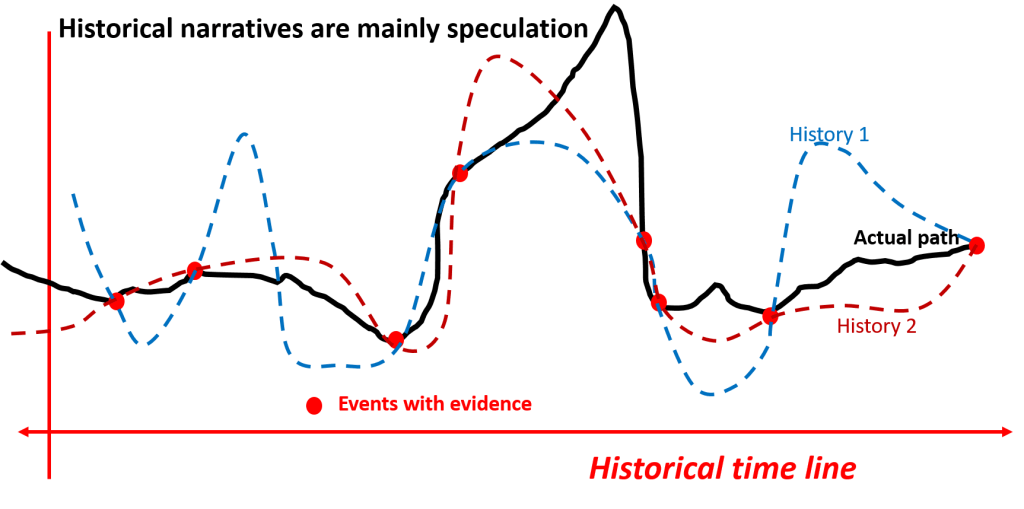
The same evidence can generate as many stories as there are story-tellers. Often the narrative between sparse evidence forms the bulk of the story. When the past is being called upon to justify current or future actions, histories are invented and reinvented by playing with the narrative which lies between the evidence. Of course, the narrative cannot contain what is contradicted by the evidence. Human memory is always perception and perception itself is imperfect and varies. I know that the story I tell of some event in my own history changes with time. Thus the “history” I tell of all that lies between the “recorded facts” of my own existence is a variable and is a function of the “now”. It is experience and knowledge of the world and the people around us which provides the credibility for the stories which lie between the evidence. But bias plays its role here as well. A desired story-line is always more credible than one which is not.
A historian looks for the events which, incontrovertibly, took place. The further back events lie in the past the less evidence survives. But histories are never merely a tabulation of events with evidence (though even what constitutes incontrovertible evidence is not without controversy). The more there is evidence the more constrained is the inter-connecting narrative. But historians make their reputations on the stories they tell. Their histories are always a combination of evidenced events and the narrative connecting them. Historian bias is inevitable.
I have been writing a story – hardly a history – about my father’s early life and through the Second World War. For a period covering some 20 years I have documented evidence for about 30 separate events – dates when certain events occurred. The date he graduated, the date he joined up, the date he was promoted or the date he arrived somewhere. The documented events are, like all documented events, just events. If not this set of events then it would have been some other similar set of events. If not these particular dates then some other set of dates. The events are always silent about what his mood was or what he had for breakfast on the day of the event. They provide a fixed frame but the overwhelming bulk of my story is speculation about why and how he went from one event to the next. The story fits my understanding of how he was much later in his life. My story about his motivations and his behaviour are entirely speculation but always fit my central story-line. The documented events are just the bones on which to hang the flesh of my story. My story is not determined by the events. It is determined elsewhere but has to conform to the events.
Go back a little under 1,000 years and consider Genghis Khan. We have documentary evidence about the date he died but even his date of birth is speculation. Current histories vary according to whether the historian desires to describe a hero or a villain. Both can be hung upon the framework provided by the few documented events available. Go back another 1,000 years and even with the large (relatively) amount of evidence available about the Roman Empire, the range of speculation possible can justify the politics of any contemporary viewpoint.
And so it is with all histories. We claim that histories help us to understand the past and that this, in turn, helps us to choose our future actions. I am not so sure. The power of a history lies in the credibility of the narrative connecting the certain events. As with the story about my father, a history is not a narrative determined by the events. The narrative is determined by other imperatives but must conform to the events. I begin to think that we write (and rewrite) our histories, always in the present, and with our present understandings, to justify where we are or the choices we want to make. They are always a justification of something in the present.


 The k2p blog