Archive for the ‘Academic misconduct’ Category

Professor at Imperial College driven to his death?

December 8, 2014

This is sad and rather depressing.

On his blog, Professor David Colquhoun, FRS reports on the case of Professor Stefan Grimm of Imperial College who seems to have been bullied to his death.

Publish and perish at Imperial College London: the death of Stefan Grimm

This week’s Times Higher Education carried a report of the death, at age 51, of Professor Stefan Grimm: Imperial College London to ‘review procedures’ after death of academic. He was professor of toxicology in the Faculty of Medicine at Imperial.

Now Stefan Grimm is dead. Despite having a good publication record, he failed to do sufficiently expensive research, so he was fired (or at least threatened with being fired).

“Speaking to Times Higher Education on condition of anonymity, two academics who knew Professor Grimm, who was 51, said that he had complained of being placed under undue pressure by the university in the months leading up to his death, and that he had been placed on performance review.”

Having had cause to report before on bullying at Imperial’s Department of Medicine, I was curious to know more. 

Martin Wilkins wrote to Grimm on 10 March 2014. ………

……. It didn’t take long to get hold of an email from Grimm that has been widely circulated within Imperial. The mail is dated a month after his death. It isn’t known whether it was pre-set by Grimm himself or whether it was sent by someone else. It’s even possible that it wasn’t written by Grimm himself, though if it is an accurate description of what happened, that’s not crucial.

No doubt any Imperial staff member would be in great danger if they were to publish the mail. So, as a public service, I shall do so. ……

Read the rest at DC’s Improbable Science

Academic progress and goodness of research are not necessarily connected.


Diederik Stapel markets himself (anonymously) on Retraction Watch

October 13, 2014

Diedrick Stapel

In June last year it disturbed me that the New York Times was complicit in helping Diedrik Stapel market his “diary” about his transgressions. There is something very unsatisfactory and distasteful when we allow wrong-doers to cash in on their wrong-doing or their notoriety. I had a similar sense of distaste when I read that the Fontys Academy for Creative Industries offered him a job to teach social psychology – almost as a reward for being a failed, but notorius, social psychologist.

Retraction Watch carried a post about the new job. And Diedrik Stapel was shameless enough to show up in the comments (first anonymously) but finally under his own name when he was exposed by Retraction Watch. The comments were all gratuitously self-serving. Perhaps he was carrying out a social experiment?

But this was noticed also by Professor Janet Stemwedel writing in the Scientific American:

You’re not rehabilitated if you keep deceiving

…… But I think a non-negotiable prerequisite for rehabilitation is demonstrating that you really understand how what you did was wrong. This understanding needs to be more than simply recognizing that what you did was technically against the rules. Rather, you need to grasp the harms that your actions did, the harms that may continue as a result of those actions, the harms that may not be quickly or easily repaired. You need to acknowledge those harms, not minimize them or make excuses for your actions that caused the harms. ….

….. Now, there’s no prima facie reason Diederik Stapel might not be able to make a productive contribution to a discussion about Diederik Stapel. However, Diederik Stapel was posting his comments not as Diederik Stapel but as “Paul”.

I hope it is obvious why posting comments that are supportive of yourself while making it appear that this support is coming from someone else is deceptive. Moreover, the comments seem to suggest that Stapel is not really fully responsible for the frauds he committed.

“Paul” writes:

Help! Let’s not change anything. Science is a flawless institution. Yes. And only the past two days I read about medical scientists who tampered with data to please the firm that sponsored their work and about the start of a new investigation into the work of a psychologist who produced data “too good to be true.” Mistakes abound. On a daily basis. Sure, there is nothing to reform here. Science works just fine. I think it is time for the “Men in Black” to move in to start an outside-invesigation of science and academia. The Stapel case and other, similar cases teach us that scientists themselves are able to clean-up their act.

Later, he writes (sic throughout):

Stapel was punished, he did his community service (as he writes in his latest book), he is not on welfare, he is trying to make money with being a writer, a cab driver, a motivational speaker, but not very successfully, and .. it is totally unclear whether he gets paid for his teaching (no research) an extra-curricular hobby course (2 hours a week, not more, not less) and if he gets paid, how much.

Moreover and more importantly, we do not know WHAT he teaches exactly, we have not seen his syllabus. How can people write things like “this will only inspire kids to not get caught”, without knowing what the guy is teaching his students? Will he reach his students how to become fraudsters? Really? When you have read the two books he wrote after his demise, you cannot be conclude that this is very unlikely? Will he teach his students about all the other fakes and frauds and terrible things that happen in science? Perhaps. Is that bad? Perhaps. I think it is better to postpone our judgment about the CONTENT of all this as long as we do not know WHAT he is actually teaching. That would be a Popper-like, open-minded, rationalistic, democratic, scientific attitude. Suppose a terrible criminal comes up with a great insight, an interesting analysis, a new perspective, an amazing discovery, suppose (think Genet, think Gramsci, think Feyerabend).

Is it smart to look away from potentially interesting information, because the messenger of that information stinks?

Perhaps, God forbid, Stapel is able to teach his students valuable lessons and insights no one else is willing to teach them for a 2-hour-a-week temporary, adjunct position that probably doesn’t pay much and perhaps doesn’t pay at all. The man is a failure, yes, but he is one of the few people out there who admitted to his fraud, who helped the investigation into his fraud (no computer crashes…., no questionnaires that suddenly disappeared, no data files that were “lost while moving office”, see Sanna, Smeesters, and …. Foerster). Nowhere it is written that failures cannot be great teachers. Perhaps he points his students to other frauds, failures, and ridiculous mistakes in psychological science we do not know of yet. That would be cool (and not unlikely).

Is it possible? Is it possible that Stapel has something interesting to say, to teach, to comment on?

To my eye, these comments read as saying that Stapel has paid his debt to society and thus ought not to be subject to heightened scrutiny. They seem to assert that Stapel is reformable. …. …… behind the scenes, the Retraction Watch editors accumulated clues that “Paul” was not an uninvolved party but rather Diederik Stapel portraying himself as an uninvolved party. After they contacted him to let him know that such behavior did not comport with their comment policy, Diederik Stapel posted under his real name:

Hello, my name is Diederik Stapel. I thought that in an internet environment where many people are writing about me (a real person) using nicknames it is okay to also write about me (a real person) using a nickname. ! have learned that apparently that was —in this particular case— a misjudgment. I think did not dare to use my real name (and I still wonder why). I feel that when it concerns person-to-person communication, the “in vivo” format is to be preferred over and above a blog where some people use their real name and some do not. In the future, I will use my real name. I have learned that and I understand that I –for one– am not somebody who can use a nickname where others can. Sincerely, Diederik Stapel.

He portrays this as a misunderstanding about how online communication works — other people are posting without using their real names, so I thought it was OK for me to do the same. However, to my eye it conveys that he also misunderstands how rebuilding trust works. Posting to support the person at the center of the discussion without first acknowledging that you are that person is deceptive. Arguing that that person ought to be granted more trust while dishonestly portraying yourself as someone other than that person is a really bad strategy. When you’re caught doing it, those arguments for more trust are undermined by the fact that they are themselves further instances of the deceptive behavior that broke trust in the first place.

Stapel will surely become a case study for future social psychologists. If he truly wishes rehabilitation he needs to move into a different field. Self-serving, anonymous comments in his own favour will not provide the new trust with his peers and his surroundings that he needs to build up. Just as his diary is “tainted goods”, anything he now does in the field of social psychology starts by being tainted with the onus of proof on him to show that it is not.

Effects of influensa medicines exaggerated by sponsored research

October 8, 2014

I have posted earlier about how flu vaccines tend to be over-hyped and over-promoted. A new study confirms that research sponsored by pharmaceutical companies were much more positive than those by independent researchers.

The manufacture and sale of flu vaccines is enormously lucrative. Just in the UK the program costs £120 million every year. Worldwide just influensa vaccine sales are an estimated $4 – 5 billion. The total vaccines market is expected to grow from about $30 billion in 2012 to about $40 billion in 2015! For adult vaccines the biggest growth comes from public health programs pushing influensa vaccines:

Moreover in public health programs

The names of the members of the committees which recommend wholesale flu vaccinations are often shrouded in secrecy and often  – when revealed – are found to have unhealthy ties to the manufacturers of the vaccines.

Swedish Radio reports:

In the world of research meta-analyses, reviews of research studies available, act as a quality assurance. But when Australian researchers reviewed 26 meta-analyses of so-called neuraminidase inhibitors it was apparent that researchers sponsored by pharmaceutical companies had made more positive conclusions than their independent counterparts.

The study is published in Annals of Internal Medicine, writes The Guardian.

But the phenomenon is not new in the scientific community.

“There are lots of examples of how corrupt the system has been” said Björn Beermann, former professor at the MPA.

Last spring, it was revealed through the research network Cochrane that Tamiflu in principle was ineffective and that the pharmaceutical company Roche had regularly concealed “negative” research findings. It caused a debate about Sweden’s decision to buy into a giant stock of Tamiflu for a quarter of a billion kronor. Globally the bill amounted to nearly seven billion kronor ($1 billion).

In recent years it has become more difficult to conceal studies with undesirable results. Now, all the studies that seek publication have to be notified in advance of the study being conducted.

How much of global warming is due to data corruption?

August 27, 2014

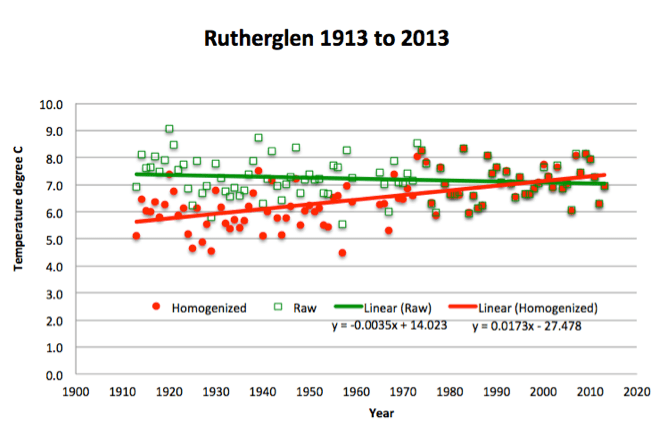
The Australian Bureau of Meteorology (BOM) is scrabbling trying to defend why the intentional corruption of data is justified. Dr. Jennifer Marohasy has a new post demonstrating that the excuses being offered do not hold up.

Whereas the Australian establishment uses “homogenisation” as their euphemism for “intentional data corruption”, the US uses “adjustment” : How NOAA Data Tampering Destroys Science

The temperature record at Rutherglen has been corrupted by managers at the Australian Bureau of Meteorology.

Of course raw data often needs to be adjusted but when the magnitude of the data adjustment is greater than the magnitude of the conclusion, then the adjustments or homogenisation become “data corruption” or ” data tampering”. As my Professor, Doug Elliott,  once told me – some 40 years ago – when I wanted to make calculated corrections for presumed errors due to radiation in flame temperature measurements, “You can argue for whatever corrections you want to make, but you cannot replace the measurement. The measurement is the measurement is the measurement”.

A “science” built on the falsification of data?

As was recently pointed out, fudging both data and model results seems endemic in “climate science”:

a recent paper from ETH Zurich.

If the model data is corrected downwards, as suggested by the ETH researchers, and

the measurement data is corrected upwards, as suggested by the British and Canadian researchers,

then the model and actual observations are very similar.


A cardiology journal not to be published in (unless you cannot publish anywhere else)

August 26, 2014

Predatory on-line journals are stretching the envelope of creative and lucrative ways of making money from the web. And researchers desperate to get something published are their willing victims. At $1200 a paper it is now possible to bypass the irritations of referees and peer-review and copy editing and a long delay between submission and publication!

Ottawa Citizen:

Important notice

A respected Canadian medical journal that was sold to offshore owners last year is now printing scientific junk for hire, but still trading on its original good name.

Experimental & Clinical Cardiology was published in Oakville, Ont., for 17 years and had a solid reputation for printing original medical research. It was sold in 2013, and its new owners say they are in Switzerland, but do their banking in Turks and Caicos.

And for $1,200 U.S. they’ll print anything — even a garbled blend of fake cardiology, Latin grammar and missing graphs submitted by the Citizen.

Experimental And Clinical Cardiology

The journal was flagged last month by Jeffrey Beall, a university librarian in Colorado who compiles a widely-followed list of “predatory” publishers. These are in the business of printing research that isn’t good enough for real science journals. They make it look legitimate, charging a fee to authors desperate to boost their careers.

Now this one has a special Canadian connection. As well, it is demonstrating a new and wildly profitable model for predatory journals.

Instead of running a cheap startup website and hunting for clients, it took over the identity — and readership — of an established business. 

This is paying off spectacularly. Experimental & Clinical Cardiology published 142 articles in July alone, worth a total of $170,000 U.S. for one month. It operates online only and doesn’t bother with editing, so it has almost no costs.

The result is sloppy, or worse. Some articles are called “Enter Paper Title” — the layout instructions instead of the intended title. One is filled with visible paragraph markers (). Some authors’ names are missing.

Scientists are worried because academic journals do more than print research. They also screen it by sending it to independent reviewers — experts in the field who can weed out low-quality work.

But the “predatory” journals skip this step. They accept everything verbatim, making it appear that experts have approved it. ……. 

Experimental and Clinical Cardiology

Open access publishing is not without costs. Experimental & Clinical Cardiology therefore levies an article-processing charge USD1200 for each article accepted for publication.

It is all perfectly legal and they probably accept all publications providing the $1200 is forthcoming.

Swedish researcher faces disciplinary proceedings for plagiarism

August 20, 2014

Back in March this year, Jesper Johansson, a senior lecturer at Linnaeus University had a 2012 article in the Nordic Journal of Migration Research retracted for plagiarism as reported by Retraction Watch. The University mounted an investigation and the University Vice-Chancellor Stephen Hwang  has now announced that the plagiarism is confirmed and that the University’s Personnel Committee will meet in September to consider disciplinary actions to be taken. Dr. Johansson is currently on leave. It is reported that he has acknowledged his plagiarism. There is also a report that it was a case of self-plagiarism but as Retraction Watch reported some of the material was copied from at least one other author:

The article, Swedish Employers and Trade Unions, Varieties of Capitalism and Labour Migration Policies,” was written by Jesper Johansson, of Linnaeus University in Växjö. It’s available as a PDF here, but not on the website of the publisher, De Gruyter — nor is it listed on Johnansson’s own site.

We chose a sentence a random from the abstract:

Employers are also thought to support policies incentive-compatible with the prevailing mode of capitalism.

And found it in this 2007 preprint of an article, “Varieties of Capitalism and Labor Migration Policy,” by another in researcher Sweden, Gregg Bucken-Knapp, of University West.

We’re guessing this wouldn’t be the only successful fishing expedition — and we wonder why the editors didn’t bother to use plagiarism detection software.

Had they done so, they would have been able to avoid having to issue this retraction notice:

This article has been withdrawn by the editors-in-chief, because it has been found to plagiarise already published work.

Johansson reports 21 publications on his site but does not include the retracted paper.

Johansson Linnaeus

Johansson Linnaeus

Johansson generally takes left-wing positions in his writings. Some extreme, racist parties in Sweden are rubbing their hands with glee.

Strange goings-on at Rajasthan University’s Physics Department

August 19, 2014

UPDATE!

The Rajasthan University website is suddenly “not available” – whatever that may imply.

A cached version of the page referred to below is here. (under the tab “Associate Professors”)

Update 2: The University website is up again and now updated. Presumably they went down to make the update.

=============================

The University of Rajasthan has a reputation of being very feudal (even if it is ranked 41 in a list of 511 Indian Universities). On anecdotal evidence they allow quite vicious ragging of first-year students and harassment of female students is quite common. Clearly all is not well at the University and specifically in the Department of Physics. Not just the academic misconduct evident from the manipulation and fabrication of data leading to multiple retractions, but also nasty charges of sexual misconduct and blackmail against the same professors.

1. Academic misconduct. Associate Professor RK Singhal has the dubious distinction of having achieved his own “category” at Retraction Watch as reward for his four (five?) retractions (so far). In his latest transgression Retraction Watch reports:

Here’s a physics retraction whose use of an exclamation point — the only one we’ve ever seen in a retraction notice! — makes the editors’ exasperation palpable.

It’s also the the fourth retraction for R. K. Singhal, of the University of Rajasthan, Jaipur, India. Behold the notice for “Magnetic behavior of functionally modified spinel Ni0.4Ca0.6Fe2O4 nanoferrite,” in the International Journal of Modern Physics B:

The editorial board discovered that the data points in several sections of the Moss-bauer spectra as given in Figs 3.(a) and 3(b) are exactly identical. This is impossible and nonphysical for the measurement of two different samples (or for that matter not even for the same sample!). The only conclusion we can draw from this figure is that some of the data is fabricated. As a result, the results and conclusions as described in the paper are unacceptable. This article is retracted from its publication in Int. J. Mod. Phys. B.

Prof. Singhal had to retract a 2010 paper and then he had to retract a correction to that retraction in 2013!!

Singhal and colleagues have another retraction — or two, depending how you look at it — in the Journal of Applied Physics. The journal has retracted a 2010 study, “Study of defect-induced ferromagnetism in hydrogenated anatase TiO2:Co,” but first they had to retract a 2013 correction of that study:

AIP Publishing LLC retracts this erratum because it was submitted and published without the knowledge of all the co-authors. Upon further investigation, it was found that the article that this erratum addressed warranted a retraction. Please also see the Retraction 1 associated with the original article.

Singhal’s colleague, Associate Professor SN Dolia of the same Department of Physics, was a co-author on the 4 Singhal papers retracted so far. They are both present as current faculty on Rajasthan University’s website. They have even had a physics paper retracted because their data was “unphysical”!!

2. Sexual Misconduct: But Singhal and Dolia have other problems to contend with. They are charged with extortion of sexual favours from a PhD student as a condition for being awarded her degree. They are said to have also fabricated obscene photographs to blackmail the student.

NDTV News: 30th June 2011.

In a huge embarrassment for teachers across the country, a professor at the Rajasthan University has been arrested for allegedly demanding sexual favours from his student.
The victim has alleged that her research guide Dr R K Singhal of the Physics department was harassing her for months.

The professor asked the girl to have sexual relations with him if she wanted to complete her PhD. Besides molesting her in February, Singhal and his colleague S N Dolia allegedly even blackmailed the student by morphing her face onto some obscene pictures. 
“While submitting her PhD thesis, the victim was asked for sexual favours by the teacher. Our preliminary investigation has found that the allegations are true and so we have arrested the Professor,” said BL Soni, Commissioner of Police, Jaipur. ….. Shockingly, despite the victim complaining about the teacher’s misconduct, the university authorities took no action initially. It was only after the girl lodged a police complaint that the accused teacher was arrested. Both Singhal and his colleague Dolia were later suspended from the university.
Besides suspending the two teachers, the university has also asked two retired Judges of the High Court to probe this shocking issue.

The legal mills in India grind on slowly and the case reached court in October 2013.

TOI: 16th October 2013.

JAIPUR: A court here on Tuesday framed charges against two assistant professors of University of Rajasthan (RU) who were accused of demanding sexual favours from a PhD student preparing thesis under their guidance.

The court of chief metropolitan magistrate (CMM) Bharat Bhushan Gupta, on Tuesday, framed charges against Dr Rishi Kumar Singhal and Dr S N Dolia under Sections 354, 341, 292 of the Indian Penal Code (IPC) and Section 4/6 of the Indecent Representation of en (Prohibition) Act.

On June 27, 2011 a girl belonging to Bharatpur, registered an FIR against the two professors at the Gandhi Nagar police station. In her complaint, the girl alleged that her research guide, RK Singhal, from the Physics department was harassing her and forcing her to have sexual relations with him. He allegedly used to threaten the girl that if she did not do as she was told, he would not let her complete her PhD.

While charges have been framed, the court hearings have not yet – apparently – commenced.

But there is no news of any results from the University investigation or of any actions being taken by the University. Interestingly the supposed University investigation reported is about the sexual misconduct charges. Nothing is reported from the University about the academic misconduct.

My expectation is that the University will not have the courage to actually do anything or to take any kind of moral or ethical position themselves. They will merely slip-stream behind the legal proceedings to avoid having to do anything.
 

Obokata’s mentor commits suicide

August 5, 2014

This is tragic and very sad and the “waste of it all” is appalling.

Yoshiki Sasai has committed suicide. He was Deputy Director of the Riken Labs and a co-author of the stem cell papers by Haruko Obokata which were later retracted because of her data fabrication. He was himself cleared of all wrong doing but he had gone out on a limb in her support when the accusations began to fly.

Retraction Watch has this statement from Nature:

This is a true tragedy for science and an immense loss to the research community.  Yoshiki Sasai was an exceptional scientist and he has left an extraordinary legacy of pioneering work across many fields within stem cell and developmental biology, including organogenesis and neurogenesis.  Our thoughts are with his family, friends and colleagues at this time.

Sasai’s own integrity was not in question but the Riken investigation criticised him for inadequate supervision.

Once Obokata’s data fabrications were established, he must have had a great struggle in determining the correct course of action to follow. I have just a very weak understanding of the shame and responsibility he must have felt as her sensei. But clearly it was sufficient to make him feel that suicide was the honourable course.

Asahi

A mentor of a young scientist whose falsified research findings sparked a scandal that engulfed Japan’s scientific community died in an apparent suicide Aug. 5, Hyogo prefectural police said.

Yoshiki Sasai, 52, deputy director of the Riken Center for Developmental Biology (CDB) in Kobe, hanged himself in a facility related to the Institute of Biomedical Research and Innovation, also in Kobe, police said. He was pronounced dead at 11:03 a.m. at a nearby hospital.

Police sources said a suicide note was found near Sasai’s body. ……… 

Sasai was a co-author of articles on a phenomenon called the “stimulus-triggered acquisition of pluripotency” (STAP), which initially appeared in the British scientific journal Nature in January.

However, the articles were later retracted due to extensive errors in the research.

A Riken investigative committee concluded that Haruko Obokata, 30, the main author of the articles, had fabricated and doctored illustrations in her research papers. The Riken committee also criticized Sasai for inadequately supervising Obokata.

Sasai appeared with Obokata at the January news conference to announce the findings about the STAP cells, saying he was proud of her wonderful discovery. …

However, after the Nature articles were retracted, he issued a statement saying: “I am deeply ashamed. It is now difficult to speak without doubt about the integrity of STAP cells.”

Sasai had a brilliant start to his research career. After graduating from the medical faculty of Kyoto University in 1986, he served as a visiting researcher at UCLA and became a Kyoto University professor when he was 36.

In 2000, he joined the Riken Center for Developmental Biology and became deputy director in April 2013.

His own research centered on the mechanism for creating nerve cells using embryonic stem cells, and he had articles published in such journals as Nature and Cell. He also received numerous awards for medical research.


Prof. Rajanish Dass wins in court but IIM Ahmedabad tries to parse the court’s verdict

August 3, 2014

Two years ago I had posted, here and here,  about the case of Prof. Rajanish Dass who resigned – under pressure – from the Indian Institute of Management Ahmedabad after being accused of plagiarism. IIM also made a police complaint accusing him of sending offensive e-mails.

But Prof. Dass has fought his case and won in court.

Now Prof. Dass has sent me an e-mail

“….. Previously, allegations of plagiarism had been manufactured against me, which were baseless, frivolous and were without any cogent proof or evidence. In fact, one of these allegations made was on a report, which did not exist at all. The same have been proved baseless over a period of time in the court of law and the inquiry report for these allegations had already been trashed when challenged in the High Court of Gujarat in 2012 (see http://timesofindia.indiatimes.com/city/ahmedabad/Hear-Dass-Out-Gujarat-high-court-tells-IIM-A/articleshow/12154670.cms.) ….

….. However, I am happy to mention to you that after a rigorous investigation by the Crime Branch Ahmedabad, I have been given a clean chit against the allegations made against me and the honorable Criminal Court has also discharged me with honor (see

  1. http://timesofindia.indiatimes.com/City/Ahmedabad/Courts-clean-chit-to-former-professor/articleshow/32382468.cms
  2. http://epaper.dnaindia.com/story.aspx?id=46728&boxid=110273&ed_date=2014-03-21&ed_code=1310005&ed_page=3… Now IIMA says that the charges of plagiarism were neither proved nor disproved. The question is had there been any legal charges, why did IIMA accept my resignation?).  ….”

India, unlike Scotland, does not have a  “not proven” verdict. If you are “not guilty” you revert to being “innocent”. IIM-A it seems to me are trying to claim that the plagiarism charges are something separate and are neither unproven nor proven though the court has thrown out their charges – now shown to be false – of malicious e-mails. But if plagiarism can not be proven – as IIM-A admits – then what was all the fuss about? If plagiarism is not proven then surely a presumption of innocence applies. 

IIM-A’s response – it seems to me is a trifle disingenuous, since if the plagiarism charges are not proven then there was no cause to force his resignation in the first place. This seems like IIM-A trying to parse the verdict of the court and convert a “not guilty” verdict to be instead “not guilty of this charge but not proven regarding plagiarism”. A mealy-mouthed response, I think.

Is IIM-A really saying that an allegation of plagiarism – which after 2 years is still unproven – was sufficient to force Prof. Dass to resign?

The honourable course for IIM-A – and especially as they cannot prove that any plagiarism took place – is to accept the verdict of the court gracefully and pay Prof. Dass his dues. Reinstatement may not be practical but IIM-A cannot keep accusing him of plagiarism which they are unable to prove.

(In his email Prof. Dass had requested me to remove the previous posts but I don’t think that would be the correct thing to do. He won his court case a few months ago – which I had missed at the time.)

AIDS scientist charged with fraud

June 25, 2014

I have long held that scientists, like many other professionals, should be subject to a sort of “product liability”, if they employ fraud, engage in some other misconduct or in some way fail to meet the standards to be reasonably expected.

If a scientist is to be considered “responsible” for his work then this must be mirrored by a corresponding “liability”. In my experience a lack of liability is always accompanied by the absence of responsibility.

The product that researchers and scientists produce is publications – mainly as papers published in scientific journals and as books. Scientific misconduct (whether plagiarism or faking data or inventing data or cherry picking data) leads occasionally to dismissals (but not always) and generally very little else. It seems to me that the concept of tort or “product liability” should be applicable to the work of scientists and researchers where their work is the result of faking data, fraud or other misconduct since it would be work that “had not been done in good faith”. Tort would apply because the ramifications of their misconduct would extend far beyond their employment contracts with their employers.

Now an AIDS scientist who faked his data is being charged with criminal offences.

Responding to a major case of research misconduct, federal prosecutors have taken the rare step of filing charges against a scientist after he admitted falsifying data that led to millions in grants and hopes of a breakthrough in AIDS vaccine research.

Investigators say former Iowa State University laboratory manager Dong-Pyou Han has confessed to spiking samples of rabbit blood with human antibodies to make an experimental HIV vaccine appear to have great promise. After years of work and millions in National Institutes of Health grants, another laboratory uncovered irregularities that suggested the results – once hailed as groundbreaking – were bogus. 

Han was indicted last week on four counts of making false statements, each of which carries up to five years in prison. He was set to be arraigned Tuesday in Des Moines, but he didn’t show up due to an apparent paperwork mix-up. A prosecutor said Han will be given another chance to appear next week. …….

Experts said the fraud was extraordinary and that charges are rarely brought in such cases. The National Institutes of Health said it’s reviewing what impact the case has had on the research it funds.

…… Oransky, a journalist who also has a medical degree, said there have been only a handful of similar prosecutions in the last 30 years.

He said Han’s case was “particularly brazen” and noted that charges are rarely brought because the U.S. Office of Research Integrity, which investigates misconduct, doesn’t have prosecution authority, and most cases involve smaller amounts of money. …… 

According to the indictment, Han’s misconduct caused colleagues to make false statements in a federal grant application and progress reports to NIH. The NIH paid out $5 million under that grant as of earlier this month. Iowa State has agreed to pay back NIH nearly $500,000 for the cost of Han’s salary.

Han’s misconduct dates to when he worked at Case Western Reserve University in Cleveland under Michael Cho, who was leading a team testing an experimental HIV vaccine on rabbits. Starting in 2008, Cho’s team received initial NIH funding for the work. Cho reported soon that his vaccine was causing rabbits to develop antibodies to HIV, which left NIH officials “flabbergasted,” according to a criminal complaint against Han. Cho’s team sent blood samples in 2009 to Duke University researchers, who verified the apparent positive impact on the vaccinated rabbits. The confirmation was seen as “a major breakthrough in HIV/AIDS vaccine research,” according to the complaint.

Iowa State recruited Cho in 2009, and with his team – including Han – he soon received a five-year NIH grant to continue the research. The team kept reporting progress. But in January 2013, a team at Harvard University found the promising results had been achieved with rabbit blood spiked with human antibodies.

An investigation by Iowa State pinpointed Han, after he was caught sending more spiked samples to Duke University. In a Sept. 30, 2013 confession letter, Han said he started the fraud in 2009 “because he wanted (results) to look better” and that he acted alone.

Individual researchers are unlikely to have the means to make restitution for all the financial waste they may have caused by their misconduct. Universities and Institutions have  some possibility of being forced to repay grants obtained by fraud but are rarely asked to do so. Careers of other researchers could also have been compromised.

It should still be possible for someone damaged by scientific misconduct to make a civil case for damages even if criminal charges are not brought.  But what that needs is that the output be considered “product” and that the scientist and his institution have then some “product liability”. That implies a duty of good faith and of application of some reasonable level of competence. Misconduct and even gross negligence on the part of the institution or the scientist could then give rise to a claim for damages. Even the journals, their editors and reviewers  ought to have some responsibility and potential liability.

If every published paper carried some product liability, the rush to publish nonsense and lies may reduce even if the publications industry would not be pleased. But it would improve the quality of publications no end.

Retraction Watch covers the story and has a discussion about the criminalisation of scientific fraud.