Archive for the ‘Academic misconduct’ Category

Faking the rythm: infantile academic spat at Rutgers University

May 7, 2013

Oh Good Grief!

As if the field of psychology did not have enough scandal and fakery already.

A childish spat between academics at Rutgers and infantile behaviour by Robert Trivers, a Professor of Anthropology who ought to know better. His opponent is William Brown, now a Senior Lecturer at the University of Bedfordshire.  But in this infantile academic spat it does seem as if the “establishment” are circling the wagons. I suspect that Robert Trivers, and Nature and other psychology heavyweights will prevail — but only to the further discredit of the discipline and its narcissistic  “star performers”.

Can’t they just both be spanked — in public? or put in the stocks?

A study featured in Nature in 2005 has drawn suspicion from university officials and one of its authors.

Nature: 

Few researchers have tried harder than Robert Trivers to retract one of their own papers. In 2005, Trivers, an evolutionary biologist at Rutgers University in New Brunswick, New Jersey, published an attention-grabbing finding: Jamaican teenagers with a high degree of body symmetry were more likely to be rated ‘good dancers’ by their peers than were those with less symmetrical bodies. The study, which suggested that dancing is a signal for sexual selection in humans, was featured on the cover of this journal (W. M. Brown et al. Nature 438, 1148–1150; 2005).

But two years later, Trivers began to suspect that the study data had been faked by one of his co-authors, William Brown, a postdoctoral researcher at the time. In seeking a retraction, Trivers self-published The Anatomy of a Fraud, a small book detailing what he saw as evidence of data fabrication. Later, Trivers had a verbal altercation over the matter with a close colleague and was temporarily banned from campus. 

An investigation of the case, completed by Rutgers and released publicly last month, now seems to validate Trivers’ allegations. Brown disputes the university’s finding, but it could help to clear the controversy that has clouded Trivers’ reputation as the author of several pioneering papers in the 1970s. For example, Trivers advanced an influential theory of ‘reciprocal altruism’, in which people behave unselfishly and hope that they will later be rewarded for their good deeds. He also analysed human sexuality in terms of the investments that mothers and fathers each make in child-rearing. …. 

In 2008, Trivers sought to retract the paper, but found the editors at Nature reluctant to do so. The paper remains unretracted, although a spokeswoman for Nature says that the case is under “active consideration”. (Information available to Nature’s research-manuscript editors is not generally shared with its reporters.) ….

…. Last year, the investigation concluded that there was “clear and convincing” evidence of fabrication by Brown, who it alleged had altered overall asymmetry measures of dancers to support the notion that better dancers were more symmetrical. The report was not published for more than a year, at which point Trivers posted it online. Rutgers has sent a copy to the NSF’s inspector-general, who is reviewing it to determine what action, if any, to take. ……

Brown, now a psychologist at the University of Bedfordshire, UK, denies fabricating the data. He criticizes the Rutgers investigation for comparing his data set with the one from Trivers’ group rather than the original hard copies of the source data.

Randy Andy FRS

May 5, 2013

Either the Royal Society has sold a Fellowship or perhaps they believe that HRH Prince Andrew, the Duke of York will bring great credit to the Society and the scientific community. A remarkable vote where only a “Yes” vote was permitted. No doubt we will hear that there was a clear consensus in favour and that his elevation was supported by – wait for it –  all those who supported him!

To put it mildly, Randy Andy has a rather spotted biography.

Either way it does little credit to the Royal Society or its Fellows.

The Guardian: 

After more than 350 years of largely happy association with assorted royalty Britain’s pre-eminent scientific institution, the Royal Society, faces unprecedented dissent from members after Prince Andrew was elected to become a fellow.

While the objections to the prince mainly centre on his slightly chequered career as a royal, a small number among the 1,450 or so Royal Societyfellowship are asking the wider question of whether it is time for an institution based on science to end the practice of honouring people on the basis of heredity.

The controversy has been fuelled by the way the prince was elected to be a royal fellow, a status he shares with Princes Philip, Charles and William, Princess Anne and the Duke of Kent, while the Queen is the organisation’s patron. The ballots sent out to ordinary fellows provided only one box to tick, supporting the measure. Those opposed had to write “no” themselves or otherwise mark or spoil the paper. … 

Fifty shades of fraud in Flanders

May 3, 2013

Following on from the publicity surrounding the Diedrik Stapel case, a new survey of medical researchers in Flanders confirms that fraud is fairly prevalent. This takes the form of making up data, manipulating data to make it match a hypothesis, plagiarism, double publishing (self-plagiarism), withholding undesirable research results, undeserved authorships or dividing research into as many separate science articles as possible (salami slicing). The article by Reinout Verbeke and Joeri Tijdink was produced with the support of the Pascal Decroos Fund for Investigative Journalism. One in twelve medical scientists admits to making up or ‘massaging’ data in order for it to match a hypothesis. And almost six in twelve see such fraudulent practices happening around them. They identify high publication pressure as one of the causes. Ivan Oransky of Retraction Watch points out that for the medical research fraternity the high rewards from pharmaceutical companies can also play a role.

In November and December 2012 Belgian  science journalist Reinout Verbeke (editor of Eos Magazine) spread an anonymous survey on fraud and pressure to publish among scientists of the Medical Science faculties of all Flemish universities. ……..  Psychiatrist and researcher Joeri Tijdink (VU University Medical Center Amsterdam) collaborated on the survey. He did another sounding in 2011 in the Netherlands, before the scandal surrounding Diederik Stapel had broken out – the social psychologist who had made up data and experiments. For years nobody had been on to him. Stapel and his unsuspecting doctoral students and co-authors even made top magazines with their fictitious studies. Luckily though, such large-scale fraud is rather rare. ……..

Fifty shades of fraud

Fifty shades of fraud

The results of the Flemish survey are striking. Of the 315 participating scientists, four (1.3%) admit to having made up data at least once in the last three years. If what they say is true, this probably concerns fraud that is still undiscovered. 23 respondents (7.3%) admit to having selectively removed data or results to make research match a hypothesis, so-called ‘data massaging’. Overall, about 8% of the Flemish medical scientists admits to recently having made up and/or massaged data. The figures are worse than the international average. A meta-analysis of 18 scientific studies on fraud by Daniele Fanelli showed that on average 2% of all scientists (from different fields of study) admitted to having done similar practices at least once (PloS ONE, 2009). Why are the results among Flemish respondents even worse? “That doesn’t surprise me, because we are talking about medical scientists”, says American journalist and fraud expert Ivan Oransky from RetractionWatch. com. “Cooperating with the pharmaceutical industry gains researchers financial rewards. That could pressurise scientists to cut corners.” André Van Steirteghem, a pioneer in reproductive medicine and secretary of the Committee on Publication Ethics (COPE), thinks there is something else at play. “There’s is a significant lack of openness on fraud and malpractice at Flemish universities. This survey asked scientists about their perceptions for the very first time. They were able to vent their feelings. I think that explains the high figures in Flanders.” We can even suspect malpractices in Flanders to be more wide-spread still. “Surveys have their limits”, says Daniele Fanelli. “Many cheaters won’t admit to having done it, or will falsely assume they have a clean conscience.” …… 

Scientific American reports on this story here.

Resentment and charges of misconduct and bias at the Delhi component of the International Centre for Genetic Engineering and Biotechnology (ICGEB)

April 30, 2013

It is not so easy to judge if the charges of bias and misconduct at the New Delhi component of the International Centre for Genetic Engineering (ICGEB) and Biotechnology are just because

  • some disgruntled junior researchers are envious about the much higher salaries of their seniors, or
  • it is because of resentment by mediocre scientists when their work is not considered of a quality and significance sufficient to earn them authorship of scientific papers, or
  • because senior scientists are exploiting junior post-doctoral researchers

The ICGEB is part of the United Nations System where of course officials tend to take care of their own.

But whatever the real reason a “scientific institution” which establishes and perpetuates  two classes of scientists where salary scales of the one are double that of the other seems a particularly ill thought-out scheme and – at best – just plain stupid. It not only invites resentment but also implies that the quality of the research done is judged by the salary paid to the researcher.

ICGEB-ND_Building

New Delhi Component of the ICGEB

The ICGEB is an international, nonprofit research organization. Established as a special project of UNIDO, it became fully autonomous in 1994 and now counts over 60 Member States. … With Components in Trieste, Italy, New Delhi, India and Cape Town, South Africa, the Centre forms an interactive network with Affiliated Centres in ICGEB Member States. The New Delhi component of the International Centre for Genetic Engineering (ICGEB) and Biotechnology is dedicated to advanced research and training in molecular biology, infectious disease biology, and biotechnology.

The Calcutta Telegraph reports: 

Allegations of discrimination, academic misconduct and lack of transparency over dramatic differences in researchers’ salaries have tainted a 25-year-old international research centre here that is hailed for its excellence in science.

Indian and foreign scientists are trying to resolve what they say is a dual crisis gripping the New Delhi component of the International Centre for Genetic Engineering and Biotechnology (ICGEB): loss of foreign funding and discontent among researchers.

A panel of Indian scientists set up by the department of biotechnology is examining options to resolve the issue of future funding. ICGEB director-general Francisco Baralle from Italy is expected to meet department of biotechnology secretary Krishnaswamy VijayRaghavan and the research institution’s staff here on April 30. ……

Twenty-four of the 30 senior scientists at the ICGEB, New Delhi, have asked Baralle to remove the Delhi director, Virander Chauhan, correspondence between the scientists and Baralle between September 2012 and February 2013 shows.

Also, a grievance committee report from within the ICGEB shows that two former researchers have complained that a senior scientist at the institution, Kanury Venkata Subba Rao, denied them authorship on a research paper.

Both Chauhan and Rao have denied any wrongdoing. ……. 

……. Some of the discontent appears to stem from differences in the salaries of scientists. The ICGEB has a two-tier pay structure — an international scale where a post-doctoral scientist could start at Rs 150,000 per month, paid in US dollars, and a national scale where a similarly qualified scientist would begin at about Rs 75,000 a month.

“The original idea at the ICGEB’s creation in 1988 was to draw the best from international faculty,” said a senior Indian scientist involved in the efforts to resolve the crisis.

“But all the 10 international-grade scientists’ positions there are now held by Indians. There seems to be discord now because sections of scientists feel there should not be huge salary differences between similarly performing and similarly qualified researchers.” ……

Why is the New York Times publicising fraudster Stapel’s book?

April 30, 2013

I would not have expected the New York Times to be an apologist and a publicist for a fraudster.

The case of Diedrik Stapel and all the data he faked by just making them up to fit his pre-determined results will always bring discredit to the field (not science) of social psychology. But Stapel is now busy creating a new career for himself where his fraud itself is to be the vehicle of his future success. He has written a book about his derailment and the adoring media have not only forgiven him but are now playing an active part in his rehabilitation: in  humanising him and publicisng his book. The con continues and the media are (perhaps unwitting) partners to the con.

The New York Times ran a long “analytical” article about Stapel and his fraud a few days ago. A long interview with Stapel and ostensibly a “neutral” piece the article is entirely concerned with humanising the “criminal”.  It seems to me that Stapel is very successfully continuing to manipulate the media which earlier used to idolise him for his ridiculous “studies” (eating meat made people selfish!). But if you look at the NYT piece as a piece of marketing material for a book written by a discredited author it all makes sense. In fact the NYT article might just as well have been commissioned by the publishers of the book

NYT:  …. Right away Stapel expressed what sounded like heartfelt remorse for what he did to his students. “I have fallen from my throne — I am on the floor,” he said, waving at the ground. “I am in therapy every week. I hate myself.” That afternoon and in later conversations, he referred to himself several times as tall, charming or handsome, less out of arrogance, it seemed, than what I took to be an anxious desire to focus on positive aspects of himself that were demonstrably not false. ….. 

Stapel did not deny that his deceit was driven by ambition. But it was more complicated than that, he told me. He insisted that he loved social psychology but had been frustrated by the messiness of experimental data, which rarely led to clear conclusions. His lifelong obsession with elegance and order, he said, led him to concoct sexy results that journals found attractive. “It was a quest for aesthetics, for beauty — instead of the truth,” he said. He described his behavior as an addiction that drove him to carry out acts of increasingly daring fraud, like a junkie seeking a bigger and better high. ….

The report’s publication would also allow him to release a book he had written in Dutch titled “Ontsporing” — “derailment” in English — for which he was paid a modest advance. The book is an examination of his life based on a personal diary he started after his fraud was made public. Stapel wanted it to bring both redemption and profit, and he seemed not to have given much thought to whether it would help or hurt him in his narrower quest to seek forgiveness from the students and colleagues he duped.

The New York Times : The mind of a con man Published: April 26, 2013

“The book is an examination of his life based on a personal diary he started after his fraud was made public.”  writes our intrepid NYT reporter.

Really? – and how much of this self-serving “diary” was faked or just made up?

Willingly or otherwise, the New York Times (and the reporter Yudhijit Bhattacharjee) are being duped and manipulated by a consummate fraudster.

Plagiarism and fake certification fell top French Rabbi

April 11, 2013

I suppose this counts as a case of academic misconduct in the world of Man and one of “bearing false witness” in higher circles.

Picture of Chief Rabbi Gilles Bernheim

Chief Rabbi Gilles Bernheim (wikipedia)

Rabbi Gilles Bernheim  is considered a leading Jewish intellectual who has clearly been lifted high on the shoulders of giants who came before him. He has blamed one of his assistants who helped write his book for him for the plagiarism. The fake certification he had claimed was from the Sorbonne.

Does it count as as plagiarism if he didn’t even write his own book?

But it was surely all done in good faith.

 Yahoo NewsFrance’s top rabbi is taking leave from his post after he acknowledged “borrowing” other people’s work and lying about his education, a top Jewish leader said Thursday.

Rabbi Gilles Bernheim asked for leave at an urgent meeting in Paris of leaders of the Central Consistory of France, which accepted the request, said Richard Prasquier, the president of France’s largest umbrella group of Jewish organizations.

Prasquier, speaking by mobile phone, said two other rabbis would temporarily fill the post of Grand Rabbi of France, which Bernheim will leave for at least six months. Talks about whether he might return at all will take place in the coming months, he said.

He said many people in France’s 500,000-strong Jewish community have been shaken over the case.

Bernheim faced accusations by a French academic who tracks suspected plagiarism that parts of his 2011 book “Forty Jewish Meditations” and part of a text he wrote about gay marriage, same-sex parenting and adoption were lifted from others. That text, written last fall, was cited in the Christmas address of Pope Benedict XVI last year.

Asked about the claims on Tuesday, Bernheim confirmed having carried out “borrowings … what others might call plagiarism” from others. “Not only do I deeply regret it, but I recognize it as a moral flaw,” he said of one instance.

Bernheim had also come under scrutiny for claiming nearly four decades ago to have received an “aggregation” — or high-level certification — in philosophy. On Radio Shalom, he acknowledged he did not actually have one, but had made the claim 37 years ago during an unspecified “tragic event.”

Prolific Cardiff Professor cleared of misconduct

April 11, 2013

The Shenanigans at Cardiff University led to an investigation by the University  into alleged research misconduct in the laboratory of its dean of medicine, Prof. BP Morgan. He has now been cleared of any misconduct but one of his former co-workers, Rossen Donev,  has been singled out for the manipulation of images. ( Dr. Donev is listed as a lecturer at Swansea University’s College of Medicine). The investigation seems to have found that Prof. Morgan could not have known about his co-worker’s image manipulation even though he was a co-author. Some 40 papers were investigated and image manipulation was found in 4 instances all by the former researcher. Some of the papers have been retracted.

It is laudable that the source of the misconduct has been identified though there is a tiny hint of  a whitewash and some scapegoating when the only guilty person is no longer at the University and every body else is completely exonerated. Does Prof. Morgan have no responsibility at all for misconduct conducted within his group?  The ubiquitous practice of the head of a lab or research group automatically being included as a co-author is not quite satisfactory when the “leader” takes no responsibility for his soldiers. There is something not quite right when there are lots and lots of papers published by the Dean, Professor B P Morgan, (172 papers and 35 review articles or chapters since 1998 – giving 207 publications in about 180 months!)”. You can’t just take the credit for authorship of more than a paper a month and then not take any responsibility for any wrongdoing. Apart from Dr. Donev, everybody else seems to have “had Doctor’s papers”!

BBC: The dean of Cardiff University’s school of medicine has been cleared of research misconduct after claims images were manipulated in academic articles. Professor Paul Morgan and other members of his research group were cleared by a formal investigation panel.

But four allegations of image manipulation in articles were upheld against a former staff member. Prof Morgan, who researches diseases, said the actions of one individual had a “profound effect” on his reputation. A clinical academic, the professor heads a team which Cardiff University’s website said is “internationally recognised for its expertise and contribution to the field of complement biology”. He remained in his post during the investigation by the panel, which was chaired by a former Cardiff circuit judge. …. 

…. The inquiry rejected all allegations against Prof Morgan and members of his research team, but upheld four allegations of misconduct against the former university employee.

The panel also said that Prof Morgan – the co-author of the four articles in question – would not have been aware that the individual had included manipulated images in the articles.

Cardiff University said it took allegations of academic research misconduct against staff extremely seriously. “The panel did find that allegations of data manipulation against a former member of university staff were substantiated and recommends that protocols are put in place to ensure that data and original image files are in future viewed and assessed prior to submission for publication,” a spokesperson said. “Cardiff University accepts these findings and recommendations and will now take action to put in place procedures to ensure that incidents of this sort do not recur.” …

When hockey sticks are not robust …

April 1, 2013

I had almost got the 1st of April out of my system but I could not resist noting that when things are not “robust” they break and the broken pieces don’t stay put.

This gets classified as misconduct.

The Marcott Filibuster

Marcott et al:  ” … 20th century portion of our paleotemperature stack is not statistically robust, cannot be considered representative of global temperature changes, and therefore is not the basis of any of our conclusions”.

Not robust

Not robust

The McIntyre – The Bane of Climate Dogma and Mighty Slayer of Hockey Sticks

March 17, 2013

Steve McIntyre is

known in particular for his statistical critique, with economist Ross McKitrick, of the controversial hockey stick graph, which shows a sharp, and arguably unprecedented, increase in late 20th century global temperature.

He is at his sleuthing best again and Science will soon have to retract this new “hockey stick” paper

A Reconstruction of Regional and Global Temperature for the Past 11,300 Years, by Shaun A. Marcott, Jeremy D. Shakun, Peter U. Clark and Alan C. Mix, Science 8 March 2013: Vol. 339 no. 6124 pp. 1198-1201 DOI: 10.1126/science.1228026

This paper is apparently based on Marcott’s PhD thesis but the thesis contains no hockey stick!

By the time the paper was published a hockey stick had appeared.  In the most generous interpretation  the paper was “modified” to fit in with global warming dogma before being published in Science. A less generous – but more likely –  interpretation is that this is just fraud instigated probably by the global warming pundits who were the reviewers of the Science paper.

McIntyre’s latest post is a breathtaking indictment of the paper:

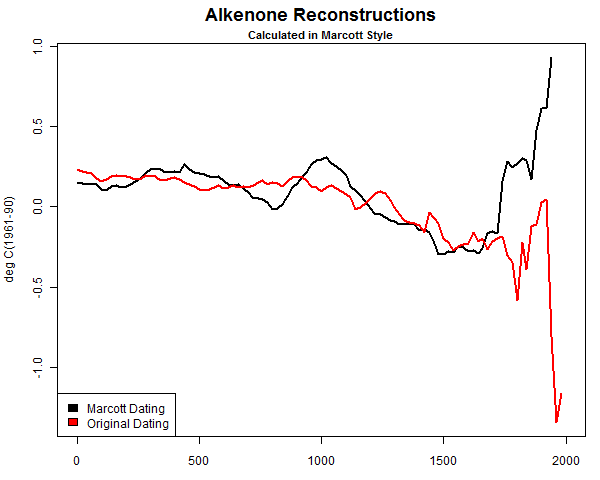
Marcott, Shakun, Clark and Mix did not use the published dates for ocean cores, instead substituting their own dates. The validity of Marcott-Shakun re-dating will be discussed below, but first, to show that the re-dating “matters” (TM-climate science), here is a graph showing reconstructions using alkenones (31 of 73 proxies) in Marcott style, comparing the results with published dates (red) to results with Marcott-Shakun dates (black). As you see, there is a persistent decline in the alkenone reconstruction in the 20th century using published dates, but a 20th century increase using Marcott-Shakun dates. (It is taking all my will power not to make an obvious comment at this point.)
alkenone-comparison
Figure 1. Reconstructions from alkenone proxies in Marcott style. Red– using published dates; black– using Marcott-Shakun dates.

Read More

The media went bonkers in reporting the Marcott paper  and this diagram will now go down in infamy:

marcott et al

This scandal is causing much attention ( here and here) but there is a deafening silence from the authors, from Science and from the – no doubt – anonymous reviewers.

I cannot draw but I have a clear image of a lone McIntyre battling against the Hockey Sticks. Perhaps a Josh can do justice to the image in my head.

The McIntyre slaying the Hockey Stick

The McIntyre slaying the Hockey Stick

Dark and mysterious ways of Turkish academia

March 7, 2013

Professor Debora Weber-Wulff addresses some of the dark and mysterious ways of Turkish academia on her blog. Academic misconduct is apparently wide-spread, largely ignored and is condoned making for a culture with very dubious ethics which has become self-perpetuating . It does not paint a very pretty picture but it is noteworthy that the picture is coming to light only because of the work of a group of other academics. But to break out of the vicious circle will not be so easy.

The Dark Alleys of Turkish Academia

I published a short note in September 2012 about the work of a group of academics in Turkey. A. Murat Eren has now organized a translation of their work into English so that a wider group of scientists can take a peek into the very dark alleys of Turkish academia. …..

….. And then there is the list of academics in Turkey with the most retractions to their name — and their current occupation. Let me quote these here, because it is so shocking:

Only one of the authors with multiple retracted papers is not affiliated with academia. Anyone who knows how difficult it is to get a paper retracted will understand the depth of concern here. How can these people teach at university and mentor doctoral students when they themselves have multiple retractions to their names?

The same chapter also reports on the Sezen case, one that I blogged about in June 2012.

Eren’s conclusions:

  • Turkey’s bad academia is self-perpetuating.
  • People who have committed ethical violations in their dissertations and publications are allowed to become thesis supervisors. Students who are misguided by these create dissertations that equally violate ethics, publish insignificant or duplicated papers, and some of them become the new academic generation, in turn completing the cycle.
  • One of the major problems that perpetuates this cycle is the difficulty of access to dissertations. University libraries limit access with arbitrary reasons, and improvements in YÖK Thesis Archive are far from solving the problem in practice.
  • Even when a dissertation is accessed and plagiarism is seen, penalties are far from being deterrent, due to legal and executive roadblocks.
  • While advanced societies take science theft very seriously, actors of science theft in Turkey silently go on with their duties, thus deleteriously undermining the credibility of the field.
  • Even though today’s scientists in Turkey are not proactive, and they are mostly mute unless they have to defend themselves, I believe that self-criticism will become a way to reveal and eventually eradicate academical problems in Turkey in the future.

I am indebted to the Turkish scientists who have worked on this. I have corresponded with them and did some proofreading on the English version. I hope that this will shine a bright light down the dark alleys