Archive for the ‘Alarmism’ Category

Pachauri’s home institute finds him guilty of sexual harassment

May 31, 2015

RK Pachauri (he of IPCC infamy) has TERI (The Energy and Resources Institute, formerly called the Tata Energy and Resources Institute) as his “home institute”. They have, in an internal investigation, found him guilty of sexual harassment.

(I am not Pachauri’s greatest fan since I consider him something of a charlatan. I met him once a long time ago but was not too impressed. But he did fit in very well in the IPCC where – as a non-scientist doing science by authority – he found himself very much at home).

First Post: RK Pachauri, former TERI chief, has been found guilty of sexually harassing a junior colleague by the organisation’s internal panel.

According, to a report on The Hindustan Times, the Internal Complaints Committee (ICC) also noted that when the woman resisted, Pachauri had retaliated by ‘taking away her work’.

The panel’s conclusion is damning evidence of the fact that Pachauri was indeed in the wrong and this development will make it impossible for him to assume charge back as TERI chief anytime soon. 

After the allegations of sexual harassment had surfaced and a criminal case filed against him on 13 February this year, Pachauri had initially refused to step down, saying that he wanted ‘the truth to win’. However, following pressure from activists, he had to quit. He also had to quit from the UN panel on climate after he was implicated in the case.

….. The Hindustan Times report: “Several of Pachauri’s emails, as attached by the woman in her complaint to TERI, go “beyond the professional space,” found the ICC, that comprised three women. Upon a detailed review of all messages exchanged between Pachauri and the woman, the ICC found that the accused’s behavior was “causing her discomfort and harassment.”

A case has been filed against him and he is on bail.

Deccan ChronicleLast week, the Delhi High Court refused to cancel immediately the anticipatory bail granted by a trial court to Pachauri.

The matter has been posted for July 16 after the counsel for Pachauri sought more time to file response to the application move by the 29-year-old woman, who has alleged that “free and fair investigation” cannot be carried out if Pachauri is “allowed to roam around freely.”

The complainant had moved the High Court seeking cancellation of the anticipatory bail granted to Pachauri by the trial court in the case. The complainant’s counsel alleged before the court that Pachauri was “dictating what needs to be said to witnesses” in the case.

He claimed there was “overwhelming evidence” against Pachauri that he misused the bail conditions. A criminal case on charges of sexual harassment, stalking and criminal intimidation was registered against Pachauri on February 18 by the police.

Now it only needs to be admitted that the IPCC, including during Pachauri’s tenure as Chairman, has raped and discredited science in general and “climate science” in particular..
Obama deals with imaginary threats while “in denial” about ISIS

May 25, 2015

I would have said that Barack Obama is not just “in denial” but living in a bubble of his own making. If one needed an example to illustrate a “clear and present” danger, there couldn’t be one better than the advance of ISIS and the lack of resistance from the Iraqi Army. It is the danger of advancing barbarism and the lack of resistance from the “civilised” world represented by the US and its allies. The risk now is greater than that imagined to be posed by Saddam Hussain’s imaginary WMD. It is greater than the risk posed by Gaddafi in Libya.

And instead Obama is blathering on about the imaginary immediacy of the imaginary risk of imaginary global warming. “An immediate risk to our national security ….and we need to act now” he proclaims. He stopped just short of ordering air strikes against global warming.

The Guardian:

Senator John McCain on Sunday attacked the president for citing climate change as a threat to national security, suggesting that the Obama administration’s focus on environmental issues was detracting from the fight against Islamic State militants in Iraq and Syria.

The comments by the Senate armed services committee chairman were part of a rotating blame game over the Memorial Day weekend about who is responsible for recent gains by Isis fighters, who last week took control of the ancient Syrian city of Palmyra and the Iraqi city of Ramadi.

“There is no strategy, and anybody who says there is, I’d like to hear what it is,” McCain said, appearing on CBS News. “Because it certainly isn’t apparent. Right now we are seeing these horrible reports, in Palmyra, they’re executing people and leaving their bodies in the streets.

“Meanwhile the president of the United States is saying that the biggest problem we have is climate change.”

In a commencement address at the US Coast Guard Academy last week, President Barack Obama said climate change posed an “immediate risk”.

“I’m here today to say that climate change constitutes a serious threat to global security,” Obama said. “An immediate risk to our national security. And make no mistake, it will impact how our military defends our country. And so we need to act, and we need to act now.”

Bolton was just as blunt, accusing the White House of being in denial.

Washington Examiner:

White House officials are “in denial” about the threat posed by Islamic State fighters in the Middle East, former U.S. Ambassador to the United Nations John Bolton said Sunday.

“They just simply will not acknowledge that ISIS is a threat,” Bolton told Fox News Sunday’s Chris Wallace. “I think they’re blinded by their own ideology.”

Bolton said countries in the region, such as Turkey and Saudi Arabia, “need American leadership” to fight the rising extremist movement that has swallowed up cities in Iraq in recent weeks.

“Are we really saying we are going to put American security in the hands of the Saudi defense ministry?” Bolton said.

And the spin doctors are out again to divert attention from the lack of US strategy and instead to blame the Iraqis. The Iraqis are now nothing more than what has been created by the US. If they lack the will to fight it is because the US “divide and rule” policy has sapped their will to fight. And the artificially created Iraq, without the Shia element will always be incomplete. But to bring the Shia into a position of strength – and thereby favour Iran – is ideologically impossible for Obama. He is stuck with his religious commitment to Saudi Arabia. Maybe that will change when the nuclear deal with Iran has to be struck.

On Sunday the US defense secretary, Ash Carter, blamed the fall of Ramadi, in Anbar province west of Baghdad, not on a lack of American commitment but on Iraqi forces, who he said lack the “will to fight”.

“What apparently happened is the Iraqi forces just showed no will to fight,” Carter told CNN. “They were not outnumbered. In fact, they vastly outnumbered the opposing force. That says to me, and I think to most of us, that we have an issue with the will of the Iraqis to fight [Isis] and defend themselves.”

The simple conclusion I come to is that merely stating that he has a strategy does not mean that Obama actually has any strategy. His actions (or lack of action) actually demonstrate that he does not.

Cold – not heat – is the real killer

May 24, 2015

Climate will change as it always has. While there is a religious belief among the radicalised of the true faith that man-made global warming is real, the reality is that there is no signature of man-made global warming that can be distinguished from the natural variations of climate. I have no doubt that whatever change occurs, humans will cope as well as they are able to, and history shows that even glacial conditions have not held back human development. When (not if) the current inter-glacial ends, humans will have access to energy levels and energy intensities magnitudes greater than what was available during the last glacial maximum (20 – 25,000 years ago). And we will have fossil fuels and nuclear energy to thank for that. Hydro Power will virtually vanish during glacial conditions. The more time we have to prepare, and the preparations we make, will determine how well we cope and how many deaths may occur while we do adjust.

It is cold which is by far the more dangerous and which requires the greater preparation. It is far, far better we prepare for the ice age that will undoubtedly come than for any imaginary man-made global warming.

A new paper in the Lancet reports on an analysis of over 74 million (74,225,200) deaths between 1985 and 2012 in 13 countries with a wide range of climates, from cold to subtropical. The results show that moderate cold or heat cause more deaths than extreme weather and that cold kills 20 times more people than heat.

Antonio Gasparrini et alMortality risk attributable to high and low ambient temperature: a multicountry observational study. The Lancet, May 2015 DOI: 10.1016/S0140-6736(14)62114-0

The Lancet (press release):

Cold weather kills 20 times as many people as hot weather, according to an international study analysing over 74 million deaths in 384 locations across 13 countries. The findings, published in The Lancet, also reveal that deaths due to moderately hot or cold weather substantially exceed those resulting from extreme heat waves or cold spells.

“It’s often assumed that extreme weather causes the majority of deaths, with most previous research focusing on the effects of extreme heat waves,” says lead author Dr Antonio Gasparrini from the London School of Hygiene & Tropical Medicine in the UK. “Our findings, from an analysis of the largest dataset of temperature-related deaths ever collected, show that the majority of these deaths actually happen on moderately hot and cold days, with most deaths caused by moderately cold temperatures.” 

…… Around 7.71% of all deaths were caused by non-optimal temperatures, with substantial differences between countries, ranging from around 3% in Thailand, Brazil, and Sweden to about 11% in China, Italy, and Japan. Cold was responsible for the majority of these deaths (7.29% of all deaths), while just 0.42% of all deaths were attributable to heat. The study also found that extreme temperatures were responsible for less than 1% of all deaths, while mildly sub-optimal temperatures accounted for around 7% of all deaths—with most (6.66% of all deaths) related to moderate cold. …

The study also shows that cold has greater impact in Japan and Italy than in Sweden but that is only to be expected. Warm countries will be more unprepared for cold and vice versa.

Greenland seasonal ice melt has hardly started and is running more than one month late

May 21, 2015

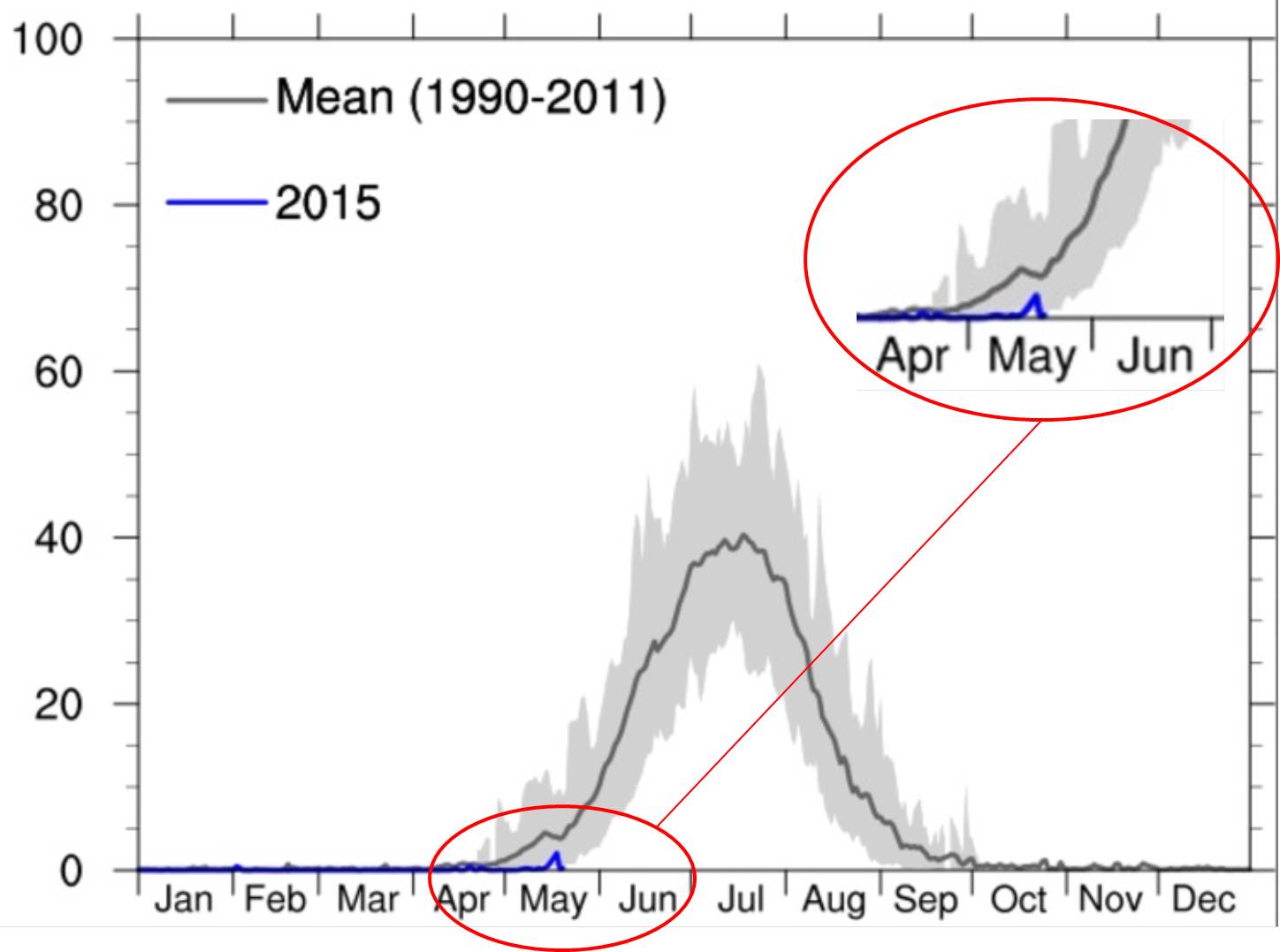
The Danish Meteorological Institute reports that the Greenland seasonal ice melt is running very late and more than a month behind the 1990 -2011 mean. It is still at very low levels and the lowest recorded for this day of the year. The alarmists would have us believe that Greenland ice was/is/will be/should be melting at unprecedented rates. But there is, as always, a gross disconnect between reality and their models and their wishful thinking.

The percentage of the total area of the ice where the melting occurred from January 1 until today (in blue). For comparison the average for the period 1990-2011 is shown in the dark grey curve. The variation from year to year for each of the days during the melt season ​are shown as the gray shaded area.

Greenland ice melt far behind normal in 2015

Greenland ice melt far behind normal in 2015

h/t Real Science

Weak El Nino conditions but timely monsoon still expected

May 18, 2015

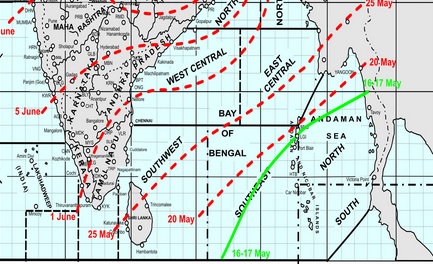
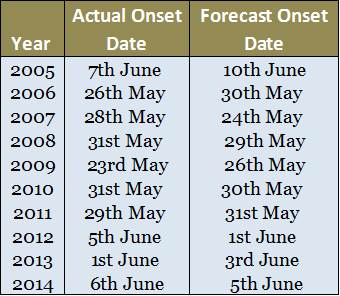
El Nino conditions can suppress the Indian southwest monsoon. Weak El Nino conditions exist for the second year running but the IMD’s forecast is for the monsoon to hit the mainland at Kerala on 30th May ± 4 days.

Whenever an El Nino is about, the doomsayers compete with catastrophe scenarios, but the possibility of a “bad” monsoon in 2015 is diminishing.The economic and industrial recovery should not be adversely affected to any great extent.

Forecasts for the last nine years (2005 to 2014) were as in the table below.

Monsoon onset dates.emf

A timely monsoon (onset during May) does not necessarily mean a “good” monsoon during the official 4 months (June to September) of the season, but does decrease the probability of a “bad” monsoon. The pre-monsoon rains during May have been somewhat higher than normal but not uniformly across the country. Rainfall at the wrong time is not that useful of course but early rainfall in May and late rainfall in October does still have value.

IMD ForecastFor the last about six months, positive SST anomalies have been prevailing over the western and the central Pacific Ocean. However, the SSTs over eastern Pacific after remaining near to below normal between late December 2014 and mid-March 2015 have now become above normal. Thus currently, weak El Nino conditions are prevailing over the Pacific.

The latest forecast from the IMD-IITM coupled model forecast indicates El Nino conditions are likely to persist during the southwest monsoon season.

At present, slight negative Indian Ocean Dipole (IOD) conditions are prevailing over Indian Ocean. The latest forecast from the coupled model indicates negative IOD conditions are likely to persist during the monsoon season. ……. the extreme sea surface temperature conditions over Pacific and Indian Oceans particularly ENSO conditions over Pacific (El Nino or La Nina) are known to have strong influence on the Indian summer monsoon.

 Quantitatively, the monsoon seasonal rainfall is likely to be 93% of the Long Period Average (LPA) with a model error of ± 5%. The LPA of the season rainfall over the country as a whole for the period 1951-2000 is 89 cm.

It is early days yet, but currently the advancing monsoon front is past the Andamans and slightly ahead of the long term average.

Monsoon front May 2015 IMD

Monsoon front May 2015 IMD

NASA “US has not seen landfall of any hurricane of Category 3 or higher for nine years”

May 15, 2015

What exactly is this man-made climate change which is caused by the use of fossil fuels?

It cannot be global warming which has been absent for almost 20 years while the use of fossil fuels has doubled.

“It is stormier weather”, I hear the warmists say.

Well not according to NASA at least for hurricanes. And when NASA can do no better than to reckon that the non-occurrence of hurricanes is a matter of “luck” I have little tolerance for the alarmists and their “religious belief” that every storm which occurs is caused by human influences.

NASA:

Statistical analyses from hurricane track data indicate that for any particular Atlantic Hurricane season, there is about a 40 percent chance that a major hurricane (category 3 or higher) will make landfall in the continental United States. However, during the period from 2006 to 2014, no major hurricanes have made landfall.
NASA’s Goddard Space Flight Center

The United States hasn’t experienced the landfall of a Category 3 or larger hurricane in nine years – a string of years that’s likely to come along only once every 177 years, according to a new NASA study.

The current nine-year “drought” is the longest period of time that has passed without a major hurricane making landfall in the U.S. since reliable records began in 1850, said Timothy Hall, a research scientist who studies hurricanes at NASA’s Goddard Institute for Space Studies, New York.

The National Hurricane Center calls any Category 3 or more intense hurricane a “major” storm. The last major storm to make landfall in the U.S. was Hurricane Wilma on Oct. 16, 2005 – the fourth major storm landfall of that year, which was the most active Atlantic hurricane season on record. Of course, storms smaller than a Category 3 have made landfall with destructive results, such as Hurricane Sandy in 2012.

Hall and colleague Kelly Hereid, who works for ACE Tempest Re, a reinsurance firm based in Connecticut, ran a statistical hurricane model based on a record of Atlantic tropical cyclones from 1950 to 2012 and sea surface temperature data. While hurricane records stretch back to 1850, the data becomes less complete prior to 1950, Hall said. The study was published recently in Geophysical Research Letters.

The researchers ran 1,000 computer simulations of the period from 1950-2012 – in effect simulating 63,000 separate Atlantic hurricane seasons. They found that a nine-year period without a major landfall is likely to occur once every 177 years on average.

While the study did not delve into the meteorological causes behind this lack of major hurricane landfalls, Hall said it appears it is a result of luck.

“The last nine hurricane seasons were not weak – storms just didn’t hit the U.S.,” Hall said. “It seems to be an accident of geography, random good luck.” ….. “Each year is roughly independent of the year before,” Hall said. “There are known signals, and natural cycles, and possibly human-induced influences. But for the most part, they are independent, especially for the rare intense landfalls.”

The Antarctic has more ice cover than has ever been measured before. Global sea ice extent is at its highest levels seen in a decade. Snow cover in the Northern hemisphere are at among the highest levels recorded. So if the 9-year non-occurrence of US hurricanes is only to be expected every 177 years, what exactly is this man-made climate change which is caused by fossil fuels?

The Lorentz effect does not apply to climate, and fossil fuels are not the “flap of a butterfly’s wings” causing climate change.

The butterfly effect

coined by Edward Lorenz, is derived from the metaphorical example of the details of a hurricane (exact time of formation, exact path taken) being influenced by minor perturbations such as the flapping of the wings of a distant butterfly several weeks earlier. Lorenz discovered the effect when he observed that runs of his weather model with initial condition data that was rounded in a seemingly inconsequential manner would fail to reproduce the results of runs with the unrounded initial condition data. A very small change in initial conditions had created a significantly different outcome”.


Reality check: Increasing sea ice making it difficult to reach Antarctic stations

May 12, 2015

This is reality – not a forecast from a a mathematical model.

news.com:

THE size and power of ships needed to break through Antarctica’s increasing sea ice levels is a worry for the global research community.

IN recent years countries including Australia have battled to reach their stations on the frozen continent, making resupply missions time consuming and expensive, Australian Antarctic Division spokesman Rod Wooding said.

“We’re noticing that the sea ice situation is becoming more difficult,” he told reporters on Monday.The sea ice through the Southern Ocean and around Australia’s Mawson Station usually breaks up for a couple of months a year allowing ships to enter the bay but that did not happen in 2013-14.“We had to get fuel in by helicopter which is inadequate for the long-term sustainability of the station,” Dr Wooding said.“Other national programs have had similar problems: the French in particular, Japanese also.”

The problem has been the main driver for a meeting of more than 50 international experts, convening in Hobart until Wednesday, to try and nut out a plan to accurately forecast sea ice levels.Meteorologists along with ice and Antarctic experts will take part in a series of workshops, looking at trends in satellite imagery and the environment.“One of the things that Antarctic programs will need to understand going forward is what sort of ice breaking capability we’re going to need to get through the ice in these areas,” Dr Wooding said.“Australia is currently in a tender process for a new ice breaker … and it’s important in understanding what sort of ice breaker we might need … to have a good understanding of likely sea ice conditions.”The

re is no single reason why sea ice levels are increasing but Hobart-based expert Tony Worby said it tends to gather around icebergs and wind patterns also play a part.“We know sea ice extent is increasing, there was a record maximum in September 2014,” Prof Worby said. “It’s quite hard to forecast but whatever effort we put in to improving our ability to forecast sea ice will ultimately pay dividends in terms of savings for national programs.”

Sunshinehours also points out that current Antarctic sea ice extent is the highest measured for this time of year. (In fact the global sea ice extent is the 3rd highest ever measured for this day of the year).

Antarctic_Sea_Ice_Extent_Zoomed_2015_Day_130_1981-2010

from sunshinehours


Earth has too many failed species and 30% need to go extinct

May 1, 2015

There is a biodiversity myth that “more species” is better than “fewer species”. Even when the species are failed or useless species. The myth counts the 5 mass extinctions of the past as “bad events”, even though many current species (including humans) could not have evolved without the mass extinctions creating the space for new species. Every mass extinction has provided a cleansing (though not always effective) process for removing the failures of evolution.

The alarmist brigade are publicising a paper which claims that 1 in 6 species will go extinct due to global warming. (I note that the paper refers to global warming but all the publicity quotes “climate change”. What if the climate change was a global cooling?) The paper published in Science is a nonsense speculation and the abstract begins “Current predictions of extinction risks from climate change vary widely depending on the specific assumptions and geographic and taxonomic focus of each study.” He then goes on to selectively review the literature and chooses just those papers which support his conclusion. The author, Mark Urban, really has no value to add to anything about the climate and has just used the most “politically correct” opinion which ensures his funding and his publication. He uses “politically correct” assumptions to come to – surprise, surprise! – “politically correct” conclusions. He is a biologist but his “suggestions” about species and species extinction are equally valueless. He concludes that if global temperatures rises by 4ºC then up to 1 in 6 existing species will go extinct.

There are two things wrong with this example of bad science:

  1. Both the magnitude of global warming and the effect of warming are assumed (by the author and the papers he chooses to cite). The argument is circular.
  2. He assumes that the extinction of 1 in 6 species is a “bad thing”, even though there are more species now than ever before.

The sheer number of species in existence today is an indicator of how inefficient the process of evolution is. There are more failed species struggling along today and which need to go extinct, than ever before. It is my thesis that there is an optimum number of interconnected species to suit any given conditions. Evolution does not go for the optimum and because of the ineffectiveness of the process produces a great deal of “rubbish”. It is my contention that the Earth desperately needs another mass extinction to clean out the accumulated and accumulating muck of the “rubbish” of failed species.

Evolution fails in over 99% of its attempts to create species that can survive. The 1%  of species that do and have survived may seem to be perfectly tailored for the prevailing conditions but that is putting the cart before the horse. Evolution has no direction and does not seek excellence. It only throws up a plethora of species where just 1% of those species happen to suit the prevailing conditions.

The “conservation” movement and its blind worship of “biodiversity” borders on the stupid. Failed and useless species are given as much weight (sometimes more weight) than successful and useful species. Failing species are protected and successful species are persecuted. Useful species are hunted and useless species are coddled.

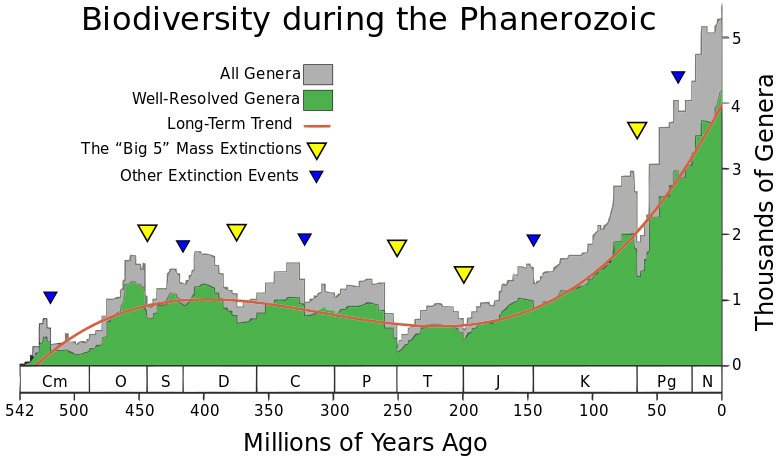
The fossil record shows that biodiversity in the world has been increasing dramatically for 200 million years and is likely to continue. The two mass extinctions in that period (at 201 million and 66 million years ago) slowed the trend only temporarily. Genera are the next taxonomic level up from species and are easier to detect in fossils. The Phanerozoic is the 540-million-year period in which animal life has proliferated. Chart created by and courtesy of University of Chicago paleontologists J. John Sepkoski, Jr. and David M. Raup.

The 3rd and 5th mass extinctions probably reduced the then existing number of species by about 50%. More than 30% of the species alive today (plant and animal) could be considered failed species – where a “failed species” is one which cannot cope with current change, or provides no benefit to any other species, or is in an evolutionary cul-de-sac. These species need to be allowed to go extinct or – when they are harmful to human or other life – to be terminated.

Adjusted (fiddled) data showing global warming to be investigated

April 26, 2015

“Global” temperature is necessarily a construct. It is “calculated” by taking raw temperature data as measured at particular locations, massaging this data according to algorithms devised by those calculating the “global temperature, applied to areas where there are no measurements by some other algorithms (oceans, poles, forests and deserts), adjusting past data and then coming up with a “global” temperature.

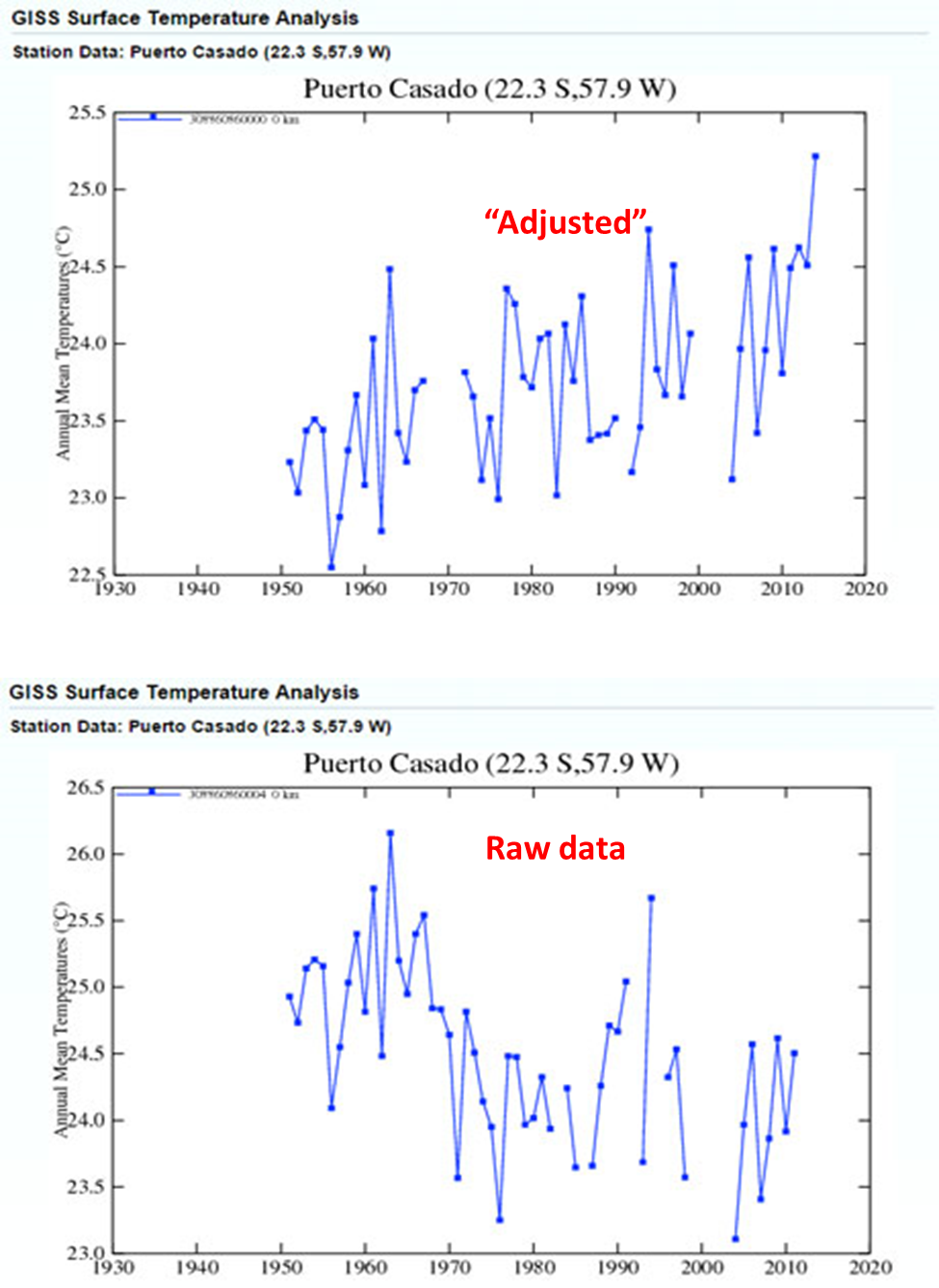
Raw data is never used without “adjustment”. Remarkably the adjustments invariably cool the past. Every year, data from the past is further adjusted! The trends and results presented represent more the adjustment algorithms used rather than the parameters themselves. As this example of “adjustment” of raw data from Puerto Casada to convert an actually measured cooling trend into an adjusted warming trend illustrates

Cooling the past: Puerto Casada From raw to adjusted data

Cooling the past: Puerto Casada From raw to adjusted data

Studies have already shown that, in the US, Australia, New Zealand, the Arctic and South America, in far too many cases, temperatures have been adjusted to show a stronger and clearer warming trend than is justified by the raw data.

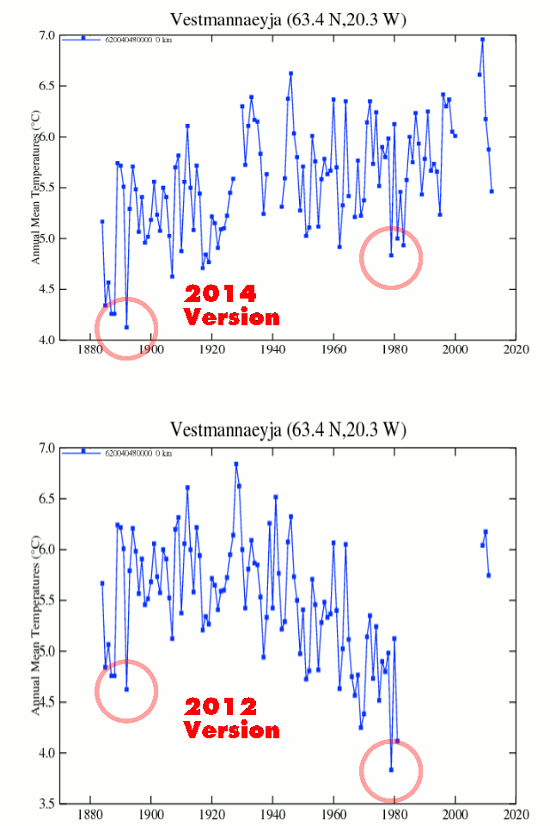
As RealScience shows with this more dramatic example from Vestmanneyja

vestmannaeyja

https://stevengoddard.files.wordpress.com/2015/01/vestmannaeyja.gif?w=640

An investigation now to be carried out by an international team is to establish a full and accurate picture of just how much of the published record has been adjusted in a way which gives the impression that temperatures have been rising faster and further than was indicated by the raw measured data.

Christopher Booker writes in the Daily Telegraph:

…. something very odd has been going on with those official surface temperature records, all of which ultimately rely on data compiled by NOAA’s GHCN. Careful analysts have come up with hundreds of examples of how the original data recorded by 3,000-odd weather stations has been “adjusted”, to exaggerate the degree to which the Earth has actually been warming. Figures from earlier decades have repeatedly been adjusted downwards and more recent data adjusted upwards, to show the Earth having warmed much more dramatically than the original data justified.

So strong is the evidence that all this calls for proper investigation ………  The Global Warming Policy Foundation (GWPF) has enlisted an international team of five distinguished scientists to carry out a full inquiry into just how far these manipulations of the data may have distorted our picture of what is really happening to global temperatures. 

The panel is chaired by Terence Kealey, until recently vice-chancellor of the University of Buckingham. His team, all respected experts in their field with many peer-reviewed papers to their name, includes Dr Peter Chylek, a physicist from the National Los Alamos Laboratory; Richard McNider, an emeritus professor who founded the Atmospheric Sciences Programme at the University of Alabama; Professor Roman Mureika from Canada, an expert in identifying errors in statistical methodology; Professor Roger Pielke Sr, a noted climatologist from the University of Colorado, and Professor William van Wijngaarden, a physicist whose many papers on climatology have included studies in the use of “homogenisation” in data records.

Their inquiry’s central aim will be to establish a comprehensive view of just how far the original data has been “adjusted” by the three main surface records: those published by the Goddard Institute for Space Studies (Giss), the US National Climate Data Center and Hadcrut, that compiled by the East Anglia Climatic Research Unit (Cru), in conjunction with the UK Met Office’s Hadley Centre for Climate Prediction. All of them are run by committed believers in man-made global warming.

Since “global” temperature – by definition – is a calculated construct it is inevitable that data must be “applied” in some way to make this calculation.

But no matter what the calculation method, rewriting history is suspect. When the data of the past keeps being adjusted, and adjusted again, and always systematically downwards, and when all the adjustments invariably cool the past more than the present, then the apparent trend in global temperature has little to do with any definition of global temperature and is merely a trend of the adjustments.

Mass extinctions correct for evolution’s greater than 99% failure rate

April 23, 2015

There are said to have been 5 great mass extinctions in the last 540 million years (the Phanerozoic) and a new paper claims  – without carrying much conviction – that it was really six (with two being very close together). The Alarmists claim that humans are causing a new great mass extinction (the 6th or the 7th) and that this threatens a catastrophic collapse of biodiversity. This contradicts the fact that there are more species alive today than ever before. Moreover, why this high level of biodiversity is necessary or a “good thing” remains a mystery.

The mass extinctions of the past are generally put down to various external events which provided a sharp shock to the environment in which highly stressed species existed. Nearby supernovas, asteroid impacts, sudden tectonic plate shifts, glaciation, and super-dooper-volcanic eruptions are among the “shocks” suggested.

But I would argue instead that mass extinctions are necessary and unavoidable. They are necessitated by the ineffectiveness of the process of evolution itself. They provide the self-correction necessary to cope with the mass of “rubbish” species created by the hit-and-miss process of evolution. The external shock is only incidental and acts as the trigger for the extinction of the highly-stressed “rubbish” species. None of the historical mass extinctions ever posed any threat to the continuation of life. Instead they have served to muck out the dung from the evolutionary stables.

The fossil record shows that biodiversity in the world has been increasing dramatically for 200 million years and is likely to continue. The two mass extinctions in that period (at 201 million and 66 million years ago) slowed the trend only temporarily. Genera are the next taxonomic level up from species and are easier to detect in fossils. The Phanerozoic is the 540-million-year period in which animal life has proliferated. Chart created by and courtesy of University of Chicago paleontologists J. John Sepkoski, Jr. and David M. Raup.

The fossil record shows that biodiversity in the world has been increasing dramatically for 200 million years and is likely to continue. The two mass extinctions in that period (at 201 million and 66 million years ago) slowed the trend only temporarily. Genera are the next taxonomic level up from species and are easier to detect in fossils. The Phanerozoic is the 540-million-year period in which animal life has proliferated. Chart created by and courtesy of University of Chicago paleontologists J. John Sepkoski, Jr. and David M. Raup.

The clue lies here:

Wikipedia: Although there are 10–14 million species of life currently on the Earth, more than 99 percent of all species that ever lived on the planet are estimated to be extinct.

Evolution fails in over 99% of its attempts to create species that can survive. The 1%  of species that do and have survived may seem to be perfectly tailored for the prevailing conditions but that is putting the cart before the horse. Evolution has no direction and does not seek excellence. It only throws up a plethora of species where just 1% of those species happen to suit the prevailing conditions. One round peg out of a 100 different shapes may happen to fit a round hole but the round peg itself was not designed to fit – it happened to be the only one of many which did. For every species which is just good enough to survive, evolution gives another 99 which are not. As a process it is a remarkably ineffective one. Humans are not the result of “intelligent design”. They are just the 1% of all the species created by evolution which happened to fit the round hole of the prevailing environment.

Stewart Brand writes in Aeon that “the idea that we are edging up to a mass extinction is not just wrong – it’s a recipe for panic and paralysis”

Aeon: Many now assume that we are in the midst of a human-caused ‘Sixth Mass Extinction’ to rival the one that killed off the dinosaurs 66 million years ago. But we’re not. The five historic mass extinctions eliminated 70 per cent or more of all species in a relatively short time. That is not going on now. ‘If all currently threatened species were to go extinct in a few centuries and that rate continued,’ began a recent Nature magazine introduction to a survey of wildlife losses, ‘the sixth mass extinction could come in a couple of centuries or a few millennia.’

The range of dates in that statement reflects profound uncertainty about the current rate of extinction. Estimates vary a hundred-fold – from 0.01 per cent to 1 per cent of species being lost per decade. The phrase ‘all currently threatened species’ comes from the indispensable IUCN (International Union for Conservation of Nature), which maintains the Red List of endangered species. Its most recent report shows that of the 1.5 million identified species, and 76,199 studied by IUCN scientists, some 23,214 are deemed threatened with extinction. So, if all of those went extinct in the next few centuries, and the rate of extinction that killed them kept right on for hundreds or thousands of years more, then we might be at the beginning of a human-caused Sixth Mass Extinction.

Worrying about whether the 6th mass extinction has started or not is moot. A 6th mass extinction is needed.

A failure rate of 99% creates a terrible lot of dross. Over time, all the “rubbish” species produced by evolution accumulate and clutter the available environment. They restrict the space available for more suitable (worthy) species. The analogy with my desk fits perfectly. Only one of every hundred pieces of paper needs to be kept. Every once in a while – usually triggered by the shock of having to make my tax declaration – I clear out the rubbish. Mass extinctions are then due to the accumulation of too many “rubbish” species which are highly stressed – because they are not quite good enough to survive – and then which end up being susceptible to any external shock which tips them over into the dustbin of extinction – where they belong. It is mass extinctions which provides room for the “good enough” species to grow and even thrive. Mass extinctions provide the clean-up mechanism for a very sloppy and inefficient evolution process. A rather drastic clean-up method perhaps but no more drastic than diverting the Alpheus and Peneus rivers to muck out the Augean stables!

If it is in fact true that we have more species alive today than ever before then the number of “rubbish” species around is also probably at an all-time high. A new, 6th, mass extinction is probably necessary to clean up the mess. It is clearly overdue.

And that is really the problem with the alarmist conservationists who are wasting resources in trying to protect some of the “rubbish” species which are merely examples of the failures of evolution and which deserve to be consigned to the dustbin of extinction. Species which do not adapt to the dominating presence of humans are among the “rubbish”. It may be regrettable that tigers and elephants are on the “rubbish” list but the reality is that they are failed species unable to cope with their environments and which are now restricting the dominant species. It only emphasises that true conservation would not try to freeze these species into failed patterns but to genetically adapt them to be neo-tigers or neo-elephants which would no longer just be “rubbish”.