Archive for the ‘Alarmism’ Category

Low-salt pseudo science

August 19, 2014

For almost 100 years, some scientists have been warning about the harmful effects of salt in our diets. For the last 40 years or so that has also been the “consensus” view of the medical/regulatory establishment. It was “settled science” we were told. There was complete “consensus” within the medical world it was proclaimed.

Salt was evil.

But apparently the “settled” science was not quite so settled after all. The “consensus” was nothing more than “group think”. In the words of the Wall Street Journal:

Yet the latest USDA food pyramid, which was updated as recently as 2011, clings to simplistic low-salt pseudo-science. The FDA is pressuring food manufacturers and restaurants to remove salt from their recipes and menus, while the public health lobby is still urging the agency to go further and regulate NaCl as if it were a poison.

The larger point is that no scientific enterprise is static, and political claims that some line of inquiry is over and “settled” are usually good indications that real debate and uncertainty are aboil. In medicine in particular, the illusion that science can provide some objective answer that applies to everyone—how much salt to eat, how and how often to screen for cancer, even whom to treat with cholesterol-lowering drugs, and so on—is a special danger.

It is not so easy now to retrace exactly how the salt scare developed and became part of the establishment view. Certainly Lewis Dahl of the Brookhaven National Laboratory was one of the key actors who spread the alarm. He was well placed within US Government circles and soon rather dubious and alarmist conclusions became part of the “establishment view”. Pseudo science became “settled science”:

Scientific American:

In 1904 French doctors reported that six of their subjects who had high blood pressure—a known risk factor for heart disease—were salt fiends. Worries escalated in the 1970s when Brookhaven National Laboratory’s Lewis Dahl claimed that he had  “unequivocal” evidence that salt causes hypertension: he induced high blood pressure in rats by feeding them the human equivalent of 500 grams of sodium a day. (Today the average American consumes 3.4 grams of sodium, or 8.5 grams of salt, a day.)

Dahl also discovered population trends that continue to be cited as strong evidence of a link between salt intake and high blood pressure. People living in countries with a high salt consumption—such as Japan—also tend to have high blood pressure and more strokes. But as a paper pointed out several years later in the American Journal of Hypertension, scientists had little luck finding such associations when they compared sodium intakes within populations, which suggested that genetics or other cultural factors might be the culprit. Nevertheless, in 1977 the U.S. Senate’s Select Committee on Nutrition and Human Needs released a report recommending that Americans cut their salt intake by 50 to 85 percent, based largely on Dahl’s work.

Thereafter “group think” took over. Consensus opinion – and not objective science – ruled. Now we are finding out that there is no clear evidence that salt is harmful and there is some evidence that too little salt is dangerous and can increase the risk of heart disease.

Scientific American:

In April 2010 the Institute of Medicine urged the U.S. Food and Drug Administration to regulate the amount of salt that food manufacturers put into products; New York City Mayor Michael Bloomberg has already convinced 16 companies to do so voluntarily. But if the U.S. does conquer salt, what will we gain? Bland french fries, for sure. But a healthy nation? Not necessarily.

This week a meta-analysis of seven studies involving a total of 6,250 subjects in the American Journal of Hypertension found no strong evidence that cutting salt intake reduces the risk for heart attacks, strokes or death in people with normal or high blood pressure. In May European researchers publishing in the Journal of the American Medical Association reported that the less sodium that study subjects excreted in their urine—an excellent measure of prior consumption—the greater their risk was of dying from heart disease. These findings call into question the common wisdom that excess salt is bad for you, but the evidence linking salt to heart disease has always been tenuous.

It has taken 40 years for this alarmist meme that salt is harmful to be brought down to earth. Group-think and “consensus science” has its own inertia which makes it difficult to overturn what becomes matters of faith rather than of evidence.

And just a few days ago another establishment paper created headlines when it stated that salt “causes 1.65 million deaths every year across the globe. A published study in New England Journal of Medicine on Thursday, found that an average consumed salt (sodium) per day is twice the amount recommended by the World Health Organization. A 3.95 gm consumption per day beyond the recommended amount of 2 gm”. But all they actually did was measure/estimate salt consumption and then multiplied that by an assumed death rate.  By the time the headlines were written a simple measurement of salt consumption became evidence of the dangers of salt! That’s consensus science!

The 1970s and 80s saw many such alarmist memes – based on little and dubious science – become the “consensus view” and the “politically correct” faith to be followed. It was the time when the nonsensical “Limits to Growth” became the bible of the day. It was the time of the DDT scare where the disadvantages were blown out of all proportion and the subsequent ban has been a case of “throwing the baby out with the bath water. Natural variations of the ozone hole were taken to be due to the human use of fluorocarbons. Acid rain was going to kill all the forests.

Whenever I now hear that some science is “settled” or that there is a consensus around some “belief” – as with climate science today – I am inclined to view the claims with a very large bushel of salt.

Climate models wrong again in ignoring brown carbon from wildfires

August 11, 2014

So much for global warming being settled and the infallibility of incomplete and inadequate climate models.

Climate models generally take the effect of wildfires (brown carbon) on climate to be zero (it is not a parameter that is normally included). Both black and brown carbon particulates are products of incomplete combustion.

A new paper reports on experiments with the combustion of biomass and the brown carbon particulate matter in the smoke:

Saleh et alBrownness of organics in aerosols from biomass burning linked to their black carbon content. Nature Geoscience (2014) doi:10.1038/ngeo2220

The research provides information which can now be included in climate models but since it is a parameter which is not usually included, the obvious conclusion is that for any given level of warming some other effect (most likely that of man-made emissions of carbon dioxide) has been overestimated in the models.

But it is not the obvious conclusion that makes the headlines. Instead it is the ridiculous and alarmist statement that Forest fires can heat the climate that is the headline that Swedish Radio (which is about as orthodox as they come) chooses to lead with. They would clearly like to project the picture of a greater threat and not that of inadequate climate models.

Abstract: …. Here we present smog chamber experiments to characterize the effective absorptivity of organic aerosol from biomass burning under a range of conditions. We show that brown carbon in emissions from biomass burning is associated mostly with organic compounds of extremely low volatility. In addition, we find that the effective absorptivity of organic aerosol in biomass burning emissions can be parameterized as a function of the ratio of black carbon to organic aerosol, indicating that aerosol absorptivity depends largely on burn conditions, not fuel type. We conclude that brown carbon from biomass burning can be an important factor in aerosol radiative forcing.

The paper claims that brown carbon is a significant factor which must be taken into account and the more significant it is the less significant is man-made carbon dioxide.

Roll on midnight – or why the Doomsday Clock is an abdication to cowardice

August 10, 2014

August 6th is Hiroshima Day and it is now 69 years since the Enola Gay dropped its bomb and the nuclear weapons age began. In 2010, there were about 227,00 hibakusha (被爆者) still alive. In 1945, Hiroshima and Nagasaki met their Doom. But such is the resilience of man that, today, less than 4 generations later, both are thriving cities. Hiroshima has a population today of 1.2 million compared to the 340,000 before the bomb. For Hiroshima and Nagasaki their Doomsday Clocks reached midnight and moved on – into yet another day.

The Doomsday Clock was “invented” in 1947 and, of course is purely symbolic. It is “set” by a group of alarmists to represent the time left before a human induced catastrophe (nuclear war, global warming, genetic modification, disease …) strikes at the “symbolic” hour of midnight. But this symbolism is flawed, rather stupid and just plain wrong. They use midnight as a symbol of the end of things whereas – certainly for me and, I suspect, for most people – midnight is just the start of another day. And when that day ends there will be yet another one to come. When it was first set in 1947 the alarmists of the time reckoned that humanity was 7 minutes away from their “midnight”.  In 1953 the clock was set to 2 minutes to midnight. The time to catastrophe has gone up and down over the years and reached 17 minutes in 1991 when the Berlin Wall fell and optimism ran high – even among the professional pessimists. Currently pessimism has taken over again and we stand just 5 minutes from catastrophe.

Doomsday Clock - Wikipedia

Doomsday Clock – Wikipedia

The Doomsday Clock is nothing more than a subjective – and less than qualitative –  assessment of the state of the world by a group of alarmist pessimists.

Naom Chomsky has a new article in The Unz Review – “How many minutes to midnight”. I’m afraid I do not have the same high opinion of Chomsky – even on language which is his own field – that others seem to have . But on the concept of the Doomsday Clock and the time left for impending disaster, his article is little more than well written drivel. He looks down on most of humanity – apart from himself of course – with a great deal of contempt when he writes

…. August 6, 1945, the first day of the countdown to what may be the inglorious end of this strange species, which attained the intelligence to discover the effective means to destroy itself, but — so the evidence suggests — not the moral and intellectual capacity to control its worst instincts.

Chomsky’s article is not particularly insightful but it serves as an example of the cowardice that alarmists exhibit. Cowardice is the subjugation of actions to fear whereas courage is the subjugation of fears to actions for a purpose. Alarmism and the Doomsday Clock pander to fear. Catastrophe theories never – ever – come to pass. But raising false alarms gets headlines, gets funding and usually provides lucrative opportunities for some. Fending off Doomsday rather than working to some objective becomes the priority of the hour. Political action is diverted to avoidance rather than to achieve goals.

Roll on midnight – and the start of another day!

Swedish Environmental Party makes a fool of itself (again)

August 9, 2014

The Swedish Environmental Party (Miljöpartiet) has not been slow in trying to cash in on the large forest fire in Västmanland. The Swedish General Elections are in September and “anything goes”. Especially if it is alarmist. I don’t expect much intellectual or scientific honesty from them any longer but I though their behaviour yesterday was particularly opportunistic and crass.

  1. Never mind that forest fires in Sweden reduced from over 250,000 hectares destroyed every year before 1850 to less than 1,000 hectares per year in recent times when forest “cultivation” increased.
  2. Never mind that because of the reduced incidence of forest fires the owners have reduced their fire watches.
  3. Never mind that the number of military helicopters suitable for fire fighting have reduced from 33 to 3 in the last 20 years.
  4. Never mind that Sweden no longer has any planes suitable for water bombing.
  5. Never mind that in the grip of complacency, fire fighting equipment has reduced under 3 successive governments.
  6. Never mind that global temperatures have been stagnant for the last 18 years and have actually reduced slightly in the last decade.
  7. Never mind that carbon dioxide emissions by humans are apparently having no impact on real global temperatures (but are absolutely fundamental to every climate model)
  8. Never mind that temperatures in Västmanland this summer are nothing out of the ordinary.

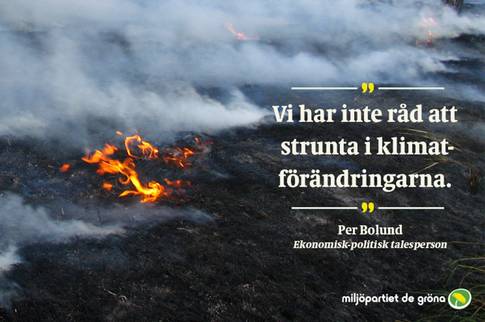
Never mind the facts, just feel the fear. They came out with this picture yesterday even though the Västmanland fire has yet to be brought under control.

“We cannot afford to ignore Climate Change” it reads.

I get the impression that the Swedish Greens have prostituted themselves on the altar of global warming orthodoxy (sorry – climate change >> sorry – extreme events >> sorry – global cooling?).

mp västmanland

mp västmanland

But the temperature anomalies in Västmanland are nothing out of the ordinary.

Västmanland temperatures - The Stockholm Initiative

Västmanland temperatures – The Stockholm Initiative


Another duck species being exterminated for being successful

August 8, 2014

The inconsistencies in the “conservation” movement and the meaningless defence of “biodiversity” have never been so apparent as in this case where the UK is wiping out all the females of a duck species just because the males are too successful.

Once again an inadequate and failing species is being “protected” by exterminating a successful one for no other reason than that it is successful. The nonsense spouted in the name of “conservationism” is amusing but always expensive and without any real benefit.

The Guardian:

It is American, oversexed and over here, but the days of the ruddy duck in the UK are finally numbered, with the latest culling data revealing that just 10 females remain.

The shooting of the final few – at about £3,000 a bird – will mark the end of half a century of occupation by the species. At their peak, their numbers reached 6,500 but their breeding prowess threatened the native European white-headed duck. 

The invasion began in 1948 when the famed conservationist Sir Peter Scott’s love for ducks led him to import three pairs of the colourful US birds to his Slimbridge reserve in Gloucestershire. But their escape and consequent flourishing in the British countryside led to an anguished debate among ornithologists decades later, as well as a nationwide cull that has cost more than £5m. …… 

Apart from their success in the duck world they don’t seem to pose any particular threat to humans

The problem is that the “sexy” males ruddy ducks (Oxyura jamaicensis) are preferred by female white-headed ducks. The resulting hybrid offspring threatened the survival of the white-headed duck, which was already struggling with habitat loss due to development. “Ruddy duck males are particularly aggressive when it comes to breeding and court females more vigorously,” said Madge. “That makes them more attractive to female white-headed ducks.”

The UK ruddy ducks also spread their wings across Europe, into France, Belgium, the Netherlands and into Spain. The discovery of hybrids in the latter country in the 1990s showed the ducks had grown into a continent-wide threat and that sealed their fate. The following year, an eradication programme began in the UK and a marksmen who has been part of the cull since then told the Guardian the birds fulfil the idea of a sitting duck.

Clearly gender equality is not something for ducks when the females are culled for the “sins” of the males. If ruddy duck males are preferred by the female white-headed ducks (and they have no problem in breeding together) why are these “conservationists” not allowing natural selection to take its course?

If male conservationists were preferred by normal females then perhaps the solution is to eradicate all female conservationists?

Related: Too much biodiversity – time to let some species die out

Cold records simultaneously in both hemispheres are inconsistent with global warming.

August 6, 2014

Cold records simultaneously in both hemispheres (Death Valley and Adelaide) don’t prove anything of course. They don’t prove that global cooling is underway but are not inconsistent with that hypothesis.

But they certainly are inconsistent with global warming.

Washington Post:

Death Valley, Calif., which is known for being the world’s hottest location, maxed out at a relatively chilly 89 degrees on Sunday. This temperature – nearly 30 degrees below average – was its coolest high temperature on record for the date by a whopping 15 degrees. The previous record of 104 was set in 1945.

This was only the eighth time that a high in the 80s has occurred in Death Valley in July or August, and there hasn’t been a high less than 90 since 1984. Weather records in Death Valley go back to 1911.

Locations that were hotter than Death Valley yesterday include Spokane Wash. (93), Missoula, Mont. (91),  Casper, Wy. (92), and Boise, Idaho (99).

The average June high in Death Valley is 110 degrees, July is 117 degrees, and August is 115. This makes Sunday’s high temperature a ridiculous 26 degrees below normal.

Death Valley set the world’s record hottest temperature of 134 degrees on July 10, 1913.

ABC News:

Adelaide has woken to its coldest start to an August day in 126 years and it was colder across other parts of South Australia.

The weather bureau said it was the coldest August morning since 1888. It was also the coldest day Adelaide has experienced in any month in six years.

Senior forecaster Mark Anolak said the low temperature has been brought on by cold air from the Antarctic moving over Adelaide. “Under a ridge of high pressure that we are experiencing at the moment, clear skies have led to very cold temperatures over the last couple of days,” he said. “Murray Bridge has had its coldest ever start to the day in August at -2.7 degrees this morning.”

Most of regional South Australia woke to cold and frosty conditions.

The weather bureau said it got down to -5.6C in Renmark, just above freezing in Lameroo and -3.9C in Loxton.

Swedish forest fire largest in recent times but a tiny fraction of pre-industrial times

August 6, 2014

Västmanland, Sweden

Increasing humidity and some rain has limited the spread of the largest forest fire which has been ongoing for 7 days in the northern part of Västmanland in Sweden. One person has been found dead  and some 4,000 homes were evacuated a few days ago. Some of those evacuated can now begin to return.

The fire followed 2 weeks of quite warm weather over the entire country with temperatures around 30ºC (high, but not unknown at this times of year and no records were broken).

What became quite clear was that the equipment available to the emergency services was sadly lacking. Three successive governments have taken the easy opportunity of cutting emergency services and there were just no helicopters or planes available in the country for containing the fire. One was requested from Italy yesterday but could not be sent. Another from France is only arriving today. Needless to say they will probably arrive after the point at which they could have done the most good. If it continues to rain today, they will be irrelevant.

Before 1850, fires consumed 250 times larger areas of forest in Sweden than today. It has been the “industrial harvesting” of forests which has drastically reduced the incidence of forest fires. And it has been the complacency brought about by the low incidence of forest fires which has led to a reduced preparedness to fight the fires when they do occur.

The climate alarmists (and there are many of them in Sweden) have not been slow to blame the fire on global warming. A little depressing to hear people so ready to switch off all their rational faculties and parroting what sounds like a climate catechism.!!

But a few sane voices can also be heard.

Swedish Radio:

Two hundred years ago forest fires raged much more freely in Swedish forests. It was when humans began to harvest the forest that fires reduced.

“Swedish forests burned much more in historical times”  says Bengt-Gunnar Jonsson, professor of plant ecology at Mid- University. “Just a few hundred years ago one percent of Swedish forests burned each year. 250 thousand hectares every year. Today only about a thousand acres are lost to forest fires every year“.

Bengt-Gunnar Jonsson sees three separate  eras of fires in the Swedish forests. From prehistoric times to the seventeenth century there were only a few but very large fires. From the seventeenth century until the mid-nineteenth century, when the population increased and people started residing there, the number of fires increased but they were smaller. In the mid-nineteenth century industrial forestry started and the number of forest fires declined sharply. There was a dramatic shift to a landscape where people – rather than fire – harvested the trees.

“Even the very first people in Sweden might have affected how much it burned in the woods”, according to Bengt-Gunnar Jonsson. “Although we have observed fires for several thousand years, we cannot really explain effects of climate and lightning. Many argue that even the ancient fires had a human footprint. It could be that humans have influenced fire history since the ice retreated”.

Västmanland forest fire 2014 - Jocke Berglund -TT

Västmanland forest fire 2014 – Jocke Berglund -TT

Predictions of a “super” or a “monster” El Niño are fizzling out

August 2, 2014

The latest forecast from the Australian Bureau of Meteorology has now downgraded any El Niño event in 2014 to be  – at worst – a normal or a weak El Niño. There is still a reasonable possibility that it will develop, but that itself means that there is now a significant probability that it may not even happen. The alarmist clamour of 3 months ago, enthusiastically disseminated around the globe was clearly somewhat exaggerated.

ENSO Wrap-Up – 29th July 2014:

Despite the tropical Pacific Ocean being primed for an El Niño during much of the first half of 2014, the atmosphere above has largely failed to respond, and hence the ocean and atmosphere have not reinforced each other. As a result, some cooling has now taken place in the central and eastern tropical Pacific Ocean, with most of the key NINO regions returning to neutral values.

While the chance of an El Niño in 2014 has clearly eased, warmer-than-average waters persist in parts of the tropical Pacific, and the (slight) majority of climate models suggest El Niño remains likely for spring. Hence the establishment of El Niño before year’s end cannot be ruled out. If an El Niño were to occur, it is increasingly unlikely to be a strong event.

Given the current observations and the climate model outlooks, the Bureau’s ENSO Tracker has shifted to El Niño WATCH status.

Back on 6th May, the ABM wrote ” The tropical Pacific Ocean has warmed steadily in recent months, with large warm anomalies in the ocean sub-surface (5-day values up to +6 °C) and increasingly warm sea surface temperatures. Climate models surveyed by the Bureau suggest El Niño development is possible as early as July”.

Climate models are not as robust as some would like us to believe.

The alarmists such as Joe Romm went to town with dire predictions just 3 months ago and were predicting a “super” and a Monster” El Niño for 2014. Of course, dire predictions which never ever materialise are the stuff of alarmism.  The clever alarmist is the one who makes unverifiable predictions which will never happen but which cannot be disproved.

Joe Romm, 26th March: Is A Super El Niño Coming That Will Shatter Extreme Weather And Global Temperature Records?

Signs are increasingly pointing to the formation of an El Niño in the next few months, possibly a very strong one. When combined with the long-term global warming trend, a strong El Niño would mean 2015 is very likely to become the hottest year on record by far. ……. 

John Upton, May 16th: A monster El Niño could be on its way, and it will likely have a complicated effect on the world’s breadbaskets.

Something fierce is rising out of the Pacific Ocean, and its appetite for the world’s major carb crops could be even more ravenous than that of a monstrous mythical sea creature. …… A dinosaurian belch of warm water thousands of miles wide has appeared at the surface of the Pacific Ocean near the equator. The warming ocean conditions have spurred NOAA to project a two-thirds chance that an El Niño will form by summer’s end. It’s tipped to be of the monster variety—the extreme type that could become more common with global warming.

El Niño events come regularly and we can expect that will continue. But in 2014 it will at worst be a “normal” or a weak El Niño. Its feared effects on the Indian monsoon have also been downgraded. The monsoon which is now half-way through its season has recovered somewhat.

But the simple truth is that not a single one of the dire predictions that global warming alarmists are wont to make has come to pass.

Adapting to climate change requires the further development and use of fossil fuels

July 31, 2014

The single thing that differentiates the human species from every other known species on earth has been the control and use of fire.The step change then from primitive to modern humans has been due not least to the control and development of the combustion process and the utilisation of fossil fuels. This in turn has multiplied many times the intensity of energy available to be harnessed by man. I would suggest that the human capability of handling change is largely a function of the power intensity available.

power intensity

power intensity

Fossil fuels have been demonised (by association with carbon dioxide emissions) for the last 30 years. In spite of that most  of the growth in the developing world has been – and continues to be – powered by fossil fuels. Fortunately the lack of evidence of any significant linkage between man-made carbon dioxide and global warming  (which is still the politically correct ideology) is beginning to be realised. The unnecessary, misplaced and ineffective increase of electricity prices in countries which have curtailed their use of fossil fuels has prolonged the recession and has cost many millions of jobs.

We have now had almost 20 years with the highest level ever of fossil fuel utilisation but “global temperature” has remained stubbornly static. In the last decade global temperatures have declined slightly. The hypothesised link between man-made carbon dioxide (which constitutes only about 3% of carbon dioxide emissions) and global temperature is well and truly broken. All the various climate computer models – which build on this link being amplified – have failed miserably.

The indicators of a global cooling cycle having started are piling up.

  1. There is more ice in the antarctic than has ever been measured
  2. There is more ice in the arctic than about a decade ago
  3. Total ice cover is higher now than has ever been measured
  4. Ice cover on the Great Lakes reached levels not seen for over 50 years and has persisted into the spring (even summer) later than has been observed for at least 40 years.
  5. The expected super El Nino forecast for this year has been dampened by a cooling Pacific and only a mild El Nino event – if at all – is now to be expected
  6. Sea level rises are no different to the long term average for sea level recovery since the last glacial minimum and may even have slowed.
  7. The deep oceans are cooling and are no repository of “hidden heat”
  8. The net cooling effect of clouds has been underestimated in nearly all models and cloud cover over the world is increasing (slightly).
  9. Man made water vapour is of greater significance than man made carbon dioxide for climate effects. But man made water vapour is almost insignificant compared to the water vapour flux due to evaporation and respiration.
  10. Solar effects are virtually ignored by all climate models but the sun does not much care for models and is reaching a low level of activity comparable to the Dalton or Maunder Minima.

Crying wolf about global warming has been the politically correct thing to do for 3 decades. Before that it was politically correct to be alarmist about the coming ice age. No doubt all the old fears about an ice age can be dusted off and recycled.

Climate change has been the most powerful force which has shaped human evolution and expansion. Sea level changes and patterns of precipitation and desertification have driven both evolution and migrations. Sea level during an ice age is about 120 m lower than it is today. More land is exposed in equatorial and tropical regions during a glacial period while land is rendered uninhabitable by the ice sheets of the north. But even primitive humanity survived during the glacials.

It is the global cooling cycles and not global warming cycles which will place the greatest demands on farming and energy. The greatest sea level change that humanity has had to – and will have to – adapt to  is the 120 m difference between glacial and interglacial conditions. During an ice age precipitation will drop sharply and river water flows will decline. Hydro power will all but dry up. It is the inevitable coming of the next ice age that will pose the real challenge – not the 1 m sea level rise that may come with another warming cycle. And when the ice age comes again it will be fossil fuels which will keep the home fires burning. It is the further exploitation of nuclear energy and fossil fuels in all its forms – coal, oil, natural gas, shale gas, gas from methane hydrates – that will be needed. It is the availability of power at the intensities provided by nuclear power and fossil fuel combustion which is what will provide humans with the wherewithal to cope with climate change, whether warming or cooling, but especially when the next ice age begins.

Whatever the alarmists would have us do in the short term, reality will eventually bite. The use of fossil fuels will – thankfully – continue as will the exploration for new sources of gas. The next generation of nuclear power plant will be developed – even though nuclear alarmism has led to a dearth of nuclear engineers. No doubt some market niches will be filled by wind and solar power but that will not be very significant in the large picture.


Too much biodiversity – time to let some species die out

July 28, 2014

Conservationists would have us believe that the earth is losing species at an alarming rate and that evil humanity is to blame and therefore more and more species must be protected by “freezing” them into an unnatural existence. Alarmist “conservationism” has led to the ridiculous situation where successful species are termed pests and are eradicated. Hopelessly unfit species – if they are cuddly or otherwise attractive to watch – are protected by being sentenced to a “frozen” existence in zoos or in “protected” and totally unnatural and anachronistic habitats.

I was just watching a program about the highly successful urban coyotes of N. America. They have found a new prey in domestic pets and are thriving. But having adapted successfully to the changing environment they have – needless to say – earned  the status of being declared a pest to be wiped out!!

And yet there have never been more species alive than there are today.

A new review paper warns with great alarm about another impending mass extinction due to the loss of fauna that man has caused. The press release for this paper (why do scientific papers need press releases?) begins thus:

Stanford biologist warns of early stages of Earth’s 6th mass extinction event

The planet’s current biodiversity, the product of 3.5 billion years of evolutionary trial and error, is the highest in the history of life. But it may be reaching a tipping point.

In a new review of scientific literature and analysis of data published in Science, an international team of scientists cautions that the loss and decline of animals is contributing to what appears to be the early days of the planet’s sixth mass biological extinction event.

If biodiversity “is the highest in the history of life” and many species are incapable of adapting to the world they live in, perhaps it is time for them to exit gracefully.

Perhaps the progress of humankind requires that some of these obsolete species must be allowed to disappear.

The dangers of reducing biodiversity are being hyped to a ridiculous extent. Without the mass extinctions of the past, most of the species living today would never have evolved. If the dinosaurs had not gone extinct we would not be around. And the disappearance of the dodo has not increased any threat to humanity.

Related:

Fighting against species extinction is to deny evolution

Genetic adaptation – not stagnating conservation – is the way to help threatened species