Archive for the ‘Alarmism’ Category

Population implosion has started

February 26, 2016

The 1960s and 70s was a period when the alarmists reigned supreme. It was the time of The Limits to Growth, peak-oil, peak-food, peak-resources, peak-water and the coming doom of the earth. Not one of their catastrophe scenarios has come to pass or shows any signs of coming to pass. The fear-mongering by alarmists about the catastrophic effects of the population explosion has been one of the most shameful examples of the prostitution of science by individual academics (like Paul Ehrlich) and cowardly institutions looking for sensational copy.

The fear-mongering of the 1960s and 1970s has continued through the 80s and 90s and beyond, but now about climate and bio-diversity and mass extinction and the ozone-hole and GM crops. These catastrophe scenarios will also gradually die out as it becomes apparent that they are just the ravings of those who make a living out of spreading alarm. The alarms are unjustifiable, but untestable, and each tends to take about 3 decades to burn itself out.

Paul Ehrlich in his The Population Bomb of 1968: “The battle to feed all of humanity is over. In the 1970s hundreds of millions of people will starve to death in spite of any crash programs embarked upon now. At this late date nothing can prevent a substantial increase in the world death rate …”

Within 50 years the world will be dealing with the challenges posed by the consequences of an ongoing population implosion in developed parts of the world (which will then include India and China) and the total world population will be in decline by 2100. The cold, relentless hand of demographics is inexorable and the decline is already visible in many countries.

Fastest shrinking countries WEF

Fastest shrinking countries WEF

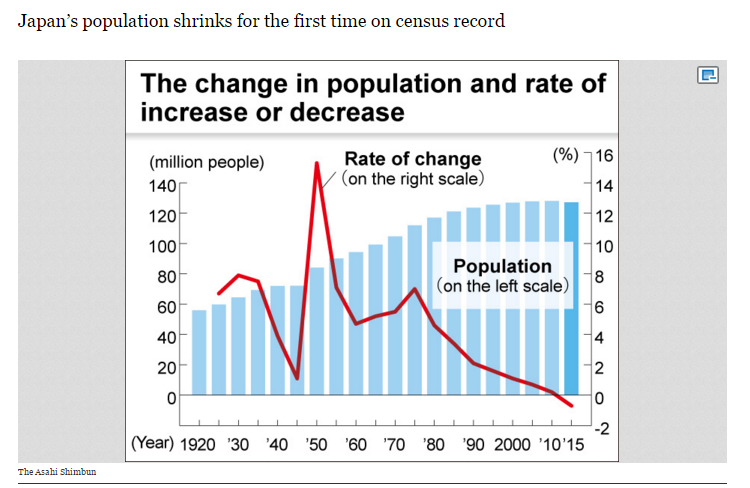
The future decline in Japan’s population has been recognised as inevitable for over 20 years and social engineering has not succeeded in reversing the inevitable. Now Japan has entered negative territory for the first time since the 1920s — entirely as expected.

Japan poulation decline - Asahi Shimbun

Japan population decline – Asahi Shimbun

In due course the fear-mongers will moan about the coming death of the species due to the population implosion, but this too shall pass. After about 100 years of a slow population decline I expect we shall see a new equilibrium for population and birth-rate, where longevity, fertility measures, incentives and a bright new world of genetic screening will be part of the mix.

By 2200, a form of non-coercive eugenics will no longer be a dirty word, but will instead seem eminently common-sensical.


The Paris Agreement sanctions a dash for coal

February 25, 2016

Now that the Paris Climate Agreement is out of the way (having actually achieved nothing while seeming to have solved everything), sensible countries that wish to implement their plans to utilise coal can do so without being castigated for it (since Paris has now solved everything). The non-sensible and sanctimonious countries – and Sweden leads all the rest – can refrain from using coal and other fossil fuels to their own self-inflicted disadvantage.

The real winners from the Paris Agreement are, of course, India and China. By using carbon emissions per unit of GDP as the measure, India has ensured that it can treble its coal consumption by 2030 (while GDP increases by a factor of 4) and still show a 30% decrease in emissions/GDP. Similarly China can double its coal consumption by 2030 while GDP increases by a factor of 2.65 and still show a 20% reduction in carbon emissions (based on my calculation from the Indian and Chinese INDC submissions for the Paris conference).

The 2012 global coal consumption (IEA report) was about 8.186 billion short tons of which China consumed 3.887 billion short tons and India consumed 0.745 billion short tons. By 2030, India alone would consume 2.235 billion short tons and still meet their Paris obligations. Similarly China would consume about 7.774 billion short tons and still meet their Paris promises. Effectively the Paris Climate Agreement sanctions that coal consumption in India and China alone will be about 10 billion short tons and exceed today’s global consumption. The global coal consumption in 2030 will then be above 14 billion short tons which is about 70% higher than the 2012 global consumption.

And now Reuters informs us that

A decision by Japan’s environment ministry to abandon its opposition to building new coal-fired power stations casts doubt on the industry’s ability to meet targets to cut greenhouse gas emissions, experts and environmental activists said …..

As Japan gets ready to open up its power retail market in April, companies are rushing to build 43 coal-fired plants or 20.5 gigawatt of capacity in coming years, about a 50 percent increase. ……. Coal is attractive because it is the cheapest fossil fuel source and prices have slumped in recent years. Japan has turned to the energy source in record amounts since the Fukushima disaster in 2011 led to the shutdown of reactors.

A group of 36 power companies, which supply 99 percent of the country’s electricity, have also formed a new body to take measures to trim emissions and meet the industry’s voluntary goal to cut emissions by 35 percent in 2030, compared with 2013.

The Paris Agreement has ensured that all those who wish to use coal can continue to do so.


Anthropogenic effects no threat to Indian monsoon “for a century or two” as Potsdam alarmism is debunked

January 28, 2016

The Potsdam Institute for Climate Impact Research in Germany is the most rabid disseminator of global warming alarm especially about sea-level rise. Stefan Rahmstorf is the Grand Mufti of this religion and most of its”science” is little more than conjecture based on speculation. They have also been forecasting increased variability and catastrophic effects on the Indian monsoon by computer simulations from 20 different climate models (none of which has succeeded in predicting the current temperature hiatus).

A new study now shows that previous Potsdam Institute monsoon forecasts were badly flawed and omitted “a dominant term in the equations of motion” no less. The equations of motion are about as basic as one can get.  The new study goes on to show that both a corrected theory and an ensemble of global climate model simulations exhibit no abrupt shift in monsoon strength in response to large changes in various forcings”. The authors don’t expect any drastic failure of the monsoon for the “next century or two”.

William R. Boosand Trude Storelvmo, Near-linear response of mean monsoon strength to a broad range of radiative forcingsPNAS January 25, 2016, doi:10.1073/pnas.1517143113

Significance

Previous studies have argued that monsoons, which are continental-scale atmospheric circulations that deliver water to billions of people, will abruptly shut down when aerosol emissions, land use change, or greenhouse gas concentrations reach a critical threshold. Here it is shown that the theory used to predict such “tipping points” omits a dominant term in the equations of motion, and that both a corrected theory and an ensemble of global climate model simulations exhibit no abrupt shift in monsoon strength in response to large changes in various forcings. Therefore, although monsoons are expected to change in response to anthropogenic forcings, there is no reason to expect an abrupt shift into a dry regime in the next century or two.

The Calcutta Telegraph reports:

India’s monsoon is in no danger of catastrophic collapse in response to global warming and air pollution, two atmospheric scientists said today, refuting earlier predictions that the monsoon could shut down within 100 years.

The scientists at Yale University in the US who used computers to model the Earth’s atmosphere, land and oceans have found that the expected changes in the monsoon will not abruptly alter their strength or their water volume.

Their results contradict earlier forecasts by scientists at the Potsdam Institute for Climate Impact Research in Germany portending frequent and severe failures and even a breakdown of the monsoon, which is critical to India’s food, water resources and economy.

“Our models show that monsoon rainfall will change smoothly in response to rising greenhouse gas concentrations, air pollution, and changes in land use,” William Boos, an associate professor at Yale University told The Telegraph“We should expect changes in the monsoon rainfall in response to changes in the global mean temperature in the coming decades, but there is no reason to expect those changes to be abrupt,” Boos said.

The earlier modelling exercises had predicted that the monsoon, under the influence of global warming and air pollution, would experience a “tipping point” that would lead to a sharp drop in rainfall over India.

Boos and his colleague Trude Storelvmo have now shown that the theory and models that were used to predict such “tipping points” had omitted a key term in climate behaviour, ignoring the fact that air cools as it rises in the atmosphere. …… 

….. A decade ago, a study by Potsdam Institute researchers suggested that increasing air pollution and forest loss could lead to a sharp reduction in rainfall within a span of decades. And three years ago, another study from the Potsdam Institute predicted a 40 to 70 per cent reduction in rainfall.

The Potsdam Institute is just one of the many so-called institutes which ensure funding by generating alarmist theories which cannot be tested.


New study debunks Himalayan glacier melting alarm – again

January 27, 2016

Over the next two decades we are going to see the gradual disappearance of global warming as the favourite meme for alarmists (after all, global warming has been solved by the Paris Agreement). Every alarmist theme over the last 80 years has been debunked, but the eco fascists merely move on to the next doomsday scenario. Whatever happened to peak oil and a world without energy? or the population bomb and the death of humanity? or peak food, mass starvation and starving billions? or the banning of DDT for the now failed elimination of mosquito borne threats? One wonders what the next alarmist theme will be? Global cooling could always come back. Vaccinations or GMO or gene selection for humans perhaps. Radiation from cellphones?

One of the much hyped stories in the last decade was the “melting of the Himalayan glaciers” and the consequent loss of clean water for one billion or more people. This story was hyped and overhyped before it was shown to be based on newspaper speculation put out by the usual suspects (WWF, Greenpeace, FoE and similar ecofascists). The IPCC – with Pachauri at its head – made idiots of themselves – again. Now comes a new paper in Nature – Global and Planetary Change that in Tibet water supplies will be stable and may even increase in the coming decades”.

EurekAlert:

University of Gothenburg Press Release

The Tibetan Plateau has long been seen as a “hotspot” for international environmental research, and there have been fears that water supplies in the major Asian rivers would drastically decline in the near future. However, new research now shows that water supplies will be stable and may even increase in the coming decades.

A report by the International Panel on Climate Change (IPCC) from 2007 suggests that the glaciers in the Himalayas will be gone by 2035. This statement was questioned and caused a great stir. …..

 ….. Since the statement by IPCC in 2007, the Tibetan Plateau has been a focus of international environmental research.

A research group led by Professor Deliang Chen at the University of Gothenburg, in close collaboration with researchers from the Institute of Tibetan Plateau Research at the Chinese Academy of Sciences, headed by Professor Fengge Su, has studied future climate change and its effect on the water balance in the region. The great Asian rivers have their source on the Plateau or in the neighbouring mountains.

The researchers recently published a study in Global and Planetary Change which modelled the water flows upstream in the Yellow River, the Yangtze, the Mekong, the Salween, the Brahmaputra and the Indus. The studies include both data from past decades and simulations for future decades.

The results show that water flows in the rivers in the coming decades would either be stable or would increase compared to the period from 1971-2000. …..

….. Dr. Tinghai Ou, who was responsible for the climate projections in the study, has commented that increased precipitation and meltwater from glaciers and snowfall are contributing to increased water flows in the region.

Ah well!

Time to find a new doomsday scenario.


Darwin’s finches can’t rely on natural selection to survive

December 18, 2015

It is only a mathematical model which predicts that a parasitic fly may drive Darwin’s finches to extinction. And the authors then suggest that human intervention is needed to “save” them because natural selection is just not potent enough or fast enough to allow them to adapt.

That’s all very well, but I feel compelled to speak up for the underdog – which is of course, the parasites. I note that Prof. Dale Clayton displays his prejudices when he says:

“They are maggots basically, is what they are,” said Prof Dale Clayton from the University of Utah, the senior author on the study. ….. “They are pretty nasty customers.”

Why the “specist” discrimination? Why should finches be in a privileged position compared to the flies? Their genes may not be threatened but they surely are more important, as a patently “fitter” species”, than those of the finches?

Another case of misguided conservation, where human intervention is proposed to protect an unfit species at the expense of a fitter species.

EurekAlert: 

Mathematical simulations at the University of Utah show parasitic flies may spell extinction for Darwin’s finches in the Galapagos Islands, but that pest-control efforts might save the birds that helped inspire the theory of evolution.

The new study “shows that the fly has the potential to drive populations of the most common species of Darwin’s finch to extinction in several decades,” says biology professor Dale Clayton, senior author of the study published online Dec. 18 in the Journal of Applied Ecology.

But the research “is not all doom and gloom,” he adds. “Our mathematical model also shows that a modest reduction in the prevalence of the fly – through human intervention and management – would alleviate the extinction risk.”

Mathematical simulations at the University of Utah show parasitic flies may spell extinction for Darwin’s finches in the Galapagos Islands, but that pest-control efforts might save the birds that helped inspire the theory of evolution.

The new study “shows that the fly has the potential to drive populations of the most common species of Darwin’s finch to extinction in several decades,” says biology professor Dale Clayton, senior author of the study published online Dec. 18 in the Journal of Applied Ecology.

But the research “is not all doom and gloom,” he adds. “Our mathematical model also shows that a modest reduction in the prevalence of the fly – through human intervention and management – would alleviate the extinction risk.”

Darwin’s finches image Wikipedia

The authors justify their unjustifiable proposals by invoking the meaningless god of “global diversity”.

The case of the flies and finches exemplifies how “introduced pathogens and other parasites pose a major threat to global diversity,” especially on islands, which tend to have smaller habitat sizes and lower genetic diversity, the researchers write.

It is only another alarmist mathematical model. Yet the fundamental reality, whenever a species goes extinct, is that it no longer has any significant part to play in an ecology. If it was relevant and significant to an ecology then its survival would be implicit. And what makes an ecology containing 10 species any better or any worse than an ecology containing 100 species? Surely it is the effectiveness or sustainability of that ecology which counts and not the number of species it contains.

Paris Climate Agreement: A review

December 14, 2015

The planet has now been saved – from a non-existent problem by an empty Agreement which promises nothing but the perpetuation of the Climate Community.

Paris Agreement

The Climate Community consists of about 20,000 – 30,000 people who are the Chosen of the God of Global Warming. They are elated at having secured their future jamborees. The politicians are all claiming great success in reaching The Paris Agreement. The unquestioning and gullible media – for the most part – are also effusive in their congratulations. I suspect that not very many have actually read and understood the Paris Agreement. I have been brought up to the view that an Agreement – to be an Agreement – consists of describing duties and obligations and with promised actions balanced by liabilities. This Agreement is devoid of any promises and accompanying liabilities. The Agreement is worth looking at – if only as an example of how to structure an empty document and still call it an Agreement.

COP21 Agreement 20151212

As I expected, the Paris agreement has no commitments – except to meet again and keep these meetings going. (One could ask, if COP21 was such a great success, why a COP22 and a COP23, and so on ad infinitum, are still needed?). But I am also very happy the parties have reached such an empty agreement. The harm it can do, for starting with a false premise (that global temperature can be controlled merely by reducing fossil fuel use), is limited by this very emptiness. In any event, all emissions reductions are voluntary and are not commitments. All developing countries will strive to reach a peak of carbon dioxide emissions – where defining the magnitude and timing of the peak is left to the judgement of each country. Developed countries will assist with money and technology to the extent they can. Any signatory can leave the agreement at any time after the first 3 years by giving one years notice.

The only binding things in the Paris Agreement is that while all parties are unbound, these UN jamborees of waste shall continue for ever. Nearly all decisions in the Agreement are about perpetuating the well-paid (and utterly useless) jobs of the Climate Community for ever.

The Paris Agreement is structured as a document in two sections. The first is entitled “ADOPTION of the Paris Agreement” consisting of VI parts describing what has been adopted. The second section is the Paris Agreement itself as an Annexe and consisting of 29 Articles.

The VI parts of the first section contains 140 paragraphs, of which 48 are “decides”. All the other paragraphs are “requests” or “takes note” or “recognises” or “invites” or “welcomes” or the like. I have extracted the “decides” and the self-serving manner in which they just protect the jobs of the Community is almost obscene.

The Decides of Paris

The “decides” are overwhelmingly about further meetings, or the setting up of committees, commissions and even champions. But the bottom line is that what has been achieved here is the perpetuation of jobs for the Chosen.

The main Paris Agreement is contained in the 29 Articles of the Annexe. There is nothing in any these 29 Articles which is a binding commitment by any country to reduce emissions by any specific amount or to provide any specific amount of funding.

I note particularly the following:

Article 20

  1. This Agreement shall be open for signature and subject to ratification, acceptance or approval by States and regional economic integration organizations that are Parties to the Convention. It shall be open for signature at the United Nations Headquarters in New York from 22 April 2016 to 21 April 2017. ….

Article 21

  1. This Agreement shall enter into force on the thirtieth day after the date on which at least 55 Parties to the Convention accounting in total for at least an estimated 55 percent of the total global greenhouse gas emissions have deposited their instruments of ratification, acceptance, approval or accession. ….

Article 28

  1. At any time after three years from the date on which this Agreement has entered into force for a Party, that Party may withdraw from this Agreement by giving written notification to the Depositary.
  2. Any such withdrawal shall take effect upon expiry of one year from the date of receipt by the Depositary of the notification of withdrawal, or on such later date as may be specified in the notification of withdrawal. …

A party which does not ratify the agreement is not even bound to the empty words even if it “has come into effect”. Any signatory can effectively leave the agreement at any time by giving one years notice. It is a binding agreement to be unbound.

But since the world has now been saved perhaps we will have a little less of the alarmist hysteria. What does it matter if the saving is by means of an empty agreement. As I have noted before, China and India can continue – quite unhindered – with their continued use of coal, oil and gas at their planned levels, while still meeting their pledges of reduction of emissions intensity (emissions/GDP).

The reporting of the “achievements” as seen by Indian eyes is telling

NDTVAsked why India made compromises, Environment Minister Prakash Javadekar told NDTV, “To achieve big things you need to be accommodating without changing the meaning and thrust of agreement and that is success.”

Here is what India and the other developing nations had to compromise on:

  • The original UN convention had a stronger language on developed world providing climate finance. Experts say current text is weaker. It also leaves room for confusion on what can be counted as climate funding – for example, developmental aid or loans can be counted as climate finance. Mr Javadekar, too, said the agreement could have been more ambitious as the actions of developed nations are “far below” than their historical responsibilities and fair shares. Most civil society experts say the dilution was made following tremendous pressure from US – which is facing issues with domestic politics – and an umbrella group of developed nations.
  • Paris agreement says all parties — including developing nations — must take action to cut emissions. This means makes developing nations must take on additional obligations.
  • For developing countries, intellectual property rights barriers to transfer technology from rich countries were important. But the Paris text is more about cooperation in technology.
  • In terms of loss and damage, the text says these will not be seen in terms for liability and compensation, so developed countries will not have no real obligation.

This is what India and the developing nations achieved:

  • Managed to put back the important principle of equity and “common but differentiated responsibilities” in text, which India has been pushing for. The US and developed nations wanted to dilute this plank.
  • Though developed countries use fossil fuel — coal and gas — they wanted developing countries to cut emissions. It is still not clear if the developed nations will be forthcoming with funds and technology for clean energy or the modalities if they do.  
  • The big challenge met was ensuring the agreement established the idea of climate justice – acknowledging that industrialised nations have been the major emitters since 1850.
  • India also wanted a mention of sustainable lifestyle and consumption, which is there in the text.

Note that “the big challenge met was ensuring the agreement established the idea of climate justice – acknowledging that industrialised nations have been the major emitters since 1850”.

If the Paris non-agreement reduces the alarmist hysteria, it would have achieved a great deal. It could provide a better atmosphere and time for acknowledging the politically incorrect reality that man-made emissions are of little significance in influencing the climate. The Agreement does no good, but at least it does not do much harm either. A Feel Good irrelevance.

Saving the World has been delayed till tomorrow

December 11, 2015

The end of the Paris Climate conference has been postponed till tomorrow (Saturday). Nevertheless some Agreement will be reached and THE WORLD WILL BE SAVED.

Of course, the agreement will be empty of any binding commitments on either emissions or money flows, but will include binding agreements to meet again. It might even contain binding commitments to make binding commitments in some dim future. It will promise to target a global temperature increase of no more than +1.5ºC from “pre-industrial times” even though nobody has the faintest idea of what impact – if any – emissions have on global temperature. Note however that this global temperature cannot be measured. It is a calculated number and the calculation process is “adjusted” almost every year to show whatever is politically correct.

The Paris conference is irrelevant to climate. It is a conference about a manufactured issue with remedies that have no impact. It will make some people feel good, but it will keep costs high in Europe, prolong the economic malaise that is prevalent, it will allow the US to burn as much gas as it wants to and it will allow India and China to continue burning as much coal as they need.

Never mind. In a sense an empty agreement tomorrow – as it will undoubtedly be –  will allow politicians to move on to other more pressing – and more real issues.

And when the ice at the poles continues to grow and global cooling continues for another 2 decades, “Mission Accomplished” can be declared and a new Alarmist meme can easily be established.

India says that OECD claim of $57 billion in 2013/14 for “climate finance” was grossly exaggerated and actually only $2.2 billion

November 30, 2015

The propaganda tsunami for the Paris climate conference is reaching a peak just in time for the 147 leaders who fly in for today’s opening. Many organisations and lobby groups and newspapers have brought out special issues and reports to sell their viewpoint. No matter how little Paris agrees on, it will be presented as a major breakthrough (too many have now invested too much to allow any other spin).

The OECD is one such organisation and they have just issued a report “Climate Finance in 2013-14 and the USD 100 billion goal” to try and show the position of the developed nations that a great deal of “climate finance” is already flowing.

OECD Climate-Finance in 2013-14

The OECD claims that developed countries and their private sectors had provided $62 billion in climate finance flows in 2014 — up from $52 billion in 2013 — and an average of $57 billion annually over 2013-14.

But this is all spin and hot air. All kinds of money flows are, by tortuous reasoning, allocated to “climate finance”. The Indian government’s Department of Economic Affairs is not amused.  They have performed a due diligence on the OECD’s claims of $57 billion disbursement in 2013/14. They find double-counting, mislabelling and misreporting and find that  “the only hard number currently available in this regard is $2.2 billion in gross climate fund disbursements from 17 special climate change finance multilateral, bilateral and multilateral development bank funds created for the specific purpose”The DEA report goes on to say “the Paris Conference and negotiators will unfortunately need to worry about the credibility of the new OECD report”.

Of course the OECD wants to show numbers bigger than they are and developing countries such as India want to show them as small as possible. The very concept that man-made emissions are going to control climate is arrogant, decadent and deeply flawed.  But climate conferences are about money flows not about climate.

The Hindu

The estimate of $57billion in assistance during 2013-14 is flawed; the only number available is $2.2bn, says Finance Ministry paper.

On a day when Prime Minister Narendra Modi left for Paris to participate in the global climate change conference beginning Monday, Economic Affairs Secretary Shaktikanta Das said that India has questioned the correctness of the recent Organisation for Economic Co-operation and Development (OECD) report which claimed that significant progress had been made on a roadmap towards the goal of $100 billion in climate change finance flows annually by 2020.

In the foreword of a discussion paper titled, ‘Climate Change Finance, Analysis of a Recent OECD Report: Some Credible Facts Needed’, the Secretary said: “We asked our Climate Change Finance Unit of the Department of Economic Affairs (DEA), Ministry of Finance, and its experts to undertake a careful review of that OECD report. Their conclusion: the OECD report appears to have over-stated progress.” ….. 

The DEA paper said the OECD report had mentioned that developed countries and their private sector had provided $62 billion in climate finance flows in 2014 — up from $52 billion in 2013 — and an average of $57 billion annually over 2013-14.

The DEA paper quoted the French Foreign Minister as saying, “estimates demonstrate that considerable progress has been made. We must mobilize our efforts to provide the remaining $40 billion.” The paper then countered these claims saying, “We are very far from the goal of $100 billion in climate change finance flows annually by 2020.”

Describing the OECD as ‘a club of the rich countries’, the DEA paper said the Paris Conference and negotiators will unfortunately need to worry about the credibility of the new OECD report. …… 

Terming the figure of $57 billion average for 2013-14 as one that was exaggeratedly reported by the OECD, the DEA paper said the only hard number currently available in this regard is $2.2 billion in gross climate fund disbursements from 17 special climate change finance multilateral, bilateral and multilateral development bank funds created for the specific purpose. ……

The OECD report is deeply flawed and unacceptable, the DEA paper said, adding that the OECD report repeats a previous experience of double-counting, mislabelling and misreporting when rich countries provided exaggerated claims of ‘fast-start climate financing’ in during 2010-12 which were widely criticized by independent observers.

Reporting of the Paris conference will see a lot of spin. But there are only 2 real questions

  1. Are any emissions targets legally binding? and
  2. Are any money flows legally binding?

And I expect nothing of substance will be legally binding – thank goodness.

Paris climate conference has failed before it has begun: No “treaty” and no legally binding emission limits to be set

November 28, 2015

My opinion (here and here for example) is that the UN’s Paris conference on global warming  (since climate change which is not global warming is not even being considered) has no purpose and is a waste of time. No matter what is agreed or not, global fossil fuel use will double in the next 20 years or so. And it will have no significant impact on “global temperature”.

The EU (Holy European Empire – blessed be its name) in the shape of France, which is to chair the conference, has been adamant that Paris must come up with legally binding emission limits to be more than just hot air. Well, France has now caved in to the US position that no legally binding limits are practical and that any agreement must not be given the status of a treaty.

Why bother then?

The Financial Times (paywalled), has just reported that France has given in. Laurent Fabius will chair the conference and he has, according to the FT, made a major climbdown and accepted that signatories will not commit to any legally binding emission limits.

France bows to Obama and backs down on climate ‘treaty’

My view that this is all a massive and pointless conference is further strengthened by the confirmation that Canada has joined the US in wanting no legally binding agreements from Paris. France- as Conference Chair and representing the EU –  has been one of the strongest proponents of legally binding agreements (which is easy for them with their recourse to nuclear power). Just two weeks ago, the EU warned the US:

Paris climate deal must be legally binding, EU tells John Kerry

Earlier today, the French foreign minister, Laurent Fabius , had said it was obvious that any agreement in Paris would contain lawful elements, and suggested that Kerry was “confused” about the point. 

But now, with France also accepting that any Paris agreement will not be given the status of a treaty and will not require any legally binding emission limits, there seems little point in all the world’s leaders flying in at the end of next week to put their names to an empty document. Don’t expect any legally binding agreement on the provision of funds either.

The only legally binding agreements that Paris may now produce are agreements to meet again and to continue to waste money.

The Hindu Business LineCanada backs US: climate deal should not be legally binding

Canada on Friday backed the US approach to major climate change talks in Paris, saying any carbon reduction targets agreed at the negotiations should not be legally binding. The announcement by Environment Minister Catherine McKenna could irritate host nation France, which wants any deal to be enforceable.

That would be politically impossible for the administration of US President Barack Obama, however, since it is clear the Republican-dominated Congress would not ratify any treaty imposing legally binding cuts on the US.

“Everyone wants to see the US be part of this treaty,” McKenna told reporters on a conference call before flying to Paris. “There are political realities in the US … they cannot have legally binding targets. We don’t expect that the targets will be internationally legally binding,” she said.

Signatories to a Paris agreement should agree to update their climate change goals every five years, she added.

US Secretary of State John Kerry told the Financial Times this month that any deal reached in Paris was “definitively not going to be a treaty”. His remarks drew a stern response from French President Francois Hollande.

The Paris conference might as well not take place. It is certainly time-consuming, expensive and completely irrelevant as far as any man-made global warming is concerned.


New Nature paper: Polar ice melt would only raise sea level by 10cm (4″) by 2100

November 25, 2015

I am surprised first that Nature, given its blatant bias, accepted such a paper for publication, and second that it was published so close to the Paris conference (end of this week). Perhaps they felt it would just get lost among the massive propaganda blitz that is currently going on.

  • Catherine Ritz, Tamsin L. Edwards, Gaël Durand, Antony J. Payne, Vincent Peyaud, Richard C. A. Hindmarsh. Potential sea-level rise from Antarctic ice-sheet instability constrained by observations. Nature, 2015; DOI: 10.1038/nature16147

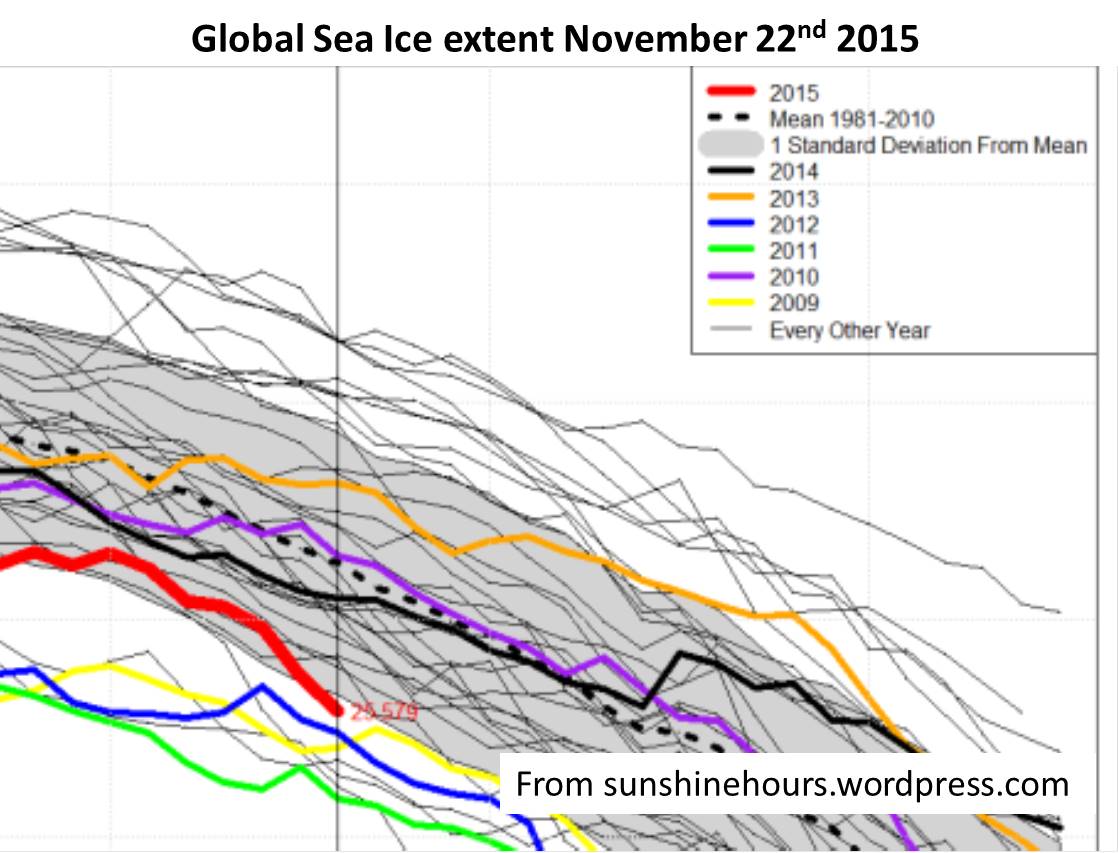
Right now the ice cover at the poles (Antarctic and Arctic) are each within one SD of the long-term average. So is the global ice cover. If now any future excess melt, if it occurs, can only cause a rise of sea level of 4 inches by 2100, one wonders what the IPCC and the Paris conference are actually trying to prevent.

Global ice cover 22Nov2015  From sunshinehours

Global ice cover 22Nov2015 From sunshinehours 

It is not the first time that the IPCC has exaggerated (and it won’t be the last). But their scare scenarios of 1 metre sea level rise are themselves plain rubbish; which make the doomsday scenarios put out by the global warming “enthusiasts”, of upto 10 metres (30 feet) or more of sea level rise by 2100 just religious fantasy.

Four inches of seal level rise is what is at stake.

GWPF:

The risk of the Antarctic ice sheet collapsing and flooding coasts around the world has been exaggerated, according to researchers.

Previous studies had claimed that melting Antarctic ice could contribute one metre to the rising sea levels by the end of the century, flooding the homes of 150 million people and threatening dozens of coastal cities.

However, a team of British and French scientists has found that the collapse in the ice sheet is likely to raise sea levels by 10cm by 2100. An increase in sea levels from the ice sheet becoming unstable is “extremely unlikely to be higher than 30cm” this century, they say, describing previous, more apocalyptic predictions, as implausible.

The study, published in the journal Nature, found that there was a one in 20 chance that parts of the ice sheet breaking off could contribute more than 30cm to the sea level by the end of the century and more than 72cm by 2200.

The sea level has already risen by 19cm since 1901 and the annual rate has almost doubled since then to about 3.2mm a year, according to the Intergovernmental Panel on Climate Change.

The UN agency predicted in 2013 that sea levels would rise by about another 60cm by 2100. The panel was unable to calculate, and did not include in its prediction, the risk of substantial parts of the Antarctic ice sheet collapsing.

Some studies suggested that the risk was high and that the overall increase in the sea level would be well over a metre by 2100 once the collapse of the ice sheet was included.

Tamsin Edwards, an author of the new study — which involved scientists from the University of Bristol and Grenoble Alpes University — said that earlier reports were likely to be wrong because they were based on simpler computer models which contained many uncertainties.