Archive for the ‘Aviation’ Category

QZ8501: All presumed lost but why no wreckage yet?

December 29, 2014

Air Asia’s QZ8501, Airbus A320-200 most probably flew into a violent thunderstorm which it could not or did not avoid and suffered a catastrophic structural failure. This is plausible and pilots avoid violent thunderstorms if at all possible. Flying through a storm is most inadvisable and usually aircraft fly around them. Just this year, this could be the third aircraft (the others were cargo aircraft) to have been lost to a thunderstorm near the equator. But why no wreckage yet?

The pilots had requested permission to increase altitude from 32,000 to 38,000 feet to avoid bad weather but this change was denied by air traffic control presumably because of other traffic on this busy route. The denial is not unusual but the storm may have had a much greater vertical spread than expected. Thunderstorms in the Java Sea can sometimes have plumes (towers) extending up to 50,000 metres feet. In emergencies, commercial pilots are trained to first control the plane, then to navigate and only then to communicate. So the lack of a distress signal – is worrying – but not a reason to rush to conspiracy theories or to invoke magic. It does suggest that whatever happened happened fast. There were 23 no-show passengers booked on the plane but this also does not seem extraordinary for a flight leaving in the early hours.

BBC: He said the captain had more than 20,500 flight hours, almost 7,000 of them with AirAsia. The flight left Surabaya in eastern Java at 05:35 local time (22:35 GMT) and was due to arrive in Singapore at 08:30 (00:30 GMT).

The missing jet had requested a “deviation” from the flight path to avoid thick storm clouds, AirAsia said. Indonesia’s transport ministry said the pilot had asked permission to climb to 38,000ft (11,000m).

Ministry official Djoko Murjatmodjo said the request “could not be approved at that time due to traffic, there was a flight above, and five minutes later [flight QZ8501] disappeared from radar”.

Map

QZ5801 planned route

This morning one of the rescue officials said that the aircraft was probably at the bottom of the sea. But I have difficulty to reconcile a “catastrophic failure” with the absence of any wreckage. The weather is still bad in the most likely location. Perhaps more time is needed. The chance of survival for the 162 people on board is diminishing very fast.

The loss of 162 lives is tragedy enough but the thought of another “vanishing act” like MH370 without any wreckage or any other physical evidence is somehow even more disturbing. Can there be a catastrophic failure without the plane breaking up into smaller pieces where some would surely float? To be “at the bottom of the sea” would surely need that the aircraft went down largely intact or in very large pieces. Then why no “distress call”? Even an implausible lightning strike which disabled all power instantaneously may have caused the plane to descend very fast but it should not have disabled all communication devices.

Only questions about QZ8501 right now. But almost every question about MH370 is still open. The loss of life is deeply tragic. That Malaysian aviation could be singled out to be hit by 3 tragedies in one year is perplexing.  But the idea that the open questions will never be answered is terrifying.


AirAsia Flight QZ8501 goes missing

December 28, 2014

It is a dismal and tragic year for Malaysian aviation. If I were superstitious 2014 would be a cursed year.

After MH30 and MH17, Air Asia’s QZ8501 has gone missing on its way from Surabaya to Singapore. AirAsia is a Malaysian low-cost airline headquartered near Kuala Lumpur.

UPDATE: QZ8501 is believed to have crashed at the location 03.22.46 South and 108.50.07 East, in waters around 80 to 100 nautical miles from Belitung. Not confirmed.


Reuters:

Indonesia’s air force was searching for an AirAsia plane carrying 162 people that went missing on Sunday after the pilots asked to change course to avoid bad weather during a flight from the Indonesian city of Surabaya to Singapore.

Indonesia AirAsia Flight QZ8501, an Airbus 320-200, lost contact with Jakarta air traffic control at 6:17 a.m. (6.17 p.m. EST), officials said.

“The aircraft was on the submitted flight plan route and was requesting deviation due to enroute weather before communication with the aircraft was lost,” the airline said in a statement.

No distress signal had been sent, said Joko Muryo Atmodjo, air transportation director at Indonesia’s transport ministry. Indonesia AirAsia said there were 155 passengers and seven crew on board. It said 156 were Indonesian, with three from South Korea and one each from Singapore, Malaysia and France.

MH17: Shot down by Ukrainian, Sukhoi-25, military jet

December 25, 2014

It is looking increasingly likely that MH17 was shot down by a Ukrainian, military, attack plane (a Su-25) using R-60 air-to-air missiles and followed by cannon fire. The Sukhoi 25 may well have been flown by a Captain Voloshin.

Ukrainian Air Force Su-25UB Wikimedia

Ukrainian Air Force Su-25UB Wikimedia

MH17 crashed in eastern Ukraine on July 17. All 298 passengers and crewmembers on board the Boeing 777 were killed. The victims were from 10 nations, while most of the passengers – 193 in total – were from the Netherlands. The second-largest number of casualties, 43, was from Malaysia.

There are two theories about the shooting down of Malaysian Airlines MH17:

  1. that the aircraft was shot down by a BUK ground-to-air missile fired by Russian separatists in Ukraine and perhaps in the mistaken belief that they were shooting at a Ukrainian military transport plane. This is the theory that is favoured by the Ukrainian government, most western countries and by NATO, or
  2. that the aircraft was shot down mistakenly by a Ukrainian miltary jet using an air-to-air missile. This was followed by cannon fire perhaps because the mistake was realised and no survivors could be permitted. This theory is supported by the Russians and the Russian separatists.

The Russian theory was initially ridiculed by the Ukrainians, NATO countries and the western media. But a few weeks ago the Dutch investigators let slip the information that at least one oxygen mask had been deployed and this was much more consistent with a weaker air-to-air missile followed by cannon fire rather than the much more powerful BUK ground-to-air missile. A BUK ground-to-air missile would not have given any time for the oxygen mask to deploy. Moreover a multitude of regular holes were found in the remains of the fuselage. They were too regular to just be shrapnel and their size and regularity were consistent with high velocity cannon fire.

Now the Russian investigation claims that it has evidence from a Ukrainian citizen who witnessed a Ukrainian military Sukhoi 25 take off, before MH17 was shot down, from an airfield in the Ukrainian city of Dnipropetrovsk, fully armed and return without its missiles. The flight was flown by a Captain Voloshin and was armed with R-60 air-to-air missiles. The Ukrainians admit that a Captain Voloshin does exist but claim he did not fly that day.

This is not a truth that the US or NATO countries would like to be revealed. The Dutch investigation is probably under intense pressure to “manage” whatever is published. The Malaysians reeling from the loss of MH370 are also probably being pressured not to make waves. (Incidentally the latest theory about MH370, is now that it was remotely hijacked, was on its way to Diego Garcia and was shot down by US assets.) I note that the information about the oxygen mask deployed on MH17 was kept concealed for a long time and was only revealed by mistake.

I don’t expect that Dutch investigation will exchange information with the Russian investigation.

The Russian Defense Ministry made public radar data indicating that a Ukrainian military jet capable of taking down the airliner with an air-to-air missile was in the vicinity of MH17 at the time of the incident.

MH17 - Su-25 graphic RT news

MH17 – Su-25 graphic RT news

RT reports:

Russia’s Investigative Committee has confirmed the claims by a Ukrainian, who said he witnessed the deployment of a Ukrainian warplane armed with air-to-air missiles on the day the Malaysian Airlines flight MH17 was shot down.

The interview was conducted on Tuesday, spokesman for the committee Vladimir Markin told the media on Wednesday. This followed a report in a Russian newspaper, in which the Ukrainian citizen, who preferred to remain anonymous, voiced his allegations.

The investigators used a polygraph during the interview, which showed no evidence of the witness lying, he added. “The facts were reported by the witness clearly and with no inconsistencies. The investigators lean towards considering them truthful. A polygraph examination confirmed them too,” the official said.

“According to his account, he personally saw the plane piloted by Captain Voloshin armed with R-60 air-to-air missiles,” Markin said. “He added there was no need for such weapons during regular air missions of the Ukrainian Air Forces because the rebel forces had no military aircraft.”

Markin said that the Investigative Committee will continue gathering and analyzing evidence perpetrating to the downing of MH17 and will share the information with the Netherlands-led international probe into the incident, “if they really interested in establishing the truth and send an inquiry.”

The witness is likely to be taken into protective custody in Russia because his life may be threatened, Markin said.

The Ukrainian Security Service confirmed on Wednesday that a Captain Voloshin does serve as a military pilot in the country’s armed services. But it said he didn’t fly any missions on the day the Malaysian Airlines flight was shot down.

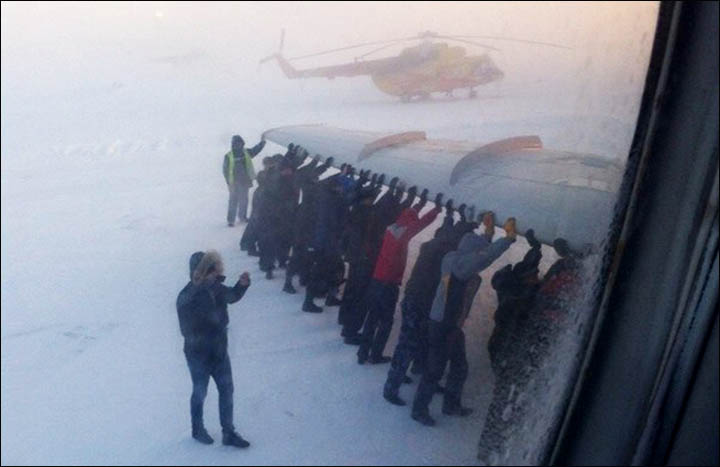
Minus 52ºC and passengers have to push their plane: Just another day in the Russian Arctic

November 27, 2014

Minus 52ºC and passengers have to push their plane: Just another day in the Russian Arctic

Men pushing aircraft

Fearing the UTair service to regional capital Krasnoyarsk could be delayed, many of the 70 passengers used brute strength to free the 30-ton Tupolev 134. Picture: Ivan Ivanov

The Siberian Times:

When their plane literally froze on the ground at Igarka airport, above the Arctic Circle, there was no need to panic. Fearing the UTair service to regional capital Krasnoyarsk could be delayed, many of the 70 passengers used brute strength to free the 30-ton Tupolev 134. ….. 

Vladimir Artemenko, technical director of Katekavia, which ran the flight jointly with UTair, said that the plane was technically serviceable, but the chilly temperatures led it to freeze up.

The airport’s tractor could not move the Tu-134 because its brake pads were frozen. ‘When people pushed the plane, the wheel cranked out, and then the aircraft could continue to move,’ he explained.

The plane later took off and landed safely in Krasnoyarsk. Most of the passengers were oil and gas workers on their way home after a stint in the Arctic production flields. Reports of the incident led to worldwide praise for the stoic Siberians for their ‘can-do chutzpah’, in the words of Agence France Presse. ‘Siberians are so tough that for them pushing a frozen plane along a runway is a piece of cake,’ added Russian daily newspaper Komsomolskaya Pravda.

But the authorities were not amused.

igarska to Krasnoyarsk

igarka to Krasnoyarsk

The amusement did not extend to some officials, however. West Siberian transport prosecutor’s aide Oksana Gorbunova rebuked the plane movers. ‘Passengers were asked to leave the plane and go to the bus standing nearby,’ she said. ‘After that, some of them voluntarily left the bus and went to the plane, trying to assist in moving it using physical force.

‘Naturally, the plane was moved by the truck, because people physically could not do it. It looks like a joke. It would be funny if it could not have dire consequences: people could damage the casing and flaps of the aircraft.’

Airport chief Maxim Aksyonov claimed: ‘Most likely, the plane’s passengers, oil workers, decided to do a kind of ‘selfie’. It was a good joke and it became a big thing on the Internet.’

However, one of the ‘hero’ passengers told Life News insisted the passengers did push the plane. ‘We were on the bus that took us on the plane when we were asked to help the tractor,’ he said. ‘Before that, we had already spent one day at the airport, waiting for our departure.

‘We pushed it a short distance – about five metres, maybe more. I worked for four years on shifts, but do not recall that we pushed the plane previously.’

Video below:


“Those Indian women in their flying machines…”

November 24, 2014
Baroness de Laroche

SEMAINE D’AVIATION DE TOURAINE (30 avril – 5 mai 1910) Madame DE LAROCHE, Collection of Dave Lam, (via earlyaviators.com)

Those magnificent ladies in their flying machines,
they go up tiddly up up,
they go down tiddly down down. (with apologies)

There are almost more than 3 times as many commercially active, women pilots in India compared to the global average.

The Wright brothers first flew a powered flight in December 1903. They had much support – and financing – from their sister Katharine Wright and she first joined them in exhibition flights in 1909.

But it was a young French actress, Elise Raymonde Deroche (who called herself the Baroness Raymonde de Laroche), perhaps inspired by Katharine, who was the first woman to fly solo in 1909 and the first to be awarded a pilot’s licence in 1910. Though some others flew solo flights earlier, the first American woman to gain a pilot’s licence was Harriett Quimby in 1911.

Amy Johnson of England was the first woman to fly solo from Croydon, London to Darwin in Australia in her Gypsy Moth in 1930. Amelia Earhart of the US was then the first woman to fly solo across the Atlantic in 1932.

Women were involved in military flying already from WW 1.

In World War I, Helene Dutrieu of France and Princess Eugenie Shakhovskaya of Russia both served as reconnaissance pilots.

The first military woman to fly combat missions did so in Turkey in 1937. Sabiha Gokcen participated in the Thrace and Aegean exercises, and in the same year joined the “Dersim Operation.” During the Seyh Riza Rebellion, she facilitated the land operation by bombing Dersim and its surroundings.

In the Soviet Union in World War II, women flew combat missions in three predominately female regiments. The 588th Air Regiment (later the 46th Taman Guards Bomber Regiment) flew night bomber missions in the PO2 biplane. The 587th Bomber Regiment (later the 125th M. M. Raskova Borisov Guards Bomber Regiment) flew bombing missions in the PE2 airplane. The 586th Fighter Regiment flew air defense missions in the YAK-1 aircraft.

Fighter pilot Lily Litvak of the 586th regiment shot down 12 German aircraft and shared the credit for two others. Regiment mate Katya Budanova shot down even more aircraft but the exact number is unknown. They were both killed in action in 1943.

Originally a navigator and a Gold Star Hero of the Soviet Union, Marina Raskova used her influence to propose and gain approval for the formation of the female regiments. She was the first commander of the 587th Bomber Regiment, and she was killed ferrying her aircraft to the front lines. Galina Brok-Beltsova, one of the navigators in Raskova’s regiment, attended our conference last year and we anticipate having her attend this year’s conference.

Rose Clement served as a Navigator in the US Navy during World War II. These women navigators were the first US military women to be aircrew, to wear wings, and to receive flight pay (half their base pay). They were generally assigned as navigator instructors, in pairs at various bases around the country, after satisfactory completion of celestial navigation training.

In Britain in November 1939, Pauline Gower proposed and was granted permission to form the Women’s Section of the Air Transport Auxiliary (ATA), which would ferry aircraft from the DeHaviland factory to RAF training bases. She was the first woman to be allowed into, let alone fly, a Royal Air Force plane.

Though women have been involved in flying from the very early days of flight, they only constitute about 6% of all licensed pilots and only about 3% of active airline pilots according to The International Society of Women Airline Pilots. But for some reason over 11% of commercial pilots on Indian airlines are now women (and over 14% among the newly qualified pilots).

sarla-thakral

Sarla Thakral image iwpa

The first Indian woman to gain a licence was Sarla Thakral in 1936. Prem Mathur was the first woman to gain a commercial licence in 1947 and she flew on domestic airlines but was only allowed as co-pilot. It was only in 1956 that Indian Airlines had Durba Bannerjee as its first woman pilot. The Indian Women Pilots Association was formed in 1967. And by 1985, Saudamini Deshmukh had led the first all-woman flight crew on a domestic commercial flight. In 2008, Sonica Chhabra became the first Indian woman to qualify as a Pilot Examiner.

But the Indian Air Force lags far behind. It was only in 1994 – 80 years after WW1 started – that 3 women were first inducted – reluctantly – as pilots into the Air Force. The first missions ever flown in a combat zone by a woman pilot was during the Kargil conflict in 1999. They are still not permitted as pilots of Indian combat jets though the first combat mission ever flown by a woman was back in 1937. The staid bureaucrats of the Ministry of Defence and the still old fashioned leadership of the Air Force are apparently very disturbed by the very idea of women wielding power. The current Air Chief Marshall Arup Raha recently displayed his rather fossilised thinking. He apparently classes pregnancy as a “health problem”!

TOI, March 13th, 2014.

IAF chief Air Chief Marshal Arup Raha, answering questions in Kanpur on Tuesday, said the capabilities of women “air warriors” in his force was never in doubt but biological and natural constraints precluded them from flying fighters.

“As far as flying fighter planes is concerned, it’s a very challenging job. Women are by nature not physically suited for flying fighters for long hours, especially when they are pregnant or have other health problems,” said ACM Raha, as per news reports.

Defence minister A K Antony, in turn, told Parliament just last month that two studies – by the integrated defence staff HQ in 2006 and a high-level tri-Service committee in 2011 – had both rejected induction of women in combat duties. A serving major-general said, “As a society, we are not ready for our women in combat roles. What if they are taken PoWs?”

Indian commercial airlines clearly don’t have the same fears of women as the Indian Air Force. In the world of commercial airlines, Indian women are progressing much faster than their colleagues abroad.  Why this should be is not very clear though it has been suggested that the availability of family support may make it easier for Indian women to cope with time away from home.

TOI 24th November, 2014.

Almost 600 of the 5,050 pilots in Indian airlines are women, according to the Directorate General of Civil Aviation (DGCA). At 11.6%, this is way above the 3% global average estimated by the International Society of Women Airline Pilots.

India is also seeing a steady rise in women pilots annually. The last five years saw 4,267 commercial pilots’ licences being issued, of which 628 or 14.7% went to women. 

A direct outcome of this trend is that Indian carriers are employing more women pilots. The Jet Group, for instance, had 152 women pilots in October 2011; today it has 194 — the highest in India. “There has been steady growth of about 10% year on year in the number of women pilots joining the airline,” says a Jet official referring to Jet Airways and JetLite. The official adds that 30.5% of their 13,674 employees are women.

At IndiGo, 11% of pilots are women. “That number is definitely growing. Of the pilots that joined from April 2014, 16.5% are women,” says an IndiGo official. Overall, 43% of the airline’s 8,200-strong workforce is women. SpiceJet and GoAir also reported that the number of women pilots is on the rise. The merged Air India-Indian Airlines has the second largest number of women pilots at 171, and often has an all-women crew operating its longest non-stop flights to the US.

MH 370 to be declared “lost” and search to end by year-end

November 12, 2014

It has been over 8 months now since MH370 vanished on March 8th with all its 239 crew and passengers.

That the mystery continues, in these times of almost universal surveillance, where even distant comets passing by Mars can be observed in real time, is unfathomable. To say that black magic was involved is almost as irrefutable as any other proposed explanation. But it was not black magic. It was almost certainly a “black operation”, an “engineered affair”. Somebody knows what happened. And what I find equally disturbing is that the world can so easily put the whole unexplained, chilling episode aside and move on.

The relatives of the victims and the unfortunate Malaysian Airlines cannot find any kind of closure. But by the end of the year the plane could be officially declared “lost” and that would allow the search to be ended. That would allow Malaysian Airlines to make “final” compensation and then calculate a liability cap and draw a financial line.

NZ HeraldSpeaking to The New Zealand Herald today, the airline’s commercial director, Hugh Dunleavy said that it was waiting for the aircraft to be officially declared lost after going missing in March with 239 people on board. It is thought to have flown into the Indian Ocean off the coast of Western Australia. 

The Australian and Malaysian governments were working together to set a date to formally announce the loss of MH370 and that was likely to be set by the end of the year.

“We don’t have a final date but once we’ve had an official loss recorded we can work with the next of kin on the full compensation payments for those families.” ….. 

Dunleavy said the Montreal Convention had set the ceiling on compensation at around US$175,000 although passengers could take legal action to pursue higher payments.

“We will ensure we do compensate them for the loss of their loved ones through our insurers,” he said. ….. 

“We are trying to hurry (compensation)it up as much as we can but some of these things are outside the scope of the airline itself. If they’re not happy with the compensation then they seek legal advice and move ahead, then once they come in our people will assess them and respond.”

Paying out relatives of those killed aboard MH17 over the Ukraine was more straightforward.

“We know exactly what happened with that aircraft and we can move ahead with the full compensation of family members aboard that aircraft,” Dunleavy said at the end of his visit which included meetings with travel agents and the tourism bodies.

I can understand the Commercial Director’s frustration at not knowing what happened and not being able to assess the final liability. Dr. Hugh Noel Dunleavy is the Head of Network, Alliance & Planning and Director of Commercial at Malaysian Airlines and was appointed in January 2012.


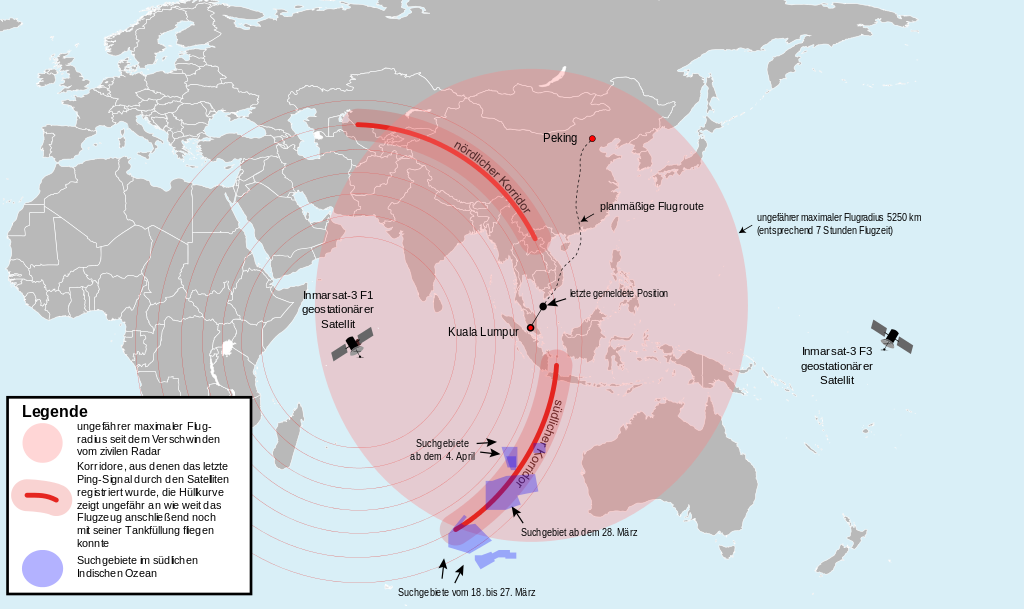
MH370: Theoretical Search Area

Even the calculations of the “theoretical search area” could just be a red herring. Nothing is believable and therefore everything is possible.

MH17: Dutch PM’s call for “independent” inquiry adds weight to Russian theory

November 5, 2014

There are two theories about the shooting down of Malaysian Airlines MH17 and the murder of 298 passengers and crew (where over 60% were Dutch):

  1. that the aircraft was shot down by a BUK ground-to-air missile fired by Russian separatists in Ukraine and perhaps in the mistaken belief that they were shooting at a Ukrainian military transport plane. This is the theory that is favoured by the Ukrainian government, most western countries and by NATO.
  2. that the aircraft was shot down mistakenly by a Ukrainian fighter jet using an air-to-air missile. This was followed by cannon fire perhaps because the mistake was realised and no survivors could be permitted. This theory is supported by the Russians and the Russian separatists.

The Russian theory was initially ridiculed by the Ukrainians, NATO countries and the western media. But a few weeks ago the Dutch investigators let slip the information that at least one oxygen mask had been deployed and this was much more consistent with a weaker air-to-air missile followed by cannon fire rather than the much more powerful BUK ground-to-air missile. A BUK ground-to-air missile would not have given any time for the oxygen mask to deploy. Moreover a multitude of regular holes were found in the remains of the fuselage. They were too regular to just be shrapnel and their size and regularity were consistent with high velocity cannon fire. Then the lead Dutch prosecutor in an interview with der Spiegel would not categorically rule out the Russian theory.

Now the Dutch Prime Minister has called for a “thorough, independent inquiry” into the shooting down of MH17, again insinuating that the assumed theory of a ground-to-air missile has some fundamental flaws.

Reuters:

Dutch Prime Minister Mark Rutte on Wednesday stressed the importance of a thorough, independent investigation of the shooting down of Malaysia Airlines Flight MH17 before any decision on where those responsible should face trial.

The Dutch have the lead role in investigating the downing of theBoeing 777 aircraft, which crashed over rebel-held territory in eastern Ukraine in July with the loss of all 298 people aboard, two thirds of them Dutch.

With the crash site too dangerous to access due to fighting, they have been relying mostly on publicly available information to carry out a remote investigation.

“What we now have to do is through the independent safety boards to exactly understand what happened and the public prosecutors have to work on the prosecution which follows from this,” Rutte said, when asked if the International Criminal Court was the right venue for any trial.

“Then it has to be decided at what court it should take place. As we see things now, it is not most likely that the International Criminal Court is most suited to this.”

Rutte was on a one-day visit to Kuala Lumpur to meet his Malaysian counterpart, Najib Razak. Rutte flew from Amsterdam on Flight MH19, re-named from MH17 after the disaster. …. 

Kiev blames pro-Russian separatists for the airliner’s destruction. Russia says a Ukrainian military aircraft shot it down.

A report by the Dutch safety board said in September that MH17 crashed after a “large number of high-energy objects”penetrated its fuselage.

The reluctance of the Dutch investigators, the lead prosecutor and now the Prime Minister to just accept the NATO supported theory is, I think, a clear indication that the Russian theory is a much more likely explanation than is being acknowledged.

Antares rocket on ISS supply mission explodes on launch

October 29, 2014

An unmanned Orbital Science’s, Antares, cargo rocket carrying a NASA payload to the International Space station has exploded at launch. An earlier launch attempt a day earlier had been scrubbed because a boat wandered into the launch area at NASA’s Wallops Flight Facility in Virginia.

Antares Rocket Explodes During Launch on Oct. 28, 2014

An Orbital Sciences Antares rocket explodes shortly after lifting off on a private cargo mission toward the International Space Station on Oct .28, 2014 from NASA’s Wallops Flight Facility in Virginia. Credit: NASA TV

Orbital also supports human space flight by supplying commercial cargo resupply services for the International Space Station using our new Antares® rocket and Cygnus™ cargo logistics spacecraft.  In addition, Orbital provides full service engineering, production and technical services for NASA, DoD, commercial and academic space programs.

Designed to provide responsive, low-cost, and reliable access to space, Antares is a two-stage vehicle (with optional third stage) that provides low-Earth orbit (LEO) launch capability for payloads weighing over 5,000 kg. Internally funded by Orbital, Antares completed a risk reduction mission and a demonstration of commercial re-supply services for the International Space Station (ISS) under a NASA Commercial Orbital Transportation Services (COTS) agreement in 2013. Antares currently is under contract for eight Commercial Resupply Missions (CRS) to deliver cargo to the International Space Station, the first of which was completed in early 2014

The previous 4 launches of the Antares have been successful. The business of operating private launch vehicles is still a risky and expensive business. Orbital Science’s contract with NASA in 2008 was for NASA to provide $171 million in addition to the $150 million to be funded by Orbital. As of December 2013 costs expended had reached $530 million with $288 million coming from NASA. Orbital is quoted on the NYSE and in 2013 had revenues of $1.36 billion with a net income of $68 million (c. 5%). They report an operating margin of 8.3% so development costs are a little over 3% of revenues.

Space.com:

A private Orbital Sciences-built cargo launch to the International Space Station ended in a fiery explosion just seconds after liftoff Tuesday night (Oct. 28).

Orbital’s unmanned Antares rocket exploded in a brilliant fireball shortly after launching from NASA’s Wallops Flight Facility in Virginia at 6:22 p.m. EDT (2222 GMT), crashing back down to the launch pad in a flaming heap. The Antares was carrying Orbital’s unmanned Cygnus spacecraft, which was toting 5,000 pounds (2,268 kilograms) of food, scientific experiments and other supplies on this flight — the third cargo mission to the space station under a $1.9 billion contract the company holds with NASA.

Antares visibility map

Antares first nighttime launch from Wallops Flight Facility planned for October 27th – Visibility area — image NASA


Dutch prosecutor does not rule out possibility of Ukrainian fighter having shot down MH17

October 27, 2014

A few weeks ago I speculated that the finding of a deployed oxygen mask on one of the victims gave some credence to the theory (favoured by Russia) that it was a Ukrainian fighter which may have shot down the ill-fated MH17 aircraft.

The point apparently is that if the aircraft had been brought down by a Russian ground-to-air BUK missile – fired by the rebels – then the aircraft would have failed catastrophically and there would have been no time for the oxygen masks to deploy. All on board would have died almost instantaneously.

If instead MH17 had been brought down by a Ukrainian fighter jet – as the Russians suggest – then the air-to-air missile would not have been as immediately catastrophic as the much more powerful BUK missile. Then there may well have been time for some of the oxygen masks to deploy – even if the aircraft was later “finished off” by cannon fire. ….. 

But the bottom line is that if there was time for the oxygen masks to deploy then it is more likely that a Ukrainian jet was responsible rather than a BUK missile.

Now in an interview with Der Spiegel, the Dutch prosecutor does not rule out the possibility that MH17 may have been shot down from the air.

Der Spiegel: In an interview, the Dutch official leading the investigation of the crash of Malaysia Airlines Flight MH17 over eastern Ukraine addresses reports that German intelligence is convinced the plane got shot down by pro-Russian separatists.

Fred Westerbeke, 52, is the chief investigator with the Dutch National Prosecutors’ Office, which is currently looking into the circumstances behind the crash of Malaysia Airlines Flight MH17 over eastern Ukraine while en route from Amsterdam to Kuala Lumpur on July 17.

SPIEGEL: High-resolution images — those from US spy satellites, for example — could play a decisive role in the investigation. Have the Americans provided you with those images?

Westerbeke: We are not certain whether we already have everything or if there are more — information that is possibly even more specific. In any case, what we do have is insufficient for drawing any conclusions. We remain in contact with the United States in order to receive satellite photos.

SPIEGEL: So you’re saying there hasn’t been any watertight evidence so far?

 Westerbeke: No. If you read the newspapers, though, they suggest it has always been obvious what happened to the airplane and who is responsible. But if we in fact do want to try the perpetrators in court, then we will need evidence and more than a recorded phone call from the Internet or photos from the crash site. That’s why we are considering several scenarios and not just one.

SPIEGEL: Moscow has been spreading its own version for some time now, namely that the passenger jet was shot down by a Ukrainian fighter jet. Do you believe such a scenario is possible?

Westerbeke: Going by the intelligence available, it is my opinion that a shooting down by a surface to air missile remains the most likely scenario. But we are not closing our eyes to the possibility that things might have happened differently.

MH370: Emirates CEO suggests plane’s flight was controlled

October 11, 2014

“Something is not right here and we need to get to the bottom of it.”

Sir Timothy Clark, CEO Emirates Airways

My “least implausible” theory about the disappearance of MH370, seven months ago, is that it was an engineered and highly successful hijack, by an unknown state intelligence agency, who incapacitated crew and passengers, took control of the aircraft and brought it down without trace, to prevent some of the cargo and some of the passengers from ever reaching China.

Now support for this – or some similar – explanation comes from an unlikely quarter within the heart of the airline industry. Tim Clark has been in the industry since 1972, was recently knighted and has been with Emirates since 1985. He became CEO in 2003 and is also President of the Emirates Foundation.

news.com:

Now, seven months after the Malaysian Airlines Boeing 777 vanished en route from Kuala Lumpur to Beijing, Sir Tim has cast doubt on the official version of events.

In an extraordinary interview with German magazine Der Spiegel, he challenges the Australian Transport Safety Bureau’s conclusion this week that MH370 flew south over the Indian Ocean on autopilot for five hours until it ran out of fuel and fell out of the sky, forcing 239 passengers into a watery grave. 

Instead, Sir Tim believes it is far more likely that “MH370 was under control, probably until the very end”, questions the veracity of the “so-called electronic satellite ‘handshake’” used by analysts to pinpoint the probable crash site and insists the mysterious cargo in the hold (removed from the manifest by Malaysian authorities) is a crucial clue to the puzzle.

That an aircraft the size of MH370 can simply disappear without a trace, “not even a seat cushion” was downright “suspicious”, he said.

Seven months since 239 passengers and crew just vanished on a modern jet liner!

This was not an accident. The complete lack of any evidence suggests that “fingerprints have been wiped”. The so-called “electronic handshakes” give a hint of being fabricated to suit a story.

These are extracts of his interview with Der Spiegel:

His view of the vanished Malaysian Airlines flight MH 370 is a provocative one. The plane that disappeared was a Boeing 777 and Emirates operates 127 such aircraft, more than any other airline in the world. ….

MH 370 remains one of the great aviation mysteries. Personally, I have the concern that we will treat it as such and move on. At the most, it might then make an appearance on National Geographic as one of aviation’s great mysteries. We mustn’t allow this to happen. We must know what caused that airplane to disappear. …. 

My own view is that probably control was taken of that airplane. ….. It’s anybody’s guess who did what. We need to know who was on the plane in the detail that obviously some people do know. We need to know what was in the hold of the aircraft. And we need to continue to press all those who were involved in the analysis of what happened for more information. I do not subscribe to the view that the Boeing 777, which is one of the most advanced in the world and has the most advanced communication platforms, needs to be improved with the introduction of some kind of additional tracking system. MH 370 should never have been allowed to enter a non-trackable situation. …..

The transponders are under the control of the flight deck. These are tracking devices, aircraft identifiers that work in the secondary radar regime. If you turn off that transponder in a secondary radar regime, that particular airplane disappears from the radar screen. That should never be allowed to happen. Irrespective of when the pilot decides to disable the transponder, the aircraft should be able to be tracked. …… The other means of constantly monitoring the progress of an aircraft is ACARS (Eds. Note: Aircraft Communications Addressing and Reporting System). It is designed primarily for companies to monitor what its planes are doing. We use it to monitor aircraft systems and engine performance. At Emirates, we track every single aircraft from the ground, every component and engine of the aircraft at any point on the planet. Very often, we are able to track systemic faults before the pilots do. ….. Disabling it is no simple thing and our pilots are not trained to do so. But on flight MH 370, this thing was somehow disabled, to the degree that the ground tracking capability was eliminated. …….

I’m still struggling to come up with a reason why a pilot should be able to put the transponder into standby or to switch it off. MH 370 was, in my opinion, under control, probably until the very end.

why would the pilots spend five hours heading straight towards Antarctica?

If they did!

I am saying that all the “facts” of this particular incident must be challenged and examined with full transparency. We are nowhere near that. There is plenty of information out there, which we need to be far more forthright, transparent and candid about. Every single second of that flight needs to be examined up until it, theoretically, ended up in the Indian Ocean — for which they still haven’t found a trace, not even a seat cushion. …. 

Our experience tells us that in water incidents, where the aircraft has gone down, there is always something. We have not seen a single thing that suggests categorically that this aircraft is where they say it is, apart from this so-called electronic satellite “handshake,” which I question as well. …..

There hasn’t been one overwater incident in the history of civil aviation — apart from Amelia Earhart in 1939 — that has not been at least 5 or 10 percent trackable. But MH 370 has simply disappeared. For me, that raises a degree of suspicion. I’m totally dissatisfied with what has been coming out of all of this.

Somehow, it feels like a betrayal as the event is labelled an “unsolved mystery” and the world just moves on. Not just a betrayal of the 239 passengers and crew and their families but of the innate sense of human curiosity and questing.