Archive for the ‘Aviation’ Category

Ranking the airports on my recent trip

April 23, 2014

Seven airports this time. I rank them as follows:

  1. Stockholm Arlanda
  2. Munich
  3. Kuala Lumpur
  4. Delhi
  5. Bangkok
  6. Frankfurt
  7.  last by a long way Madras (Chennai)

Stockholm Arlanda had fairly efficient, courteous and hassle-free security checks. The enforced walk through the shops is irritating. Quick check-in this time and the distances to be covered by my poor knees were not that great.

I like Munich airport even if arriving from a non-Schengen destination can be a real pain. This time I was arriving from a Schengen port (no security check needed) and departing to a non-Schengen port which was fine. Distances were not unreasonably long and the walkways were all working.

The airport at Kuala Lumpur is well laid out and clean and impressive. But Malaysian airline staff were far too laid back (my euphemism for “lazy”) and uninterested. Some long distances to cover though – with no walk-ways in sections.  Immigration was fairly efficient. I was not searched by customs but those who were seemed to be being hassled unnecessarily.

The new Delhi airport is modern and clean and generally well laid out. The distances to be walked are excessive and the walk-ways coverage is not well planned. The carpeting (cheap and already going tatty) is not helpful for rolling baggage along. Passport control was unremarkable and baggage arrived fast. Security checks – as with other Indian airports – are slow but not inordinately so.

Bangkok has deteriorated from when it was built. Distances to cover are enormous (especially if having to transfer from one wing to the other). Security checks were slow, the lay-out was labyrinthine and the staff very smart but inefficient. I was not very impressed this time either by the airport or by the staff. Thai Airlines staff – on the other hand – are very efficient and courteous.

Frankfurt has become a pain. It is just too big. The train between terminals has remarkably bad coverage. Passport control is slow because there are never enough counters for the number of passengers involved. The security staff at Frankfurt are particularly arrogant and officious and petty (even with a 3 year old child). They are also very slow. The charm-schools they went to just don’t work. The distances to be walked have grown to become quite painful. Changing terminals is not fun.

The new Chennai airport was pathetic. Entering the terminal is chaotic and badly sign-posted. Construction is not yet complete  and where it is, bits are falling off. Airport staff are not well trained and don’t seem to know what they are doing. Toilets were unclean and smelly. Passport control was OK and the security checks were again slow but otherwise unremarkable. The gates are badly designed and have no space for departing passengers . Stores are charmless and chaotic. It has been designed to be all chrome and glass and to look pretty but lacks all the substance needed for a modern international airport. The quality of the construction leaves much to be desired. (somebody has made a lot of money by using sub-standard fixtures, fittings and materials).
 

Malaysia moves towards issuing death certificates and writing-off MH370

April 23, 2014

MH370 remains missing. The Malaysian authorities now want to issue death certificates for all on board and to draw a line under the whole incident. A declaration of death is a “preventive adjudication”. Normally a presumption of death requires a prolonged period of absence (7 years for example) but can be reached faster after overwhelming evidence of a crash or a sinking or a disaster. For MH370 there is no evidence of any kind.

Death certificates allow the process of closing the whole matter to start. Funds set up for the relatives of those presumed dead and for meeting any damages assessed by courts is a way of “liquidating the damage” and walking away.

A nightmare to wake up from.

The “search” continues in the Indian Ocean –  but the only evidence that this is where the plane is, is based on a calculation method which is itself based on an untested hypothesis. Even the international search team are beginning to entertain the notion that the plane may have landed somewhere.

Today, sources within the International Investigation Team admitted that the search may have to start again from scratch.

Speaking to the New Straits Times, a source said: “We may have to regroup soon to look into this possibility if no positive results come back in the next few days.”

The team has not suggested which country the plane might have landed in and have admitted it was difficult to know for sure if the plane crashed into the Indian Ocean.

But, as reported by Mail Online, sources from the search team said: “The thought of it landing somewhere else is not impossible, as we have not found a single debris that could be linked to MH370.

“However, the possibility of a specific country hiding the plane when more than 20 nations are searching for it, seems absurd,.”

A modern airliner going missing and leaving no trace is also absurd.

That this event was a deliberate act and the observed result is what was intended is increasingly likely.

This was no accident!


MH370: The most successful, state-sponsored hijacking ever?

April 13, 2014

It has been 5 weeks since MH370 vanished. The story is leaving the front pages. I have just spent a week in Malaysia and have been listening to much fascinating speculation (and speculation because there is no evidence). There was a growing feeling that the lack of evidence itself was intended and was critical.

A modern airliner with all it’s crew, passengers and cargo has vanished from the face of this earth. Five weeks after the event there is still no trace of anything. No debris of any kind. Even the supposed pings from the black-box are suspect and could be anything and even these are now fading.

All this in an age where satellite images have a resolution of better than 1m; where communications between anybody to anybody anywhere in the world can be – and are – routinely tapped by the NSA and it’s counterparts in Germany, the UK, Russia, China and even Australia; and where computers with communication facilities can be hacked into by all security agencies and especially when such computer hardware or software are pre-enabled for such hacking. It has become apparent that auto-pilots and flight computers fitted on Boeing aircraft have the capability of being programmed remotely and the auto-pilot can be switched into an “uninterruptible” mode.

This was no accident!

The most parsimonious explanation is that this vanishing trick was the deliberate and intended result of an operation which was spectacularly and successfully implemented.

Who then and why?

There were 20 Chinese software experts on board. They had been working for Freescale Technology in Texas on technology which could convert ordinary aircraft into “stealth” aircraft. Patents had been applied for but have not yet been granted. MH 370 was carrying a “large” package as a Chinese diplomatic package and was therefore not subject to any search or security procedures. The speculative, uncorroborated but plausible and most parsimonious explanation becomes:

  1. The Chinese software engineers “stole” technology on behalf of the Chinese government from Freescale.
  2. Freescale was slow in picking up the theft and alerting the authorities.
  3. US intelligence and security agencies were unable to prevent the engineers and their package from reaching Malaysia.
  4. They were also unable to prevent the engineers boarding MH370 bound for Beijing or the precious cargo from being loaded as diplomatic cargo.
  5. The operational arm of a US Security Agency took the decision – without recourse to their political masters – to prevent the engineers and their cargo from reaching Beijing, at any cost.
  6. Since collateral damage would be high it was imperative that all evidence be obliterated.
  7. With the probable assistance of Boeing, and soon after take-off, the in-flight computer was remotely re-programmed.
  8. The auto-pilot was remotely put into uninterruptible mode.
  9. The Malaysian military was “persuaded” – without the knowledge of their political masters – to ignore the plane’s turn-back and flight westwards over Malaysia for a few critical hours.
  10. The passengers and crew were all “executed” by the excursion up to 45,000 feet implemented by the autopilot.
  11. The remainder of the flight path was to get the plane and it’s cargo into an as inaccessible a location as possible.
  12. The aircraft was allowed to run out of fuel such that the auto-pilot made as soft a  ditching as possible in as remote a place as possible. This increased the probability of the plane sinking intact with little or no debris.
  13. The location was deliberately chosen to be over deep ocean so that any black-box evidence would be almost impossible to come by.

I am becoming convinced that this was all deliberate and a highly successful operation with a very high level of collateral damage – 239 dead.

Who should be blamed? The Chinese government for its industrial espionage which provoked the over-kill response? The US Agency which carried out the action to protect sensitive technology? Freescale for being lax? The political establishments in China and the US which exercise little oversight or control over their intelligence and security agencies?

“Collateral damage” has become the euphemism to use as a cloak whenever the ends are used to justify the means and where the means always lead to the death of many innocents.

MH370: The mystery may be that we think there is a mystery

April 3, 2014

I had dinner this evening with a varied group here in Kuala Lumpur.

I was rather struck by the reminder that a great deal of finding solutions lies in the framing of the problem.

Three were from the UK with peripheral connections to the airline industry who had just arrived from the Philippines. A couple were retired but knowledgable Australians and our hosts were our friends who were well respected Malaysian industrialists.

Inevitably the talk turned to MH370 and the mystery of its disappearance. Perhaps the problem lay in assuming that the disappearance was a mystery!

Of course this is all speculation but within this group some ” conclusions” were felt to be justified. It is almost impossible to avoid a conspiracy theory at some level since without some form of conspiracy, such a disappearance and such a long delay for the alarm to be raised should have been impossible.

  1. A “simple” catastrophic event followed by 7 hours of flying to nowhere makes little sense.
  2. A hijack “gone right” makes more sense than a hijack “gone wrong”.
  3. We should assume that what was achieved – the complete disappearance of aircraft and crew – was what was intended.
  4. The 239 passengers and crew perished a long time ago, and probably when the plane went up to 45,000 feet.
  5. The objective was to prevent certain cargo and/or certain passengers from completing their journey.
  6. The rest of the deaths were collateral damage.
  7. Whether the aircraft continues under a false identity or has been crashed into the ocean is irrelevant since the aircraft was irrelevant.
  8. If certain key passengers or the cargo were to be the target then the hijacking was probably state sponsored.
  9. The time delay between last contact and an alarm being raised (about 5 or 6 hours)  is suggestive that the Malaysian and some other governments were aware that something was up.

And now I cannot get it out of my head that the mystery lies in unravelling who wanted the plane, passengers, crew and cargo NOT to reach their destination – to vanish from the face of the earth.

All of this may be speculation but I am convinced that many Sate Governments  know a great deal more than they are letting on and that one or more of them know precisely what has transpired.

A hijacking gone right?


MH370: The altitude excursion which could have rendered most unconscious

April 1, 2014

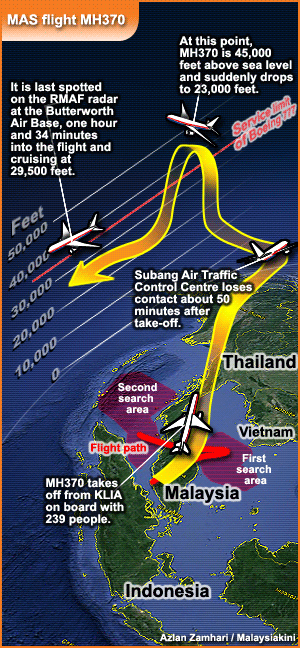
I just came across this graphic from malaysiakini. I hadn’t seen the altitude presented graphically before.

The altitude excursion about 1 hour into the flight up to 45,000 feet could have rendered everybody on board unconscious. If it was done deliberately or otherwise is still the burning question.

MH370 altitude excursion

Graphic from Malaysiakini

MH370: It may be the “best available” but is the evidence really “overwhelming”?

March 31, 2014

It does not add to the confidence when the story keeps changing. Tha last reported words from the cockpit were not “All right, good night” from the co-pilot but ” Goodnight. Malaysian three seven zero”  and it is not yet finalised as to who spoke the words.

I noticed today that Tony Abbott was quoted as saying that

“The accumulation of evidence is that the aircraft has been lost and it has been lost somewhere in the south of the Indian Ocean,” he told reporters at the Perth military base coordinating the search.

“That’s the absolutely overwhelming wave of evidence and I think that Prime Minister Najib Razak was perfectly entitled to come to that conclusion, and I think once that conclusion had been arrived at, it was his duty to make that conclusion public.”

But as far as I am aware the evidence of its location south west of Perth in the Indian Ocean is entirely – and solely – based on the analysis of routine communication signals between the ACARS system on the plane and Inmarsat’s satellite.

Slate: On the morning of Saturday, March 8, MH370 replied seven times to these pings, saying, in effect, “Yes, I’m here.” The line was open for the plane to communicate with the outside world. But the system that generates the messages themselves, called ACARS, had been shut off. So nothing else was communicated between the satellite and the plane.

…. When Inmarsat pinged it at 8:11 a.m. and received MH370’s reply, the amount of time it took the plane to respond allowed investigators to calculate its distance from the satellite. This did not correspond to a specific location but to an arc of possible locations across Central Asia in the north and the Indian Ocean to the south. … 

Could analysis of the six earlier pings narrow down the route that the plane had taken? ……  The first ping coincided more or less with the time when MH370 slipped out of range of Malaysia’s military radar. So we have a starting point. By knowing the interval to the next ping, and by estimating the plane’s speed, we can arrive at a distance traveled during that time. Given the radius of the next arc, it’s a simple matter to calculate a route by angling the distance traveled to meet up with that arc.

When the NTSB ran the numbers, the resulting plot showed the plane winding up in a remote part of the Indian Ocean, and that’s where searchers began focusing their efforts. …… Though the NTSB’s process worked for generating a likely path to the south, it could also be used just as effectively to create a path to the north. The satellite data itself is ambiguous—it provides no clues about which direction the plane is moving. 

….. the clever engineers at Inmarsat managed to squeeze one more drop from the thimbleful of data contained in those pings. …….. 

“This is an old satellite,” Exner said. “When satellites start to run out of hydrazine, you can’t keep them exactly geostationary.” Instead of keeping perfectly still above a certain spot, the satellite begins to slowly wobble. Over the course of the day, it makes a narrow figure eight around a central spot located on the Earth’s equator.

“It’s a small effect,” Exner says, “And normally you’d overlook it.” But in the hunt to overcome the symmetry of the ping data, Inmarsat likely realized that it could use the wobble of the satellite to its advantage. The satellite itself, depending on where it is in its orbit, will have a different relative motion compared to a northbound and a southbound plane. That relative motion can be detected as a Doppler effect. ….. The effect was subtle and difficult to tease out of the data, but when Inmarsat ran simulations, it found that the amount of Doppler effect observed in the MH370 data matched the predictions for the southern route and not the northern one. Comparisons with other flights whose location and speed were known supported that conclusion ….

Numbers don’t lie. But any analysis requires assumptions to be made and the results of mathematical analysis are only as good as the assumptions made. The analysis is based on the satellite’s wobble. Somewhere in the analysis Inmarsat also had to take account of the history of how ACARS systems on Malaysian Airlines flights had communicated with their wobbling satellite. That suggests that there is variation in how systems on different aircraft react. There is no reason to suspect that the assumptions made in this case were in error but there must be a quite substantial error band.

But apart from these signals and their analysis there is no corroborating evidence of any kind. No debris so far. No black box signal. The only “eye-witness” accounts of “something”, were off the Vietnam coast and over the southern part of the Maldives!

I suppose Tony Abbott was just supporting the Malaysian PM.

It is one piece of evidence and it may be the best evidence available, but I am far from certain that the evidence available is as yet “overwhelming”. I suppose that only finding debris from the aircraft could provide that.

Interpol attacks Malaysian Home Minister while Defence Ministry backtracks

March 29, 2014

I don’t think the Malaysian Home Minister Datuk Seri Ahmad Zahid Hamidi can win this one. He was the one who first rushed to judgement and blamed (his own) immigration officers for incompetence in  not being able to detect “Asian looking” people carrying stolen European passports.

On Wednesday, Zahid told Parliament that consulting the Interpol database of of 40.2 million stolen passports was too time consuming for immigration officers and caused airport delays. The Malay Mail Online reported that Zahid maintained Malaysia’s immigration department had matched “world standards” when carrying out border control. He reportedly said immigration officers guarding Malaysia’s entry points were trained by other countries including the US, UK, Australia and Canada to carry out profiling and detect false travel documents.

In other words says Malaysiakini he maintains that:
Interpol has a facility that is inadequate. Hence the world is not secure from potential terrorists and illegals from easily entering nations with fake documents. Malaysia cannot be blamed. ….. The home minister’s claim certainly smacks of a failed if not an unreliable and impractical system being provided by Interpol. Hence Malaysia has taken an official stand why it has not and probably will not use Interpol’s SLTD and thus absolves itself of any blame for allowing would-be terrorists and illegal travels to depart from Malaysia on-board its national carrier to any destination in the world serviced by the airlines.
But Interpol has not taken this lying down. They have issued a press release rejecting Malaysia’s claim and they take the Malaysian Home Minister severely to task in less than diplomatic language:
Malaysia’s decision not to consult INTERPOL’s Stolen and Lost Travel Documents (SLTD) database before allowing travellers to enter the country or board planes cannot be defended by falsely blaming technology or INTERPOL. If there is any responsibility or blame for this failure, it rests solely with Malaysia’s Immigration Department.
INTERPOL’s SLTD database takes just seconds to reveal whether a passport is listed, with recent tests providing results in 0.2 seconds.
The fact is that the US consults this database more than 230 million times per year; the UK more than 140 million times; the UAE more than 100 million times and Singapore more than 29 million times. Not one of these countries, or indeed any INTERPOL member country, has ever stated that the response time is too slow.
The truth is that in 2014 prior to the tragic disappearance of Malaysia Airlines Flight MH 370, Malaysia’s Immigration Department did not conduct a single check of passengers’ passports against INTERPOL’s databases. ….. 
In this regard, despite this unjustified attack on INTERPOL, we remain ready, willing and able to help Malaysia better safeguard its citizens and visitors from those seeking to use stolen or fraudulently altered passports to board planes.
INTERPOL has no idea why Malaysia’s Home Minister chooses to attack INTERPOL instead of learning from this tragedy.
After years of witnessing countries fail to consult INTERPOL’s SLTD database prior to allowing travellers to cross borders and board planes, INTERPOL created I-Checkit which will allow airlines and cruise lines to ensure that no passenger can use a stolen or lost passport registered in INTERPOL’s database to board one of their planes or ships.
In the meantime the Malaysian Ministry of Defence is struggling to explain why they did not detect MH370 flying back through Malaysian airspace. The Deputy Defence Minister first came up with the story that it had been detected but was assumed to be following Air Traffic Control’s directions.

the malaysian insider: ….. deputy Defence Minister Datuk Abdul Rahim Bakri told Parliament today . “It was detected by our radar, but the turn back was by a non-hostile plane and we thought maybe it was at the directive of the control tower,” he said in winding up points raised by MPs on the King’s royal address.

But on the next day he had to backtrack,

malay mail online: “In relation to my statement in the debate on the royal address in Parliament last night (March 26, 2014) which said the MH370 flight may have turned back after receiving orders from the control centre. I wish to explain that it was only my andaian (assumption) and also possibilities that could have occurred. After carrying out checks, I wish to stress that my assumption was not accurate,” Abdul Rahim said in a two-paragraph statement issued by the Defence Ministry.

So it still remains unclear as to why the Malaysian military did not detect or did not react to the aircraft crossing over the country.

Having no pilot will soon be less risky than having a pilot

March 28, 2014

The cockpit of the future will have one pilot and a dog. The pilot is there to watch the systems and make sure everything is operating correctly. The dog is there to bite the pilot if he tries to touch anything.

Much of the speculation about the MH370 disappearance is about the role of the pilots in whatever transpired. But whether they were heroes or villains or under duress or on a suicide trip, they achieved the changes in the flight path by reprogramming the on-board, flight computer.

For a commercial flight all the pre-flight instrument checks and the programming and the reprogramming where necessary, can be accomplished in advance or remotely. The role of the pilot nowadays seems most intense during taxiing on the ground and at take-off. Thereafter he does not need to play much part. He is still – it is thought – indispensable if an emergency situation were to arise. But even that perception is only true for unforeseen emergencies. For all situations which can be foreseen and then are pre-defined emergencies, the automatic controls would react faster and with more certainty than any human intervention. I am not sure if control systems are already sufficiently sophisticated to cope with all situations on the ground. But even here it is human error which is the main cause of incidents. Collisions on the ground are usually due to some incompetence on the part of pilots or of the ground traffic control.

But it is just a matter of time and we are getting close to the point where the risks of having a pilot will outweigh the risks of not having a pilot!

For military attacks and even for surveillance we are already at the point where pilotless craft pose less risk – for the attacker – than manned aircraft. Drones for military and civil applications are proliferating. In modern fighter jets, the pilot’s survival now limits some of the design and performance parameters of the aircraft. Altitude, speed, maneuverability, rate of climb, g-forces are all constrained by what the pilot can survive. Of course some new risks would be introduced with pilotless, commercial aircraft. With aircraft under remote control, hijacking would become a matter of hacking into the flight computer. On the other hand, the possibility of in-flight hijacking by a passenger would be eliminated. Drunken or suicidal pilots would pose no risk – but computers “drunk” on contaminated code might constitute a new risk. The risk with unmanned cargo aircraft would then be just the possibility of crashing into inhabited areas. Unforeseen emergencies remain an unknown unknown. But even here, the solution will lie with how “smart” the control computers can be made. My car can already correct for a skid faster than I can. It can park in a tight spot neater than I can. Some more “smartness” and automation will also be required in the air traffic control systems. The security and integrity of communications to on-board computers and how and when over-rides will be permitted will pose their challenges.

Driverless cars are coming. I would guess that in 20 years the road infrastructure will allow the majority of cars being sold to be driverless. There are developments in the infrastructure of airports and air traffic control systems which will be necessary and there will be a psychological barrier to overcome, but pilotless commercial aircraft will also – I think – start flying within 20 years. Cargo planes probably first  – before passengers are ready to take the plunge.

Airbus future

Airbus future

Related: Future by Airbus

FAA requires GE software fault on Boeing 747-8 aircraft to be urgently fixed

March 26, 2014

In the wake of the MH370 disappearance where an aircraft fault – even if considered unlikely – cannot be ruled out, any safety issue on Boeing aircraft takes on a higher profile. Glitches with the Dreamliner contribute to the a slightly more nervous environment than usual. A software fault with some GE engines which could cause Boeing’s 747-8 aircraft to lose thrust while landing and crash into the ground has to be urgently fixed according to an instruction from the FAA. The new directive reads

[Federal Register Volume 79, Number 57 (Tuesday, March 25, 2014)] [Rules and Regulations] [Pages 16173-16175] From the Federal Register Online via the Government Printing Office [www.gpo.gov] [FR Doc No: 2014-06476]

SUMMARY:

We are adopting a new airworthiness directive (AD) for certain The Boeing Company Model  747-8 and 747-8F series airplanes powered by certain General Electric (GE) engines. This AD requires removing certain defective software and installing new, improved software. This AD was prompted by a determination that the existing electronic engine control (EEC) software logic can prevent  stowage of the thrust reversers (TRs) during certain circumstances, which could cause the TRs to move back to the deployed position. We are issuing this AD to prevent in-flight deployment of one or more TRs due to loss of the TR auto restow function, which could result in inadequate climb performance at an altitude insufficient for recovery, and consequent uncontrolled flight into terrain. 

This AD is effective April 9, 2014.

Reuters Wed Mar 26, 2014 

The U.S. Federal Aviation Administration on Tuesday ordered an immediate fix to the latest version of Boeing Co’s 747-8 plane, saying a software glitch could cause it to lose thrust when close to landing and fly into the ground. The FAA’s so-called airworthiness directive covers Boeing’s 747-8 and 747-8F planes with certain General Electric Co engines. It calls for replacing defective software with a new improved version. The rule, the fourth such directive involving the 747-8, directly affects seven airplanes in the United States, the FAA said. If adopted internationally, the rule would cover a larger number. Boeing’s website said it had delivered 66 of the four-engine jets, the company’s largest, to customers worldwide since the model was introduced in October 2011. …. …. GE said it owned the software and jointly analyzed it with Boeing, but plane maker decided to recommend the software change to customers. According to the FAA, the risk arises when a plane is changing back into “air mode” while performing a “rejected or bounced landing.” That change halts hydraulic pressure used to stow the engine thrust reversers, which slow the plane on landing, the agency said. Without hydraulic pressure, the reversers may not stow fully and might redeploy, which “could result in inadequate climb performance at an altitude insufficient for recovery, and consequent uncontrolled flight into terrain,” the FAA said. Unidentified business jet/VIP customers own the eight passenger models of the aircraft in the United States, according to Boeing’s website. Air cargo company Atlas Air is the largest U.S. commercial owner of the jet, with a fleet of eight 747-8F freighters. Among passenger carriers, Lufthansa is the largest operator, with 11. It said its planes were unaffected by the directive. “GE has confirmed that all our engines already have the software update that is required by the FAA,” a spokesman said on Wednesday. China’s Cathay Pacific has 13 freighters and Cargolux, based in Luxembourg, has nine. Korean Airlines Co, Nippon Cargo Airlines Co Ltd and Volga-Dnepr UK Ltd also own 787-8F freighters, according to Boeing’s website.

In November 2013 another long running software fault on GE engines for Boeing 787’s and 747’s which caused engine flameout in icy conditions seemed to be finally fixed.

FlightGlobal: 10th Nov. 2011 Reports of eight in-flight and four on-ground unintended shutdowns of General Electric CF6-80C2B wide-body turbofan engines have prompted the US Federal Aviation Administration (FAA) to mandate a change out of the engine’s electronic control unit (ECU). A proposed airworthiness directive, to be published on 14 November, will affect 697 CF6 engines flying on US-registered widebody aircraft. The directive supersedes a 2007 AD requiring a software upgrade (8.2.Q1) on the same ECU to increase the engine’s margin to flameout after several incidents where engines had flamed out due to exposure to ice crystals and ice shedding into the engine. With the new software in place, problems continued. FAA said it received two reports of “ice crystal condition flameouts”, which prompted GE to develop another software upgrade (8.2.R) for the ECU. The new software included “improved inclement weather capability, and enhanced fuel metering valve fault handling logic to reduce the risk of [in-flight shut down] caused by intermittent fuel metering valve feedback signals”, said the FAA. Since that time however, there have been 12 additional engine shutdowns, eight in flight and four on the ground, with engines using upgraded ECU software and other upgrades. The problem was found to be caused by ignition system induced noise that created dual-channel faults in the ECU computer.

MH370: All lives presumed lost! The unedifying competition which has hijacked the search efforts

March 24, 2014

I had not intended to write any more about the 239 lives which have certainly been lost.

But I have been following the search efforts (there is no rescue mission left to perform). And the competition between Malaysia, Australia and China in the rush to show-off their capabilities and, by implication, their humanity, leaves a bad taste in my mouth.

First we had Tony Abbott rushing to announce that the satellite images had been found – 4 days after they had been photographed. We had the Malaysian Minister of Defense – breaking in to his own press conference – with “Breaking News” that the Chinese had also found a satellite image. Like some cheap Indian TV station which has nothing but Breaking News. He read out a hand-written note where the dimensions of the object sighted were transcribed wrongly and he then had to issue a correction later. Then the French jumped in to show that they also have satellites. The Chinese have rushed search planes to Perth where, instead of landing at the designated military airport outside of Perth which is the centre of the search operations, they first landed by mistake at the civil airport. The ice-breaker Xue Long (which rescued the infamous Chris Turney and his Ship of Fools from the Antarctic) was diverted to the search area. Then this morning the Chinese announced the first real sightings of debris by one of their planes. The Xue Long will arrive in the area tomorrow.

(It has just been announced by the Malaysian Prime Minister that based on new analysis from Inmarsat and the UK Air Accident Investigation Branch (AAIB) the plane was lost in the Indian Ocean and all on board must be presumed lost. I am thankful that unlike some other politicians, David Cameron did not rush to hold his own press conference).

I have no doubt that the search personnel are performing a great job – from whichever country they come. But there is no longer any real hope for the 239 passengers and crew. There is of course an important mystery to be solved since whatever happened to MH370 has fundamental implications for air safety.

With no lives any longer at stake, the announcements and “breaking news” emanating from China and Australia and Malaysia now have a strong smell of political positioning. The announcements have been hijacked by the political establishment. I find the use of the search process for political positioning between China – which wishes to be seen as the regional power – and Australia – which is the de facto proxy for the US –  and Malaysia – which is trying to avoid being seen as chaotic and incompetent – is less than edifying.