Archive for the ‘Behaviour’ Category

Hillary Clinton’s health is suspect after fourth coughing fit

March 13, 2016

When one has a coughing fit one can’t do anything much and neither can Hillary Clinton. But she has now had her fourth major coughing fit in 3 months while making a public speech. She is left completely incapacitated. There has always been a question about her health (68 going on 69) and these questions are now coming to the fore. The speech incapacitation lasts for over 2 minutes and it is embarrassing to watch.

She is clearly in distress which lasts much longer than the actual coughing fit itself. I have acid reflux and asthma and I think I can recognise how she feels.

Maybe it is just acid reflux reaching the throat. But I doubt that.

The risk is that she is a lot sicker than she is letting on.

Inquistr: In July (2015), her campaign released medical records pronouncing her sufficiently healthy to serve as president and that also indicated that the Democratic front-runner in election 2016 is taking medicine for an underactive thyroid as well as another prescription for the above-mentioned blood clots following a concussion suffered in December 2012.

There are claims that the media is covering up the fact that she is suffering from hypothyroidism/Hashimoto’s disease.

The liberal press believes that these health concerns are a right wing conspiracy.

Gawker: These theories are promulgated by far-right fringe figures like Jerome Corsi at World Net Daily, but they’ve been amplified by people as mainstream as Karl Rove. They’re common knowledge to regular readers of Breitbart and the Daily Caller. The “Hillary Clinton is hiding a serious medical condition” theory has rapidly become an alternate conservative narrative of the election—it is, in other words, already the birtherism of 2016. How did that happen?

It is easy to dismiss over the top reports about Benghazi flu or brain injury or a heart problem, but it is not just a simple cough due to acid reflux.


Six months of Russian intervention shows up 5 years of Obama’s ineptitude in Syria

March 13, 2016

Russia began its current intervention in Syria on September 30th last year, whereas the US began its anti-Assad campaign in 2011:

……… with the financing, training and encouragement of selected “moderate rebels”. They have no doubt weakened Assad but have also been instrumental in creating ISIS.

The Russian intervention has had a focus and an end-game in mind, both of which were missing from the US/NATO “strategy”. The “ceasefire” that is currently in place allows Russia (and Assad) to continue operating against the “terrorists” (ISIS, Al Nusra…) who are not party to the ceasefire. The US is now just following Russia’s lead much to the chagrin of the many Sunni opposition groups and of Saudi Arabia.

The only objective which Obama and Kerry ever had in Syria was to remove Assad but they had no strategy either for that or for what would follow. In Syria, Vladimir Putin has highlighted Obama’s ineptitude.

Canada Free Press:

On February 27, 2016, a ceasefire went into effect in Syria between the forces of the Assad regime and the opposition. The ceasefire was achieved after the United States and Russia reached understandings regarding the terms of the agreement; Bashar al-Assad and the representatives of the opposition who took part in the contacts accepted its terms; and the ceasefire was grounded in a UN Security Council resolution.

The Islamic State, Jabhat al-Nusra, and other jihadist rebel groups are not party to the ceasefire, and Russia and the United States have agreed that they would continue fighting them in cooperation with one another. In actuality, the ceasefire was reached as a result of the combined efforts of the two superpowers currently engaged in leading the campaign for a political solution to the Syrian crisis. All the other actors are dependent on the assistance of these two powers and are subject to their influence.

In order to translate its military achievements in the Syrian arena into achievements in the realm of international politics, Russia worked intensively to advance the ceasefire along two parallel channels. The first channel was operational – specifically, a joint air and ground offensive against rebel forces aimed at exhausting them, carried out by a pro-Assad coalition including Iran, Syrian military forces that are loyal to Assad, Hezbollah, and Shiite militias. The severe damage sustained by the rebel forces is what brought them to the negotiating table. The second channel focused on advancing a political process, primarily vis-à-vis the United States, but also Saudi Arabia.

Moscow sought to promote the political dialogue while it enjoyed the upper hand on the military battlefield and was able to dictate the outcome of the process. Russia translated its achievements on the ground into a political roadmap for a cessation of hostilities and the establishment of a transitional period toward a solution to the conflict within 18 months. Russian policy with regard to the Syrian crisis was also motivated by Russia’s aspiration to promote its standing within the international arena and reduce the Western foreign and economic pressure leveled against it following its actions in Ukraine. In this context, Moscow led the joint offensive of the forces of the pro-Assad coalition in an effort to demonstrate its determination and to create pressure on the West and on Turkey by means of a massive flight of refugees toward Turkey from the embattled areas. It is unclear whether Russia received anything in return from the contacts that took place behind the scenes between Washington and Moscow, such as an easing of the Western sanctions.

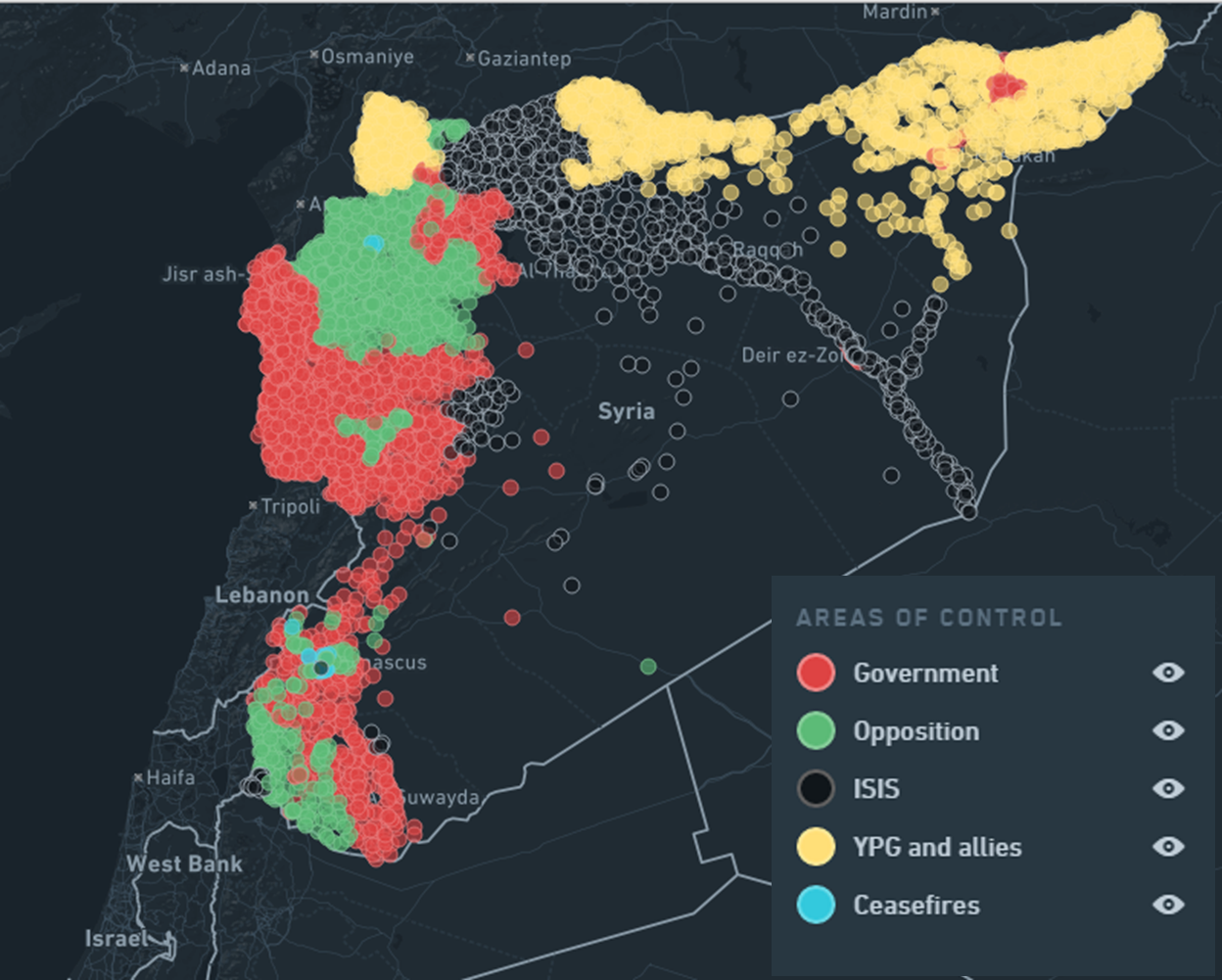
Syria conflict map 13th March 2016 Carter Center

Syria conflict map 13th March 2016 Carter Center

The Russian intervention has seen the ISIS expansion halted and reversed. They have secured breathing space for the Assad regime though they expect to have him replaced in an orderly manner in time. ISIS will shift (is already shifting) to Libya which is in chaos (for which Obama passes the buck to Cameron and Sarkozy). The EU with its shambles of a refugee policy is providing the sink which swallows the bulk of those displaced.

The real Middle East end-game is a very long way away but Russia is reaching its immediate objectives of supporting the Syrian regime, halting the march of Sunni- groups, restraining the ambitions of Saudi Arabia and of getting in the good books of Iran.

The US and Europe will still have to handle ISIS in Libya but here they will not have the Russians to rescue them.


The “niqab” is a pre-Islamic, Jewish tradition

March 10, 2016

I didn’t know that.

In Egypt, a Member of Parliament has introduced a bill to ban the niqab in public places and in government institutions:

Independent:

The Egyptian parliament is drafting a law banning women from wearing the niqab veil. The ban will apply to wearing the clothing in public places and government institutions, it has been reported.

……..

MP Amna Nosseir, professor of comparative jurisprudence at Al-Azhar University, who has backed the ban, said that wearing the veil is not a requirement of Islam and in fact has non-Islamic origins. She has argued that it is a Jewish tradition which appeared in the Arabian Peninsula prior to Islam and that a variety of Quran passages contradict its use. Instead, she has advocated that the Quran calls for modest clothing and covered hair, but does not require facial covering.

Jewish niquab image - Faisal Kutty

Jewish niqab (image – Faisal Kutty)

There are some Jewish sects which today use the niqab or something similar – a frumka, (a Haredi sect and some Sephardic women). There are references in the Old Testament which refer to women putting on a veil before meeting with strange men.

Certainly there seems to be strong evidence that the full-face veil was in use for at least a 1000 years before Islam was invented. Even in Islam, the Qur’an seems to call for modesty rather than specifying a particular mode of dress.


The “Oh God! Anybody but Hillary” effect could take Trump all the way

March 3, 2016

The US Presidential election is getting to be extremely entertaining and well beyond my expectations. It looks like it is going to be Trump (85%) versus Hillary (98%) in November. An additional and quite unexpected source of entertainment has emerged as Republicans become contortionists to escape from their previous criticisms of Trump and find a convoluted way to align themselves behind him.

(I note also that many of Trump’s critics in Europe are beginning to realise that it might not be very healthy to be too loud in their criticism and disdain of somebody who could be the next President of the US. The Pope has already backtracked. Some Scottish Nationalists are also becoming intellectual contortionists.)

The Republican “elite” are in abject disarray it seems (but they have been in disarray ever since the Tea Party gained ground). As an opposition they have been pathetic. Even with a resounding majority in the House their establishment chinless wonders (guess who I mean?), have been remarkably ineffective.  “Stop Trump” is their new game, but they can’t. They can – possibly – dislodge him from being the GOP nominee but then he goes independent and then the GOP disintegrates.

For a Trump – Clinton battle in November, all conventional thinking is going to be of little use. The play-book for that game does not yet exist. It will be written from now on. It would, I think, be quite wrong to assume that the Trump then (in the mind’s eye of the electorate) will be the Trump we see now. It will be the perceptions he creates from now on, not those he has created so far, which will turn out to be decisive. Trump is turning out to be a rather smart – and clever – operator, in a clown’s clothing. He is becoming the champion of common sense and seems immune to attacks from “liberal McCarthyism” and from the tyrants of “political correctness”.

The conventional wisdom seems to be that Hillary Clinton would beat Trump easily. Her grass-roots organisation and the “Clinton brand” would, it is thought, rally the hordes to her cause and Trump would be wiped away. But I think conventional wisdom will turn out to be conventional folly in such a battle. Even on the feminism front, Clinton does not appear to have any decisive edge over Trump’s over the top support of being “feminine” (as opposed to feminism), which is sexist only to the most ardent of feminists. Clinton versus Trump will not be about ideologies but will be a battle of perceptions engendered and the emotions that are aroused. Clinton versus Trump will be black-and-white TV versus colour, it will be Blackberry versus the iphone, it will be – put simply – boring but known versus exciting if unknown. Normally unknown would be frightening – but not if the status quo is even more hopeless.

I have a sneaking suspicion that in a Clinton – Trump match-up, Clinton will defeat herself. Boring but known has its attractions when things are going well and the voter wants the status quo to be maintained. But for an electorate wanting “change” there will be little enthusiasm for Hillary. She projects the antithesis of “change”. She represents the worst of the establishment entrenched in their towers of elitism. Even adopting some of Bernie Sanders’ socialist ideas does not lift her up from “boring”. Obama promised “change” and “hope” and delivered neither. “American values” which made America “great” seem to have been diluted by too many years of wishy-washy liberalism.

“Oh God! Anybody but Hillary” and an anti-establishment tsunami could make Donald Trump President of the United States.

Trump and Brexit are both manifestations of a “class revolution”

February 27, 2016

Glen Reynolds makes the case of anti-establishment, anti-elite revolution being the driver behind both the Trump wave in the US and the surge for BREXIT in the UK. He has a point.

In America, Donald Trump — who many of the experts thought had no chance — is dominating the polls. In Britain, meanwhile, much of the public seems to be mobilizing in favor of exiting the troubled European Union — a British Exit, or Brexit.

Writing in The Spectator, Brendan O’Neill puts this down to a class revolt on both sides of the Atlantic. And he’s right as far as he goes, but I think there’s more than just a class revolt. I think there’s also a developing preference cascade. O’Neill writes: “In both Middle America and Middle England, among both rednecks and chavs, voters who have had more than they can stomach of being patronised, nudged, nagged and basically treated as diseased bodies to be corrected rather than lively minds to be engaged are now putting their hope into a different kind of politics. And the entitled Third Way brigade, schooled to rule, believing themselves possessed of a technocratic expertise that trumps the little people’s vulgar political convictions, are not happy. Not one bit.”

Well, that’s certainly true. Both America and Britain have developed a ruling class that is increasingly insular and removed from — and contemptuous of — the people it deigns to rule. The ruled are now returning the contempt.

I think this is certainly partially correct. Every attack on Trump has contained a large degree of intellectual contempt, and every such attack has only increased his support. Now we may be seeing signs that the establishment is going to have to get off their superior backsides and treat with the contemptible. Similarly Cameron is being reduced to telling the UK electorate that he knows best what is best for them. He is treating the BREXIT supporters also with a contempt which is now back-firing. I expect that he, too, will have to come of his high horse. It does not help him that the bottom line is the EU will make their real concessions only after the UK votes – if they do – for a BREXIT. So far they have tried to fob him off with cosmetic changes.

This trend is visible across other parts of Europe as well and it has been brought to a head by the refugee/immigration issue. It has become the habit for the establishment, ruling elite to be contemptuous of the far right and in many cases, of avoiding debate with them. Just talking to the disaffected right has been seen as being beneath their interest. That disaffection has now spread to the middle ground and I expect that every election in Europe in the near future will be dominated by an anti-establishment wave.

Political correctness is taken as the child of the establishment elite and has therefore become the target of this new class revolution.


Tiffin carrier lunch culture is alive and well (and thriving)

February 25, 2016

As a child in Poona (now called Pune to mollify the nationalists), my mother packed a “tiffin carrier” for my brother and myself with our school lunch. Our driver brought this to school arriving about half an hour before the lunch break and we grew up thinking that having a hot, home-cooked lunch every day at school was nothing out of the ordinary. A tiffin carrier was and still is a supremely practical way of carrying a meal consisting of a variety of dishes. The versions from my childhood were nearly always made of brass or stainless steel but modern versions come in a variety of materials.

traditional tiffin carrier (yk antiques)

traditional tiffin carrier (yk antiques)

In the 1960’s I worked at a research establishment in the UK and we often worked 12 hour shifts when conducting programmes on prototype test equipment – generally for about a week or 10 days at a time. For a while I took to using a tiffin carrier to take my meals to work when on shift, much to the envy of my colleagues with their plastic boxes of sandwiches. The tiffin carrier with the variety of food it carries is naturally conducive to sharing food and that kind of sharing creates – I think – a social environment somewhat deeper than merely eating a meal together at a cafeteria.

I have just returned from India and was more than a little pleased to see that the practice of groups of 5 – 8 people gathering in the work place, each with his or her own tiffin carrier, sharing their home-cooked lunches was not just alive, but well and thriving. The gathering at lunch time, with each person in turn opening his or her tiffin carrier to reveal the days delicacies was a ritual seriously observed. In this fast food world, the tiffin carrier may seem anachronistic but the pleasures of home-cooked food clearly still survive. Often the variety of food being shared was extremely wide, reflecting home cooking styles from across the sub-continent. It was possible to have dosais from the south with channa masala or jeera aalu from the north. Or bhaturas from the north being eaten with onion or coconut chutney from the south. Biriyanis being mixed with kootu and chapattis with sambar or avialParatthas with poriyal or aapams with a Bengali fish curry. And perhaps jelebis or mysore pak or sandesh for desert. Inevitably the conversation also included comments about food and cooking and the home environment, and an insight into the lives of colleagues which carried social bonding to a far deeper level than without the sharing of home-cooked meals

This account of using a tiffin carrier  to school by Krishnamurthy Yenugu predates my experiences by just a few years. I find it incredibly nostalgic about a world long gone. But the tiffin carrier culture is still going strong in the work place – and long may it continue into the fast-food world.

YK Antiques: This vintage brass 5-tier tiffin box was used by me during my school days to carry lunch to my school. I was born in the year 1940. My grandfather who was a head master for the only elementary school we had in our village Someswaram, in the East Godavari District of Andhra Pradesh, India, had admitted me into the school when I was five years old after doing proper pooja and ceremonial Akharabhyasam (writing OM first time on the slate). I started going to school along with my grandfather Sri Yenugu Krishna Murthy carrying a palaka and balapam (stone slate and stone pencil) in a cotton bag. This was all my school kit. I graduated from 5th standard when I was 10 years old and that was the maximum education my school could offer. The nearest high school was 5 kilometres away and the only way to reach there was by a bicycle. Since I was considered as too young to go alone on a bicycle, my grandfather decided I should stay with my uncle Sri Rajupanthlu garu in the town Peddapuram.

I was admitted in the ULCM High School, Peddapuramin the 1st form (now equivalent of 6th standard) and I successfully completed my 3rd form when I was 13 years old. By then, I was considered eligible to ride a bicycle. So I was shifted back to our village Someswaram and got admitted in a high school in a village named Rayavaram about 5 kilometres from my village. I got a new cycle and a tiffin carrier with 5 boxes in the year 1953. I do not know if I got a brand new lunch box or an already old one by then. Let us consider that as new at that time. That brings us to the age of this 5-tier brass tiffin box set at 60 years old.

Complete assembly of Tiffin carrier showing 5 dabbas, frame, spoon and handle

Complete assembly of Tiffin carrier showing 5 dabbas, frame, spoon and handle

This 13 inches tall lunch carrier has an assembly of five containers- a large one with 3 inches height, three medium sized ones with 2 inches height and a one small one (5th one) with one inch height. All the round boxes are 4.5 inches wide (diameter). All the five containers are held tight by a brass strap frame resembling an inverted “U”shape that has a bent at the top. The two parallel sections have grooves that fit snugly into the knobs on the lower container. The upper most box tightly fits into the bent part of the “U”. The top part of the “U” is used as a handle to carry the tiffin carrier assembly. There is an aluminium spoon that holds the boxes and the frame together. The brass frame has two holes at the bent, and the top vessel lid has a knob with one hole. When the frame is pushed on to the five container assembly, the two holes in the frame and the hole at the top box lid come in a single straight line and the aluminium spoon is inserted through the 3 holes. That seals the assembly tight.

The lunch carrier has a stamping on the top vessel cover reading as ” 41/2“meaning there are four and half containers in the assembly.The top box which is of 1 inch height is considered as half box. There is also another stamping giving the patent details reading as “Patent1937 HK22729”. This reveals that this design was patented in the year 1937. I do not know who the manufacturer is but with the help of patent number maybe we can find the manufacturer. All the vessels are coated with tin coating, locally known astagarampoota. This coating is given to prevent the contact of the food with brass metal since brass reacts chemically with certain types of food materials, particularly Tamarind juice, which is profusely used in Andhra food preparations, and also with lime juice.That is precisely the reason as to why an Aluminium spoon is used instead of a brass spoon.The spoon is used for locking purpose and also as a spoon for serving and eating purpose.You cannot eat food with brass spoon for the reason of chemical reaction. Hence aluminium spoon is used which serves both the purpose. …

I used to start from home at 9 a.m. every day to school and my mother used to keep my lunch carrier, which she used to call it dabba, ready by the same time packed with hot food for my mid-day meal. She used to pack rice in the big dabba at the bottom, the second one with the pulusu or pappu, the third one with vegetable curry, the fourth one with curd and the top one with pickle. The pickle will be eitherAavakaya with badda ( mango slice) or Maagaya with juicy tenka (mango seed). I used to keep the hot brass tiffin box into a cotton bag with handles and hang the bag on the left side of the handle bar of the cycle. My school books were pushed into another similar bag and it was hung on the right side of the handlebar. This was how my journey to school started. If there was an item of interest, it was the carrier. My mind would always be on the carrier instead of on the class subject and I would wait impatiently for the lunch time bell. The children of our village used to sit together and eat our lunch and most of the times we used to share our lunch. Our school used to be at the far end of the village amidst paddy fields.There used to be small canals (bodikalva) to irrigate the paddy fields. We would sit on the banks of these canals under a mango tree and eat lunch with a picnic atmosphere. After that we would wash our tiffin carrier in the canals, reassemble them and put it back in the cotton bag.

I was using this vintage brass lunch carrier for three years during my studies for 4th,5th forms and SSLC (Secondary School Leaving Certificate) which is equivalent to present day 10th. After my SSLC, I had gone to Kakinada to study my Intermediate in PR College. Thus, my cycle journey and my dear lunchbox carrier were given rest. While my cycle was disposed, I retained the brass lunch carrier, my companion for 3 years. It is now an integral part of my antiques collection. This fabulous 5-tier tiffin box is my goddess Annapoorna which fed me for three years in my life.

The best deal for the UK in the EU will only come after a NO vote in the referendum

February 8, 2016

A view from afar of Cameron’s negotiations with the EU.


I have seen my share of negotiations over 40 years and my judgement is that the current negotiations are far away from the crunch. They are just not serious. In fact they are a little naive. To think that the UK can get a “best deal” without first formally rejecting a proposal goes against everything I think I know about negotiations. The simple, fundamental reality is that the UK will get a better deal only after it has first rejected the “best deal” that the EU and Cameron can cobble together.

No party in a negotiation ever gives up some cherished position except when it perceives a real threat. There is just no real threat or incentive for the EU to pursue real reforms as long as Cameron has effectively promised that he will campaign in favour of whatever “deal” he brings to the referendum. The EU will not negotiate seriously with the UK until after a NO vote in the referendum.

The EU desperately needs to reform. The bureaucracy of the European Commission and the parasitic European Parliament need to be respectively, defanged and eliminated. The EU needs the UK to stay in and the UK would be better off in a reformed EU (but could be better off outside if the EU insists on setting up the Holy European Empire).

The current negotiations are not serious. They are primarily cosmetic and known – by both parties – to be cosmetic. The discussions will only get serious when a referendum has delivered a resounding NO and it is seen by the EU countries that a BREXIT is really possible. Right now they expect that some cosmetic changes – especially about high visibility issues like benefits and non-EU immigration, will be sufficient for placating Cameron and for allowing him to take a “good deal” into the referendum. But they are not even talking about the real issues of EC autocratic rule and the redundant layer of the EU parliament.

Of course Cameron would have to be sacrificed. The sequence would be:

  1. Cameron brings “best deal” to a referendum,
  2. the referendum would reject the deal and vote for BREXIT
  3. Cameron resigns,
  4. new PM would initiate formal move to request an exit from the EU,
  5. EU would come with a “better” deal,
  6. a new referendum would be called on the grounds that “substantial” improvements had been offered
  7. 2nd referendum votes YES and for BREXIN


Positive effects of oil price drop should kick-in by Q2

February 8, 2016

The net effect of lower oil price has always been expected to be positive.

Although oil price gains and losses across producers and consumers sum to zero, the net effect on global activity is positive. The reasons are twofold: simply put, the increase in spending by oil importers is likely to exceed the decline in spending by exporters, and lower production costs will stimulate supply in other sectors for which oil is an input.

Since June 2014, oil price has dropped by over 70%, but the boost to the global economy has not materialised as yet. The “explanations” being produced include – but are not limited to – the turn-down in China, the collapse of various economic “bubbles”, the fear factor, the reluctance of governments (especially in Europe) of allowing a pass-through of the price reduction to consumers and  the too rapid decline of tax revenues in oil producing countries.

Oil price 8th Feb 2016 - Nasdaq

Oil price 8th Feb 2016 – Nasdaq

Certainly the “fear factor” and the reluctance of governments and private players to plan for any extended period with low prices has been a major factor. The stock markets have not hit bottom yet. But the strange thing is that the money pulled out of the stock markets has not all shifted to gold and has resulted in only a modest increase of gold price.  The other traditional safe havens of government paper are providing very low yields.

While company earnings are down they are nowhere near as bleak as the stock markets would indicate. Dividends are somewhat down but also do not match the decline in valuations. Now I see that sales volumes are also not as far reduced as the valuations and that margins are generally holding up. But the first lot of dividends I have received in 2016 convince me that while absolute values are down, the “yield” based on current valuations has actually increased.

Of course markets can still go down. But the drop in earnings will be far less than the loss of valuations that has already taken place. P/E ratios are beginning to look quite attractive and if earnings can hold up in line with sales volume, I expect that dividends will still provide a good “yield” through 2016.

As the IMF puts it:

Low oil prices provide a window of opportunity to undertake serious fuel pricing and taxation reform in both oil-importing and oil-exporting countries. The resulting stronger fiscal balances would create space for increasing priority expenditures and/or cutting distortionary taxes, thereby imparting a sustained boost to growth. In a number of low- and middle-income countries, energy sector reforms aimed at broadening access to reliable energy would have important development benefits.

Maybe I am just an optimist, but new company budgets – especially those for the year starting April 2016 – are now factoring in some of the 70% drop of oil price as being sustainable (typically an oil price of $45 as being taken as a “safe” but sustainable level). That leads me to expect a change of mood and a corresponding change in markets in the second quarter of 2016.


Danish revelations about Snowden suggest Swedish charges against Assange were trumped up for rendition to the US

February 5, 2016

The ridiculousness of the Swedish charges against Assange have always left with me with a sneaking suspicion that there is a very murky back story lurking somewhere. On the surface it just seems like Swedish feminism gone mad. But the Swedish Justice system does not pursue even murderers with the viciousness with which it has pursued Assange. It has seemed like just another crazy, paranoid, conspiracy theory to think that it was all engineered at the request of the US authorities to try and get Assange (by extraordinary rendition) to the US. But it does not look like such a crazy theory any more.

Assange and Wikileaks have been a thorn in the side of the US authorities. Just as Snowden and his associates were. The UK government was very active in helping the US authorities try to get hold of Snowden and his associates. It has now been revealed that by the Danish Justice minister that the Danish government of the time led by Social Democratic prime minister Helle Thorning-Schmidt was also ready to allow the rendition of Edward Snowden to the US on the flimsiest of paperwork. The FBI had requested the assistance from all the Scandinavian countries and it is pretty clear that Sweden and Norway and probably Finland would also have cooperated.

With the level of Danish cooperation with the FBI for the possible rendition of Snowden now being admitted, it does not seem that far fetched that Sweden, with its desire to join NATO, would also go to extraordinary lengths to be in the “good books” of the US.

The clear intention of the Danish government to cooperate with the US over Snowden suggested that Scandinavian governments “would probably do the same with Julian Assange”, were he to travel to Sweden to face rape allegations

I begin to suspect that the framing of charges against Assange – on extremely flimsy grounds – after the prosecutor’s office had first declined to proceed was a ruse devised at the highest levels of Reinfeld’s government to get Assange to the US via Sweden and gain a number of brownie points while doing so. Perhaps Assange has good reason to be paranoid.

The Guardian:

A US government jet was lying in wait in Copenhagen to extradite the whistleblower Edward Snowden if he had come to Scandinavia after fleeing to Moscow in June 2013, the Danish government has revealed.

……. Søren Pind, the justice minister, wrote to Danish MPs (pdf): “The purpose of the aircraft’s presence in Copenhagen airport is most likely to have been to have the opportunity to transport Edward Snowden to the United States if he had been handed over from Russia or another country.”

“I must note that my answer was not adequate at this point,” he wrote in the letter, dated Thursday 4 February and revealed by MPs on Friday. “Usually, information of this nature is confidential because of Denmark’s relations with foreign states. In view of the impression that my earlier answer may have created, I think it proper to inform parliament thereof. The US authorities have also been informed.”

Nicholaj Villumsen, MP and foreign affairs spokesman for the Red Green Alliance, said: “It is grotesque that the then government put the interests of the United States above citizens’ freedoms. They violated fundamental democratic rights. We owe Edward Snowden a big thank you for his revelations of illegal US mass surveillance. Denmark should therefore in no way participate in the hunt for him.”

The clear intention of the Danish government to cooperate with the US over Snowden suggested that Scandinavian governments “would probably do the same with Julian Assange”, were he to travel to Sweden to face rape allegations, Villumsen said. Assange’s insistence that he faces a risk of extradition was a central aspect of his appeal to the UN working group on arbitrary detention, which on Friday ruled in his favour.

Time for Sweden’s Moderate Party to show some courage

February 5, 2016

At the last general election in September 2014 the Moderate Party led Alliance lost its mandate to govern. That passed to the Red/Green combination of the Social Democrats and the Environmental Party who still needed the support of the Left (Communist) Party to become a viable minority government.

Currently the Swedish Parliament has 349 members from 8 parties.

Social Democrats – 113, Moderates – 84, Sweden Democrats – 49, Environment Party – 25, Centre Party – 22, Left Party – 21, Peoples Party – 19, Christian Democrats – 16.

Swedish political landscape 2014

Swedish political landscape 2014

In December 2014, the Moderate led Alliance entered into a “collusion of the cowardly”, called the December agreement, promising to allow the Red/Green group to govern. The Alliance was dominated by fears of getting the unwanted support of the right wing Sweden Democrats and they had a new party leader in Anna Kinberg-Batra. She was still finding her feet, which meant that the cowardly wing of the Moderates (in my perception led by Tomas Tobé) got their way.

Fortunately one of the smaller alliance parties, the Christian Democrats, refused to ratify the December Agreement at their convention in October 2015, and that finally killed it. Though the Moderates now lead the Social Democrats in the polls, the establishment still prefers to abdicate its responsibilities as an opposition.

Moderates now largest party in the polls

Even though – and probably because – the Sweden Democrats have indicated that if the Alliance present their own combined autumn budget this year they will – without preconditions – vote for it to ensure its passing, the Moderates are still vacillating about presenting such a budget which could actually be passed and remove the Red/Green government from power. They seem to prefer to present separate party budgets which will surely lose than to present a combined Alliance budget which might well win. They are just too scared to be seen to rely on support from the Sweden Democrats, officially or not and even without preconditions.

My definition of cowardice is when actions are subordinated to fears. Courage is when fears are subordinated to purpose.

The December Agreement and the present vacillation of the Moderates is an almost classical case of cowardice. It is time they grew a backbone and started opposing the Red/Green/Communist nonsense that they are letting go through by default. It is time for Anna Kinberg-Batra to put her foot down and exhibit a little bit of courage.


I pay my membership dues to the Moderate Party – even if I am not very politically active beyond voting.