Archive for the ‘Behaviour’ Category

Idiotic – but expected – Indian government ban on BBC rape film

March 5, 2015

The banning of a BBC film by the BJP and the Court in Delhi, because it reported on an interview with one of the Delhi rapists, is – at best – idiotic. Leslee Udwin had received all necessary permissions to interview the rapist in jail – from the government and from the jail authorities. The film is banned in India but was broadcast in the UK last night.

Of course the real reason for the knee-jerk banning (with little or no exercise of mind either by the government or the Court) is that what the rapist/murderer said is no different from what the male members of the BJP think. He showed absolutely no remorse and contended that if his victim had not struggled and had accepted being raped she would not have been killed. The BJP – and especially their spiritual leaders – all firmly believe that in every instance of rape it is the behaviour of the woman which has invited the rape. And it is not just the BJP of course. It is the mind-set which still prevails in most of rural India (and especially it seems in northern India where the male-female ratio is heavily skewed towards males). It is exacerbated when droves of macho young men migrate to the urban areas and continue to treat women as prey – just as they do with women of “lower caste” in their villages. And the so-called god-men with their fossilised minds don’t help.

DNA:

Mukesh Singh is a man without remorse, retelling in staccato, precise detail how he and his friends raped and grievously wounded the 23-year-old physiotherapy intern on a moving bus on the night of December 16, 2012, and why they were not in the wrong. She was.

His lawyers are equally blasé, men who have little compunction in echoing the view that a girl who goes out at night has only herself to blame — or words to that effect — with one going on to say that he would burn his daughter alive in public were she to have premarital sex. 

The death row convict is the unrepentant, boastful face, the defence lawyers the brazen reflection of a deeply misogynistic society that views as brutal a crime as rape as a consequence of something wrong that a woman has done. And the twin mirrors have found currency in the documentary India’s Daughter by British filmmaker Leslee Udwin that will be telecast by BBC on International Women’s Day on March 8; the chilling testimonies being played out on television prime time, the likes of Mukesh Singh and lawyers ML Sharma and AP Singh, who are not forwarding legal points in a client’s defence but just articulating their views, entering our homes as channels replay the interviews.

…….. there is a degree of voyeurism in a film which has a rape convict expounding at length before a TV camera on his crime and saying that the girl should have just “submitted herself quietly to the rape”. There is also the uneasy question of whether a filmmaker would be given similar licence in Britain to get a rapist’s views out in the public domain. And that, too, when the appeals of three of the convicts against their death sentence are still pending.

There’s another point to ponder — how Udwin got permission to interview a death row convict in Tihar jail when rights activists are consistently denied access to prisoners while probing a case.

…. The various arms of the Indian establishment have reacted true to type — with home minister Rajnath Singh declaring that the government would take all steps to stop the telecast, Delhi Police registering an FIR and a court stepping in on Wednesday to restrain the broadcast of the film.

And that is really no answer.

The knee-jerk ban culture, as we have seen repeatedly, is short-term, ill-advised and serves little or no purpose. The freedom of expression, however uncomfortable, cannot be selective. India’s Daughter may have touched a raw nerve and putting the how and why in question, but seeking a blackout is not the way out.

The simple reality is that Udwin should never have been given permission to interview a rapist/murderer awaiting execution. The BJP as the party in government is responsible for such permission being given. Just bureaucratic and administrative incompetence I think rather than any sinister conspiracy. The subsequent banning both by the Delhi Court and the government however, is a typical reflex, reactive action of guilty consciences with no exercise of mind.

Should Jihadi John have been killed at birth?

March 4, 2015

I was listening to a discussion this morning about who was to blame that Jihadi John (Mohammed Emwazi ) is what he is. The consensus seemed to be that it was not his parents, it was not the UK, it was not “the system”, it was not his schooling, it was not his childhood friends and it was not his University. Some blame clearly attached to the radical preachers he had been exposed to, but the primary blame and culpability lay with Jihadi John himself. In effect with his genes. His nature not his nurture.

(Of course I ignore all his companions and partners in cruelty and barbarity who think he is some kind of a hero destined for paradise).

And that brought to mind this story from last week about the quality control of Danish pigs:

TheLocal.se: Swedish supermarket giant Ica has promised action after it emerged that hundreds of thousands of underweight piglets are killed every year in Denmark by banging their heads against the floor.

Hans Aarestrup, head of the Danish organization for swine producers, Danske Svineproducenter, told Swedish Radio’s news programme Ekot on Monday that about half a million piglets are killed every year for “humane” reasons.

“Instead of waiting for the weakest pigs to die, we kill them. The most humane way is to grab them by their hind legs and hitting them on the floor,” he said.

In the latest edition of Danske Svineproducenter’s magazine, they estimate that a farm with one thousand sows could save half a million Danish kroner a year if they put down all newborn pigs weighing less than a kilo, under the headline “Could it be a win-win situation to kill pigs at birth?”. …

We exercise quality control over all our manufactured goods. We exercise quality control over all domesticated pets and livestock. Even the Swedish indignation about the manner of the killing of the Danish piglets is about the method – not about the quality control. We cull wolves and deer and reindeer and even “threatened species” (lions, tigers, giraffes) in an effort to maintain “healthy genes”.  We even exercise some quality control over humans before birth when we abort severely disabled foetuses.

Suppose now that gene testing at birth (or before) could have revealed the monster that Jihadi John was going to become. The underlying assumption is that his genes alone – and not his nurture – were to blame. Suppose that gene testing had revealed that he was like an underweight Danish piglet. That there was “high” probability that his gene mix would lead him to be a monster. Should quality control have kicked in? Should he then have been “eliminated” at birth?

And who else would then fail to pass the quality control gate at birth and end up in the “reject” pile? There is a case for a new eugenics.

Swedish appeals court supports municipality in the degradation of the aged

February 26, 2015

“It is not the pain of death that frightens as much as the degradations of growing old”.

As we live longer, it seems, we also have a longer period of being useless in the eyes of surrounding society. People with diminished capabilities are provided Home Care help in Sweden. This applies also to the elderly until – say with dementia or Alzheimers – they have to be placed (hidden away) in “care” homes where their capabilities gradually deteriorate. The treatment meted out to them also deteriorates and, as we see in so many cases, the lack of care becomes institutionalised. In some cases the lack of care becomes intentional mistreatment. As the elderly become useless to society, society shows them that they are useless.

In Sweden the increase in longevity and the expenditure incurred by the welfare state leads to the care of the elderly becoming primarily a cost issue. The level of care is no longer about quality, let alone excellence, but instead of the minimum to be “acceptably” provided. Though the elderly are an increasing number of the population, politically they are grossly underrepresented in parliament. Age discrimination may be illegal but it is endemic. Privatised care givers and homes have the municipalities as their clients and paymasters. The municipalities just want to do the minimum necessary to stay within their budgets and comply with their legal obligations. So in both privatised and municipal run homes, there is an incentive to reduce costs – and the quality of care – to a minimum. And the municipalities are now using the Courts – where the elderly are hardly represented – to establish the minima they can get away with. The quality of life of the elderly is not really of concern to the municipalities. Their only concern is a minimum compliance with the law.

This is a case reported in Hallands Posten, and it shows the insidious way in which a municipality uses the courts to establish a minimum level of care – in this case how often a person needs to shower during the provision of Home Care. But what has also been established by this unfortunate judgement is that the Social Services Act does not include the “well-being” of the elderly  as being part of a “reasonable standard of living”. Clearly no care giver or care home need now help any of their charges to shower more than 3 times a week!

I wonder how many of the judges on the Appeal bench or how many members of the Home Care Board consider 3 showers a week reasonable for themselves. But of course, they are not elderly.

Hallands Posten:

An 82-year-old man who has fought to be able to shower every day lost his fight against the municipality. The Appeal Court accepted the view of the Home Care Board that three showers a week is enough.

The man has dementia and does not always manage to get to the toilet in time. He also suffers from oily skin and greasy hair and wants to feel clean and fresh every day. But the Home Care Board found that three showers a week was enough. The man appealed to the Administrative Court – which found in his favour.  The Court ruled that the 82-year-old had a quite extensive need for help and to have a shower every day was a reasonable requirement.

But the Home Care Board refused to accept that judgement and argued that it was based on a judgement of well-being. They claimed that the  Social Services Act says nothing about a daily shower to be included in a “reasonable standard of living”.

I would go so far as to say that the Courts are part of the institutionalised discrimination against, and for the degradation of, the elderly. However, they only interpret laws made by parliaments where the elderly are under-represented. But I have a measure of contempt for the Halmstad municipality which has not the courage to take a call on what is right, and instead has used the Courts to come to a minimum liability. And the well-being of their elderly citizens is clearly not of any importance.


Immortality of identity

February 26, 2015
The winner spermatazoon - Gabriel Sancho

The winner spermatozoon – Gabriel Sancho

The human reproductive process is remarkably inefficient. A male produces sperm throughout his life from puberty on. The quality and quantity deteriorates with age but he probably produces between 500 billion and 1 trillion sperm during a lifetime. Most get nowhere near where they are supposed to go, are very badly directed and eventually die. Unexpelled sperm are reabsorbed. Some few tens of millions find their way into a female reproductive system but the vast majority of these never meet a mature egg and wander around aimlessly until they die, unrequited and unfulfilled. On average a male fathers between 2 and 3 children. Each such instance requires just one sperm. There is little evidence to suggest that the successful sperm is the “best” of the bunch. It is more a case of which lucky one was at the right place at the right time. The “hit rate” for male sperm is thus – quite pathetically in process terms – around one in 300 billion. Things are much more focused on the female side. The success rate for mature eggs is very much higher than for sperm, but still quite low. A woman has a total of some 400 – 500 mature eggs, released singly during each menstrual cycle over a child-bearing period of 30 – 40 years. Of these, on average, with widespread contraception, between 2 and 3 will be fertilised by a sperm to result in a child. A hit rate of around one child for every 200 eggs. Perhaps twice that without contraception.

The inefficiency of the process is a commentary on evolution but it is still sufficient to produce more births than the replenishment rate needed to keep the total population stable. (Evolution never looks for “excellence” since it is always satisfied with what is “good enough”). In fact the resultant population growth rate has been so high that humankind has had to apply methods to further restrict the already low hit rate. In the last 100 years, globally, fertility rates have declined from over 6 to the current 2.5 per woman. Contraception, sterilisation and abortion are the methods of choice (and infanticide is now very rare but not unknown). Contraception has had the largest impact on this decline in fertility rate.

I was listening to a politician recently spouting politically correct platitudes about abortion and got to wondering how to describe the various human attitudes, in spite of a commonality of purpose (the avoidance of a child), between contraception and abortion and, by extension, infanticide.  It would certainly be incorrect to claim that a sperm or an egg are not “living”. They show in fact that “life” is a continuum from the parents, and then through their eggs and sperm to the fertilised egg, its birth and then its life as an independent individual. So why should it be that preventing an egg being fertilised, which would otherwise go on to become a foetus, causes no moral qualms but aborting that same foetus after it has been conceived is so disturbing to some? Extending that thought, what is it that makes aborting a foetus and preventing a child from being born much less disturbing than terminating the existence of that same child after birth?

I suspect that it is our concept of “identity” rather than “life” which determines.

Contraception and sterilisation prevent conception. Prior to that we cannot attribute any clear identity to one sperm within a swarm of millions. An ovum is much closer to having identity but it still only has the identity of a “component part”. In fact the sperm and eggs live under the umbrella of the identity of their originating individuals. Only one sperm in 300 billion and one egg in 200 succeed in combining and developing into a child. All the rest die unrequited. But when they die or produce a fertilised egg, they do not diminish the identity of the individuals they came from. The component identities cease when the sperm or eggs cease to be. About 70-80% of all foetuses conceived would normally come to term. After about 10-12 weeks of pregnancy this is closer to 90%. (Currently around 20 – 25% of conceptions are aborted globally). The moment of conception is unique in that it is when a new identity is formed. It is a discontinuity in the playing field of identities. It is an additional identity, connected to but separate from the identities of the parents. There is a strong case, I think, for considering the fertilised egg as the start of a new, recognisable, unique human identity even though the life of that identity is not (yet) independently viable. Many societies set a limit of 22 or 24 weeks after conception as being the point when a foetus acquires the “right” to live but this boundary is irrational. This time is based on when a foetus – if born prematurely – is considered to be viable. I don’t find this very useful since the alternative to an abortion is not usually a premature birth. I note also that the probability of a foetus reaching full term changes very little after the first 10-12 weeks of a pregnancy. A 12 week old foetus has almost the same chance of being born as a 30 week old foetus. An abortion at any time after about the first 12 weeks effectively eliminates a birth which – with a 90% probability – would otherwise occur. After birth, infant mortality rates today are generally around 5% (ranging from close to 15% in the poorest parts of Africa to less than 2% in well developed societies).

Looking at probabilities, and based on all the sperm and all the eggs that are produced by humans, contraception halves what is already a very low chance of conception. The probability of an egg being fertilised reduces from about 1:100 (1%)  – of an unidentifiable egg being fertilised by an even less identifiable sperm  – to be about 1:200. Abortion however terminates a 70-80% probability of an independent, identifiable entity coming into being. Infanticide eliminates a 95-98% probability of an independent human life continuing. Could it be that our sense of outrage is related to the probability of an independent entity coming into being? When the probability is very low we see no great harm in reducing it still further but when the probability is high we feel it “unnatural” and “immoral” to intervene?

It is possible that we intuitively assess probabilities but I don’t think that we connect “morality” to probability. I suspect that it is primarily identity and the point at which we are prepared to recognise or assign an independent identity that is the key. It is probably the same cognitive process which leads to our lack of engagement when many thousands of people – but without recognisable identities – perish in a tsunami and the close emotional engagement when somebody known suffers harm. And why it is said to be emotionally easier to drop a bomb on an unknown, unidentifiable mass of people than to be a sniper who can see his target in his sights.

A unique identity is recognisable first when an egg is fertilised. That identity cannot be foretold but it may be remembered long after the individual dies. It may in due course be forgotten. But whether or not it is forgotten, the fact of the creation of that identity remains. Forever. It is identity, once created, which remains unique and immortal.


Patchy’s gone – joins the growing line of privileged sexual predators

February 24, 2015

There will be those who say that Pachauri’s resignation from the IPCC for sexual harassment charges will not hurt the IPCC. After all the transgressions of the Chairman are not necessarily those of others in the IPCC.

But they would be wrong.

The privileged arrogance of Pachauri parallels the privileged arrogance of the IPCC. Pachauri’s sleaze is now being exposed. The IPCC sleaze was revealed with Climategate. And glaciergate and global-ice-gate and global-warming-hiatus-gate and Kilimanjaro-gate. But with so many people in the IPCC the sleaze was spread thin. And we hear now that much of the supposed “global warming” is due to the use of “adjusted” temperatures to cool the past! The sleaze increases. Now even climate itself is denying the global warming /climate change creed.

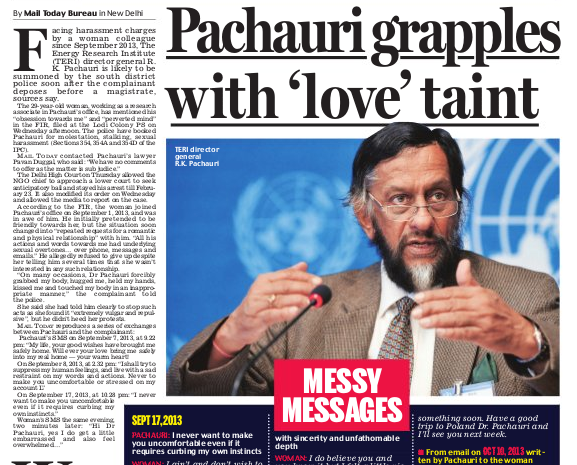
pachauri grapples mail today  http://epaper.mailtoday.in/443860/mt/Mail-Today-February-21-2015#page/2/1

pachauri grapples mail today

I remain hopeful that wallowing in the IPCC sleaze will eventually reach a critical level and become unacceptable. The Mail Today carries details of the “creepy” nature of Pachauri’s harassment. He sounds like a love-sick teenager.

(I met him a few times back in 2000 when we were considering engaging TERI for a project. Partly because of the lack of impact he had, we engaged another party).

FirstPost:

The Daily Mail (Mail Today), has published a detailed report on the interaction between Pachauri and 29-year-old research associate who has sued him for sexual harassment. The several text messages and emails exchanged suggest that Pachauri was relentless in his pursuit of the woman, and had on one occasion embraced her and even tried to kiss her.

When the woman ticked him off saying that such behaviour would not be entertained, he played a miffed teenager complaining that an act spurred by ‘love’ has been misunderstood by the victim as a case of sexual misdemeanour.

“Please you are not to grab me and or kiss me,” the complainant told Pachauri in a text.

To which Pachauri replied, “I wish you would see the difference between something tender and something tender and loving and something crass and vulgar. So I shall slink away and withdraw.” 

It’s a bit of a horrifying image, but you can almost picture Pachauri pouting and crying ‘not fair’.

In another email Pachauri says, “I find it now very difficult to hug you. What haunts me are your words from the last time that I ‘grabbed’ your body. That would apply to someone who would want to molest you. I loved you in the soul, mind, heart…”

While you might be shocked at the audacity of a man, who has been asked to back off by a woman for sexual misbehaviour, Pachauri’s defence will probably strike a chord with many in India.

Indian government plays down swine flu epidemic which has killed 833 so far

February 24, 2015

Over 14,000 people have been affected so far and the death toll till yesterday had reached 833. The swine flu epidemic in India is spread across the northern states – mainly – though deaths have also been reported in Telengana. But health officials both at state level and in the central government are resisting any discussion and insist that all is under control.

There are reviews and review committees galore and the bureaucratic process is in full swing. State and central government health departments are assiduously collecting data. But state assemblies will not allow debate. There is no shortage of medicines. Health departments “are on the job” but the number of states affected and the number of deaths are rising.

It is not so much being in denial as trying to sweep “unpleasantness” under some bureaucratic carpet. The public private partnership in health care is broken. It is the partnership of an underfunded and hopelessly inadequate public service and a rampant and avaricious private sector. Private hospitals are turning away “public” patients – who they are normally obliged to accept – on the grounds of lacking isolation wards. Private labs are charging exorbitant rates for tests. Tamiflu is being hoarded for the use of paying patients.

DNA: Every time a disease outbreak is reported, the government swings into action. High level review meetings are held in the health ministry and the cabinet secretariat, guidelines are issued for states, health minister visits hospitals and makes reassuring statements that  there is ‘no shortage of drugs and vaccines’. On the ground, however, government hospitals are crowded with patients complaining about lack of proper care, confusion prevails on diagnostic tests and medicines, and generally there is an atmosphere of panic among the general public. This is pretty much the picture whenever a disease outbreak occurs in India or there is a threat of a pandemic touching Indian shores. We have had a series of them in the past decade – Severe Acute Respiratory Syndrome (SARS), Avian influenza (bird flu), swine flu, Ebola and so on. The current outbreak of Influenza A (H1N1) — popularly called swine flu because it originally got transmitted to humans from swine — is no different. The last major outbreak of this flu in India was in 2009 when Influenza A (H1N1) was declared a pandemic by the World Health Organisation. ….. 

…. The private sector today provides nearly 80 per cent of outpatient care and about 60 per cent of inpatient care. However, when outbreaks like swine flu or SARS occur private sector draws into a shell. Patients are denied admission on the pretext of private hospitals not having isolation wards or the fear of losing medical tourists. Pathological labs start charging exorbitant fees for conducting diagnostic tests, as has been happening in the case of the current outbreak. Chemists begin hoarding or black marketing essential drugs like oseltamivir (trade name Tamiflu), working in tandem with private doctors and hospitals.

Critical PR exercise for Greece today

February 23, 2015

Greece needs to present its own reform package today to get the rest of the Eurozone countries to ratify the 4 month extension of its bailout tomorrow. The extension was agreed on Friday provided the package to be presented today was sufficiently credible for the lender countries.

That leaves the new Greek government with the PR problem of presenting what is essentially an “austerity package” but which

  • is its own package and not “imposed” by others,
  • is packaged as something different to “austerity” for domestic consumption.

No doubt the leftist government will include items which are ideologically sound but which have little relevance in monetary terms. Among these cosmetic items will be such things as attacking tax evasion by the rich, and getting rid of some “fat-cat” bureaucrats in the civil service, reemploying some who lost their jobs and increasing some social spending.

But the bottom line is that they will have to present a package which is all about “austerity” in everything but name.

In every financial crisis in the last 40 years I am struck by how using economic jargon and quoting high-sounding economic theory does not alter the fundamental fact that a country’s economy is just like that of any household. Past profligacy leads inevitably to current austerity. That many of the profligates may have fled the nest does not alter the fact that the rest of the household must bear the burden of the austerity. There is little doubt that in Greece, the profligacy of a few (the nexus of corrupt politician/civil servants/ business) is leading now to the austerity of the many. Unfortunately not all of the profligacy is a thing of the past. Not all the profligates have fled.

A bankrupt household must increase its earnings to get out of debt. It has no other option. Of course it must first end profligate spending. All household members must “tighten their belts”. Luxuries must be given up. All external expenditure must be curtailed. Assets may have to be sold off. And Greece must do the same. (Selling some islands to Turkey is beyond the pale). The only quick way that I think Greece can increase its earnings is by tourism – not by industry which will take much longer.

And I am convinced that tourism to Greece will do much better with a Greek drachma which is allowed to find its own level rather than being forced to use a Euro which – for Greece – is at too high a level.

Does Swedish emergency service have a rejection quota?

February 20, 2015

If the manner in which emergency services react to emergencies is a measure of an advanced and civilised society, then the corporatised central emergency service in Sweden (SOS Alarm tel. no 112) leaves a great deal to be desired. It is owned 50% by the State and 50% by counties and municipalities. But it is required to make a “profit”. And the most significant cost cutter it has in its arsenal is not to respond. The latest events and especially the response of their press spokesman makes me wonder if the emergency operators at SOS Alarm are judged by the number of emergency calls they reject?

It has an amazingly bureaucratic method for complaints. But complaints from the dead aren’t too many. Being a state owned institution, it and its employees have little liability and virtually no accountability for their decisions.

Right now it is facing a massive amount of criticism – not for the first time – for its arbitrary decisions on what constitutes an emergency.

The Local: A 16-year-old boy says he feared he would die when he made an emergency call to report he’d been shot, but wasn’t believed by the operator.

The teenager, who hasn’t been named by Swedish media, says he was seriously injured in the shooting and managed to crawl to a bus stop before calling Sweden’s emergency services. He dialed the emergency number 112 several times but was cut off. After then trying the general number for police in Sweden, 114 14, he says the operator did not believe his story. “I was frustrated and yelled that I was dying. Yet she did not believe me,” he said of the woman who picked up the call ……… 

The attack on the boy took place last October during a shootout in Norrahammar just outside Jönköping in southern Sweden. He was also stabbed during the incident in which his friend, 17, died. 

According to the surviving teenager, the phone operator thought he was lying, because he could not tell her his exact location. ……. 

After trying to reach friends and family members instead, he eventually got through to a different operator via 112 and an ambulance was called to the scene.  “I do not feel good. I think my friend might have been saved if the ambulance had arrived immediately,” ……
It has happened before. Emil Linell, 23, died in Stockholm after the SOS Alarm operator arbitrarily decided that his claims that he couldn’t breathe were false. Even though one of his many calls to 112 was terminated as he fainted. He was found dead by a neighbour.
The operators are trained nurses and SOS Alarm uses 3 call centres to cover all of Sweden. Of course the operators then have little local knowledge. The recording of the shot boy’s calls released recently also shows that the operator – who takes a very sharp tone in her suspicions about the boy being shot – could not comprehend the address he was giving.  But my suspicion is that the operators are under instructions to minimise costs by reducing the number of emergencies they respond to. That shows up quite clearly in the very defensive response of SOS Alarm’s Press spokesman:
Swedish Radio: Now SOS Alarm’s spokesman Anders Klarström responds to the massive criticism it has received. … 
“First I want to say that I have great sympathy for this boy’s terrible experiences and the frustration he felt, but I also want to say that this conversation is not true for all the 10 000, 112 calls that come in every day to our SOS centers, of which 4000 should not have been called.
Note that the spokesman starts with the excuse about unnecessary emergency calls. I know many who have nothing but praise for the emergency services. But what I discern here is a corporate culture which is very disturbing. It seems as if SOS Alarm start with the assumption that the call is unnecessary and the caller is required to prove the emergency. The spokesman is clearly justifying the rejection on the grounds that 40% of the calls are unnecessary (in the opinion of SOS Alarm). It would not surprise me at all if the number of rejections by each operator was logged and constituted a Key Performance Indicator (KPI). I begin to suspect that SOS Alarm gives its operators a rejection quota or a rejection target to fulfill.
To give him his due the spokesman does go on to acknowledge the mistake – 6 months after the event. But there are no real repercussions beyond an “internal investigation”. Liability is diluted and nobody needs to take responsibility.  There is no hint of a change of attitude where each call is first assumed to be genuine. If the boy had died – as his friend did – there would be no story.
I note that the tone was too hard on this well-behaved boy. Here we would have presented a smoother attitude. However, I want to emphasize that aid has not been delayed. The actual treatment received during the call is not okay.
And no responsibility was ever taken for the negligent death of Eric Linell.
And if I am ever in an accident or have a heart attack and call 112, I just hope I get a sympathetic operator who does not have a rejection quota to fulfill.

If you want it to survive, print it out!

February 17, 2015

The Google VP Vint Cerf has been warning of the dangers of the loss of digital material as newer programs become unable to read older files and as digital material is corrupted.

Guardian:

Piles of digitised material – from blogs, tweets, pictures and videos, to official documents such as court rulings and emails – may be lost forever because the programs needed to view them will become defunct, Google’s vice-president has warned.

Humanity’s first steps into the digital world could be lost to future historians, Vint Cerf told the American Association for the Advancement of Science’s annual meeting in San Jose, California, warning that we faced a “forgotten generation, or even a forgotten century” through what he called “bit rot”, where old computer files become useless junk.

Cerf called for the development of “digital vellum” to preserve old software and hardware so that out-of-date files could be recovered no matter how old they are.

“When you think about the quantity of documentation from our daily lives that is captured in digital form, like our interactions by email, people’s tweets, and all of the world wide web, it’s clear that we stand to lose an awful lot of our history,” he said.

“We don’t want our digital lives to fade away. If we want to preserve them, we need to make sure that the digital objects we create today can still be rendered far into the future,” he added.

It’s my birthday today and it comes as a sobering thought as I look around my study, that the only things in here that are older than myself are around 20 books which were published and printed in the first half of the 20th century. There is not a single artefact that is older than me. There is one book here printed towards the end of the 19th century.

If you want any writings or images or presentations to have a chance of surviving 100 years, PRINT IT OUT. That may not be enough but it stands a better chance on paper than as a digital file. (I have a large granite rock – a 2m tall “obelisk” – in my garden and possibly the surest way to leave my mark would be to carve something into it. It will have to be symbols since the alphabet may be long forgotten in 10,000 years).

On the legitimacy and morality of taxation

February 16, 2015

These are two questions that I have been wrestling with. First whether the concept of taxation of individuals by a state is legitimate and moral, and second, what basis of taxation is the least unjust. Here I just consider the legitimacy and morality of the concept of taxation.

Anarchists and libertarians see taxation as theft. They see it as the oppression of the individual (private or corporate) by the greater society – ostensibly for the “common good”. Communists and socialists see it otherwise. For them there is no individual ownership of property and all wealth is owned by the masses. It is a manifestation of the conflict interface between an individual and the larger society. Some – libertarians for example – suggest that the “greater society” cannot abrogate to itself an authority which is not delegated to it by its individual members. And the power to confiscate the property or wealth of some of its members is not an authority that originates with the individual “victim”. Liberal democrats would argue that taxation is merely the membership fee for individuals to be part of the “club” represented by the “greater society”.

There have been many headlines in the last week about HSBC and the manner in which it has assisted its clients to avoid and evade taxation (where avoidance is legal whereas evasion is illegal). The indignation of politicians rings rather hollow. That the poor resent the rich is not surprising. It is inevitable that in a “democracy” the majority poor will seek to oppress the rich minority. But the bottom line is that all taxation is a confiscation of an individual’s property or wealth by a society (state). It is confiscation by force or under the threat of force. But much of the recent turbulence is based on envy and resentment and of various socialist politicians attempting to create a populist wave out of such resentment and envy. (Of course they conveniently forget that the poor are not poor because the rich are rich. Most are poor because they do not, or do not have the opportunity to, create wealth).

I am persuaded that the concept of taxation as practised today is immoral. It is fundamentally a coercion of an individual by a larger (stronger) society. It is an enforced confiscation (by threat of legal action) of an individual’s property or wealth. It cannot be seen as a membership fee for being a member of the society because leaving (or being expelled from) the society is not an option. It is closer to the extortion of “protection money” than to the membership dues for a golf club. The use to which the funds are put is irrelevant. The key point is whether the payment is voluntary or coerced. When early Christians paid a “tithe” to the Church voluntarily it was not immoral. But when the payment was coerced and no longer voluntary, the system became immoral. Similarly Islam requires the payment of zakat on individual wealth over the minimum nisab and this also shifted from a quite unexceptionable and moral voluntary payment to become an obligatory and immoral coercive confiscation.

I don’t quarrel with the need for any society to generate “common funds” to improve the well being of that society. But the legitimacy of appropriating the funds lies only in that the society (state) is stronger than the individual. Might becomes right. I come to the conclusion that a tax code by which the amount a “good citizen” should contribute to society is calculated is quite moral as long as the payment is then voluntary. There would be no moral issue if all taxation was voluntary. The immorality lies in the use of threat or force to confiscate the payment. It is the oppression of the minority by the majority which is immoral. (I observe that all democracies use the very fact of being a “democracy” as being a justification for the oppression of minorities when that is the will of the majority. As if being in the majority – by and of itself – ensures proper behaviour). But, the good socialist will argue, compulsory payment of tax is necessary to ensure the funds for the common good. Without coercion society as a whole would suffer. The common good – as seen by the majority – is worth the oppression of the minority who do not pay their dues.

And so we come full circle. The end justifies the means. Oppression of the minority by a majority is acceptable for the good of the majority. A society must be able to use force and coercion against its own minorities for the greater good. Taxation is made legitimate only because the state is stronger than the individual.

But that does not alter the fact that involuntary taxation is fundamentally immoral.

Whether a tax code should be based on wealth creation or wealth consumption is a question for another day.