Archive for the ‘Behaviour’ Category

How long can Germany bear the cost of their Greens?

September 4, 2013

Less than 3 weeks to go for the German elections and the polls put Angela Merkel at 39% with the Social Democrats at 23%, the Greens at 11% and the Far Left at 10%. But polls have been wrong in German elections and sometimes spectacularly wrong:

Reuters:

Eight years ago Angela Merkel stared gloomily at the election results with disbelief when her party crashed to 35.2 percent of the German vote, seven points below the opinion poll forecast.

Her poll lead melted away again on election day four years later, though her conservatives stayed in power despite their worst result since 1949. Indeed her Christian Democrats (CDU) and their Bavarian sister party, the Christian Social Union (CSU), have fallen short of forecasts in the last six elections.

They are leading again as the September 22 vote comes round, but that humbling record explains why Merkel is not letting up, with 56 campaign stops in the month before voters give their verdict.

The chancellor warns in her speeches that supporters will have a “rude awakening” if they place too much faith in polls.

Once highly accurate, voter surveys in Germany have become a less reliable barometer as party allegiances weaken, voter turnout falls, differences between parties disappear and small newcomers crowd the ballot sheet.

The success of the Greens and their profligate policies have been mainly due to the German electorate looking desperately for a “feel-good” factor. My 3 years living in Germany – in the heart of the “old” Eastern Germany – only convinced me that the normally very pragmatic Germans were extremely apprehensive and tentative about touting their undoubted economic successes. They feared to take too much pride in their achievements since it brushed perilously close to Nationalism and all the dark ghosts that evoked. The Green Party – I think – filled this need for somehow “feeling good” about their own achievements in a benign way while avoiding any of the sinister negatives associated with “national pride”.

But this has been an expensive experiment – in money and in jobs. How much longer the Green bubble will continue remains to be seen. It is fundamentally unsustainable and all over Europe it is beginning to penetrate that the cost of “feeling good” for no benefits is a luxury. But German common sense, pragmatism and realism will eventually prevail as the costs of “feeling good” become increasingly obvious.

The Local:

Higher renewable energy subsidies due to be introduced in October will add an extra €40 onto the annual energy bill for a three person household, wrote Der Spiegel magazine in a report published on Monday. 
The cost of supporting German producers of renewable energy is, under German law, passed on to the consumer. The cost per kilowatt hour of green energy is simply added onto their bills. 
Set every October for the following year, this year the cost is set to jump 20 percent from 5.3 cents per kilowatt hour to 6.5 cents, wrote the magazine. 
Perversely, the price hike is necessary because the electricity market is actually being flooded with cheap electricity, wrote the magazine. 
Germany’s green energy producers have been guaranteed fixed rates feed-in-tariffs for 20 years, while recently the electricity stock market price has fallen to its lowest value in years. 
This has led to a widening gap between the falling prices grid operators are able to sell electricity for on the market, and the fixed guaranteed prices they have to pay out to producers of renewable energy. The result is that consumers have to make up the difference.

And consumers can only take so much. My expectation that common sense will prevail is – to no small part – also dependent upon the Greens propensity for being silly. Many of the Greens’ policies are silly without initially being seen to be silly. But calls – by some Green leaders – for a ban on driving cars on weekends and by other Greens for the legalising of incest go beyond silly and enter the realms of “stupid”. It is beginning to dawn on the electorate that the Greens may be a luxury – in money, jobs and in ideas – that Germany can ill afford.

NoTricksZone:

German daily Die Welt writes that one of the leaders of Germany’s influential Green Party is now calling for a ban of car driving in Germany on weekends.

Die Welt writes:

Green parliamentary group leader Fritz Kuhn wants cars of German drivers to be idle on weekends. […] With a driving ban a clear signal against climate change would be made. According to estimates by Kuhn, the citizens would quickly notice, “that you can also get along without cars”.

Fritz Kuhn, the mayor of Stuttgart, cites a ban used in Northern Italy in 150 cities last Sunday in order to fight air pollution. People can use their bicycles or go by foot.

By now readers may be thinking that the German Greens want to ban everything. Though it seems to be that way, this is not true.

There are some things they want to legalize: incest for example. According to FOCUS magazine here:

The incest ruling by the European Court of Justice for Human Rights (EGMR) against a 34-year old man from Leipzig has led to controversial reactions. Green Party politician Hans-Christian Ströbele reacted the most sharply. He wants to permit sex between siblings and other close relatives, and is requesting doing away with the incest laws. It is an isolated relic of another time when adultery was punishable, which we also have done away with,’ Ströbele told news network N24. Paragraph 173 no longer matches ‘in this time of enlightened opinion on marriage and family. It must be abolished’.”
Israel Education Ministry bans sex education material in text books

September 3, 2013

One has to conclude that everything is circular. If you go far enough to the Right you approach the Extreme Left. If you go to the extremes of one religion you approach the extremists of another.

Ultra-orthodox Imams and Rabbis, invariably male, seem to share a similar view of women and sex and sex education.

The Orthodox religious right in Israel has just got its way in its effort to return to good old-fashioned prudery.

Haaretz reports that “Chapters on human reproduction don’t accord with state religious school system’s educational doctrine for junior high schools, says Education Ministry”.

The Education Ministry has asked textbook publishers to eliminate chapters on human reproduction, pregnancy prevention and sexually transmitted diseases from science textbooks used in state religious junior high schools as well as from their teacher manuals.

The Guardian writes:

State education in Israel is divided into religious and secular sectors for Jewish children, with separate schools for Arab children. Many ultra-Orthodox Jews send their children to segregated private schools, with strict controls on curricula, behaviour and dress. Around a quarter of Israeli children attend ultra-Orthodox schools, according to 2010 data – a figure that is steadily rising.

Anat Hoffman, executive director of the Israeli Religious Action Centre, which advocates progressive Judaism, described the education ministry’s move as a “slippery slope. When we start filtering science for modesty reasons, that in the end will hinder our ability to teach science to Israeli children,” she said. …. The move should be seen in the context of the growing influence of rightwing rabbis in Israel. “Modesty considerations are being used as a political tool to keep women ‘in their place’,” she said.

Some elements of the ultra-Orthodox community in Israel have campaigned in recent years to remove images of women from advertising hoardings, and impose gender segregation on buses and in other public spheres.

The education ministry said the changes did not cover pictures of women. “The image of women has a place and expression in school textbooks,” it said.

But what the ultra-Orthodox want in Israel is not so very different from what Hamas wants in Gaza.

Israel National News reported in June this year:

A new law passed by the Hamas government in Gaza banning co-ed schools has left many Christians fearful that their schools are in danger of closure, according to the Beirut-based Al-Akhbar daily.

The new law, which mandates gender segregation in all schools, also bans men from teaching at girls’ schools. The law will likely force Christian educational institutions to close their doors to Muslim and Christian students alike, reported the newspaper.

Mutassim Minawi, director of public relations at Gaza’s education ministry, …… argued that “the Gaza Strip’s culture is conservative and does not favor gender mixing. The majority of Palestinians in Gaza praised the law and only leftist parties criticized it.”

Several months ago, Gaza’s Hamas terrorist rulers took another step towards the implementation of strict Islamic sharia law in the region by introducing a strict dress code for female students at the Al-Aqsa University. A letter distributed to students in November stated that all students should wear “modest clothing” on campus.

Since violently taking over Gaza in 2007, Hamas has enforced a stringent interpretation of Islamic law in Gaza. The terror group has banned women and teenagers from smoking hookahs in public, ordered that women’s clothing stores are not allowed to have dressing rooms, men cannot have hairdressing salons for women and that mannequins shaped like women must be dressed in modest clothing.

Citation stacking rife in Brazil

September 3, 2013

The impact factor of an academic journal is a measure of the average number of citations for articles in the journal. In the academic world it is always better to have your papers published by a “high impact” journal. For editors and publishing houses, impact factor is directly related to revenues earned. Over the years the methods of increasing the number of citations (not self citations, by articles in other journals and preferably from a different publishing house) and the impact factors of journals have become increasingly sophisticated.

Citation stacking has been the method that has developed where editors of journals – sometimes even from quite different publishing houses – have colluded to see to it that articles in their journals cited articles in the others. This has been going on for some time and a year ago THE reported that Thomson Reuters had suspended 26 journals for citation stacking.

“Anomalous citation patterns” is a euphemism for excessive citation of other articles published in the same journal. It is generally assumed to be a ruse to boost a journal’s impact factor, which is a measure of the average number of citations garnered by articles in the journal over the previous two years.

Impact factors are often used, controversially, as a proxy for journal quality and, even more contentiously, for the quality of individual papers published in the journal and even of the people who write them.

When Thomson Reuters discovers that anomalous citation has had a significant effect on a journal’s impact factor, it bans the journal for two years from its annual Journal Citation Reports (JCR), which publishes up-to-date impact factors.

In Brazil the Ministry of Education is obsessed by impact factor. In consequence publishing in high impact factor journals has become a matter of survival in academia.  Journals have been caught in a vicious cycle where nobody wants to publish in their pages because their impact factor is too low and their impact factor falls further because they have insufficient citations.

“By 2009, editors of eight Brazilian journals decided to take measures into their own hands”. 

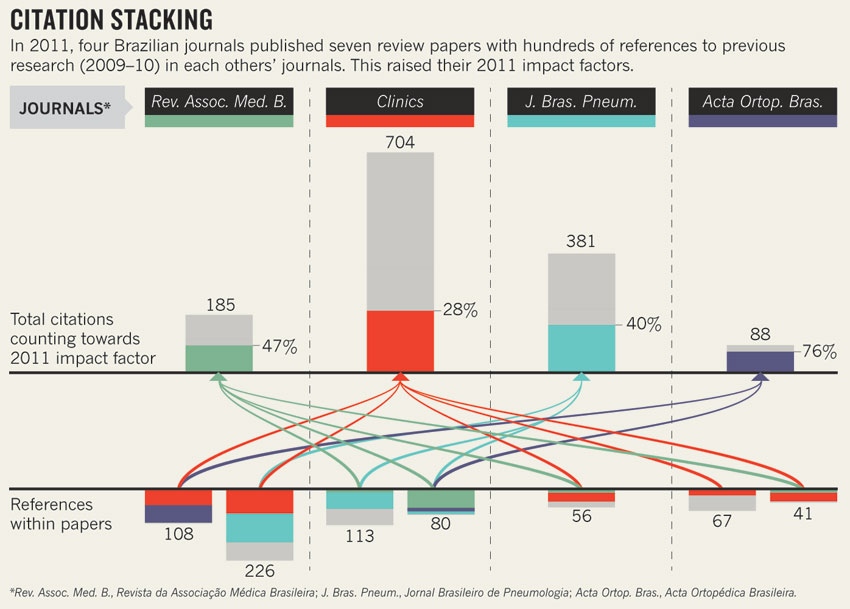
Ciencia Brasil has been pointing out dubious cases in Brazilian journals for some time. The Brazilian scam has now reached the pages of Nature as Thomson Reuters suspends some Brazilian journals from its rankings for ‘citation stacking:

Brazilian citation scheme outed

Mauricio Rocha-e-Silva thought that he had spotted an easy way to raise the profiles of Brazilian journals. From 2009, he and several other editors published articles containing hundreds of references to papers in each others’ journals — in order, he says, to elevate the journals’ impact factors.

Because each article avoided citing papers published by its own journal, the agreement flew under the radar of analyses that spot extremes in self-citation — until 19 June, when the pattern was discovered. Thomson Reuters, the firm that calculates and publishes the impact factor, revealed that it had designed a program to spot concentrated bursts of citations from one journal to another, a practice that it has dubbed ‘citation stacking’. Four Brazilian journals were among 14 to have their impact factors suspended for a year for such stacking. And in July, Rocha-e-Silva was fired from his position as editor of one of them, the journal Clinics, based in São Paulo.

…. Editors have tried before to artificially boost impact factors, usually by encouraging the citation of a journal’s own papers. Each year, Thomson Reuters detects and cracks down on excessive self-citation. This year alone, it red-flagged 23 more journals for the wearily familiar practice. But the revelation that journals have gained excessively from citations elsewhere suggests that some editors may be searching for less detectable ways to boost their journals’ profiles. In some cases, authors may be responsible for stacking, perhaps trying to boost citations of their own papers.

The journals flagged by the new algorithm extend beyond Brazil — but only in that case has an explanation for the results emerged. Rocha-e-Silva says the agreement grew out of frustration with his country’s fixation on impact factor. In Brazil, an agency in the education ministry, called CAPES, evaluates graduate programmes in part by the impact factors of the journals in which students publish research. As emerging Brazilian journals are in the lowest ranks, few graduates want to publish in them. This vicious cycle, in his view, prevents local journals improving.

Abel Packer, who coordinates Brazil’s system of free government-sponsored journals, known as SciELO, says that the citation-stacking venture was “unfortunate and unacceptable”. But he adds that many editors have long been similarly critical of the CAPES policy because it encourages local researchers to publish in high-impact journals, increasing the temptation for editors to artificially boost their own impact factors, he says.

Nature 500, 510–511 (29 August 2013) 

Read the articledoi:10.1038/500510a

Rudd trailing Abbott in the final stretch and the bookies start paying out

September 2, 2013

My perception is not so much of Abbott taking or stretching his lead but rather of Rudd trailing and falling further behind. Like an over-the-hill runner attempting a come-back, who cannot quite keep up and who falls increasingly further behind as they enter the home stretch.

There is less than a week to go and they have had 3 debates. Neither scored a knockout but neither  fell down either. The personal popularity that was Rudd’s calling card is just a shadow of what it used to be. His beaming smile now has a hint of being sinister. If this election is in any sense a referendum on the carbon tax, Rudd is on the wrong side – even if it is Julia Gillard who takes most of that hit. The nexus between corrupt union leaders and Labour politicians lives a life of its own and a mere election will not put a stop to that. But all the recent headlines don’t particularly help Rudd.

In the critical state of Queensland, Rudd is going the wrong way.

Poll results.

The ALP is going the wrong way in Queensland. – The Age

I can’t help thinking that part of the ALP’s problem is that Rudd (and Gillard before him) had an over-inflated perception of their own importance on the world stage. Part of that was no doubt due to the elevated position Howard had in US eyes with his support of the Iraq War. Being a little more realistic can be to Abbott’s advantage

Herald-Sun:

TONY Abbott says Australia should stop boasting on the world stage and bring some “humility” back to foreign policy.

In a direct swipe at Kevin Rudd, the Coalition leader suggested the Government should stop “overstating” its influence and be realistic about what authority it could command internationally.

The Prime Minister yesterday continued to use to the Syria crisis to attack Mr Abbott’s apparent lack of depth on global affairs.

But in a stinging rebuke to the man once dubbed Kevin 747 for his extensive world travel as PM, Mr Abbott said Australia could be more effective as a non-permanent member of the UN Security Council if it stopped exaggerating its power.

“Australia should do what it can to build a better world but we shouldn’t exaggerate our own influence,” he said following a Press Club address in Canberra to make the case for a Coalition government.

As always, following the money is usually very revealing. If the bookies had just stopped taking bets on Abbott it would have been pretty telling. But when a bookie starts paying out even before the polls have opened – let alone before the result is announced – it can only mean that one contender is overwhelmingly dominant or that the result has been fixed. Either way the result is a done thing, and one bookmaking company has started paying out bets on Abbott a full week before the election.

Reuters: Thu Aug 29, 2013

An Australian bookmaker on Thursday began paying out bets on a conservative opposition victory, declaring the country’s September 7 election race already over for Prime Minister Kevin Rudd’s struggling Labor government.

With nine days to go, online bookmaker Sportsbet said it had begun paying A$1.5 million ($1.34 million) in bets received on a victory for opposition leader Tony Abbott’s centre-right coalition, because the outcome was already clear.

“As far as Sportsbet’s betting markets are concerned, the Abbotts can start packing up their belongings ahead of their imminent move to Kirribilli House,” Sportsbet spokesman Haydn Lane said, referring to the prime minister’s residence in Sydney.

The race it seems is over.

Are Kerry and Obama dancing to an Israeli tune?

September 2, 2013

There are a number of inconsistencies between the various  “intelligence” reports concerning the alleged Syrian use of chemical weapons which give rise to convoluted stories about “who knew what”, “who made up what” and “why”? That Israeli intelligence is heavily involved in presenting the “right” story is only to be expected. That Turkish sources slant everything in favour of what may help get rid of Assad is also to be expected. That Al Qaida ( and I would not put it past them to be behind the chemical attack even if only through a renegade Syrian Army general) would like Assad to be attacked and the hostilities prolonged is equally obvious. That the various Syrian opposition groups (including Al Qaida) each has its own corner to protect is apparent every day.

Perhaps everybody involved is trying to orchestrate the “intelligence” and the “evidence” –  and the result will then be something that nobody has actually designed. It is US Foreign Policy happening by accident and not by design – at least not by US design.

Admittedly many of the stories are from sources who themselves have some vested interest and nothing emanating from Syria can be taken without a major dose of salt. Nevertheless some of the stories may well have some kernel of truth. And it does seem strange that one of the first to hear about Obama’s intention to delay the expected strike and defer to Congress – before he announced it – was the Israeli Prime Minister!

Haaretz reports:

U.S. President Barack Obama called Prime Minister Benjamin Netanyahu on Saturday and informed him that he planned to delay what seemed like an imminent attack on Syria, ahead of his speech at the White House to that regard.

Obama also told Netanyahu that he would relegate the matter to Congress, and ask for a congressional vote on any military action.

Craig Murray:  

It is therefore very strange, to say the least, that John Kerry claims to have access to communications intercepts of Syrian military and officials organising chemical weapons attacks, which intercepts were not available to the British Joint Intelligence Committee.

On one level the explanation is simple.  The intercept evidence was provided to the USA by Mossad, according to my own well  placed source in the Washington intelligence community.  Intelligence provided by a third party is not automatically shared with the UK, and indeed Israel specifies it should not be.

But the inescapable question is this.  Mossad have nothing comparable to the Troodos operation.  The reported content of the conversations fits exactly with key tasking for Troodos, and would have tripped all the triggers.  How can Troodos have missed this if Mossad got it?  The only remote possibility is that all the conversations went on a purely landline route, on which Mossad have a physical wire tap, but that is very unlikely in a number of ways – not least nowadays the purely landline route. … The answer to the Troodos Conundrum is simple.  Troodos did not pick up the intercepts because they do not exist.  Mossad fabricated them.  John Kerry’s “evidence” is the shabbiest of tricks.  More children may now be blown to pieces by massive American missile blasts.  It is nothing to do with humanitarian intervention.  It is, yet again, the USA acting at the behest of Israel

Moon of Alabama

During next weeks discussions it will be important to point out that the U.S. “intelligence” about the chemical incident in Syria is full of holes. The paper by the British Joint Intelligence Organisation used by Cameron to ask for war speaks of 350 people killed in the incident. On Friday Secretary of State Kerry spoke of 1,429 people killed. The draft war resolution speaks of “more then thousand” killed. 350, 1,429, 1,000 – which is it?

Jack Goldsmith, the Henry L. Shattuck Professor at Harvard Law School writes at Lawfare:

The administration’s proposed Authorization for the Use of Military Force (AUMF) for Syria provides:

(a) Authorization. — The President is authorized to use the Armed Forces of the United States as he determines to be necessary and appropriate in connection with the use of chemical weapons or other weapons of mass destruction in the conflict in Syria in order to –

(1) prevent or deter the use or proliferation (including the transfer to terrorist groups or other state or non-state actors), within, to or from Syria, of any weapons of mass destruction, including chemical or biological weapons or components of or materials used in such weapons; or

(2) protect the United States and its allies and partners against the threat posed by such weapons.

There is much more here than at first meets the eye.  The proposed AUMF focuses on Syrian WMD but is otherwise very broad.  It authorizes the President to use any element of the U.S. Armed Forces and any method of force.  It does not contain specific limits on targets – either in terms of the identity of the targets (e.g. the Syrian government, Syrian rebels, Hezbollah, Iran) or the geography of the targets.  Its main limit comes on the purposes for which force can be used.  Four points are worth making about these purposes.  First, the proposed AUMF authorizes the President to use force “in connection with” the use of WMD in the Syrian civil war. (It does not limit the President’s use force to the territory of Syria, but rather says that the use of force must have a connection to the use of WMD in the Syrian conflict.  Activities outside Syria can and certainly do have a connection to the use of WMD in the Syrian civil war.).  Second, the use of force must be designed to “prevent or deter the use or proliferation” of WMDs “within, to or from Syria” or (broader yet) to “protect the United States and its allies and partners against the threat posed by such weapons.”  Third, the proposed AUMF gives the President final interpretive authority to determine when these criteria are satisfied (“as he determines to be necessary and appropriate”).  Fourth, the proposed AUMF contemplates no procedural restrictions on the President’s powers (such as a time limit). 

…….. Does the proposed AUMF authorize the President to use force against Iran or Hezbollah, in Iran or Lebanon?  Again, yes, as long as the President determines that Iran or Hezbollah has a (mere) a connection to the use of WMD in the Syrian civil war, and the use of force against Iran or Hezbollah would prevent or deter the use or proliferation of WMD within, or to and from, Syria, or protect the U.S. or its allies (e.g. Israel) against the (mere) threat posed by those weapons.  Again, very easy to imagine.

No acknowledgement or apology for plagiarism from Rawnsley

September 1, 2013

A few weeks ago the Observer’s political correspondent Andrew Rawnsley was apparently caught plagiarising an article in the Economist by Jeremy Cliffe:

The revelations about Rawnsley came 2 weeks ago from Guido Fawkes on his blog (run by Paul Staines and is probably the most read right-of-centre political blog in the UK):

Rawnsley’s column went missing for a few weeks but I see that he has returned today. His absence could have been vacation or a spot of “gardening leave” as a slap on the wrist for his “cut and paste” activities. But I can find no reference or acknowledgement or apology for his apparently quite blatant plagiarism.

The article today is a rather topical piece about Cameron and his lost vote in the House of Commons. This only happened 3 days ago so the article is probably mostly his own work. He expounds on the thesis that Cameron’s loss was his own and not a loss for the country!

But the basis for his thesis is odd and seems to be fundamentally unsound.

Why on earth would a political commentator in the “democracy” that is the UK  think that a vote taken in a duly elected Parliament could ever be a loss for the country? Unless he believes that Parliament’s normal role is just to rubber stamp all decisions made by the sitting Government.

Before the Sandwich came the snowy chocolatti

September 1, 2013

The use of the word “sandwich” to describe sliced meat between two slices of bread is supposed to originate after John Montagu, 4th Earl of Sandwich, (13 November 1718 – 30 April 1792). But the invention of the sandwich as a dish probably goes back to the first use of flat breads and of wrapping other edible foods within the breads. As far as we know flat breads originate at least from 4,000 BCE as they were known in Sumeria and Ancient Egypt.

“Sandwich”: It was named after John Montagu, 4th Earl of Sandwich, an 18th-century English aristocrat, although he was neither the inventor nor sustainer of the food. It is said that he ordered his valet to bring him meat tucked between two pieces of bread, and because Montagu also happened to be the Fourth Earl of Sandwich, others began to order “the same as Sandwich!”. It is said that Lord Sandwich was fond of this form of food because it allowed him to continue playing cards, particularly cribbage, while eating without getting his cards greasy from eating meat with his bare hands.

But it would seem from research by Kate Loveman that Admiral Sir Edward Montagu, the first Earl of Sandwich (1625 -1672) has an even greater claim to culinary fame than his great, great, grandson. Of course chocolate has been in use for at least some 800 years for pleasure and as a medicine but the first iced chocolate – or is it a chocolate ice? – is still a culinary milestone.The Earldom was created in 1660 and this recipe for a “snowy chocolatti” dates from 1668 or earlier.

The Earl’s iced chocolate recipe

  1. Prepare the chocolatti (to make a drink)
  2. Putt the vessell that hath the chocolate in it, into a jaraffa (carafe) of snow stirred together with some salt
  3. Shake the snow together sometyme and it will putt the chocolatti into tender curdled ice
  4. Soe eate it with spoons

Kate LovemanThe Introduction of Chocolate into England: Retailers, Researchers, and Consumers, 1640–1730,  Journal of Social History (Fall 2013) 47 (1): 27-46. doi: 10.1093/jsh/sht050

Abstract: 

In the mid-seventeenth century chocolate was a new and fascinating product in England, often grouped with two equally exotic drinks, coffee and tea. This article focuses on the early history of chocolate, examining how it was marketed, perceived, and consumed. Chocolate sellers, who included coffee-houses proprietors, frequently made use of print to educate potential customers: the 1640s and 1650s saw chocolate-drinking promoted as medicinal, excitingly foreign, and pleasurable. Further insights into the scientific, governmental, and social factors that drove interest in chocolate during the Restoration can be found in the manuscripts of the first Earl of Sandwich (1625–72).

Despite evidence of considerable industry on the part of chocolate consumers, in the 1690s the success of a new breed of elite chocolate houses led to chocolate becoming strongly associated with leisure and decadence. These cultural associations were promoted in succeeding decades by periodicals, drama, and satirical poems. Throughout the late seventeenth and early eighteenth centuries, consumers’ experimentation with chocolate took place in the context of succeeding government’s fiscal experiments with cacao and chocolate: new tax measures influenced the cost of chocolate and its availability. By consulting a range of sources, from customs records to recipe books, we can track the ways chocolate was used across the decades and the factors in its adoption by different groups of consumers.

BBC News writes:

Dr Kate Loveman, from the University of Leicester, said she found the recipes in manuscripts which belonged to the Earl of Sandwich in 1668.

At the time, the chocolate treats came with a health warning for damaging the stomach, heart and lungs. The research also shows some of the regular themes in chocolate advertising across the centuries.

Dr Loveman, a senior lecturer in 17th and 18th Century English literature, said she was looking through a Samuel Pepys journal when she came across a 30-page section on chocolate.

Dr Kate Loveman
Dr Kate Loveman said the recipe was for a very solid, dark version of iced chocolate drinks. “It struck me as quite an unusual, odd thing because I have never come across anything quite like this before,” she said. “So I thought I would look into it further to find out how unusual it actually was.

“It’s not chocolate ice-cream, but more like a very solid and very dark version of the iced chocolate drinks you get in coffee shops today. Freezing food required cutting-edge technology in 17th Century England, so these ices were seen as great luxuries.”

The Earl’s recipe was written about 100 years before his great-great-grandson allegedly invented the sandwich. Dr Loveman said: “In the 1660s, when the Earl of Sandwich collected his recipes, chocolate often came with advice about safe consumption. 

“The papers included quite stern warnings about the dangers. It was a drug as far as people of the 17th Century were concerned.

“One physician cautioned that the ingredients in hot chocolate could cause insomnia, excess mucus, or haemorrhoids. People worried that iced chocolate in particular was ‘unwholesome’ and could damage the stomach, heart, and lungs.”

Dr Loveman’s research also shows some of the continuities in chocolate advertising across the centuries, such as links between chocolate and women, pleasure and sexuality.

Obama blinks, passes the buck to Congress and Kerry looks like a war-monger

August 31, 2013

Well, I thought that Kerry’s speech yesterday had effectively closed off all options for retreat.

But I had not reckoned with Obama’s risk aversion and his distaste for making decisions.

He blinked, passed the buck to Congress and Kerry now looks like a war-monger! 

He found his exit from the “red-line box” he was in. And Cameron’s slap-in-the-face from his own Parliament probably provided Obama not only with the inspiration to find his own exit policy but also convinced him not to go it alone. Having French support (and the Turkish support does not really count) was clearly not sufficient for Obama to stick his neck out. The “special relationship” with the UK still has meaning – even if Cameron is smarting.

I suspect this deferment to Congress is more due to Obama’s reluctance to take risky decisions rather than his desire to support the role of Congress. Congress will not be recalled especially for this and will resume normally on Monday 9th September. If Congress approves a strike his back is covered – even if a strike achieves nothing. And if Congress rejects any strike he has an “out” and a Congress to berate for lack of moral “spine”. 

Quite clever really. A win-win for him at the cost only of enhancing perceptions of his risk aversion and his indecision. And he has no elections to face any more.

 So probably no strikes for the next 10 days but 10 days is a very long time for anything to happen.

======================

UPDATE! Someone pointed out to me that a delay of 10 days could also be very useful in the collection or manufacture of “evidence”. That may be unduly cynical but I note also that Putin’s call for the evidence to be shown and his statement that evidence which could not be seen could not be considered evidence came before Obama decided to pass the buck.

======================

US now has no option but to attack Syria – but to what end other than “feeling good”?

August 31, 2013

A “feel-good” strike?

After Kerry’s speech yesterday, it is no longer possible for the US not to carry out a strike (else Kerry will have no option but to resign). The UN inspectors left Syria today. Their analyses will take at least two weeks and the US cannot – after Kerry’s assertions yesterday – wait for that. President Obama is due in Sweden next Wednesday on his way to the G20 meeting in Saint Petersburg.

So an attack will surely take place between now and then. Probably tonight. It will be “limited” and targeted according to Obama. It will be in retaliation against those who killed 1429 people by using a nerve agent. The strike will certainly bring comfort to the Syrian rebels (including Al Qaida) and raise their hopes of a deepening intervention. If the strike is limited it is unlikely to be decisive in toppling Assad. It may weaken him. Right now Assad’s forces seem to have the upper hand. So a weakened Assad is likely to lead to the civil war being prolonged – whoever comes out on top.

So what would the objectives of the strike be? And how would success be measured?

It will not get rid of all chemical weapons. It may give pause for thought to future users of chemical weapons but it will only be a limited deterrent to future users (since previous users have not faced any repercussions). If the strike kills more than 1429 people or a significant number of “innocent civilians”, it will be difficult to claim any success.  if the numbers killed are small and the material destruction is limited, it will also provide – paradoxically – succour to Assad in that he has weathered the US-led storm. The only real success would be if the numbers killed are very small but the material destruction is so high that it may prevent Assad or his officers from being so quick to use such weapons again.

Certainly the US and its allies will “feel better”. Anybody killed in the strike will not. Assad will not but his opposition will.

But the risk with a “feel-good” strike is that it will not make the war any shorter and will only lead to further intervention and the risk of strengthening Al Qaida.

Noted in passing 29th August 2013 – Silly season 2013 comes to an end

August 29, 2013

The varied headlines on all fronts today tell their tale. Silly season 2013 has come to an end.

David Cameron’s rush to war got a slap in the face: Back from the brink: PM forced to retreat over Syria.

Barack Obama does not want to be seen to be following in Bush’s footsteps: U.S. Facing Test on Proof to Back Taking Action on Syria

In Australia Kevin Rudd is desperate to join the big table: Rudd demands ‘robust’ response to Syrian chemical attack

Angela Merkel is beginning to campaign seriously for the German elections: Greece should never have been allowed to join euro: Merkel

Finally the main stream media are realising that global warming stopped some time ago: Global warming slowdown linked to cooler Pacific waters

Sweden’s equivalent of Eton, the elite Lundsberg school, was closed down by the authorities after some vicious ragging incidents: Swedish boarding school shut down after bullying claims

The gloss on the surface of Incredible India is getting badly tarnished: Economix: India’s Economic Crisis

We are all Martians: Earth life ‘may have come from Mars’

The oldest archaeological sites in the Amazon region: 10,000-year-old remains of settlements are unearthed in Bolivia

A clash between righteous do-gooders: Wind farms are a breach of human rights says UN. No, really.

Even articles in Nature are showing that the IPCC’s reliance on climate models rather than real observations is beginning to look particularly inane: Overestimated global warming over the past 20 years

Surprise! Surprise! Forensic Experts May Be Biased by the Side That Retains Them

Tony Blair continues his money-grubbing ways: TONY BLAIR EN MISSION POUR LA PAIX… SUR UN YACHT

A late spring and a short summer has led to Arctic ice melting much slower than for many years: IS ARCTIC SEA ICE REBOUNDING?