Archive for the ‘Brazil’ Category

Hamza subterranean “river” criticised by Petrobras geologist – a case of “sour grapes”?

August 28, 2011

It seems that a Petrobras geologist – Dr. Jorge Figueiredo – does not like all the attention that Hamza and Pimental are getting. He may well have a point but there seems to be a touch of “sour grapes” about his carping. The data was Petrobras data available to their own geologists after all. Perhaps if the river had been named after him Dr. Figueiredo would not be quite so petulant.

If the flow is regular and serves to drain the Amazon then I think it can be called a river even if it is only a tiny seepage through the pores in rocks. The key is that the flow should be regular. Continuity of flow or the velocity of flow cannot be the arbiter. Even surface rivers can be seasonal and discontinuous, can completely dry up at times but they all regularly return from the same source to the same sink.

BBC:

…. Valiya Hamza and Elizabeth Tavares Pimentel, from the Brazilian National Observatory, deduced the existence of the “river” by using temperature data from boreholes across the Amazon region. The holes were dug by the Brazilian oil company Petrobras in the search for new oil and gas fields, and Petrobras has since released its data to the scientific community.

Using mathematical models relating temperature differences to water movement, the scientists inferred that water must be moving downwards through the ground around the holes, and then flowing horizontally at a depth of several km.

They concluded that this movement had to be from West to East, mimicking the mighty Amazon itself. A true underground river on this scale – 6,000km (4,000 miles) long – would be the longest of its kind in the world by far. But Professor Hamza told BBC News that it was not a river in the conventional sense. “We have used the term ‘river’ in a more generic sense than the popular notion,” he said.

In the Amazon, he said, water was transported by three kinds of “river” – the Amazon itself, as water vapour in atmospheric circulation, and as moving groundwater. “According to the lithologic sequences representative of Amazon [underground sedimentary] basins, the medium is permeable and the flow is through pores… we assume that the medium has enough permeability to allow for significant subsurface flows.”

The total calculated volume of the flow – about 4,000 cubic metres per second – is significant, although just a few percent of the amount of water transported by the Amazon proper. The underground flow could be confirmed with coastal measurements, scientists suggest. But the speed of movement is even slower than glaciers usually display, never mind rivers.

And whether water really is transported right across the region in this way is disputed by Jorge Figueiredo, a geologist with Petrobras. “First of all, the word ‘river’ should be burned from the work – it’s not a river whatsoever,” he told BBC News.

Water and other fluids could indeed flow through the porous sedimentary rock, he said, but would be unlikely to reach the Atlantic Ocean because the sedimentary basins containing the porous rock were separated by older rock deposits that would form an impermeable barrier. “But the main problem is that at depths of 4,000m, there is no possibility that we have fresh water – we have direct data that this water is saline,” said Dr Figueiredo. “My colleagues and I think this work is very arguable – we have a high level of criticism.” 

The research – Indications of an Underground “River” beneath the Amazon River: Inferences from Results of Geothermal Studies – was presented at the 12th International Congress of the Brazilian Geophysical Society in Rio de Janeiro, and has not been published in a peer-reviewed scientific journal.

The team has named the underground flow the “Hamza River”.
The Hamza – a subterranean river to rival the Amazon: 6,000km long, 4,000 m down

August 25, 2011

Subterranean rivers are the stuff of mythology and there is something dark and mysterious and yet wonderful about them. Greek mythology includes the Styx, Phlegethon, Acheron, Cocytus, and Lethe as rivers within the Underworld. The Saraswati River is believed to have drained the north and northwest region of India in ancient times, supporting over 16,000 settlements. Although the river does not have a physical existence today many still believe that it flows underground. The River Fleet is London’s largest subterranean river. Forced underground by the city’s burgeoning populace the river still flows from its source in Hampstead Heath to its mouth where it joins London’s main waterway, the Thames. The longest known subterranean river was the Disu Subterranean river in Du’an, Guangxi Province, China – until now.

Forbes / AP: Sao Paulo

A huge underground river appears to be flowing thousands of feet beneath the Amazon River, Brazilian scientists said Thursday. Valiya Hamza of Brazil’s National Observatory said researchers found indications the subterranean river is 3,700 miles (6,000 kilometers) long, about the same length as the Amazon on the surface. Hamza said the discovery of the possible underground river came from studying temperature variations at 241 inactive oil wells drilled in the 1970s and 1980s by Brazil’s state-run oil company, Petrobras.

He said the “thermal information” provided by Petrobras allowed his team of researchers to identify the movement of water 13,100 feet (4,000 meters) under the Amazon River.

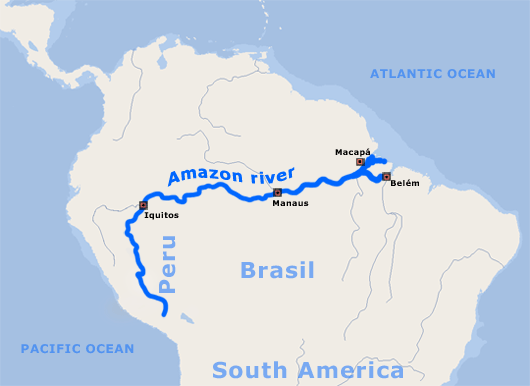
map of the amazon river

map of the amazon river image - 2.bp.blogspot.com

Their findings were presented last week in Rio de Janeiro at a meeting of the Brazilian Geophysical Society. The apparent underground river has been named after Hamza, honoring him as the head of the research team that found the signs of the flowing water. He said the existence of an underground river that also flows west to east would mean that the Amazon rain forest has two drainage systems – the Amazon and Hamza rivers.

There is much about the earth we still don’t know that we don’t know.

And the sense of wonder will remain alive as long as that is so.

UPDATE! Dr. Hamza explains the discovery in an email “interview” with The Hindu. 

Hydro power plants can release more CO2 emissions than a coal plant

August 24, 2011

Man-made carbon-dioxide emissions are of little significance in the global concentration of carbon dioxide in the atmosphere and the effect of carbon dioxide concentration on global climate is of even less significance. In fact it is much more likely that CO2 concentrations in the atmosphere follow global temperature rather than the other way around.

Nevertheless there are perceptions of fossil fuel fired power plants being terribly polluting and of being the dominant source of man-made emissions while hydro-power plants are perceived as being totally non-polluting. These perceptions are mainly based on pre-determined political positions and not necessarily on measurements or reality.

A new study from Brazil looking at the impact of hydro power plants and the Balbina dam has been published in the Journal of Geophysical Research. One caveat of course with many such studies is that it is not based on measurements but on some measurement followed by hypotheses built into computer models. Nothing wrong with that of course but the weakness with many model results – as with climate models – is that the results can neither be verified or dis-proved by measurements.

Kemenes, A., B. R. Forsberg, and J. M. Melack (2011), CO2 emissions from a tropical hydroelectric reservoir (Balbina, Brazil), J. Geophys. Res., 116, G03004, doi:10.1029/2010JG001465 

Swedish Radio P1:

Electricity from hydropower can lead to several times the emissions of greenhouse gas emissions than produced from fossil fuels. At least from hydro-electric dams in the rain forest areas, according to a new study from Brazil. 

The Balbina dam, which was built fifteen years ago, is located north of Amazonas state capital Manaus. When the rain forest area here was flooded large amounts of organic material ended up at the bottom of the pond. Rotting vegetation then caused large emissions of carbon dioxide and methane. According to this study this corresponded to three tonnes of carbon dioxide per megawatt-hour of energy produced, which is almost ten times that of a coal-fired power plants, and just over half of the emissions from burning fossil fuels in the city ​​of São Paulo.

A recently published study of 85 hydroelectric dams in the world shows that emissions vary between different ponds, depending on size, age and what kind of soil is soaked. How big emissions Swedish hydroelectric dams produce has not yet been studied, but estimates indicate that they are significantly lower than from those in tropical areas in Brazil says Professor Philip Fernside of  Instituto Nacional de Pesquisas da Amazônia (INPA) in Manaus. “It is true that dams in tropical areas such as the Amazon produces more than ponds in temperate climate, but there are emissions in these areas also” says Philip Fernside.

A pdf version of the paper is here.


La Niña driving severe rains and floods in Brazil and Australia

January 12, 2011

The La Niña event established this year is particularly intense and maybe the most severe in a 100 years. Such events are known to give warm sea surface temperatures and greater evaporation giving heavy rains in the Western Pacific in Australia, less rain in the Eastern Pacific on the western coast of S. America (coastal Chile and Peru) but increased rain on the east coast in southern Brazil and  northern Argentina.

Yesterday, heavy rainfall and floods in Brazil  claimed 80 lives.

UPDATE!! This morning the death toll is reported to be over 250.

UPDATE 2!! 13th January: Now death toll is around 400.

BBC:

More than 80 people have died in towns near Rio de Janeiro as heavy rains continue to cause flooding and mudslides in south-eastern Brazil. Overnight downpours triggered landslides in the mountain town of Teresopolis, where more than 50 were reported to have died. At least three firefighters were among several people buried in mudslides in Nova Friburgo.

Brazil has seen severe flooding this year which has left thousands homeless.

The death toll is expected to climb as rescuers reach remote villages in the mountains. One report, compiling official and media figures, put the toll so far at 93.

This week, torrential rains in neighbouring Sao Paulo state left 13 people dead and brought traffic chaos to Brazil’s biggest city. In Teresopolis, 100km (62 miles) north of Rio Janeiro, a river burst its banks, submerging buildings, while the rainfall set off several mudslides.

The rains and floods in Queensland have claimed 13 lives so far but the peak in Brisbane a few hours ago was fortunately about 1 m lower than in the 1974 floods. Nevertheless many thousands of homes have been inundated and the damage to Queensland industry and agriculture is severe. The final death toll is likely to be higher since it is feared that some bodies will only be discovered after the waters recede. Now heavy rain and flash floods have hit Victoria as well.

The Guardian:

The devastating flooding in Queensland is the result of Australia being in the grip of an unusually strong “La Niña”, a periodic climate phenomenon that brings more rain to the western Pacific, and less to South America along the eastern Pacific.

“The Queensland floods are caused by what is one of the strongest – if not the strongest – La Niña events since our records began in the late 19th century,” said Prof Neville Nicholls at Monash University and president of the Australian Meteorological and Oceanographic Society. “The La Niña is associated with record warm sea-surface temperatures around Australia and these would have contributed to the heavy rains.” Warmer oceans produce damper air and hence more rain. This is driven onshore by the stronger east-to-west trade winds characteristic of La Niña.

In both Australia and S. America the rains have about another 2 months to run.

related posts:

June 2010 – https://ktwop.wordpress.com/2010/06/26/high-probability-of-la-nina/

October 2010 – https://ktwop.wordpress.com/2010/10/25/la-nina-strengthens-further/