Archive for the ‘Business’ Category
November 30, 2010
The information paradigm is changing, whether in the political or industrial or commercial or academic world. We are now in the age of megadumps of information and megaleaks from Wikileaks and its inevitable successors.
While the world’s governments threaten legal action against Wikileaks, and bemoan the damage to diplomacy, Australia is considering whether to revoke Julian Assange’s passport. Media which were not in the group of 5 who received the documents in advance are writing heavyweight editorials about the dangers to society of publishing “confidential” information. Some politicians want Wikileaks to be declared a terrorist organisation and many are warning of the “number of lives that will be put at risk”. Professors are weighing in with the dangers to history ! They are all attacking the messenger but “methinks they do protest too much”.
The risk, if any, emanates ultimately from the information or action that is the subject of the document released, not from the release in itself. Diplomats – or others – who are involved in “speaking with a forked tongue” must accept that their duplicity may be revealed. When governments – in the name of the society they represent – take upon themselves the right to tap telephones, intercept documents divert emails, search or arrest members of that society to collect “confidential” information then they will just have to live with the fact that members of that society may feel – technology permitting – the necessity to access and disseminate “confidential” government information. The information world has changed irreversibly and megadumps of information is a reality. It is not a genie which can be stuffed back into the bottle — though some politicians will try.
Attacking the messenger is essentially counter-productive.
I am sure that the self-righteous (and self-serving) indignation currently being exhibited by many politicians and diplomats as their dirty laundry becomes visible will not be present with the next megadump – according to Forbes – of Wikileaks revelations – concerning the banking sector. I find that this information may be of greater public interest than some of the secrets of governments – but that is because I have such low expectations of politicians and diplomats. I have the belief that being in government is inherently corrosive (the corruption of power) and all who attain “positions of power” will always engage in hypocrisy and double-talk. Forbes writes:
Early next year, Julian Assange says, a major American bank will suddenly find itself turned inside out. Tens of thousands of its internal documents will be exposed on Wikileaks.org with no polite requests for executives’ response or other forewarnings. The data dump will lay bare the finance firm’s secrets on the Web for every customer, every competitor, every regulator to examine and pass judgment on.
Sitting for a rare interview in a London garden flat on a rainy November day, he compares what he is ready to unleash to the damning e-mails that poured out of the Enron trial: a comprehensive vivisection of corporate bad behavior. “You could call it the ecosystem of corruption,” he says, refusing to characterize the coming release in more detail. “But it’s also all the regular decision making that turns a blind eye to and supports unethical practices: the oversight that’s not done, the priorities of executives, how they think they’re fulfilling their own self-interest.”
The diplomatic cable megadump is already a reality. The banking megadump will follow. And after banking it may be Energy.
The full transcript of Assange’s interview with Andy Greenberg is here.
Tags:Banking, Julian Assange, Megadump, megaleak, Wikileaks
Posted in Behaviour, Business, Corruption, Ethics, Media | Comments Off on Next target for Wikileaks will be a megadump of banking information
November 29, 2010
Sweden continues to show strong GDP growth and in the 3rd quarter of 2010 was significantly higher than the 5.2% forecast earlier by the Riksbank and reached “Asian” levels at 6.9%. Unemployment is down and expected to continue to reduce slowly and is currently at about 8%. The growth is primarily export led and exports to Asia and Latin America are particularly strong.
Freely translated from Svenska Dagbladet:
Today came the news that Sweden’s GDP landed at 6.9 percent for the third quarter of this year. The positive figure may accelerate interest rate increases. “It’s a really good figure. This is well above the Riksbank’s assessment “said Annika Winsth, chief economist at Nordea Bank. The Riksbank believed that the increase in GDP would end up at 5.2 percent for the third quarter and Nordea’s forecast was forjust 6.2 percent. This shows that Sweden’s economy is growing across the board, among households and businesses as well as in the state, according to Nordea’s chief economist Annika Winsth. “This means that there is still so much spare capacity left in companies, that there is a belief in the future. They dare to invest, “she says.
Robert Bergqvist, chief economist at SEB was surprised at the growth figure of 6.9 percent. “It’s a long way from what we thought. What strikes me is that the sun is shining so brightly in Sweden, while many countries in Europe have huge problems to contend with. Industry and employment have recovered remarkably quickly, although we are not 100 percent back yet”, he says. The main reasons for this is, according to Robert Bergqvist, that taxes and the krona exchange rate has made household purchasing power strong, helped the export industry and given strong public finances. The latter means that Sweden can avoid drastic tax increases, he says.
According to Annika Winsth Sweden’s economy is almost back to a “normal” economic level. “There is little left to do on the employment side “, she says. “We went stronger into the economic crisis than many other countries, and that means that we do not get hit as hard” she says.
Tags:3rd quarter 2010, Economic growth, Sweden GDP
Posted in Business, Economy, International Trade, Sweden | Comments Off on Swedish 3rd Quarter GDP growth up to “Asian” levels at 6.9%
November 28, 2010

Cancun Hotels & Resorts : image cancun-travelnet.com
While winter comes early to Europe and China with heavy November snow and temperatures down to minus 37 Celcius in N. Sweden, 15,000 of the faithful travel to the balmy, holiday resort of Cancún (min 21 deg C, max 29 deg C) for the UN / IPCC conference on climate change and to try and blow some life back into the carbon trading scheme.
That Cancún is just about money has become apparent especially since Copenhagen and Nagoya. But it is the unrestrained greed represented by the carbon-trading, money trail that is most telling.
A Global Investor Statement on Climate Change has been issued by:
259 investors – both asset owners and asset managers – that collectively represent assets of over US$15 trillion.
Reducing Risks, Seizing Opportunities & Closing the Climate Investment Gap
Investors are interested in the large potential economic opportunities that the transition to a low-carbon economy presents. In particular, investors are calling for:
- Domestic policy frameworks to catalyze renewable energy, energy efficiency, and other low-carbon infrastructure, so as to provide investors with the certainty needed to invest with confidence in receiving long-term risk-adjusted returns.
- International agreement on climate financial architecture, delivery of climate funding, reducing deforestation, robust measurement, reporting, and verification, and other areas necessary to set theglobal rules of the road, bolster investor confidence, and allow financing to flow.
- International finance tools that help mitigate the high levels of risk private investors face inmaking climate-related investments in developing countries, enabling dramatic increases inprivate investment.
But Christopher Booker in The Telegraph gets it right:
These are the bodies (major banks, insurance companies and pension funds) calling most stridently for “government action on climate change”, because they are the ones who hope to make vast sums of money out of it. They are desperate for a treaty of the type they failed to get at Copenhagen – even more so since the collapse of the US cap and trade bill – because they see their chance of turning global warming into the most lucrative fruit machine in history dwindling by the month.
Top of their wish list is “a rapid time-frame” for implementing the UN’s REDD scheme, which would enable them to make hundreds of billions of dollars by selling the CO2 locked up in the world’s tropical rainforests as “carbon offsets”, thus allowing firms from the developed world to continue emitting CO2. Under this scheme, for instance, environmental bodies including the WWF hope to share in the $60 billion which they estimate as the “carbon value” of the Brazilian rainforest.
But nothing better betrays their gloom about any result from Cancún than that they at least want it to give “a clear mandate” for the adoption of “a legally binding agreement” at the UN’s next conference, due in South Africa next year.
Tags:Cancún, Carbon Trading, climate change, climate fraud, IPCC, UN
Posted in Alarmism, Business, Climate, Fraud | Comments Off on Cancún – Follow the money
November 27, 2010
The flight, QF1 from Sydney to London, was due to leave at 6.05pm – but passengers were pulled off the plane after a loud noise emanated from the engine while they were taxiing towards the runway. The flight was later cancelled.
Earlier, passengers watched as Qantas CEO Alan Joyce staged a media conference to assure the public the company was now “100 per cent confident” A380 planes were safe. But while passengers on the A380 flight to London got away on time, passengers on board flight QF1 to London via Bangkok were pulled off their flight because of an engine fault.
The passengers disembarked about 7pm and were given meal vouchers, while engineers examined the engine. But at 9pm they were told the flight was cancelled. It was expected to leave at 9am today.A passenger on the plane told The Sunday Telegraph he could hear the engine die. “We were on the tarmac and then the captain said there was a mechanical problem; he said there was an electrical fault and that every time they tried to start the engine up it cut out,” he said. “We sat for 45 minutes and then they took us off the plane.”
The captain of yesterday’s flight, David Evans, who was part of the cockpit crew onboard flight QF32, said as “a precaution” Qantas had decided to use “reduced thrust” on the engines for the initial flights.
Tags:A380, A380 resumes flying, engine falure, Qantas
Posted in Australia, Aviation, Business, Engineering, Technology | Comments Off on A380 resumes flying but Qantas has another engine failure on a B747
November 26, 2010
For large, complex, expensive, high-technology products (airplanes, turbines, power plants or ships for example) it is usually not worth indulging in too much negative marketing based on a competitor’s technical difficulties. Early technical difficulties and “teething” problems are common and when a competitor has difficulties it usually leads to some feeling of satisfaction but it is tempered by the knowledge that one could easily suffer similar difficulties. So when GE experiences some problem with its gas turbines or Areva has delays in its nuclear plants there will never be an overt, negative marketing campaign by Siemens against GE or by Westinghouse against Areva.

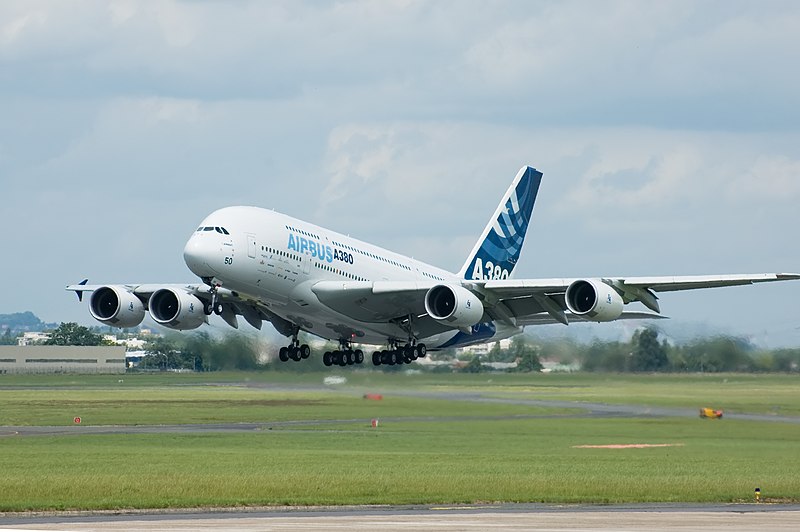
A380: image wikipedia
And this is the current situation between the Airbus A380 and Boeing’s 787 Dreamliner. The A380 had its share of delays and was over 2 years late in coming into service. Right now the troubles that Rolls Royce are having with their Trent 900 engines is not helping the A380 image. (There are only two engines available for the A380 but it is noteworthy that the General Electric / Pratt & Whitney Alliance which manufacture the GP7200 engine which competes with the Trent 900 are not indulging in any overt negative marketing). The “Rolls Royce effect” for Airbus is currently negative because of the Trent 900 issues but it is indirectly mitigated by the reports of delays in developing the Trent 1000 which is one of the engines for Boeing’s 787.

B787 First flight: image Wikipedia
As Airbus fights to get airlines to accept the A380 their “best friend” strangely is the delays to the B787 Dreamliner program. The Dreamliner has been further delayed by an electrical system fault which caused a fire on a test flight in early November. For an airline the decision of choosing between Boeing and Airbus has become not one of comparing the advantages each has to offer but instead one of judging the risk exposure that a choice may bring. It becomes a comparison of potential “downsides” and risk mitigation possibilities rather than selecting between potential “upsides”.
For Airbus and Boeing, their sales processes now have to emphasise the risk mitigation available with their products rather than promoting all the advantages their products have to offer. This is unusual for a “sales process” but nothing new in the history of marketing of technologically new products. But it is not so easy for corporations, their salesmen and for sales processes to shift from promoting advantages to the much more difficult task of showing that the risks (whether of delay or of technical difficulties) they pose are less than that of the competitor. Even in terms of financing, the usual offers of financing and leasing packages for the customer must now additionally address the mitigation of financial and consequential exposures in the event that a risk materialises. When a single A380 costs around $320 million, a Boeing 747-400 about $250 million and a Dreamliner has a price tag of $150 -200 million, then downtime and delays have enormous financial consequences for the customer. Marketing strategy for new products in the face of heightened risk perceptions is quite different to the marketing of “tried and tested” products. But this is a fascinating marketing challenge!
The latest reports of delays to the Dreamliner has led to harsh words about Boeing from a potential customer. CityAM reports:
QATAR Airways has threatened to hand extra business to European aircraft giant Airbus after attacking Boeing over problems with its new 787 Dreamliner. Chief executive Akbar Al Baker said the airline was considering increasing its order for five Airbus A380 super-jumbo planes and might order a re-engined version of the A320 single-aisle jetliner. He did not say how many more A380s it might order.
Qatar has expanded its fleet from four to 94 aircraft in 13 years and has orders for 200 more from Airbus and its US rival Boeing worth $40bn, including 30 Dreamliners. Al Baker said Boeing had “failed” in developing its 787 Dreamliner, which is expected to suffer further delays following a fire on a test flight.
Boeing’s development of the carbon-composite 787 is running around three years late and brokers expect a further delay as it addresses the cause of a fire which led to the test flight being grounded two weeks ago.
But I would expect that there is a strong element of price negotiation in Qatar Airways’ statement!
Tags:A380, Airbus, Boeing, Boeing 787 Dreamliner, Dreamliner delays, GP7200, marketing new technology, marketing strategy, risk mitigation, Trent 900
Posted in Aviation, Business, Engineering, Management | Comments Off on Airbus vs. Boeing: or a tale of the marketing of delays and engine problems
November 23, 2010
Qantas will have one A380 ready to fly again on Saturday 27th, 23 days after the engine explosion on QF32. Bloomberg reports:
Chief Executive Officer Alan Joyce will be on the first flight, which will go to London from Sydney via Singapore, he said at a media briefing today. The carrier will conduct further inspections with Airbus, regulators and engine-maker Rolls-Royce Group Plc before resuming other routes, it said in a statement.
The carrier will have four 450-seat A380s in service before Dec. 25, including two new ones, Joyce said. The airline is also due to receive two superjumbos next year. Joyce said it is too early to estimate the cost of the disruption caused by grounding the A380s or to comment on whether the carrier will seek compensation.
The Financial Times reports that Rolls Royce are likely to restrict the operating regime of the Trent 900 by limiting the maximum thrust that can be used,
Reports in Australia said Rolls-Royce was about to impose new guidelines on users of its Trent 900 engines stipulating that they cannot be operated at above 70,000 pounds of thrust.
Downgrading thrust to 70,000 pounds would knock out Qantas’s A380 services from Sydney and Melbourne to Los Angeles, a worrying development for the Australian airline that dominates the Pacific route.
“72,000 pounds of thrust is needed for the Pacific route,” a Qantas spokesman said. The airline would not comment on reports that at 70,000 pounds of thrust, Qantas A380s would be forced to fly to Los Angeles less than half full. It said the voluntary suspension on the Pacific route remains “until further operational experience is gained or possible additional changes are made to engines”.
“Pilots still have access to maximum certified thrust [of 72,000 pounds] if they require it during flight. It is not a manufacturer’s directive,” the company added.
Tags:Airbus A380, Qantas, Rolls Royce, Trent 900, Trent 900 operating regime
Posted in Aviation, Business, Engineering, Technology | 2 Comments »
November 22, 2010
From Wattsupwiththat:
Former Vice President Al Gore has admitted that his “support for corn-based ethanol in the United States was “not a good policy”, weeks before tax credits are up for renewal.”
Gore was the tie-breaking vote in the Senate mandating the use of ethanol in 1994.
From Reuters:
“It is not a good policy to have these massive subsidies for (U.S.) first generation ethanol,” said Gore, speaking at a green energy business conference in Athens sponsored by Marfin Popular Bank.
“First generation ethanol I think was a mistake. The energy conversion ratios are at best very small.
“It’s hard once such a programme is put in place to deal with the lobbies that keep it going.”
He continues (admitting more of the obvious):
“One of the reasons I made that mistake is that I paid particular attention to the farmers in my home state of Tennessee, and I had a certain fondness for the farmers in the state of Iowa because I was about to run for president.”
He never did get a Nobel prize for his vote in 1994, so
……….. don’t make the mistake that he has had an epiphany on climate change:
Read the whole post at:
http://wattsupwiththat.com/2010/11/22/gore-admits-the-obvious-us-corn-ethanol-was-not-a-good-policy/
Tags:Al Gore, ethanol, ethanol from corn, U-turn on ethanol
Posted in Business, Energy, Environment, Ethics, Renewable Energy | Comments Off on Al Gore does a U-turn and admits the obvious
November 22, 2010
In the first half of 2010 Rolls Royce had revenues of £5.421 billion with a PBT of £465 million (8.6%) of revenues. Cash position was strong with net cash for the period at £915 million. But it looks less impressive considering the order backlog of £58.4 billion. How much of the net cash was due to order down-payments is not clear. Orders received during the period were £5.9 billion (and backlog was virtually unchanged) and this would have provided net cash of around £550 million. So operating cash flow (excluding financial posts) was probably only £350 million.
The Trent 900 debacle will probably eat up at least £200 million – and perhaps more – over the next 12 -18 months. The immediate effect will also be the loss of some expected orders and 22 A380s – bought by Qatar Airways, Kingfisher, Etihad and Air Austral – are yet to decide whether to use the Trent 900 or the rival GP7200 made by the GE / Pratt & Whitney Alliance. Any loss of market share will be difficult to recover. To sell the 100 additional engines that will be needed to recover the costs of this fix will take a few years. Even though all the costs will not be incurred in this quarter, some significant provision will have to be made this year (and it will be a real warning sign if such provision is not made).
The financial and technological position of Rolls Royce is strong and they should be able to make the fix and weather the storm. But profits will be hit hard for at least the next 12 months and perhaps even longer if Trent 900 sales suffer or if the Trent 1000 is further delayed.
Until the Trent 1000 is established in the Dreamliner (which depends on the Boeing 787 coming into service through next year), Rolls Royce share value is capped and with a big downside. It is perhaps time to sell and it could be time to re-enter in about 12 months if some of the major uncertainties are resolved by then.

ROLLS-ROYCE Share Graph: graphs.lse.co.uk
Tags:Rolls Royce, share price, Trent 1000, Trent 900
Posted in Aviation, Business, Engineering, Technology, UK | 1 Comment »
November 22, 2010
Swedish P1 Radio had a broadcast this morning where wind turbine owners in southern Sweden were interviewed. Wind turbines in Southern Sweden operate at an average capacity of about 25% but when the wind blows in in Sweden it usually blows in Denmark as well. As Denmark builds more subsidised but intermittent wind turbines they become more dependant upon the import of hydro and nuclear power from Sweden and Norway.
It could be a dark future for wind power, at least for wind power owners in southern Sweden. As wind turbines multiply, the surplus power when the wind blows reduce prices and wind turbine revenues are reduced drastically.
The Marketing Director for Lunds Energi said that they had no plans for building any more wind turbines to add to the 6 small wind turbines they already had. There was no chance, he said, of the Danes importing wind power from Sweden when the wind was blowing for then they had their own power. And when the wind was not blowing and prices were better there was no power to sell!

Wind power plant in Lake Vännern. Foto: Fredrik Sandberg/Scanpix
Kjell Jansson, the Managing Director of Svensk Energi was also interviewed and pointed out that electricity could not be stored except as hot water. Therefore using surplus wind energy to store in heating systems was at best a partial solution but did not help the fact that industry and people needed electricity as electricity – and not just as hot water. Even the planned Danish solution of using surplus power to “charge up” heating systems for district heating as hot water or for “charging up” electric cars relied on having electricity – from nuclear and hydro power from Sweden and Norway – available to be imported for the Danish electricity system.
Therefore, he continued, when the wind did not blow in Denmark – and then usually did not blow over the whole of Scandinavia – the high electricity price was an advantage for the hydro and nuclear generators. In any case this would require much more investment in transmission systems and in hydro power generation.
But I can see a situation where Denmark will pay swingeing prices for imported electricity when the wind is not blowing and a cold wave is sweeping across Europe. And if it is a really severe cold wave then there may be no electricity available for import.
Tags:electricity prices, Energy, Energy storage, Sweden, wind power
Posted in Business, Economy, Energy, Environment, Sweden, Wind power | Comments Off on Bleak future for wind power generators in Sweden
November 21, 2010
AFP reports:
Indonesia’s Yogyakarta airport, which had been closed for about two weeks by the eruption of the Mount Merapi volcano, reopened for operations Saturday, officials said.
Merapi, which means “Mountain of Fire”, has killed 283 people since it began erupting last month and more than 270,000 are still living in temporary shelters.
Volcanic ash and clouds belched high into the sky threatened the safety of aircraft, causing dozens of international flights to and from the country to be cancelled.
But the mountain’s activity level has now decreased, although an alert remains in place.
Transportation Ministry director general of aviation Herry Bhakti told AFP: “The Yogyakarta airport has resumed operation at 12:00 pm (0500 GMT) today. The effect of volcanic ash has been insignificant.”
Tags:Indonesia, Mount Merapi, Yogyakarta
Posted in Business, Environment, Indonesia, Volcanos | Comments Off on Flights resume from Yogyakarta, Mt. Merapi quiet


 The k2p blog