Archive for the ‘Business’ Category
November 20, 2010
Two days after the Tokyo Stock Exchange attacked the “rampant” insider trading prevalent in Japan, US federal authorities after a three-year investigation, “are preparing insider-trading charges against consultants, investment bankers, hedge-fund and mutual-fund traders and analysts across the nation” according to the Wall Street Journal. Where Tokyo calls it “rampant” the US calls it “vast” and “pervasive”.
The criminal and civil probes, which authorities say could eclipse the impact on the financial industry of any previous such investigation, are examining whether multiple insider-trading rings reaped illegal profits totaling tens of millions of dollars, the people say. Some charges could be brought before year-end, they say.
The investigations, if they bear fruit, have the potential to expose a culture of pervasive insider trading in U.S. financial markets, including new ways non-public information is passed to traders through experts tied to specific industries or companies, federal authorities say.
Among the expert networks whose consultants are being examined, the people say, is Primary Global Research LLC, a Mountain View, Calif., firm that connects experts with investors seeking information in the technology, health-care and other industries. “I have no comment on that,” said Phani Kumar Saripella, Primary Global’s chief operating officer. Primary’s chief executive and chief operating officers previously worked at Intel Corp., according to its website.
In another aspect of the probes, prosecutors and regulators are examining whether Goldman Sachs Group Inc. bankers leaked information about transactions, including health-care mergers, in ways that benefited certain investors, the people say. Goldman declined to comment.
Independent analysts and research boutiques also are being examined. John Kinnucan, a principal at Broadband Research LLC in Portland, Ore., sent an email on Oct. 26 to roughly 20 hedge-fund and mutual-fund clients telling of a visit by the Federal Bureau of Investigation.
“Today two fresh faced eager beavers from the FBI showed up unannounced (obviously) on my doorstep thoroughly convinced that my clients have been trading on copious inside information,” the email said. “(They obviously have been recording my cell phone conversations for quite some time, with what motivation I have no idea.) We obviously beg to differ, so have therefore declined the young gentleman’s gracious offer to wear a wire and therefore ensnare you in their devious web.”
The investigations have been conducted by federal prosecutors in New York, the FBI and the Securities and Exchange Commission. Representatives of the Manhattan U.S. Attorney’s office, the FBI and the SEC declined to comment.
Another aspect of the probe is an examination of whether traders at a number of hedge funds and trading firms, including First New York Securities LLC, improperly gained nonpublic information about pending health-care, technology and other merger deals, according to the people familiar with the matter.
Read the article:
http://online.wsj.com/article/SB10001424052748704170404575624831742191288.html?mod=WSJ_hp_LEFTTopStories
Tags:ethics, Federal Bureau of Investigation, fraud, hedge funds, Insider trading, investment bankers, U.S. Securities and Exchange Commission
Posted in Business, Corruption, Ethics, Fraud | Comments Off on Now Wall Street to crack down on insider trading
November 19, 2010
Rolls Royce now faces direct costs for replacement of 40 Trent 900 engines, compensation claims from Airbus and from the airlines involved and lost opportunity costs as the Trent 900 inevitably loses market share to the General Electric / Pratt & Whitney Alliance GP 7200 engine. These could add up to around 300 million $ for fixing the Trent 900 problems and that is a best case scenario which assumes that they have not been negligent in knowingly supplying unfit engines. The cost of the consequent loss of market share cannot be easily quantified.
Airbus has already signalled that it is preparing its compensation claims for the additional costs incurred by diverting new engines from the Airbus production line to the replacement of faulty engines for Qantas, Singapore Airlines and Lufthansa. Any consequent delays to the aircraft under production at Airbus will no doubt lead to further penalties for Rolls Royce. The airlines are also, I am sure, preparing their compensation claims. Qantas is said to be losing one million dollars for every day without its A380’s. The fleet has been grounded for 15 days so far and it seems likely that this may last another 2 or 3 weeks and maybe for the rest of the 2010 calendar year. Qantas has already prepared its summer schedules based on no A380’s being available. Singapore Airlines has restarted its A380 flights.
In most supply contracts the consequential business losses at the airlines would not normally accrue to Rolls Royce but if it can be shown that the faulty engines delivered by Rolls Royce were “not fit for service” or – even more damagingly – that Rolls Royce were aware of the faults when the engines were delivered then Rolls Royce could be liable for massive damages and even for criminal negligence. In fact it would be comparable to issuing a cheque with no money in a bank account which could be construed as criminal negligence and fraud. Certainly it seems that Rolls Royce has known for some time that some of the engines delivered were “not fit for service” and it is highly unlikely that they could completely escape paying some compensation to the airlines. If the method of operation or maintenance by Qantas could be shown to be a contributory factor then Rolls Royce would have had some possibility of resisting the claim and of mitigating the penalties. But if the engines were “unfit for service” to begin with, then it even becomes possible for Airbus and the airlines to make claims for “loss of reputation” in addition to claims for loss of business. There is no viable defence at all if Rolls Royce knowingly supplied unfit engines.
A Trent 900 engine has a price of about 30 million $ and a complete A380 sells for about 320 million $. The direct cost for the engine rectifications for 40 engines is likely to be around 100 million dollars and this could easily increase to 300 or 400 million dollars with the compensation claims mainly from Airbus and Qantas. The Singapore Airlines and Lufthansa claims for compensation will not be small but will be significantly lower than the claims from Qantas. But if Rolls Royce has been negligent- whether criminally or not – then all bets are off and I think costs could escalate to be of the order of one billion dollars.
While the direct costs and compensation – once settled – can be quantified, the effects of loss of market share is potentially even more damaging but much more difficult to quantify. Since there are only 2 engine suppliers I would estimate that Rolls Royce will lose at least 5% market share to its rival as a consequence of this incident.
From my previous knowledge of the costs of fixing problems with land based gas turbines (more than 1 billion $ each for General Electric with their F-class Frame 7 and Frame 9 machines and for Alstom and Siemens with their versions of F-class machines), I would be looking for Rolls Royce to provide – as a matter of prudence – for at least 200 million £ (300 million $) during this quarter. Rolls Royce will need to sell around 100 new engines just to recover this cost.
From an investor perspective I find the lack of communication from Rolls Royce inexplicable and suggestive that there has in fact been some negligence.
Tags:costs, Fixing the Trent 900, Rolls Royce, Trent 900, Trent 900 failures
Posted in Aviation, Business, Engineering, Technology | 6 Comments »
November 19, 2010

Tokyo Stock Exchange: image via Wikipedia
That insider training is endemic at all major stock exchanges is a modern-day legend. Evidential proof of insider trading is also notoriously difficult. Regulators are usually more concerned about the more “sexy” malfeasance a la Enron or a Madoff but usually long after the event and where recovery of losses is insignificant (Madoff caused 65 billion of losses and auction of his personal possessions by US Marshalls raised just 2 million dollars). If I am a little cynical it is because the actual creation and growth of real wealth (by actually making things that are wanted or providing real services that are needed) seems to be less important and less appreciated than the inflating of values (by creation of bubbles) and redistributing the artificially created “wealth” by “smart” methods.
Many of the statements and actions of the regulators are mainly for public relations purposes and sometimes lead to a few high-profile prosecutions. It is very rare for any small investors to recover what they may have lost as a consequence of fraud. Nevertheless it is always good to see the regulators have some success. Asahi News reports that
Financial authorities are taking action to prevent what has been embarrassingly described as “rampant” insider trading through short selling on the Tokyo Stock Exchange. The Securities and Exchange Surveillance Commission (SESC) is looking into allegations of insider trading of certain stocks on the TSE, but declined to disclose the issues or amount traded. The Financial Services Agency (FSA) and the TSE, meanwhile, are considering tighter rules on short selling.
“We hear from overseas investors that insider trading is rampant in Japan. It’s a grave issue,” a senior TSE official said. In short selling, investors borrow shares from brokerages or stockholders under expectations the price will drop. They sell them and buy them back for a profit after the price drops, returning the same number of shares to the lender.
Insider trading suspicions have been raised over the public stock offerings by Tokyo Electric Power Co. (TEPCO), Nippon Sheet Glass Co. and INPEX Corp., which were announced between July and September. The stock prices of all three firms plunged before the announcements of their public stock offerings.
TEPCO, for example, made public it would raise 550 billion yen ($6.6 billion) on Sept. 29 at 4:30 p.m.–after the close of trading. Earlier in the day, however, large volumes of TEPCO stock, six to 10 times more than usual, were traded mainly through short selling, with the issue closing 7.8 percent lower than the previous day. Likewise, there was a surge in short sales of Nippon Sheet Glass Co. and INPEX Corp. shares, causing the prices of both stocks to fall just before the companies announced their capital increase plans.
Companies issue public stock offerings to secure funds from a large number of unspecified investors by issuing new shares. Because it increases the total number of the company’s shares, the value per share drops, leading to lower stock prices in the short run. “I’m sure information got out beforehand,” a market source said about the recent cases. “Foreign hedge funds sold in large volumes.” These suspicions are nothing new. “Often, after receiving many inquiries in the morning from foreign investment banks on how many shares of a particular stock we have, we find a capital increase announcement by the company. There was such an incident just recently,” said a senior official at a securities company. An SESC official said: “If we do nothing about such practices, we could lose credibility of Japanese markets. If there are allegations, we intend to investigate and crack down on them.” One apparent source of inside information is a “demand survey” on institutional investors conducted in advance by brokerages that handle public stock offerings. The survey is intended to gauge the enthusiasm of institutional investors to see if the capital increase plan would go well. But an SESC official said, “People who got the information beforehand could abuse it.”
The SESC has already taken action. Following the Sumitomo Mitsui Financial Group’s issue of about 300 billion yen worth of preferred stock in 2003, the SESC revealed in 2004 and 2006 that employees of investment corporations in Singapore and Britain had been involved in illegal trading of the shares, using information they obtained beforehand. But such investigations take time because the SESC needs to exchange information with overseas regulatory authorities. The investigation involving Singapore spanned a year and a half. The one concerning the British investment corporation required three and a half years.
Both the FSA and the TSE are considering limiting short selling for a defined period after an announcement of a capital increase–until the issue price of the new stock is determined. Under a U.S. regulation introduced in the late 1990s, investors who conducted short selling within five business days before the issue price is set are prohibited from buying new shares issued through a capital increase.
“A (regulation) system has been established in the Untied States, but apparently not in Europe. We need to look into the background, and it will take some time before we reach a conclusion,” a senior FSA official said.
Tags:Financial Services Agency, Insider trading, short trading, Tokyo Stock Exchange
Posted in Behaviour, Business, Ethics, Fraud | 1 Comment »
November 18, 2010
The CEO of Qantas has revealed that when the Trent 900 engine failed on QF32, shrapnel from the exploding engine narrowly missed the wing fuel tank which could have caused the plane to explode. The Sydney Morning Herald:
SHRAPNEL from the engine explosion on Qantas QF32 severed a fuel pipe and narrowly missed the wing’s fuel tank, according to official preliminary reports. The chief executive, Alan Joyce, also confirmed yesterday that as many as 40 Rolls-Royce Trent 900 engines fitted to A380 superjumbos worldwide might have to be replaced.
The reports, seen by the Herald, of the damage incurred on November 4 reveal the extent to which metal components tore through the wing. The debris severed wiring looms, chopping a main fuel pipe, puncturing structural spars and ribs and punching through wing surface panels.
Qantas was ”very, very lucky” that thousands of litres of highly flammable jet fuel in the wings did not ignite from the ruptured fuel pipe or from a spark from severed wiring, said Adrian Mouritz, the head of aerospace and aviation engineering at RMIT University. ”If that fuel ignited, that aircraft would have exploded,” he said.
The questions for Rolls Royce are multiplying and their lack of communications is astounding. Not only, it seems, did Rolls Royce know about the risks of engine failure before the Trent 900 exploded on QF32, but they have also modified the engine and quietly started introducing the modifications without Qantas and Airbus being aware of the significance or the risks with the unmodified engines!!!!!
https://ktwop.wordpress.com/2010/11/14/did-rolls-royce-know-the-risk-about-the-trent-900-engine-fault-before-the-qantas-failure/
https://ktwop.wordpress.com/2010/11/15/problem-with-trent-900-was-known-before-accident-and-raises-ethical-questions/
Tags:Airbus, Qantas, Rolls Royce, Trent 900 failures
Posted in Aviation, Business, Engineering, Technology | 1 Comment »
November 18, 2010

Location of Spaceport America: image via Wikipedia
Reuters reports:
The New Mexico Spaceport Authority, which plans to start launching citizen astronauts on suborbital flights within 18 months, has begun soliciting contract bids from local businesses for day-to-day operations of the facility.
Construction of the world’s first commercial passenger space terminal, dubbed Spaceport America, is slated to be finished next year near the town of Truth or Consequences in southern New Mexico. The 2-mile-long main runway was completed in October.
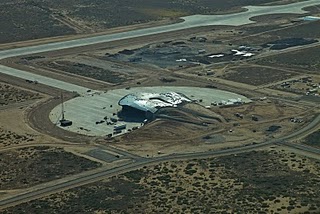
Spaceport America Wednesday, 10 November 2010 04:09 :image spaceportamerica.com
Two other major structures nearing completion at the nearly $200 million facility are the air-fire rescue facility and a 110,000-square-foot hangar, authority spokesman David Wilson said.
To date, 380 wannabe space cowboys have each plunked down $200,000 each to reserve a seat aboard a Virgin Galactic six-passenger spacecraft for a 2-1/2-hour suborbital flight some 70 miles above the Earth, Wilson said.
Under a 20-year lease with the state, Richard Branson’s firm is Spaceport America’s anchor tenant and principal spaceliner, paying lease charges of up to $200 million, plus user fees to operate their own aircraft and to contract with other aerospace companies.
The site has been providing commercial launch services for the aerospace industry since 2006 and is expected to be fully operational by mid-2011. But Virgin Galactic expects to take another year to begin its private passenger service, once its test-flight program is complete.
The authority’s executive director, Rick Homans, this week issued a call for businesses to submit proposals for three major areas of operation of the spaceport.
They include general services, such as maintenance; protective services for site security, safety and environment health management; and technical services, including airfield and launch support, airspace management and flight safety engineering.

Artists impression of Virgin Galactic: image forums.finalgear.com
Virgin Galactic’s VSS Enterprise made its solo flight in October.
Tags:Business, New Mexico, Richard Branson, Spaceport America, Virgin Galactic
Posted in Aviation, Business, Engineering, Future Transport, Space, Technology | Comments Off on Spaceport America gets ready for first commercial passengers to space
November 18, 2010
I posted a few days ago that Rolls Royce would need to change out about 40 of the Trent 900 engines on the A380’s in operation with Qantas, Singapore Airlines and Lufthansa.
Now -via Qantas and The Press Association – this number has been confirmed by Rolls Royce:
Up to half of the Rolls-Royce engines of the type which disintegrated on an Airbus superjumbo this month may need to be replaced by the three carriers in Australia, Singapore and Germany, Qantas’s chief executive has said.
Australia’s Qantas, Singapore Airlines and Germany’s Lufthansa fly A380s powered by four giant Rolls-Royce Trent 900 engines, with a total of 80 engines on 20 planes.
Qantas chief Alan Joyce said that Rolls-Royce had indicated that up to 40 of them may need to be replaced.
“Rolls-Royce are still working through the criteria for which engines need to be changed,” he said on the sidelines of an event in Sydney unrelated to the A380 incident. He said that 14 of the 24 engines on Qantas planes may have to be replaced.
Whether Rolls Royce knew about the engine fault and the consequent risk prior to the accident on QF32 remains unanswered and whether the European Regulator (EASA) relaxed its inspection frequency Directive in response to Rolls Royce representations also remains unanswered.
Tags:EASA, Qantas, Rolls Royce, Trent 900, Trent 900 failures
Posted in Aviation, Business, Engineering, Technology, Travel | Comments Off on Rolls Royce must replace 40 of 80 Trent 900 engines deployed
November 17, 2010

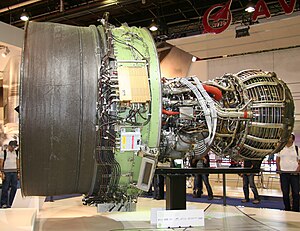
Trent 900: image via Wikipedia
Rolls Royce is asking Airbus to return new engines destined for new aircraft so that they can be supplied to Qantas, Singapore Airlines and Lufthansa for their operations. This in turn is having a knock-on effect on future A380 deliveries.
In the meantime Qantas seems to be having a rash of minor issues which have caused aircraft to return after cockpit fires, bird hits and lightning strikes.
The European Regulator (EASA) has not commented on why they relaxed their Airworthiness Directive and whether this was done in response to representations from Rolls Royce. The engine maker is also silent on whether they knew of the Trent 900 problem and the risk for an engine fire prior to the uncontained explosion of an engine on QF32.
Reuters reports on the logistics problems faced by Rolls Royce:
British enginemaker Rolls-Royce has asked Airbus to return Trent 900 engines from A380 superjumbo production lines so they can be used to replace faulty ones on aircraft already in service.
The Airbus A380 — the world’s largest passenger aircraft with an average list price of about $350 million — has been hit by safety concerns after a Rolls-Royce engine partly disintegrated mid-flight, forcing a fully laden Qantas plane to make an emergency landing in Singapore on Nov 4.
Rolls-Royce’s move could be another blow to a much-delayed A380 program as Airbus was scheduled to deliver over a dozen Rolls-Royce-powered A380s — primarily to Singapore Airlines, Qantas and Lufthansa by the end of next year.
“Until this problem is fully resolved I think the situation with the delivery of A380 to customers … will be in jeopardy,” Standard & Poor’s analyst Sukhor Yusof said. But both Singapore Airlines and Qantas, with a combined 22 A380s still to be delivered, said on Tuesday they had not been informed of any delivery delays.
Airlines using the Rolls-Royce Trent 900 engines have been ordered by European aviation authorities to undertake major tests, which analysts said were so strenuous they would likely disrupt schedules.
“I can confirm that Rolls-Royce is arranging to supply some new engines from the production line to replace some engines removed from the serviced aircraft,” an Airbus spokesman in Singapore said, without saying which airlines would receive those engines.
Shares in Rolls-Royce, which on Friday said fixing the fault would lead to only slightly slower profit growth, have suffered during its probe and were 0.2 percent down at 596.50 pence by 1130 GMT on Tuesday, around 9 percent below their last trade before the Qantas incident. Airbus parent EADS has lost 5 percent since the incident and hit a one-month low on Monday. Its shares were 1.3 percent down at 17.78 euros. Qantas is down 4.9 percent since the incident. Airbus said last week that the problem with the Rolls-Royce engine could have an impact on its earnings and delivery target for 2011 but did not give details, and airlines contacted on Tuesday had no knowledge of delivery timetable changes.
Tags:Airbus, European Aviation Safety Agency, replacement engines, Rolls-Royce Trent 900, Trent 900
Posted in Aviation, Business, Engineering, Ethics, Technology | Comments Off on Rolls Royce scrambling to find Trent 900 replacement engines
November 16, 2010
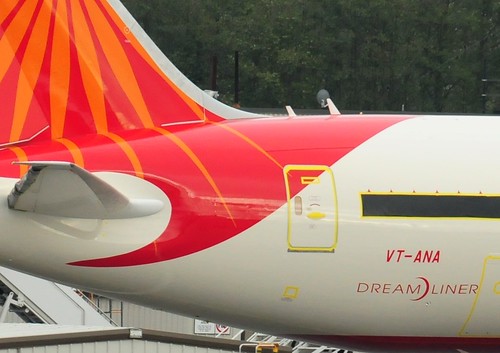
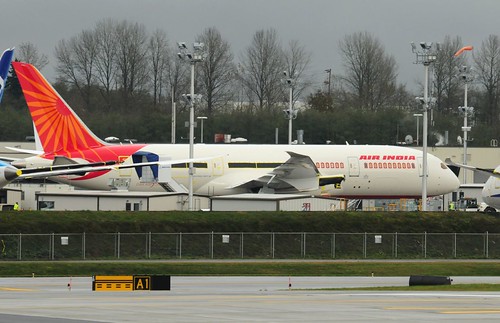
Air India‘s first 787 Dreamliner, registered VT-ANA, has been moved from the paint hangar to the Everett flight line. Airplane 25 is slated for a second quarter 2011 delivery to the Indian flag carrier.
Air India has 27 Dreamliners on order.
The VT prefix on Indian aircraft continues an old tradition and stands for “Viceroy Territory”:
The ICAO, a United Nations agency based in Montreal, was established in 1944 to draw up international regulations and standards for air travel. It is responsible for assigning the codes for airlines, airports and individual aircraft used by air traffic controllers across the world. It assigned the code VT to British India in 1944, three years before the country was divided into the independent states of India and Pakistan. India kept VT, while Pakistan was assigned AP. Britain now uses G. Several other former British colonies and territories still use codes that begin with V, such as Australia (VH), Antigua and Bermuda (V2), and the Falkland Islands (VP-F). Others have changed theirs, such as Fiji, which now uses DQ, and Kenya, which uses 5Y.

Plane 25 will be Air India's first Boeing 787 Dreamliner:Photos Credit Moonm

Air India Dreamliner VT-ANA: photo credit moonm
The black plasic on the windows is for storage. Air India will be using General Electric GEnx engines (and the Rolls Royce Trent 1000 is the only other engine available for the Dreamliner).

Image via Wikipedia
General Electric GEnx at the Paris Air Show 2009: image Wikipedia
http://www.flightglobal.com/blogs/flightblogger/2010/11/photo-of-note-air-indias-first.html#comments
Tags:Air India, Boeing 787, Dreamliner, Genx, Trent 1000, Viceroy Territory, VT-ANA
Posted in Aviation, Business, Engineering, Technology | Comments Off on Air India’s first Dreamliner gets its colours
November 14, 2010
Another new twist to the Rolls Royce Trent story.
First it appears that the regulators (EASA) relaxed their original inspection requirements in their Directive of August. It is not clear if this relaxation was in response to the airlines or to the engine maker requesting a change.
Now it seems that Rolls Royce may well have known (perhaps a year ago) that a number of their engines on “older” A 380s were susceptible to oil leaks and therefore to the potentially catastrophic consequences of a fire. About 40 engines on the Qantas, Singapore Airlines and Lufthansa A 380s have to be changed out. The newer engines have undergone two modifications compared to the older engines. It seems that Rolls Royce started modifying oil systems on some engines almost a year ago.
If Rolls Royce knew about the risk to the Trent 900 before the flight of Qantas QF32 on November 4th, there is an ethical dimension which needs to be considered.
According to the Herald Sun,
Fourteen of the 24 Trent 900 engines fitted to the six A380s Qantas has grounded are suspected of having an oil leak problem. Another 24 “faulty” engines are on Singapore Airlines jets. The airline has grounded three A380s. Two have been found by the German carrier, which has suffered two Trent incidents.
Revised versions of the engine are being rushed to Qantas.
Sir John Rose, chairman of the British engine maker, issued a statement late on Friday in which he admitted a “specific component in the turbine area of the engine caused an oil fire”, which led to a turbine disc hurtling out. He offered “regret” for causing “disruption”. But he failed to reveal when Rolls-Royce discovered the turbines of the Trent 900 were being exposed to the dangerous oil leaks and the dates of the two upgrades.
Qantas, Singapore Airlines and German carrier Lufthansa installed the original-spec engines on some of their jets. It is understood Qantas has begun record checks to see whether Rolls kept its engineers informed of the design changes to the $25 million engines.
An aircraft mechanic with one of the three airlines claimed Rolls-Royce began modifying the oil lubrication system on the Trent 900 engine in the second half of last year.
Tags:ethics, European Aviation Safety Agency, Lufthansa, Qantas, Rolls Royce, Singapore Airlines, Trent 900, Trent 900 failure risk
Posted in Aviation, Business, Engineering, Ethics, Technology | 5 Comments »
November 13, 2010
Reuters

State-run Coal India (COAL.BO) is in talks to buy mines from U.S.-based Peabody Energy and Massey Energy , according to a media report citing the company’s chairman. “They expressed interest in offering certain mines to us and we are looking at that,” Partha Bhattacharyya said in a report by the Associated Press carried in the Economic Times newspaper on Saturday. “The discussions are continuing,” the report quoting him as saying. He declined to provide further details.
The Economic Times:
Coal India has budgeted $1.2 billion to buy assets in the US, Indonesia and Australia during the year ending March as it battles a widening gap between domestic coal supply and demand. The company, which last month raised $3.4 billion in the nation’s biggest-ever initial public offering, has near-monopoly control of India’s coal market. Indian companies are increasingly turning to the US to secure vital commodities to fuel the nation’s breakneck growth.
This year, Reliance Industries — India’s most valuable company by market value — bought stakes in three US shale gas companies for a combined $3.4 billion, the largest Indian investment in the US ever made. In 2007, India’s Essar Group acquired Minnesota Steel and is investing over $1 billion to build two plants and run its iron ore mine near Nashwauk, in northern Minnesota. This March, the company spent $600 million to acquire US-based Trinity Coal with mines in Kentucky, West Virginia.
St Louis, Missouri-based Peabody Energy says it is the world’s largest private sector coal company, with 9 billion tonnes of reserves. Richmond, Virginia-based Massey Energy says it is the largest coal producer in the Central Appalachian region, which accounted for 20% of United States coal production in 2007.
Tags:Acquisitions, Coal India, Essar Group, Massey Energy, Peabody Energy, Reliance Industries
Posted in Business, Energy, Environment, India, International Trade, Investing | Comments Off on Coal India looking to acquire mines in US, Australia and Indonesia






 The k2p blog