Archive for the ‘Development’ Category

The ancient melting pots of Europe

October 11, 2013

Stone Age settlers migrated across Europe in multiple waves that replaced older hunter-gatherer cultures with the genes from each wave blending into the population of the day. Ancient mtDNA studies are revealing that cultures spread to a great extent by the physical migrations of peoples and possibly faster and more effectively than by cultural diffusion alone. And the many different gene-melts continue today. Whereas in the Stone Age much of the action was in Central Europe, in the jet-age the melting-pots have shifted westwards and are mainly now in Western and Northern Europe. The peopling of Europe is an ongoing thing.

Guido Brandt, Wolfgang Haak, Christina J. Adler, Christina Roth, Anna Szécsényi-Nagy, Sarah Karimnia, Sabine Möller-Rieker, Harald Meller, Robert Ganslmeier, Susanne Friederich, Nicole Nicklisch, Joseph K. Pickrell, Frank Sirocko, David Reich, Alan Cooper, Kurt W. Alt and The Genographic Consortium, “DNA reveals key stages in the formation of Central European mitochondrial genetic diversity,” Science doi: 10.1126/science.1241844

National Geographic:

… the people who lived in Central Europe 7,000 years ago had different DNA lineages than those that lived there 5,000 years ago, and again different to those that lived 3,500 years ago. Central Europe was dynamic place during the Bronze age, and the genetic composition of the people that lived there demonstrates that there was nothing static about European prehistory.

Genographic Project Director and National Geographic Explorer-in-Residence, Spencer Wells expounds: “spanning a period from the dawn of farming during the Neolithic period through to the Bronze Age, the [genetic] data from the archaeological remains reveals successive waves of migration and population replacement- genetic ‘revolutions’ that combined to create the genetic patterns we see today.”

What we see in Europeans today is a kind of mixture of what was present there at different times in our past. So, just like parts of Europe today are melting pots from different living cultures across the world, Europe is also a melting pot of genetic lineages from different prehistoric cultures that lived there at different periods of time.

timeline peopling of europe Brandt et al, DOI: 10.1126/science.1241844 fig.3


Dienekes: “Central Europe, once populated exclusively by hunter-gatherers, experienced a virtual disappearance of their matrilineages for almost two thousand years after the advent of farming.  Then, between the Middle to Late Neolithic, around five thousand year ago, the hunter-gatherers make their re-appearance before their lineages converge to their modern (minority) frequency”

2013 was a “good” year for the cryosphere – but could it be the beginning of the end of this interglacial?

October 8, 2013

According to the NSIDC – which is an important part of orthodox officialdom – 2013 was a better year for the cryosphere since:

“This summer, Arctic sea ice loss was held in check by relatively cool and stormy conditions. As a result, 2013 saw substantially more ice at summer’s end, compared to last year’s record low extent. The Greenland Ice Sheet also showed less extensive surface melt than in 2012. Meanwhile, in the Antarctic, sea ice reached the highest extent recorded in the satellite record”.

What makes for “good” or “bad” depends upon what the fears are. If global warming is the fear then – as the NSIDC states – it was a good year. But if a cooling cycle or even a coming ice age is the fear then the increasing ice extent, the short summer, the extended winter last year and the increased snow cover in the Northern Hemisphere are all just early warning signs of what is to come.

We don’t know if we are in:

  1. a run-away global warming period (as the global warming orthodoxy will have us believe), or
  2. a series of global warming and cooling cycles, each about 20 – 30 years long and responding to the decadal ocean cycles, or
  3. the beginning of the end of this interglacial (which is overdue).

The global warming pause of the last 17 – 18 years suggests that “run-away” global warming is unlikely. The slight decrease in global temperatures over the last 7 – 8 years is not conclusive but is also evidence that the effect of increasing carbon dioxide on global temperature is far from certain. Even if it exists it is very small  and is clearly not yet properly understood. Catastrophe scenarios may attract funding but reduce the credibility of the doom-sayers.

If we are just in a regular cooling cycle then the increasing ice level is nothing to be afraid of. Even if 2 or 3 decades of cooling give us another Little Ice Age, it will be followed by a warming cycle. It will not necessarily mean the start of the end of the current interglacial. But it will mean 20 – 30 years of cooling and the increased use of fossil fuels will be required. Fracking and methane hydrate recovery from the deep sea will be needed along with the continued – and increased – mining of coal. Wind and solar energy can play their little part in the niches that they are suitable for. Nuclear energy will have to make a come-back.

But if the Earth is now responding – by mechanisms unknown – to the Milankovitch cycles – and has started its many thousands year journey into glacial conditions, then we would be well served by developing the strategies and technologies for prospering in such times. We will gradually lose habitat in the North to growing ice sheets but we will gain new habitat as the sea level sinks. But these changes will take place over many generations (50 – 100) and we will have time to adapt. One lost generation – as the last 20 years of global warming hysteria will be – will be of little consequence. Humans have lived and prospered through glacial conditions before and will again. One big difference will be the availability of affordable and abundant energy which gives us the ability – not to stop the advance of the ice sheets – but to be able to continue to access resources and minerals under the ice sheets. We may even have colonies living on top of the shallower ice sheets. But there will also be new opportunities. The increase of habitat as the sea levels drop (by upto 150m) will be in exceptionally fertile areas for food production. Mineral and energy resources currently under the sea will become even more accessible. As with the last glacial period it will probably be a period in which human ingenuity is challenged and innovation will flourish.

The coming of a new glacial period will be no catastrophic change. We will have plenty of time to adapt. And in the 1,000 or 2,000 years it will take to establish glacial conditions, humans will probably have found new frontiers and established new colonies in space. And in 50 or 100 generation humans will continue to evolve. The humans coming out of the next glacial will not be quite like us.

2013 monsoon begins withdrawal across India – Bumper crops after a “good” monsoon year

September 30, 2013

The official 4 month monsoon season ends today and the rains will withdraw across India over the next 3 months. Though monsoon statistics are usually focused on the 4 months from June to September, many parts of the country get significant rainfall during the withdrawal. For example the South-East coast will get significant rainfall during December. The entire monsoon cycle lasts about 7 months and the withdrawal has started. Over the 4 months rainfall has been 5% higher than the long term average and this would class this monsoon as a good monsoon.

Conventional wisdom has it that a “good” monsoon year adds 2% or more to GDP growth while a “bad” monsoon (>15% less than the long term average) can reduce the GDP growth by over 2%. Many industries are directly affected by agricultural growth. Not only fertlisers and pesticides but even farm vehicles and equipment. A good monsoon even impacts consumer goods which the rural population are waiting to get their hands on. With the slowdown in the economy many in the now lame-duck government are hoping for a monsoon boost without any action on their part and in time for the benefits to show before the general election next year. In any event, the monsoon or divine intervention cannot be blamed by ineffective politicians seeking reelection. But there is little doubt that a good monsoon has an enormous “feel-good” effect.

The monsoon is now withdrawing – perhaps a week or so behind its normal schedule (which means that some precipitation will continue to occur in Central India after the official season is over).

Withdrawal of 2013 monsoon September 30th source IMD

Withdrawal of 2013 monsoon September 30th source IMD

Crop yields are expected to be at record levels after this good monsoon.

Reuters: Grains production this summer is likely to be just short of an all-time high, according to a preliminary government forecast on Tuesday, leaving plenty for exports and helping to boost growth and trim inflation ahead of elections due by May. A heavy monsoon has ensured bumper harvests even though rice output could be lower than last year as rains were patchy over the rice-growing areas of some eastern states. The monsoon waters 55 percent of farmland without irrigation.

“Growth in agriculture … will rebound this year because rains are good,” Agriculture Minister Sharad Pawar told reporters as he announced the output forecast, which is usually conservative. “Today’s estimates are the first projections for 2013/14 and invariably we have seen that final estimates are 5-10 percent higher than the first estimate,” Pawar said.

Total output of summer-sown grains is likely to be 129.3 million tonnes in the current crop year from July, Farm Commissioner J.S. Sandhu said on Tuesday, just below the record 131.3 million tonnes of 2011/12 and up 0.9 percent on last year. Bumper output should mean India can continue exporting crops such as cotton, corn, rice and sugar.

Output of oilseeds, which could trim India’s imports of edible oils, should rise around 15 percent. Production of lentils – another foodstuff that India imports – should be up 3.2 percent.

Rice production is seen at 92.3 million tonnes against 92.8 million tonnes in the previous year. That marginal fall in rice output is not a great concern as India’s stocks are 21 million tonnes, more than double its target for September 1.

The government is relying on a bumper harvest to push agricultural growth and help the wider economy, as well as provide ample supplies of rice and wheat to support food subsidy programmes and cool double-digit food inflation. …… 

India may have gone Digital but the bricks and mortar are lagging behind

September 25, 2013

India has leap-frogged into the digital age in a big way.

But the only problem (and it is a debilitating affliction) is that bricks and mortar cannot be dispensed with.  Just hopping over the steps of building up the infrastructure does not help even if mobile and wireless services are as widespread as they are.

indian farmer and mobile

indian farmer and mobile

As I noted during the dot.com boom,

You cannot eat e-food and carry your goods down an electronic highway or use an e-house to keep out the rain. Old fashioned roads and rails and bridges and buildings cannot be replaced by a virtual world.

But the mobile penetration into rural India is extremely high. There may be no good roads to reach the villages and some may have little access to electricity but they all have their mobiles phones.

India Mobile Landscape (IML) 2013 study.

…… the field survey was conducted between May and mid-July 2013 covering 109 urban centres and 196 villages in all the 28 states and 3 union territories in India.

“It (the survey) covered 80 of the 88 regions as classified by the National Sample Survey Organisation under the Ministry of Statistics and Program Implementation. The study sample represents 94.8 per cent of the Indian population and 96.1 per cent of the total Indian households,” he said. Meanwhile, as per the data revealed by sectoral regulator TRAI, there are total 87.33 crore (873.3 million) mobile subscribers in the country. Of this, 73.14 crore (731.4 million) customers were found to be active on a particular date in June. The cumulative revenue of telecom service providers was Rs 54,284 crore (542.8 million) in the January-March quarter as per TRAI data.

There are 55.48 crore (554.8 million) actual mobile users in the country and 14.32 crore (143.2 million) internet users, according to a study by research firm Juxt.

…” More than 29.8 crore, (298 million) about 54 per cent, of these device owners are in rural areas as compared to 25.6 crore (256 million) in cities and towns,” Juxt co-founder Mrutyunjay told PTI. There are total 77.39 crore (773,9 million) functional SIMs with validity but only 64.34 (643.4 million) SIMs are being used by (the) 55.48 crore (554.8 million) mobile devices owners, the study report said.

Read more at: http://ibnlive.in.com/news/india-has-5548-crore-mobile-owners-1432-crore-internet-users/420444-11.html?utm_source=ref_article

Flying Railway Wagons

June 23, 2013

Logo EPFL

Many times when boarding large aircraft I have fantasised about having a cabin module instead of the waiting lounge, where passengers could take their places at leisure. When filled, the module would slide into the aircraft and lock into place just like the modular containers containing baggage. Now Swiss researchers are realising my fantasies with a futuristic concept for a modular aircraft consisting of

  1. A flying wing that includes the cockpit, the motors, and the fuel and
  2. Up to three flexible modules (capsules) that can carry either passengers, freight, or fuel.

Clip Air concept from Ecole Polytechnique Federale de Lausanne

They see their “Clip-Air” craft having modules where the  maximum dimensions of each capsule would becomparable to the fuselage of an A320 with a maximum weight of 30 tons and a length of 30 meters (the length of a train wagon) and where:

  • Dimensions of the flying wing: wing-span of 60 meters
  • Motors: 3, identical to those of the A320 (Swiss version)
  • Passengers: Together, the three modules can carry a total of 450 passengers.

The aircraft would allow passengers to board a module at a railway station and disembark at their destination without ever setting foot in an airport.

Clip Air EPFL

Rail transport’s flexibility in air transport?

How could this conundrum be unraveled? Clip-Air proposes a revolutionary air transport concept based on a flying wing that can carry mobile and interchangeable capsules. On the one hand, the Clip-Air plane is made up of a support structure including wings, engines, fuel and a cockpit. On the other hand, there is the load to be transported: passengers and freight.

The capsule is the equivalent to a conventional airplane’s fuselage, but without motors, without a cockpit, without fuel, without landing gear, or any of the other parts that usually make up a plane. The premise behind Clip-Air is to bring rail transport’s flexibility to air transport and to make airports reach all the way into railway stations.

Potential
Theoretical studies have shown Clip-Air’s potential in terms of transport capacity. In the scenarios that were analyzed, Clip-Air was able to transport more passengers than a standard fleet thanks to a more efficient allocation of the available capacity.

Based on various hypotheses, the estimated costs of Clip-Air are also competitive. In 89% of the analyzed cases, Clip-Air generates a profit. According to the model that is currently being considered, carrying passengers without combined cargo transport, Clip-Air is actually less expensive than a standard fleet, as long as it operates carrying three capsules. The architecture of modular aircraft is remarkably vast, and a flying wing carrying three capsules is but one possible choice. However, whether the aircraft is designed to carry one, two, or three capsules, its modularity is what makes this project strong.

Architecture and design
How should a flying wing be designed? How can the capsules be made as functional as possible? The extraordinary challenge lies in finding the most adapted architecture that incorporates all of the compromises involved in achieving such a project. A team of engineers is working on finding the most optimal design, rethinking everything from the materials used to the details of the attachment system, so that the latest technologies can be leveraged whenever possible.

Energy
Clip-Air is revolutionary in its design, but it must also be so in its choice of fuel. In the current stage of the project, Clip-Air has clearly proven its potential to adapt to tomorrow’s renewable energy challenges. Numerous alternative paths have been explored internally and have demonstrated the utility of a modular architecture (with liquid hydrogen, biofuels, classical fuel).

Security
The complete separation of the cockpit (located under the wing) and the passengers (in the capsules) opens new doors in terms of security with, most notably, a reduced risk due to the decoupling between the fuel reservoirs and the passengers.

Aeronautics
Aeronautical engineers assure that Clip-Air can fly, but many questions remain to be addressed. Future developments of the project will involve aerodynamic simulations and a six meters long flying prototype equipped with propulsion engines to explore the aircraft’s flight performance and the overall feasibility of the project.

Clip Air in “flight”: EPFL

Coping with climate change drove innovation

June 18, 2013

When and how innovation occurs sometimes seems random and the corporate world has long pursued the creation of “environments” in which innovation can flourish. And while the very definition of what counts as innovation can be debated, it seems to me that it is a changing environment rather than a static environment which is a key ingredient. And it could well be that the greater the change to be handled then the very necessity of coping with that change could be the “mother of all innovation”.

I suspect that some of the most fundamental innovations have been driven by the need not just to survive but also to thrive in “rapidly” changing and threatening environments. And climate change where “rapid” would mean several hundred if not thousands of years would also have been a powerful driver. One advantage in the stone age would have been that humans would have focused on coping with the change as it unfolded and not wasted too much effort in trying to control the climate.

A new paper addresses how climate change could have driven innovation in the stone age centered around the discovery and establishment of new refuges.

Ziegler, M. et al. Development of Middle Stone Age innovation linked to rapid climate changeNature Communications 4, Article number: 1905.

Abstract: The development of modernity in early human populations has been linked to pulsed phases of technological and behavioural innovation within the Middle Stone Age of South Africa. However, the trigger for these intermittent pulses of technological innovation is an enigma. Here we show that, contrary to some previous studies, the occurrence of innovation was tightly linked to abrupt climate change. Major innovational pulses occurred at times when South African climate changed rapidly towards more humid conditions, while northern sub-Saharan Africa experienced widespread droughts, as the Northern Hemisphere entered phases of extreme cooling. These millennial-scale teleconnections resulted from the bipolar seesaw behaviour of the Atlantic Ocean related to changes in the ocean circulation. These conditions led to humid pulses in South Africa and potentially to the creation of favourable environmental conditions. This strongly implies that innovational pulses of early modern human behaviour were climatically influenced and linked to the adoption of refugia.

PhysOrg reviews the paper:

According to a study by the Universitat Autònoma de Barcelona, the University of Cardiff and the Natural History Museum in London, technological innovation during the Stone Age occurred in fits and starts and was climate-driven. Abrupt changes in rainfall in South Africa 40,000 to 80,000 years ago triggered the development of technologies for finding refuge and the behaviour of modern humans. This study was recently published in Nature Communications.

Archaeological and genetic evidence suggests that modern humans (the modern form of Homo sapiens, our species) originated in Africa during the Stone Age, between 30,000 and 280,000 years ago. The latest  in southern Africa have shown that technological innovation, linked to the emergence of culture and modern behaviour, took place abruptly: the beginnings of symbolic expression, the making of tools from stone and bone, jewellery or the first agricultural settlements.

An international team of researchers has linked these pulses of innovation to the climate that prevailed in sub-Saharan Africa in that period.

Over the last million years the  has varied between  (with great masses of ice covering the continents in the northern hemisphere) and interglacial periods, with changes approximately every 100,000 years. But within these long periods there have been abrupt climate changes, sometimes happening in the space of just a few decades, with variations of up to 10ºC in the average temperature in the polar regions caused by changes in the Atlantic . These changes affected rainfall in southern Africa.

The researchers have pieced together how  varied in southern Africa over the last 100,000 years, by analysing  deposits at the edge of the continent, where every millimetre of  corresponds to 25 years of sedimentation. The ratio of iron (dissolved from the rocks by the water during the rains) to potassium (present in arid soils) in each of the millimetre layers is a record of the sediment carried by rivers and therefore of the rainfall throughout the whole period.

The reconstruction of the rainfall over 100,000 years shows a series of spikes that occurred between 40,000 and 80,000 years ago. These spikes show rainfall levels rising sharply over just a few decades, and falling off again soon afterwards, in a matter of centuries. This research has shown that the climate changes coincided with increases in population, activity and production of technology on the part of our ancestors, as seen in the archaeological records. In turn, the end of certain stone tool industries of the period coincides with the onset of a new, drier climate.

The findings confirm one of the principal models of Palaeolithic cultural evolution, which correlates technological innovation with the adoption of new refuges and with a resulting increase in population and social networks. For these researchers, the bursts of demographic expansion caused by climate change in southern Africa were probably key factors in the origin of modern humans’ behaviour in Africa, and in the dispersal of Homo sapiens from his ancestral home.


When this interglacial ends ….

June 7, 2013

This interglacial will end.

It may take another 100 years or 5,000 or it may already have ended. From whenever the end is reckoned  it could take about 4,000 years for full glacial conditions to set in.

interglacials

This interglacial will end

The ice sheets will advance again. New land will be exposed as sea levels fall – up to 120m.

The land mass of the world with the reduced sea levels might look like this (http://www.ngdc.noaa.gov/mgg/topo/globega2.html:

world map ice age image National Geophysical Data Center at NOAA

world map ice age image National Geophysical Data Center at NOAA

Geography will change. Islands will expand. Some seas will disappear as water gets locked up in the expanding ice sheets.  Greenland will expand. Siberia will connect to North America again. The United Kingdom will once again rejoin the continent. Indonesia and Australia will be extremely close. Japan will no longer be islands. The Baltic Sea will not exist. The Persian Gulf will disappear. Across the world coastlines will be “pushed out”. Ancient coastal city sites – long submerged – will reappear. The ice sheets will expand and will drastically reduce populations above 55 °N. The global population would have stabilised and may even fall. Populations will migrate. Nation states will  see their boundaries changing – physically not just by war. No doubt there will be new human conflicts as populations shift – though the shifts will be over hundreds of years and quite gradual in our terms. Average global temperatures will be about 2 – 4°C colder than today.

But this time the ice sheets will not stop humans from utilising the resources under some of the ice sheets. As during the last glacial period, human innovation and engineering will flourish and reach new heights as the challenges are met. New science and new technologies will appear. Art will take new forms. A new wave of exploration will occur – this time into space. And through all of this our energy needs will increase.

Time line of prehistoric inventions (pdf)

But it is the availability of abundant energy which will be the deciding factor, which allows growth to continue and which allows the continued  improvement of the human condition. And this energy will primarily be fossil energy and nuclear energy.  It will be nuclear energy for large central plants (> 1000 MW), fossil energy (coal, and gas) for medium sized plants (100 – 1000 MW)  and gas for municipal and domestic applications. Transportation will – largely as now – be electric or oil-based though the proportion of electric (charged from “cheap” nuclear power) vehicles will increase. Solar and wind and wave and tidal power will have their little place but will – as now – be of small impact.

It is fossil and nuclear power which will allow humanity to meet these new challenges. They will be a necessity for humans to flourish. Carbon dioxide emissions – as now – will be irrelevant. It is in the development of small nuclear, energy storage and more efficient gas- winning and utilisation that we should be concentrating.

The next 100,000 years

June 1, 2013

In my other blog I try to address the life and times of the last 6,000 generations but trying to look forward to the next 6,000 is a fascinating thought experiment.

I was looking at the history of glacials and interglacials and just thinking that it was was terribly “unfair” that while I could imagine the future to my mind’s content, I could never know it. At least for even the distant past, we can look at surviving clues and by the logic that the past must have led to the present we can fill in the gaps and imagine what must have happened. The present constrains the past and helps to keep the imagination within narrow bounds. But for the future, the present  provides a starting point  and natural laws must also constrain any development of an unfolding future. But there are more natural laws we don’t know about than we do. And we haven’t a clue about all that we don’t know that we don’t know.

But I am still free to imagine what the next 100,000 years may bring.

As best we can judge, interglacials (defined as being when temperatures are higher than or equal to those at present)  have lasted upto 28,000 years and some seem to have been as short as 4,000 years. However most seem to last around 13,000 years. This interglacial period will surely end – whether within a 1000 years or in 10,000 – and a new glacial period will ensue.

http://roperld.com/science/sealevelvstemperature.htm

interglacials

But the next glacial will be different for humans and primarily because we have access to “abundant energy” (mainly based on fossil fuels and nuclear energy).

(more…)

Norwegian goat genes in 300,000 Tanzanian goats

April 12, 2013

Now this is a project which makes sense to me unlike so many of the WWF or other so-called “conservation” projects. A project which looks forward rather than looking back, which looks to manage change by adapting livestock  for new realities rather than trying to stop change.

Science Nordic reports that 80 Norwegian dairy goats which were transplanted into Tanzania 30 years ago have bred with Tanzanian goats to create a brand new goat dairy economy where none existed.

ScienceNordic: 

Eighty Norwegian dairy goats were flown into Tanzania thirty years ago. Now there are 300,000 goats with genes from these founder animals on dairy farms in mountainous areas. 

Tanzania’s Uluguru Mountains are a green paradise, with verdant slopes that rise over 2,600 metres. But now, not far from forests populated with yellow baboons, blue monkeys and black-and-white colobus monkeys, you’ll find goats of Norwegian ancestry in the mountain towns of this East African country.

The goats live on steep terraced hills planted with corn, bananas and coffee, at altitudes that would be barren and rocky in Scandinavia. They are a result of a long-term Norwegian-Tanzanian research partnership aimed at boosting small-scale milk production. The partnership has helped many farmers diversify and has yielded tangible benefits. ….. 

….. 

Professor Lars Olav Eik has decorated his office at UMB in Ås, Norway, with Norwegian and African cowbells. As an up-and-coming agronomist he accompanied the first goat kids to Tanzania in 2009. He still coordinates the Norwegian input to the project. Professors Martin Luther Kyomo of Tanzania and Asmund Ekern and Ola Syrstad of Norway initiated the effort. The outset was a desire to boost the East African country’s dairy production. Goats were a natural choice. “Goats are known as the poor man’s cows,” says Eik.

“We discovered that Tanzania had no dairy goats and decided to send them some Norwegian kid goats,” says Eik. The first goats were transported by air, with the young goats shipped in cargo cages designed for dogs — three kids per cage. 

The animals have since interbred with local goats. There may be as many as 300,000 goats in Tanzania with Norwegian genes. That figure is just a rough estimate because no one has actually conducted a goat census. What is certain is that the popularity of the Norwegian goats expanded way beyond the framework of the research project. …..

Dairy goats with Norwegian genes are now established in the economy of many peasant farmers in Tanzania. Simforiani L. Mahenge and his wife Jovita Joseph with their favourite goat, a ten-year-old animal named Chama. (Photo: Asle Rønning, forskning.no)

Mammoth tusks are — mammoth!

March 26, 2013

Woolly mammoths are thought to have finally become extinct about 4,000 years ago but their bones are being recovered in increasing numbers from under the Siberian permafrost.

They have been recovered for thousands of years whenever they have been found. But now with the use of aerial surveys and with the high demand for ivory, mammoth ivory is beginning to be recovered in large quantities and used instead of illegal ivory. It is promoted as “ethical” ivory and the prices are high enough for Russian entrepreneurs to expand their digging.

National Geographic carries a story about a modern-day Siberian mammoth hunter.

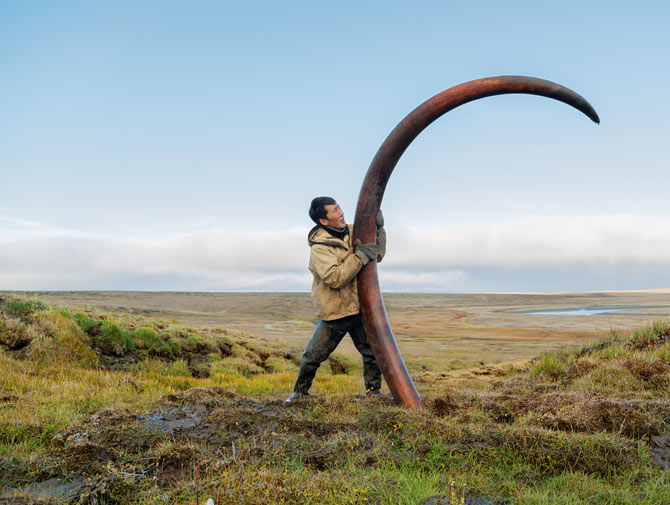
The shaggy giants that roamed northern Siberia during the late Pleistocene epoch died off about 10,000 years ago, though isolated populations lingered on islands to the north and east, the last dying out some 3,700 years ago. The mammoths’ tusks, which could spiral to more than 13 feet, are reemerging from the permafrost—and fueling a trade that benefits the people of Arctic Siberia, including the native Yakuts, an Asiatic ethnic group that speaks a language of Turkic origin. …..

…. The specimen that emerges is as thick as a tree trunk—150 pounds—and in near-pristine condition. Before hauling the tusk away, Gorokhov tosses a silver earring into the hole he has dug, as an offering to the local spirits. If he gets the ancient relic safely home, it could fetch more than $60,000.

Stunning photographs by Evgenia Arbugaeva in National Geographic of mammoth tusks recovered in Arctic Siberia.

Photograph by Evgenia Arbugaeva (via National Geographic)

Photograph by Evgenia Arbugaeva (via National Geographic)

http://www.evgeniaarbugaeva.com/

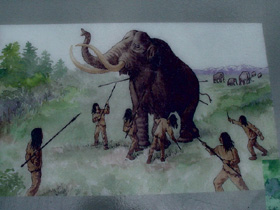
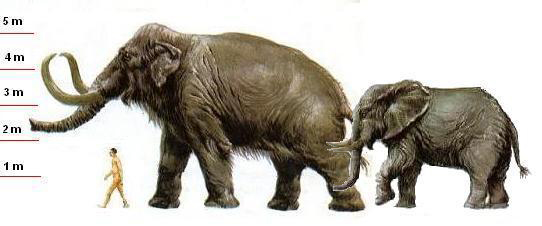
It is not always easy to imagine quite how big the mammoths were and what would have been involved in hunting them 4,000 years ago. That humans did actually manage to successfully hunt these massive beasts cannot be put down to their stature or their weapons or their prowess with spears and can only have been a result of co-operation and strategy.

mammoth hunting

Size comparison animalpicturesarchive.com