Archive for the ‘Education’ Category

From perverting schools to perverting children to being perverted ISIS murderers

August 27, 2014

Why so much perversion among Bristish Muslim youth?

It could just be my perception, but on the basis of recent news reports one would be justified in concluding that Muslim youth in Britain – in particular – are a perverted lot. And protected and shielded by others of their communities. From the stealth hijacking of Birmingham schools  in an effort to create bigoted madrassas by the back door, or the obscene perversions of their Rotherham brethren, to the apparently retarded youth joining ISIS and exulting in murderous  jihadi cool.

The centre of any religion or movement is defined by the extremes that the centre allows. Clearly the extremes of perversion being exhibited among their youth are not sufficiently opposed by main-stream “moderate” Muslims in Britain. The extremes are defining Islam in the UK. The travails of immigrant youth are not restricted to just the Muslim community in the UK. Other immigrant groups have the same difficulties of language and alienation and unemployment to contend with, but the Muslim youth of the UK seem to be grossly over-represented in the perversion stakes.

It cannot just be poor academic achievements at school except that that may be an indicator of something else. Possibly they mirror something in the environment in which they are brought up and the attitudes of their parents.  But political correctness and the fear of being seen as racist by the authorities has probably led to the “appeasement” policies that have been followed. Turning a blind eye to barbaric practices because they are “religious” is a poor excuse. As in this University of Warwick paper from 2010 where the problem statement is fine,

Including the religious viewpoints and experiences of Muslim students in an environment that is both plural and secular

…….Another reason for the persistence of the Muslim education question is a concern that has greater priority for education professionals than observance of religious practices, the serious underachievement of children and young people of Pakistani, Bangladeshi heritage, and, more recently, of Somali and Turkish heritage groups. In 2004 the Office for National Statistics reported that 33% of British Muslims of working age had no qualifications, the highest proportion of any religious group in the country. They also had the highest rates of unemployment and poorest health.

but where the proposed solution seems to shirk the issue of values and panders instead to “religious” viewpoints

…… I shall argue for a form of inclusion that moves beyond making Muslim pupils feel affirmed or comfortable and allows them to contribute their religious perspectives to their own and others’ learning. A directness of communication is needed that is not found in the identity-based approaches where the language used about religion is secondary and indirect. Identity-based approaches justify the accommodation of aspects of Muslim pupils’ religion in school in terms of the self-esteem and self-confidence of the believer, rather than of any intrinsic value in that which they believe.

I suspect that it is not the schools alone that are the problem (the Chinese and the Indian immigrant children seem to do fine there) but that the home environment (not wealth or poverty but attitudes) which is the major factor which distinguishes the under-achievers.

No doubt this article in The Spectator is “politically incorrect” and a little over the top but it is not wrong.

The Spectator

Under the Conservative and then Labour governments, radical preachers toured Britain trying to rally and isolate Muslim youth. They said that to be a Muslim you had to sympathise with your Muslim ‘brothers’ anywhere in the world. What you should not do was to feel any of that gratitude or desire to assimilate which had existed in their parents’ generation.

Everywhere, this madness was allowed to spread. Religiously segregated areas were accepted, separate values were allowed to thrive and, eventually, even separate rules of law tolerated and encouraged. All the time, we pretended to ourselves that this was simply ‘diversity’. I remember one Muslim woman in particular, who I interviewed in Birmingham some years ago. Born and bred in the area, she had been horribly mistreated by her local sharia court. ‘All my life,’ she told me, ‘I have been told what my rights are as a Muslim woman. No one ever told me what my rights are as a British woman.’ …..

In 2007, one of Michael Howard’s creations, the Muslim Council of Britain (MCB) published a 72-page blueprint on how to Islamicise secular state schools. It called for schools to avoid teaching any art involving ‘three-dimensional imagery of humans’, and discourage any play ‘associated with celebrating aspects of other religions’. There was no particular complaint. One of the two authors of the MCB report, Tahir Alam, is now a central figure being investigated in the Trojan Horse plot.

Culture changes inevitably with immigration. It evolves and must be allowed to. But far too often the politically correct “multi-culturlaism” as practiced in Europe is more concerned about keeping cultures in isolated silos. It tries to preserve the past rather than to forge the culture of the future. A medieval barbarism should not be acceptable or allowed to overthrow existing values just because it has been labelled as being part of a “religious culture”.

Why are Indian-Americans sweeping the US spelling bee?

May 30, 2014

I have watched the US spelling bee competition on TV a few times when visiting the US. For excitement and entertainment I would place it below the Olympics, the World Cup and a good cricket test match but above a 20/20 junket or the Eurovision song contest (which in recent times has just become ridiculous).

But there is something remarkable that is showing up. This year 6 out of the 12 championship finalists, and the top four, were of Indian origin.

The HinduIndian-Americans Sriram Hathwar of New York and Ansun Sujoe of Texas shared the title after a riveting final-round duel in which they nearly exhausted the 25 designated championship words. ………. The past eight winners and 13 of the past 17 have been of Indian descent, a run that began in 1999 after Nupur Lala’s victory, which was later featured in the documentary “Spellbound.”

American Bazaar:

…… although it’s an American competition open to students from all over the country, students of Indian origin have dominated the competition by a significant margin over the last several years. In fact, in both 2012 and 2013, all the top three contestants were of Indian origin.

From 2008-2013, the winner of the Scripps National Spelling Bee has been Indian American: Sameer Mishra, Kavya Shivashankar, Anamika Veeramani, Sukanya Roy, Snigdha Nandipati, and Arvind Mahankali. Since 1999, only five winners have not been of Indian descent, meaning 67% of winners over the last 15 years have been Indian.

Is the ability to spell then learned or is it genetic or both? From the manner in which Indian-Americans have swept this competition in the last few years, there is clearly some genetic component.

Spelling ability is not a measure of intelligence. But intelligence is a necessary – but not a sufficient – ingredient.  Excellent spelling ability as exhibited in the spelling bee competitions would seem to also need memory, drive, focus, education, supportive families and peers in addition. They also practice a very great deal.  A recent winner trained for 4 hours a day and a few thousand hours in total and committed some 100,000 words to memory. Spelling ability and reading skills are known to be linked but it is not too clear as to which depends upon which. Good spellers have been found in some surveys to be more organised than the “average”.

The Age: Kids who are good readers are often great spellers too, and now Australian scientists have uncovered a genetic explanation as to why. Researchers from Sydney, Melbourne and Brisbane tracked 650 sets of young twins to work out how much reading and spelling abilities are controlled by genes. 

The study found that the ability to read and spell were about 50 per cent inherited, with a child’s upbringing and schooling controlling the other half. But what was most remarkable, says University of Melbourne researcher Anne Castles, was the discovery that the same genes were involved in both activities. …… 

…… The scientists also evaluated the two main skills involved in reading – the ability to sound out words aloud and the ability to recognise words by sight that don’t follow the phonic rules, like “yacht”.

They discovered that these specific skills involved two distinctly different sets of genes, which explains why kids are often competent at doing one but not the other.

Poor spellers may be subject to a neurological deficiency. Lesions in the right brain which impaired some visual activity are known to have also causes spelling difficulties – a “spelling dyslexia”. It is also thought that personality traits have some connection to the ability to spell. It is thought that spelling ability is associated with a deep interest in language, its roots, in words and how they sound. Many good spellers make and use mental, visual representations of words.

There may not be a specific spelling gene, but genetics surely have a part to play.

Learn that word:

Why is a population that makes up roughly 1% of the US population so heavily represented at the event? 

1 –  The American school system and culture has a conflicted relationship with memory-based learning. Indian culture values academic achievement highly and values memorization as well, as a building block of higher-level knowledge. This, by the way, is also the reason why Indian Americans are not only dominating the Spelling Bee, but also produce much more than their statistical share of doctors, engineers and executives. 

2 –  Indian Americans/South Asians maintain tightly knit family and social communities, and place a paramount value within their community on academic performance. Social expectations around academic performance tend to be much higher than in other demographic groups. Academic success therefor has a big social pay-off.

3 –  Last but not least, the success at Spelling Bees is fostered by various initiatives that exclusively support Indian American/South Asian students. NorthSouth Foundation and the South Asian Spelling Bee are both set up to support the Indian American/South Asian community of aspiring champions. 

It’s great to win the first prize at the Scripps National Spelling Bee by competing with 10 million students for over $40,000 in prizes. There is certainly more incentive to dedicate the thousands of hours of intense study needed knowing that you can also apply these skills at the South Asian Spelling Bee, where you compete with just a few thousand other kids for a $10,000 first prize. 

Give all your students an A+ and lose your job

February 4, 2014
Denis Rancourt

Denis Rancourt

Denis Rancourt is a recognised researcher and he may even be an excellent physics teacher for all I know. But he either suffers from wanting to be a “martyr” for the cause of “no competition in education” or is just plain lazy and couldn’t be bothered to go to the trouble of grading his students.

I am inclined to believe it is the latter together with a desire for the limelight.

Ottawa citizen:

Denis Rancourt has lost his bid to reclaim his job as a professor at the University of Ottawa. ….  arbitrator Claude Foisy concluded he had no reason to intervene in the university’s 2009 decision to fire Rancourt, then a tenured physics professor, for defying its orders to grade his students objectively.

The university dismissed Rancourt after he awarded A+ marks to all 23 students who completed an advanced physics course he taught in the winter of 2008. The university had earlier issued him a letter of reprimand for awarding A+ marks to virtually everyone in a first-year physics course he gave in 2007. As well, Rancourt’s dean, the late André Lalonde, gave him “clear and unequivocal direction” in March 2008 that he must not grant every student in his courses a grade of A+ based only on their attendance at class.

Rancourt, ……  testified that he’d come to believe that traditional methods of teaching and evaluating physics students were ineffective. Learning physics, he said, must be anchored in self-motivation. Key to his “student-centred” pedagogical method, he testified, was allowing students to learn free of the stress produced by the traditional method of grading and ranking.

…… Foisy noted that the university had opposed Rancourt’s evaluation method “every step of the way.” Lalonde testified that it would undermine the university’s reputation, causing it to be seen as a “Mickey Mouse university,” and was prejudicial to students graded in the traditional manner.

Foisy agreed, even accepting Lalonde’s characterization of Rancourt’s failure to objectively evaluate his students as “a form of academic fraud. This, in my opinion, is a very serious breach of his obligations as a university professor.”

Even though Rancourt was “well aware” of the university’s opposition to his method of evaluation, “he continued to defy the administration,” Foisy said. “Is the dismissal the appropriate remedy in the circumstances? The short answer is yes.”

The arbitrator rejected arguments that Rancourt’s teaching methods were protected by academic freedom, freedom of expression and his tenure status.

“Academic freedom is not so wide as to shield a professor from actions or behaviour that cannot be construed as a reasonable exercise of his responsibilities,” he said.

Foisy did uphold one of Rancourt’s grievances, ordering the university to remove any mention of a disciplinary letter dated Nov. 20, 2007, from Rancourt’s record. The letter blamed Rancourt for not having taught the content of an approved course.

But he rejected Rancourt’s demands for a written apology, monetary reparations and help in partially recovering lost time and career advancement.

joanne st lewis

joanne st lewis

Rancourt is not a stranger to controversy.  He claims that he was fired for political reasons rather than for his teaching methods, but that does not seem to have cut much ice with the arbitrator. His own blog is here and there does seem to be a touch of paranoia. In fact reading his blog suggests he is more interested in publicity through controversy than actually in teaching. He is also being sued for libel by Joanne St. Lewis a Law Professor at the University of Ottawa, after Rancourt referred to her as university president Allan Rock’s “House Negro” on his blog.

From my own experience – though not in a classroom – it was always very difficult to get my managers to objectively grade the performance of their subordinates. Poor performance ratings in a department reflected also on the manager’s own competence. And in my experience it was the goodness of the manager which determined whether he got the balance right in the application of stress to improve the performance of his subordinates or if he went over the top and caused a burn-out. But I have no doubt that performance ratings – done right – improved performance in the work place.

And I am quite sure that much of the poor performance of students reflects on the teacher’s ability to teach. An element of competition and stress is – in my experience – necessary for learning.

Which leaves me without much sympathy for Denis Rancourt.

Swedish University reprimanded for poor quality but refuses to return foreign student’s fees

November 6, 2013

In some respects the attitudes taken by Swedish Institutions today is reminiscent of the high-handed attitudes taken by old-fashioned, communist, East Block countries. Very high levels of individual freedom are coupled to a very high level of protection for institutions (and their employees) which can lead to peculiar situations at the interface.

Standards are – usually – very high but public institutions in Sweden – hospitals, schools, colleges, universities, local or national government organisations – rarely take responsibility for poor quality or negligence. The extent of accountability is normally restricted to correcting a problem once it has been identified. An individual who has suffered from the negligence – and even gross negligence  – has little recourse in law and generally gets little compensation. Damages for institutional wrongdoing are either at ridiculously low levels or completely absent. Institutional employees are highly protected and very rarely held accountable or sanctioned for their negligence or lack of quality. Blame – if wrong-doing can be proven –  is allocated to the institution as a whole which of course leads to no-one being accountable.

It is almost impossible for a lone individual to sue an institution or claim damages or get any equitable compensation for any damage suffered.

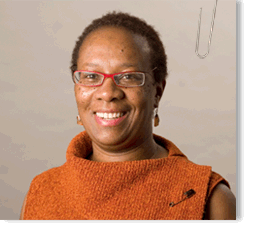
In this case it was Mälardalen University College which did not provide the promised education to a foreign student from the US. She paid a great deal of money for a 2-year course in Mathematics and Mathematical Statistics but received education which even the Swedish Higher Education Authority agreed was lacking in quality. But of course, the institution does not believe that it had any kind of contract with the student to provide any particular level of quality and feels no obligation to repay her tuition fees.

Sourced and freely translated from Sveriges Radio and Svenska Dagbladet:

Not enough chairs, not enough computers and a lecturer who could not speak Swedish or English properly. That’s what the US student paid nearly 200,000 kronor for (about $26,000). But Mälardalen University does not intend to return her money.

“I thought it would be interesting to study abroad. The program looked promising”, said Connie Dickinson .

A suitable program and being cheaper than in the United States convinced Connie Dickinson to chose to study mathematics and mathematical statistics at Mälardalen University in Sweden , where she has relatives . But it was nothing like she had imagined. “The lecturer did not spend  much time with us in the classroom. We had to share computers. There weren’t enough chairs and some students had to sit on the floor. The teacher handed out papers  and walked away and she couldn’t speak either English or Swedish. I was really surprised at the low standard”

Connie complained to the college about the problems, and even informed the Swedish Higher Education Authority UKÄ, about the shortfall in the education. UKÄ agreed that the the education lacked quality and has given the University one year to fix the problems or to discontinue the course.

But that is insufficient for  Mälardalen University to repay Connie her 183 000 SEK.

But whether it is discontinued or not, Connie attended a training course for two years that does not measure up  either for her or the Swedish Higher Education Authority.

Bjorn Magnusson , CFO at the college , claimed that it is not possible to give money back just because of a complaint about the lack of quality . “You can’t get back the tuition fee because of a complaint about the lack of quality. You pay the fee to participate in regular training. it’s not like a contract between us and an individual”. Besides dissatisfaction is subjective he says.

A broad education is vital

October 15, 2013

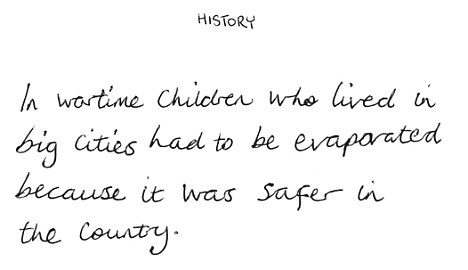
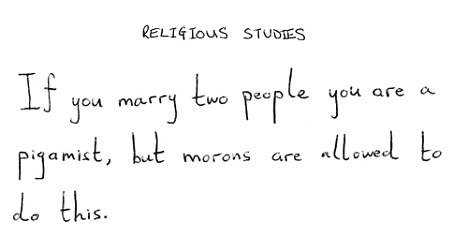
I got this in an email  and I wish I knew the original source.

I do like crushed asians – preferably grilled.

(h/t Nessan)

broed education 1

broad education 2

broad education 3

broad education 4

broad education 5

broad education 6

broad education 7

broad education 8

broad education 9

broad education 10

broad education 11

broad education 12

broad education 13

broad education 14

broad education 15

broad education 16

broad education 17

broad education 18

Europe increasingly adopting English for higher education

October 11, 2013

Competition for international students is leading to Universities in continental Europe increasingly offering higher education courses in English. There has been a ten-fold increase in the number of English courses offered since 2002.

Times Higher Education reports:

Thousands of international students may be shunning the UK in favour of continental Europe, where a growing number of courses are being offered in English, a study suggests.

A total of 6,407 taught master’s programmes in the language were offered on the Continent in June this year – a 38 per cent rise on the 4,644 courses available just 18 months earlier, according to a report by the New York-based not-for-profit organisation the Institute of International Education.

That total was 10 times higher than the overall number offered in 2002, says the report, titled English-Taught Master’s Programs in Europe: A 2013 Update.

The new briefing paper published by IIE’s Center for Academic Mobility Research suggests that the number of English-taught Master’s Programs in Europe has increased significantly since 2011. The paper, English-Taught Master’s Programs in Europe: A 2013 Update”, is an update of a report published by IIE in June 2011, and provides a data-driven look at the continued growth of master’s programs in Europe taught entirely or partially in English.

Growth of English courses in Europe

Growth of English courses in Europe

In recent years, European countries in which English is not the primary language of instruction have developed an increasing number of programs taught either fully or partly in English in order to serve domestic demand for higher education in English and to attract students from around the world. …..  The authors examine the growth of English-taught master’s programs in Europe, including the total number of programs offered by country and academic discipline, their duration, and data on prospective students.

According to the report, as of June 2013 the total number of English-taught programs in Europe was 6,609, a 42 percent increase since 2011. The top host countries for English-taught Master’s programs are: Netherlands, Germany, Sweden, France, and Spain.

Growth of English courses by country and year

Growth of English courses by country and year

Israel Education Ministry bans sex education material in text books

September 3, 2013

One has to conclude that everything is circular. If you go far enough to the Right you approach the Extreme Left. If you go to the extremes of one religion you approach the extremists of another.

Ultra-orthodox Imams and Rabbis, invariably male, seem to share a similar view of women and sex and sex education.

The Orthodox religious right in Israel has just got its way in its effort to return to good old-fashioned prudery.

Haaretz reports that “Chapters on human reproduction don’t accord with state religious school system’s educational doctrine for junior high schools, says Education Ministry”.

The Education Ministry has asked textbook publishers to eliminate chapters on human reproduction, pregnancy prevention and sexually transmitted diseases from science textbooks used in state religious junior high schools as well as from their teacher manuals.

The Guardian writes:

State education in Israel is divided into religious and secular sectors for Jewish children, with separate schools for Arab children. Many ultra-Orthodox Jews send their children to segregated private schools, with strict controls on curricula, behaviour and dress. Around a quarter of Israeli children attend ultra-Orthodox schools, according to 2010 data – a figure that is steadily rising.

Anat Hoffman, executive director of the Israeli Religious Action Centre, which advocates progressive Judaism, described the education ministry’s move as a “slippery slope. When we start filtering science for modesty reasons, that in the end will hinder our ability to teach science to Israeli children,” she said. …. The move should be seen in the context of the growing influence of rightwing rabbis in Israel. “Modesty considerations are being used as a political tool to keep women ‘in their place’,” she said.

Some elements of the ultra-Orthodox community in Israel have campaigned in recent years to remove images of women from advertising hoardings, and impose gender segregation on buses and in other public spheres.

The education ministry said the changes did not cover pictures of women. “The image of women has a place and expression in school textbooks,” it said.

But what the ultra-Orthodox want in Israel is not so very different from what Hamas wants in Gaza.

Israel National News reported in June this year:

A new law passed by the Hamas government in Gaza banning co-ed schools has left many Christians fearful that their schools are in danger of closure, according to the Beirut-based Al-Akhbar daily.

The new law, which mandates gender segregation in all schools, also bans men from teaching at girls’ schools. The law will likely force Christian educational institutions to close their doors to Muslim and Christian students alike, reported the newspaper.

Mutassim Minawi, director of public relations at Gaza’s education ministry, …… argued that “the Gaza Strip’s culture is conservative and does not favor gender mixing. The majority of Palestinians in Gaza praised the law and only leftist parties criticized it.”

Several months ago, Gaza’s Hamas terrorist rulers took another step towards the implementation of strict Islamic sharia law in the region by introducing a strict dress code for female students at the Al-Aqsa University. A letter distributed to students in November stated that all students should wear “modest clothing” on campus.

Since violently taking over Gaza in 2007, Hamas has enforced a stringent interpretation of Islamic law in Gaza. The terror group has banned women and teenagers from smoking hookahs in public, ordered that women’s clothing stores are not allowed to have dressing rooms, men cannot have hairdressing salons for women and that mannequins shaped like women must be dressed in modest clothing.

No cheating!

August 28, 2013

Found at Coconuts Bangkok (via 22 words)

Designed by the students at Kasetsart University, Bangkok. Now discontinued.

Anti-cheating Hats

No cheating hats at Kasetsart University, Bangkok

Bangkok’s Kasetsart University announced today that it has decided to end the use of its anti-cheating helmets.

A photo of the horse blinder-like device was first posted on Coconuts Bangkok yesterday. Shortly thereafter the post went viral as thousands of netizens commented and shared the photo.

The university said that its agro-industry faculty students had designed the headgear as part of an ethics lesson. Natdanai Rungruangkitkrai, the course lecturer, said he seriously regretted that the issue had received such a strong negative response. He added that he had intended to teach the students about ethics and as part of the lesson he had asked them to think creatively about how to prevent cheating.

The students proposed different sets of exam papers and boxes, but they finally agreed to use A-4 paper blinders. The students said they had seen similar headsets in other countries. About 90 students agreed to the use of the blinkers and to make the hats themselves on the exam day. Asst Prof Tanaboon Sajjaanantakul, the faculty’s dean, said the device was used for a mid-term examination for a textile testing course.


What’s in an “e”? Berkley vs. Berkeley

August 12, 2013

From Copy, Shake and Paste

Everyone knows that Berkley is an excellent university in the United States. Or was that Berkeley? Whatever, if someone is sporting a degree that looks impressive, it must be from that place. 

Except when it is not.

It has come to light, as the Swiss daily paper Tages-Anzeiger noted on 9 August 2013, that the IT-boss at the University Hospital in Zürich has stepped down because of a missing ‘e’. The University of California, Berkeley, is indeed one of the top universities in the US. But it did not grant a doctoral degree to Jürgen Müller. Müller had been working on his doctorate at the University of Passau in Germany when his financing ran out.

Müller then heard about the University of Berkley, and for only $ 3000 in fees he was soon the proud owner of a sheepskin declaring him to be a “Doctor of Science”, according to the Tages-Anzeiger

…… 

…. The Tages-Anzeiger article ends with an interesting note. It seems that in March of 2013 a whistleblower tried to contact Müller’s boss about his purchased degree. Müller, as IT boss, apparently had this person on a blacklist, so that emails from him did not bounce, but were just silently destroyed. 

I suppose the University Hospital in Zürich is glad that he has resigned. The question is, where will he pop up again where people don’t know the difference one letter can make?

The University of Berkley’s rates for purchasing degrees are below. It’s best to buy your Master’s and Doctor’s degrees together and in advance!!

Buying your Berkley degree

Buying your Berkley degree

The University of Berkley is a diploma mill and the subject of many scam reports and warnings such as this one:

University of Berkley Distance Learning Accreditation Report

CAUTION: You should be aware… this college is NOT ACCREDITED by any agency recognized by the Council on Higher Education Accreditation or the US Department of Education to award degrees.
Distance learning accreditation claims include:

  • New Accrediting Partnership for Educators Worldwide (NAPEW)

You should be aware that this agency is NOT RECOGNIZED by the Council on Higher Education or the US Department of Education as a college accreditation institution. What does this mean? For you, as a consumer, this means credentials earned at this college might not meet with wide acceptance at other CHEA-accredited online colleges and might not meet with academic or employment acceptance across the USA. You should be aware that in some states and for some professions it may be illegal to use a degree from an non accredited school for employment purposes.

CAUTION: the following State Warnings apply to this online college

  • Michigan State Warning: CAUTION! The State of Michigan classifies this online college as an UNACCEPTABLE INSTITUTION for credentialing for those seeking jobs in the State’s Department of Civil Service: (Consult Michigan’s NON ACCREDITED COLLEGES/UNIVERSITIES – “Degrees from these institutions will not be accepted by the Department of Civil Service as satisfying any educational requirements indicated on job specifications”:  http://www.michigan.gov/documents/Non-accreditedSchools_78090_7.pdf)
  • Texas State Warning: CAUTION! The State of Texas classifies this online college as an ILLEGAL SUPPLIER of educational credentials in the State of Texas (Consult: Texas Higher Education Coordinating Board Institutions Whose Degrees are Illegal to Use in Texas:  http://www.thecb.state.tx.us/AAR/PrivateInstitutions/NoTX.cfm)

Mathematical genius?

June 4, 2013

Retraction Watch reports on the retraction of a paper by a Turkish mathematician for plagiarism. The author did not agree with the retraction.

But what struck me was the track record of this amazing Assistant Professor at Ege University.

Ahmet Yildirim Assistant Professor, Ege University, Turkey

Editorial Board Member of International Journal of Theoretical and Mathematical Physics

  • 2009       Ph.D      Applied Mathematics, Ege University (Turkey)
  • 2005       M.Sc      Applied Mathematics, Ege University (Turkey)
  • 2002       B.Sc        Mathematics, Ege University (Turkey)

Since 2007 he has a list of 279 publications!

That’s an impressive rate of about 50 publications per year. Prolific would be an understatement.

All peer reviewed no doubt.