Archive for the ‘Education’ Category
May 22, 2013
I was reading about the new grammar and spelling tests for 11-year-olds in England. I was a little surprised though at the apparent incoherence of politicians, teachers, teachers unions and even academics about the tests, why they were necessary and what they might help achieve. For the unions, of course, testing of any kind smacks of elitism and becomes an ideological issue. Even among the language professionals there seemed to be a fundamental lack of understanding of the importance – or otherwise – of grammar and punctuation and spelling. Ideology on the one hand versus muddled “keepers of the language” on the other.
Grammar and vocabulary are dynamic – in any living language. “Correct” grammar is a consensual thing – it is subservient to what is considered “acceptable”. What is acceptable grammar is subject to change; with time and subsequent to usage. There is no such thing as an absolute “correctness” of language. Whatever is acceptable is “correct”. No rule of grammar survives if it is continuously violated. Words are continuously absorbed into a language (from science or from other languages or from changes of behaviour or of technology). Words are invented and sometimes reach a critical mass of users and survive while other invented words disappear into oblivion. Some change their meanings over time by changed usage and some die through disuse. In fact it is the fact that a language is changing which defines that it is alive.
It is only for a “dead” language – no longer subject to change by usage – where the vocabulary and grammar are fixed and sterile.
Every language seems to have its share of “keepers of the language” who try and define “correct” grammar and dictionaries of “acceptable words”, their spelling and their meaning. Grammarians and lexicologists tend to overlook the fact that they are – for a living language always – and of necessity – behind the times. They have to be. Some finite time is always needed for the compilation of their “Grammars” and their “Dictionaries” and – for a living language – the language will have moved on. What they actually achieve is a snapshot at a particular moment time of a living and moving thing. And by the time the snapshot is available, it is already out of date.
But I do believe grammarians and lexicologists are of great value even if language itself is only a tool for communication (no doubt the primary tool for humans – but a tool nevertheless and not an end in itself). But their value lies not (as they might think) in being arbiters of what is “correct” or “incorrect” but in establishing a reference point which then allows for the proper communication of meaning by language.
The purpose of vocabulary and grammar is clarity of what is expressed by language. And this clarity depends upon the commonality of meanings ascribed to words and the rules – the grammar and punctuation – by which they are strung together. They become important only because an unknown recipient of the language may well have to assume the meaning of the words and their structure. But they are certainly not relevant for the judging of any intrinsic “rightness” or “wrongness”.
To take liberties with grammar and with vocabulary from some established norm is always available to a user of language. But he does need to know what the norm is to be able to take such liberties in the pursuit of an improved communication. The testing then – in my view – becomes simply a tool to ensure that 11-year-olds know what the current established norms are.
Tags:England, Grammar, Linguistics, Punctuation, Spelling
Posted in Education, Language | 1 Comment »
May 2, 2013
The Daily Mail runs an article today about why the middle class are not breeding any more. It is not difficult to get a faint whiff of eugenics. But I can’t help feeling that some level of eugenics is not necessarily all bad as we move from natural selection to a world where artificial selection (IVF, surrogacy, sperm banks etc.) is increasing. And of course, even the availability of abortion on demand is in itself a form of selection.
- Educated women deferring motherhood for so long they’re no longer fertile
- Bearing children ‘has largely become the province of the lower classes’
- TV historian Dr Lucy Worsley is poster girl for intentionally childless women
…. as author and demographic expert Jonathan Last observes in his controversial book What to Expect When No One’s Expecting:
‘The bearing and raising of children has largely become the province of the lower classes. It’s a kind of reverse Darwinism where the traditional markers of success make one less likely to reproduce.’
If “lower class” were a genetic trait then the middle and higher classes should fear extinction in due course. Fortunately “class” is just relative and subjective so no matter what the demographics are, distinctions of class will be introduced into any population that exists. But what is more interesting to consider is the fact that women with a higher level of education (which says nothing about native intelligence) have fewer children. This seems to be a global phenomenon. Data from 2010 in the extract below.
The full table is here. Primary School Enrollment and Total Fertility Rates, Latest Year (2000-2010)
|
Primary School Enrollment and Total Fertility Rates for Selected Countries, Latest Year 2000 – 2010
|
|
| Rank |
Country |
Primary School Enrollment
|
Total Fertility Rate
|
|
|
Percent
|
Number of children
per woman
|
|
|
|
|
| 1 |
Japan |
100.0
|
1.3
|
| 2 |
Spain |
99.8
|
1.5
|
| 3 |
Iran |
99.7
|
1.8
|
| 4 |
Georgia |
99.6
|
1.6
|
| 5 |
United Kingdom |
99.6
|
1.9
|
| … |
|
|
|
| 181 |
Equitorial Guinea |
53.5
|
5.3
|
| 182 |
Guinea-Bissau |
52.1
|
5.7
|
| 183 |
Djibouti |
40.1
|
3.9
|
| 184 |
Sudan |
39.2
|
4.2
|
| 185 |
Eritrea |
35.7
|
4.6
|
|
| Note: Rankings are based on a list of 185 countries for which primary enrollment data are available. |
|
| Source: EPI from UNESCO |
Fertility rates tend to be highest in the world’s least developed countries. When mortality rates decline quickly but fertility rates fail to follow, countries can find it harder to reduce poverty. Poverty, in turn, increases the likelihood of having many children, trapping families and countries in a vicious cycle. Conversely, countries that quickly slow population growth can receive a “demographic bonus”: the economic and social rewards that come from a smaller number of young dependents relative to the number of working adults.
For longer term population stability the goal is to reach replacement-level fertility, which is close to 2 children per woman in places where mortality rates are low. Industrial countries as a group have moved below this level. Some developing countries have made progress in reducing fertility, but fertility rates in the least developed countries as a group remain above 4 children per woman.
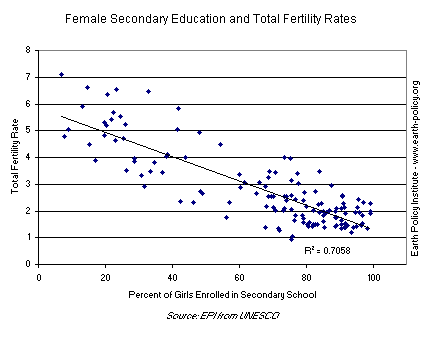
The trends with secondary education are also very clear:
Of course the level of development in a country dominates and fertility rates around the world are reducing and converging. Whether this trend will continue even when all female children enjoy secondary education remains to be seen. The UK case where nearly all children do get secondary education would suggest that those with higher (university) education continue to show a declining fertility. But the real test of this hypothesis will only come when education levels around the world have equalised and fertility rates all lie around the same level.
So is the human population “dumbing down”? Not really. Education level is not intelligence. To what extent intelligence is a hereditary trait is uncertain. While it would seem that evolution should favour increasing intelligence, even this is not crystal clear. It is certainly a perception I have that “successful” people tend to be more intelligent but high intelligence does not ensure success. And success in life correlates with wealth but not so well with number of offspring. “Success”, however we define it, is not a genetic trait. There have been some suggestions that there may be some optimum level of intelligence for the genetic success of the species and that hunter-gatherers were actually somewhat more intelligent than we are now. Perhaps humans can be “too clever by half”!
But for some time to come, as the developing world catches up with the developed world, we can surely conclude that less-educated parents will have the higher fertility. Whatever that may mean for the long term evolution of humans, and that will be the result of the level to which we intentionally apply genetic selection.
Related: “Selection” lies in the begetting and evolution is just a result
Tags:Education and fertility, Evolution, Intelligence, Total fertility rate
Posted in Demographics, Education, Evolution | Comments Off on “Bearing children has largely become the province of the lower classes”
March 18, 2013
A new paper suggests that math and reading differences between the genders persist regardless of a country’s “gender equality” level. Though I am not sure why there should be so much surprise about such a finding. That the genders are fundamentally different – I would have thought – was self-evident. That some of the biological differences between the sexes must lie in the brain also seems obvious. It has always confused me as to why legislation – which should be for ensuring the equality of opportunity between the genders – often tries to suppress or deny gender differences in futile attempts to try and make the genders “equal”. We will – I think – only achieve a real equality of opportunity when we truly understand and acknowledge all the inherent differences between the sexes. Legislation can surely help to address behaviour but it cannot do away with the inherent differences. As Prof. Geary states “Educational systems could be improved by acknowledging that, in general, boys and girls are different.” And I would add that equality of opportunity between the genders has to start by acknowledging that men and women are different. It could well be that “Swedish boys fall behind in reading more so than in most other highly developed nations” just because Sweden spends so much effort to create gender equality by suppressing gender difference.
Stoet G, Geary DC (2013) Sex Differences in Mathematics and Reading Achievement Are Inversely Related: Within- and Across-Nation Assessment of 10 Years of PISA Data. PLoS ONE 8(3): e57988. doi:10.1371/journal.pone.0057988
The University of Missouri has a press release:
… even in countries with high gender equality, sex differences in math and reading scores persisted in the 75 nations examined by a University of Missouri and University of Leeds study. Girls consistently scored higher in reading, while boys got higher scores in math, but these gaps are linked and vary with overall social and economic conditions of the nation.
“Educational systems could be improved by acknowledging that, in general, boys and girls are different,” said David Geary, MU professor of psychological science. “For example, in trying to close the sex gap in math scores, the reading gap was left behind. Now, our study has found that the difference between girls’ and boys’ reading scores was three times larger than the sex difference in math scores. Girls’ higher scores in reading could lead to advantages in admissions to certain university programs, such as marketing, journalism or literature, and subsequently careers in those fields. Boys lower reading scores could correlate to problems in any career, since reading is essential in most jobs.”
Generally, when conditions are good, the math gap increases and the reading gap decreases and when conditions are bad the math gap decreases and the reading gap increases. This pattern remained consistent within nations as well as among them, according to the study by Geary and Gijsbert Stoet of the University of Leeds that included testing performance data from 1.5 million 15-year-olds in 75 nations. The top five percent of scores within nations generally showed girls to be lower in math and boys to be lower in reading. That pattern continued in lower scoring groups until reaching the lowest scoring students, where the math achievement of boys and girls evened out but the reading gap increased, according to Geary.
“The consistent pattern within nations suggests the sex differences are not simply related to socio-economic factors,” said Geary. Socio-economic and cultural factors are important in that they influence the performance of all students, but boys, as a group, respond more strongly than girls, perhaps due to a biological difference in sensitivity to wider conditions.” For example, in nations with impoverished or violent conditions, boys’ scores tended to fall faster and further than girls. On the other hand, in wealthier, socially stable nations boys’ scores benefitted more than girls. This resulted in boys reducing the reading gap and widening the math gap.
“This finding has important implications for how we interpret the math gap of other countries,” said co-author Gijsbert Stoet of the University of Leeds. “For example, policy makers often take Sweden as an example of being particularly good for reducing the gender gap in science, technology, engineering and math, but they do not realize that Swedish boys fall behind in reading more so than in most other highly developed nations. This is a good example of the inverse relation between the math and reading gaps. This phenomenon urgently needs more attention.” ……
Tags:David Geary, Gender differences, Gender equality, Mathematics, reading, Sweden, University of Missouri
Posted in Behaviour, Biology, Education, psychology | Comments Off on Math and Reading gender differences are not affected by level of gender equality
March 7, 2013
Professor Debora Weber-Wulff addresses some of the dark and mysterious ways of Turkish academia on her blog. Academic misconduct is apparently wide-spread, largely ignored and is condoned making for a culture with very dubious ethics which has become self-perpetuating . It does not paint a very pretty picture but it is noteworthy that the picture is coming to light only because of the work of a group of other academics. But to break out of the vicious circle will not be so easy.
I published a short note in September 2012 about the work of a group of academics in Turkey. A. Murat Eren has now organized a translation of their work into English so that a wider group of scientists can take a peek into the very dark alleys of Turkish academia. …..
….. And then there is the list of academics in Turkey with the most retractions to their name — and their current occupation. Let me quote these here, because it is so shocking:
- Mustafa Saltı, whose 40 papers have been retracted, was a doctoral student then. Today he is a research assistant in Dicle University Physics Department.
- Dr. Oktay Aydoğdu, whose 29 papers have been retracted, was a doctoral student then. As of now, he is a reserch assistant in Mersin University Physics Department.
- Dr. Sezgin Aygün, whose 15 papers have been retracted, was another doctoral student at that time. Now he works as an assistant professor in Çanakkale Onsekiz Mart University Physics Department.
- Murat Korunur, another doctoral student whose 14 papers have been retracted, currently works as a research asistant in Dicle University Physics Department .
- Dr. Ali Havare was an assistant professor when his 13 papers have been retracted. He is currently an associate professor in Mersin University Physics Department (he also served as a thesis supervisor for Mustafa Saltı, Dr. Oktay Aydoğdu and Taylan Yetkin, all actors in this same plagiarism scandal.)
- Dr. İsmail Tarhan was an associate professor when his 13 papers were retracted. He is currently a full professor at Çanakkale Onsekiz Mart University Physics Department. In 2011 he was serving as director of Science & Engineering Graduate School at ÇOMU, and as rector’s consultant.
- Melis Aygün (now Melis Ulu) was a doctoral student when her 10 papers were retracted. She is now a research assistant at Çanakkale Onsekiz Mart University Physics Department.
- Dr. Hüsnü Baysal, whose 7 papers were retracted, was an associate professor then. He is currently a full professor at Çanakkale Onsekiz Mart University, Department of Secondary-level Science and Mathematics Teaching.
- Dr. İrfan Açıkgöz, whose 5 papers have been retracted, is still a professor at Dicle University Physics Department (he also supervised the thesis of Murat Korunur, who is mentioned above).
- Dr. İhsan Yılmaz, whose 4 papers have been retracted, is still a professor at Çanakkale Onsekiz Mart Unversity, Department of Space Sciences and Techonologies. In 2011, he was also serving as director of Revenues Office and as Vice Rector at ÇOMU.
- Dr. Figen Banbay, whose 3 papers are retracted, is still an assistant professor at Dicle University Physics Department.
- Dr. Nurettin Pirinççioğlu was a doctoral student when his 3 papers were retracted. He is currently an assistant professor at Dicle University Physics Department.
- Can Aktaş, then a doctoral student, had 1 paper retracted. Today he is an assistant professor at Çanakkale Onsekiz Mart University Mathematics Department.
- Taylan Yetkin was a lecturer at Mersin University Physics Department when his 3 papers were retraced. Today – as far as I can see – he is not affiliated with academia. In this list, he is the only one who is not in academia any more.
Only one of the authors with multiple retracted papers is not affiliated with academia. Anyone who knows how difficult it is to get a paper retracted will understand the depth of concern here. How can these people teach at university and mentor doctoral students when they themselves have multiple retractions to their names?
The same chapter also reports on the Sezen case, one that I blogged about in June 2012.
Eren’s conclusions:
- Turkey’s bad academia is self-perpetuating.
- People who have committed ethical violations in their dissertations and publications are allowed to become thesis supervisors. Students who are misguided by these create dissertations that equally violate ethics, publish insignificant or duplicated papers, and some of them become the new academic generation, in turn completing the cycle.
- One of the major problems that perpetuates this cycle is the difficulty of access to dissertations. University libraries limit access with arbitrary reasons, and improvements in YÖK Thesis Archive are far from solving the problem in practice.
- Even when a dissertation is accessed and plagiarism is seen, penalties are far from being deterrent, due to legal and executive roadblocks.
- While advanced societies take science theft very seriously, actors of science theft in Turkey silently go on with their duties, thus deleteriously undermining the credibility of the field.
- Even though today’s scientists in Turkey are not proactive, and they are mostly mute unless they have to defend themselves, I believe that self-criticism will become a way to reveal and eventually eradicate academical problems in Turkey in the future.
I am indebted to the Turkish scientists who have worked on this. I have corresponded with them and did some proofreading on the English version. I hope that this will shine a bright light down the dark alleys
Tags:Academia, academic misconduct, PhD theses, Plagiarism, Turkey
Posted in Academic misconduct, Education, Turkey | Comments Off on Dark and mysterious ways of Turkish academia
December 20, 2012
The issue is not measurement – for measurements made properly do not lie.
But the interpretation of what they measure and how they may be related to what we choose to call “intelligence” is controversial. The uncertainty is exacerbated by the varying definitions of what “intelligence” is. Where is the boundary between native intelligence and that dependent upon some measure of knowledge? Is there intelligence without memory or artificial intelligence without data storage? Is intelligence just processing power or is it processing with purpose? Does judgement matter? Or the speed of learning? Can there be wisdom without intelligence?
Nevertheless “well-constructed IQ tests are generally accepted as an accurate measure of intelligence by the scientific community”.
IQ scores are used as predictors of educational achievement, special needs, job performance and income. They are also used to study IQ distributions in populations and the correlations between IQ and other variables. The average IQ scores for many populations have been rising at an average rate of three points per decade since the early 20th century, a phenomenon called the Flynn effect. It is disputed whether these changes in scores reflect real changes in intellectual abilities.
Science Daily reports on a new paper : “After conducting the largest online intelligence study on record, a Western University-led research team has concluded that the notion of measuring one’s intelligence quotient or IQ by a singular, standardized test is highly misleading.”
Fractionating Human Intelligence by Adam Hampshire, Roger R. Highfield, Beth L. Parkin and Adrian M. Owen, http://dx.doi.org/10.1016/j.neuron.2012.06.022
(A pdf version of the paper is available here).
Summary
What makes one person more intellectually able than another? Can the entire distribution of human intelligence be accounted for by just one general factor? Is intelligence supported by a single neural system? Here, we provide a perspective on human intelligence that takes into account how general abilities or “factors” reflect the functional organization of the brain. By comparing factor models of individual differences in performance with factor models of brain functional organization, we demonstrate that different components of intelligence have their analogs in distinct brain networks. Using simulations based on neuroimaging data, we show that the higher-order factor “g” is accounted for by cognitive tasks corecruiting multiple networks. Finally, we confirm the independence of these components of intelligence by dissociating them using questionnaire variables. We propose that intelligence is an emergent property of anatomically distinct cognitive systems, each of which has its own capacity.
Highlights
- We propose that human intelligence is composed of multiple independent components
- Each behavioral component is associated with a distinct functional brain network
- The higher-order “g” factor is an artifact of tasks recruiting multiple networks
- The components of intelligence dissociate when correlated with demographic variables
While this paper adds weight to the view that the standard IQ test is much too simplistic, I tend to accept that IQ tests do measure some diffuse thing which is connected to whatever can be said to constitute intelligence. But in over 30 years of recruiting I have never found it particularly decisive as a selection criterion. While it has been sometimes helpful in screening a large number of applicants, I cannot recall a single instance where an IQ score has been the deciding factor for my making a selection.
Tags:Artificial intelligence, brain, G factor (psychometrics), Intelligence, Intelligence quotient, Standardized test
Posted in Education, Intelligence, Science | 1 Comment »
June 13, 2012
Open access is still evolving and the bottom-line is finding the revenue model that works. But open access is inevitable and the glory days of the high impact factor, pay-walled journals is coming to an end. They will not disappear any time soon but history will show that their era was the 20th century and that their decline was the natural consequence of the world-wide-web.
PeerJ provides academics with two Open Access publication venues: PeerJ (a peer-reviewed academic journal) and PeerJ PrePrints (a ‘pre-print server’). Both are focused on the Biological and Medical Sciences, and together they provide an integrated solution for your publishing needs. Submissions open late Summer.
Reuters reports:
(more…)
Tags:Academic publishing, open access, pay-walled journals, PeerJ, PeerJ Preprints
Posted in Education, Media, Science | Comments Off on PeerJ – Open access Journal gets started
November 4, 2011
The status conferred by academic titles in the Czech Republic is almost as strong as in Germany. Whereas in Germany it is the title of “Doctor” which is most sought after by politicians – as a stamp of public acknowledgement that one is a “deep thinker” – even a Masters degree in the Czech Republic can lead to the title “Pani magistra” or literally “Mrs Master’s degree holder.”
Petty politicians appending academic titles to enhance their electoral chances is not of course so uncommon. What is surprising for me is that Prague and its citizens, who I think are extremely sophisticated and discerning in matters academic and who have a strong sense of the long academic traditions of the city, would be taken in by such nonsense.
And the mass-production of fake doctorates by the law faculty of the University of West Bohemia (ZČU) in Plzeň led to over 300,000 degree awards being audited in 2009! This even led to a Wikileaks cable from the US Embassy in Prague ( Wikileaks id #233660) in November 2009 about the scandal and reporting:
A joke is making the rounds: “What are you doing this weekend?” Answer: “Getting a law degree.”
Czech position now reports that yet another politician is accused of plagiarism – this time for a Master’s thesis.
Prague district mayor ‘plagiarized’ his master’s thesis
… Two prominent academics who separately examined the master’s thesis of Prague 11 mayor Dalibor Mlejnský (Civic Democrats, ODS), due to suspicions of plagiarism, say the majority of the paper was indeed copied verbatim — and almost completely lacked citation. Mlejnský’s thesis titled “The History of Charles University” was lifted from two books (Jacques LeGoff’s “Intellectuals in the Middle Ages” and, more obviously, volumes of “The History of Charles University” by various scholars over the centuries, according to the two academics, who had been asked by the state broadcaster to make the expert assessments.
(more…)
Tags:Czech Republic, degree-mill, fake degrees, Jan Kalvoda, Milan Jančík, Plagiarism, Plzeň, Prague, University of West Bohemia
Posted in Academic misconduct, Corruption, Czech Republic, Education, Politics | Comments Off on Plagiarising politicians and weekend Doctorates in the Czech Republic
November 1, 2011
 David Held, who is currently Graham Wallas professor of political science at the LSE, has announced that he is leaving in January to take up a post at Durham University.
But he is leaving one step ahead of the reports on Saif al-Islam Gaddafi’s funding of research at the LSE. and one on charges of plagiarism in his PhD thesis.
 According to the Guardian, Held said in a statement “I will be taking up the positions of master of University College and chair of politics and international relations at the University of Durham from January. This move is being made for academic reasons and I look forward to the new avenues of research that this role will bring. I have many links to LSE which will be maintained in the years ahead.”
But Held who had very close links to
(more…)
Tags:David Held, Durham University, Graham Towl, Howard Davies, Libya, London School of Economics, Muammar al-Gaddafi, Saif Al-Islam Gaddafi
Posted in Academic misconduct, Business, Education, Libya, Politics | 1 Comment »
October 22, 2011
Once upon a time I was a post-doc at University College Cardiff which has a Royal Charter dating from 1883 and which was part of the University of Wales, Cardiff until 2004 when it became Cardiff University. I have fond memories of Cardiff since it was with Cardiff as a base that my colleagues ensured my education on the finer points of rugby and Welsh pubs and Dylan Thomas and rugby songs. So it was a matter of some regret for me to hear that the current University of Wales was to be abolished because of wrong-doings at one of its accredited colleges.
The University of Wales was a federal university founded in 1893 with accredited institutions throughout Wales, including the universities of Glyndŵr, Newport, Swansea Metropolitan and Trinity Saint David. It accredited courses in Britain and abroad, with over 100,000 students but following a visa fraud at one of its accredited colleges, Rayat London College, it no longer exists. At the time of its closure, the Chancellor of the University of Wales was HRH the Prince of Wales and the Pro-Chancellor was the Archbishop of Wales, Dr. Barry Morgan. Professor Marc Clement was President and the Vice-Chancellor was Professor Medwin Hughes.
It is not the first time that the techniques of academic cheating and fake degrees have been found to have been exported from India to colleges around the world.
THES:The Rayat London College which offered courses validated by the University of Wales has been linked to an alleged scam that helped foreign students to cheat their way to qualifications. The BBC found a lecturer from Rayat College London explaining to students how to cheat in exams and how to deceive the UK Border Agency. …. The scam would have allowed students to complete a 15-month course in under a week by cheating in exams. …. The college has suspended a lecturer, registrar and admissions officer, and said it dissociated itself from any wrongdoing and had referred the matter to the police.
(more…)
Tags:Rayat College London, Surya Medicherla, University of Wales, visa scam
Posted in Academic misconduct, Education, Fraud | Comments Off on Visa Scam at Rayat London College lays low the University of Wales
October 15, 2011
Professor Ramakrishna Ramaswamy was appointed the Vice Chancellor of the University of Hyderabad in India in June this year and he runs a blog – possibly the only University Vice Chancellor in India to do so.

Ramakrishna Ramaswamy, VC UoH
A central Central University
What is particularly unusual with Ramaswamy’s blog is his attempt to reach out to all levels at the University and abroad. The hierarchical and paternalistic (some would say feudal) tendencies in Indian society in general and at Indian Universities in particular are so strong that they create impenetrable barriers between every distinct academic or management “level”. Normally Vice Chancellors – in my limited experience though my mother was also a Vice Chancellor – keep their distance from the riffraff and zealously protect the access that is allowed to them.
As Prof. Ramaswamy writes
This blog is devoted to matters that are of concern to the community at the University of Hyderabad, and more generally to anyone interested in higher education matters in India. This is not to say it is purposely limited, it is just that some issues tend to be region specific.
and I wish him every success with his attempt. He takes some risk with his blog but I commend the challenge he places in front of his colleagues and students to genuinely participate and not just to “kowtow”.
I note that he is writing all his posts himself but that the comments are generally very politically correct and somewhat timid. The timidity is understandable since a Vice Chancellor wields enormous power at a University. It will take some time for the chains of political correctness to break.
A few interesting posts – like this one on anonymous allegations about corruption.
My impression with some of the comments was of people positioning themselves in front of the “boss” – but this will surely evolve.
Tags:A central Central University, India, Ramakrishna Ramaswamy, University of Hyderabad, VC Blog, Vice Chancellor
Posted in Behaviour, Education, India | 2 Comments »

 The k2p blog