Archive for the ‘Energy’ Category
July 6, 2012
I don’t believe in subsidies.
In over 30 years in power generation I have yet to see a convincing case of public subsidies in the market place actually helping to commercialise new technologies. I have seen cases where Government support at the research stage has helped to bring new areas into focus and which has eventually led to commercially driven investments which have deployed the technology. But temporarily distorting the market place by means of public subsidy is unsustainable and does not – in itself – help to make a new technology commercially viable. In fact an artificially distorted market in favour of a new technology only helps to cuccoon and insulate it such that there is no incentive left to make it competitive. Subsidies shift the focus from technology development to subsidy maximisation and when subsidies begin to be removed all creativity is wasted on prolonging subsidies.
The case of subsiding the market place for the deployment of renewable energy is a case in point. Developing technology for wind and solar power is desirable but distorting the market place to deploy wind and solar is just plain stupid and unsustainable.
1. Der Spiegel
Solar subsidies cost German consumers billions of dollars a year and are widely regarded as inefficient. Even environmentalists are concerned that Berlin’s focus on solar comes at the detriment of other renewables. But the solar industry has a powerful lobby, and politicians have proven powerless to resist.
…… A new study by Georg Erdmann, professor of energy systems at Berlin’s Technical University, reveals just how far Germany’s current center-right governing coalition — made up of Chancellor Angela Merkel’s CDU and the business-friendly Free Democrats (FDP) — has strayed from its own self-imposed goals. Erdmann has calculated the effects that the latest changes to the EEG will have between now and 2030. He believes that subsidies for renewable energy, including an expansion of the power grid, will saddle energy consumers with costs well over €300 billion ($377 billion). ….
2. BBC News
Fight on for wind power subsidies
Wind power firms warn they may take the government to court if they get caught in a political row over subsidies. After conducting technical studies, the energy department proposed a subsidy cut of 10% for power from onshore wind. But the chancellor is under pressure from back-benchers to scrap subsidies, and is said to favour a 25% cut.
The industry body, Renewable UK, says it may take legal action if the government makes a decision that overrides its own technical evidence. …
3. GWPF / IVN
California’s Green Suicide
New economic impact study on California’s Global Warming Solutions Act finds that the average California family will end up paying an additional $2,500 annually by 2020. In addition, the state is expected to lose an additional 262,000 jobs, 5.6 percent of the gross state product, and a whopping $7.4 billion through decreased annual state and local tax revenues as a result.
The California Manufacturers and Technology Association released a new report last week that suggests costs associated with AB 32 may be a lot higher than previously estimated. AB 32, otherwise known as the California Global Warming Solutions Act of 2006, was signed into law by Governor Arnold Schwarzenegger- propelling California to the forefront in the fight against global warming. Successful passage of the law effectively turned the state into one of the most stringent regulators of green house gas emissions in the nation and globally. Some would argue that the move all but eliminated California’s competitive edge in today’s market. ……
Tags:Energy, Renewable energy, Solar power, subsidies, technology commercialisation, wind power
Posted in Business, Energy, Politics, Renewable Energy, Technology | 1 Comment »
June 21, 2012
I have a theory that political correctness is transient and driven by electoral advantage. But common sense – over time – provides the restoring force.
The move away from wind power euphoria is becoming all more evident in the UK. It is a shift that is inevitable since – eventually – common sense does prevail. And as with all such shifts of political correctness it is accompanied (or is it caused) by a change which appears to provide some electoral advantage for somebody. Causes which once provided electoral advantage to the Greens across Europe – because they were seen (partly) as being the “minority” view being suppressed by the establishment – are now themselves part of the establishment view across most parties. But these views are now perceived as being suppressive and coercive and the backlash is beginning to move us back towards common sense.
No doubt the coming Age of Gas will be supported by all the political parties as reduced energy costs provide electoral advantage. And being cynical, it will also – just like wind power – be exploited to excess, to the point where it becomes coercive and suppressive of other alternatives and then political correctness will shift again.
Benedict Brogan writes in The Telegraph:
A government re-think on costly green energy resources is a winning statement of intent. ..
(more…)
Tags:Age of Gas, political correctness, Renewable energy, Renewable Obligation, Shale gas in the United States, wind power
Posted in Alarmism, Behaviour, Energy, Politics, Renewable Energy | Comments Off on Political correctness shifts away from wind in the UK
June 6, 2012
While oil from Siberia is nothing new the vast shale resources in the Bazhenov – containing oil and gas – have yet to be exploited. But fracking technology to extract these is now available. The West Siberian basin is the largest petroleum basin in the world.
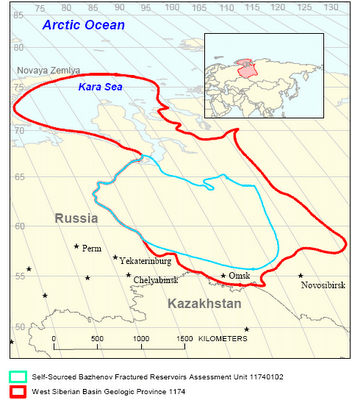
Bazhenov basin Western Siberia
The shale in Western Siberia also contains large amounts of gas. Shale gas and oil are already flowing in the US, the shale gas potential in China and India is being explored and developed and now vast reserves of oil and gas are available from shale deposits in Russia. Europe also has large deposits of shale gas but are dithering under the influence of alarmist environmentalism. They will have little choice but to join the brave new world of shale – or be left far behind.
Forbes reports:
(more…)
Tags:Bakken formation, Bazhenov basin, Shale gas, shale oil, Western Siberia
Posted in Energy, Gas, Oil | Comments Off on Vast shale oil deposits in Siberia
May 14, 2012
As distorting subsidy regimes are reduced or withdrawn and even with the collapse of prices for solar pv modules, solar power shows that it is still a long way from being commercially viable. This report is on the unhealthy and distorted situation in New Jersey where even more “artificial” legislation is planned to keep this non-viable industry alive. It would be far healthier to allow solar power plants to find their natural – unsubsidised – commercial niches. And there are commercially viable niches in industry and in domestic use for solar power – albeit only as an auxiliary energy source (pv) or in support of domestic heating or of conventional thermal power plants (solar thermal).
Press of Atlantic City
The prices that power companies pay for solar power have all but collapsed, curtailing future development and leaving those who installed systems struggling to repay their loans. A glut of power has meant that prices have fallen by more than 80 percent in the span of a year.
In response, solar power advocates are pushing for state legislation that would limit the amount of solar power that can be produced by large companies, while mandating that power companies buy more solar power. …..
(more…)
Tags:New Jersey, price collapse, Solar power, subsidies
Posted in Energy, Politics, Renewable Energy | Comments Off on “Boom and bust” for solar power in New Jersey
May 13, 2012
The Renewable Energy Law was introduced 12 years ago in Germany. It prioritises the use of “green energy”. What was thought to be a way of helping the introduction of new technology and fulfilling a political agenda has backfired and has led to a severe weakness of the electricity grid and the second-highest electricty price in Europe.
The Law leads to large conventional coal and gas plants leaving the grid far too early and these are the only plants which can guarantee a stable supply of power. This in turn has led to many of these plants being decommissioned prematurely since they were being forced to operate at uneconomic levels of loading. They are then no longer available to compensate when the wind does not blow or at night or on cloudy days as wind and solar power generation fluctuate wildly.
The hidden costs of renewable power are now being revealed and an entirely new market for “balancing power” has appeared. The “balancing power” – nearly always gas-fired – is just to compensate for the inherent unreliability of wind and solar. For every 100 MW of renewable capacity added around 70 MW of (mainly) gas-based balancing capacity has to be added to ensure a stable and steady supply of power. With subsidies and “balancing” costs added to the direct cost of building wind or solar plants, the actual costs of renewable power have been exorbitant and have contributed significantly to the increase of electricity prices to the consumer. Germany now has the second highest consumer electricity price in Europe (second only to Denmark with its profligate use of subsidised wind turbines)
The German Federal Network Agency has issued a report warning of the dangers during the coming winter. Daniel Wetzel of Die Welt writes (translation from GWPF – Philip Mueller):
Last winter, on several occasions, Germany escaped only just large-scale power outages. Next winter the risk of large blackouts is even greater. The culprit for the looming crisis is the single most important instrument of German energy policy: the “Renewable Energy Law.”
(more…)
Tags:balancing power, Federal Network Agency, Germany, Renewable energy, Renewable Energy Law, Sustainable energy
Posted in Energy, Gas, Germany, Renewable Energy | Comments Off on Renewable Energy Law has weakened the German electricity grid
May 12, 2012
It has been just over two years since I started this blog – my first – and I now feel sufficiently comfortable to move away from the general and to try and focus just on the topics that interest me most. I have changed the sub-heading to reflect this.
My opinions on aspects of energy and power generation and climate and environment will now take centre stage on this blog. I shall have to try to address my interests in technology and materials and behaviour and management and anthropology and politics elsewhere. It has been the advent of accessible electric power which has been the single most liberating force for the human condition – ever. For the foreseeable future humanity will continue to use – and need to use – electric power. And virtually all our sources for electric power – except perhaps some nuclear fuels – derive from the Sun.
Sol Invictus.
The blog image is of sunrise on a very cold day in February last year.
Tags:climate, Electric Power, Energy, environment
Posted in Climate, Energy, Environment | Comments Off on A slight shift of focus
May 11, 2012
It would seem that the wind lobby is more influential with the US Government than the wildlife lobby. Of course there is a lot more money involved in extracting subsidies for wind and solar energy than there is in wildlife.
The US Fish and Wildlife Service has been investigating the increased incidence of wildlife deaths (large birds, foxes and tortoises among others) at solar and wind energy project sites. The USFWS now proposes – presumably because these deaths will continue for a long time at such projects – that they be given a licence to kill for 30 years! But this support for solar and wind projects is a tacit acknowledgement by the US Fish and Wildlife Service that renewable projects are rather more dangerous to large birds and other wildlife than the enthusiasts would like us to believe.
Euphemistically, the USFWS obscures these licences to kill under the innocuous sounding “programmatic permits to authorize eagle take“.
The Foundry has this :
(more…)
Tags:Bald Eagle, Bird kills by wind turbines, licence to kill, Renewable energy, United States, United States Fish and Wildlife Service
Posted in Behaviour, Business, Energy, Politics, Renewable Energy, US, Wildlife | 4 Comments »
May 3, 2012
Methane hydrates represent the largest source of hydrocarbons in the earth’s crust.
Methane clathrate (CH4•5.75H2O), also called methane hydrate, hydromethane, methane ice, fire ice, natural gas hydrate, or gas hydrate is a solid clathrate compound (more specifically, a clathrate hydrate) in which a large amount of methane is trapped within a crystal structure of water, forming a solid similar to ice. Originally thought to occur only in the outer regions of the Solar System where temperatures are low and water ice is common, significant deposits of methane clathrate have been found under sediments on the ocean floors of Earth.
The worldwide amounts of carbon bound in gas hydrates is conservatively estimated to total twice the amount of carbon to be found in all known fossil fuels on Earth.
(more…)
Tags:DoE, gas, Methane clathrate, methane hydrate, Shale gas
Posted in Energy, Gas | Comments Off on With gas from methane hydrates added to shale and natural gas, the world has gas for a thousand years
April 13, 2012
Even with the advent of shale gas, the capital cost of nuclear power plants means that they remain the most economic, viable and safe option for large-scale, base-load power generation for the foreseeable future. And part of the unnecessary time (and cost) associated with building nuclear power plants is primarily due to the obstructionist and delaying tactics of the alarmist lobbies.
A new research paper finds that some of the alarmist scenarios after the Chernobyl accident have been grossly exaggerated. In all likelihood the same strident alarmism evident after Fukushima is also highly exaggerated.
J. T. Smith, N. J. Willey, J. T. Hancock. Low dose ionizing radiation produces too few reactive oxygen species to directly affect antioxidant concentrations in cells. Biology Letters, 2012; DOI: 10.1098/rsbl.2012.0150
(more…)
Tags:Chernobyl, Environmental science, Fukushima, J. T. Smith, Nuclear power, radiation effects on wildlife
Posted in Alarmism, Energy, Nuclear Power | Comments Off on Another dent in anti-nuclear paranoia as wildlife thrives after Chernobyl
April 8, 2012
Common sense and simple economics are beginning to reassert themselves as the the fundamental weaknesses in the fashionable – but subsidised – expansion of solar and wind power plants are revealed. The expensive, intermittent and unpredictable generation that derives from solar and wind power plants can – at best – be used to augment an existing system. They are actually useful as an auxiliary heat and power source as small decentralised units. But in a large power grid they are more of a nuisance than an asset and can only increase the cost to the consumer.
China has now published a policy document changing direction towards nuclear and hydro power and an accelerated development of shale gas use. Solar and wind power are downgraded.
Electric Light & Power
China will accelerate the use of new-energy sources such as nuclear energy and put an end to blind expansion in industries such as solar energy and wind power in 2012, Chinese Premier Wen Jiabao says in a government report published on March 5.
(more…)
Tags:China, Energy, Energy development, Hydro Power, Nuclear power, Shale gas, Solar power, wind power
Posted in China, Energy, Nuclear Power, Renewable Energy | Comments Off on China downgrades solar and wind power – pushes for nuclear, hydro and shale gas


