Archive for the ‘Energy’ Category

Saudi Arabia is losing its war against oil shale

August 3, 2016

Saudi Arabia started its war on US shale oil in the autumn of 2014. Oil prices in June 2014 were around $110 per barrel and were on the way down as US shale oil producers were ramping up production. The expectation was that the OPEC cartel would reduce production to hold prices up. The conventional wisdom was that whereas Saudi Arabia had a production cost of about $3 per barrel, shale oil had a production cost of over $50 per barrel and upto close to $100. Oil from Canadian tar sands was thought to have a production cost of above $70 per barrel. Both were though to require oil prices well in excess of $70 and close to $100 to be viable.

But Saudi Arabia decided to strangle the burgeoning shale oil industry and started an oil war. It forced other OPEC members to focus on market share and hold production levels. Even though there was a glut of oil on the market. Oil fell to below $30 per barrel earlier this year before recovering to around $45. Saudi’s strategy was based on the assumption that rock-bottom prices would kill off the upstart non-OPEC, US shale producers. Low production costs would allow the OPEC producers to take some pain for a year or so. Certainly this strategy has had some effect. U.S. oil production is about one million barrels per day lower than a year ago.

Certainly some shale oil producers have gone out of business. But US oil production is much higher than thought possible at the prevailing price. The main effect of the Saudi strategy has been counter-productive. There has been a remarkable burst of innovation among the shale frackers which has drastically reduced shale oil production costs. The costs for shale production that I had reported 2 years ago no longer apply.Then the cheapest shale oil to produce was from Marcellus shale at around $24 per barrel. But the cheapest today costs $2.25 a barrel on horizontal wells in the Permian Basin of West Texas. That is directly – and even favourably – comparable with the Saudi production costs.

Reuters: Improved fracking techniques have helped cut Pioneer Natural Resources Co’s production costs in the Permian Basin to about $2 a barrel, low enough to compete with oil rival Saudi Arabia, CEO Scott Sheffield said on Thursday. 

The comments from Sheffield, who is retiring soon, were perhaps the most concrete sign yet that the fittest U.S. shale oil producers will survive the price crash that started in mid-2014 when Saudi Arabia and OPEC moved to pump heavily to win back market share from higher-cost producers.

Dozens of shale companies, many with marginal assets, have filed for credit protection in the biggest wave of corporate bankruptcies since the telecoms crash of the early 2000s. Sheffield said high costs would continue to make U.S. shale plays outside the Permian basin relatively less competitive. 

On Pioneer’s second-quarter results call, Sheffield said that, excluding taxes, production costs have fallen to $2.25 a barrel on horizontal wells in the Permian Basin of West Texas, so it is nearly on even footing with low-cost producers of conventional oil.

“Definitely we can compete with anything that Saudi Arabia has,” he said.

“My firm belief is the Permian is going to be the only driver of long-term oil growth in this country. And it’s going to grow on up to about 5 million barrels a day from 2 million barrels,” even in a $55 per barrel price environment, he added. …….. 

Pioneer expects output to grow 15 percent a year through 2020 after posting production of 233,000 barrels of oil equivalent a day this past quarter. It sees most of its growth in the Permian, though it also has acreage in the Eagle Ford.

Pioneer helps limit costs by doing much of its oilfield services work in-house. It also has its own sand mine, and uses effluent water from the city of Odessa for frack jobs using pressurized sand, water and chemicals to unlock oil from rock.

Pioneer said it is now introducing its third generation of well completion techniques, called version 3.0, that is using even more sand and water than the super-sized volumes introduced at the start of the price crash to pull more oil out of rock.

permian basin texas

Even at prices less than $20 per barrel, some considerable quantities of shale oil would continue to be produced.

The Saudi strategy is backfiring.


The GT26 lives on with Ansaldo (for now)

June 21, 2016

I have previously expressed my doubts as to how long sequential combustion technology will continue for gas turbines after the technology has been transferred to Ansaldo Energia (as part of the acquisition of Alstom by GE).

Ansaldo has announced (in March this year) the sale of 2×2 GT26 machines as part of power islands for the Ibri and Sohar#3 combined cycle plants Oman.

Ansaldo Energia Switzerland has been awarded two contracts worth approximately 600 million Euros in total for the supply of major power plant equipment to two large IPP projects. The Ibri 1510 MW CCPP and Sohar III 1710 MW CCPP in the Sultanate of Oman are expected to be commissioned in early 2019. The Ibri and Sohar III CCPP IPP projects are developed by the sponsor consortium of Mitsui & Co. Ltd., ACWA – International Company for Water and Power Projects and DIDIC – Dhofar International Development and Investment Holding Company, following a simultaneous award of the two projects to the development consortium by Oman Power and Water Procurement Company SAOC of Oman earlier this month. The two power stations will operate and supply power under a PPA to the grid in the Sultanate of Oman. Ansaldo Energia will supply the main power train equipment components, including for each power plant, four of Ansaldo Energia’s newly acquired high-efficiency advanced GT26 class gas turbines, four heat recovery steam generators (HRSGs), two steam turbines and six turbo generators to SEPCOIII Electric Power Construction Cooperation of China (SEPCOIII), who will be responsible for engineering, procurement and construction (EPC) on a turnkey basis. Ansaldo Energia will also provide field services to SEPCOIII – under separate contracts – during the construction phase and long term maintenance services to the operator after commissioning. These projects mark Ansaldo Energia’s first success with its recently acquired and formerly Alstom owned GT26 gas turbine technology and will be one of the largest CCPP project awards in the Gulf region. Ansaldo Energia will certainly have a firm place the CCPP and IPP market where highly efficient, operationally flexible and reliable technology is required. With these two projects in execution in the region and Ansaldo Energia’s presence as a service provider in the Middle East area through Ansaldo Thomassen Gulf in Abu Dhabi, Ansaldo Energia’s position in the Gulf will be further strengthened. Juerg Schmidli, Ansaldo Energia Switzerland President, commented: “With its operating flexibility and high efficiency, the GT26 gas turbine will play a critical role in generating maximum project returns for our customer. This is the perfect start for our newly formed Company Ansaldo Energia Switzerland”.

I hope these machines from Baden/Birr will truly mean that Ansaldo has grabbed the sequential combustion ball and is running with it (and not that these are just machines already largely manufactured while under Alstom ownership and completed by Ansaldo).

What I still doubt is whether Ansaldo has the tradition, expertise and financial clout left to manage and implement any innovations. If they cannot, the Alstom version of the GT26 Ansaldo has acquired is already outdated. Especially since Siemens, GE and Mitsubishi have H-class machines in operation and are already moving on to H+ engines. GE’s HA-class machine (9HA) is operational in France for EdeF (62.22% claimed efficiency). The GT26 is still probably only at the G+ level and Ansaldo will need to get beyond the H-class efficiency level to be a realistic fourth player. If not the GT26 will be consigned – at best – to some niche markets. The 60Hz (including US) market and the GT24 are not available to Ansaldo and that does not help in the experience stakes.

How long it may take to get a commercial version of the next generation GT36 to market, or whether it will ever see the light of day, is an open question. I have a soft spot for sequential combustion and would like to see it continue. But I will stay pessimistic and remain doubtful that Ansaldo Energia has the wherewithal to remain a serious player with this technology.

And hope to be proved wrong.

Alstom GT26

Alstom GT26


Saudi Arabia seeks bank loans for first time in a decade

March 9, 2016

I am still of the opinion that the oil price war that Saudi Arabia has been waging against shale oil, Russia and Iran, was misguided and due primarily to a geopolitical machismo that was grossly overestimated. It was misguided because shale fracking is not a technology that is going to go away. In the short term some of the more expensive shale wells may close, but they can very soon start up again. But more importantly, shale gas and oil are available all over the world. They just haven’t been developed yet. And those that don’t have access to shale – like Japan – will have access to gas from methane hydrates within a decade. And there is more gas available from methane hydrate than from shale which, in turn, is more gas than all the natural gas resources known.

In the long run I expect the Saudis to be the losers. Their budget deficit climbed to approach $100 billion last year and now, for the first time in a decade, they are looking to borrow.

Reuters: 

Saudi Arabia is seeking a bank loan of between $6 billion and $8 billion, sources familiar with the matter told Reuters, in what would be the first significant foreign borrowing by the kingdom’s government for over a decade.

Riyadh has asked lenders to submit proposals to extend it a five-year U.S. dollar loan of that size, with an option to increase it, the sources said, to help plug a record budget deficit caused by low oil prices.

The sources declined to be named because the matter is not public. …

The kingdom’s budget deficit reached nearly $100 billion last year. The government is currently bridging the gap by drawing down its massive store of foreign assets and issuing domestic bonds. But the assets will only last a few more years at their current rate of decline, while the bond issues have started to strain liquidity in the banking system. …….. 

…… Analysts say sovereign borrowing by the six wealthy Gulf Arab oil exporters could total $20 billion or more in 2016 – a big shift from years past, when the region had a surfeit of funds and was lending to the rest of the world.

All of the six states have either launched borrowing programs in response to low oil prices or are laying plans to do so. With money becoming scarcer at home, Gulf companies are also expected to borrow more from abroad.

In mid-February, Standard & Poor’s cut Saudi Arabia’s long-term sovereign credit rating by two notches to A-minus. The world’s other two major rating agencies still have much higher assessments of Riyadh, but last week Moody’s Investors Service put Saudi Arabia on review for a possible downgrade. ……. 

The pricing of the loan is likely to be benchmarked against international loans taken out by the governments of Qatar and Oman in the last few months, according to bankers. Because of banks’ concern about the Gulf region’s ability to cope with an era of cheap oil, those two loans took considerable time to arrange and the pricing was raised during that period.

Oman’s $1 billion loan was ultimately priced at 120 basis points over the London interbank offered rate (Libor), while Qatar’s $5.5 billion loan was priced at 110 bps over, with both concluded in January.


The Paris Agreement sanctions a dash for coal

February 25, 2016

Now that the Paris Climate Agreement is out of the way (having actually achieved nothing while seeming to have solved everything), sensible countries that wish to implement their plans to utilise coal can do so without being castigated for it (since Paris has now solved everything). The non-sensible and sanctimonious countries – and Sweden leads all the rest – can refrain from using coal and other fossil fuels to their own self-inflicted disadvantage.

The real winners from the Paris Agreement are, of course, India and China. By using carbon emissions per unit of GDP as the measure, India has ensured that it can treble its coal consumption by 2030 (while GDP increases by a factor of 4) and still show a 30% decrease in emissions/GDP. Similarly China can double its coal consumption by 2030 while GDP increases by a factor of 2.65 and still show a 20% reduction in carbon emissions (based on my calculation from the Indian and Chinese INDC submissions for the Paris conference).

The 2012 global coal consumption (IEA report) was about 8.186 billion short tons of which China consumed 3.887 billion short tons and India consumed 0.745 billion short tons. By 2030, India alone would consume 2.235 billion short tons and still meet their Paris obligations. Similarly China would consume about 7.774 billion short tons and still meet their Paris promises. Effectively the Paris Climate Agreement sanctions that coal consumption in India and China alone will be about 10 billion short tons and exceed today’s global consumption. The global coal consumption in 2030 will then be above 14 billion short tons which is about 70% higher than the 2012 global consumption.

And now Reuters informs us that

A decision by Japan’s environment ministry to abandon its opposition to building new coal-fired power stations casts doubt on the industry’s ability to meet targets to cut greenhouse gas emissions, experts and environmental activists said …..

As Japan gets ready to open up its power retail market in April, companies are rushing to build 43 coal-fired plants or 20.5 gigawatt of capacity in coming years, about a 50 percent increase. ……. Coal is attractive because it is the cheapest fossil fuel source and prices have slumped in recent years. Japan has turned to the energy source in record amounts since the Fukushima disaster in 2011 led to the shutdown of reactors.

A group of 36 power companies, which supply 99 percent of the country’s electricity, have also formed a new body to take measures to trim emissions and meet the industry’s voluntary goal to cut emissions by 35 percent in 2030, compared with 2013.

The Paris Agreement has ensured that all those who wish to use coal can continue to do so.


Saudi oil policy has ensured the survival of the shale oil producers

January 1, 2016

WTI Crude Oil Price. $107 in June 2104 and $37 yesterday (graphic Bloomberg).

WTI Crude oil price 2014-2015 (Bloomberg)

WTI Crude oil price 2014-2015 (Bloomberg)

In years to come the Saudi strategy through the last 2 years will form the basis of case-studies in business school about classic strategies which back-fired.

The Saudi overproduction has not managed – as they hoped – to kill off the US shale oil producers during 2015. They have reduced their costs much more sharply than the Saudi’s calculated for. They have also developed the ability to “mothball” and restart their wells at short notice. Iranian oil will come into the market in 2016 and their production costs are even lower than the Saudi cost.

Fighting for market share – while the market is down – is an expensive business. But I think the fundamental error in the Saudi strategy is believing that they will be able to retain market share when the market turns up. Not only will they have to fight off the Iranians but with an increase in demand, all the shale producers will be back. Moreover new shale producers in the UK and Asia are waiting in the wings. The Saudi attack on the shale oil producers has only made them far more competitive, very much faster than they ever expected. With the US experience to draw on, the learning curve for new producers in new countries will be that much easier and faster to traverse.

Reuters:

The U.S. shale industry, meanwhile, surprised the world again with its ability to survive rock-bottom crude prices, churning out more supply than expected, even as the sell-off in oil slashed by two-thirds the number of drilling rigs in the country from a year ago.

The United States also took a historic move in repealing a 40-year ban on U.S. crude exports to countries outside Canada, acknowledging the industry’s growth.

“You do have to tip your hat to the U.S. shale industry and their ongoing ability to drive down costs and hang in there, albeit by their fingernails,” said John Kilduff, a partner at Again Capital, an energy hedge fund in New York.

The bottom line is that Saudi oil is no longer without alternatives. That shale oil producers will disappear is a Saudi fantasy. In fact they have now helped the shale oil industry to become lean and mean enough such that their survival is guaranteed. The oil prices during 2015 were insufficiently low to drive an economic recovery but that could well come in 2016. The number of oil producers will only multiply and Saudi oil revenues will be permanently impaired.

Record number of German households have electricity disconnected following high prices

November 18, 2015

The German Energiwende is proving to be an embarrassing  fiasco, at an enormous cost – to producers as well as consumers – and with no returns. The only plus that can be discerned is to the ego of the “green” parties. Germany has the highest electricity prices in Europe directly as a result of the renewable energy surcharges. There is one small group of people which has benefited hugely. That has been the developers of renewable energy projects who have managed to build plants with very little of their own equity. They have then transferred ownership to plant operators and have shortened their own payback periods and maximised their returns.  Equipment manufacturers have seen their prices tumble, plant operators have seen their returns decline and consumers have seen their prices increase. But the developers have walked away with huge returns.

And it has all been for nothing.

The correlation between residential electricity price and installed renewable capacity is compelling. From Energy Matters.

The Y-axis shows residential electricity prices for the second half of 2014 from Eurostat. The X-axis installed wind + solar capacity for 2014 as reported in the 2015 BP statistical review normalised to W per capita using population data for 2014 as reported by the UN.

Now Der Spiegel reports:

Because of rising prices, more and more German citizens are unable to pay their electricity bills. In 2014, 351,802 residential households were disconnected, reports the Federal Network Agency (BNetzA) and the Federal Cartel Office in its new monitoring report. 

The number of disconnections  increased to the highest value ever recorded. In 2013, 344.798 cuts had been imposed and in 2012 there were approximately 320,000 disconnections. Yet far more households have problems with their electricity bill. According to the Federal Network Agency suppliers threatened their customers with disconnections a total of 6.3 million times.

The main reason for the increasing number of disconnections are the rapidly rising electricity prices. Since 2002, the costs for consumers almost doubled, partly because the levy for renewables rose, and because while the big power utilities reduced costs, these were not passed on to consumers.

The main victims are the households. Their electricity costs are around 45 percent higher than the EU average of 20.52 Euro cents per kilowatt hour. Adjusted for taxes industrial electricity price however is 6.27 cents per kilowatt hour, well below the EU average of 9.37 Euro cents per kilowatt hour.

For 2016, several utilities have already announced further increases. On average, this will be just over three per cent, which would mean an additional cost of approximately 40 euros per year for a four-person household.  .. Further increases are expected to be announced in the coming week. Customers must be notified of planned price changes for 2016 by November 20th. Experience has shown that many send these unpopular letters at the last minute.

The Energiwende has indeed been a revolution but it has not functioned as it was meant to. Costs have increased sharply and nothing has been achieved for the climate.

Because, of course, it couldn’t.

NoTricksZone comments:

It’s a glaring paradox of the Energiewende: On the production side, power plants are losing billions of euros because they can no longer even get a modest price for their power, while on the consumer side more and more households are unable to afford the skyrocketing prices brought on by the mandatory infusion of expensive and unstable green energies into the German power grid. The once mighty German power grid now teeters on the brink of crumbling.

Greenpeace endangers national economic security and is deregistered in India

November 7, 2015

Greenpeace has been deregistered in India and has 30 days to shut down. They intend to challenge the deregistration in court. But their brand of eco-fascism (“we know best what is good for you”) is a luxury that India can ill afford. When per capita energy consumption in India is just one tenth of that in Europe, and one fifteenth of that in US, Greenpeace’s attempts to block coal and nuclear power in India is unconscionable.

Greenpeace in India just reflects the views and values of its foreign membership. Most of this membership is from developed countries and represents the do-gooding, self-righteous attitudes of  a comfortable, energy-guzzling middle class. In Europe, these members are often from the hard-left who, after the fall of communism, have found themselves politically homeless. They have become a political lobby group hiding under the cloak of being a welfare organisation. They not only believe they “know best what is good for others”, they also want to impose that on others. In the developing world, Greenpeace are as “colonialist” as the empire builders of the 19th century and try to impose their values and their solutions by legal and extra-legal means. In India this colonialist attitude showed up with their local “rajahs” acting as feudal lords believing they had the right of droit de seigneur. In nearly every developing country their campaigns are opposed to development projects.

In India their efforts to show that solar energy could be an alternative to coal back-fired badly. They sponsored a solar pv installation at a village in Bihar but only ended up promoting coal power. The villagers now refer to coal power as “real power” and solar power as “fake power”.

Scientific American: Over three months, engineers set up 70 kilowatts of photovoltaic cells on the rooftop of public buildings scattered throughout the village. They installed 224 batteries to store the energy. …. All told, the installation cost 2.7 crore rupees ($407,050). ……

The day the power came was one of celebration. …. Then, the wealthy families plugged in energy-inefficient televisions and refrigerators. With the power suddenly facing heavy demand, the batteries drained within hours.

The microgrid operators scrambled to fix the mess. The village electrification committee decided to restrict electricity supply to five hours at nighttime. Greenpeace put up posters telling people not to use energy-hungry appliances such as rice cookers, electric water heaters, irons, space heaters and air coolers. ….. One month after the rollout, Greenpeace invited Bihar’s former chief minister, Nitish Kumar, to inaugurate the solar village. ……. One week later, trucks rolled in and set up a 100-kW transformer in town, connecting Dharnai to the grid. ….. Power is now free for Kumar and his neighbors who are below the poverty line. Others pay 3 rupees per kilowatt-hour of electricity. As of July, villagers were getting electricity day and night, …….

Meanwhile, enrollment in the solar program has fallen to 120 households, down from 380 at the start ……..At present, solar power in Dharnai costs at least three times as much as grid power. It can support only expensive energy-efficient appliances, such as CFL bulbs. A CFL bulb in India costs 700 rupees ($10), while an incandescent bulb costs 10 rupees (15 cents).

Now Greenpeace India has lost its registration, on the surface for violating financial regulations applying to NGO’s with foreign funding, but more fundamentally, for being anti-development and a threat to the economic security of the country.

NDTV: India has cancelled Greenpeace International’s license to operate and gave the group 30 days to close down, citing financial fraud and falsification of data, …… Last year, the government withdrew permission to Greenpeace to receive foreign funding, saying the money was used to block industrial projects.

Under the latest order issued by authorities in Tamil Nadu where Greenpeace is registered, the government said it had found that the organisation had violated the provisions of law by engaging in fraudulent dealings. ……. A government official confirmed that the closure order had been issued on Wednesday but did not elaborate.

In recent months the federal government has toughened rules governing charities and cancelled the registration of nearly 9,000 groups for failing to declare details of overseas donations.

In India, Greenpeace has blindly opposed almost every project concerned with coal mining, coal power plants, nuclear power plants, GMO crops, forest clearing, and even building of dams. They have opposed India’s tea exports in the name of supporting plantation workers. They have openly supported candidates from a particular political party (AAP). They have tried to influence elections. Agitation has been the name of their game and foreign support has been brought in to manage conflicts that they initiate. The government’s Intelligence Bureau (IB) has estimated that Greenpeace India’s activities depress growth by 2 -3%.

The New Indian Express:

Months before Tamil Nadu’s crackdown on Greenpeace, the Ministry of Home Affairs (MHA) in September had cancelled the Foreign Contribution Regulation Act (FCRA) licence of Greenpeace India. It was alleged that the NGO misused foreign funding for political activities which prejudicially affected the country’s public and economic interests.

The Home Ministry Dossier on ‘Greenpeace Activities’ with Express said that NGO was found violating the FCRA by engaging in political activities to influence and lobby for the formulation of policies of its liking. “Not only Greenpeace activists are involved in agitation, they also invited foreign activists like Emma Rachel Tranquility Gibson (UK national) for handling conflict / team dynamics, prioritisation and difficult decisions and her given task was ‘Election Project’as mentioned in the terms of reference of her job,” the MHA dossier said ……..

The financial irregularities are concerned mainly with hiding the use that foreign funds are put to:

An on-site inspection of the NGO’s accounts and records conducted on September 24 to September 27, 2014 found that Greenpeace first transferred foreign contribution received in FCRA designated bank account to FCRA utilisation account and from there to five other bank accounts without informing the authority concerned.  The NGO also shifted its office and activities from Chennai to Bengaluru without approval /intimation of the Ministry. It claimed that Greenpeace was also involved in international negative campaign against India’s most popular tea brands to reduce India’s export by publicising questionable forensic tests in an undisclosed foreign lab.

“ On October 27-28, 2013, Greenpeace India also invited a 10-member team of international activists (1 US and 9 Bangladesh nationals, nine being on tourist visa) to visit three coal block locations, Waidhan and Mudwani (Baiga Basti) in district Singrauli and Amelia to conduct an environmental study on coal blocks allocated to power plants in the district. The team also attended a meeting organised by a NTPC plant employee, Shyam Kishore……all the payments in respect of boarding and lodging were made by Greenpeace India.”

Timeline 

  • April 9, 2015: Centre freezes Greenpeace India’s seven bank accounts over FCRA violation
  • May 5: Greenpeace India’s executive director Samit Aich tells staffers that they have one month left to fight; face imminent shut down
  •  May 27: Delhi HC allows Greenpeace to utilise two accounts for collecting donations
  • May 28: District Registrar, Chennai, sends notice on inspection of Greenpeace India office in Chennai by Sub-Registrar (Chit & Society)
  • June 3: Sub-Registrar (Chit & Society) inspects Greenpeace office
  • June 16: Showcause notice sent by District Registrar on several irregularities and violations found during inspection
  • August 4: HC directs District Registrar to allow petitioner to peruse documents that RoS based its allegations on
  • October 5: Greenpeace sends extensive rebuttal through its counsel
  • November 4: District Registrar passes order cancelling Greenpeace India’s registration

Those who consume more than the world average of 1.78 toe/individual should shut up and not comment on those who consume less

November 6, 2015

The numbers tell the story.

Taking the data available in the BP 2015 Statistical Review of World Energy and the UN’s World Population Prospects – 2015 revision, it is simple arithmetic to see the current disparity in the energy consumed at the individual level. Per capita energy consumption in tons of oil equivalent varies from less than 0.2 in sub-Saharan Africa to over 7 in the US.

Energy per capita 2014

Energy per capita 2014

China has already developed to consume 2.17 toe per capita,  a little above the world average of 1.78 toe. The sharp growth came around 15 years ago. India is still at 0.49 toe/capita and the sharp growth is just beginning now. Probably India will exceed the world average in about 15 years. Sweden is at over 5 toe/capita and the US lies over 7 toe. The per capita energy consumption is a good reflection of the state of development. The developed countries flattened out after the 1970s. There ought to be a slight reduction in developed countries as energy efficiency effects kick in, and this effect is just starting to be apparent.

Energy consumption per capita 1965 - 2014

Energy consumption per capita 1965 – 2014

Suppose now that an average per capita consumption of around 3.5 toe is a reasonable goal to meet the aspirations of the global population by 2100. The global population will then be about 10.5 billion compared to the 7.2 billion in 2014. The total energy consumption will then increase by a factor of 2.9.

Currently 86% of global energy consumption is from fossil fuels. Suppose that by increased use of nuclear power and a much greater use of hydro, wind and solar power, the dependence upon fossil fuels can be reduced to – say – 70%. This is overly optimistic as to the potential of these other sources and does not seem very likely, but I use 70% to make the calculation.

0.7 *2.9/0.86 = 2.36

That would then require a fossil fuel consumption level around 2.3 times the present consumption by 2100. That in turn requires just a 1% growth of fossil fuel consumption per annum for the next 85 years. This is eminently doable – unless the alarmists, most of who already enjoy a consumption level of greater than 5 toe/ individual, manage to hold down the billions now trying to improve from levels less than 1 toe/capita.

Nobody who consumes more than the world average of 1.78 toe/individual should be allowed to comment on the energy use of all those who lie below that average. 

Forty years of subsidy and wind and solar provide all of 1.3% of global energy

November 6, 2015

The 2015 BP Statistical Review of World Energy is out.

It is an excellent reality check for those who care to subject their religious views about energy and climate to some sanity checks.

Subsidies for solar and wind and even bio-mass began around 1975. They took off after about 1985. I just note that after 40 years of subsidising wind and solar power, these two sources of energy provide all of 1.3% of the global energy consumption in 2014. I note also that the global energy need that people aspire to is almost double that actually consumed.

Energy consumption 1975 and 2014

Energy consumption 1975 and 2014

Fossil fuels contributed 86.3% of global energy in 2014 and have more than doubled since 1975. While carbon dioxide emissions from the use of fossil fuels had increased by 110%, carbon dioxide in the atmosphere rose from 330 ppm in 1975 to reach 398 ppm in October 2015, an increase of about 20%. The man-made emissions are still less than 5% of all carbon dioxide emissions and there is still no certainty as to how much – if any – of the man-made emissions contribute to the carbon concentration in the atmosphere. And the satellite record shows that there has been no significant increase in global temperature over the last 19 years.

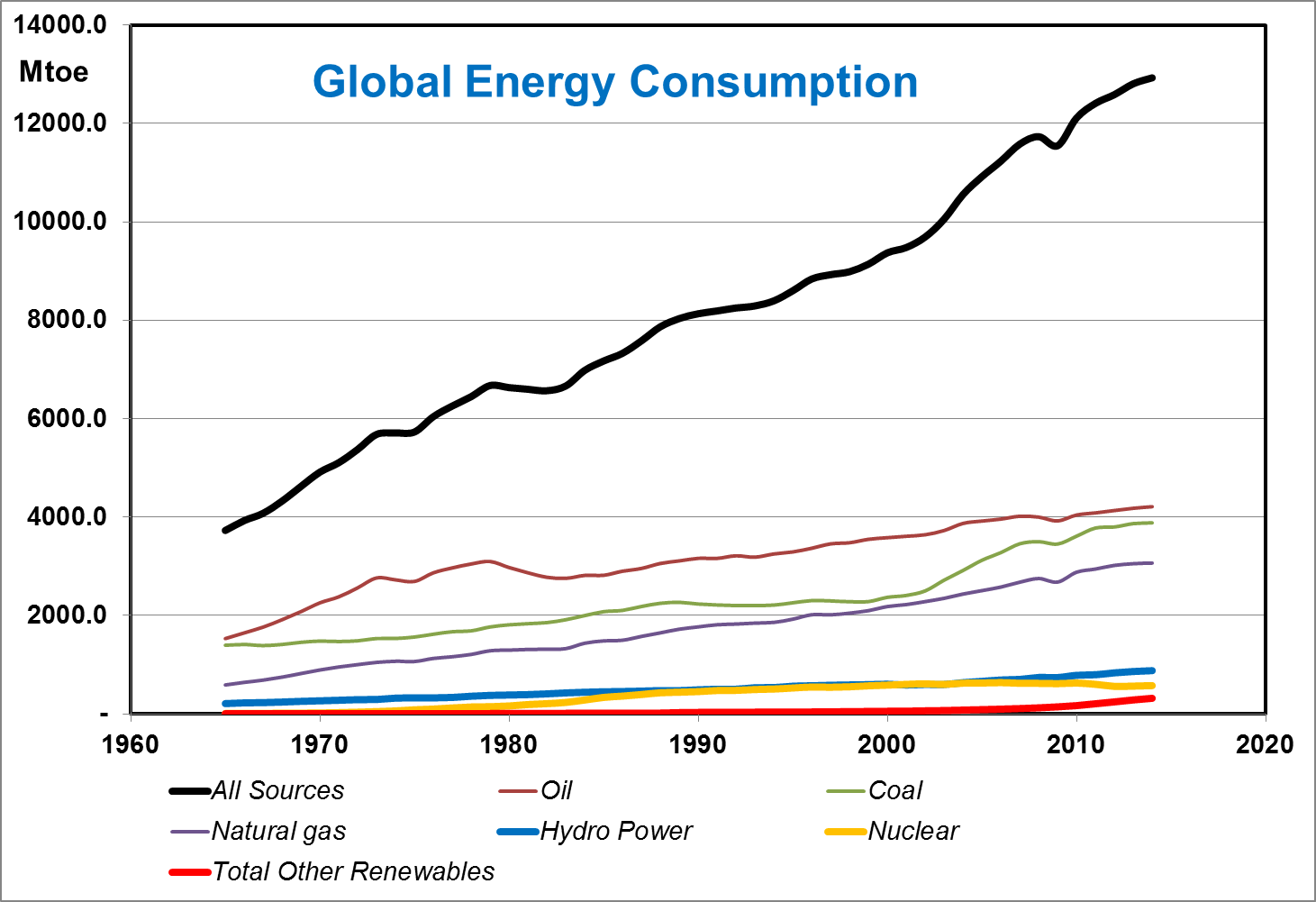
It is not that solar and wind power do not have their niches where they make sense. But without energy storage, the need for back-up capacity always adds a hidden cost. The intermittent nature of the source then means that they can never make more than a marginal contribution. The problem with subsidies is that they can’t make the wind to blow or the sun to shine. And even when the sun is shining, the subsidies can’t control cloud cover. What I dislike even more about subsidies is that they have not been used to develop energy storage. Instead they have distorted the market, put large sums of money into the pockets of “cowboy” developers and have provided no benefits to the consumers. Solar and wind hardly show up when looking at global energy consumption since 1965.

Global energy consumption 1965 - 2014. Data from 2015 BP Statistical Energy Review

Global energy consumption 1965 – 2014. Data from 2015 BP Statistical Energy Review

To see the growth in wind and solar on the same diagram as fossil fuel consumption, it is necessary to use a log scale.

Global Energy Consumption log scale 1965 - 2014. Data source 2015 BP Statistical review of Energy

Global Energy Consumption log scale 1965 – 2014. Data source 2015 BP Statistical review of Energy

Which makes one wonder why the Paris conference is taking place at all. A more pointless exercise, and one which has no real measurable objectives , is hard to imagine.

European nuclear moratoria are ineffective and counter-productive as China plans 110 nuclear plants by 2030

October 18, 2015

Update! Numbers have been corrected. By 2030 China plans 110 nuclear plants in operation which is another 60 reactors in addition to the 50 currently in operation or under construction. (I had earlier assumed that the plan was for 110 new reactors).


The European nuclear industry is almost dead as a consequence of,

  1. the ban on nuclear power in countries which have succumbed to environmental political correctness (e.g. Sweden, Germany…)
  2. the ridiculously long and costly permitting processes (environment and safety) in countries where nuclear power has not been banned (UK, Finland…)

As a contribution to the global use (or non-use) of nuclear power, the European reluctance to use nuclear power is entirely meaningless. For the objectives of killing the European nuclear industry and raising costs for electrical power in Europe, the anti-nuclear lobby has been entirely successful.

China currently has 23 nuclear plants in operation and 27 under construction which will be in operation by 2020. By 2020 the Chinese nuclear generating capacity will have almost tripled from the 21GW, 2014 level to be about 58GW in 2020. They have just announced their next five-year plan and some long-term strategies. Another $78 billion has been earmarked to reach 110 nuclear plants in operation by 2030. These plants will be built using indigenous Chinese technology. This technology is now available for export. It is being actively considered for projects in Pakistan and Argentina and now China is even a possible investor in the UK. Each Chinese nuclear plant has a capacity of about 1.1GW (1,100MW). At $78 billion for a further 60 plants, the investment cost planned is about $1200/kW. This is incredibly low, not just for nuclear plant, but for any type of power generating plant. Even assuming a volume effect, it can be expected that Chinese nuclear power plants could be exported at about $1,200-1500/kW.

The Hindu:

China plans to build 110 nuclear power plants by 2030 with an investment of over $78 billion overtaking the U.S. which has 100 such plants amid criticism that Beijing is yet to implement enough measures to develop safety controls in existing projects.

China will build six to eight nuclear power plants annually for the next five years and operate 110 plants by 2030 to meet the urgent need for clean energy, Beijing-based China Times quoted plan analysts as saying. China will invest 500 billion yuan ($78.8 billion) on domestically developed nuclear power plants, the report said. According to the China Times, the country plans to increase its electricity generation capacity to 58 gigawatts by 2020, three times the 2014 level. 

China currently has 23 nuclear power generating units in operation and 27 under construction, about one-third of the world’s unfinished nuclear units.

The construction resumed after the Chinese government which put the brakes on nuclear power plant approvals after the Fukushima nuclear accident in Japan in 2011 permitted their construction after a safety review.

nuclear sites in china (graphic world-nuclear.org)

nuclear sites in china (graphic world-nuclear.org)

In Europe the Olkiluoto #3 nuclear plant of 1,600MW in Finland, was first expected to cost about $2,000/kW, but with all the delays and cost overruns it is going to end up costing about $5,300/kW. Even if the unnecessary approvals and cost overruns incurred just to satisfy the environmental lobbies were not there, the investment cost for new nuclear capacity in Europe would still be about $2,600-3000/kW (compare that with about $1,100/kW for gas fired plant, about $2,500/kW for a coal or onshore wind plant and about $6,800/kW for offshore wind power).

As a comparison, India currently has 21 nuclear rectors in operation with a capacity just under 6GW. A further 6 reactors giving another 4 GW are under construction. The Indian plan is to reach about 63GW of nuclear capacity by 2032 which, of course, will not happen. My experience of Indian power planning is that about 60% of the plan will be implemented (though the track record is improving). So it is quite probable that India will construct around another 40 nuclear reactors (@800MW/reactor on average) by 2032. (In that period Indian coal consumption would also have trebled).

At the Chinese cost of exporting nuclear plant for around $1,200-1,500/kW, it is only to be expected that the electrification of Africa and nuclear expansion in S. Asia will be satisfied to a large extent by nuclear power.  A big chunk of that would be with Chinese technology. I have no doubt that European nuclear plants operate to much higher safety standards than the current Chinese reactors, but the European nuclear industry is now dead and it is Chinese nuclear technology which will be affordable and will prevail.

Considering the goals it was set out to achieve, the European anti-nuclear stance has been totally ineffective (except locally in Europe) and grossly counter-productive:

  1. it has no long-term impact on global use of nuclear energy,
  2. it has effectively killed the European nuclear power industry,
  3. it has effectively reduced the safety levels of all those nuclear plants that will be built over the next two decades, and
  4. it has increased the cost of electric power in Europe.

It is worth remembering that while the Great 2011 Earthquake and Tsunami killed some 18,000 people in Japan, the Fukushima accident it caused has killed no-one directly due to radiation. Now, less than 30 years after the major disaster at Chernobyl, the area is very far from being some nuclear waste-land, and plant and wild-life are thriving as never before in the region.