Archive for the ‘Energy’ Category

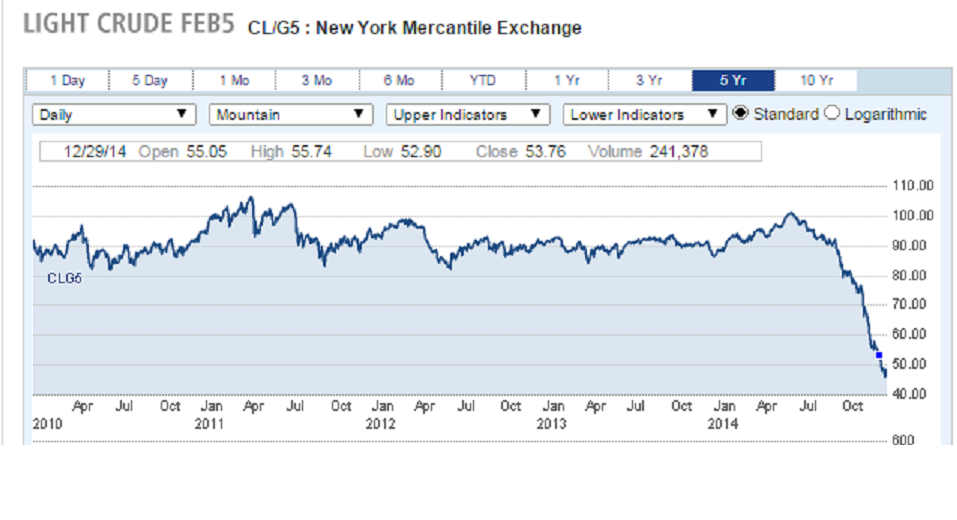
Oil wars: US crude drops below $50 as Saudi Arabia drops prices to protect market share

January 6, 2015

Some stock markets are spooked as oil prices continue to slide, but bringing oil price back to a cost-based price is a good thing in the long term. For too long – almost 45 years – oil producers and their governments have fleeced the consumer. Oil prices have had no relationship to cost of production but have been governed by artificially controlling its scarcity (by the OPEC cartel) and pricing it at the level of unacceptable pain for the consumer. Predatory governments have assisted by taxing oil products as far as they can even for the necessities of living (gasoline, diesel, LPG, fertilisers, pesticides…). If the present oil wars bring the price to the consumer in line with the cost of production – and there is no shortage of oil available to be produced – then it is a fundamentally sound, and long overdue, removal of one of the great, artificial distortions of the market place.

History will show the OPEC cartel to have held back development for 4 decades and to have been an evil thing.

Even if Saudi Arabia is engaged in a multi-pronged war – against shale oil, against Russia, against Iran – the root cause of the drop is that there is no longer a monopoly that the OPEC cartel enjoys. And the the way being shown by US shale oil is available to many more countries. In the short term it may well affect stock markets as these fetters are removed but in the long term this is an inexorable driver of growth – especially for the developing countries and their hard pressed consumers.

Remarkably many oil producers are now even increasing production in a time of a glut and cutting prices to win market share. They are being short-sighted. As the Opec cartel collapses, and it becomes a buyer’s market it will be oil price which governs and even then only for short term supply contracts. It will no longer be possible for the cartel oil producers to extort long-term contracts at high prices from developing countries who have no alternatives.

FP0106_Oil_C_JR

2015 not 2014 — via Financial Post

 Financial PostU.S crude crashed below US$50 a barrel while benchmark Brent crude tumbled under US$53 after data showed Russian oil output at post-Soviet era highs and Iraqi oil exports at near 35-year peaks.

Meanwhile, the outright price for Canadian heavy crude fell below US$35 a barrel. ……. The drop in WTI pushed the pushed the price of Canadian heavy crude to US$34.64 per barrel, a level that could make producing crude from the oilsands unprofitable for most operators in the world’s third-largest crude reserve.

Many of the region’s operators have already slashed capital spending and slowed work on new projects in order to cope with the price crash, though production from the region has not yet been affected.

…… Top crude exporter Saudi Arabia revealed it had made deep cuts to its monthly oil prices for European buyers , the sixth time in a row since June when it had slashed prices, corresponding with the rout in crude futures markets over the period. Analysts read the latest cut as reflecting Saudi Arabia’s deepening defence of its market share for crude. The OPEC kingpin also trimmed its prices for U.S. refiners for a sixth straight month, while raising rates for Asia.

…… Some traders seem certain that U.S. crude will be trading in the US$40 region later in the week if weekly oil inventory numbers for the United States on Wednesday show another supply build. ……. 

Russia’s oil output hit a post-Soviet high last year, averaging 10.58 million barrels per day (bpd), up 0.7% thanks to small non-state producers, Energy Ministry data showed. Iraq’s oil exports were at their highest since 1980 in December, an oil ministry spokesman said, with record sales from the country’s southern terminals.

The Russian and Iraqi data overshadowed reports of drops in Libya’s oil output due to conflict. Libya’s oil output has fallen to around 380,000 bpd after the closure of the OPEC producer’s biggest oil port Es Sider, along with another oil port Ras Lanuf.

The sooner oil price drops to less than $40 per barrel, the sooner the oil price can stabilise for 12 – 18 months. Then, as the price works its way through the economies of the consumer countries, the markets could see a year or two of stable, sustainable growth.

Erectile dysfunction of a wind turbine

January 5, 2015

Environmentalists like wind turbines mainly for their phallic symbolism. The sight of multiple phalluses sticking up all over the countryside  makes them feel good about the virility of their “movement”.

The erectile dysfunction problem is probably psychological. As it is, wind turbines are subsidised because they cannot perform with no wind or with high winds. But this collapse was in light winds. A rapid infusion of subsidies would probably help.

Turbine collapse County Tyrone 2nd January 2015 The Independant

Wind turbine No. 3 at the Screggagh wind farm, Northern Ireland (Nordex N80, 2.5MW, 80m rotor) collapsed in light winds – image The Independent

The Nordex N80 wind turbine has an 80m diameter rotor and the tower, from ground level to hub, is also 80m tall. It is supposed to operate between wind speeds of 3 m/s and 25 m/s and its power rating of 2.5 MW is for a wind speed of 15 m/s. It is supposed to be able to withstand a wind speed of 70 m/s (but I suspect that this is just an optimistic calculation and not based on any realistic trials).

The design is with a modular tubular steel lattice tower. From the pictures I would speculate that it is a tower design failure. Possibly the fatigue conditions (caused by rotor imbalance or wind gusts) have been underestimated such that some strength (thickness) has been sacrificed for keeping the weight down.

The Guardian: The cause of the collapse is unclear as winds were light on Friday. It is understood the rotor blades spun out of control and the sound of the mechanical structure crashing to the ground could be heard up to seven miles away.


Less than $60 – but where’s the bottom for oil price

December 12, 2014

I reckon the bottom is about 6 months away and probably less than $40 per barrel before there is some recovery. If the price does not fall that much, or if it recovers faster, then Saudi Arabia will have lost its battle against shale oil. In any event, shale oil is here to stay and all Saudi Arabia can hope for is to restrict new and small oil shale wells. Even a steep fall to around $40, held for a period of only 6 – 12 months, will not be enough to put all shale oil producers out of business and win the battle against shale oil.

oil price bottom

Finland approves new Russian nuclear plant

December 5, 2014

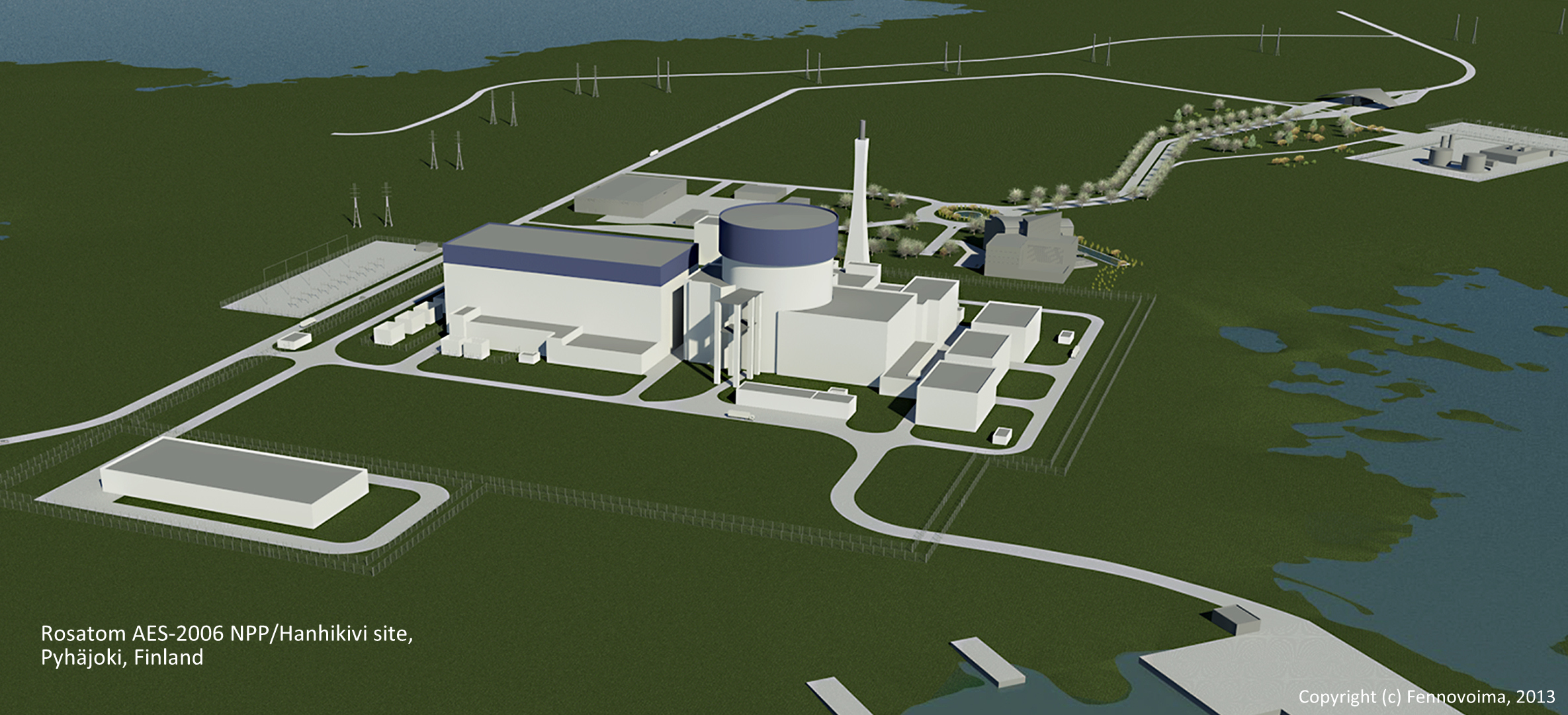
Russia’s Rosatom had offered a to supply the reactor for the 1,200 megawatt Hanhikivi 1 nuclear power plant for Fennovoima at Pyhäjoki in north-east Finland. The Finnish government had required Finnish ownership of greater than 60% as a condition for granting a license for construction. Construction is planned to start in 2015 for the plant to be in operation in 2024. With Finnish Fortum now taking a 15% share in the project, Finnish ownership now exceeds 65%.

The Finnish parliament has this morning has given the basic approval for construction to start.

Reuters:

Finland’s parliament on Friday approved plans to build a new nuclear plant supplied by Russia’s state-owned Rosatom despite East-West tensions over the Ukraine crisis.

With support from 115 parliamentarians against 74 opposed, the vote comes at a time when the European Union has called for EU member states to curb energy deals with Russia.

The Fennovoima reactor in northern Finland, which will be supplied and fuelled by Rosatom, is expected to begin output in 2024.

Hanhikivi 1

The AES-2006 model proposed for the Hanhikivi site (source: Fennovoima)

NEI: Finland’s Fennovoima and Rusatom Overseas have signed a Project Development Agreement aiming at a nuclear power plant supply contract for Hanhikivi 1 to be signed by the end of 2013.

The companies have set “common targets,” according to which negotiations will be carried out. They are also in talks over the possibility of Rusatom Overseas acquiring a 34% stake in Fennovoima.

The Russian 1200 MW AES-2006 pressurized water reactor (VVER) is being considered for the Hanhikivi 1 project, in northern Finland. The plant corresponds with IAEA and EUR requirements, according to Rusatom Overseas. However, for licensing purposes it “will be adapted to be in accordance with Finnish national safety standards.”

Direct negotiations with Rusatom Overseas begun in April 2013. Talks also started with Toshiba in February 2013, but will now only continue with the Russian firm.

Fennovoima, which is owned by 60 companies representing industry, trade, and energy sectors from all around Finland, said that before a plant supply contract is signed, all of Fennovoima’s owners must decide on their continuation in the project.

Foto: Fennovoima

Image Fennovoima


Break-even price for shale oil could be as low as $40 per barrel

November 28, 2014

UPDATE: Reuters – Saudi Arabia’s oil Minister Ali al-Naimi declares war on US Shale OIL


Yesterday Saudi Arabia got its way at the OPEC meeting and successfully resisted all calls for a cut in production to try and stop the decline of world oil prices.  It seems Saudi Arabia (which has the lowest oil production cost in the world) has chosen the strategy of maintaining an oil price low enough to put a cap on US shale oil production and provide a disincentive for new shale oil wells.

This strategy is premised on the break-even price for shale oil being at or above $80 per barrel for small production sites down to about $30 per barrel for large production sites. For example Credit Suisse estimated these levels as varying between $24 and $85 earlier this year.

shale oil break even estimates credit suisse

shale oil break even estimates credit suisse sep 2014


The US department of Energy puts sustainable break even values between $35 and $54. The Saudi calculations seem to be based on similar estimates. They appear to believe that with current oil prices moving down to about $70 per barrel, some of the smaller US oil shale wells are already uneconomic and that at this price new investment for further production sites will dry up.

But shale oil production costs are declining – fast. Costs are coming down following the learning curve for both capital costs and running costs. The analyst estimates are already out of date. My estimate is that actual break-even points are already down about 20% from those in the Credit Suisse estimate.

So I believe the Saudis have miscalculated. The average break-even world price for shale oil is probably – already – closer to $40 per barrel rather than $60-70 per barrel being assumed. While new investment in shale oil wells may well be toned down by world oil consumption, it will probably not be because world oil price is below some critical threshold. If the Saudis believe that any uptick in consumption will bring the oil price back up to over $80 per barrel, they are following a flawed strategy. We could be in for a decade of relatively low oil prices perhaps with a floor at around $40 per barrel and set by the average break-even for shale oil.

Consumers are still very wary. They are not sure that the reduction in oil price will be sustained and is not just a temporary dip which might lure them into a higher and more vulnerable consumption level. It will take a few months for them to see that OPEC has actually lost control over the world oil price but is still in denial about that. A sustained low oil price is what will trigger a new – and sustained – wave of global growth that is now so badly needed. The cartel is shrinking. New shale oil producers will all be outside the cartel – and the sooner Europe, China and India start production the better. But it is the beginning of the end of the OPEC cartel power.

History will – I think – show that the OPEC cartel lasted for 50 years. It will show that the cartel started in 1973 and that market forces of supply and demand were re-established around 2020.

Are shale oil and low prices the beginning of the end of the OPEC cartel?

November 24, 2014

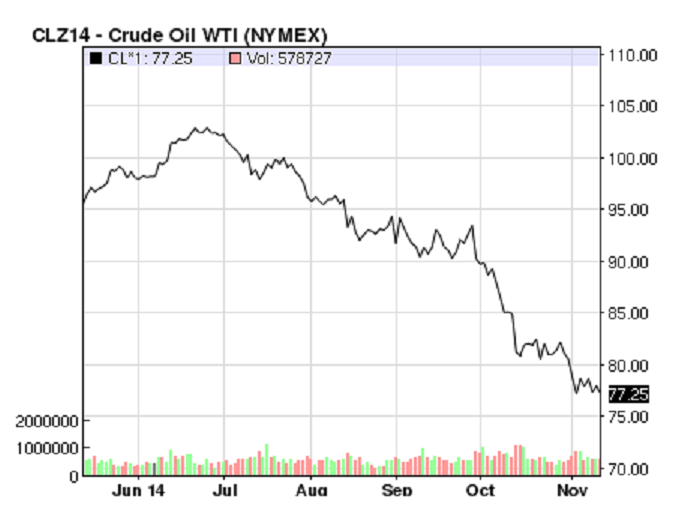
Currently US crude is at just above $76 per barrel and Brent oil is at about $80. OPEC members are meeting this week in Vienna and it is thought that cuts to oil production of between 0.5 million and 1.5 million barrels per day (bpd) are possible. The drop in oil prices since June (from around $110 per barrel is due to a glut which in turn is due to over production, large quantities of US shale oil becoming available and simultaneously a reduced demand from China and others. Saudi Arabia is conspicuous by not having made any significant production cuts so far. This could be due to one of 3 reasons:

  1. Saudi Arabia is testing the breaking point for some of the shale oil producers since some of the smaller shale wells probably have a break-even level of around $60-70 per barrel, or
  2. Saudi Arabia and the US are targeting Russia and Iran whose economies are vulnerable and very dependent on the oil price (and the Russians alone would lose some $100 billion in oil revenues per year), or
  3. Saudi Arabia is tired of bearing the brunt of the production cuts and is forcing some of the smaller OPEC producers to take their share of the pain of production cuts.

If cuts of less than 0.5 million barrels per day are made it is thought that the prices are headed down to about $60 per barrel. One analyst estimates that a cut of 2 million bpd is needed to get back up to $80 per barrel. Something in between will be – well – something in between.

I just don’t like cartels and especially when they are state sponsored cartels. So far shale oil production is just from the US, and the OPEC strangle-hold on oil price has yet to be broken. But, over time, I expect this cartel to weaken as other countries produce oil and gas from shale. I remain of the opinion that the OPEC cartel has – no doubt – enriched the oil producing countries but has only done so at the expense of the rate of development of non-producers. OPEC has done the global economy a disservice by holding back the developing countries and the strongest correlation in geopolitics is the link between energy consumption and development (not just GDP but also virtually every development parameter).

It may cause some short term turbulence but in the long run it will be a “good thing” even if oil price were to collapse to below $50 per barrel. Some producers will be hard hit but the net result for the global economy will be positive. So I shall be quite happy if OPEC cannot reach agreement on how much oil production to cut or if they make just a small cut. It is time for some of the the developing countries to get a break from the oil price extortion which has been in place since 1973. The sooner the OPEC cartel is rendered obsolete the better.

Reuters:

Some commodity fund managers believe oil prices could slide to $60 per barrel if OPEC does not agree a significant output cut when it meets in Vienna this week. Brent crude futures have fallen by a third since June, touching a four-year low of $76.76 a barrel on Nov. 14. They could tumble further if OPEC does not agree to cut at least one million barrels per day (bpd), according to some commodity fund managers’ forecasts. ….. 

Yet fund managers and brokerage analysts are divided over whether OPEC will reach an agreement on cutting output. Bathe put the likelihood at no more than 50 percent. Oil prices have been falling since the summer due to abundant supply, partly from U.S. shale oil, and because of low demand growth, particularly in Europe and Asia. As a result, some investors believe a small cut of around 500,000 bpd would not be enough to calm the markets. Doug King, chief investment officer of RCMA Capital, sees Brent falling to $70 per barrel even with a cut of one million bpd.

“With this, I would expect lower prices in the first half of 2015,” he said. If OPEC fails to agree a cut, prices will drop “further and quite quickly”, with U.S. crude possibly sliding to $60, he said. U.S. crude closed at $76.51 on Friday, with Brent just above $80. ……..

The market has been awash with conspiracy theories as to why Saudi Arabia has not already intervened. New York Times columnist Thomas Friedman hinted at “a global oil war under way pitting the United States and Saudi Arabia on one side against Russia and Iran on the other”. Hepworth argued that Saudi Arabia appeared pretty happy with current pricing levels and suggested they were waiting to see where the cut-off point for U.S. production was. “Time is on their side, they can afford to wait,” he said, stressing he was talking months, not years, but added if oil fell below $70 that waiting time “shrinks to weeks”.

Tom Nelson, of Investec Global Energy Fund, said he believed Saudi Arabia had allowed the price to fall to incentivise smaller OPEC producers, which often rely on the biggest producer to intervene, to join Riyadh in cutting output. “They (the Saudis) want to cut but they don’t want to cut alone,” Nelson said, adding that a cut of between one million and 1.5 million bpd should be sufficient to balance the market.

“The market really wants to see that OPEC is still functioning … if there is a small cut, with an accompanying statement of coherence from OPEC that presents a united front, and talks about seeing demand recovery, and some moderation of supply growth, then Brent could move up to $80-$90.”

Saudi attack on shale oil could backfire

November 12, 2014

If the recent drop in oil price has been engineered (even in part) by Saudi Arabia as an attempt to put some of the burgeoning shale oil production sites out of business they will need to go much further. A break-even for shale oil production is probably at less than $50 per barrel. In any event the drop so far (25%+ in 6 months) is just the fillip the world economy needs. Saudi Arabia is probably not as vulnerable as other oil producing countries but increasing production to drive down the oil price is a dangerous game which could be self-defeating. Whether the current glut is just due to reduced world (read Chinese) demand and increased shale oil (US) production or has also been exacerbated by increased Saudi production, the oil consumer wins. Consumption will increase – and that will automatically reduce the glut and further increase the production of oil from shale.

If the global economy is to come out of the doldrums it needs the Asian economies – the tigers, the dragon and the elephant – to start prowling in earnest. Increasing consumption in the developing world seems to be one of the most effective ways of stimulating the world economy. It inevitably leads to increased production of consumer goods in the developed countries. And this current step-reduction of oil price could be just the trigger that is needed.

Yesterday the price of crude (WTI) was at about $77 per barrel and that price is sufficient to keep even the small shale oil wells in operation.

crude oil price Nov 2014

crude oil price Nov 2014


Two years of $70 oil could be the boost the global economy needs desperately

October 27, 2014

There are two questions here of course:

  1. How will oil price develop over the next 2 years? And the only certain thing is that forecasts will be wrong, and
  2. Can the net difference between the positive effect on oil consuming countries and the negative effects on oil producing countries be sufficient to lift the global ecoonmy out of its doldrums?

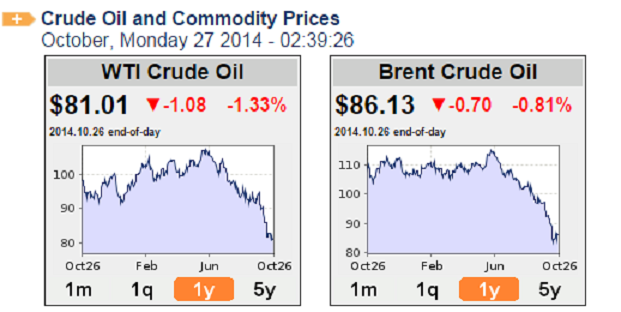
Oil prices have dropped 25% since June and currently WTI crude is at $81 and Brent crude is at $86 – down from around $110 – 115 in June. How far can prices drop and for how long? Of course this depends on supply and demand. But I think there is a new paradigm here and created by the injection of shale oil into the mix. I suspect that shale oil production now establishes a new floor price which means that the prices cannot drop lower than about $60 or possibly even $70. Oil from the traditional, large oil wells can still be produced profitably at much lower prices. But shale oil is more expensive to produce partly due to the costs of fracking but also due to smaller individual wells which last for shorter periods than the large oil wells. This in turn means that there is both a higher investment cost and a higher operating cost for shale oil compared to “traditional” oil. It is thought that as shale oil increases its contribution to the total mix, this production cost will set a floor for all oil at around $60-70 instead of the $30-40 needed for break-even (zero exploration) with traditional oil. The oil companies will maintain profits and dividends by scaling down jobs and their new exploration costs which is the variable they can play with . It is the oil producing countries who will lose tax revenues (offset by increased production – if any).
oil price 2710214 oil-price.net

oil price 27102014 oil-price.net

Goldman Sachs have forecast in a new research report that prices could drop to $70 by the second quarter of 2015.

Reuters 27/10: Brent crude futures fell below $86 a barrel on Monday after Goldman Sachs cut its price forecasts for the contract and for U.S. oil in the first quarter of next year by $15.

The U.S. investment bank said in a research note on Sunday that it had cut its forecast for West Texas Intermediate to $75 a barrel from $90 and that for Brent to $85 from $100, with rising production in non-OPEC countries outside North America expected to outstrip demand.

The bank expects WTI to fall as low as $70 a barrel and Brent to hit $80 in the second quarter of 2015, when it expects oversupply to be most pronounced.

Even Saudi Arabia now seems to have accepted that a regime of low prices will last  1 – 2 years.

Reuters 26/10The recent decline in global oil prices will prove temporary even if it lasts a year or so, since population growth will ultimately bring higher consumption and prices, the chief executive of Saudi Basic Industries Corp said on Sunday.

Mohamed al-Mady was speaking to reporters after the company, one of the world’s largest petrochemicals groups and the Gulf’s largest listed company, reported a 4.5 percent drop in third-quarter net income, missing analysts’ forecasts.

At these price levels for 2 years almost $3 trillion will shift from the “few” producers to the “many” consumers.  But most of this could fuel consumer growth (which it would not do to the same extent when in the hands of the oil producers). The consumer countries will also lose the foreign exchange constraints they must operate under for purchase of oil in US Dollars. It could release monies desperately needed for infrastructure projects. But the consumer countries need the prices to stay low for some time – and I would guess that 2 years is a minimum – for the public funds released to be utilised in “growth” projects.

The EconomistFor governments in consuming countries the price fall offers some budgetary breathing-room. Fuel subsidies hog scandalous amounts of money in many developing countries—20% of public spending in Indonesia and 14% in India (including fertiliser and food). Lower prices give governments the opportunity to spend the money more productively or return it to the taxpayers. This week India led the way by announcing an end to diesel subsidies. Others should follow Narendra Modi’s lead.

Producer countries will be hit. Russia has actually been helped by the fall in the rouble which has cushioned – a little – the rouble values of the dropping oil revenue.

The most vulnerable are Venezuela, Iran and Russia.

The first to crack could be Venezuela, home to the anti-American “Bolivarian revolution”, which the late Hugo Chávez tried to export around his region. Venezuela’s budget is based on oil at $120 a barrel. Even before the price fall it was struggling to pay its debts. Foreign-exchange reserves are dwindling, inflation is rampant and Venezuelans are enduring shortages of everyday goods such as flour and toilet paper.

Iran is also in a tricky position. It needs oil at about $140 a barrel to balance a profligate budget padded with the extravagant spending schemes of its former president, Mahmoud Ahmedinejad. Sanctions designed to curb its nuclear programme make it especially vulnerable. Some claim that Sunni Saudi Arabia is conspiring with America to use the oil price to put pressure on its Shia rival. Whatever the motivation, the falling price is certainly having that effect.

Compared with these two, Russia can bide its time. A falling currency means that the rouble value of oil sales has dropped less than its dollar value, cushioning tax revenues and limiting the budget deficit.

There are a number of other effects of $70 per barrel for oil.

Bio-fuels and bio-diesel, which are fundamentally unsound, have stayed alive on the back of subsidies on the one hand and a high oil price on the other. If the prices stay at $70 for 2 years or longer, land currently being wasted on bio-fuels could revert to food production. With lower fertiliser and transport costs in addition, a great deal of pressure on food prices go away. If the floor price is set by shale oil production costs, it may be too low for oil production from tar sands to take off in any big way. Electricity production costs will be bench-marked against the cost of gas turbine combined cycle plants.

But most importantly, another 2 years or longer with the public spending pressures reduced will allow a number of other countries to get their own shale oil (and gas) production going. And that will make Opec and the oil cartel obsolete. Oil and gas price speculation will no longer be possible.

It could provide the start for a long sustained period – perhaps even a decade or two – with oil prices stable at around $70 per barrel.
Bats attracted to wind turbines because they think they are tall trees?

October 26, 2014

A new study published in PNAS has used thermal imaging to test the the hypotheses that wind speed and blade rotation speed influenced the way that bats interacted with turbines.  They found that the air currents around slow speed turbines could be fooling the bats into thinking they were the air currents associated with tall trees. It is suggested that around trees the air currents led to the bats searching for roosts and nocturnal insect prey that could accumulate in such air flows. Thus bat behaviour which had evolved as being advantageous around tall trees might now be the reason why many bats die at wind turbines.

“Fatalities of tree bats at turbines may be the consequence of behaviors that evolved to provide selective advantages when elicited by tall trees, but are now maladaptive when elicited by wind turbines”.

Paul Cryan et al, Behavior of bats at wind turbines, PNAS, Vol. 111 no. 42,  15126–15131, doi: 10.1073/pnas.1406672111

Significance

Bats are dying in unprecedented numbers at wind turbines, but causes of their susceptibility are unknown. Fatalities peak during low-wind conditions in late summer and autumn and primarily involve species that evolved to roost in trees. Common behaviors of “tree bats” might put them at risk, yet the difficulty of observing high-flying nocturnal animals has limited our understanding of their behaviors around tall structures. We used thermal surveillance cameras for, to our knowledge, the first time to observe behaviors of bats at experimentally manipulated wind turbines over several months. We discovered previously undescribed patterns in the ways bats approach and interact with turbines, suggesting behaviors that evolved at tall trees might be the reason why many bats die at wind turbines.

Fig. 1.

Fig. 1 Still images of night-flying bats (green arrows) at wind turbines that were detected in thermal-infrared video footage. Cameras were positioned 12 m from the base of the turbine, looking up the 80-m monopole toward the nacelle (rectangular machinery enclosure) and rotor, to which three 40-m blades attach. Red circles represent the object identified as a bat by the automated software used for finding their presence in nightly (∼10 h) video recordings. A variety of detection conditions are illustrated, including a bat approaching fast-rotating (14 rpm) …

Abstract

Wind turbines are causing unprecedented numbers of bat fatalities. Many fatalities involve tree-roosting bats, but reasons for this higher susceptibility remain unknown. To better understand behaviors associated with risk, we monitored bats at three experimentally manipulated wind turbines in Indiana, United States, from July 29 to October 1, 2012, using thermal cameras and other methods. We observed bats on 993 occasions and saw many behaviors, including close approaches, flight loops and dives, hovering, and chases. Most bats altered course toward turbines during observation. Based on these new observations, we tested the hypotheses that wind speed and blade rotation speed influenced the way that bats interacted with turbines. We found that bats were detected more frequently at lower wind speeds and typically approached turbines on the leeward (downwind) side. The proportion of leeward approaches increased with wind speed when blades were prevented from turning, yet decreased when blades could turn. Bats were observed more frequently at turbines on moonlit nights. Taken together, these observations suggest that bats may orient toward turbines by sensing air currents and using vision, and that air turbulence caused by fast-moving blades creates conditions that are less attractive to bats passing in close proximity. Tree bats may respond to streams of air flowing downwind from trees at night while searching for roosts, conspecifics, and nocturnal insect prey that could accumulate in such flows. Fatalities of tree bats at turbines may be the consequence of behaviors that evolved to provide selective advantages when elicited by tall trees, but are now maladaptive when elicited by wind turbines.


Shale gas in Europe worries Putin

October 25, 2014

It might seem counter-intuitive for Russia to be against the advent and development of shale gas in Europe since they themselves have huge quantities of oil and gas bearing shale in SiberiaBut Russia has a very large investment in conventional natural gas production and pipelines (through Gazprom) which must be protected and nurtured. Putin needs to ensure revenues and that exports of conventional natural gas gives them a reasonable return on the investment before moving onto shale gas. About 30% of Europe’s gas comes from Russia. Russia needs Europe to go slow with its own shale gas production and to continue buying Russian gas at reasonably high prices for as long as possible. So much so that Russia has even been supporting anti-fracking groups in Europe. (It is a little ironic when the European anti-fracking alarmists take well disguised Russian funds and play into Russian hands).

The MotleyFoolNow there are accusations that Russia is working hard to keep Europe dependent on its gas supplies. According to Nato chief Anders Fogh Rasmussen, Russia is doing this by funding anti-fracking groups. That’s something that some of the larger groups deny, but it would be hard to suss out where all of their donations come from in the anti-fracking movement.

There are good reasons for Russia to undertake such a covert operation. For starters, Gazprom would suffer greatly if its European business started to slip away. Second, by keeping Europe hooked on Gazprom gas, Russia maintains a strong bargaining position in world politics.

That, however, just gives the United States more reason to come to the aid of its European allies. Right now, the export of U.S. natural gas is severely limited. With the combination of horizontal drilling and hydraulic fracturing (fracking) in the U.S., however, the flow of gas has outstripped demand and pushed U.S. domestic gas prices to record low levels.

While being able to sell natural gas to Europe would be a huge win for Europe politically and U.S. gas drillers financially, it would also be a big win for pipeline operators like Kinder Morgan (NYSE: KMI  ) . Moving natural gas from where it’s drilled to where it’s used made up roughly 50% of Kinder Morgan’s business last year. The business isn’t about natural gas prices, either; it’s about providing a service. CEO Richard Kinder describes it this way: “We operate like a giant toll road.” So, if natural gas starts going overseas, Kinder Morgan will be involved in the process and make money doing it.

The possibility of surplus shale gas from the US entering Europe and depressing sales of Russian natural gas is a nightmare economic scenario for Vladimir Putin. Even the recent drop in oil prices has seriously unbalanced the Russian budget which needs an oil price of over $100 to be in balance.

Putin takes part in final session of 11th Valdai International Discussion Club meeting

Putin at the 11th Valdai International Discussion Club meeting in Sochi

Putin is clearly worried. Russian President Vladimir Putin took part at the plenary session of the Valdai International Discussion Club in Sochi. He talked up the risks with US shale gas to Europe and talking up the benefits of Russian gas.

TassPutin: Europe’s transition to American shale gas will be suicidal for EU economies

Russian President Vladimir Putin believes that transition to shale gas will be suicidal for the EU economies. In his speech at the Valdai discussion club on Friday, Putin said that Russia’s trade turnover with the European Union stood at 260 billion dollars in the first half of 2014 even despite sanctions. He assumed, however, that the trade volumes could fall if Russia stopped all gas and oil supplies to Europe.

“We assume that it can happen at the will of our partners in Europe. But it’s hard to imagine,” Putin said, explaining that alternatives to Russian gas and oil supplies were worse.

It is either the crisis-hit Middle East where the “Islamic State” militants have stepped their operations or deliveries of shale gas and shale oil from the United States.

“We can imagine that /deliveries/ of shale oil and shale gas from the United States are possible. But how much it will cost?” Putin asked.

“This is going to be a direct way to reducing their own competitive ability because it is going to be more expensive than our pipe gas or oil delivered from deposits in Russia,” the Russian president went on to say.

“They are simply going to kill their competitive ability. What kind of a colony Europe should be to agree to this option. But I believe that common sense will prevail. The same is true of Asia,” Putin said in conclusion.

For very many reasons the very best thing that Europe (and Asia) could do would be to expedite the production of their own shale gas. It would bring down energy prices, stimulate growth, increase jobs, increase independence from Russia, increase exports, increase competitiveness against the US and consolidate energy intensive industries which are moving out. But this would have to overcome the opposition of the alarmist, European green parties who have a remarkable facility for being counter-productive.

Opposing the development of shale gas in Europe gives Russia the edge on the geopolitical playing field.