Archive for the ‘Engineering’ Category

About 3 hours to launch of ISRO’s GSLV-D5 mission

January 5, 2014

ISRO’s GSLV-D5 on the launch pad

Countdown Operations are underway at the Satish Dhawan Space Center on India’s East Coast from where a Geosynchronous Satellite Launch Vehicle will launch on a demonstration flight on Sunday at 10:48 UTC. GSLV is carrying the GSAT-14 communications satellite to Geostationary Transfer Orbit.

Links for live webcast, 3:52 PM IST onwards, today

http://webcast.isro.gov.in/
http://www.24framesdigital.com/isro/webcast/050114/

Chang’e 3’s Jade Bunny begins gambolling on the moon

December 15, 2013

Chang’e 3 landed on the moon on Saturday and her Jade Bunny has now started gambolling on the moon.

China’s first lunar rover separates from Chang’e-3 moon lander early Dec. 15, 2013. Picture was taken from the screen of the Beijing Aerospace Control Center in Beijing, capital of China. (Xinhua/Li Xin)

Xinhua:China’s first moon rover, Yutu, or Jade Rabbit, separated from the lander early on Sunday, several hours after the Chang’e-3 probe soft-landed on the lunar surface.

The 140 kg six-wheeled rover touched the lunar surface at 4:35 a.m., leaving deep trace on the loose lunar soil. The process was recorded by the camera on the lander and the images were sent to the earth, according to the Beijing Aerospace Control Center.

After the separation, the rover and lander will take photos of each other and start their own scientific explorations.

Engineers made final checks of the environment of the landing site, the situation of the probe and the solar incidence angle late night on Saturday and sent signals of separation to Chang’e-3.

Yutu, atop the probe, extended its solar panel and started to drive slowly to the transfer mechanism at 3:10.

The transfer mechanism unlocked at 4:06 with one side reaching the moon’s surface, allowing the rover to descend to the surface following a ladder mechanism.

Chang’e-3 landed on the moon’s Sinus Iridum, or the Bay of Rainbows, at 9:11 p.m. Saturday, making China the third country in the world to carry out such a rover mission after the United States and former Soviet Union. 

In ancient Chinese mythology, Yutu was the white pet rabbit of the lunar goddess Chang’e. The name for the rover was selected following an online poll that collected several million votes from people around the world. 

The rover, 1.5 meters long with its two wings folded, 1 m in width and 1.1 m in height, is a highly efficient robot controlled by the command center from the earth. It will face challenges including temperature differences of more than 300 degrees Celsius on the moon. 

Yutu will survey the moon’s geological structure and surface substances and look for natural resources for three months, while the lander will conduct in-situ exploration at the landing site for one year.


Volvo to test self-driving cars on Gothenburg streets in 2017

December 2, 2013

It is only a matter of time. As I get older it gets easier to drive. As it is, I already rely heavily on the car’s sensors and cameras when parking or reversing and especially at night. For parking in tight spots and getting as close to a wall as possible the proximity sensors work exceedingly well. And I miss them badly in very cold icy weather when my sensors are iced over. In 2017, 100 self-driving (autonomous) cars will be let loose on selected highways around Gothenburg with ordinary individuals as a test driver .

And it will not be long before the cars talk to each other.

Swedish Radio: (free translation)

Claes Tingvall, the Swedish Transport Administration’s Traffic Safety Director says that self-driving cars  cars are a prerequisite to achieving the “zero vision” of no fatalities due to traffic accidents. “One should be very careful with the word paradigm shift but for once, I think, it applies in the case of self-driving cars. If you look a little more into the long run, this is really like a fundamental solution to the problem of safety in a traffic system”, he says. To the question if this is what is needed to finally achieve zero fatalities he says, “Yes it is. And we are getting there”.

Self-driving cars thanks to cameras , GPS and various sensors detect the environment around the car . Therefore they can, all by themselves, can get around in traffic, so that the man behind the wheel can indulge in other things – read a book, for example. These robotic cars can virtually eliminate traffic accidents because computers are better at driving than humans and do not take unnecessary risks. “It is a fact that a machine, in most situations, is better able to deal with driving than a human”, says Claes Tingvall. “It will also be quite a careful driver. It is not going to take the risks that we as individuals are sometimes inclined to take. It will not be racing at 150 km/h at night with a drunken operator behind the wheel”.

Volvo’s autonomous car technology

Automakers around the world are right now intensively researching  self-driving cars. Among others Japanese Nissan has announced its intention of having self-driving models on the roads before 2020. Now Volvo has also joined the party.

The project, called “Drive Me” kicks off next year, and is a collaboration between Volvo, the Swedish Transport Administration, the Swedish Transport Authority , the City of Gothenburg and Lindholmen science park . In 2017, 100 self-driving cars will be let loose on selected highways around Gothenburg with ordinary individuals as a test driver .

“That’s what this kind of self- driving car provides, where it works with and supports the driver. It has its ears and eyes open and can intervene in situations when necessary. The effects will be enormous”, says Claes Tingvall.

Chinese Jade Bunny took off for the moon tonight

December 1, 2013

UPDATE!! 1st December 2013 2030 GMT

Xinhua: The probe’s carrier, an enhanced Long March-3B rocket, blasted off from the Xichang Satellite Launch Center in southwest China at 1:30 a.m. Chang’e-3 is expected to land on the moon in mid-December to become China’s first spacecraft to soft land on the surface of an extraterrestrial body.

It is also the first moon lander launched in the 21st century. The probe entered the earth-moon transfer orbit as scheduled, with a perigee of 200 kilometers and apogee of 380,000 kilometers. “The probe has already entered the designated orbit,” said Zhang Zhenzhong, director of the launch center in Xichang. “I now announce the launch was successful.”

========================

Various Xinhua reports

China will launch the Chang’e-3 lunar probe to the moon at 1:30 a.m. Monday from Xichang Satellite Launch Center, The Chang’e-3 programme encompasses a lander and a moon rover called “Yutu” (Jade Rabbit). The Chang’e-3 mission is the second phase of China’s lunar program, which includes orbiting, landing and returning to Earth. It follows the success of the Chang’e-1 and Chang’e-2 missions in 2007 and 2010.

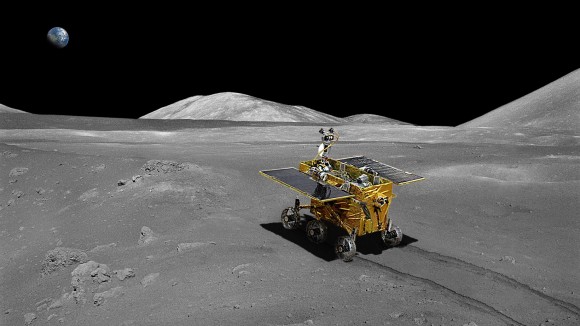
Artist's conception of the Chinese moon rover, called Yutu. Credit: CNSA

Artist’s conception of the Chinese moon rover, called Yutu. Credit: CNSA

The probe will be launched to orbit aboard an enhanced Long March-3B carrier which is more than three meters in diameter and 56.4 meters high. The mission will be the 25th launch of the Long March-3B, which is the most powerful launch vehicle in the Long March fleet.

After entering lunar orbit, Chang’e-3 will go through six stages of deceleration to descend from 15 km above to the lunar surface. The soft-landing processes of the U.S. and former Soviet Union’s unmanned spacecraft had no capacity to hover or avoid obstacles. Chang’e-3, on the other hand, can accurately survey landforms at the landing site and identify the safest spots on which to land.

In order to land quickly, the probe is equipped with high-precision, fast-response sensors to analyze its motion and surroundings. The variable thrust engine (completely designed and made by Chinese scientists) can generate up to 7,500 newtons of thrust.

But the real story I like of Chang’e and her Hou Yi and the reincarnation of Hou Yi as a Jade Bunny is this one from Over A Cuppa Tea. A Jade Bunny is much more evocative than a Jade Rabbit. Chang Er is perhaps a better phonetic rendition of Chang’e.

Once upon a time, there live two immortals in the Heaven, they are Hou Yi and Chang Er. Hou yi and Chang Er were lovers who goes through great obstacle before their love is approved by the Heaven.

The Heaven was ruled by the Jade Emperor and his Empress. One day, ten sons of Jade emperor accidentally transformed into the sun, and revolves around the earth playfully, causing great drought and suffering to the mortals below.

Worried and concern for the mortals, the Jade emperor summons the imperial archer, Hou Yi to help him solve the problem. Hou Yi then went to Earth and shot down nine of the Jade Emperor’s sons. The emperor had thought that Hou Yi would not harm any of his sons. Now that his sons are dead, the emperor was very furious. In anger, the emperor took away Hou Yi and his wife’s immortality and condemn them to live on Earth forever.

Chang*e and her jade bunny on the moon

Chang Er was grief stricken with her loss of immortality. Hou Yi could not bear to see his saddened wife, and so, he decided to steal the immortality pill from the heavenly medicine manufacturer so that both of their immortality could be restored. He manage to steal the pill from heaven, and brought it to Chang Er. He told her that they only need to take half of the pills to regain immortality.

In the meantime, the Jade Emperor found out about the stolen immortality pill, and command an imperial guard to retrieve the pills and catch both Hou Yi and Chang Er so that he could punish them for their misdeed.

And so, the imperial guard went down to earth in pursuit of the couple and the pill of immortality. But the guard himself was tempted by the idea of immortality. So he waited until Hou Yi is not at home, and attacked Chang Er who is defenseless at home. He demanded for the pill but Chang Er refused to hand it to him. Hou Yi, who seems to forget his arrows went back home to get it and discovered that his wife is in danger. He fought the imperial guard courageously.

Unfortunately, Hou Yi is an archer, not a fighter. He was stabbed right in his heart in front of Chang Er. Chang Er was grief stricken, and wishes to die with her husband too. However, Hou Yi’s dying wish was for Chang Er to regain her immortality and live happily for all eternity.

So, Chang Er took out the pill from her sleeves and swallowed the whole pill so that the guard would not be able to get it and obtain immortality. Right after swallowing the pill, Chang Er started to float towards the sky, and after flying for some time, she landed on the moon. She cried and grieve for her husband’s death.

Her cries was heard by a group of Jade Bunnies that lives on the moon. They went to her and listened to her story. These Jade Bunnies were captivated by Chang Er’s beauty and kindness towards them, so they built a palace for her to stay, knowing that she could never return to Heaven or Earth. They hailed her as their goddess and pledge allegiance to her. These bunnies can be seen pounding on the face of the moon on some cooking utensil.

It is believed that these Jade Bunnies are trying to make resurrection pills so that they could revive their Goddess’s love. It’s said that the resurrection pills is shaped like a mooncake. But it’s not dictate anywhere on whether Hou Yi was revived or not, but in many folklore, it’s told that Chang Er would bestow blessing of love and happiness to lovers who pray hard and sincere enough to the moon during mid-autumn.

According to my husband, however, there’s only one Jade Bunny on the moon, and it’s actually the reincarnation of Chang Er’s husband. He told me that the Jade Empress took pity on the couple, and so reincarnate Hou Yi as a Jade Bunny so that Chang Er will not be lonely on the moon. That explains why Chang Er can always be seen with a bunny everywhere she goes on the moon.

Heigh-ho, ISRO, it’s off to Mars we go

November 30, 2013

UPDATE!!

Trans-Mars injection has been completed successfully.

  • Trans Mars Injection (TMI) operations completed successfully. The liquid engine burn time was 1328.89 sec and the imparted incremental velocity was 647.96 m/sec.
  • Trans Mars Injection (TMI) operation began at 00:49 hrs (IST) on Sunday Dec 01, 2013.
  • Forward rotation of spacecraft, to put it into the right orientation to perform Trans Mars Injection (TMI) operation has been completed successfully at 00:30 hrs IST on Dec 1, 2013

=================

A big night for ISRO and congratulations are due! And not least for ISRO’s coverage of the event – almost live – on their Facebook page. (I have not been too enamoured of the ISRO website but somebody did a great job on the live updates).

The Indian Mars Orbiter (Mangalyaansuccessfully completed its final burn in earth orbit and has been inserted into a Trans Mars Trajectory (to be confirmed). It may just be one small step in Man’s exploration of space but it is a giant leap for ISRO. After spending a month in 6-ever increasing orbits around Earth the craft now has a 300 day journey to get to Mars with the possibility of 3 mid-course corrections before the liquid engine has to be fired up again to enter into orbit around Mars.

So far, so good!

A number of “firsts” for the Indian Space Research Organisation (ISRO) and, no matter what may now happen, a great many accomplishments already in the bag. The lack of a sufficiently powerful rocket necessitated that the craft first enter earth orbit and then the month-long, laborious compared to NASA, procedures where the space craft engine had to be used  to first to increase the earth orbits and then – tonight – be fired for an extended time (23 minutes) to be inserted into a heliocentric Trans Mars Trajectory.

Mission Operations Complex ISTRAC  Bangalore.

Mission Operations Complex ISTRAC Bangalore.

Photo

One hour before the final engine firing the craft was put under the control of its on-board computer which was to carry out the final burn. Forward rotation of the spacecraft to put it into the right orientation for the burn was carried out and completed about 20 minutes before firing. Engine firing started on schedule just before the craft reached perigee. The actual burn of the 440 N Liquid Engine lasted its planned 23 minute long firing entirely under local on-board computer control. The objective was to impart an incremental velocity of 648 m/s and the indications are that that was achieved. The engine firing manoeuver seems to have gone exactly to plan. The orbit determination team have now to confirm now confirmed the trajectory actually achieved.

The new heliocentric orbit is yet to be confirmed. confirmed

The ISRO chorus (with apologies to Walt Disney)

Heigh-ho, ISRO

It’s off to Mars we go

We keep on working all day long

Heigh-ho, ISRO 

Photo: Liquid Engine propels MOM into Mars Transfer Trajectory and India into interplanetary space !Trans-Mars injection has been completed successfully.

Liquid Engine propels MOM into Mars Transfer Trajectory and India into interplanetary space !Trans-Mars injection has been completed successfully. ISRO


Moment of truth approaches for India’s Mars Orbiter Mission

November 28, 2013

When everything is for the first time,achievements are incremental and there are very many critical “moments of truth” to meet and overcome. But now comes a very large “moment of truth” as ISRO prepares to inject the Mars Orbiter spacecraft into its Trans Mars Trajectory.

India’s Mars Orbiter (Mangalyaan) is currently in its final orbit around the earth and is scheduled to fire its 440 Newton liquid engine at 0049 hours IST on Sunday morning ( 1919 GMT Saturday 30th November).  It entered its final Earth orbit yesterday which has an orbital period of 5575 minutes (just under 4 days) and it should be approaching apogee later tonight (early hours of Friday morning) and the next engine burn will take place at perigee. Currently apogee is about 193,000 km from earth and perigee is around 350km.

The spacecraft must first be manoeuvred into the right attitude using its thrusters for the firing of its main engine which must then be fired to impart the correct change of velocity (delta-vee). Both, an incorrect attitude and/or an incorrect delta-vee are potential sources of error. Three mid-course corrections are planned  (the first on December 11th) but the margin of error allowable is still extremely small. Too low a velocity change could leave the craft in earth orbit or put it into a heliocentric orbit which does not get close enough to Mars. Too high a delta-vee would also put the craft into a heliocentric orbit which would eventually decay into the sun. I believe there is no chance of achieving a velocity high enough to escape the sun. And even if the velocity change is correct but the direction is too far in error then just another orbital path around the sun would result.

NDTV:“The trans-Mars injection- we are planning to depart on December 1, 2013 early hours of 00:49 hours IST and we are going to burn a liquid engine for duration of roughly 23 minutes which will impart an incremental velocity of 648 metres per second consuming a fuel of 198 kgs,” ISRO Scientific Secretary V Koteswara Rao told reporters in Bangalore.

K. Radhakrishnan, ISRO Chairman. (For the) trans-Mars injection and its insertion into the Martian orbit, the firing of the liquid engine is done in a closed loop mode. Here, a precision accelerometer is used to estimate the incremental velocity added as the liquid engine burns and when the accelerometer gives a feedback that the required incremental velocity added to the spacecraft has been achieved, the burning of the liquid engine is automatically terminated. So, minor variations in the performance of the liquid engine will not matter because we are cutting off its burning based on the delta-v that is achieved. That is why we call it closed loop of firing. … The spacecraft’s propulsion system, i.e., the 440 Newton liquid engine, will complete its first phase of operations on December 1. It has to be re-started for its operation on September 24 (2014).

MOM Trans Mars Injection ISRO

MOM Trans Mars Injection ISRO

ISRO: This voyage is achieved by a combination of navigation and propulsion technologies, governed by the gravity of Sun and Mars, and assisted by the 440 N Liquid engine. Further fine tuning of the trajectory is achieved using the Attitude and Orbit Control Thrusters during the Trajectory Correction maneuvers planned en route.

… on December 11, we plan to have one small firing for mid-course correction of the spacecraft. There may be one more mid-course correction during the helio-centric phase, and subsequently, a fortnight before the spacecraft’s arrival near Mars, there will be one more mid-course correction. So there will be three mid-course corrections between December 1, 2013 and September 24, 2014. 

Mangalyaan is eventually to be placed into a Martian orbit, with a periapsis height of 365 km, apoapsis height of 80,000 km and an orbital period of about 77 hours.

So on Saturday I shall have as many of my fingers crossed as I can manage. I suspect there will be many others doing the same across India.

Political statues in India cost more than the Mars Orbiter Mission

November 24, 2013

A very critical moment for the Indian Mars Orbiter Mission (Mangalyaan) comes a week from today when the spacecraft’s engine has to be fired as it reaches perigee in its Earth orbit, to insert  it into  a trajectory to reach Mars some 10 months later.

The Mission has been criticised both in the West and in India (here and here for example) as being too expensive, too elitist and the wrong priority for a developing country like India. I think such criticism misses the point. The Indian Mars Orbiter Mission is primarily a test of technology and capability and self-confidence and self-belief”. The cost pales in comparison with the spend on religious festivities and what other much less productive projects can cost. As an example of what frugal engineering can achieve, the inspiration and ingenuity it can foster is immeasurable.

Manoj KumarPatairiya writes in the New York Times:

If the Mars Orbiter successfully reaches the vicinity of the planet in September 2014, after 300 days’ journey into deep space, it will make India the first Asian country and the fourth in the world to reach the red planet. …. The mission has, however, started an intense debate. While its supporters trumpet its incredibly low cost of around $75 million (a fraction of the cost of a similar American expedition), critics question the logic behind spending any amount when India is dealing with such deep-rooted problems as widespread hunger, poverty and corruption. ……. 

But U. R. Rao, a former chairman of the Indian Space Research Organization, compared the $75 million spent on the mission to the amount Indians spend on Diwali crackers for one day: “For going all the way to Mars, just one-tenth of the money is being spent. So, why are they shouting?”

Part of the reason the mission is so much less expensive is that it is able to take advantage of existing deep space communications systems and navigation support from NASA. But India is becoming known for its low-cost innovations in many diverse fields, including health care, renewable energy, sanitation, mobile technology and tablet computers. Indian scientists like to share this anecdote: “Americans spent millions to develop a pen that will not leak in space, whereas Russians used a pencil!”

The cost of the Indian Mars mission is about $75 million and just to put it into perspective:

  • Mayawati’s park in Noida was constructed at the cost of $130 million, and has 24 huge statues of elephants, and one of herself.
  • the total cost to build the Narendra Modi sponsored “Statue of Unity” is estimated to be about $340 million

Politicians will of course argue that the “feel-good” effects generated by such monuments to themselves or their heroes are well worth the cost!

If the MOM succeeds in its main objectives, there is even a case for using the window that is coming in 2018 to attempt a manned trip around Mars and back in 501 days.

Boeing issues warning: Further icing problems with GE GenX engines on Boeing aircraft

November 23, 2013
GenX 2B GE

GenX 2B GE

UPDATE:

Reuters: Boeing advised airlines on Friday about a risk of engine icing problems on its new 747-8 and 787 Dreamliner planes with engines made by General Electric, urging 15 carriers to avoid flying them near high-level thunderstorms. 

The move followed six incidents from April to November involving five 747-8s and one 787 when aircraft powered by GE’s GEnx engines suffered temporary loss of thrust while flying at high altitude. The problem was caused by a build-up of ice crystals, initially just behind the front fan, which ran through the engine, said a GE spokesman, adding that all of the aircraft landed at their planned destinations safely.

Boeing on Friday issued a notice prohibiting the affected aircraft from flying at high attitude within 50 nautical miles of thunderstorms that may contain ice crystals.

Icing problems with GE engines on Boeing’s Dreamliner has led to Japan Airlines pulling the Dreamliner from two international routes.

This comes on top of the icing problems noticed recently on the latest 747 cargo aircraft. A few weeks ago it was reported that a number of the latest long-haul Boeing 747 cargo aircraft fitted with the new GenX series of GE engines experienced engine icing problems when flying in particular cloud conditions at 41,000 feet:

Wall Street JournalIcing Hazards Surface on Boeing’s Newest 747 Jet

Years after aviation-safety experts thought they had eliminated the danger of airliner engines abruptly shutting down from internal ice accumulation, the same airborne hazard is showing up on a new generation of Boeing Co. jumbo jets.

The Chicago plane maker and General Electric Co., whose engines are installed on the biggest and newest Boeing 747 model, are now working together on fixes to prevent ice buildup that can prompt the giant airliner’s engines to temporarily malfunction or even stop working while cruising roughly 7 miles, or 41,000 feet, above the earth.

A GE spokesman said there are proposed software changes—which still need to be tested and then approved by the Federal Aviation Administration—designed to detect the presence of ice crystals in the atmosphere and eject the tiny particles before they form a coating deep inside engines that can melt or break into chunks.

… challenges with the GEnx-2B engines on extra-long 747 aircraft—known as 747-8s—highlight complex and nagging icing hazards that once again are forcing industry leaders and an international research team to scramble for answers. Before the partial government shutdown, according to industry officials, the FAA was moving toward mandating modifications to the 747-8’s computerized engine controls and making plans to warn pilots about susceptibility to internal engine icing while flying over storm-prone regions at roughly 40,000 feet.

Previously, experts believed such icing occurred primarily below 25,000 feet. ….

These cases of icing are different to those normally encountered and which are relatively well understood.

Aviation Week: 

….. The AirBridge Cargo event is the latest in a growing number of engine-icing incidents, which have triggered recent changes in international certification requirements. Unlike traditional engine icing, in which supercooled liquid droplets freeze on impact with exposed outer parts of the engine as the aircraft flies through clouds, engine core ice accretion involves a complex process where ice particles stick to a warm metal surface. These act as a heat sink until the metal surface temperature drops below freezing, thereby forming a location for ice and water (mixed-phase) accretion. The accumulated ice can either block flow into the core or shed into the downstream compressor stages and combustor, causing a surge, roll-back or other malfunction.

Until relatively recently, it was assumed that ice particles would bounce off structures and pass harmlessly through bypass ducts, or melt inside the engine. Now, there is evidence of an environment where a certain combination of water, ice and airflow is susceptible to accreting ice. Like many of the other known core icing events, the ABC 747-8F incident occurred near convective clouds. When incidents were first reported, investigators initially assumed supercooled liquid water, hail or rain were responsible because they had been lifted to high altitudes by updrafts. Yet most events have been recorded above 22,000 ft., which is considered the upper limit for clouds containing supercooled liquid water. ……

To find out exactly what is happening inside the convective systems that most frequently cause core icing, particularly in mid-latitude and tropical regions, an international team plans to conduct the High Ice Water Content (HIWC) test campaign in Darwin, Australia. The team includes NASA, FAA, Environment Canada, Transport Canada, Airbus, Boeing, the U.S. National Center for Atmospheric Research and the Australian Bureau of Meteorology. Also joining the effort will be the European Union’s High Altitude Ice Crystals (HAIC) project, which will be contributing a specially configured Falcon 20 research aircraft. ……

But now Boeing has warned all its clients who use aircraft with GE’s GenX engines not to fly them near certain kinds of storm clouds. And Japan Airlines whose Boeing 787 Dreamliners are powered by GenX engines has pulled the aircraft from two of its international routes:

Reuters: Japan Airlines (JAL)  said on Saturday it will pull Boeing 787 Dreamliners from two international routes after the U.S. aircraft maker notified it of icing problems in engines produced by General Electric .

Japanese carrier said Boeing notified airlines not to fly aircraft with GE’s GEnx Series engines near storm clouds following a recent incident in which a 747 aircraft experienced a loss of thrust after flying through anvil cloud.

As a result, JAL will replace Dreamliners on its Tokyo-Delhi and Tokyo-Singapore flights with other types of aircraft while also dropping a plan to use 787s for its Tokyo-Sydney route from December.

JAL will continue to fly 787s for other international and domestic routes, which are unlikely to be affected by cumulonimbus cloud for the time being.

MOM turns its camera on Earth while preparing for critical insertion into Mars trajectory

November 21, 2013

While the MOM spacecraft “Mangalyaan” is in orbit around Earth, its systems and scientific instruments are being tested to prepare for the critical burn at 0036 IST on 1st December (1906 GMT 30th November) to inject it into a Mars trajectory. The colour camera has been turned on Earth during testing and ISRO has released this photograph.

This image was taken yesterday at around 1350 hrs (IST) from a height of almost 70,000 km above earth and has a spatial resolution of 3.5 km.

Earth from MOM 20131120 image ISRO

Earth from MOM 20131120 image ISRO

The spacecraft’s engine has so far been fired as follows:

  • first orbit-raising manoeuvre 416 seconds
  • second orbit raising manoeuvre 570.6 seconds
  • third orbit raising manoeuvre 707 seconds
  • fourth orbit-raising manoeuvre (time not specified, firing curtailed inadvertently)
  • fourth supplementary orbit raising manoeuvre 303.8 seconds
  • fifth orbit raising manoeuvre 243.5 seconds

The next critical burn (the seventh) has to to use the 440 Newton liquid engine again to impart a delta-v of nearly 648 m/s and the engine will have its longest burn time of 1,351 seconds. Three mid course corrections on the spacecraft’s journey to Mars are planned for and the fuel carried has to also cater for finally braking to enter into Mars orbit.

The Hindu carries a long, fascinating interview with  K. Radhakrishnan, ISRO Chairman. The article is a little unusual in its length and technical detail which most Indian newspapers would fight shy of! Some selected extracts below but the entire interview is worth reading:

After the Polar Satellite Launch Vehicle (PSLV-C25) put India’s Mars Orbiter into a perfect earth-bound orbit on November 5, it has been a smooth journey so far for the spacecraft. The Indian Space Research Organisation (ISRO) boosted the Mars Orbiter’s apogee in six complex manoeuvres executed between November 7 and 16. ISRO did this by giving commands from the ground to the spacecraft’s propulsion system, called 440 Newton engine, to fire. A crucial event of the trans-Mars injection of the spacecraft will take place on December 1 by a prolonged firing of the 440 Newton engine.

…. Till now, we have completed six manoeuvres including a supplementary one. Currently, the spacecraft’s apogee is 1,92,915 km. 

In the early hours of December 1, around 00.36 hours, we have the trans-Mars injection of our Mars spacecraft. On that day, we are going to use the 440 Newton liquid engine again to impart a delta-v, that is, an incremental velocity of nearly 648 metres a second to the spacecraft and the engine will burn for 1,351 seconds. It is crucial in the sense that we need to give the exact velocity required to take the spacecraft from the earth-orbit, passing through the sphere of influence of the earth which extends up to 9.25 lakh km from the earth, cruise through the long helio-centric phase, then get into the sphere of influence of Mars, and on its arrival near Mars on September 24, 2014, it has to be put into 376 km plus or minus 50 km above Mars at that point of time. On the same day, the next crucial operation of the spacecraft’s Mars orbit insertion has to take place. When this running of the 440 Newton liquid engine takes place on December 1, we also have eight numbers of 22 Newton control thrusters firing. 

There are two tasks for them. One is the spacecraft’s attitude control. Secondly, if it is required, they will aid the 440 Newton thrusters to augment its thrust-level. Both the functions will be performed and the Mars spacecraft will then be moving towards the helio-centric orbit. Then on December 11, we plan to have one small firing for mid-course correction of the spacecraft. There may be one more mid-course correction during the helio-centric phase, and subsequently, a fortnight before the spacecraft’s arrival near Mars, there will be one more mid-course correction. So there will be three mid-course corrections between December 1, 2013 and September 24, 2014. 

With the velocity imparted to the spacecraft on December 1, 2013, we will have an estimate of its expected position on September 24, 2014. We will be continuously tracking the spacecraft and if there are deviations vis-à-vis the end goal, we will make the corrections. So December 1 will be a crucial operation. The spacecraft’s propulsion system, i.e., the 440 Newton liquid engine, will complete its first phase of operations on December 1. It has to be re-started for its operation on September 24. There is thus a long gap. 

How confident are you that you can re-start the 440 Newton engine after it has hibernated in deep space for about 300 days during the spacecraft’s voyage? 

We have been using the 440 Newton engine for our Geo-synchronous Satellite – GSAT- missions where the spacecraft’s orbit has to be raised about a week after its launch. In the case of Chandrayaan-1, we had to restart the operation after a fortnight. For that, we had qualified the liquid engine in 2008 to restart after one month. 

During the last two years, considering the specific requirements of our Mars Orbiter Mission for re-starting the spacecraft’s 440 Newton engine after it has idled for about 300 days, we had done these two actions. One is we have provided a set of parallel circuits for the propellants’ flow-lines and also provided redundancy in the form of a latch-valve. So what essentially happens is that one portion of the fluid circuit will be closed after December 1. The parallel path will be energised for the operation in September 2014. 

……. In the spacecraft’s orbit-raising manoeuvres, during its trans-Mars injection and its insertion into the Martian orbit, the firing of the liquid engine is done in a closed loop mode. Here, a precision accelerometer is used to estimate the incremental velocity added as the liquid engine burns and when the accelerometer gives a feedback that the required incremental velocity added to the spacecraft has been achieved, the burning of the liquid engine is automatically terminated. So, minor variations in the performance of the liquid engine will not matter because we are cutting off its burning based on the delta-v that is achieved. That is why we call it closed loop of firing. …… 

Up to (925,000) km from the Earth, the spacecraft will be in the sphere of influence of the Earth. Subsequently, it will be moving into the helio-centric phase of its flight. It is a long one, where you have to look at the influence of other planets and the Moon and then the solar radiation pressure acting on the spacecraft. That pressure varies with respect to time because the geometry of the sun and the spacecraft matters here. This is something we have not done so far and this helio-centric phase of the flight is new to us. 

In Chandrayaan-1, we had travelled up to (400,000) km, which was well within the sphere of influence of the Earth. But here for the first time, we are moving out of the sphere of influence of the earth. So how the spacecraft will behave during the helio-centric flight of 680 million km along the arc is new to us. Then the spacecraft gets into the sphere of influence of Mars which is nearly six lakh km from Mars. 

From our understanding of the Mars gravity model, the influence of the atmosphere of Mars, the influence of the two satellites of Mars and the solar radiation pressure there on the spacecraft are very important. This is also a new thing that we are attempting. 

So the navigation of the Mars spacecraft from the orbit of the Earth to the orbit of Mars, passing through all these three phases, is a new knowledge that we are acquiring and validating during the next 300 and odd days.

Read the whole article.

Alternate paths to Mars: NASA’s MAVEN compared to India’s MOM

November 16, 2013

Update! 18th November 2013. The launch of MAVEN – in about 1 hour from now – can be seen live on NASA TV.

The Indian Mars Orbiter Mission is primarily a test of technology and capability and self-confidence and self-belief.

With a very limited budget.

The scientific investigations of the planet and the Martian atmosphere are only a secondary or even a tertiary objective. For the Indian mission everything is virtually for the first time. For NASA and the US, the MAVEN mission which is due to launch on Monday 18th November is the 15th Mission to Mars. The first mission (Mariner 3) failed and the second mission, Mariner 4, launched in November 1964 was the first to reach Mars. In the 49 years since there have been a few failures (Mariner 8 in 1971, Mars Observer 1992, Mars Climate Orbiter in 1998 and the Mars Polar lander/Deep Space2 in 1999) and some spectacular successes for NASA with the Mars Global Surveyor in 1996 , the Phoenix Mars Lander in 2007 and the Mars Rover in 2011.

Many Mars missions have failed. Between 1960 and 1971 the Russians (USSR) failed in 11 attempts to send a spacecraft to the vicinity of Mars. The 12th attempt with M-71 in 1971 succeeded in orbiting Mars. Of eight further attempts by Russia, 4 failed to reach Mars. The Japanese Nozomi failed while cruising. Two European missions led to one orbiter (but a failed landing) and one flyby.

On the surface they may both seem to be similar in that both are attempting to get a spacecraft into orbit around Mars. But the missions are, in reality, quite different. MOM is essentially a first-time test of technology and capability whereas MAVEN is primarily a scientific mission utilising the deployment of now well proven US technology. Technology development on the one hand and a scientific investigation on the other.

1. NASA’s Mars Atmosphere and Volatile EvolutioN (MAVEN) is a space probe designed to study the Martian atmosphere while orbiting MarsIndia’s Mars Orbiter Mission (MOM – “Mangalyaan”) is a space probe designed to explore Mars’ surface features, morphology, mineralogy and Martian atmosphere using indigenous scientific instruments while orbiting Mars.

2. MAVEN is expected to have a budget of about $672 million. MOM has a budget of about $70 million.

3. The Atlas 5 rocket to be used to launch MAVEN has the capability to lift about 7,000 kg directly into a Geostationary transfer orbit (GTO). This allows MAVEN (2500 kg) to be injected directly into a Trans-Mars trajectory from launch.

The PSLV to be used for MOM can lift about 1300 kg into a GTO. With the MOM having a mass of 1337 kg, it becomes necessary for a  launch first into earth orbit and then a multi-step transition  through ever increasing earth orbits and finally into a Trans-Mars trajectory.

4. MAVEN is due to launch on an Atlas 5 rocket at 1:28 p.m. EST (1828 GMT) on Monday (Nov. 18) from Florida’s Cape Canaveral Air Force Station. Within one hour of launch MAVEN will be in a Hohmann Transfer Orbit with periapsis at Earth’s orbit and apoapsis at the distance of the orbit of Mars. MAVEN should reach Mars orbit on 22nd September 2014.

MAVEN trajectory - NASA-LASP-JPL

MAVEN trajectory – NASA-LASP-JPL

Because of the relatively low payload capability of the PSLV for an interplanetary mission MOM will spend more than four weeks in earth orbit and has to be equipped with radiation shielding to endure the numerous passages through earth’s radiation Belts. MOM has fired its Liquid Motor six times – always when passing perigee to gradually increase the apogee of the orbit to work its way up to departing Earth orbit in a fuel-efficient manner. The sixth (including one correction) firing yesterday placed the spacecraft in a 600 by approx 193,000 kilometer orbit around Earth and sets up the proper perigee passage for the final engine burn that puts the vehicle onto its Trans-Martian Trajectory using s standard Hohmann Transfer Orbit on 30th November/ 1st December. MOM should reach Mars orbit on 24th September 2014 (2 days after MAVEN).

mangalyaan trajectory

mangalyaan trajectory

5. MAVEN’s body has a cubical shape of about 2.3 m x 2.3 m x 2 m high, spans a total of 11.4 m with its solar panels deployed and has a lift-off mass of  2,454 kg (including fuel) and has a dry payload of 903 kg.

Mangalyaan’s body is a cuboid measuring about 1.5 m per side, a span of 4.2 m with solar panels deployed and an initial mass of 1337 kg of which 852 kg is fuel.

MAVEN - MOM (NASA- ISRO)

MAVEN – MOM (NASA- ISRO)

6. MAVEN is carrying 8 main, highly sophisticated instruments. Neutral Gas and Ion Mass SpectrometerImaging Ultraviolet SpectrographMagnetometerSolar Wind Electron AnalyzerSupraThermal And Thermal Ion CompositionLangmuir Probe and Waves antennaSolar Energetic ParticlesSolar Wind Ion Analyzer

Mangalyaan is carrying a camera, two spectrometers, a radiometer and a photometer. Together, they have a weight of about 15 kg.

7. MAVEN is targeting a science orbit of 150 by 6,200 Kilometers at an inclination of 75 degrees. It will perform measurements from a highly elliptical orbit around Mars over a period of one Earth year, with five “deep dips” at 150 km minimum altitude to sample the upper atmosphere.

Mangalyaan will be much further out and targets an operational orbit of 365 by 80,000 Kilometers with an inclination of 150 degrees and a duration of 76.72 hours from where it will perform its science mission. The MOM mission in Mars orbit is open-ended and is expected to last about 160 days.

8. MAVEN’s science phase features regular communication sessions. The spacecraft points its High Gain Antenna at Earth for high data rate communications twice per week with the exact timing depending on Deep Space Network visibility. Those comm sessions take place on Tuesday and Friday and have a duration of eight hours during which at least five hours of Earth pointing are required to downlink all science data and housekeeping telemetry. 

Mangalyaan is equipped with a 2.2-meter diameter High Gain Antenna which is a parabolic X-Band reflector antenna that is used for data downlink and command uplink. Science data and spacecraft telemetry is stored in two 16Gb Solid State Recorders aboard the vehicle for downlink during regular communications sessions. Low and Medium Gain Antennas are used for low-bandwidth communications such as command uplink and systems telemetry downlink.

As missions go, MAVEN represents a Mercedes “S” class to the Volkswagen that is MOM.

Mangalyaan - MOM (ISRO)

Mangalyaan – MOM (ISRO)

Sources: 

http://www.spaceflight101.com/

http://www.spaceflight101.com/mars-orbiter-mission.html

http://www.spaceflight101.com/maven-mission-profile.html

http://www.nasa.gov/missions/index.html#.UodLu8SkoYE

http://www.space.com/

http://www.isro.org/mars/home.aspx