Archive for the ‘Environment’ Category

How can we – if we should – prepare for a new Little Ice Age?

August 22, 2010

It seems that we are in a Solar Cycle Minimum – a Landscheidt Minimum which will perhaps be comparable to the Maunder Minimum.

The last decade has seen flat or declining global temperatures.

The Ocean temperature oscillations could indicate 20 or 30 years cooling ahead of us.

If these are all indicators of a coming Little Ice Age, then it may be time to take some preparatory actions to help humans adapt. I think adaptation to Climate Change when it happens is the key not some mis-guided and futile attempt to prevent the Climate Change from happening (as being proposed by the IPCC and other global warming fanatics).

image: http://t2.gstatic.com/images?q=tbn:TtpOoja-ueuOLM:http://www.wilsonsalmanac.com/images3/frost_fair_C18.jpg

The question which is more for engineers rather than for scientists is “What are the actions that could be taken to prepare and help for such an adaptation?”

Increasing whiskey production can save the environment

August 21, 2010

By-products from distilling whiskey produce a biofuel with 30% more power output than ethanol !

Using samples from the Glenkinchie Distillery in East Lothian, researchers at Edinburgh Napier University have developed a method of producing biofuel from two main by-products of the whisky distilling process – “pot ale”, the liquid from the copper stills, and “draff”, the spent grains. The new method developed by the team produces butanol, which gives 30% more power output than the traditional biofuel ethanol. It is based on a 100-year-old process that was originally developed to produce butanol and acetone by fermenting sugar. The team has adapted this to use whiskey by-products as a starting point and has filed for a patent to cover the new method. It plans to create a spin-out company to commercialise the invention. Butanol is superior to ethanol — with 25 – 30% t more energy per unit volume. The biofuel can also be introduced to unmodified engines with any gasoline blend, whereas ethanol can only be blended up to 85 percent and requires engine modification.

Read more:http://solveclimate.com/blog/20100817/scottish-scientists-develop-whisky-biofuel

Professor Martin Tangney, who directed the project said that using waste products was more environmentally sustainable than growing crops specifically to generate biofuel. “What people need to do is stop thinking ‘either or’; people need to stop thinking like for like substitution for oil. That’s not going to happen. Different things will be needed in different countries. Electric cars will play some role in the market, taking cars off the road could be one of the most important things we ever do.”

“The production of some biofuels can cause massive environmental damage to forests and wildlife. So whisky powered-cars could help Scotland avoid having to use those forest-trashing biofuels,” said Dr Richard Dixon, of WWF Scotland.

“DRINK IT and then DRIVE IT” has a nice ring to it and  is something I could enjoy supporting.

Climate models don’t need the sun – “Venus is similar to Earth” !!!

August 17, 2010

Japanese Spacecraft Approaches Venus

Venus Climate Orbiter “AKATSUKI”

This from NASA Science News:

[Global view of Venus]

Imamura is the project scientist for Akatsuki, a Japanese mission also called the Venus Climate Orbiter. The spacecraft is approaching Venus and will enter orbit on December 7, 2010. Imamura believes a close-up look at Venus could teach us a lot about our own planet.

“In so many ways, Venus is similar to Earth. It has about the same mass, is approximately the same distance from the sun, and is made of the same basic materials,” says Imamura. “Yet the two worlds ended up so different. We want to know why.”

Considering NASA’s own Venus fact sheet and the fact that Venus is about 41 million km closer to the sun it is – in the kindest interpretation – sloppy to permit a statement that “Venus is similar to earth.. approximately the same distance from the sun”.

“By comparing Venus’s unique meteorology to Earth’s, we’ll learn more about the universal principles of meteorology and improve the climate models we use to predict our planet’s future” says Imamura.

Of course the models will no doubt take into account that solar radiation on Venus is about  2688 J while the Earth receives 1365 J or perhaps the models don’t need the sun and will base everything on the heating effects of carbon dioxide.

I would have thought that it is the differences between Venus and Earth which can be revealing and to consider a distance of 41 million km closer to the sun as being negligible does not inspire confidence in any subsequent climate modelling.

Flattening the Mann hockey stick

August 15, 2010

The shape of Mann’ s hockey stick is morphing. The long horizontal handle (obtained by eliminating the MWP)  actually turns out to be sloping and the sharp upturn gets flattened.

WUWT reports a new and important study on temperature proxy reconstructions (McShane and Wyner 2010) submitted into the Annals of Applied Statistics and is listed to be published in the next issue.

A Statistical Analysis of Multiple Temperature Proxies: Are Reconstructions of Surface Temperatures Over the Last 1000 Years Reliable?

BY BLAKELEY B. MCSHANE∗ AND ABRAHAM J. WYNER†
Northwestern University∗ and the University of Pennsylvania†
This paper is a direct and serious rebuttal to the proxy reconstructions of Mann. It seems watertight on the surface, because instead of trying to attack the proxy data quality issues, they assumed the proxy data was accurate for their purpose, then created a bayesian backcast method. Then, using the proxy data, they demonstrate it fails to reproduce the sharp 20th century uptick

FIG 16. Backcast from Bayesian Model of Section 5. CRU Northern Hemisphere annual mean land temperature is given by the thin black line and a smoothed version is given by the thick black line. The forecast is given by the thin red line and a smoothed version is given by the thick red line. The model is fit on 1850-1998 AD and backcasts 998-1849 AD. The cyan region indicates uncertainty due to t, the green region indicates uncertainty due to β, and the gray region indicates total uncertainty.

The Mann Hockey Stick
Multiproxy reconstruction of Northern Hemisphere surface temperature variations over the past millennium (blue), along with 50-year average (black), a measure of the statistical uncertainty associated with the reconstruction (gray), and instrumental surface temperature data for the last 150 years (red), based on the work by Mann et al. (1999). This figure has sometimes been referred to as the hockey stick. Source: IPCC (2001).

The authors conclude that:

“…..we conclude unequivocally that the evidence for a ”long-handled” hockey stick (where the shaft of the hockey stick extends to the year 1000 AD) is lacking in the data.…..Climate scientists have greatly underestimated the uncertainty of proxy based reconstructions and hence have been overconfident in their models.”


Arctic melt season seems to be over for 2010

August 13, 2010

From the DMI mean temperatures above 80 degrees North it would seem that the Arctic melt season is over. Temperatures are now clearly below zero. This year it has been about 8 days shorter than the average melt season (green line below) of about 67 days.

Arctic tempereatures

IPCC / GISS: This is fraud !

August 12, 2010

Post by Willis Eschenbach in WUWT

There seems to be no end to the fraud-based advocacy being touted as science and propagated by the IPCC.

Temperatures in Nepal seem to have been particularly crudely “homogenised” by GISS.

IPCC Table 10.2 says: Nepal:  0.09°C per year in Himalayas and 0.04°C in Terai region, more in winter

The black line below is unadjusted temperatures and the red is temperatures after homogenisation. The yellow represents the level of “fudging” that was introduced to convert a cooling trend (in spite of the explosive urbanisation of Kathmandu and the consequent UHI effect) into a “warming” trend.

As Willis Eschenbach puts it

GISS has made a straight-line adjustment of 1.1°C in twenty years, or 5.5°C per century. They have changed a cooling trend to a strong warming trend … I’m sorry, but I see absolutely no scientific basis for that massive adjustment. I don’t care if it was done by a human using their best judgement, done by a computer algorithm utilizing comparison temperatures in India and China, or done by monkeys with typewriters. I don’t buy that adjustment, it is without scientific foundation or credible physical explanation.

This is not just shameless – it is simple fraud.

Antarctic sea ice growing fast

August 10, 2010

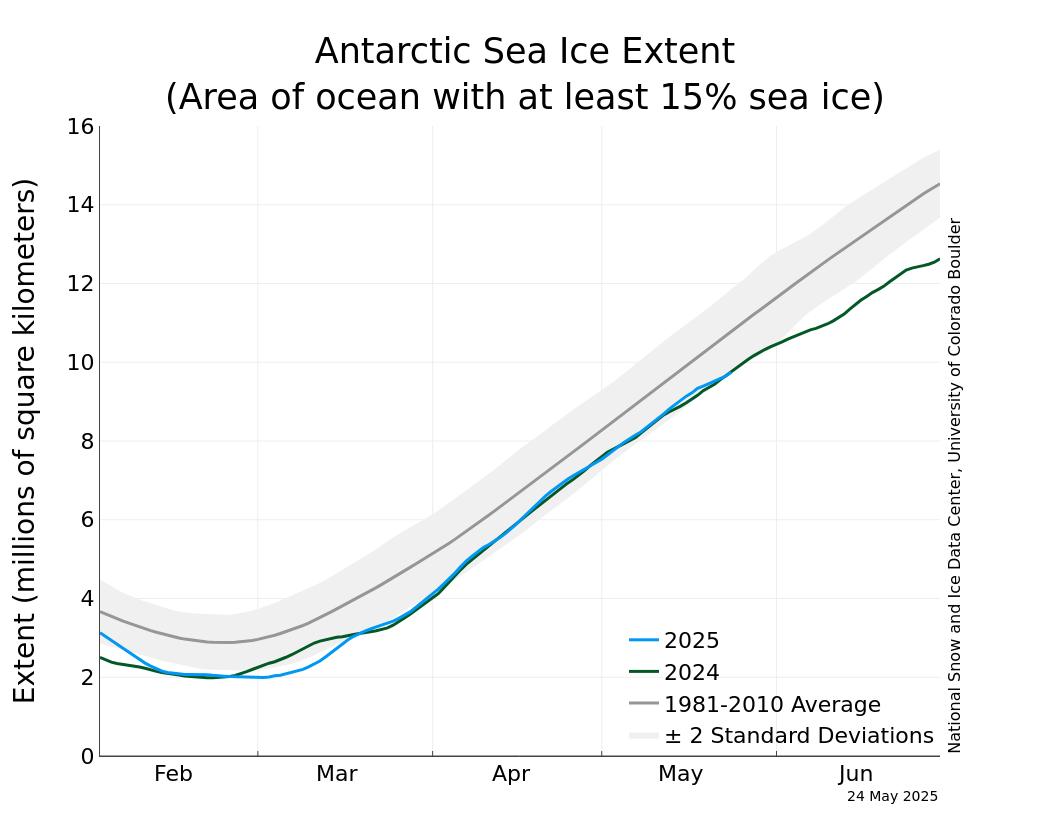
The sea ice extent in the Antarctic continues to be well above the 2009 level and more than 2 SD’s higher than the 1979-2000 average. Sea ice extent peaks at the end of September and, if anything, the growth is accelerating rather than slowing down when we are now in the middle of August.

http://nsidc.org/data/seaice_index/images/daily_images/S_stddev_timeseries.png

In the Northern Hemisphere, temperatures above the 80th parallel have dipped below freezing and are also clearly lower than the 1958 -2002 average.

http://ocean.dmi.dk/arctic/meant80n.uk.php

Looks like we are in for another long and cold winter.

La Niña conditions now established?

August 9, 2010

It would seem that La Niña conditions are no longer just a probability.  La Niña conditions are expected to strengthen towards the end of the year and through the first quarter of 2011.

In the latest bulletin issued by the NOAA (Update prepared by Climate Prediction Center / NCEP 9 August 2010) we see that

  • La Niña conditions are present across the equatorial Pacific. Negative sea surface temperature anomalies continue to strengthen across much of the Pacific Ocean.  La Niña conditions are likely to continue through early 2011
  • Since March 2010, positive SST anomalies have decreased across much of the equatorial Pacific. Since the beginning of May 2010, SST anomalies have become increasingly negative in the eastern half of the Pacific.
  • During the last four weeks, equatorial SST anomalies have been negative in the eastern half of the Pacific. During the last 30 days, negative SST anomalies increased in magnitude in the central equatorial Pacific
  • Since mid-June 2010, negative subsurface temperature anomalies have dominated the central and eastern equatorial Pacific, with only slight variations in the magnitude of the anomalies.

The formal designation of a La Niña is keyed to a 3 month mean of the Oceanic Niño Index (ONI) in Region 3.4 and is likely to happen in the first two weeks of September.


Ethanol more damaging to the Gulf than BP oil spill

August 8, 2010

Supposed environmental solutions often create new problems.

Dead zone in gulf linked to ethanol production

While the BP oil spill has been labeled the worst environmental catastrophe in recent U.S. history, a biofuel is contributing to a Gulf of Mexico “dead zone” the size of New Jersey that scientists say could be every bit as harmful to the gulf.

Each year, nitrogen used to fertilize corn, about a third of which is made into ethanol, leaches from Midwest croplands into the Mississippi River and out into the gulf, where the fertilizer feeds giant algae blooms. As the algae dies, it settles to the ocean floor and decays, consuming oxygen and suffocating marine life.

Known as hypoxia, the oxygen depletion kills shrimp, crabs, worms and anything else that cannot escape. The dead zone has doubled since the 1980s and is expected this year to grow as large as 8,500 square miles and hug the Gulf Coast from Alabama to Texas.

The gulf dead zone is the second-largest in the world, after one in the Baltic Sea. Scientists say the biggest culprit is industrial-scale corn production. Corn growers are heavy users of both nitrogen and pesticides. Vast monocultures of corn and soybeans, both subsidized by the federal government, have displaced diversified farms and grasslands throughout the Mississippi Basin.

“The subsidies are driving farmers toward more corn,” said Gene Turner, a zoologist at Louisiana State University. “More nitrate comes off corn fields than it does off of any other crop by far. And nitrogen is driving the formation of the dead zone.”

The sins of BP and “the greatest environmental disaster ever”

August 8, 2010

Thames in danger of impending catastrophe

Father Thames in Victorian England

Considering that the BP oil spill has been designated the “greatest environmental disaster ever”, the danger to the Thames from clumsy motorists has not been properly appreciated.

If we conveniently forget Bhopal and focus solely on the Gulf of Mexico, then spilling about 2 litres of engine oil into the Thames would be equivalent to the concentration of oil in the Gulf.

A very nice sanity check by Raedwald.

(More on Rædwald, of East Anglia here . He was called Rex Anglorum – King of the Angles by Bede but presumably has not been much of a role model for the University of East Anglia – Climatic Research Unit).

The volume of the Gulf of Mexico is 2,424,000 cubic kilometers, or 6.43 * 1017 US gallons. The volume of oil spilt is estimated at 20m gallons to 50m US gallons; let’s take the max, 5 * 107 gallons. That’s one part of oil to 1.29 * 1010 parts of water. The volume of the Thames at mid tide between Teddington and Gravesend is about 2.4 * 107 cubic metres (633 * 107 US gallons, or 127 times the total volume of the BP oil leaked). To replicate the ‘environmental disaster’ , I’ll therefore have to empty 1.87 litres of engine oil into the river.

Over 75% of the Gulf oil spill has now dispersed.