Archive for the ‘Environment’ Category

European commission extends carbon market freeze indefinitely

January 27, 2011

And about time too.

A raft of countries (including Japan, Australia, Canada and the United States) have already shelved cap and trade schemes.

Of course the fundamental fraud that is carbon trading goes much deeper than just the  recent thefts of credits. Hopefully it will never be revived!

image wattsupwiththat.com

The Guardian:

The European commission’s emergency suspension last week of trading in carbon allowances to put a halt to rampant theft of credits by hackers has been extended indefinitely until countries can prove their systems are protected from further fraud.

While the suspension had been expected to end last night, Brussels now says that the freeze in trades had been imposed to give the commission executive some breathing space to figure out what to do.

“The suspension last week was only a transitional measure to give the commission and member states the time to assess the situation and decide the way forward,” the commission’s climate spokeswoman, Maria Kokkonen, said. “Okay, this hurts, but it must hurt in order to make things more secure, more robust. Evolution through crisis.”

A total of 30 countries that participate in the Emissions Trading Scheme, Europe’s flagship climate change policy, must now send assessments of the situation performed by independent monitors. On 19 January, the commission suspended “spot” trading in allowances after up to 2m permits worth around €30m were stolen by computer hackers. Brussels said that half the participating countries were not sufficiently secure. Permits went missing in Austria, the Czech Republic and Greece.

Another perversion of science: Confirmation bias in the name of global warming dogma is also scientific misconduct

January 25, 2011

A new paper has been published in Ecology Letters

Ran Nathan, Nir Horvitz, Yanping He, Anna Kuparinen, Frank M. Schurr, Gabriel G. Katul. Spread of North American wind-dispersed trees in future environmentsEcology Letters, 2011; DOI: 10.1111/j.1461-0248.2010.01573.

In this paper the authors have assumed that climate change will cause changes to CO2 concentration and wind speed. They have assumed also that increased CO2 will “increase fecundity and advance maturation”. They have then modelled the spread of 12 species as a function of wind speed.

So far so good – they have actually modelled only the effect of wind speed  which they assume will reduce due to climate change.

Their results basically showed no effect of wind speed:

“Future spread is predicted to be faster if atmospheric CO2 enrichment would increase fecundity and advance maturation, irrespective of the projected changes in mean surface windspeed”.

And now comes the perversion!

From their fundamental conclusion that wind speed has no effect and that therefore any CO2 increase resulting from climate change will enhance the spread of the trees, they invoke “expected” effects to deny what they have just shown:

“Yet, for only a few species, predicted wind-driven spread will match future climate changes, conditioned on seed abscission occurring only in strong winds and environmental conditions favouring high survival of the farthest-dispersed seeds. Because such conditions are unlikely, North American wind-dispersed trees are expected to lag behind the projected climate range shift.”

This final conclusion is based on absolutely nothing  and their modelling showed nothing and yet this paper was accepted for publication. I have no problem that a result showing “no effect of wind speed” be published but suspect that it needed the nonsense, speculative conclusion to comply with current dogma.

Science Daily then produces the headline: Climate Change Threatens Many Tree Species

when the reality is

This study Shows No Effect of Wind Speed But Yet We Believe that Climate Change Threatens Many Tree Species

“Our research indicates that the natural wind-driven spread of many species of trees will increase, but will occur at a significantly lower pace than that which will be required to cope with the changes in surface temperature,” said Prof. Nathan. “This will raise extinction risk of many tree populations because they will not be able to track the shift in their natural habitats which currently supply them with favorable conditions for establishment and reproduction. As a result, the composition of different tree species in future forests is expected to change and their areas might be reduced, the goods and services that these forests provide for man might be harmed, and wide-ranging steps will have to be taken to ensure seed dispersal in a controlled, directed manner.”

Whether the perversion is by the authors themselves anticipating what is needed to get a paper published or whether it is due to pressure from the Journal Ecology Letters or by their referees is unclear.

Abstract:

Despite ample research, understanding plant spread and predicting their ability to track projected climate changes remain a formidable challenge to be confronted. We modelled the spread of North American wind-dispersed trees in current and future (c. 2060) conditions, accounting for variation in 10 key dispersal, demographic and environmental factors affecting population spread. Predicted spread rates vary substantially among 12 study species, primarily due to inter-specific variation in maturation age, fecundity and seed terminal velocity. Future spread is predicted to be faster if atmospheric CO2 enrichment would increase fecundity and advance maturation, irrespective of the projected changes in mean surface windspeed. Yet, for only a few species, predicted wind-driven spread will match future climate changes, conditioned on seed abscission occurring only in strong winds and environmental conditions favouring high survival of the farthest-dispersed seeds. Because such conditions are unlikely, North American wind-dispersed trees are expected to lag behind the projected climate range shift.

In essence this paper is only based on belief and the results actually obtained are denied. It seems to me that denying or twisting or “moulding” results actually obtained to fit pre-conceived notions is not just a case of confirmation bias but comes very close to scientific misconduct.

Sea of Okhotsk: The saga continues…..

January 23, 2011

From Itar-Tass today:

from Itar-Tass

VLADIVOSTOK, January 23 (Itar-Tass) – An unusually strong ice nipping in the Sakhalin Bay of the Sea of Okhotsk impedes the efforts of the Admiral Makarov and the Krassin icebreakers to lead to clear waters The Bereg Nadezhdy transport refrigerator and the Sodruzhestvo floating factory.

The fishery ships got stuck in the ice December 31, 2010, and the caravan did not manage to move a single mile forwards since Saturday morning. It is still mired at a distance about 30 miles away from the areas of open floating ice, the Far-Eastern Shipping Line said.

The rescue operation is multi-stage and complicated, as the Admiral Makarov and the Krassin will first have to free the refrigerator from the ice trap, after which they will have to return for the floating factory, deadlocked in the ice together with the 348 crewmembers aboard.

Awaiting the caravan at the edge of the ice shield are the icebreaker Magadan and the tanker Viktoria. The latter will have to refuel the two icebreakers before they start the voyage back into the ice-packed spaces of the sea.


Ships and crew safe but Sea of Okhotsk rescue suspended for bad weather

January 20, 2011

The Okhotsk saga continues: http://www.itar-tass.com/eng/level2.html?NewsID=15874433&PageNum=0

MOSCOW, January 20 (Itar-Tass) – The operation to rescue the Shore of Hope refrigerator ship and the Sodruzhestvo mother ship, ice-nipped in the Sea of Okhotsk, has been suspended as weather conditions have deteriorated, sources from the press service of the Russian Transport Ministry report.

According to the source, the operation to get the ships out of a heavy ice zone by the Admiral Makarov and the Krasin icebreakers began at 21:30 Moscow time on Wednesday.

“However, the deterioration of weather conditions (a cyclone is hovering over Sakhalin, and there is no transport connection) has suspended the active phase of the operation to get the ships out of ice,” the source said, adding that an abnormally bad weather is characterized by zero visibility, the strengthening of winds and ice compression.

Now the ships are relatively safe, and nothing threatens the crews, the sources said. As soon as weather conditions improve, the active phase will be resumed.

Sea Of Okhotsk rescue not quite over yet

January 19, 2011

While the icebreakers had broken through the worst of the ice, the rescue is not yet over and my previous post was a little premature.

A report of the latest news is available here: http://eureferendum.blogspot.com/2011/01/its-not-over.html

I was not expecting to be writing about the Okhotsk Sea today, but in yesterday’s account there were warnings that the crisis was not quite over. And indeed that is the case, with Voice of Russia observing that the rescue operation “will not be over today”. Conditions appear to have deteriorated sharply and, last night, the four-ship convoy covered “no more than three miles”. A helicopter is out reconnoitring the ice situation today.

The convoy in the Sea of Okhotsk

Icebreakers tour de force: Sea of Okhotsk rescue completed

January 17, 2011
en: The Russian icebreaker KRASIN breaks throu...

The Krasin: Image via Wikipedia

The rescue of the ships trapped by ice in the Sea of Okhotsk has been completed. A tour de force at temperatures as low as – 27°C by the three ice breakers, Magadan, Admiral Makarov and Krasin. The Krasin joined last and was the star of the show.

Richard North has been following and anticipating the story and a more complete description of this admirable rescue is available here.

This morning from Ria Novosti:

http://en.rian.ru/russia/20110117/162171301.html

07:04 17/01/2011The Krasin and Admiral Makarov icebreakers have managed to take the Sodruzhestvo mother fishery ship and the Bereg Nadezhdy refrigerator vessel out of thick ice in the Sea of Okhotsk, the Far Eastern Shipping Company said Monday.

“The icebreakers first towed the mother ship to a safer area, and then returned for the Bereg Nadezdy, which they took to thinner ice,” company spokeswoman Tatyana Kulikova said.

The Bereg Nadezhdy ship, the Professor Kizevetter research vessel, and the Sodruzhestvo mother fishery ship, carrying altogether over 400 people, got stuck in two-meter-thick ice in the Sea of Okhotsk on December 31. Two other ships, the Mys Yelizavety and the Anton Gurin, became trapped a few days later.

The Admiral Makarov released the Professor Kizevetter and the Mys Yelizavety vessels from the ice trap, while the Anton Gurin managed to cope on its own.

Then the operation to rescue the Bereg Nadezhdy started, but the two icebreakers changed their plans, returning to the Sodruzhestvo vessel, which was the hardest to tow due to its wide body. Towing ropes snapped soon after the start of the operation, which resumed next day.

The rescue effort has been hampered by strong winds, low visibility and shifting ice floes in the area.


Slow progress in the Sea of Okhotsk – but progress

January 15, 2011

Itar-Tass reports.

MOSCOW, January 14 (Itar-Tass) — The Admiral Makarov and Krasin icebreakers, which are leading the Sodruzhestvo mother ship out of an ice trap in the Sea of Okhotsk, have reached the drifting refrigerator ship Bereg Nadezhdy, a source at the Transport Ministry told Itar-Tass.

“The convoy of the Admiral Makarov, the Krasin and the Sodruzhestvo reached the drifting Bereg Nadezhdy at 10:30 a.m. Moscow time on Friday,” he said.

The Admiral Makarov cleared a two-mile strip in the afternoon and returned to the convoy. “The coordinating staff led by Deputy Transport Minister Viktor Olersky is analyzing weather and ice conditions for elaborating the tactics of the further operation,” the source said.

The ships need to cross the ice for meeting with the Magadan icebreaker and the Victoria tanker.

A number of ships trapped in the ice in the Sea of Okhotsk, among them the Sodruzhestvo, the Bereg Nadezhdy, the Professor Kizevetter research ship and the Mys Yelizavety trawler, asked for help on December 31, 2010. Two vessels were taken to a safe area.

It is yet unknown when the rescue of the Sodruzhestvo and the Bereg Nadezhdy may be over, as weathermen have a bad forecast for about one week.


Current La Niña most intense in 50 years

January 14, 2011

La Niña is expected to continue well into the Northern Hemisphere spring 2011.

The latest report from NOAA’s Climate Prediction Center (CPC) noted that “A moderate-to-strong La Niña continued during December 2010 as reflected by well below-average sea surface temperatures (SSTs) across the equatorial Pacific Ocean.” The CPC report said that La Niña is expected to continue well into the Northern Hemisphere spring 2011.

Physorg reports:

New NASA satellite data indicate the current La Niña event in the eastern Pacific has remained strong during November and December 2010.

The La Niña is evident by the large pool cooler than normal (blue and purple) water stretching from the eastern to the central Pacific Ocean, reflecting lower than normal sea surface heights. "This La Niña has strengthened for the past seven months, and is one of the most intense events of the past half century," said Climatologist Bill Patzert of NASA JPL. Credit: NASA JPL/Bill Patzert

A new Ocean Surface Topography Mission (OSTM)/Jason-2 satellite image of the Pacific Ocean that averaged 10 days of data was just released fromNASA. The image, centered on Dec. 26, 2010, was created at NASA’s Jet Propulsion Laboratory (JPL), Pasadena, Calif.

“The solid record of La Niña strength only goes back about 50 years and this latest event appears to be one of the strongest ones over this time period,” said Climatologist Bill Patzert of JPL. “It is already impacting weather and climate all around the planet.”

“Although exacerbated by precipitation from a tropical cyclone, rainfalls of historic proportion in eastern Queensland, Australia have led to levels of flooding usually only seen once in a century,” said David Adamec, Oceanographer at NASA’s Goddard Space Flight Center, Greenbelt, Md. “The copious rainfall is a direct result of La Niña’s effect on the Pacific trade winds and has made tropical Australia particularly rainy this year.”

The new image depicts places where the Pacific sea surface height is near-normal, higher (warmer) than normal and lower (cooler) than normal. The cooler-than normal pool of water that stretches from the eastern to the central Pacific Ocean is a hallmark of a La Niña event.

Related: https://ktwop.wordpress.com/2011/01/12/la-nina-driving-severe-rains-and-floods-in-brazil-and-australia/


Mt. Etna bursts into life

January 14, 2011

The European Space Agency reports:

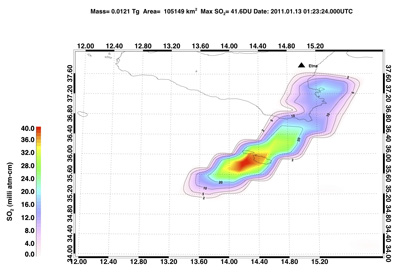
Sulphur dioxide plume over Mediterranean

This image, which was acquired by the Atmospheric Infrared Sounder on NASA's EOS-AQUA satellite, shows the plume of sulphur dioxide currently being carried over the Mediterranean Sea. Credits: NASA, Norwegian Institute for Air Research

13 January 2011


Europe’s largest active volcano, Mount Etna on the Italian island of Sicily, erupted briefly yesterday sending flames and ash hundreds of metres into the air.

This image, which was acquired by the Atmospheric Infrared Sounder on NASA’s EOS-AQUA satellite, shows the plume of sulphur dioxide currently being carried over the Mediterranean Sea.

The data have been processed by the Norwegian Institute for Air Research within the framework of ESA’s Data User Element and can be used to warn aviation companies on the hazardous plume.

File:Mount Etna snow-toppd.jpg

Mount Etna, Sicily, topped in snow 5 February 2009: image Wikimedia

Sea of Okhotsk rescue operations restarted

January 14, 2011
Depths

Depths in Sea of Okhotsk: Image via Wikipedia

The suspended rescue operation of the trapped ships in the Sea of Okhotsk has restarted and is progressing slowly in deteriorating weather and increasing ice.

From Ria Novosti:07:45 14/01/2011

Russia’s Krasin and Admiral Makarov icebreakers continue to lead the Sodruzhestvo mother fishery ship through thick ice floe to clear waters, the Far Eastern Shipping Company said Friday.

The fishing ship with about 300 people on board has been stranded in heavy ice in the Sea of Okhotsk for two weeks. The Admiral Makarov and Krasin started towing the vessel on Wednesday afternoon, but towing ropes snapped soon after the start of the operation. The rescue resumed on Thursday morning.

“The convoy has covered 17 miles since the beginning of the rescue operation, and will reach the Bereg Nadezdy refrigerator ship after another eight miles,” spokeswoman Tatyana Kulikova said. “After the meeting with the refrigerator, they will face a very difficult stretch of ice floe before reaching clear waters.”

According to the rescue plan, the icebreakers will continue towing the Sodruzhestvo, while the Bereg Nadezhdy will attempt to sail on its own along the channel cut in the ice by Admiral Makarov and Krasin.

The weather conditions in the area continue to deteriorate rapidly. Strong winds, low visibility and shifting ice floes hamper the rescue effort, the spokeswoman said.

Photographs from the Sea of Okhotsk can be seen here:

http://en.rian.ru/photolents/20110111/162101793.html

and here:

http://english.ruvr.ru/photoalbum/39338590/39338722/index.html

Related: https://ktwop.wordpress.com/2011/01/03/unusually-thick-ice-traps-ships-in-the-sea-of-okhotsk/

https://ktwop.wordpress.com/2011/01/11/sea-of-okhotsk-rescue-update-tartar-straits-frozen-to-the-bottom/