During this coronavirus pandemic, many authoritarian, draconian and oppressive measures have been used across the world. They have been justified, and accepted, as necessary during a crisis. Some measures will, no doubt, remain after the crisis is over. Many infected, old people across Europe, have intentionally received a lower level of care to conserve resources. There have been cases of being denied oxygen or respirators to “protect the health care system”. In some cases, in care homes, old people have been put directly onto palliative, end-of-life care without even an attempt to treat the virus infection. “Years of useful life remaining” is euphemistically claimed not to be age-discrimination. Care decisions have not been irrational but they have exposed the myth that people’s lives are of equal value.
As a subject, “human rights” is surrounded by such an impenetrable halo of sanctimonious political correctness that any rational discourse is suppressed. Yet the entire concept is imaginary and misleading.
I have borrowed freely from an earlier, related post: Humans are not equal
What makes a being human?
Infant chimpanzees treated and brought up as human babies, very quickly demonstrate by their behaviour that they are not human. The very few documented cases of feral children have shown that while they looked and were genetically “human”, they had an incapacity for language, social interaction and other learned “human” behaviour. Many animals have been taught some very limited skills to communicate with their humans, but they do not, by any stretch of the imagination, exhibit human behaviour. Working dogs show an ability to be able to understand some part of the abstract goals of their humans, but their behaviour is easily distinguished from that of humans. Many people behave towards their pets as if they were part of their human family, but the behaviour of their pets remains that of the animal species they belong to. Some have even tried to accord “human” status to rivers and mountains and trees. Within this century we may well achieve autonomous entities having artificial intelligence and some degree of sapience and even sentience. We may then be diverted into discussing how they are to be treated and what “rights” they are to accorded.
Does human identity lie in form or in substance? The form is appearance. The substance lies in the behaviour exhibited – not in the behaviour received. Our appearance is determined by our genes. Robots, with AI and maybe even sentience, may or may not have a humanoid appearance. The real challenge will come when we create, or encounter, an entity which does not have the form of a human, yet exhibits the full spectrum of human behaviour. Treating a chimp or a pet or any entity as a human does not make it human. My contention is that the identity of an entity lies in substance rather than form. Identity is not determined by received behaviour but by behaviour exhibited. A humanoid robot, which followed all of Asimov’s three Laws of Robotics, or was incapable of exhibiting anger or aggression or violence, would be a marvelous robot but very far from being human.
A human being is a being which exhibits human behaviour.
Man’s behaviour to man.
Humans are born unique. In one legal estimate by the FBI, the criterion for a match between two human DNA profiles was to be considered satisfied if the probability of a mismatch was less than 1 in 260 billion. All the humans who have ever lived over 200,000 years as “anatomically modern humans” number about 110 billion. No two have ever been exactly alike. Humans are not born “equal” in their genes, nor are they “equal” in their nurture. They are not, through their lifetimes, equal in the behaviour they exhibit nor in the behaviour they receive.
A “right” is an entitlement to privilege. The universe provides no entitlements of any kind to any entity. No living thing has any entitlements, not even any entitlement just to live. For all creatures, survival is a result, not an entitlement. The universe we perceive functions according to laws which must be complied with, but the universe makes no promises beyond these. The world does not owe any living things – including humans – anything, whether as individuals or as species. No species has any entitlement to exist. Human survival or happiness or suffering are resultant states, not entitlements.
A so-called ” human right” is an entitlement to privilege; where an entitlement is a promise and a privilege is a position of advantage for an individual or a group. Though promised, a benefit may not materialize. Only when realized does a privilege actually become a benefit. All human societies, ranging from families to book clubs to political parties to countries, grant conditional “rights” to their qualified members. No society can, or does, provide any guarantee that the “rights” it bestows will actually be realised as benefits. All so-called “human rights” are imaginary entitlements to privilege. They have no physical existence. They do not flow naturally from the laws of the universe. The post-WW2 concept of “human rights” is as an artificial, social construct of universal entitlements of unconditional privilege. No qualification is required. It is of an imagined, social contract between every individual and the rest of humanity. The individual’s entitlements are to be considered free of the cost of any duties and are an obligation upon everybody else. Ostensibly, the purpose of the UN Declaration on Human Rights is to “improve” the behaviour of humans to each other. It is a commentary about received behaviour but does not directly address the actions which are the root causes of the received behaviour. The question is whether this “entitlements approach” has had any real impact on the behaviour of humans to other humans.
It has not.
It can not.
The range of potential human behaviour
For any creature, it’s DNA identifies the individual and the cluster of similar entities (species) it belongs to. The genome creates the species-specific, envelope of behaviour which encompasses all that all the individuals of any specific species can possibly exhibit. The scope of individual human behaviour (what each person is capable of doing) is whatever is enabled first by the individual human genome and then as constrained by the individual’s own abilities, physical state, cognitive processes and by the natural laws. Though always within the envelope of behaviour which is characteristic for the species, a person’s actions are also constrained by capability. For all living things actions are driven primarily by the individual’s perceptions of self-interest. For humans, this derives from the cognition which gives rise to reason. One person’s self-interest could well be, and often is, in conflict with that of others. Often, whether intentionally or not, one human’s behaviour causes harm to others. What constitutes “bad” behaviour is a subjective judgement. Actions may be intentional or accidental, may be motivated or reactive, but in most cases will not be considered “bad” by the perpetrators. We behave differently with different people at different times. We are capable of being, simultaneously, utterly vile to some people, while being selfless and altruistic to others. In some circumstances, or by some people, actions which cause harm to others, directly or indirectly, may be considered justified, and may even be considered “good”.
The human concept of justice is subjective and is itself founded on discrimination by the prevailing power against what is judged to be unjust or “bad”. The prevailing power gets to decide what is “bad”. We tend to overlook that justice systems are always based on societies doing future harm to some, to balance or compensate for past harm to others. All cases of sanctions or punishments or penalties are for the intentional causing of harm to those adjudged to be culpable of having done harm. For societies to do harm to those “formally” judged to have harmed others, is considered to be the proper exercise of power. It is correct, ethical and even “good”. (It is unlikely that those harmed by the exercise of justice always consider such exercise to be just).
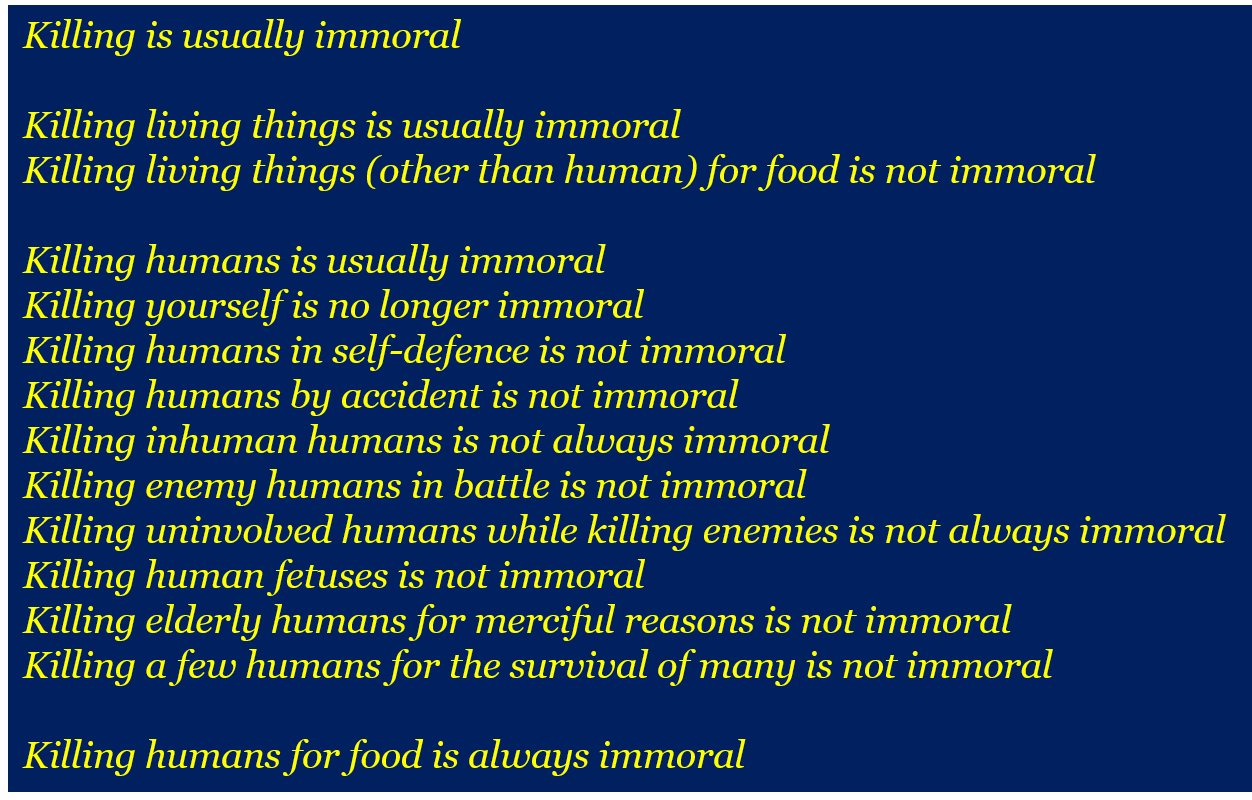
The “sanctity” of human life has been, and still is, a popular delusion. Whether by warfare, or murder, or execution, or infanticide, or abortion, or euthanasia, or indifference, or in self-defense, or by accident, the killing of other humans has always been selectively justifiable. In every society, and throughout history, particular circumstances are allowable for the harming (including killing) of other humans as the correct and proper thing to do. Every justice system exempts certain categories of humans from the usual consequences of their actions. In the context of the universe, abstractions about the human condition, individually or collectively, are of no significance. No human life or suffering or happiness has any relevance whatsoever for the elements and the forces of nature.
Modifying behaviour
Barbarous or atrocious human acts have not changed much since ancient times when humans, at least, had the excuse of being barbarians. The portfolio of all possible human behaviour was probably established by our genes when we became human some 200,000 years ago. The extremes of how well or how badly humans can treat each other has also not changed that much. Neither were atrocities first invented by ISIS or the Nazis or by Genghis Khan or even by Gilgamesh. All behaviour deemed “inhuman”, including the commitment of “atrocities”, still lies within the envelope of potential human behaviour enabled by the human genome. Aggression and violence are survival traits and part of what makes us humans. Enlightened and civilized societies (as all societies invariably label themselves) have had, and still have, their fair share of atrocities. Even the most atrocious and “inhuman” acts ever committed, still lie within the repertoire of behaviour that humans are capable of today. Technology may have changed, but the worst behaviour today is no different to the vilest behaviour 10,000 years ago. Some of the most cultured humans, living in the most sophisticated of civilizations, have also indulged in cruel and barbarous acts towards others. They still do. History is replete with philanthropist murderers and saintly torturers. Every individual has the capacity to be a saint to some and a barbarian to others, or both to anyone – even simultaneously. Each one of us does invariably behave well to some and badly to others.
There is always a potential conflict between the interests of the individual and those of the collective. The collective always has greater force to bring to bear than the individual. While societies seek to influence the behaviour of their members, the universe is equally indifferent to civilized sinners or barbarous saints. The usual tools are legislation (and all legislation is ultimately coercion by the prevailing power) and peer pressure (the herd instinct). From time to time, some societies have managed to establish high levels of compliance with their rules of membership. Smaller societies, with greater homogeneity and a narrower range of variation among members, generally have a closer correspondence between the self-interests of the individual and the collective, and achieve a higher level of uncoerced compliance. Larger societies – because individuals are not equal – exhibit greater dissent. The more diverse a society, the greater the observed dissent. Some disparate societies have succeeded in getting high compliance by using high levels of indoctrination or repression or suppression or coercion. Even the most “enlightened” system of education – as every education system – is all about indoctrination. The smooth functioning of a society is the usual justification for whatever chosen level of coercion that may be used. The superior force available to the collective usually prevails and particular behaviour is often suppressed. However, no association of humans has yet managed, by the act of association, to change the innate range of behaviour its members are potentially capable of. That only happens by cultural evolution in the short term, and genetic evolution in the long term. Cultural evolution gives voluntary change while genetic evolution gives involuntary change. The range of genetically enabled, potential, behaviour that humans are capable of, is not affected by whether the surrounding society is monarchic or democratic or fascist. All modes of government (including democratic) rely on the ultimate threat of superior force to try and achieve compliance. All the available examples, today and throughout history, only confirm that while some particular individual behaviour can be temporarily suppressed, the range of potential human behaviour is not changed at all. But where individuals’ self-interests can be aligned with some specific behaviour, cultural change can be effected, and that behaviour can sometimes be sustained and perpetuated across many generations. The question is how a society should organize itself such that the manner in which people suppress their own self interest and constrain their own behaviour in the treatment of others, meets the “standards” established by that society. “Standards” are not written in stone or shared by all. They vary across individuals. They vary with societies, within societies and over time. Some current standards of behaviour would have been abhorrent in the past, just as some medieval behaviour is considered barbarous today. Even what is considered depraved and decadent varies over space and time and is dynamic. Some parts of the world are considered decadent by some and other parts are considered repressive and even barbarous by others. Role models of behaviour yesterday have become contemptible today, and role models of behaviour today were once considered brutish or freakish. Some standards applicable now in some societies, or some parts of the world, are anathema in others. Standards of behaviour have to be manifested, first, locally by individuals. Every society tries to “improve” the behaviour of its members, where “improvement” is defined as greater compliance with that society’s current, consensus set of values.
The human rights delusion
For the last 70+ years the “human rights” approach has tried to decree entitlements to privileges, to be universally applicable to everybody and not conditional upon the behaviour of those privileged. The UN Declaration of Human Rights is built on the proposition that all humans should be entitled to certain unconditional privileges of received behaviour, independent of their own behaviour and which must be effected by the rest of the universe. It is implied that member countries should be making these promises, and legislating for these unconditional entitlements, to everybody without qualification (citizens as well as non-citizens). In practice, no such legislation can, or does, avoid conditions for qualification, boundaries for applicability and limits of jurisdiction. The Declaration is a well-meaning, aspirational commentary on received behaviour but does not attempt to address causing behaviour. In essence, the Declaration piously declaims that “no human should be harmed by other humans” but not that “no human shall harm other humans”. As if the level of water in the sink can be controlled without controlling the tap. The Declaration does not bother to define humans, but merely assumes that the form of a human, irrespective of substance, is sufficient for qualification. It is a wish-list for individual entitlements without any balancing duties.
The Declaration as written was profoundly influenced by the atrocities in Europe leading up to and during the Second World War. It was, to a great extent, driven not only by outrage but also by the suppressed guilt in Europe for its complicity and acquiescence. An underlying driver was that so many in the rest of Europe had agreed with and supported German antisemitism. In any event, it ends up as a self-declaration of virtue by the victors. The assumption is that the declaration of a set of unconditional entitlements of privilege for all humans everywhere (received behaviour) will somehow preempt or discourage the causing behaviour by all other humans. The Declaration is no doubt well-meaning but it is silent about the reality that all individuals act as they see fit in their own perceived self-interest – and are constrained only by their own assessments of unacceptable behaviour. Even in a crowd – be it a disciplined army or a rioting mob – actions are by individuals who judge that their self-interest lies in compliance with the actions of the crowd.
Ultimately, behaviour is manifested by individuals, who can only act locally. Whether of benefit to others or causing harm to others, an individual’s actions are dominated by perceived self-interest. When an individual “mistreats” another, the “human rights” of the victim can be declared to be violated, but the compulsions leading to the perpetrating behaviour are hardly addressed. When Cain murdered Abel, Abel’s “human rights” were surely infringed but Cain’s behaviour was not preempted (and he even got to populate the world). My “universal entitlement” to not be tortured or murdered is of little deterrence and of no value to me if the local compulsions of others lead to my torture or murder. My “universal entitlement” to freedom of speech and expression is of little note if my cantankerous neighbour dislikes what I say or my surrounding local society labels my speech as “politically incorrect”. It matters even less when my burly neighbour or my surrounding society can exert greater force (moral or physical) than I can. When faced by physical confrontation, and irrespective of who is “right”, my self-interest lies in having access to a stick rather than in waving a “bill of rights”. My supposed entitlements are of no consequence if I am a victim of malice, or an accident, or if I am just collateral damage. My entitlements to the ownership of assets are always subject to the vagaries and expressions of superior force (including state force) around me. Any declared entitlements I may have are irrelevant if the harm I experience is the consequence of malice from someone wishing me ill, or gross negligence by someone wishing me well, or by accident. My entitlement to life, liberty and security of person has no value when my time has come, or if I am infected, or if an earthquake strikes, or a burglar breaks in, or if I am hit by a drunk driver, or if society implements a judgement of harm against me. What I actually receive depends upon the immediate, local behaviour of those around me. That behaviour may well have been provoked by my own behaviour. In practice, whatever I may actually be “entitled” to, by way of privileges in my local society, depends, first and foremost, upon my own behaviour. My supposed entitlements, if any, and even if granted, are never guaranteed – by anybody. All my supposed entitlements are of no consequence if just one person next to me – for whatever reason – exercises greater force and – whether by choice or by accident – performs an act which harms me. In practice, an artificial, global declaration of my imaginary “human rights” is irrelevant to the immediate compulsions of individuals around me. When individuals treat others well, or murder or torture or otherwise mistreat others, they are driven by their own compelling, local, immediate motivations and not by any abstract contemplation of some, artificial “human rights” of others.
The UN Declaration goes down the wrong path from the very beginning. In its “Preamble” itself:
Whereas disregard and contempt for human rights have resulted in barbarous acts which have outraged the conscience of mankind, and the advent of a world in which human beings shall enjoy freedom of speech and belief and freedom from fear and want has been proclaimed as the highest aspiration of the common people,
“Disregard and contempt for human rights” are not the root cause of “barbarous acts”. The text is a logical nonsense. It is the same mankind which shows the disregard and contempt which supposedly outrages itself. For the text to make any sense, those who showed “disregard and contempt” would need to be separated from “mankind”. The reality is that the root cause is that all “barbarous acts” are also human acts. They are acts which lie within the capability of all humans, and are performed by individuals when particular circumstances and their local, immediate compulsions so dictate. That some humans, even if very few, take enjoyment in inflicting cruelty, is also reality. Cruel, vicious and sadistic actions lie within the natural repertoire of the same “common people” who aspire to freedom of speech and belief and freedom from want and fear. In fact, many of these reprehensible actions stem from these same aspirations. The aspiration to freedom of religion drives more religious strife than any other reason. The aspiration to freedom from want drives more robbery than any other reason. Any idealized, sanctimonious concept of humanity and the “spirit of brotherhood” which ignores this reality is self-delusional. When the Declaration condemns all received barbarity as anti-human, it becomes mired in a logical contradiction when it further insists that the perpetrators still be classed as being human. It is a focus on form which ignores substance. The Declaration denies the reality that the identity of an entity is not determined by the behaviour it receives, but by the behaviour it exhibits. Human is as human does. All “barbarous acts” envisaged by the Declaration fall well within the envelope of actions that humans are capable of and can, and do, perform. They were, and still are, usually caused by the behaviour of only a minority of individuals. Nevertheless, the minimization, if not the elimination, of “barbarous acts” requires that the perceived self-interest which compels such human behaviour be addressed, not just that a “barbarous act” be labeled so, by a consensus, after the event. The “highest aspiration” of any individual is ultimately self-interest and the “highest aspiration of the common people” has no meaning when it is the same “common people” who commit the “barbarous acts”. Being able to be cruel and nasty and barbarous is an integral part of being human and to deny that is fantasy.
Right from Article 1, the UN Declaration is pious and virtuous, but utterly false.
All human beings are born free and equal in dignity and rights. FALSE
Humans are not born equal, they do not live equally and they do not die equal. The reality is that all humans are born naked, with no resources, no debts, no liabilities and with only those privileges as may be granted, or liabilities that may be imposed, by the surrounding human society. “Dignity and rights” are merely labels for a class of beneficial, received behaviour, but are not something inherent within any individual. It bears repeating to break out of this mass delusion. Humans are not born equal. They are born helpless and utterly dependent upon other surrounding humans for their survival. That is hardly being “born free”. The vastly varying levels of support they receive from others, at birth and through their upbringing, further emphasizes that they are not equal. They behave differently from each other, to each other and differently through their lives. The value of a human life to its own surrounding society is a subjective judgement. It varies across societies, from one human to the next and over the life of that human. It is neither static nor a constant. The value of a human life within its own society varies with manifested behaviour and over time. Human lives are not lived equally. The value of a distinguished life may extend far beyond the boundaries of the local society and long after that life is over. The value of an undistinguished human life may be priceless to friends and relatives, but quite low in its immediate society and may approach zero to a distant society. “Years of useful life remaining” is proportional to value.
They are endowed with reason and conscience and should act towards one another in a spirit of brotherhood. ILLOGICAL. (REASON leads to an assessment of self-interest not of “brotherhood”).
“Brotherhood” has no meaning unless a “brother” is distinguished, by his privileged status, from a non-brother. If everybody belongs to a “brotherhood” then there is no meaning to being a brother. The “spirit of brotherhood” was imaginary at the time of Cain and is imaginary now. In reality, it is because humans are endowed with reason that they have an assessment of their own self-interest. “The spirit of brotherhood”, when it exists, is a cognitive assessment, applied to a particular group and which is always, without exception, subordinated to perceived self-interest. As it was with Cain. It is unconscionable to refer to conscience as if that label represents values common to all humans. To act according to one’s conscience may be an explanation, but can never be an excuse for behaviour. Majorities rule and minorities are always suppressed (even if not necessarily oppressed), always in good conscience. That, after all, is Democracy. “Justice” and judicial sanctions and even miscarriages of justice are carried out in good conscience. Burglers burgle and fraudsters defraud with perfectly placid consciences. People oppose, in good conscience, and even with great violence and cruelty, the equally conscientious actions of others. Every riot or revolution is made up of protesters acting in good conscience. Every war has been started for some perceived common good. Every riot that is viciously put down is for the greater good. Harming a few for the greater good is always considered morally and ethically correct. Harming others (them), for the sake of our good (us), is always acceptable even if only as a last resort. Psychopaths and drunk drivers kill and maim without conscience. The worst atrocities (and what an atrocity is, is a subjective judgement) carried out by man have always been in good conscience. The collective always imposes upon individuals in good conscience (with the excuse that it is for the individual’s own good). The forcible sterilization of, and abortions among, lunatics or blacks or aborigines or the Sami, were all considered moral and ethical in their time. Long before Nazi Germany, eugenics and birth control were promoted to facilitate “the process of weeding out the unfit [and] of preventing the birth of defectives.” The practice of coercive eugenics whether by the Nazis, or by all the supposedly charitable organisations which subscribed to the theory, were always for the greater good. Religious killings, whether during the Crusades then, or by Islamic fanatics now, are always in eminently good conscience. Human sacrifice, religious inquisitions and the slaughter of infidels were the stuff of good conscience. The stairway to paradise is littered with the tortured remains of the victims of religious conscience. Warfare, violent revolutions, executions, egregious cruelty, infanticide, euthanasia of the old, medical triage of any kind, honour killings and even abortions are all carried out in good conscience.
Article 2 is little better than sanctimonious drivel:
Everyone is entitled, to all the rights and freedoms set forth in this Declaration, without distinction of any kind ….
You could as well add: without any corresponding obligations,
This has not the makings of a contract. It sanctifies entitlements and downgrades duties. A contract is untenable if one party has only benefits and the second only has liabilities. This purports to be about received behaviour and yet assumes that initiating behaviour is irrelevant. Humans will not exclude some particular behaviour from their repertoire when they perceive a compelling self-interest in exhibiting such behaviour. Human capability for violence survives because it is a critical survival trait. Human behaviour can only “improve” if the cognitive process at the individual level perceives no benefit, and a high probability of penalty, in “bad” behaviour. Behaviour within any particular society can only “improve” if privileges granted to individuals by their local society are earned by “good” behaviour and lost by “bad” behaviour. Self-interest must be made to align with “good” behaviour for such behaviour to prevail. It is inevitable that if even “bad” behaviour can attract privileges, then “good” behaviour is undermined. If “entitlements” apply even to the perpetrators of “bad” behaviour then that behaviour is effectively shielded and perpetuated. Artificial declarations of entitlement to received behaviour, which ignore the behaviour of those being so entitled, cannot address, let alone improve, behaviour. The “human rights” approach cannot guarantee these privileges, but instead places a blanket liability on the rest of the universe to deliver them. There are no duties, whatsoever, placed on the individuals (everybody) to be granted the privileges. The imbalance is unsustainable. In any legal system, unconditional entitlements to privilege for received behaviour inherently lacks the balance needed for a meaningful social contract. It does not help that every individual is an identified, unencumbered beneficiary of a supposed contract, where all the obligations are to be delivered by an unidentified, diffuse, second party (which encompasses the rest of humanity). The artificial concept of “human rights” represents, at best, an unbalanced and “bad” contract. At worst, it is no social contract at all and misleads by feigning to be a contract.
A culture of entitlement has to shift to a culture of duties
I merely observe that since 1948, the “worst” human behaviour has not, by any measure, “improved”. By one (somewhat underestimated) count, there have been at least 24 mass-atrocity/genocide like events since WW2. More people are murdered today (around 450,000 per year) than ever in the past. However one defines “bad”, the population increase means there are more “bad” people alive today than in 1948. Even though the awareness of imaginary “human rights” is high, and even though the number of people employed in the “human rights” industry has exploded, the frequency of “atrocities” and genocide-like events has, if anything, increased. (It could be argued that the continuing growth of the “human rights” industry is itself an indicator of worsening behaviour!) We cannot even claim that the worst atrocities we commit are any less “bad”. The range of human behaviour is largely unchanged. In one sense, human behaviour may actually be worse, in that, the “entitlements” approach now provides protections even for the perpetrators of the worst atrocities. It gives rise to the horrible situation in many societies that those who harm are afforded greater privileges and protections than their victims ever had. The dead, of course, have no rights though their murderers do.
(I note also, in passing, that “animal rights” are not claimed by any animal. They know better. All “animal rights” are, without exception, claimed by some humans seeking to coerce the behaviour of other humans).
The UN Declaration is about what behaviour all individuals are entitled to receive but never directly about how an individual should behave. It is about what everybody else owes an individual. It is insidious and subversive in that it justifies the idea of having entitlements without any corresponding obligations. If the question is whether the UN Declaration can prevent atrocities from happening again, the answer is clearly that it cannot. It is not the UN or the Declaration but the interconnected world of self-interests which may prevent the scale of the Nazi atrocities from ever being repeated. If the objective is to influence behaviour, the emphasis has to shift away from entitlements to privilege and focus instead on the behaviour of individuals. Behaviour must be addressed at the point of action and not at the receiving end. That can only happen first at the individual level and only within the “local” society. It is the impotence of global, top-down platitudes versus the bottom-up alignment of self-interest with desired behaviour. Societies can – and do – use legislation to try and influence local, individual behaviour. However, pious assumptions of “universal laws” which are not grounded at the local level, are of little practical help and add little value. The fundamental and guiding principle needs to be that all individuals are responsible and accountable for their own behaviour. Far too often the entitlements approach leads to explanations of behaviour being used to excuse that behaviour. Psycho-babble explanations of “bad” behaviour are used as an excuse. Any entitlements to privilege, in any society, can only be contingent upon behaviour. Where is the UN Declaration on Human Duties?
The artificial “human rights” concept and its imaginary social contract is unbalanced and untenable. If there is no cost to the acquisition of human rights, then they can have no great value. I come to the conclusion that human behaviour is surely capable of being influenced by a social contract. But it needs to be a real social contract where benefits for the individual are balanced by duties and obligations. Entitlements without duties are no social contract and ultimately, anti-social. It is only by aligning desired behaviour with perceptions of self-interest (and not just the interests of others), that we will see a change in the desired direction.
A human is defined by behaviour exhibited, not by behaviour received. And the place to begin is by local, not global, declarations of the behaviour to be exhibited to qualify for the privileges to be accorded to humans. The human condition will improve only when “bad” behaviour is perceived as being against self-interest, not just by labeling such behaviour as a sin against imaginary “human rights”.
“Ask not what behaviour others owe you, but what behaviour you owe to others”






 The k2p blog