Archive for the ‘Ethics’ Category

“Hausergate” and the perversion of peer review

August 14, 2010

It would seem that  Marc Hauser fudged or exaggerated or imagined or just plain made up some of the results in at least 3 papers which were published after peer review.

Predictably, Harvard is being very reticent with information but as reported by The Boston Globe the university has assured the world that all necessary corrections will be made. Harvard University confirmed yesterday that it has examined concerns about scientific work by prominent psychology professor Marc Hauser and said it has “taken steps to ensure that the scientific record is corrected’’ in three journal articles for which he was a coauthor.

Also predictably others at Harvard are rationalising and taking a sympathetic view. Greg Laden says: “I know Marc Hauser, and I trust him.”

http://homelessmanspeaks.files.wordpress.com/2008/11/circling-wagons-nov-27-2008.jpg

Hauser himself is taking a year off as penance and to purge himself of his misconduct.

1. A 2002 paper published in the journal Cognition is being retracted by Hauser and two coauthors. The retraction notes that an internal Harvard examination found that the data do not support the findings.

The journal ( or is it magazine) and Elsevier need to now defend their editorial process. Who were the peers and what did they review?

2. Also called into question by the investigation is a 2007 paper in the journal Science. Ginger Pinholster, a spokeswoman for the journal, said that one of the coauthors — Justin Wood, a former graduate student at Harvard who now is an assistant professor of psychology at the University of Southern California — wrote a letter to the journal in late June. According to Pinholster, the letter stated that an internal investigation at Harvard found there were missing field notes and that the team at Harvard had recreated its research as a result. Science has yet to make a formal change to the article.

Did the missing notes ever exist? Time for Science to open up.

3. A 2007 paper in the Proceedings of the Royal Society B has already been corrected, because of missing video records and field notes. Earlier this week, Victoria Millen, publishing editor of the British journal, confirmed that the authors contacted the journal last month and informed it of the investigation. The correction notes that incomplete video records and field notes were collected by “the researcher who performed the experiments,’’ a scientist named David Glynn, who has not responded to multiple e-mail and voicemail messages.

Hausergate and Climategate and all its associated “gates” show that the peer review process is sufficiently perverted and corrupted that it needs an overhaul. It is time for the assenting and dissenting peers to stand up and be counted and not hide behind the skirts of anonymous independance.

The Harvard statement said that in cases like Hauser’s, Harvard reports its findings to federal funding agencies, which do their own reviews.

But Harvard cannot pass the buck.

IPCC / GISS: This is fraud !

August 12, 2010

Post by Willis Eschenbach in WUWT

There seems to be no end to the fraud-based advocacy being touted as science and propagated by the IPCC.

Temperatures in Nepal seem to have been particularly crudely “homogenised” by GISS.

IPCC Table 10.2 says: Nepal:  0.09°C per year in Himalayas and 0.04°C in Terai region, more in winter

The black line below is unadjusted temperatures and the red is temperatures after homogenisation. The yellow represents the level of “fudging” that was introduced to convert a cooling trend (in spite of the explosive urbanisation of Kathmandu and the consequent UHI effect) into a “warming” trend.

As Willis Eschenbach puts it

GISS has made a straight-line adjustment of 1.1°C in twenty years, or 5.5°C per century. They have changed a cooling trend to a strong warming trend … I’m sorry, but I see absolutely no scientific basis for that massive adjustment. I don’t care if it was done by a human using their best judgement, done by a computer algorithm utilizing comparison temperatures in India and China, or done by monkeys with typewriters. I don’t buy that adjustment, it is without scientific foundation or credible physical explanation.

This is not just shameless – it is simple fraud.

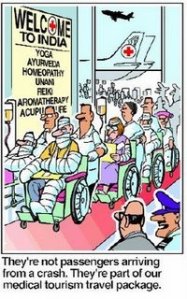
Indian “superbug” report is a scare to hurt medical tourism?

August 12, 2010

The Times of India is not impressed by the report in The Lancet Infectious Diseases Journal which claims that “India also provides cosmetic surgery for Europeans and Americans, and it is likely the bacteria will spread worldwide.”

cartoon from indianmta.blogspot.com

Scientists have tracked down a drug-resistant superbug that infects patients and causes multiple organ failure to Indian hospitals but doctors here see in it the germ of a move to damage the country’s booming medical tourism industry. While the study has the medical world turning its focus on infection control policies in Indian hospitals, the Indian Council of Medical Research has alleged a bias in the report and said it is an attempt to hurt medical tourism in the country that is taking away huge custom from hospitals in the West. “Such infections can flow in from any part of the world. It’s unfair to say it originated from India,” said ICMR director Dr VM Katoch. The superbug NDM-1 (New Delhi metallo-beta-lactamase) is named after the national capital, where a Swedish patient was reportedly infected after undergoing a surgery in 2008.

Senior doctors working in infection control said India lacks policies on antibiotics, infection control and registries for hospital-acquired infections. By the ICMR director’s own admission, India cannot scientifically fight back allegations of being the source of such superbugs, as the country does not have a registry of such hospital-acquired infections.

“Two in every five patients admitted to hospitals acquire infections. This extends the patient’s stay in the hospital, increases the expenses and causes side-effects,” said Dr Dilip Mathai, head of the department of internal medicine, Christian Medical College, Vellore.

The Lancet report  is causing some alarm within the medical tourism fraternity in India and doctors are rushing to defend the business.

But doctors in India said there was little chance this bacteria would infect overseas “health tourism” visitors. “Most of these bacteria are mostly transmitted to ICU patients, those in ventilators or critically ill patients. Since overseas patients come for selective surgeries, chances of them getting these bugs are negligible,” said Dr Monica Mahajan, senior consultant at Delhi-based Max Healthcare. Dr Amit Verma, director of critical care medicine at Fortis said he did not anticipate any major impact to medical tourism in India. The sample size of the study was very small to arrive at a conclusion, he said, adding that the chances of the bacteria becoming a global epidemic was negligible due to the restricted transmission capability of the bacteria.

Somehow the glib statement that Most of these bacteria are mostly transmitted to ICU patients, those in ventilators or critically ill patients. Since overseas patients come for selective surgeries, chances of them getting these bugs are negligible” does not inspire much confidence!

The pandemic is over but 300 million vaccines were sold for a small fortune

August 11, 2010

The world is no longer in the middle of an H1N1 pandemic, the World Health Organisation has announced. We are now in the “post pandemic period”, Margaret Chan, director-general of the WHO, has announced.

But as reported by the The  Star in Toronto,

Three members of the emergency committee that advised Director General Dr. Margaret Chan on the H1N1 pandemic work at public health agencies in the United States and United Kingdom that have received research funding from pharmaceutical companies or their industry associations, and a fourth member had previously worked as a paid consultant for five different vaccine manufacturers.

The international health authority came under fire in June when a prominent medical journal alleged scientists with undisclosed financial ties to drug manufacturers had helped develop its pandemic strategies.

The article noted that guidelines published in 2004 urged countries to stockpile antiviral medication in advance to avoid scrambling for supplies when an outbreak occurred, but the WHO failed to disclose that three of the committee members who contributed to the document had at one point received funding from companies that manufacture antiviral drugs.

The joint investigation by the BMJ (formerly called the British Medical Journal) and the London-based Bureau of Investigative Journalism also spoke out against the WHO for keeping the lid on the names of its 15-member H1N1 emergency committee.

Over 300 Million vaccines were sold during this alarmist nonsense.

Sounds like fraud.

Misconduct at Harvard or is it scientific fraud?

August 11, 2010

Harvard does not want to say very much but the story was broken by the Boston Globe.

Harvard University psychologist Marc Hauser — a well-known scientist and author of the book “Moral Minds’’ — is taking a year-long leave after a lengthy internal investigation found evidence of scientific misconduct in his laboratory.

Scientist Marc Hauser’s studies include work on the cognitive and evolutionary underpinnings of language.

As reported in Nature:

A 3-year investigation has found evidence of scientific misconduct in publications by prominent Harvard University psychologist Marc Hauser, the Boston Globe reports today.

Hauser’s research, which has frequently been highlighted in newspapers and on television, has addressed the evolutionary roots of human language, mathematical ability, and morality. His 2006 book, Moral Minds, argued that the human brain is programmed to embrace certain moral principles. Earlier this year, Hauser co-authored a study that found no impact of religion on how humans respond to moral dilemmas (for more, see ‘Morals don’t come from God’).

But by then, Hauser’s lab was already the subject of a Harvard University investigation. According to the Globe article, the trouble centers on a 2002 paper published in the journal Cognition (subscription required). Hauser was the first author on the paper, which found that cotton-top tamarins are able to learn patterns – previously thought to be an important step in language acquisition. The paper has been retracted, for reasons which are reportedly unclear even to the journal’s editor, Gerry Altmann.

Two other papers, a 2007 article in Proceedings of the Royal Society B and a 2007 Science paper, were also flagged for investigation. A correction has been published on the first, and Science is now looking into concerns about the second. And the Globe article highlights other controversies, including a 2001 paper in the American Journal of Primatology, which has not been retracted although Hauser himself later said he was unable to replicate the results. Findings in a 1995 PNAS paper were also questioned by an outside researcher, Gordon Gallup of the State University of New York at Albany, who reviewed the original data and said he found “not a thread of compelling evidence” to support the paper’s conclusions.

This sounds more like fraud.

Not for the first time at Harvard and surely not the last.

How many “peers” have been duped along the way?

Has “peer review” failed??

August 7, 2010

An interesting, provocative and thought provoking post by Nigel Calder here.

It would seem that “peer review” which was intended to improve the quality of scientific papers has actually been a hindrance to new discoveries rather than a help. As Climategate has shown very clearly the “peer review” process is easily perverted by the ruling clique preventing anything opposing their views to be published and the prevailing group-think ensuring that anything “heretical” is suppressed.

“As there is not the slightest sign of any end to science, as a process of discovery, a moment’s reflection tells you that this means that the top experts are usually wrong. One of these days, what each of them now teaches to students and tells the public will be faulted, or be proved grossly inadequate, by a major discovery. If not, the subject must be moribund.”

Back in 1989, James Lovelock had this to say about “peer review”: ‘Before a scientist can be funded to do a research, and before he can publish the results of his work, it must be examined and approved by an anonymous group of so-called peers. This inquisition can’t hang or burn heretics yet, but it can deny them the ability to publish their research, or to receive grants to pay for it. It has the full power to destroy the career of any scientist who rebels.’

Galileo facing the inquisition

Calder continues:This month the life sciences magazine The Scientist has interesting articles on peer review.

One, entitled “Breakthroughs from the Second Tier”, describes five “high-impact” papers that should have been published in more prestigious journals than they were. You can see it here http://www.the-scientist.com/2010/8/1/30/1/.

Also in The Scientist is “I Hate Your Article” by Jef Akst, who quotes David Kaplan, professor of pathology at Case Western Reserve University:

Theoretically, peer review should “help [authors] make their manuscript better,” [Kaplan] says, but in reality, the cut-throat attitude that pervades the system results in ludicrous rejections for personal reasons—if the reviewer feels that the paper threatens his or her own research or contradicts his or her beliefs, for example—or simply for convenience, since top journals get too many submissions and it’s easier to just reject a paper than spend the time to improve it. Regardless of the motivation, the result is the same, and it’s a “problem,” Kaplan says, “that can very quickly become censorship.”

Akst’s full article is here: http://www.the-scientist.com/article/display/57601/ . It goes on to discuss some of the ideas on offer for easing the peer review problem. That’s the basis for this brief update to be added to Magic Universe.

Amid growing recognition of problems with peer review, a few scientific journals tested various remedies. As reported by The Scientist magazine, by 2010 they included ending the anonymity of reviewers, so that they could both be held responsible for their comments and be acknowledged for their work, which was time-consuming. Another policy was to insist that reviewers should concern themselves only with the rigour and proper reporting of the work, not with its impact or scope. And to speed up publication, reviewers’ comments made for one journal might be passed on to others. Some journals went so far as to publish preliminary versions of papers before the peer-review process was complete.

Peer review has to get back to being strictly a review of the quality of the work done and not a commentary on or a review of the conclusions to be drawn.

American gets an Indian heart

August 7, 2010

I wish the recipient a long and useful life.

But the headlines in The Hindu newspaper and the , no doubt justified, pride in the accomplishments of the medical fraternity is a little disturbing.

Nearly 25 years ago, Prathap C. Reddy, a cardiologist set up a hospital in Chennai after he lost a patient who could not afford to go to the United States for surgery. At Apollo Hospitals, things have come full circle since, with a 65-year old American undergoing a heart transplant here.

In the process, two records were also created. The patient was not only the first U.S. citizen to undergo a heart transplant in India, but he was also the oldest person to undergo a heart transplant in the country, Paul Ramesh, primary consultant cardiac surgeon who performed the surgery said.

The recipients heart function was about 28 per cent and in January, doctors back home in Minneapolis told him that he required a heart transplant within a year, failing which he would die, T. Sunder, consultant cardiac surgeon, Apollo Hospitals, explained.

However, the American recounted in a press conference on Thursday, it could have taken him a year and a half to get a heart back home. He had meanwhile, read of the facilities for heart transplant in India, checked with some friends and decided to make the trip to India to get a new heart.

On the night of July 21, the American got really lucky. A brain dead donor’s 36-year old heart was available but there were no other takers. M.R. Girinath, chief cardio vascular surgeon, called up the State co-ordinator for the Cadaver Transplant Programme seeking a go-ahead to use the heart on the foreigner. Once the sanction came, the hospital performed the transplant, working eight hours to put an Indian heart into an American.

But there is a dark side to this kind of “medical tourism”. The transplant and organ donor business in India is already a growing and lucrative business for many medical institutions and practitioners. There is now a thriving “black market” in kidneys for transplantation preying on the poor on India’s slums .  ( After the Tsunami struck this was the only way out for many poor women in some villages in Southern India).

The grapevine tells me that the kidney “donor” is paid around 25,000 Indian Rupees (about $500) while the recipient is charged around 100,000 – 200,000 Indian Rupees (about $2,000 – 4,000) for the kidney and the paperwork to legitimise the organ. A foreign buyer is usually charged more (as much as $30,000) but kidney brokers are available to try and “minimise” the cost. The medical charges for transplantation are of course extra. The organ business is not caused by medical tourism but the money-flows are the key driving force and tourism adds hugely to the money flows.

If the organ trade now targets hearts ………..

When “models” and fudge factors are touted as evidence

August 6, 2010

Doomsday scenarios are taken to be evidence!!

Dr. Nepstad is at it again but he has a great deal of money to protect.

The same actors, the same advocacy and the same techniques to forecast DOOM.

Only this time drought, land use, illegal logging and climate change  are taken together to provide the necessary forcings to provide the catastrophe. It is called a “study” and implies some objectivity but the models use a variety of fudge factors to decide on the impact of the various variables. It might be more accurate to call it The Doomsday Scenarios since the “study” is no more than the generation of scenarios to come to a pre-determined conclusion. The conclusion is of course that we must immediately reduce greenhouse gas emissions drastically!

The Daily Telegraph reports today that

Rainforest loss may have been overstated, scientists

Climate change and illegal logging could wipe out rainforest wildlife by 2100

Daniel Nepstad, an ecologist at the Woods Hole Research Center in Massachusetts, said only a cut in greenhouse gases can save the world’s wildlife.

“This study is the strongest evidence yet that the world’s natural ecosystems will undergo profound changes — including severe alterations in their species composition — through the combined influence of climate change and land use,” he said.

Unfortunately Dr. Nepstad is already rather tainted. He works for the Woods Hole Research Centre which is associated in Brazil with the Instituto de Pesquiza Ambiental da Amazonia (IPAM).  IPAM is a Brazilian advocacy group. He appears to have a vested interest in magnifying the value of carbon contained within the Rain Forests.

He is entitled to advocate for his point of view of course and to advocate for getting even more funding but his advocacy is not science.

Booker had this to say about 3 weeks ago:

This curious episode may also point to another reason why WWF and Woods Hole have been so active in recent years to promote concern over the danger of global warming for the Amazon rainforest. As I revealed here on March 20, they have been closely allied in support of a scheme known as REDD (Reduction in Emissions from Deforestation and Degradation of Tropical Forests). Its aim is to turn the CO2 in forest trees into “carbon credits”, saleable on the world market to allow firms to continue emitting CO2. Backed by $80 million from the World Bank, WWF, Woods Hole and IPAM are partners in a consortium, supported by the Brazilian government, to protect and manage a vast area of forest in the Tumucumaque region, in return for which they would have the right to sell its carbon credits. In 2007 Dr Nepstad published a formula which would allow the carbon contained in the entire forest to be valued at $60 billion.

25 years on and toxicity is still being exported….

July 23, 2010

25 years after Bhopal where the manufacture of toxic products was “exported” to India the same “export” philosophy – this time with toxic wastes to the Ivory Coast – continues.

I thought I could see signs of ethics returning to the corporate world but I was being too optimistic. “Business as usual and pay a few fines if you get caught” seems to apply. Nobody goes to jail after all.

Trafigura found guilty of exporting toxic waste

A Dutch court has found multinational Trafigura guilty of illegally exporting toxic waste from Amsterdam and concealing the nature of the cargo.

Two civil protection workers pass by a bulldozer clearing a site polluted with toxic waste at the Akouedo district in Abidjan - 19 September 2006

In 2006, Trafigura transported waste alleged to have been involved in the injury of thousands of people in Ivory Coast. The firm was fined 1m euros (£836,894) for its ship, the Probo Koala, transiting Amsterdam with its cargo.Trafigura, an oil trading company, initially tried to clean up low-grade oil by tipping caustic soda into the hold of the Probo Koala. The company tried to unload the waste in Amsterdam for treatment, declaring it as “harmless slops”.

Timeline

Sept 2006 – Thousands in Ivory Coast report falling ill from waste in Abidjan

Oct 2006 – About 1,000 Ivorians sue Trafigura

Feb 2007 – Trafigura reaches $160m out-of-court settlement with government of Ivory Coast

Oct 2008 – Ivory Coast court finds two people, not employees of Trafigura, guilty of dumping toxic waste in Abidjan

Sept 2009 – Trafigura agrees to pay $50m to people in Ivory Coast who say they were poisoned by the waste

June 2010 – Dutch prosecutors accuse Trafigura of illegally exporting hazardous waste to Ivory Coast

Trafigura denies responsibility for the dumping of the waste and any deaths or injuries caused !!