Archive for the ‘European Union’ Category

Why hasn’t Juncker resigned?

June 27, 2016

Why hasn’t  Jean-Claude Juncker resigned?

The European Commission, Council of Ministers and the European Parliament are answerable and accountable, theoretically to all the EU members but in practice to nobody.

MEPs are accountable in the sense that they are voted in every 5 years. But in many countries that use party list systems of voting, candidates are simply put on a list by their party and the voters have no or a limited say on who is going to be elected. 

In most countries it is very difficult to present a new list alongside the lists of the traditional parties represented in the national parliaments. Voters have a formal choice but not necessarily a real possibility to have their own views being represented by an MP or MEP.   ……..

MEPs receive €4,299 per month in a general expenses allowance. MEPs do not need to deliver any proof as to how their money has been spent.

Commissioners need to be accountable to the European Parliament. They are obliged to answer questions from MEPs both orally and in writing. Many MEPs do not feel that they receive satisfactory answers. Many believe that the Commissioners are hiding too much; ………. You should also have the right to know how the different Commissioners vote on the different topics put on their table, but at present one has no idea.

During 2004-14, under the mandate of Commission President Barroso, the Commissioners did not vote among themselves at all. Discussions took place behind closed doors on proposals for new EU laws. The Commission President often reads a text prepared by his official services. There is usually no real political debate. The President concludes. Most decisions are taken in the name of the Commission outside the Commission meeting room ……..

The Commission now publishes agendas and minutes of their decisions. However nowhere can it be seen how they actually came to those decisions. They do not provide access to documents relating to their discussions or preparations. EU Commissioners give information about the amounts spent on representation. Yet this does not happen for individual spending, unlike what journalists can receive or request in most countries from their national ministers. …… Commissioners may hire special advisors. These names are now published – but the information does not include the salaries paid for the special advice they may receive from political friends or others. 

Commissioners are proposed by the prime ministers or presidents of the member states. Often a prime minister or president proposes a candidate who could no longer be elected as an MP or appointed as a minister in his or her own country. When former Prime Minister Tony Blair appointed Peter Mandelson as an EU Commissioner he had already been twice rejected as a minister by the British Parliament at Westminster. 

Prime Ministers may sometimes propose the names of national politicians they want to get rid of. There is no election procedure safeguarding voters so that they may have the best candidate from their country. 

There is some EU accountability in some of the national parliaments. In Denmark the European Affairs committee has met in public every Friday since October 2006 and  it can  give negotiating mandates to Danish ministers before the latter can approve something in the  EU Council of Ministers.  

There is no other  EU country where ministers need to have a negotiating mandate for such votes at EU level. In most countries the national MPs are rather badly informed about EU law proposals and have no real influence. Even in Denmark it is normally the civil servants in the ministries who decide and implement the Danish position in the 275 Council working groups. 

They are assisted by 35 special committees composed of representatives from business organisations and NGOs in an tightly woven corporative system. 

The ordinary members of parliament, the media and citizens are sidelined in the important preparatory phase where most EU decisions are prepared and then adopted.

The President of the European Commission – a former PM of Luxembourg – is the living face of the privileged, protected, arrogant, unaccountable bureaucracy that is Brussels. The EC – more than anybody – else is the reason for the deep and widespread dissatisfaction in Europe with the way in which the EU operates and where it is headed.

It is time for Jean-Claude Juncker to resign. And that means that the leaders of the core countries need to tell him to go.


Is Brexit already dead?

June 26, 2016

The Brexit referendum was advisory and non-binding. There is no absolute requirement for the government or parliament to follow the result. There may be a moral obligation but with the split 52/48 result it is not all that compelling. It could be argued that since David Cameron called the election, he is responsible for implementing whatever result it produced. He has said that he will not start the formal Brexit process (invoking Article 50) and it seems unlikely that he will cave in to pressure from the EU, either in verbal or written form, such that the EU can “deem” the process to have started. Certainly if he stays he has some obligation, but he has got out of that by announcing his coming resignation.

The same parliament but with just a new Prime Minister – and even one from the Brexit camp – will not have a parliamentary majority in favour of Brexit. (In fact I am not convinced now that a Brexiteer could even win a majority among the current Conservative MP’s). Without a parliamentary majority no necessary legislation will get passed. Moreover the Scottish parliament will withhold consent for any legislation which makes any change to how EU laws affect Scotland. Theoretically, the UK parliament could overrule a Scottish withholding of consent, but, without a parliamentary majority for Brexit, that  probably could never happen. So the new Prime Minister has little option but to call a General Election asking for a mandate. But first he has to lead a party which takes on Brexit in its manifesto. And that today is not possible for either the Conservative or the Labour party. I cannot see a Conservative Conference in October accepting to put a Brexit in its manifesto. The Labour party is in shambles and it was labour voters defecting to a UKIP immigration agenda which tipped the balance in the referendum. The Liberal Democrats will not have any anti-EU manifesto and UKIP will. Even supposing that UKIP win a number of seats, they will never have enough to form a government. The bare majority in the referendum comes from across party lines. But any government, now or after a general election, will follow party lines.

So, even after a General Election, there can be no government committed to a Brexit and willing to set it in motion.

The EU is suffering from “interesting times”. Perhaps the EU will actually be reformed along the way. But I am beginning to wonder – just two days after an advisory, non-binding referendum – whether there can be a Brexit at all without a government and a parliament committed to implementing a Brexit. Is Brexit already dead?

My preference for a reformed EU without a Brexit is not – at least on this Sunday evening – not looking as impossible as it was yesterday.

Running away from Brexit


The EU cannot expel the UK and any UK government will need parliament’s approval to invoke Article 50

June 26, 2016

The key question for the timing of a UK exit becomes “Can any UK government invoke Article 50 merely on the strength of an advisory referendum and without the express approval of parliament?” I think not. It may be that merely changing Prime Minister will not create a majority in parliament and then a General Election on the question of Brexit will be needed. Without a government willing to apply for withdrawal, Brexit does not begin.

The core founding members of the EU met yesterday and have issued demands that the UK leave the EU quickly. But the EU bureaucrats and the core founding countries seem terrified of a slow measured process of withdrawal. It is not difficult to see that they are expecting a domino effect and further countries holding referenda about EU membership. No matter what they do referenda in the Netherlands and France are just a matter of time.

But their strident calls yesterday for a quick withdrawal seem to be a knee-jerk reaction. David Cameron and his government cannot now invoke Article 50 (he could theoretically do that but after his resignation speech he would then have to emigrate). Suppose the UK, by October, gets a pro-Brexit Prime Minister. He would have a new cabinet and it is inconceivable that he could invoke Article 50 without first getting that action approved by the UK parliament. That approval will not be so easy. Assume that such approval is forthcoming. The timing of an invocation of Article 50 would then be at the discretion of that new government and that would surely not happen until all member countries had been sounded at the political level (rather than the elite bureaucrats of the EU), as to the conditions of the withdrawal.

The EU bureaucrats can talk as tough as they like, but they know very well that there are no provisions in the EU treaties to expel a member.

Extract from : Withdrawal and expulsion from the EU and EMU. Legal Working Paper Series No 10 / December 2009.

Unlike the Charter of the United Nations (UN), Article 6 of which expressly provides for the possibility of a UN Member being expelled for persistently infringing the principles of the Charter, there is no treaty provision at present for a Member State to be expelled from the EU or EMU. The closest that Community law comes to recognising a right of expulsion is Article 7(2) and (3) TEU, allowing the Council to temporarily suspend some of a Member State’s rights (including its voting rights in the Council) for a ‘serious and persistent breach by a Member State of the principles mentioned in Article 6(1)’ of the EU Treaty. This might be thought of as a preliminary step to the expulsion of a Member State, but it is not the same as its definitive expulsion.

In fact the EU cannot expel a member without effectively negating all its treaties:

A Member State’s expulsion from the EU or EMU would inevitably result in an amendment of the treaties, for which the unanimous consent of all Member States is necessary under Article 48 TEU. Given that a Member State’s expulsion would, by definition, be contrary to the presumed wish of that Member State to continue its membership of the EU, a right of expulsion would be inconceivable, since it would have to entail an unauthorised Treaty amendment, in breach of Article 48 TEU. Besides, it is likely that some Member States would object to the introduction of a right of expulsion in the treaties, coupled with an amendment of Article 48 TEU to make that possible, since this would expose them to the risk of being forced out at some future date. 

In practice I begin to think that a General Election will be needed before Article 50 can be invoked and where the incoming government will need to have been elected to implement a Brexit.


An independent Scotland could probably not join the EU until 2030

June 25, 2016

Scotland’s desire to remain a part of the EU is not so easily satisfied even if a new independence referendum is carried out rapidly. Three different timetables (which can partly be in parallel) have to mesh.

  1. Exit process for UK from EU
  2. Independence process for Scotland from the UK
  3.  Application and accession process for an independant Scotland into the EU.

Looking at these 3 timetables, I reckon the earliest an independent Scotland could enter the EU in its own right would be around 2030.

Brexit now sets in motion an exit process for the UK from the EU. The only deadline is that the process will be completed 2 years after the UK invokes Article 50. However it is up to the UK to invoke Article 50. So the start point is flexible and is solely in the control of the UK government of the day. Even if Cameron is replaced by another Prime Minister, it will be up to his new government and the UK parliament to decide when they are comfortable enough to start the ball rolling (because then the 2 year deadline will apply). There is no reason for the UK to give up too early its current time pressure advantage which will pass to the EU once Article 50 has been invoked. I see the earliest that a UK government is prepared for this will be around March 2017. That would give an exit being effective in March 2019.

March 2017 is probably the earliest a new referendum on the independence of Scotland could be held. Using the timetable put forward by the SNP for the 2014 referendum, it would then be March 2019 before Scotland was an independent nation. This may be a little too optimistic both for when the referendum could be held and for the time required for the legal measures necessary. Whether the UK parliament could be handling the bills necessary for exiting the EU simultaneously with passing the bills for Scotland’s exit from the UK is also doubtful. Nevertheless I assume a referendum could be held by March 2017.

To apply for EU membership, Scotland would need to have, and be able to show, a “stable” economy and stable, established institutions. With the best will in the world, this is going to require at least 3 years (and probably more) as an independent nation. Assume anyway that Scotland can submit an application for membership sometime around 2022/2023. The minimum time needed for accession of a new member has been the 3 years for Finland and Sweden. It is more usually of the order of 10 years with countries with weaker economies taking longer. It is not unreasonable to assume that a newly independent Scotland would need 7 years for accession.

Accession times to the European Union (pdf)

And that would take us to 2030 for an independent Scotland’s accession to the EU.


EU bureaucrats, but not the elected politicians, are in denial

June 24, 2016

Listening to the European bureaucrats reacting to Brexit today, it was very quickly obvious as to why euroscepticism has never been as high and as widespread in Europe as today. Every bureaucrat, who by definition is part of the EU gravy train, was angry and wanted the UK out as soon as possible. Not one, not Jean-Claude Juncker, not Martin Schulz, not Donald Tusk did not but want to punish the UK for the poll result. Juncker would not even address the question of euroscepticism within member countries. What he does not want to see, it seems, does not exist. He does not see that it is the form and manner of the EU itself which fuels the desire of many to leave.

3 monkeys

They are the non-elected, spoiled and pampered bureaucrats of Europe who have gotten used to the idea of issuing European Directives, for all EU members to follow and overruling any objections from national parliaments. The elected politicians from Germany and France were a little more circumspect in their statements. The arrogance and self-righteousness on display today was as clear a symptom of the European malaise as could be imagined. They had no conception of the contempt in which they are held by so many in Europe.

I have no doubt that the UK can manage without being a member of the inner circle of the EU. Of course the UK will need to negotiate a good trade agreement with the EU but there is no reason why this should not be possible – in spite of the EU bureaucrats. Angela Merkel indicated today that some form of EU association with the UK would not be unthinkable. The bureaucrats, of course, dislike this because it may give heretical ideas to the eurosceptics in other countries. It is a myth to think that trade with the US or China or Latin America is enhanced greatly by being a member of the EU. I have no doubt, for example and from my own experience, that the UK can do more business in Africa or in India from outside the EU. There are trading opportunities in a Brexit – but it will need some skill to seize them.

But the one thing that struck me today was that for the survival of the EU in some sustainable form, the EU bureaucrats need to be reigned in by their own politicians from the member countries. Here I mean by the politicians in their own governments and parliaments and not the utterly useless MEPs in the even more pointless European Parliament. The EU bureaucracy has become parasitical. The self-serving and blinkered behaviour of the bureaucrats keeps them completely out of touch with how deep euroscepticism actually runs. Their denial of reality is the single factor which is most likely to lead to the break-up of the EU.


BREXIT

June 24, 2016

Brexit

A leave could take around 3 years.

A new dawn? for the EU?

Clear win for BREXIT (but a win for remain in Scotland).

Cameron thought he knew how to use referenda as a tool of government. But he got virtually no concessions from the EU and his strategy has backfired. Now we will see whether David Cameron is a leader or just another follower. I think his position is untenable — except if he can get real concessions and call yet another referendum.

It is time to dismantle the Brussels machine and the first step shoud be to abolish the European parliament.


UK likely to vote to remain but fundamental flaws in the EU concept are now exposed

June 20, 2016

I see the BREXIT vote as an opportunity to correct the glaring flaws in the EU concept of a Holy European Empire. Whether BREXIT wins or not in this vote, the EU will no longer be able to just ignore the disconnect between the concept and the bulk of the voters/tax payers in the EU. Of course if BREXIT does not win, it will slow down the inevitable reforms that the EU must introduce.

I suspect that finally the fear of leaving will govern and that BREXIT will lose by a small margin. The EU politicians and bureaucrats will probably tout this as a win for the EU concept but, in fact, they will have to prepare for drawing back the various EU encroachments into the territory of national sovereignty.

NYT: 

There is no argument that the European Union is a flawed institution. Its dysfunction has been on display in its fitful handling of the Greek debt and refugee crises, its bureaucracy is pathetically slow to recognize or correct its failings and it often acts like an out-of-touch and undemocratic elite. Part of that is the inherent inefficiency of an institution of 28 member states with big differences in size, wealth and democratic traditions, and which participate to different degrees in the single currency and border-free zone.

Yet the E.U. is an extraordinary achievement, a voluntary union of nations whose histories include some of the bloodiest wars ever waged. However flawed the bloc, it has replaced blood feuds with a single market, shared values, free travel and labor mobility. Britain has always been something of an outlier in the E.U., joining what began as the European Coal and Steel Community two decades after it was formed and declining to participate in either the euro currency or the borderless Schengen zone. Yet there is no question that Britain has benefited from membership, both economically and as a strong voice in shaping E.U. policy.

The euroskepticism that has led to the British referendum, and that forms a strong component of the right-wing nationalist parties on the rise in many European countries, is not about efficiency or history. It is about ill-defined frustration with the complexities of a changing world and a changing Europe, a loss of faith in mainstream politicians and experts, a nostalgia for a past when nations decided their own fates and kept foreigners out. To those who hold these views, the European Union is the epitome of all that has gone wrong, an alien bureaucracy deaf to the traditions and values of its members. Not surprisingly, Mr. Trump and the French politician Marine Le Pen both favor Brexit.

I see parallels in the “anti-establishment” views embodied in euroscepticism and in the “anti-establishment” views of the Trump supporters in the US. In both cases the revolt is a reaction to what is perceived as the over-weening arrogance of a political, liberal, elite who insist on defining political correctness and on telling the electorate that they know best what is good for them.

In 2016, both in the EU and in the US, it is immigration and the flawed concept of multiculturalism which is dominating. It is occupying this ground which may well determine many of the elections. In fact the rise of the right-wing nationalists in Europe is the pendulum swinging back from 3 decades of self-righteous, social democratic dogma. Europe has moved further left in the 3 decades after communism fell than while communism was still an acceptable philosophy. But I note that some of the right-wing parties (Sweden, Denmark, France …. ) are losing some support as more of the centrist parties adopt more restrictive measures on immigration and take away this ground from the right. Take Trump’s immigration ground away from him and he will not stand a chance.


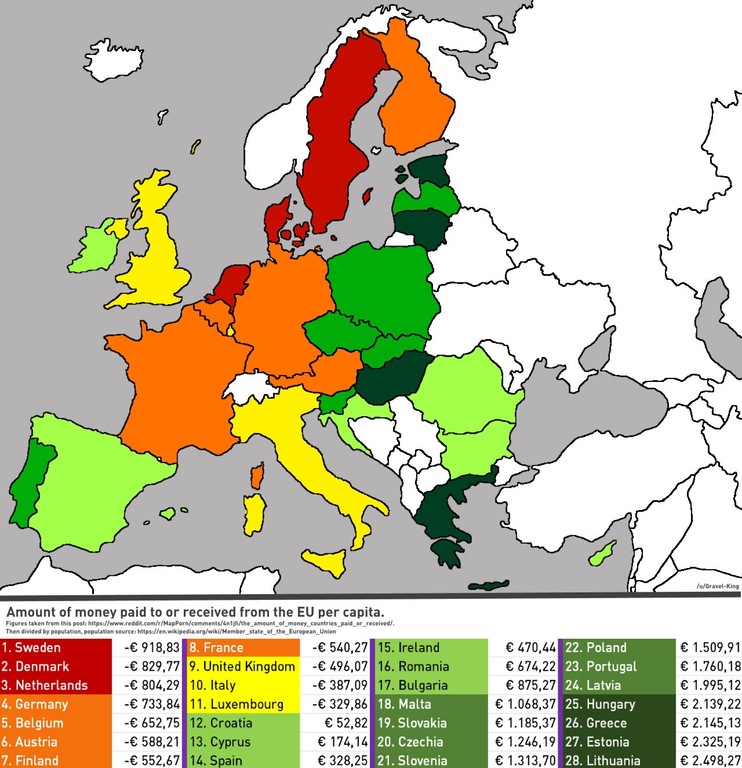
Sweden pays most per capita into the EU

June 14, 2016

A very revealing map by Gravel King on Reddit. He writes

Some people asked for a per capita map of this post.

I took the figures from that post and divided it by the population of every single EU country.

I apologise in advance if I made some mistakes when colouring the countries (I wasn’t sure if the Faroe islands had to be part of Denmark, for instance.) or some other mistakes.

Per capita contribution to or from the EU between 2010 – andf 2014. Eleven countries are “givers” and 17 are “takers”. Sweden pays most into the EU (more’s the pity).

EU contribitions per capita 2010-2014 (map by Gravel King)

EU contribitions per capita 2010-2014 (map by Gravel King)


The EU cannot change geography , but they can change their rules

June 11, 2016

The geographical reality of the UK being part of the continent of Europe will not change with Brexit. Europe will not disappear even if the EU does.

The European Union is a somewhat artificial, and now also very sick, association. The EU as it is today “is a misassembled, headless monster, owing less to Charlemagne than to Frankenstein.” Economically the EU has become the sick man of the global economy. It is a club which needs to revise its reason for being. It has to move away from grandiose dreams of creating a new Holy European Empire and its rules need urgently to change. The European Parliament is a useless appendage and needs to be abolished. It is the most wasteful and non-democratic parliament ever. The European Court of Human Rights has done more than most institutions to demonstrate that the EU (not human rights) is an ass. The European Commission is a self-righteous, self-serving, profligate bureaucracy which dwarfs Roman bureaucracy. It may have been intended to be a disseminator of best practices, but has become instead the propogator of scams designed to milk EU subsidies. The Euro is a failed experiment.

With less than two weeks to go for the UK referendum, it is worth remembering that the vote itself is just the start of a long 2-3 year process. It can be stopped by the UK parliament at any time (though at the cost of a government and a few politicians). A NO vote would galvanise similar sentiments in Holland and Denmark and even some of the newer members. I am convinced that it is the shock necessary for the EU to confront its existential problem and tone down its political aims and focus on its trdaing and economic aims. The free movement of genuine labour has to be tempered to exclude the free movement of the scavengers. The European Commission has to be decimated and drawn back from its intrusion into what are local, national matters.

My desired scenario is that a NO vote in the referendum will give the EU the biggest shock it has had since its inception. Minds will then be sufficiently concentrated to really think about reforms and to be more than the cosmetic sops so far offered to David Cameron. The rush to reform (led by Germany, France and Italy) will be real and announced well before any ratification vote (probably in about 6 -12 months) in the UK parliament. And then the UK parliament can overrule the BREXIT referendum and have that ratified by a General Election.

Just wishful thinking on my part. But I see a glorious future possible for Europe. But not for the Europe of the European Union.

Frank Jacobs wrote in his piece “Where is Europe” in the NYT:

…… This “Europe” is a misassembled, headless monster, owing less to Charlemagne than to Frankenstein. It stalks the bureaucratic labyrinth of Brussels, beying for tribute from the peoples of Europe. But this modern minotaur is also a petty, powerless bureaucrat, issuing directives on the correct curvature of cucumbers, but unable to save the euro from collapsing. …

…… most of Europe’s borders are self-evident. They are the waters that border it on three sides: the Arctic Sea to the north, the Atlantic Ocean to the west and the Mediterranean and Black Seas to the south. Ah, but then the ultimate problem becomes painfully clear: Where to draw Europe’s eastern border? And does it even have one?

Let’s return to our earlier definition: A continent is a large, contiguous land mass. And not half of one. Many geographers see what we call the European continent as a mere peninsula of a gigantic continent of Eurasia, spanning halfway across the world, from the Strait of Gibraltar to the Bering Strait. There is no good reason to divide that continent in two. No good geographic reason. …..

Europe as she should be

Europe as she should be

Europe is not a continental mass in itself. It is just the western end of the Eurasian continental plate. The Eurovision song (?) contest may – in its inanity – include Israel and Turkey and Azerbaijan and Australia but whatever definition of Europe finally evolves it should not include Turkey and cannot include Ukraine or Belarus. That the definition must encompass Switzerland and Iceland – and the UK – is self-evident.


Arrogant EU warning to Poland provides BREXIT with a proof

June 1, 2016

That the European Union does take away national sovereignty is obvious even if David Cameron may argue (now) that it doesn’t. Even though I think that we must eventually evolve away from nation states, the EU is not a development in that direction. It involves surrendering autonomy – away from the “nation” to the faceless, supercilious, self-righteous, European Commission and the European parliament. Poland may be pursuing policies that its EU members disapprove of, but surely that is Poland’s prerogative.

BREXIT supporters have a clear example of how the EU fancies itself a super-state and one which thinks it has the right – if not necessarily the power – to dictate to its members how to think. Like it or not, the Justice Party was elected “democratically” in Poland. The European Commission is far from being any kind of democratic institution. It is an executive body. There is something deeply disturbing about EU bureaucrats telling an elected government what it may or may not do. The self-righteous arrogance of the European Commission is often offensive.

The Guardian: 

The EU executive has given Poland an official warning that changes to its constitutional court endanger the rule of law in the country.

Frans Timmermans, vice president of the European commission, said he had written to the Polish government warning that recent alterations to the workings of Poland’s highest court posed “a systemic risk to the rule of law”.

The publication of a formal opinion ratchets up pressure on Poland and marks the first time that the EU executive has criticised a member state under its rule-of-law procedure.

After Poland’s Law and Justice (Pis) party came to power, the Polish parliament passed a law allowing the government to appoint the judges of its choosing to the highest court and not recognise those chosen by its predecessor, the liberal Civic Platform party.

Legal experts advising the Council of Europe have concluded that the changes breach the rule of law, democracy and human rights.

If Poland refuses to back down, it could face the ultimate sanction of being stripped of EU voting rights, although Brussels is keen to avoid that scenario.

I am not sure if BREXIT is good or bad for the UK, but there should be little doubt that staying within the EU does mean giving up a large measure of sovereignty. It is surely better for the EU that the UK remain a member. But the best for both the UK and the EU, I think, is for reform of the EU. I remain convinced that a vote in favour of BREXIT vote will only cause the EU to finally make real concessions rather than the cosmetic changes offered to Cameron. A BREXIT vote is – after all – only the start of a long negotiation. But the negotiation could be real and not just a PR exercise. Of course the UK would need a real negotiator – and that isn’t either Cameron or Corbyn.