Archive for the ‘European Union’ Category

A Holy European Empire is – for now – untenable

November 29, 2015

The EU has been facing an unprecedented assault on its borders with the refugee crisis. So much so that internal dissent about the free movement across the EU has never been higher. The Schengen agreement has been suspended and member states are reintroducing border controls. Political disparity across the member states ranges from far-left governments (Greece, Portugal….) to nationalistic governments which include far-right elements (Poland, Hungary…). Economic disparities across the member states are also extremely wide with the poverty (relative) of Greece and Romania at one end and the wealth of Scandinavia and Northern Europe at the other. Some members pay only lip service to fiscal responsibility and balanced budgets (inevitably these are left-of centre governments and includes France) while others keep within the nominally required deficit limit of 3% of GDP. Civic values are not homogeneous across the EU and individual behaviour follows national mores. In Greece, to pay tax is almost a “sin” and tax avoidance is a national game. In Sweden, it is almost considered a sin for a handyman to be paid in cash for fixing a creaking door and waiters are expected to declare and offer up their tips for taxation.
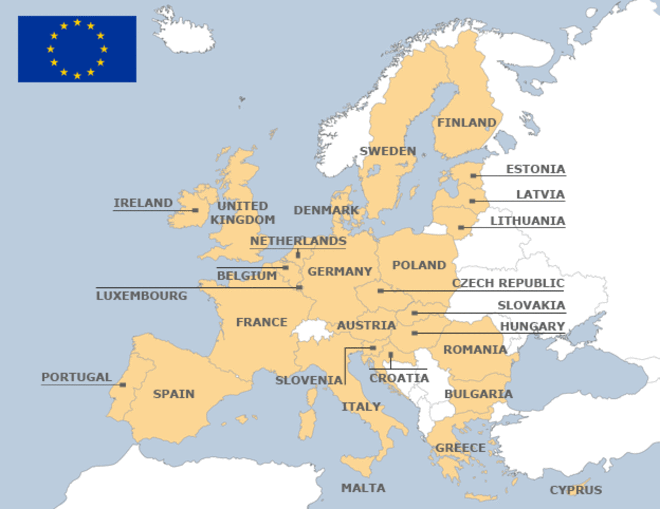
EU 28 members Oct 2013

EU 28 members Oct 2013

At the core of the EU idea has been a vision of a Holy European Empire which is far, far more than a free trade zone. It was a vision of a modern Utopia, a homogeneous Empire, a single state, administered from Brussels and stretching far into Asia, all the way till Kazakhstan. People would be citizens of Europe first. The nations would fuse their sovereignty into that of the Empire. Values and living standards and employment opportunity and prosperity would be uniform. There would be a single currency and a uniformity of education, health and welfare services across this new Empire. It would be a Holy Empire in that the values it espoused would be the envy of, and the standard aspired to by, the rest of the world.

There’s nothing wrong in having such a vision, but instead of trying to do this over a few centuries or a millennium, the EU has tried to do this over decades. Worse, EU leaders have not bothered to carry people with them but have allowed the administrators to lead the way. Country after country has been admitted to membership even though the disparities of values and prosperity and politics and behaviour were huge. In the last 30 years it has been an aggressively expansionist EU. The tail has been wagging the dog. Enforced monetary union has been used as tool to try and enforce a fiscal uniformity instead of being as a result of fiscal harmony. Free movement of labour has been encouraged before establishing harmony of unemployment and welfare benefits. There has been a significant number of people moving (always towards the more prosperous nations) – not for the sake of employment – but for the sake of the welfare services available. Brussels has became a place where the worst practices within member states become enshrined as the norm, rather than being from where best practices are disseminated.

The expansion has gone too far, too fast. And now the cracks can no longer just be papered over. The geographical boundaries have been expanded and the borders have become indefensible. So much so that “the fall of Rome” is being looked at as an analogy.

Business InsiderDutch Prime Minister Mark Rutte suggested that western European states might need to bring in a “mini-Schengen” to deal with the bloc’s migrant crisis, ….. He turned that into a more startling analogy, according to a report from the Financial Times. Here’s the kicker:

“As we all know from the Roman empire, big empires go down if the borders are not well-protected,” said Mr Rutte in an interview with a group of international newspapers. “So we really have an imperative that it is handled.”

Niall Ferguson is professor of history at Harvard University and writes in the Boston Globe:

Paris and the fall of Rome

…. Here is how Edward Gibbon described the Goths’ sack of Rome in August 410 AD:

“In the hour of savage license, when every passion was inflamed, and every restraint was removed . . . a cruel slaughter was made of the Romans; and . . . the streets of the city were filled with dead bodies . . . Whenever the Barbarians were provoked by opposition, they extended the promiscuous massacre to the feeble, the innocent, and the helpless . . .”

Now, does that not describe the scenes we witnessed in Paris on Friday night?

True, Gibbon’s “History of the Decline and Fall of the Roman Empire’’ represented Rome’s demise as a slow burn over a millennium. But a new generation of historians, such as Bryan Ward-Perkins and Peter Heather, has raised the possibility that the process of Roman decline was in fact sudden — and bloody —rather than smooth: a “violent seizure . . . by barbarian invaders” that destroyed a complex civilization within the span of a single generation.

…. Let us be clear about what is happening. Like the Roman Empire in the early fifth century, Europe has allowed its defenses to crumble. As its wealth has grown, so its military prowess has shrunk, along with its self-belief. It has grown decadent in its shopping malls and sports stadiums. At the same time, it has opened its gates to outsiders who have coveted its wealth without renouncing their ancestral faith. Uncannily similar processes are destroying the European Union today, though few of us want to recognize them for what they are. …….

It is conventional to say that the overwhelming majority of Muslims in Europe are not violent, and that is doubtless true. But it is also true that the majority of Muslims in Europe hold views that are not easily reconciled with the principles of our modern liberal democracies, including those novel notions we have about equality between the sexes and tolerance not merely of religious diversity but of nearly all sexual proclivities. And it is thus remarkably easy for a violent minority to acquire their weapons and prepare their assaults on civilization within these avowedly peace-loving communities. ……

…… I do know that 21st-century Europe has only itself to blame for the mess it is now in. ……. “Romans before the fall,” wrote Ward-Perkins in his “Fall of Rome,” “were as certain as we are today that their world would continue for ever substantially unchanged. They were wrong. We would be wise not to repeat their complacency.”

The EU has to put its grand visions of a Holy European Empire on the shelf for now. It has to focus on the building up of the fundamentals of economic prosperity and fiscal rigour and trade among its members, and forget – for now – its ambitions to force economic uniformity on its members. It has to stop interfering and trying to be a social engineer. Values cannot be imposed, they have to develop naturally. When all member states have achieved, each in its own time, a uniformity of values, fiscal structure and economic prosperity, a single currency will be the natural outcome. And if a Holy European Empire is ever to develop it can only do so when it becomes the obvious choice for the peoples of its member states.


Poland downgrades the EU

November 26, 2015

The EU has probably never before been subject to as much internal dissent as it is today. And that’s even without the frustration and anger at the chaos within the EU about the flood of refugees at its borders. The Schengen agreement is effectively suspended if not yet in its death throes. The concept of the “Holy European Empire” is fundamentally flawed and member states are rebelling against the interfering hand of Brussels.

Poland’s new government has decided that it will no longer display the EU flag at its weekly government press conferences.

October 2015:

Polish govt weekly press conference October 2015 photo AP

Polish govt weekly press conference October 2015 photo AP

The new Polish government was quick to demonstrate its dissatisfaction with the EU. There could not be a clearer statement that the Polish cabinet does not intend to be bullied by the EU.

Lodzpost:

“We have adopted the principle that the statements made after the meeting of the Polish cabinet will be held against the background of the most beautiful, white-and-red flags,” Ms Szydlo, who was sworn in as prime minister last week, said in response to a question asking where the EU flags, which had previously featured alongside Polish flags, had disappeared to.

Szydlo’s Law and Justice party (PiS) won the majority of votes of last month’s election. This was the first time a party won the elections with a majority of votes in Poland since the collapse of communism.

November 2015

Polish govt press conference Beata Szydło November 2015 photo via Lodzpost-com

Polish govt press conference Beata Szydło November 2015 photo via Lodzpost-com


“ISIS first, Assad later” gains traction but St. Jeremy makes UK the weakest European actor against ISIS

November 18, 2015

Most of Europe is now falling behind the Russian strategy of “ISIS first, Assad later” as being the only viable way forward in Syria. The UK is also acquiescing with this line, but only verbally, since it is prevented from making any strikes in Syria without parliamentary authority to do so. With the self-canonised St. Jeremy Corbyn now in charge of the Labour party, such a vote may be a long time coming. After Paris, Hollande – though a St. Jeremy soul-mate in normal times – is forced to go all out against ISIS and is now coordinating attacks with Russia. Even Germany is considering supporting military action against ISIS. France has invoked a treaty provision for the first time ever and called for support from the other EU countries. All EU countries have promised that – as yet undefined – support. But the UK is now perceived as the weakest European actor against ISIS terrorism. The instant and automatic opposition of the SNP to any government motion and the naivete of St. Jeremy (which is not so innocent) has seen to that.

The Barack Obama – US led coalition’s “strategy”, if it can be called a strategy, has been to get rid of Assad at all costs. What was to happen afterwards or the question of whether Syria, as a nation , could even exist was left to the future to determine. It has been Russia’s reluctance to abandon Assad and his regime which has prevented any UN resolutions of any significance. Before the Russians recently started their attacks on ISIS they tried to rally support for the strategy of attacking ISIS and other rebels/terrorists first (which would help Assad) and then arranging for Assad to leave the scene after ensuring a transition to something sustainable. Obama and Kerry virtually dismissed that idea but did not go so far as to set themselves up against any Russian strikes on ISIS. The US and their coalition partners did, however, try and project the view that Russian intervention was more harmful than helpful.

After the Russian passenger plane was destroyed by – it is claimed – ISIS, the Western objections to the targets of the Russian strikes were a little more muted. Now after Paris, France has signed up to the line of “ISIS first, Assad later”. The rest of Europe is falling-in line with the notable exception of the UK. The Kurds love this, the Turks don’t. Saudi Arabia is very apprehensive that even if Assad eventually goes, a Shia government could still remain in place. Besides, they are reluctant to be seen to be accepting the demise of a Sunni organisation, even if it is as murderous as ISIS. From Kerry’s recent statements it seems as if the US is preparing the ground to also accept this strategy though the US, of course, can never be seen to falling-in behind Russia.

One way for the UK to save face and even get involved in Syria, would be if a UN resolution establishing “ISIS first, Assad later” could be accepted in the Security Council. Possibly the UK could propose it and recover some of the face they have already lost. Neither the Russians or the US would then veto such a resolution, though one or both might abstain depending upon the text. But it should not be impossible in the present climate. That would give the hapless St, Jeremy something to hide behind when a vote is called for in parliament. But he has already cost the UK a great deal of political clout in the fight against ISIS.

G20 meets in Turkey today – but will Saudi and Turkish (and EU) support for ISIS be confronted?

November 15, 2015

The agenda of the G20 meeting starting in Turkey today will be dominated by Paris – and so it should.

The G20 is made up of 19 countries and the EU: Argentina, Australia, Brazil, Canada, China, France, Germany, India, Indonesia, Italy, Japan, Mexico, Russia, Saudi Arabia, South Africa, South Korea, Turkey, the United Kingdom, the United States of America and the European Union.

129 people died in Paris on Friday night and another 90 are still in critical condition. At least two of the terrorists had posed as refugees passing through Turkey and Greece just about a month ago. One more has now been identified as a known, 29 year old, “radicalised” French citizen.

The G20 is intended primarily as an economic forum, but Paris and Syria and ISIS can be expected to dominate. But I am not sure that any discussions about ISIS will be open enough or sufficiently meaningful in addressing root causes. To do that the agenda would have to include,

  1. the tacit support for ISIS from Turkey and Saudi Arabia, and
  2. the funding and growth of ISIS caused by the EU and US support of anti-Assad  rebels, and
  3. the misguided “multiculturalism” in the EU which – among other things – allows Saudi funded, radicalising mosques and madrassas all across Europe, and
  4. the EU “soft” policies which have now probably allowed at least hundreds of terrorists to be sneaked into Europe as “refugees”.

Both Saudi Arabia and Turkey are members of the G20, but their support for ISIS, not officially perhaps, but indirectly and by inaction and by default, will not, I think, be confronted directly. Turkey is a Nato member and is “protected” from criticism of its excesses. Criticism of Saudi Arabia is always muted from those countries dependent on oil imports or defence exports.

A great deal of ISIS financing is from private Saudi sources but surely not without the knowledge of the Saudi authorities. The official Saudi support is ostensibly for groups of Sunni rebels who are opposed to Assad and who are also said to be opposed – sometimes very mildly – to ISIS. Moreover some of these groups are no more than conduits to ISIS and al Qaida. Saudi Arabia’s primary aim seems to be to support anti-Shia groups and opposition to ISIS is only secondary. If ISIS was the only Sunni group available to oppose the Shia forces then Saudi Arabia would make sure they were supported.

Prince Bandar bin Sultan, once the powerful Saudi ambassador in Washington and head of Saudi intelligence until a few months ago, had a revealing and ominous conversation with the head of the British Secret Intelligence Service, MI6, Sir Richard Dearlove. Prince Bandar told him: “The time is not far off in the Middle East, Richard, when it will be literally ‘God help the Shia’. More than a billion Sunnis have simply had enough of them.”

Saudi Arabia, Qatar and the other Sunni Gulf States, all want the Shia to be wiped off the face of the Earth and if that means supporting the murderous psychopaths of ISIS – well, the end justifies the means.

In the case of Turkey, it is also an overwhelming desire to prevent any Kurdish state which rules their actions. Turkish hatred of a Kurdistan is on a par with the Saudi hatred of the Shia. They are also against terrorism, provided that the Kurds are first defined as terrorists. And ISIS, as an enemy of their Kurdish enemies, is often their friend. Turkey sees Kurdish successes in Northern Iraq and parts of Syria as ominous and are quite happy to bomb Kurds in or close to Turkey, even if it helps ISIS to gain territory.

Greater Kurdistan dreams map from Jon Davis via Quora

Greater Kurdistan dreams map from Jon Davis via Quora

Turkey will not take actions against ISIS if there is any chance that Kurds may gain an advantage.

I don’t expect the G20 meeting to get more than empty statements from Turkey and Saudi Arabia. Obama will order a few more air strikes. The EU is now a dithering and fractured entity. In fact the EU is now part of the problem and European countries (France, UK, Germany …) will need to act independently to oppose and attack the growth of ISIS. The G20 meeting in Antalya will get no commitments

  1. from Turkey to attack ISIS even if it helps the Kurds, or
  2. from Saudi Arabia to shut off all private funding for ISIS, or
  3. even to withdraw official Saudi support from Sunni groups who “leak” funds to ISIS, or
  4. from the EU to stop the funding from the Middle East of radicalising mosques and madrassas in Europe, or
  5. from the EU to winnow out the terrorists and criminals from among the influx of “refugees”

Sunni Muslims across the world need to pay more than lip-service to opposing the barbarism of ISIS. The Shia are already opposed to all things Sunni. But far too many Sunnis – by inaction – allow their own fanatics to prosper. They allow their fanatic imams to continue preaching their brand of hatred. They turn a blind eye to their radicalised sons and daughters. They too harbour dreams of the establishment of a new Islamic (Sunni, of course) Caliphate and have secret sympathies for the objectives of those “fighting” or murdering for this dream.

I am afraid that Sunnis anywhere (and for me that means all over Europe and the Middle East, Africa and even India, Bangladesh, Malaysia and Indonesia) who do not declare themselves – by word and action – to be against the Islamic Caliphate must be taken to be supporters of, and sympathisers with, ISIS.

Another alarmist meme bites the dust – UK study shows neonicotinoids don’t harm honey bees

November 2, 2015

The EU is almost a perfect example of an organisation which makes all its actions subservient to fear (which also happens to be my definition of cowardice). They banned neonicotinoids two years ago as a result of alarmist hype about their feared catastrophic effects on honey bees. It seems the fears have probably been grossly exaggerated.

HCJ Godfray et al, A restatement of recent advances in the natural science evidence base concerning neonicotinoid insecticides and insect pollinators, Proceedings Royal Society B

Farmers Weekly:

Honeybees are avoiding any significant damage from neonicotinoid insecticides according to an academic review of all in-field research carried out so far.

With the European Commission’s two-year ban on neonicotinoids to be reviewed soon, and new trial data about to be published, a number of academics were asked to study the current data.

“The evidence so far points to a lack of effect on honeybee colonies from neonicotinoids,“ Professor Charles Godfray, Oxford University Professor of Entomology, told a news briefing. He and his colleague Prof Angela McLean were two of the academics asked by the UK’s chief scientific adviser, Sir Mark Walport, to review the data as the European Commission (EC) considers whether to extend the ban.

The EC imposed a ban in December 2013 on three neonicotinoids that were used as seed dressing on bee-attractive crops such as oilseed rape, due to their perceived harmful effect on bees. Prof Godfray said although there was no field data so far to show neonicotinoids had any effect on honeybee colonies, a Swedish study led by Dr Maj Rundlof had shown they have a harmful effect on bumblebees.   ……

He and Prof McLean are members of the Oxford Martin School, a research arm of Oxford University, and they were asked to review more than 400 scientific papers on the topic. Prof McLean said they looked to act as an “honest broker” to give a summary.

The EC ban covers three neonicotinoids – clothianidin, used in Bayer CropScience’s Modesto, thiamethoxam, used in Syngenta’s Cruiser, and also imidacloprid.

The seed dressings were used to control cabbage stem flea beetle and without the treatment, 3.5% of the nation’s oilseed rape crop was lost to the pest in autumn of 2014, according to an AHDB survey.

This season, growers in four flea beetle hotspot counties – Suffolk, Cambridgeshire, Bedfordshire and Hertfordshire – were allowed to use neonicotinoids on up to a maximum of 30,000ha or about 5% of the national crop.

The UK government has always opposed the EC ban, as has the agrochemical industry, which has agreed to fund an independent trial run by the Centre for Ecology and Hydrology, due to be published before Christmas.

The summary of recent evidence surrounding neonicotinoids and bees is published in the journal Proceedings of the Royal Society B.

I note also the statement by the authors in their paper that:

An analysis of the historical shifts in the ranges of European and North American bumblebees showed that they have failed to track climate warming at their northern range limits, while southern range limits have contracted.

They wouldn’t be able to track a non-existent warming now, would they?

Poland demonstrates that the EU is not one country – yet

October 26, 2015

Poland has moved quite decisively to the right and towards an anti-EU stance. It demonstrates once again that the dreams of a New Holy Roman Empire in the form a single European nation state are more than a little premature. A single state can only follow a levelisation of living standards and a natural homogenisation of fiscal and monetary policies. Brussels has to learn (and so do Hollande and Merkel) that a single EU state cannot be imposed by dictat or by fiscal and monetary coercion. The Euro has to be a consequence of levelisation. As a tool for levelisation, it is a very blunt and ineffective instrument.

Colours of the EU

Colours of the EU

BBC:

Poland’s conservative opposition Law and Justice party has won parliamentary elections. Exit polls suggest it has enough seats to govern alone, with an anticipated 39% of the vote.

Its eurosceptic leader Jaroslaw Kaczynski has claimed victory, and the outgoing Prime Minister, Ewa Kopacz of the centrist Civic Platform party, has admitted defeat.

Law and Justice has strong support in Poland’s rural areas. If the numbers suggested by the exit poll are confirmed, it will be the first time since democracy was restored in Poland in 1989 that a single party has won enough seats to govern alone, the BBC’s Adam Easton in Warsaw says.

How Syrian refugees are helping to solve a German conundrum

September 8, 2015

Germany is now perceived as the land of “sanctuary” in Europe, which was once a position occupied by the UK for many years. Certainly after the xenophobia exhibited by the Hungarian government (but not by all Hungarians) and the reluctance of some other European governments to accept refugees (Czech Republic, Poland, Serbia, Denmark …..), Angela Merkel has won many brownie points by exhibiting a generosity not visible from other countries. In fact the response means that Germany now occupies the moral high ground. By announcing that they can take up to 500,000 per year for several years, they make other EU countries look like “hardhearted cheapskates”. The UK response, with 20,000 in 5 years makes Ebeneezer Scrooge look generous.  Even the US is shown up by German actions as just one of the group of countries who speak highly about the value of compassion but fail to walk the talk.

The Guardian:

Germany could take 500,000 refugees each year for “several years”, the country’s vice-chancellor, Sigmar Gabriel, has said, as fresh clashes broke out overnight between police and refugees on the Greek island of Lesbos and thousands of people gathered amid chaotic scenes on the Greek border with Macedonia.

“I believe we could surely deal with something in the order of half a million for several years,” he told ZDF public television. “I have no doubt about that, maybe more.” Germany expects to receive 800,000 asylum seekers this year, four times the total for 2014.

But this generosity is not entirely due to altruism.

In March this year I posted about a study by the Bertelsmann Stiftung which pointed out how Germany needed to have an immigration level of 500,000 per year till 2050 to overcome labour shortages and compensate for an ageing population. It pointed out that “efforts to attract skilled workers from non-EU countries should be intensified.”

The report also pointed out that it would be difficult to maintain the level of skilled immigration needed. It would seem that for Germany to be fairly generous with its approach to Syrian refugees is not just altruism but may well be in Germany’s self-interest. The Syrians generally have a much higher level of education and skills than is evident from refugees originating from Africa and those that stay in Germany may well be able to enter the productive work force much faster.

The Syrian refugees help solve a conundrum that was faced by Germany.

Zuwanderungsbedarf aus Drittstaaten in Deutschland bis 2050

Press Release: Without immigrants, the potential labor force would sink from approximately 45 million today to less than 29 million by 2050 – a decline of 36 percent. This gap cannot be closed without immigration. Even if women were to be employed at the same rate as men, and the retirement age was increased to 70 in 2035, the number of potential workers in the country would rise by only about 4.4 million.

In 2013, a total of 429,000 more people came to Germany than left the country. Last year, the net total was 470,000, the Federal Statistical Office reports. According to the study, net immigration at this level would be sufficient for at least the next 10 years to keep the country’s potential labor force at a constant level. From that time onward, however, the need for immigrants will grow, because the baby-boomer generation will be entering retirement. One out of two of today’s skilled workers with professional training will have left the working world by 2030. …

….. the current high levels of immigration from EU countries (2013: around 300,000) will soon decline significantly, as demographic change is shrinking populations across the European Union, and because incentives to emigrate in crisis-stricken countries will decline with economic recovery. The experts forecast an annual average of just 70,000 immigrants or fewer from EU counties by 2050. For this reason, efforts to attract skilled workers from non-EU countries should be intensified. …

But Angela Merkel is implementing today actions that will be needed by nearly all European countries suffering from a declining fertility and a rapidly ageing population. It is no accident that Germany is probably best placed in Europe to have a chance of maintaining the critical ratio of its working population to its supported population (under 15s and over 65s) beyond 2050.

I begin to see Angela Merkel as being much more long-sighted and much more of a visionary than I have ever given her credit for.

Alstom and GE trim the scope of their deal by €300 million to ensure EC approval

July 29, 2015

The “remedies ” that GE has proposed to the European Commission to meet the EC’s concerns about their acquisition of Alstom’s power and grid businesses have not been disclosed. Now it has been announced that the Alstom Board has approved a reduction of €300 million in the sale price to GE. Since I suspect that GE’s proposed “remedies” are in two main areas (technology and service business), it would seem that the €300 million is made up of Alstom retaining some “balance sheet items” and some profitable business that will not, now, be transferred to GE.

Alstom shareholders will be looking at the numbers. Alstom has 309,419,350 shares with a nominal value of €7 each, giving a paid up share-capital of €2.165 billion. The current market cap is €8.22 billion with a share price of €26.6. The original deal with GE was for a sale price of €12.35 billion (€39.9 per share). This has now been reduced by just under €1 per share. Since the deal was originally announced Alstom agreed to pay a fine of €695.4 million ($772 million) to the US to settle past bribery charges. GE had also agreed to pay Alstom an additional €400 million for further, unspecified, commercial arrangements. Since the announcement of the deal therefore the Alstom shareholders have taken a net hit of €595 million (-695+400-300) or €1.9 per share. Estimates of what could finally be received by the shareholders varies between €3.2 and € 3.7 billion ( c. €10-12 per share).

Just as a number crunching exercise I assume that the €300 million reduction is made up of – say – €150 million of balance sheet items (assets to be retained by Alstom) and €150 million is for ongoing business (with a profit potential of about €15 million per year) which will remain in Alstom’s hands. If some of the assets to be retained are IP then their “value” will probably have to be written off by Alstom (as “goodwill”?). Whether Alstom can sell such IP to any other buyer (Shanghai/Ansaldo?, Doosan?) is doubtful but could be a little bonus for shareholders if it does transpire. If some real assets are retained, then presumably they could still generate some profit for Alstom. It occurs to me that a “smart” way out for GE could be with Alstom retaining PSM (Power Systems Mfg., LLC.) a wholly owned subsidiary. This unit is Alstom’s “pirate” company for performing service on non-Alstom machines. This might kill 2 birds with one stone. In 2000 Alstom lost its GE licence and acquired ABB’s gas turbine business. PSM was formed in 2000(?) and acquired by Alstom in 2007. As a “pirate” it is involved with the service of  GE Frame 6B, 7E/EA, 9E and 7FA machines, the Siemens/Westinghouse 501F (SGT6-5000F) engine and the Mitsubishi 501F engine. The loss of competition in the service business is one of the particular areas of concern for the EC. Moreover, GE does not really need PSM. It could well be that Alstom retaining PSM may provide the necessary concession regarding competition in the service business and the entire business may well have a value as an ongoing business of €150-200 million.

Such a solution would mean a much smaller hit for the Alstom shareholders since Alstom could probably continue with the this very self-contained business especially since it is not concerned with the Alstom range of Heavy Duty Gas Turbines. The profitability of this continuing business should not be much impaired by remaining in Alstom ownership. PSM should be “saleable” and could be quite attractive to an aspiring player.

Of course this is speculation, but perhaps Alstom shareholders need not be too despondent over the latest Alstom concession of €300 million. If most of that is due to the retention of PSM then the value of that ongoing and profitable business will not be lost.

Previous posts on the GE/ Alstom deal.

Surge of news articles suggests that EC will approve GE acquisition of Alstom’s power and grid businesses

July 22, 2015

I speculated a few days ago that the remedies that GE had submitted to meet the European Commission’s concerns for this deal could well succeed. I also speculated that GE would have addressed concerns in two main areas; gas turbine technology and the business of servicing the Alstom fleet of gas turbines.

The EC decision is not due till late August but I observe that there has been a surge in speculative reports about a likely approval. These are appearing in the business and in the trade press and my guess is that they must be based on some background, unattributable discussions not only with Alstom and GE officials but also with officials of the EC. It does seem that a conditional approval will come in August and with the time needed for implementing the proposed remedies, financial closure could come early in 2016, Q1. Financial closure by the end of 2015 would be a little optimistic.

Reuters: France sees ‘reassuring elements’ in GE/Alstom bid

Nuclear Power Industry News: GE Proposes “Remedies” In Push For Alstom Acquisition

WSJ: GE Says It Submitted Remedies to EU Regulators for Alstom Deal

Recharge: Alstom CEO says GE deal ‘moving ahead’ as pair await EU verdict

The Street: GE’s $13.8 Billion Alstom Deal Likely to Get EU Approval, Alstom CEO Says


GE close to getting EC approval for Alstom acquisition

July 18, 2015

After a closed door meeting on 2nd July with the EC to explore the EC’s concerns over its acquisition of Alstom’s power and grid business, GE was given till 16th July to make a written submission of any modifications to the deal. The EC decision is expected by the 3rd week of August.

GE has now made its written submissions and they should now be clearly focused on the EC’s concerns. My guess is that GE would have addressed two areas:

  1. So as not to block potential – and qualified – competitors from entering the HDGT market, GE may have offered to make “open source” that technology and IP from Alstom which they do not use themselves. This could, for example, be done by making specified patents and associated test and operational results “freely” available though, perhaps, subject to some nominal royalties. These concessions may satisfy the EC’s concern that the number of OEM’s for HDGT’s would decrease such that there would be an unhealthy concentration of market share.
  2. So as to ensure that pricing for the servicing and for spare parts for Alstom’s fleet of engines would not be unduly or unfairly increased, GE could have offered to limit some margins on this business. They could, for example, hold or index prices for spare parts to 3rd party service providers in – say – Europe for machines installed prior to – say – the year 2000. I suspect that GE would have found a creative way to ensure that their business plan revenue from the service business was maintained with concessions to the EC only on margins rather than on revenue. This should bridge much of the gap, since the EC is primarily looking to avoid monopoly or predatory pricing and unjustifiable margins.

I expect that EC approval for the deal is now very close. Perhaps one more iteration will do the trick. Of course I am only speculating and I personally would like to see the deal go through.