Archive for the ‘Evolution’ Category

The next 100,000 years

June 1, 2013

In my other blog I try to address the life and times of the last 6,000 generations but trying to look forward to the next 6,000 is a fascinating thought experiment.

I was looking at the history of glacials and interglacials and just thinking that it was was terribly “unfair” that while I could imagine the future to my mind’s content, I could never know it. At least for even the distant past, we can look at surviving clues and by the logic that the past must have led to the present we can fill in the gaps and imagine what must have happened. The present constrains the past and helps to keep the imagination within narrow bounds. But for the future, the present  provides a starting point  and natural laws must also constrain any development of an unfolding future. But there are more natural laws we don’t know about than we do. And we haven’t a clue about all that we don’t know that we don’t know.

But I am still free to imagine what the next 100,000 years may bring.

As best we can judge, interglacials (defined as being when temperatures are higher than or equal to those at present)  have lasted upto 28,000 years and some seem to have been as short as 4,000 years. However most seem to last around 13,000 years. This interglacial period will surely end – whether within a 1000 years or in 10,000 – and a new glacial period will ensue.

http://roperld.com/science/sealevelvstemperature.htm

interglacials

But the next glacial will be different for humans and primarily because we have access to “abundant energy” (mainly based on fossil fuels and nuclear energy).

(more…)

We were lowly scavengers long before we became noble hunter-gatherers

May 10, 2013

There has always been an aura of romance about our ancient hunter-gatherer forbears. The term “noble savage” ( “bon sauvage”) only dates back to 1672 but the concept gained ground in the 18th and 19th centuries and the idea of “nature’s gentlemen” flourished in the sentimentality of that time. Jean M Auel’s hugely successful Earths Children series also paints a picture of rather noble hunter-gatherers. Hunters are of course intrinsically heroic and appending “gatherers” to their description does not take too much away. The heroic stature is only dissipated when we become fully settled agriculturists – mere farmers – in the Holocene. Farmer’s don’t conjure up images of nobility and heroism and of course when humans became traders they also get greed and deviousness added to their image.

But there is no perceived nobility or honor in scavenging. It is the image of the hyena versus that of the lion. But long before we became hunter-gatherers we were scroungers and scavengers. New archaeological findings indicates that we were hunter-scavengers some 2 million years ago. And we were scavengers before that and scroungers when we first split from the chimps.

Ferraro JV, Plummer TW, Pobiner BL, Oliver JS, Bishop LC, et al. (2013) Earliest Archaeological Evidence of Persistent Hominin Carnivory. PLoS ONE 8(4): e62174. doi:10.1371/journal.pone.0062174

My imagined time-line for the various phases of human development then becomes:

  • 8 million YBP           Human Chimpanzee divergence – Scroungers
  • 4 million YBP           Bipedalism – Scavengers
  • 2 million YBP           Stone tools – Hunter-scavengers
  • 600,000 YBP          Archaic Human – Neanderthal divergence
  • 200,000 YBP          Hunting teams, herd followers  Hunter-nomads
  • 60,000    YBP          Semi-permanent dwellings, Hunter-gatherers
  • 11,500     YBP          Settled agriculture Farmers
  • 5,000       YBP          Mercantile expansions Merchant-soldiers

Sense and nonsense : The Aquatic Ape Theory

May 9, 2013

The Aquatic Ape Theory is one that the mainstream loves to lampoon and ridicule (here and here for example). For the first time in some 50 years a conference on the subject is being currently held in London — much to the disgust of main-stream evolutionists.

But for all the ridicule, the fact remains that we do not yet have a satisfactory explanation for how modern humans came to shed their fur, developed bi-pedalism and developed a layer of fat under our skins. The “consensus” theory that climate change caused forests to change to savannahs and forced primates to leave the trees, walk on two legs to use their hands, start running to catch prey,  discard their fur to stay cool and develop sweat glands to get rid of the heat generated, actually has almost as many holes as the Aquatic Theory.

Maybe some integration of these theories is necessary. Or perhaps there is a better theory waiting to be found. In any event, I have a natural suspicion of all science which has to invoke a “consensus” to justify itself.  But more importantly I just like the idea of some idyllic, aquatic interlude in our ancient past.

But whatever the truth of it,  Elaine Morgan is always entertaining and well worth listening to. As she puts it  “You cannot stave off the Aquatic Theory to protect a vacuum. … History is strewn with cases when we have all got it wrong!”

Baboons can tell “more” from “less” – but that is still a long way from counting

May 4, 2013

Being able to distinguish between “more” and “less” is – most likely – a capability that is a pre-requisite for the evolutionary development of the ability to count which itself must lead to the invention of numbers. Recent experiments with baboons demonstrates that they have a clear ability to make quite complex more/less distinctions.

Allison M. Barnard, Kelly D. Hughes, Regina R. Gerhardt, Louis DiVincenti, Jenna M. Bovee and Jessica F. Cantlon.Inherently Analog Quantity Representations in Olive Baboons (Papio anubis)Frontiers in Comparative Psychology, 2013 DOI: 10.3389/fpsyg.2013.00253

From the University of Rochester press release:

… Now a new study with a troop of zoo baboons and lots of peanuts shows that a less obvious trait—the ability to understand numbers—also is shared by man and his primate cousins.

“The human capacity for complex symbolic math is clearly unique to our species,” says co-author Jessica Cantlon, assistant professor of brain and cognitive sciences at the University of Rochester. “But where did this numeric prowess come from? In this study we’ve shown that non-human primates also possess basic quantitative abilities. In fact, non-human primates can be as accurate at discriminating between different quantities as a human child.”

“This tells us that non-human primates have in common with humans a fundamental ability to make approximate quantity judgments,” says Cantlon. “Humans build on this talent by learning number words and developing a linguistic system of numbers, but in the absence of language and counting, complex math abilities do still exist.” ……

……… The baboons’ choices, conclude the authors, clearly relied on this latter “more than” or “less than” cognitive approach, known as the analog system. The baboons were able to consistently discriminate pairs with numbers larger than three as long as the relative difference between the peanuts in each cup was large. Research has shown that children who have not yet learned to count also depend on such comparisons to discriminate between number groups, as do human adults when they are required to quickly estimate quantity. 
Studies with other animals, including birds, lemurs, chimpanzees, and even fish, have also revealed a similar ability to estimate relative quantity, but scientists have been wary of the findings because much of this research is limited to animals trained extensively in experimental procedures. The concern is that the results could reflect more about the experimenters than about the innate ability of the animals. ……..

……… To rule out such influence, the study relied on zoo baboons with no prior exposure to experimental procedures. Additionally, a control condition tested for human bias by using two experimenters—each blind to the contents of the other cup—and found that the choice patterns remained unchanged.

A final experiment tested two baboons over 130 more trials. The monkeys showed little improvement in their choice rate, indicating that learning did not play a significant role in understanding quantity.

“What’s surprising is that without any prior training, these animals have the ability to solve numerical problems,” says Cantlon. The results indicate that baboons not only use comparisons to understand numbers, but that these abilities occur naturally and in the wild, the authors conclude. …….

“Bearing children has largely become the province of the lower classes”

May 2, 2013

The Daily Mail runs an article today about why the middle class are not breeding any more. It is not difficult to get a faint whiff of eugenics. But I can’t help feeling that some level of eugenics is not necessarily all bad as we move from natural selection to a world where artificial selection (IVF, surrogacy, sperm banks etc.) is increasing. And of course, even the availability of abortion on demand is in itself a form of selection.

  • Educated women deferring motherhood for so long they’re no longer fertile
  • Bearing children ‘has largely become the province of the lower classes’ 
  • TV historian Dr Lucy Worsley is poster girl for intentionally childless women

…. as author and demographic expert Jonathan Last observes in his controversial book What to Expect When No One’s Expecting:

‘The bearing and raising of children has largely become the province of the lower classes. It’s a kind of reverse Darwinism where the traditional markers of success make one less likely to reproduce.’

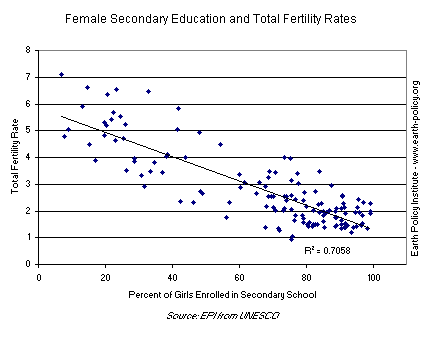
If “lower class” were a genetic trait then the middle and higher classes should fear extinction in due course. Fortunately “class” is just relative and subjective so no matter what the demographics are, distinctions of class will be introduced into any population that exists. But what is more interesting to consider is the fact that women with a higher level of education (which says nothing about native intelligence) have fewer children. This seems to be a global phenomenon. Data from 2010 in the extract below.

The full table is here. Primary School Enrollment and Total Fertility Rates, Latest Year (2000-2010)

Primary School Enrollment and Total Fertility Rates for Selected Countries, Latest Year 2000 – 2010

Rank Country

Primary School Enrollment

Total Fertility Rate

Percent

Number of children
per woman

1 Japan

100.0

1.3

2 Spain

99.8

1.5

3 Iran

99.7

1.8

4 Georgia

99.6

1.6

5 United Kingdom

99.6

1.9

181 Equitorial Guinea

53.5

5.3

182 Guinea-Bissau

52.1

5.7

183 Djibouti

40.1

3.9

184 Sudan

39.2

4.2

185 Eritrea

35.7

4.6

Note: Rankings are based on a list of 185 countries for which primary enrollment data are available.
Source: EPI from UNESCO

Fertility rates tend to be highest in the world’s least developed countries. When mortality rates decline quickly but fertility rates fail to follow, countries can find it harder to reduce poverty. Poverty, in turn, increases the likelihood of having many children, trapping families and countries in a vicious cycle. Conversely, countries that quickly slow population growth can receive a “demographic bonus”: the economic and social rewards that come from a smaller number of young dependents relative to the number of working adults.

For longer term population stability the goal is to reach replacement-level fertility, which is close to 2 children per woman in places where mortality rates are low. Industrial countries as a group have moved below this level. Some developing countries have made progress in reducing fertility, but fertility rates in the least developed countries as a group remain above 4 children per woman.

The trends with secondary education are also very clear:
Female Secondary Education and Total Fertility Rates

Of course the level of development in a country dominates and fertility rates around the world are reducing and converging. Whether this trend will continue even when all female children enjoy secondary education remains to be seen. The UK case where nearly all children do get secondary education would suggest that those with higher (university) education continue to show a declining fertility. But the real test of this hypothesis will only come when education levels around the world have equalised and fertility rates all lie around the same level.

So is the human population “dumbing down”? Not really. Education level is not intelligence. To what extent intelligence is a hereditary trait is uncertain. While it would seem that evolution should favour increasing intelligence, even this is not crystal clear. It is certainly a perception I have that “successful” people tend to be more intelligent but high intelligence does not ensure success. And success in life correlates with wealth but not so well with number of offspring.  “Success”, however we define it,  is not a genetic trait. There have been some suggestions that there may be some optimum level of intelligence for the genetic success of the species and that hunter-gatherers were actually somewhat more intelligent than we are now. Perhaps humans can be “too clever by half”!

But for some time to come, as the developing world catches up with the developed world, we can surely conclude that less-educated parents will have the higher fertility. Whatever that may mean for the long term evolution of humans, and that will be the result of the level to which we intentionally apply genetic selection.

Related: “Selection” lies in the begetting and evolution is just a result

Monkeys – except the top monkey – switch behaviour to conform to local customs

April 29, 2013

Where humans are in a subordinate position in a new society (new immigrants for example) they usually conform to avoid attracting attention which could be dangerous. They observe, they copy behaviour to try to fit in and thereby ensure their own security in the new environment. All driven no doubt by the instinct to survive. But a conquering human does not bother to conform to local customs – he imposes his own. All humans are clearly capable of both types of behaviour. Whether to conform or not is then entirely dependent upon the individual’s position in the society he finds himself in.

And monkeys are – it seems – no different.

I suspect this holds true for many more species than just humans and primates and am a little surprised that the researchers are surprised at this behaviour.

A new paper: E. van de Waal, C. Borgeaud, A. Whiten. Potent Social Learning and Conformity Shape a Wild Primate’s Foraging DecisionsScience, 2013; 340 (6131): 483 DOI:10.1126/science.1232769

From University of St. Andrews press release:

Noha group feeding on pink corn

Noha group feeding on pink corn

….. In the initial study, the researchers provided each of two groups of wild monkeys with a box of maize corn dyed pink and another dyed blue. The blue corn was made to taste repulsive and the monkeys soon learned to eat only pink corn. Two other groups were trained in this way to eat only blue corn. A new generation of infants were later offered both colours of food – neither tasting badly – and the adult monkeys present appeared to remember which colour they had previously preferred. Almost every infant copied the rest of the group, eating only the one preferred colour of corn.

The crucial discovery came when males began to migrate between groups during the mating season. The researchers found that of the ten males who moved to groups eating a different coloured corn to the one they were used to, all but one switched to the new local norm immediately.

The one monkey who did not switch, was the top ranking in his new group who appeared unconcerned about adopting local behavior.

Dr van de Waal conducted the field experiments at the Inkawu Vervet Project in the Mawana private game reserve in South Africa. She became familiar with all 109 monkeys, making it possible for her to document the behaviour of the males who migrated to new groups.

She said, “The willingness of the immigrant males to adopt the local preference of their new groups surprised us all. The copying behaviour of both the new, naïve infants and the migrating males reveals the potency and importance of social learning in these wild primates, extending even to the conformity we know so well in humans.”

Commenting on the research, leading primatologist Professor Frans de Waal, of the Yerkes Primate Center of Emory University, said that the study “is one of the few successful field experiments on cultural transmission to date, and a remarkably elegant one at that.”

Abstract: Conformity to local behavioral norms reflects the pervading role of culture in human life. Laboratory experiments have begun to suggest a role for conformity in animal social learning, but evidence from the wild remains circumstantial. Here, we show experimentally that wild vervet monkeys will abandon personal foraging preferences in favor of group norms new to them. Groups first learned to avoid the bitter-tasting alternative of two foods. Presentations of these options untreated months later revealed that all new infants naïve to the foods adopted maternal preferences. Males who migrated between groups where the alternative food was eaten switched to the new local norm. Such powerful effects of social learning represent a more potent force than hitherto recognized in shaping group differences among wild animals.

180 million Neanderthals are among us

April 16, 2013

From John Hawks Weblog

Just got back proofs of a book chapter I have coming out soon with Zach Throckmorton. My favorite paragraph:

Nearly seven billion people inhabit our planet. At least six billion carry the genes of Neandertal ancestors. Inheritance from Neandertals makes up approximately 3% of the genomes of randomly chosen people outside sub-Saharan Africa today (Green et al., 2010; Reich et al., 2010). A back-of-the-envelope calculation shows if we took all of the Neandertal genes from today’s human population, we would have enough raw material to make up 180 million Neandertals.

I love that because it makes the Neandertals into the evolutionary success story they really were. They succeeded by becoming part of us.

The idea that all the various hominids who developed bipedalism have all disappeared except Anatomically Modern Humans does not appeal. I prefer to think that many of them – and not just the Neanderthals and Denisovans – live on; in us.

File:Homo-Stammbaum, Version Stringer.jpg

Possible archaic human admixture with modern Homo sapiens (Wikipedia)

Middle managers are like monkeys

April 3, 2013

Middle managers are the ones with the fewest “degrees of freedom”. They have the least space to escape from pressure from their superiors because of the demands from their subordinates. Conflict situations in the work place  can generally be avoided by those at the lowest hierarchical levels and can be unilaterally resolved by those at the highest. But those in the middle have no place to run. It seems to be an inherent characteristic of all human organisations. Which is why conventional wisdom tells us that it is middle managers who are subjected to the highest levels of stress and run the highest risk of stress-related disabilities.

Now a new paper shows that it is an organisational characteristic which can also be observed in the hierarchical structure of troops of monkeys. Monkeys in the middle experience the greatest stress. Perhaps it is in our genes? How we (or monkeys) organise  is a natural consequence of the need to cooperate. And it is probably our genes which have given us the propensity to cooperate.

Katie L. Edwards, Susan L. Walker, Rebecca F. Bodenham, Harald Ritchie, Susanne Shultz. Associations between social behaviour and adrenal activity in female Barbary macaques: Consequences of study designGeneral and Comparative Endocrinology, 2013; 186: 72 DOI: 10.1016/j.ygcen.2013.02.023

From the Manchester University press release:

A study by the universities of Manchester and Liverpool observing monkeys has found that those in the middle hierarchy suffer the most social stress. Their work suggests that the source of this stress is social conflict and may help explain studies in humans that have found that middle managers suffer the most stress at work.

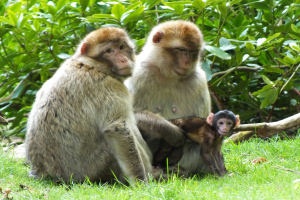
Female Barbary macaques at Trentham Monkey Forest

Female Barbary macaques at Trentham Monkey Forest

Katie Edwards from Liverpool’s Institute of Integrative Biology spent nearly 600 hours watching female Barbary macaques at Trentham Monkey Forest in Staffordshire. Her research involved monitoring a single female over one day, recording all incidences of social behaviour. These included agonistic behaviour like threats, chases and slaps, submissive behaviour like displacing, screaming, grimacing and hind-quarter presentation and affiliative behaviour such as teeth chatter, embracing and grooming. 

The following day faecal samples from the same female were collected and analysed for levels of stress hormones at Chester Zoo’s wildlife endocrinology laboratory.  

Katie explains what she found: “Not unsurprisingly we recorded the highest level of stress hormones on the days following agonistic behaviour. However, we didn’t find a link between  lower stress hormone levels and affiliative behaviour such as grooming.”  

She continues: “Unlike previous studies that follow a group over a period of time and look at average behaviours and hormone levels, this study allowed us to link the observed behaviour of specific monkeys with their individual hormone samples from the period when they were displaying that behaviour.”  

Another key aspect of the research was noting where the observed monkey ranked in the social hierarchy of the group. The researchers found that monkeys from the middle order had the highest recorded levels of stress hormones.  

Dr Susanne Shultz, a Royal Society University Research Fellow in the Faculty of Life Sciences at The University of Manchester oversaw the study: “What we found was that monkeys in the middle of the hierarchy are involved with conflict from those below them as well as from above, whereas those in the bottom of the hierarchy distance themselves from conflict. The middle ranking macaques are more likely to challenge, and be challenged by, those higher on the social ladder.”  

Katie says the results could also be applied to human behaviour: “It’s possible to apply these findings to other social species too, including human hierarchies. People working in middle management might have higher levels of stress hormones compared to their boss at the top or the workers they manage. These ambitious mid-ranking people may want to access the higher-ranking lifestyle which could mean facing more challenges, whilst also having to maintain their authority over lower-ranking workers.”   

The research findings have been published in the journal General and Comparative Endocrinology.   

The return of Eugenics

March 30, 2013

It is the association of the practice of Eugenics with Adolf Hitler and his Nazis and the stigma which that brings which makes it – at least overtly – politically incorrect and tabu. But it was formally practiced by many governments through the 1900’s and as late as 1975 in Sweden.  But Hitler was also a vegetarian, a teetotaler and a non-smoker. So something more than a “Hitler connection” is needed when discussing eugenics. This recent tweet from Richard Dawkins  together with all the recent developments in genetics and IVF and pre-natal screening got me to wondering as to why there is a perception in some quarters that eugenics is “evil”.

Richard Dawkins@RichardDawkins  “Eugenics”: What’s wrong with a nonrandom choice of a gene your child COULD have got from you at random, anyway, by normal genetic lottery? 9:18 AM – 17 Mar 13

Definition oeugenicsnoun [treated as singular]

the science of improving a population by controlled breeding to increase the occurrence of desirable heritable characteristics.

The application of eugenics included genetic screening, birth control, promoting differential birth rates, marriage restrictions, segregation, compulsory sterilization, forced abortions or forced pregnancies and genocide. But the history of the practice of eugenics goes back to infanticide in pre-historic times and we apply it every day without any objections in the management of domestic and wild animals. In the days when we were hunter gatherers – it is thought – infanticide was commonly prevalent:

Joseph Birdsell believed that infanticide rates in prehistoric times were between 15% and 50% of the total number of births, while Laila Williamson estimated a lower rate ranging from 15% to 20%. Both anthropologists believed that these high rates of infanticide persisted until the development of agriculture during the Neolithic Revolution. Comparative anthropologists have calculated that 50% of female newborn babies were killed by their parents during the Paleolithic era. Decapitated skeletons of hominid children have been found with evidence of cannibalism.

The Hitler and the Nazi connotation is certainly part of it but is it primarily the application of coercive measures which today gives eugenics its unsavoury reputation? As practiced in the early 20th century eugenics was applied to humans pretty much as it was for animals – effectively by promoting certain types of matings, preventing others and culling unwanted individuals. I suspect that it is not just the Hitler connection and the coercive treatment of humans which is so objectionable but also that groups of humans were treated en masse as animals for the sake of improvement of the herd.

In today’s world it is perfectly acceptable for couples using IVF to choose – so far as is possible – desirable genetic characteristics of the sperm or egg donor or both. Genetic pre-natal screening can and does lead to abortions if certain criteria are met or others are found wanting. It is effectively culling before birth. Potential surrogate mothers are genetically screened before selection. Genocide and mass rape still take place in conflict situations (Kosovo, Rwanda…) but are universally condemned. We find it perfectly acceptable however that these choices be made by individuals or couples about “their” child. It is taken to be a proper expression of individual rights – though the consequences are mainly borne by the child yet to be born (or not born). But we would find it quite unacceptable today if any government or society would impose these choices on any individual.

It would seem therefore that eugenics is here to stay. As a preventative health measure it is already acceptable if practiced voluntarily by the individuals involved. Selective breeding practiced voluntarily by individuals is also acceptable but is unacceptable if imposed by coercive decree. Enforced sterilisation of those considered mentally or physically defective was a major part of the Eugenics programs in Europe and the US and Australia but the sterilisation of the mentally ill is much rarer now. It seems inevitable that as physical or behavioural or mental characteristics can be connected to specific genes or groups of genes that these characteristics will become part of the criteria for selecting sperm or eggs or for continuing with a pregnancy or not. And even if “voluntary” individual eugenics is already in place today, I am afraid that it is not unthinkable that governments and societies will once again insist on specifying the criteria to be used to improve the common condition. I conclude therefore that it cannot be eugenics which is evil but it is the manner in which it is practiced which can.

Mammoth tusks are — mammoth!

March 26, 2013

Woolly mammoths are thought to have finally become extinct about 4,000 years ago but their bones are being recovered in increasing numbers from under the Siberian permafrost.

They have been recovered for thousands of years whenever they have been found. But now with the use of aerial surveys and with the high demand for ivory, mammoth ivory is beginning to be recovered in large quantities and used instead of illegal ivory. It is promoted as “ethical” ivory and the prices are high enough for Russian entrepreneurs to expand their digging.

National Geographic carries a story about a modern-day Siberian mammoth hunter.

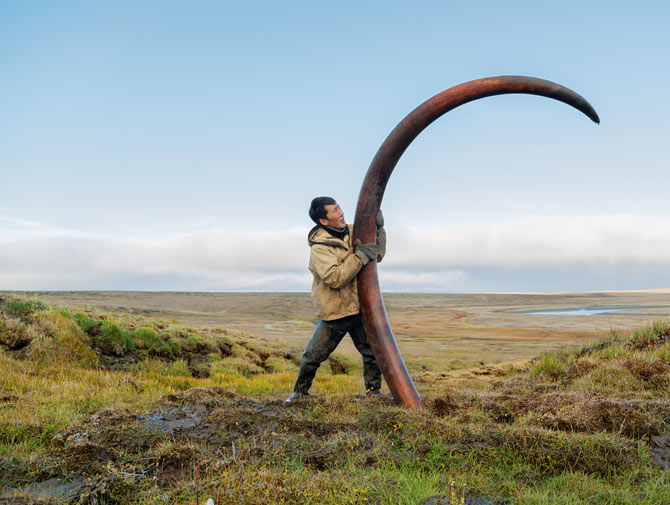
The shaggy giants that roamed northern Siberia during the late Pleistocene epoch died off about 10,000 years ago, though isolated populations lingered on islands to the north and east, the last dying out some 3,700 years ago. The mammoths’ tusks, which could spiral to more than 13 feet, are reemerging from the permafrost—and fueling a trade that benefits the people of Arctic Siberia, including the native Yakuts, an Asiatic ethnic group that speaks a language of Turkic origin. …..

…. The specimen that emerges is as thick as a tree trunk—150 pounds—and in near-pristine condition. Before hauling the tusk away, Gorokhov tosses a silver earring into the hole he has dug, as an offering to the local spirits. If he gets the ancient relic safely home, it could fetch more than $60,000.

Stunning photographs by Evgenia Arbugaeva in National Geographic of mammoth tusks recovered in Arctic Siberia.

Photograph by Evgenia Arbugaeva (via National Geographic)

Photograph by Evgenia Arbugaeva (via National Geographic)

http://www.evgeniaarbugaeva.com/

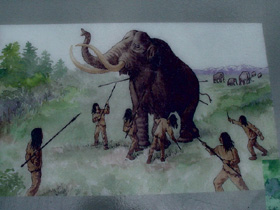
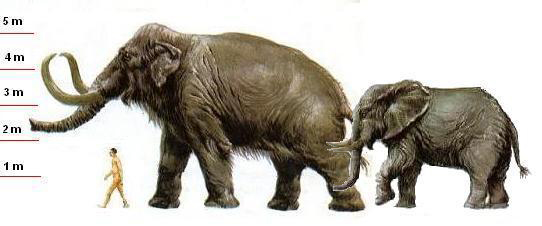
It is not always easy to imagine quite how big the mammoths were and what would have been involved in hunting them 4,000 years ago. That humans did actually manage to successfully hunt these massive beasts cannot be put down to their stature or their weapons or their prowess with spears and can only have been a result of co-operation and strategy.

mammoth hunting

Size comparison animalpicturesarchive.com