Archive for the ‘History’ Category

Nobel prize announcements next week

October 4, 2014

It is that time of the year again.

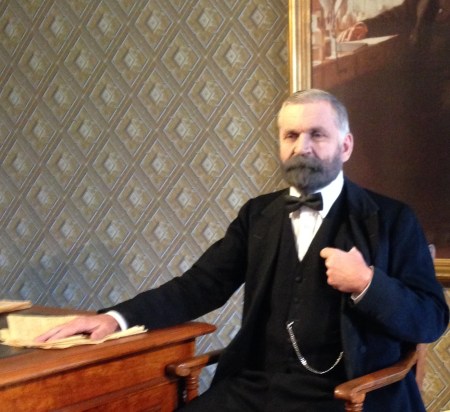
Alfred Nobel at his desk (photo kkp)

“Alfred Nobel” at his desk (photo kkp)

2014 Nobel Prize Announcements

Physiology or Medicine:
Monday 6 October, 11:30 a.m. CET at the earliest

Physics:
Tuesday 7 October, 11:45 a.m. CET at the earliest

Chemistry:
Wednesday 8 October, 11:45 a.m. CET at the earliest

Peace:
Friday 10 October, 11:00 a.m. CET

Economic Sciences:
Monday 13 October, 1:00 p.m. CET at the earliest

Literature:
The date will be set later

I only learned the story behind how the Nobel prizes came into being this summer – on a visit to Björkborn Manor in Karlskoga.

How Sohlman and 3 white Russian stallions ensured the establishment of the Nobel prizes

The Thomson-Reuters Nobel predictions are here.

More women than men – throughout history

September 26, 2014

The Max Planck Institute for Evolutionary Anthropology is pioneering many new techniques of investigative genetics and is causing minor revolutions in many areas of anthropology. Perhaps the best known of these is Svante Pääbo and his group’s work on extracting and analysing ancient DNA.  Their work on the Neanderthal genome is changing the previously accepted history of Modern Humans and their relationships with Neanderthals, Denisovans and other ancient branches of homo erectus.

A new paper reports on a DNA study of 623 males from 51 different populations and comes to the conclusion that throughout history women have outnumbered men. The study compared the paternally-inherited Y chromosome (NRY) with maternally inherited mitochondrial DNA (mtDNA). The researchers developed a high-resolution Y chromosome sequencing assay that allowed them to get paternal and maternal histories of similar quality and resolution. Female populations were larger before the out-of-Africa migration(s) and remained so throughout almost all subsequent migrations. Women migrated more (presumably as they were married out) and men stayed put more. For most of our history a greater proportion of women in the population reproduced than men leading to females making a larger genetic contribution to the current global population than males did. Men tended to fertilise multiple females (perhaps an indicator of polygyny).

CBS News: …. people in East Asia and Europe have larger genetic differences for paternal than for maternal DNA, suggesting high levels of female migration. In contrast, populations in Africa, Oceania and the Americas have bigger differences for maternal DNA than for paternal DNA.

Human paternal and maternal demographic histories: insights from high-resolution Y chromosome and mtDNA sequences, Sebastian Lippold, Hongyang Xu, Albert Ko, Mingkun Li, Gabriel Renaud, Anne Butthof, Roland Schroeder and Mark Stoneking, Investigative Genetics 2014, 5: 13

Eurekalert:

Female populations have been larger than male populations throughout human history, according to research published today in the open access journal Investigative Genetics. The research used a new technique to obtain higher quality paternal genetic information to analyse the demographic history of males and females in worldwide populations.

The study compared the paternally-inherited Y chromosome (NRY) with maternally inherited mitochondrial DNA (mtDNA) of 623 males from 51 populations. The analysis showed that female populations were larger before the out-of-Africa migration and remained so throughout almost all subsequent migrations. The main drivers of this trend are likely to be processes such as polygyny, where one male mates with many females, and the fact that in most societies, women tend to move to live with their husbands. This has resulted in females making a greater genetic contribution to the global population than males.

Previous research on genetic history has used different techniques to analyse NRY and mtDNA, which has led to an ascertainment bias in the results. In this study, researchers from the Max Planck Institute for Evolutionary Anthropology developed a high-resolution Y chromosome sequencing assay that allowed them to get paternal and maternal histories of similar quality and resolution, so they could make a direct comparison. The results confirmed previous findings that when comparing human populations on a global scale, there are greater genetic differences in paternal NRY than in mtDNA. However, these differences are not as large as previously thought and the authors were surprised to see substantial variation in relative amounts of NRY vs. mtDNA differentiation at the regional level.

The authors argue that using this new technique, greater analysis can be undertaken at a regional level to create a clearer picture of the paternal and maternal influences on specific populations. In the African populations they studied, they saw lower paternal genetic diversity, which may be a direct result of the Bantu expansion into eastern and southern Africa beginning about three thousand years ago. In samples taken from the Americas, initial results suggest higher maternal genetic diversity, indicating that there were fewer males than females among the original colonisers.

Dr. Mark Stoneking, Department of Evolutionary Genetics, Max Planck Institute, an author on the paper, said: “Our new sequencing technique removes previous biases, giving us a richer source of information about our genetic history. It allows us to take a closer look at the regional differences in populations, providing insights into the impact of sex-biased processes on human genetic variation.”

Madras Day, the Coromandel coast and the Yonghy-Bonghy-Bo

August 23, 2014

Madras Day: 22nd August 1639 – 2014

Madras Day was celebrated yesterday as the 375th anniversary of the founding of the city now known as Chennai on the Coromandel coast.

Andrew Cogan and Francis Day’s factory site on an uninhabited sandy strip eventually grew to become one of India’s renowned metropolises, and the capital city of Tamil Nadu. Every year, August 22 is celebrated as Madras Day, and this year, 2014, is Chennai’s 375 birthday.

Excerpt from Edward Lear’s The Courtship of the Yonghi-Bonghi-Bo  (this should be read in its entirety and only be read aloud)

On the Coast of Coromandel
Where the early pumpkins blow,
In the middle of the woods
Lived the Yonghy-Bonghy-Bo.

………….

“On this Coast of Coromandel
Shrimps and watercresses grow,
Prawns are plentiful and cheap,”
Said the Yonghy-Bonghy-Bo.
“You shall have my chairs and candle,
And my jug without a handle!
Gaze upon the rolling deep
(Fish is plentiful and cheap);
As the sea, my love is deep!”
Said the Yonghy-Bonghy-Bo,
Said the Yonghy-Bonghy-Bo.
……….
“Lady Jingly! Lady Jingly! 
Sitting where the pumpkins grow, 
Will you come and be my wife?”
Said the Yonghy-Bònghy-Bò.
……….
Down the slippery slopes of Myrtle,
Where the early pumpkins blow,
To the calm and silent sea
Fled the Yonghy-Bonghy-Bo.
………
From the Coast of Coromandel
Did that Lady never go;
On that heap of stones she mourns
For the Yonghy-Bonghy-Bo.
………
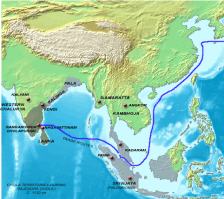
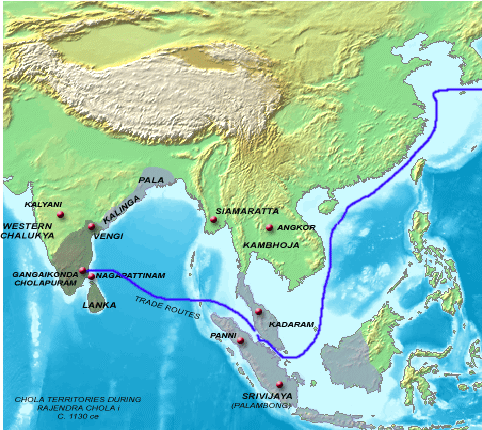
Chola trade under Rajendra Chola c. 1130 Wikimedia

Chola trade under Rajendra Chola c. 1130 Wikimedia

The earliest known settlements in South India date back to more than 2 million years ago in the form of Acheulian stone tools (Lower Paleolithic from about 2.6 million to 300,000 years ago). The oldest human remains (probably homo erectus or archaic homo sapiens)  found is a fossilised infant skull from about 200,000 years ago. The unfortunate and love-sick Yonghi-Bonghi-Bo was never destined to win his Lady Jingly Jones but the Coromandel coast has seen a continuous settlement of humans for over 2 million years. Homo sapiens probably came in two waves; one before the Toba eruption of 74,000 years ago and another perhaps around 50,000 years ago. The Toba eruption was possibly the greatest catastrophe ever visited on humans on that coast. In due course, hunter-gatherers gave way to farmers and the evidence shows that the Neolithic was long established by around 2,600 BCE (4,700 years ago). The early Chola-dynasty rule was established by 100 CE in the Sangam era. They lost power to the Pallavas around 300 CE who in turn were replaced by Pandyas around 600 CE but then the Cholas returned around 900 CE. Whether these medieveal Cholas were truly descendants of the early Cholas is uncertain but they certainly claimed to be. By 1,000 years ago at the height of the Chola Empire, their territories extended well into South-east Asia. Chola traders were finding their way up to today’s Korea, protected by a Navy which even had some blue-water capabilities. The later Cholas were again replaced by the Pandyas in 1279 but the rule of the great Tamil dynasties came to an end with the establishment of the short-lived Madurai Sultanate in 1335 and its many subsequent successors. Then came the colonists. The Portuguese, the Dutch, the British, the Danes and the French. The Portuguese were first. The “realm of the Cholas” in Tamil was “Cholamandalam” and from this came the Portuguese corruption to “C(h)oro-mandel”. Vasco da Gama reached the Western Indian Malabar coast on 20th May 1498. In 1522 they established São Tomé de Meliapore named after St. Thomas who was supposed to have preached at St. Thomas’ Mount between 52 and 70 CE.  The legend is that St. Thomas died here and by 1523, the Portuguese had built a shrine there. “By late 1530 the Coromandel Coast was home to three Portuguese settlements at Nagapattinam, São Tomé de Meliapore, and Pulicat”. The Dutch reached the Coromandel Coast by 1606 and built their Geldria Fort near Pulicat (where the Portuguese were already present) as a staging post to the East Indies. The first British trading post was established in 1610 at Masulipatnam which had been abandoned by the Portuguese. The Danes reached in 1620 in Tranquebar and established a protestant mission. The French were late out and their first permanent colony was not established till they purchased Pondicherry in 1673.

By 1825, the Dutch had lost the last of their trading posts in India. The Danes left Tranquebar in 1845. The British left with Independence in 1947. By 1954 the French had ceded all colonies in India (though not ratified by the French Parliament till 1962). The Portuguese lost all footholds on the Coromandel coast by 1749 and were finally pushed out of India by military action in 1961.

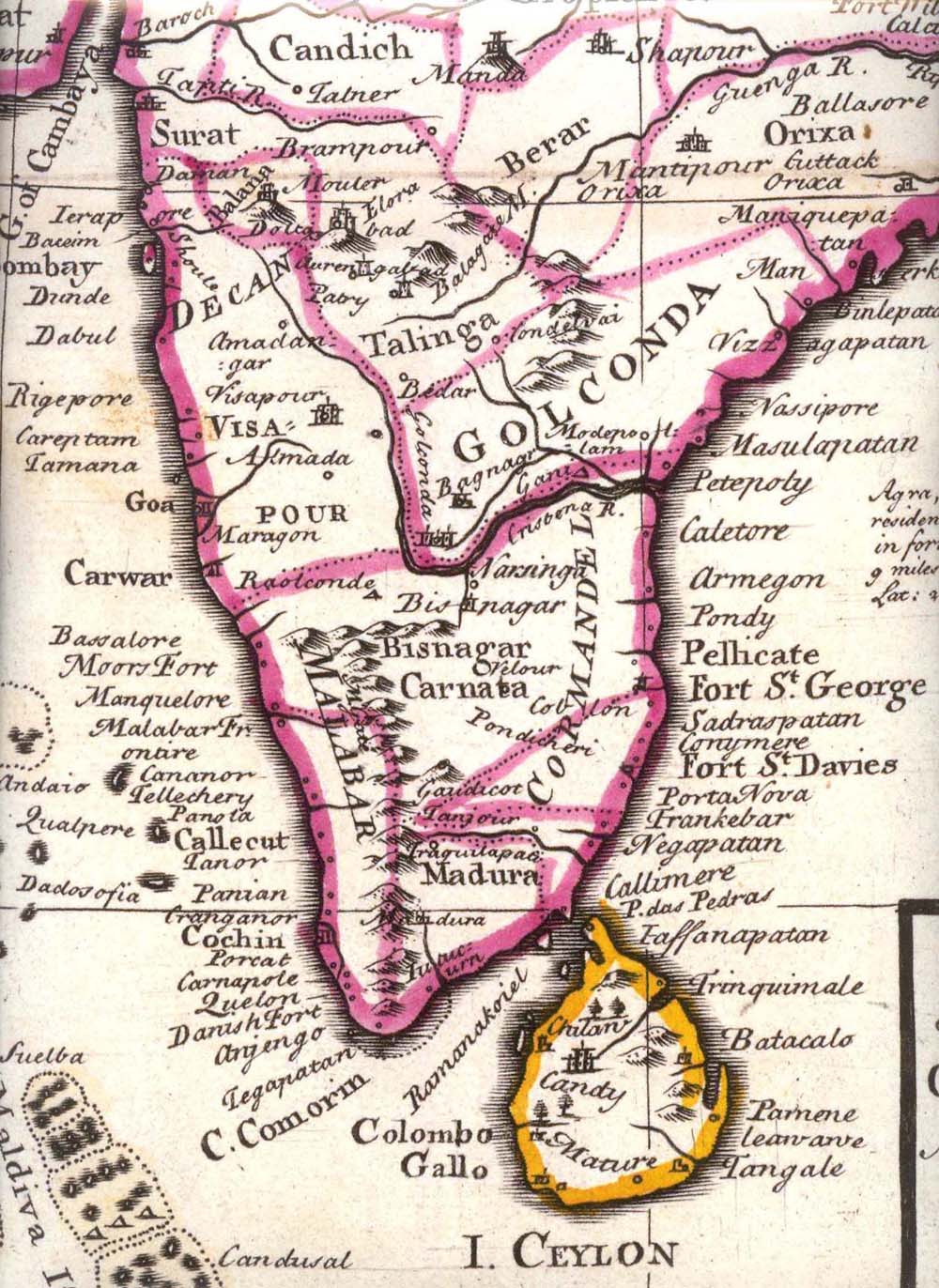
The Coromandel coast 1715
coromandel coast 1715 by moll

coromandel coast 1715 by moll

The British East India Company was quite desperate to find a foothold on the Coromandel coast but their efforts at Pulicat were defeated by the Dutch. They tried at to settle at Peddapalli and Nizampatnam but were laid low by the climate and by disease. The English, after some effort, secured the privilege of building a factory at Masulipatam port.

The Beginnings: 

But they later abandoned their factory and crept away in a small boat to Durgarazpatnam (otherwise known as Armagaon) situated about 35 miles to the north of Pulicat. This place was a miserable port and was too poor to supply the calico cloth which the English wanted for export to Europe. But it was the only safe shelter for the English at the time and here they built a small fort and mounted a few pieces of cannon upon it. But trade did not thrive and the miserable English traders planned to go back to Masulipatam under the protection of a Golden Firman which the Sultan of Golconda was kind enough to give them. But Masulipatam was in the throes of a famine just then ….. 

With Masulipatam unprosperous and Armagaon hopeless, the English traders anxiously looked out for a new site that would be more propitious for them. Mr. Francis Day, the future founder of Madras, who was then a Member of the Masulipatam Council and the Chief of the Armagaon Factory, made a voyage of exploration in 1637 down the coast as far as Pondicherry with a view to choose a site for a new settlement. 

Damarla Venkatapathy Nayak ruled all the coast country from Pulicat to the Portuguese settlement of San Thome now included within the City of Madras. He had his head-quarters at Wandiwash and his brother Ayyappa Nayak resided at Poonamallee, a few miles to the west of Madras, and looked after the affairs of the coast. 

And so it was in August 1639 that Francis Day and Andrew Cogan on behalf of the East India Company purchased a 2 year grant from the Nayak for the village of Madraspattnam and with permission to build a fort and a factory. That became Fort St. George  with the village of Madraspattnam just to the south and a village  – called Chennaipattnam by the locals – to the north.

And the rest is history.

Day and Cogan are commemorated nowhere — except by Madras Day on 22nd August every year. But what is not really known is how the village of Madraspattnam, which clearly existed before Day and Cogan turned up, got its name. In one story it was named after a Christian fisherman named Madresan and in another after a Muslim madrassa in the vicinity. Another story speculates that it was because of the nearby Madre de Dios Church built by the Portuguese in São Tomé de Meliapore. But the story I like best is that it comes from the name of the wealthiest Portuguese family of the time in São Tomé de Meliapore – the Madeiros.

And that is the tale of Chennai on the Coromandel coast which once went by the name of a Portuguese family, where prawns are still plentiful and cheap and where the Yonghy-Bonghy-Bo broke his heart over the Lady Jingly Jones.
Not so random animal sounds may show a stepping stone towards language

August 21, 2014

The manner in which humans came to invent gestures and sounds, then developed these into words, then into language and eventually on into writing is a critical and fascinating story from our past that will probably never be fully known or understood. No doubt for humans there is also a connection to the invention of counting, the use of abstract symbols and the evolution of numeracy and the beginnings of the languages of mathematics.The timeline of these evolutions are also in much doubt. Possibly gestures and sounds go back 300,000 years (or even further), but language was established among humans only by about 50,000 years ago. Words and their earlier sounds must have come much, much earlier and writing very much later. Cave paintings around 30,000 years ago may represent the period when abstract symbolism was taking off. It is thought that writing did not come until agriculture expanded – perhaps from about 12,000 years ago.

Now research on animal sounds suggests that for some species the sounds they make are not as random as they were originally thought to be. They exhibit levels of complexity which are suggestive of stepping-stones along the long road to grammar and language. Such steps may have assisted humans from moving from sounds and words to context-free grammars and thence to language.

The sequence in humans – I speculate – could have been:

(300KYA) gestures>> sounds>> (smiles, laughter?)>> words>> ..(unknown steps)>> simple grammar>> context-free grammar>> language>> symbols>> abstract symbols>> writing (12KYA)

Kershenbaum A, Bowles A, Freeburg T, Dezhe J, Lameira A, Bohn K. 2014. Animal vocal sequences: Not the Markov chains we thought they were. Proceedings of the Royal Society B. rspb.royalsocietypublishing.or… .1098/rspb.2014.1370

PhysOrg reports:

The study, published today in the journal Proceedings of the Royal Society B, analyzed the vocal sequences of seven different species of birds and mammals and found that the vocal sequences produced by the animals appear to be generated by complex statistical processes, more akin to human language. ….

Many species of animals produce complex vocalizations – consider the mockingbird, for example, which can mimic over 100 distinct song types of different species, or the rock hyrax, whose long string of wails, chucks and snorts signify male territory. But while the vocalizations suggest language-like characteristics, scientists have found it difficult to define and identify the complexity.

Typically, scientists have assumed that the sequence of animal calls is generated by a simple random process, called a “Markov process.” Using the Markov process to examine animal vocalization means that the sequence of variables—in this case, the vocal elements—is dependent only on a finite number of preceding vocal elements, making the process fairly random and far different from the complexity inherent in human language. ……. 

…… the study found no evidence for a Markovian process. The researchers used mathematical models to analyze the vocal sequences of chickadees, finches, bats, orangutans, killer whales, pilot whales and hyraxes, and found most of the vocal sequences were more consistent with statistical models that are more complex than Markov processes and more language-like. …… 

“Language is the biggest difference that separates humans from animals evolutionarily, but multiple studies are finding more and more stepping stones that seem to bridge this gap. Uncovering the process underlying vocal sequence generation in animals may be critical to our understanding of the origin of language,” said lead author Arik Kershenbaum, a postdoctoral fellow at the National Institute for Mathematical and Biological Synthesis.

Abstract:

Many animals produce vocal sequences that appear complex. Most researchers assume that these sequences are well characterized as Markov chains (i.e. that the probability of a particular vocal element can be calculated from the history of only a finite number of preceding elements). However, this assumption has never been explicitly tested. Furthermore, it is unclear how language could evolve in a single step from a Markovian origin, as is frequently assumed, as no intermediate forms have been found between animal communication and human language. Here, we assess whether animal taxa produce vocal sequences that are better described by Markov chains, or by non-Markovian dynamics such as the ‘renewal process’ (RP), characterized by a strong tendency to repeat elements. We examined vocal sequences of seven taxa: Bengalese finches Lonchura striata domestica, Carolina chickadees Poecile carolinensis, free-tailed bats Tadarida brasiliensis, rock hyraxes Procavia capensis, pilot whales Globicephala macrorhynchus, killer whales Orcinus orca and orangutans Pongo spp. The vocal systems of most of these species are more consistent with a non-Markovian RP than with the Markovian models traditionally assumed. Our data suggest that non-Markovian vocal sequences may be more common than Markov sequences, which must be taken into account when evaluating alternative hypotheses for the evolution of signalling complexity, and perhaps human language origins.

A “right” to be remembered

July 6, 2014

We shall all die and we shall all be forgotten. And if our works have not been captured on tablets of stone or our images as cave paintings then the “forgetting” will not take very long. While stone tablets and cave walls have a life of tens of thousands of years, the life of parchment is at most about two thousand and paper is unlikely to survive more than a thousand years. Media for the storage of electronic data can live for probably no more than a few decades – at best. And with the internet the medium is getting ever more ephemeral.

History does not change. But the historical record depends on who recorded it and with how much bias, on what medium and who rewrote it before the medium died. Data corruption and plagiarism were not of great concern in the days of stone tablets. The ease of corrupting data has increased with the ease of recording data and the lifetime of the recording media have decreased.

David Mitchell writes in The Observer:

These days thousands are campaigning for “the right to die” and “the right to be forgotten as if they’re genuinely worried it might otherwise not happen.

What will our descendants think of it? “Bloody hell, those guys were a bit glass-half-empty! What else did they want? ‘The right to self-harm’? ‘The right to feel humiliated’? ‘The right to decompose’? ‘The right to have someone you hate turn up at your funeral and claim you liked them’?” Historians of future ages could be forgiven for concluding that this whole era was clinically depressed. ……… 

The only thing I ever liked about the internet was that I thought it would help historians – that, assuming there wasn’t an all-data-destroying power surge, millions of searchable written sources would be left to posterity. Without that, it’s all just grooming and bookshop closures and mind-blowing opportunities for fraud. So this news that Ozymandias can apply to have records of his works suppressed in case they invoke too much despair in the Mighty – ie prospective employers – is a real blow.

You may say that Ozymandias is dead – or rather fictional but, even in the fiction, dead – so couldn’t apply to have his virtual trunkless legs buried in the unsearchable sand (I will retain control of this metaphor). The internet can still be accurate about the deceased, you might think. I don’t. They’re the very people you can say anything about, true or false, because they cannot be libelled. Only the living have legal recourse to ensure accuracy, but why would anyone bother to get things corrected if they can effectively just delete anything written about them that they’re not keen on?

People’s right to suppress unpleasant lies which are publicly told is being extended to unpleasant truths – until they die when it’s suddenly open season on slander. The internet will become constructed entirely of two different sorts of untruth: contemporaneous unalloyed praise and posthumous defamatory hearsay.

We are 7 billion today and all the humans who ever lived (as Anatomically Modern Humans since about 200,000 years ago) probably number around 110 billion. Being forgotten is is the norm.

I want the “right” to be remembered – but not for those things I don’t want to be remembered for! But I will be long gone, long forgotten, and will have little interest in any “rights” by then.

Lest we forget — Tiananmen Square 25 years

June 3, 2014

Martial Law was imposed on 4th June 1989.

Some have identified the “Tank Man” as Wang Weilin but this has not been confirmed and his fate is unknown.

Most likely his body died that day – along with thousands of others – when he faced the tanks and he was then hustled away — 5th June 1989.

But the Tank Man of Tiananmen Square is now immortal.

File:Tank Man Long Shot by Stuart Franklin.jpg

Tank Man Long Shot by Stuart Franklin

Tank Man (AP Photo - Jeff Widener)

Tank Man (AP Photo – Jeff Widener)

You Tube Video here.

Trousers were invented for riding horses

June 3, 2014

Trousers were invented at least 3,000 years ago – for riding

The Tarim Basin in Central Asia with its hot but exceedingly dry climate has yielded a number of well preserved mummies and over 500 tombs have been found and excavated in the last 50 years. A new paper describes the finding of well preserved trousers from 3,000 to 3,300 years ago.

Whether these were the first ever trousers cannot be determined of course. But these remains found in Central Asia tell us that horse riding is at least 3,000 years old (and herding, capturing, breaking and training horses must have been “invented” well before that).

Chinese trousers 3000 years old - photo M Wagner, German Archaeological Institute

Chinese trousers 3000 years old – photo M Wagner, German Archaeological Institute

Half of Newton’s papers were on religion, 10% on alchemy and only 30% on science and math

May 16, 2014

Unlike Alfred Nobel who I posted about recently, Isaac Newton left no will when he died in 1727. But he left behind him a mass of papers estimated to run to about 10 million words. But most of the notes he left behind dealt with religious subjects and alchemy and his views were not just politically incorrect but potentially embarrassing if not dangerous to his heirs.

Wired has interviewed Sarah Dry who has just published her book on The Newton Papers.

WiredHe wrote a forensic analysis of the Bible in an effort to decode divine prophecies. He held unorthodox religious views, rejecting the doctrine of the Holy Trinity. After his death, Newton’s heir, John Conduitt, the husband of his half-niece Catherine Barton, feared that one of the fathers of the Enlightenment would be revealed as an obsessive heretic. And so for hundreds of years few people saw his work. It was only in the 1960s that some of Newton’s papers were widely published.

Now of course The Newton Project is putting all of his papers online and they have so far transcribed about 6.4 million words:

The Newton Project is a non-profit organization dedicated to publishing in full an online edition of all of Sir Isaac Newton’s (1642–1727) writings — whether they were printed or not. The edition presents a full (diplomatic) rendition featuring all the amendments Newton made to his own texts or a more readable (normalised) version. We also make available translations of his most important Latin religious texts.

Although Newton is best known for his theory of universal gravitation and discovery of calculus, his interests were much broader than is usually appreciated. In addition to his celebrated scientific and mathematical writings, Newton also wrote many alchemical and religious texts.

Sarah Dry traces the history of the Newton papers and how they languished over the years. It was not perhaps by conspiracy but there was some clear apprehension that sorting and cataloguing them would be embarrassing because there was so much of a “heretical” nature:

Sarah Dry in WiredThere’s roughly 10 million words that Newton left. Around half of the writing is religious, and there are about 1 million words on alchemical material, most of which is copies of other people’s stuff. There are about 1 million words related to his work as Master of the Mint. And then roughly 3 million related to science and math.

…… one of the messages of the book is that getting too involved in the papers can be hazardous to your health. One of the first editors of the papers said an older man should take up the task, because he’d have less to lose than a younger man.

This is highly technical stuff. The alchemical stuff is technical, the scientific stuff is technical, the religious stuff is technical. I was more interested in the papers and the characters that worked on them. One person was David Brewster, who wrote a biography of Newton during the Victorian Era. He fought long and hard to resuscitate Newton’s reputation. But he was also one of these Victorians that had to tell the truth. So when he published his biography [in 1855], it included much of the heresy and alchemy, despite the fact that Brewster was a good orthodox Protestant.

…. When the papers came to Cambridge in the late 1800s, they were unsorted and chaotic. And the two men given to sorting them were John Couch Adams and George Stokes. Adams was the co-discoverer of Neptune. He famously never wrote anything down. And Stokes was just as great a physicist, but he wrote everything down. He in fact wrote 10,000 letters. So these two guys get the papers, and then they sit on them for 16 years; they basically procrastinate.

When actually confronted with Newton’s paper, they were horrified and dismayed. Here was this great scientific hero. But he also wrote about alchemy and even more about religious matters. Newton spent a long time writing a lot of unfinished treatises. Sometimes he would produce six or seven copies of the same thing. And I think it was disappointing to see your intellectual father copying this stuff over and over. So the way Adams and Stokes dealt with it was to say that, “His power of writing a beautiful hand was evidently a snare to him.” Basically, they said he didn’t like this stuff, he just liked his own writing.

There’s also Grace Babson, who created the largest collection of Newton objects and papers in America. She was married to a man who got rich predicting the crash of 1929. And Roger Babson [her husband] based his market research on Newtonian principles, using the idea that for every action there is an equal an opposite reaction. The market goes up so it must come down. Interestingly, he thought of gravity as an evil scourge.

Clearly people felt that tarnishing Newton’s image was a heresy in itself and they felt that publicising his stranger writings could do such damage to their icon. But the time since his death is critical here. Newton’s image  is now immune to such damage. I think that no matter how weird his views may have been about the Bible and prophecies and the occult and alchemy, they cannot – now – detract from his work on maths and physics and motion.

But his catalogers have a point. If one part of his work had been  debunked or ridiculed soon after his death, it could have damaged his reputation and even the credibility of his work in Physics and Maths. It is common practice now – as it was common practice then – for detractors to attack an opponent’s views on one subject obliquely, by denigrating his views or work in some other field. Wrong thinking in one field – by association – becomes wrong thinking in all fields.

It may have been different if they had TV in those days. For if Newton had lived in today’s world it could well be that his eminence in Physics and Maths  would have made him an instant TV pundit on all subjects. We would be suffering the pain of listening him to expound on his other weird and wonderful ideas. As we all must endure when we have to listen to actors pontificating about environmental science or psychiatrists excusing errant behaviour or politicians pretending they understand economics!!

How Sohlman and 3 white Russian stallions ensured the establishment of the Nobel prizes

May 15, 2014
Björkborn Manor (photo kkp)

Björkborn Manor (photo k2p)

Yesterday we visited the Nobel Museum at the Björkborn Manor and Estate in Karlskoga. Björkborn was Alfred Nobel’s last “residence” but he never really lived in it except as a sort of guest house. In fact he died at his villa in Italy. But Björkborn was critical in ensuring that the Nobel prizes even exist at all.  A visit I would now strongly recommend to any visitor to Sweden. For me personally it was memorable on many levels, but primarily for teaching me so much new and in such a dramatic fashion. Till this visit, I knew very little about Alfred Nobel’s last will and testament and what a close run thing it was that it was ever implemented.

This quite remarkable, but little known, story of Ragnar Sohlman and the 3 white Russian stallions which ensured that Nobel’s will could be followed and that the Nobel Foundation and its 5 prizes could be established was something quite new for me. Ragnar Sohlman who, at the age of 26 spent five years against formidable opposition in at least 3 countries to establish the Nobel prizes in accordance with Nobel’s wishes, is the real unsung hero of the creation of the brand equity which is today the hallmark of the Nobel prizes.

But more of Ragnar Sohlman later.

(more…)

A multiverse model of the Universe from 800 years ago

May 6, 2014

Bishop Robert Grosseteste, detail of a window on the South transept Westernmost. St Paul’s Parish Church, Morton, Near Gainsborough. 1896

Robert Grosseteste (ca. 1168–1253), Bishop of Lincoln from 1235 to 1253, was one of the most prominent and remarkable figures in thirteenth-century English intellectual life. His views on light and matter were some 800 years in advance of his time.

If a single leitmotif runs through Grosseteste’s works, it is that of light. The notion of light occupies a prominent place in Grosseteste’s commentaries on the Bible, in his account of sense perception and the relation of body and soul, in his illuminationist theory of knowledge, in his account of the origin and nature of the physical world, and, of course, in his writings on optics. 


His treatise De Luce (meaning “Concerning Light”), written in 1225, describes a Universe created via a Big Bang-like explosion of light before forming into a series of nine celestial spheres.

Past Horizons:

The Ordered Universe Project, which brings together physicists, psychologists, cosmologists, Latin experts and medieval historians, has been studying the texts of Robert Grosseteste, one-time Bishop of Lincoln. The team created a fresh Latin translation, aided by other experts with knowledge of the medieval mindset and its context, before applying modern mathematical and computational techniques to Grosseteste’s equations. ….

Dr Giles Gasper, the Ordered Universe Project’s Principal Investigator and Associate Director of Durham University’s Institute of Medieval and Early Modern Studies, said: “De Luce is the earliest known attempt to describe the Universe using a coherent set of physical laws, centuries before Sir Isaac Newton.

“It proposes that the same physics of light and matter, which explain the solidity of ordinary objects, could be applied to the cosmos as a whole. In doing so it also suggests, although this was probably not apparent to Grosseteste at the time, a series of ordered universes reminiscent of the modern “multiverse” concept.

“Grosseteste’s calculations are very consistent and precise. Had he had access to modern calculus and computing methods, he surely would have used them, so that is what the team has done.”

Richard G. Bower, Tom C. B. McLeish, Brian K. Tanner, Hannah E. Smithson , Cecilia Panti, Neil Lewis, Giles E. M. Gasper, A Medieval Multiverse: Mathematical Modelling of the 13th Century Universe of Robert Grosseteste, Royal Society Journal, Proceedings of the Royal Society A, arXiv:1403.0769

Abstract: In his treatise on light, written in about 1225, Robert Grosseteste describes a cosmological model in which the Universe is created in a big-bang like explosion and subsequent condensation. He postulates that the fundamental coupling of light and matter gives rises to the material body of the entire cosmos. Expansion is arrested when matter reaches a minimum density and subsequent emission of light from the outer region leads to compression and rarefaction of the inner bodily mass so as to create nine celestial spheres, with an imperfect residual core. In this paper we reformulate the Latin description in terms of a modern mathematical model. The equations which describe the coupling of light and matter are solved numerically, subject to initial conditions and critical criteria consistent with the text. Formation of a universe with a non-infinite number of perfected spheres is extremely sensitive to the initial conditions, the intensity of the light and the transparency of these spheres. In this “medieval multiverse”, only a small range of opacity and initial density profiles lead to a stable universe with nine perfected spheres. As in current cosmological thinking, the existence of Grosseteste’s universe relies on a very special combination of fundamental parameters.