Archive for the ‘Japan’ Category

A garbage disposal system for space junk

January 17, 2014

NASA keeps track of all the debris in orbit. About 13,000 known objects are bigger than 10 centimeters in diameter and there are more than 100,000 pieces of orbital debris between 1 cm and 10 cm. Pieces smaller than 1 cm number in the tens of millions. All pieces of debris larger than 10 cm are carefully tracked using radar and telescopes.

Many schemes have been proposed for trying to get rid of space debris orbiting the Earth. The schemes have ranged from space harpoons, clouds of of ballistic gas, housekeeping, robotic satellites and laser cannon. The Japanese have a plan for an electrodynamic tether to be attached to the debris by a robot arm. the tether then generates an electric field as it orbits around the Earth and the magnetic field then encourages the debris to drop into lower orbits and eventually burn up. A tether is going to be sent up into space at the end of February for a trial.

Electrodynamic tether

SpaceDaily: Researchers at The Japan Aerospace Exploration Agency (JAXA) have developed what they called an electrodynamic tether made from thin wires of stainless steel and aluminium.

The idea is that one end of the strip will be attached to one of the thousands of dead satellites or bits of rocket that are jamming up space and endangering working equipment.

The electricity generated by the tether as it swings through the Earth’s magnetic field is expected to have a slowing effect on the space junk, which should, scientists say, pull it into a lower and lower orbit.

Eventually the detritus will enter the Earth’s atmosphere, burning up harmlessly long before it has chance to crash to the planet’s surface.

“The experiment is specifically designed to contribute to developing a space debris cleaning method,” said Masahiro Nohmi, associate professor at Kagawa University, who is working with JAXA on the project, told AFP. Nohmi said a satellite developed by the university is expected to be launched into space on February 28, with the tether aboard.

“We have two main objectives in the trial next month,” he said. “First, to extend a 300-metre (1,000-foot) tether in orbit and secondly to observe the transfer of electricity.” The actual reeling in of orbiting rubbish will be the objective of future experiments, he said. A spokesman for JAXA said the agency also plans to conduct its own trial on a tether in 2015.

More than 20,000 bits of cast off equipment, including old satellites, pieces of rocket and other fragments are uselessly orbiting the Earth in a band 800-1,400 kilometres (500-900 miles) from the surface of the planet at terrific speed. 

JAXA write:

If we are able to calculate the motion of debris, we can attach a propulsion system for removal. As the propulsion system, we have envisioned an “electrodynamic tether”, which is extremely efficient because it does not require fuel. The end of an electrically conductive cord (tether) is attached to the debris, transferring it to a lower orbit through the Lorentz force generated by the interference between Earth’s magnetic field and the current flowing through the tether, causing it to re-enter the atmosphere. Two methods are being considered for attaching the tether. One is a method of using a robot arm, for example, to hook the end of the tether into a 1-meter-diameter hole in a payload attachment fitting used as a base for mounting the satellite onto the rocket.  Another is a method where the side of the rocket stage, which is extremely thin for reduced weight, is approached and harpooned by the tether end to attach it. This method is considered to be a safer operation since the tether can be attached from a distance of 10 to 20m.

Fear of nuclear radiation is much worse than the reality

October 27, 2013

The Fukushima Dai-Ichi nuclear accident which followed the Great Tohoku Earthquake and Tsunami of 2011, was about the worst accident that could have happened in a nuclear plant. Hydrogen explosions occurred in the outer containment casings of 2 of the 6 reactors and meltdown of 2 of the cores also took place. A nuclear plant is not a nuclear bomb and a chain reaction leading to an explosion is not a real possibility. It is meltdown of the cores which is the bottom line.

Yet there were no deaths. As the official report from May this year said:

 No radiation-related deaths or acute effects have been observed among nearly 25,000 workers (including TEPCO employees and contractors) involved at the accident site.

It was the earthquake and tsunami which did the damage, caused some 18,000 deaths  and which led to the nuclear accident. But radiation from the nuclear accident has caused no deaths. And the radiation will cause no deaths. The report goes on:

The additional exposures received by most Japanese people in the first year and subsequent years due to the radioactive releases from the accident are less than the doses received from natural background radiation (which is about 2.1 mSv per year). This is particularly the case for Japanese people living away from Fukushima, where annual doses of around 0.2 mSv from the accident are estimated, arising primarily through ingestion of radionuclides in food. …. 

Given the small number of highly exposed workers, it is unlikely that excess cases of thyroid cancer due to radiation exposure would be detectable. Special health examinations will be given to workers with exposures above 100 mSv including annual monitoring of the thyroid, stomach, large intestine and lung for cancer as a means to monitor for potential late radiation-related health effects at the individual level.

The assessment also concluded that although the rate of exposures may have exceeded the levels for the onset of effects on plants and animals several times in the first few months following the accident, any effects are expected to be transient in nature, given their short duration. In general, the exposures on both marine and terrestrial non-human biota were too low for observable acute effects.

The fears of radiation it would seem are completely out of proportion to the reality of damage actually done. The imagination gone wild of writers and movie scriptwriters, has fantasised about mutations and monsters but have had little basis in the history of both military and civil use of nuclear power. The psychological effects of the fears – apparently quite unfounded – have been orders of magnitude greater than the direct effects of any radiation. Japanese children in Fukushima have suffered more from obesity because they have been banned from playing outside than by any effects of radiation.

Perhaps the biggest disservice done by environmental groups is due to their propensity to exaggerate quite legitimate – but manageable – concerns to become Alarmism. Once the Alarmist phase is reached, rational behaviour is no longer possible.  But they have been calling “Wolf” for 3 decades and for far too long now. As catastrophe scenarios and doomsday predictions keep being pushed into the future, alarmist scenarios are increasingly being discounted. There is a beginning of a welcome  return to rationality.

David Ropeik writes in the New York Times:

It has been more than two and a half years since the Fukushima nuclear disaster began to unfold, and still the world watches events closely, fearfully. The drumbeat of danger seems never ending: Earlier this month, to take just one example, international news reports spread word that six workers at the plant had been accidentally doused with radioactive water.

Yet leading health scientists say the radiation from Fukushima has been relatively harmless, which is similar to results found after studying the health effects of Chernobyl. With all that evidence, why does our fear of all things nuclear persist? And what peril does that fear itself pose for society?

Our anxiety about nuclear radiation is rooted in our understandable fear of the terrible power of nuclear weapons. But in the 68 years since those weapons were first used in anger, we have learned, from the survivors of Hiroshima and Nagasaki themselves, that ionizing radiation — the type created by a nuclear reaction — is not nearly the powerful carcinogen or genetic mutagen that we thought it was.

Beginning shortly after World War II, epidemiologists and radiation biologists began tracking atomic bomb survivors. Researchers have followed roughly 112,600 Japanese: 86,611 who had been within 10 kilometers of the center of the explosions, and 26,000 who were not exposed.

The most current analysis estimates that, out of 10,929 people in the exposed population who have died of cancer, only 527 of those deaths were caused by radiation from the atomic bombs. For the entire population exposed, in many cases to extremely high levels of radiation, that’s an excess cancer mortality rate of about two-thirds of 1 percent.

These studies have also found that, more than two generations later, there have been no multigenerational genetic effects on humans, Godzilla and the mutant giant ants in the 1954 film “Them!” notwithstanding. Fetal exposure in utero produced horrible birth defects, but no permanent genetic damage.

Perhaps most importantly, research on the bomb survivors has found that at lower doses, below 100 millisieverts, radiation causes no detectable elevations in normal rates of illness and disease. (Among several measures of radiation exposure, sieverts reflect the biological effects of radiation.) The vast majority of the doses received by people living near Fukushima or Chernobyl were well below this 100 millisievert threshold.

The robust evidence that ionizing radiation is a relatively low health risk dramatically contradicts common fears.

….

The World Health Organization’s 20-year review of the Chernobyl disaster found that its psychological impacts did more health damage than radiation exposure did, and a principle cause of the population’s debilitating stress was “an exaggerated sense of the dangers to health of exposure to radiation.”

Epidemiologists are already seeing the same things in Fukushima, where radiation exposures were far lower than at Chernobyl. Radiation biologists say the increased cancer risk from Fukushima will be so low it won’t change general cancer rates for that area, or Japan generally. (The World Health Organization predicts minor increases in rates of some cancers, for some ages and genders, in small pockets of more highly contaminated areas near the plant.)

Nonetheless, thousands of people are refusing to return to their homes and businesses in evacuated areas, even where dose levels have fallen low enough to declare those areas safe. Levels of stress, anxiety and depression are significantly elevated. One survey found that stress among children in the Fukushima area is double the level of other children in Japan.

And the Japanese Education Ministry reports that the children in Fukushima Prefecture have become the most obese in Japan since the nuclear accident prompted schools to curtail outside exercise, in most cases in areas where the risk from radiation was infinitesimal.

Great Tohoku quake in 2011 caused standing waves in Norwegian fjords 30 minutes later

August 13, 2013

Seismic seiches are standing waves set up on rivers, reservoirs, ponds, and lakes when seismic waves from an earthquake pass through the area. They are in direct contrast to tsunamis which are giant sea waves created by the sudden uplift of the sea floor.”

A new paper describes how these seiches -standing waves – observed in the Norwegian fjords in 2011 – for the first time since the 1950’s – have been linked to the Great Tohoku Quake of 2011 half an hour earlier.

Stein BondevikBjørn Gjevik and Mathilde B. Sørensen, Norwegian seiches from the giant 2011 Tohoku earthquake, Geophysical Research Letters, DOI: 10.1002/grl.50639, 2013

Abstract: Seismic waves of the giant 2011 Tohoku earthquake triggered seiches in western Norwegian fjords. The seiching began a half hour after the earthquake origin time. The oscillations were noted by eyewitnesses and recorded by surveillance and cell phone cameras. The observations show maximum trough-to-peak amplitudes of 1.0–1.5 m and periods of 67–100 s. The water waves were not triggered from the arrival of the surface waves, the timing inferred for other seiches. Instead, the seiching began during the passage of horizontal waves. We reproduced the S wave trigger by means of a shallow-water wave model calibrated previously to Norwegian tides and storm surges. The simulations, which used the observed earthquake motion as forcing, show water waves with periods and amplitudes similar to those in the film clips. However, the strongest horizontal ground oscillations with shorter periods (20–30 s) did not contribute much to the formation of the seiches.

It is not the first time that such standing waves have been observed so far away. As the US Geological Service notes:

The term seismic seiche was first coined by Anders Kvale in 1955 to describe oscillation of lake levels in Norway and England caused by the Assam earthquake of August, 1950. But this was not the first time that seismic seiches had been observed. The first published mention was after the great earthquake of November 1755 at Lisbon, Portugal. An article in Scot’s Magazine in 1755 described seiches in Scotland in Loch Lomond, Loch Long, Loch Katrine and Loch Ness. They were also seen in English harbors and ponds and were originally described in the Proceedings of the Royal Society in 1755.

…….

Seismic waves from the Alaska earthquake of 28 March, 1964, were so powerful that they caused water bodies to oscillate at many places in North America. Seiches were recorded at hundreds of surface-water gaging stations – although they had rarely been reported following previous earthquakes. Indeed, four seiches were observed in Australia.

Some of the 1964 seiches were very large. Waves as high as 1.8 meters were reported on the Gulf Coast – probably because they were generated in resonance with the seismic surface waves.

In the case of the Norwegian fjords and the Great Tohoku quake, PhysOrg reports:

The scene was captured by security cameras and by people with cell phones, reported to local media, and investigated by a local newspaper. Drawing on this footage, and using a computational model and observations from a nearby seismic station, Bondevik et al. identify the cause of the waves—the powerful magnitude 9.0 Tohoku earthquake that hit off the coast of Japan half an hour earlier.

In closed or semi-enclosed bodies of water, seismic waves can trigger standing waves known as “seiches.” Seiching had not been recorded in Norway’s fjords since 1950. Scientists have traditionally thought that seiching is caused by seismic surface waves, but the authors find that the fjord seiching was initiated before the surface waves had arrived.

Using seismic observations and a model for local fjord behavior, they find that in this case the seiching was triggered by S waves, which travel through Earth’s body, and later was amplified by Love waves, which travel on Earth’s surface. There are a lot of open questions surrounding the connection between earthquakes and seiching, but the authors’ research supports the idea that not all earthquakes will cause seiching in all enclosed bodies of water. The occurrence of the Japanese earthquake?induced seiches depended on the period and orientation of the seismic waves aligning with the natural frequency and orientation of the body of water.

Fire Ice (methane hydrate) success in Japan gets India all excited

March 17, 2013

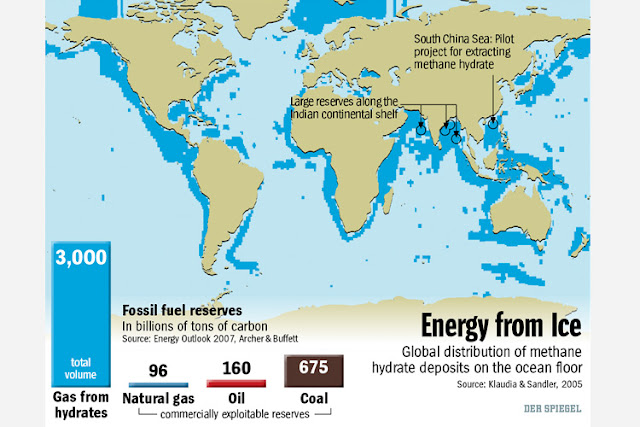
I get the impression that not only the oil and gas industry but also countries with limited energy resources have not been this energised about prospects for energy independence for a long time ( and perhaps not since the discovery of North Sea Gas). First came Shale gas and then Shale oil and now Fire Ice is catching the imagination. The sheer abundance of methane hydrates around the globe and the thought that much of this gas could soon be economically extractable is almost intoxicating for those involved.

“The worldwide amounts of carbon bound in gas hydrates is conservatively estimated to total twice the amount of carbon to be found in all known fossil fuels on Earth”.

I posted recently about the successful flow test for extracting gas from deep sea methane hydrate conducted in Japan. Of course commercialisation of this technology is still many years away (though Japan hopes this could be as early as 2016). Deposits of methane hydrate are known to be extensive and generally exist either under permafrost or under the sea. The deep sea deposits were laid down under conditions of high pressure (deep sea conditions). India is known to have substantial deposits and this is now getting some people very excited:

Types of methane hydrates deposits

Economic Times:

Estimates of global reserves are sketchy, but range from 2,800 trillion to 8 billion trillion cu.metres of natural gas. This is several times higher than global reserves of 440 trillion cu. metres of conventional gas. However, only a small fraction of hydrate reserves will be exploitable.

Methane hydrate is a mixture of natural gas and water that becomes a solid in cold, high-pressure conditions in deep sea-beds (where the temperature falls to 2 degrees centigrade). It is also found in onshore deposits in the permafrost of northern Canada and Russia. Heating the deposits or lowering the pressure (the technique used by JOGMEC) will release gas from the solid. One litre of solid hydrate releases around 165 litres of gas.

India has long been known to have massive deposits of methane hydrate. These are tentatively estimated at 1,890 trillion cu.m. An Indo-US scientific joint venture in 2006 explored four areas: the Kerala-Konkan basin, the Krishna-Godavari basin, the Mahanadi basin and the seas off the Andaman Islands. The deposits in the Krishna Godavari basin turned out to be among the richest and biggest in the world. The Andamans yielded the thickest-ever deposits 600 metres below the seabed in volcanic ash sediments. Hydrates were also found in the Mahanadi basin.

Formidable economic and environmental challenges lie ahead. Nobody has yet found an economic way of extracting gas from hydrates. Industry guesstimates suggest the initial cost may be about $30/ mmBTU, double the spot rate in Asia and nine times higher than the US domestic price. JOGMEC is optimistic that the cost can be cut with new technology and scale economies.

The Indian National Gas Hydrate Program (NGHP) Expedition was conducted together with the US Geological Service

The World’s Largest Potential Energy Resource
Released: 2/7/2008 9:21:21 AM

An international team led by the U.S. Geological Survey (USGS) and the Directorate General of Hydrocarbons, which is under the government of India’s Ministry of Petroleum and Natural Gas, conducted the expedition.

Highlights include:

  • gas hydrate was discovered in numerous complex geologic settings, and an unprecedented number of gas hydrate cores and scientific data were collected;
  • one of the richest marine gas hydrate accumulations ever discovered was delineated and sampled in the Krishna-Godavari Basin;
  • one of the thickest and deepest gas hydrate occurrences yet known was discovered offshore of the Andaman Islands and revealed gas hydrate-bearing volcanic ash layers as deep as 600 meters below the seafloor;
  • and for the first time, a fully developed gas hydrate system was established in the Mahanadi Basin of the Bay of Bengal.

“NGHP Expedition 01 marks a monumental step forward in the realization of gas hydrates becoming a viable energy source,” said USGS Director Mark Myers. “This partnership combines the expertise of two organizations dedicated to understanding gas hydrates, and research results provide new and exciting information about this important potential energy resource.”

Directorate General of Hydrocarbons Director General and NGHP Program Coordinator V. K. Sibal said, “The global gas hydrate resources are estimated to be huge. Although the exploration and exploitation of gas hydrates pose significant challenges, the opportunities are unlimited. The combined wisdom of the scientific community from across the world could provide the answers and solutions to many of these challenges. The Indian gas hydrate program has been fortunate in having the benefits of a truly global collaboration in the form of the first gas hydrate expedition in Indian waters. The results of the studies are not only encouraging, but also very exciting. I believe that the time to realize gas hydrate as a critical energy resource has come.”

Methane hydrate deposits around the world: Graphic Der Spiegel


Two years on and Japan returns to nuclear power

March 11, 2013

It is two years today since the Great 2011 Tohoku Earthquake and Tsunami and the meltdown at 3 reactors of the Fukushima Daiichi nuclear plant.

It was the most powerful known earthquake ever to have hit Japan, and one of the five most powerful earthquakes in the world since modern record-keeping began in 1900. The earthquake triggered powerful tsunami waves that reached heights of up to 40.5 metres in Miyako in Tōhoku’s Iwate Prefecture and which, in the Sendai area, travelled up to 10 km inland. The earthquake moved Honshu (the main island of Japan) 2.4 m  east and shifted the Earth on its axis by estimates of between 10 cm  and 25 cm.

On 12 September 2012, a Japanese National Police Agency report confirmed 15,881 deaths, 6,142 injured and 2,668 people missing across twenty prefectures, as well as 129,225 buildings totally collapsed, with a further 254,204 buildings ‘half collapsed’, and another 691,766 buildings partially damaged. … 

The tsunami caused nuclear accidents, primarily the level 7 meltdowns at three reactors in the Fukushima Daiichi Nuclear Power Plant complex, and the associated evacuation zones affecting hundreds of thousands of residents.

In the knee-jerk reaction to the Fukushima accident all Japan’s 50 nuclear reactors in operation were shut down. Ongoing nuclear power plant projects were suspended. The global debate was more an emotional wave rather than rational discussion. The fear was real of course but what was generally ignored was that while the earthquake and tsunami killed some 18,000 the Fukushima accident did not cause any direct radiation related fatalities. The reality is that the Fukushima reactors were designed in the 1960’s and yet managed to survive the magnitude 9.1 earthquake but they could not cope with and succumbed to the massive tsunami. After the earthquake the reactors were actually shut down – automatically and in good order – but the emergency power to the cooling systems were knocked out by the subsequent tsunami. The failure was a failure of anticipating and designing for a tsunami that was as large and as powerful as it was. Tsunami’s as large as the 2011 event have occurred in Japan roughly every 1000 years. The Fukushima failure was not so much a fault of the nuclear plant as the failure of the designers in anticipating a sufficiently large tsunami within the lifetime of the plant.

But two years on, some rationality is returning to the debate. Two reactors have been turned back on and construction has gingerly been restarted on the new 1383 MW advanced boiling-water reactor at Oma.

Map credit Washington Post

Washington Post: 

In the aftermath of March 2011 meltdowns in Fukushima that contaminated 700 square miles with radiation and forced 150,000 to flee their homes, most never to return, Japan’s utility companies paused nearly all nuclear-related projects. The accident sparked a global debate about nuclear power, but it was especially fierce in Japan, where all 50 operable reactors were taken offline and work was halted on three new plants where building had been underway.

But two of the existing reactors are back in action, and the resumption of construction at the Oma Nuclear Power Plant here — a project that broke ground in 2008 and was halted by the operator, J-Power, after the accident — marks the clearest sign yet that the stalemate is breaking. ….. 

At the national level, Japan has cycled through three prime ministers since Fukushima — the first fiercely anti-nuclear, the next moderately anti-nuclear, the current one cautiously pro-nuclear. The previous ruling party tried last fall to plot a nuclear phaseout by the 2030s, but anti-nuclear advocates say the pledge was watered down to the point of being meaningless. The new prime minister, Shinzo Abe, plans this month to convene the latest in a series of expert panels to help overwrite the phaseout plan, and its makeup suggests that he prefers a role for nuclear power.

Japan’s anti-nuclear movement, which swelled after the Fukushima accident, could still play a role, but it is politically disorganized and has grown quieter in recent months. Individual activists cite the resumption at Oma as controversial but note that the move did not prompt mass-scale protests. ….. 


Japanese demographics are alarming as Finance Minister tells elderly to “Hurry up and die”

January 27, 2013

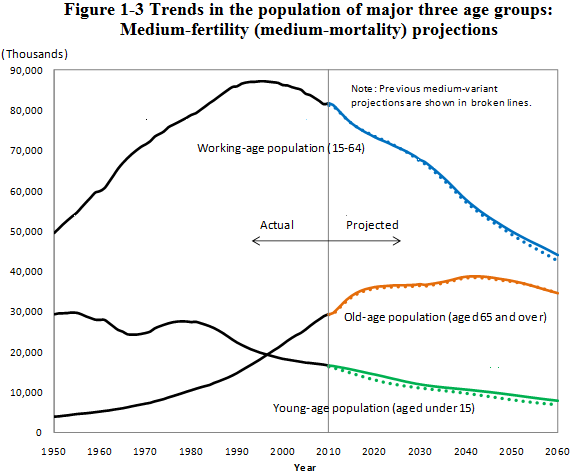
The demographic strains in Japan are beginning to tell. They face a shrinking population and an increasing proportion of the elderly and without measures to increase the productive proportion of the population the situation is not sustainable. That the problems are not in some long distant future but are already exercising the minds of the current administration shows in the outburst from the new Finance Minister and Deputy Prime Minister, Taro Aso, when he exhorted the elderly to “Hurry up and Die”

The Japanese deputy prime minister Taro Aso kicked up a storm of controversy Monday with his comments on the financial burden the elderly place on society. 

The 72-year old finance minister said elderly should be allowed to “hurry up and die” at a meeting of the National Council on Social Security reforms, hoping to ease the financial strain caused by an aging population where fertility rates are low and the economy is struggling. Heaven forbid if you are forced to live on when you want to die,” Aso said. “You cannot sleep well when you think it’s all being paid for by the government.” 

“This won’t be solved unless you let them hurry up and die.” …. Aso is no stranger to controversy: the former prime minister once said he wanted to make Japan the kind of country where “the richest Jews would want to live,” and compared the opposition to the Nazis.

But the fact is that he is the first politician who has dared to defy political correctness – his subsequent apology notwithstanding – and address what is likely to be Japan’s most serious challenge within the next decade. It is a challenge that is going to come to dominate the realities in Europe as well. In the US – and in some countries in Europe –  it is the continuing immigration into the ranks of the productive population which helps to keep this challenge a little further away in the future. In any event it will be population decline that is the global issue within one hundred years. Globally the proportion of productive population to elderly population will not be so wrong – but it will be too low where population is declining unless active measures to keep this in balance are taken.

The latest data from the Japanese National Institute of Population show why Aso is so alarmed. The projections for the next few years of the rate at which the productive population is declining are alarming.

Aso’s outburst is not palatable or feasible but there are only 4 basic ways to address this issue:

  1. reduce the proportion of elderly requiring support 
  2. increase the birth rate,
  3. allow immigration to bolster the productive part of the population , and
  4. increase the age at which the elderly get support from the state

Increasing the birth rate is a long term measure and that assuming that birth rate can be increased. In the short term it has to be immigration into the productive portion of the population which can have an effect (assuming of course that they can contribute to growth).

But before the demographic challenge can be addressed it has to be acknowledged and maybe Aso’s outburst – unpleasant as it is – will bring the issue to the table.

Tohoku University struggles to handle transgressions by its President Akihisa Inoue

March 14, 2012
Photo

Professor Akihisa Inoue

Professor Akihisa Inoue is the President of Tohoku University, is a leading materials scientist and the author of over 2,500 publications. But criticism from other Japanese scientists (as on this Japanese website) has now led to at least 7 retractions for plagiarism. Three investigations have been conducted so far  with rather wishy-washy conclusions. The investigations are in uncharted territory since Japan has no established processes for handling cases of scientific wrong-doing. There is no institution or body for supervising ethics or misconduct in research. And now yet another investigation committee is proposed. Without the guidance of precedent Tohoku University and even the Japanese Science and Technology Agency are not really sure how to proceed – especially when the allegations are against as prominent a person as the President of a University. Almost a classic case of  what in industry would be called “paralysis by analysis” where every analysis shirks the task of coming to conclusions, declines to make judgements and merely proposes further analysis.

Nature reports:

Japan fails to settle university dispute

It has been a rough year for materials scientist Akihisa Inoue, the president of Tohoku University in Japan.

(more…)

Update on Matsubara

March 13, 2012

In December I posted about the suspicious goings on at Kyoto Prefectural University:

A Japanese investigative website (http://blog.m3.com/Retraction/) has found 12 published articles where manipulation of images is very likely. The suspicious images in the papers published by the Matsubara lab are carefully deconstructed by Abnormal Science in an ongoing series of posts: herehere and here.

Today Retraction Watch reports that the efforts of M3 (now discontinued) and Abnormal Science have not gone unnoticed:

The American Heart Association, which publishes a number of journals, has issued an Expression of Concern about five papers in three of their publications, following allegations of image manipulation. All of the papers include Hiroaki Matsubara, of Kyoto Prefectural University, as a co-author.

The notice begins:

It has come to the attention of the American Heart Association (AHA), in a public manner, that there are questions concerning a number of figures in several AHA journals’ articles…

The “public manner” was three posts last year on the Abnormal Science blog… alleging that images were manipulated in the manuscripts, and that histology slides were reused.

The notice continues:

After reviewing these concerns, we have asked the institution, Kyoto Prefectural University of Medicine, to investigate the allegations. Until we learn the outcome, we feel it is best to post this Expression of Concern to alert our readers that concerns about these articles have been raised.

One year on from the Great Tohoku earthquake and tsunami

March 11, 2012

One year on and young hopes bloom eternal.

Illustration by Yuko Shimizu

Young hopes bloom eternal: Illustration by Yuko Shimizu: From The Japan Times

I was in Japan during the Great Hanshin Earthquake in 1995 when over 6,000 perished in Kobe and – inevitably – I try to relate events to my own experience. But the Graeat Tohuku earthquake and tsunami were something quite different and have claimed more than 20,000 lives.

The death toll was much greater after the Aceh earthquake and tsunami but was spread over many more countries and in that sense is more “diffuse”. Perceptions sometimes get diluted compared to the intensity of the reactions one year ago. The 2004 Indian Ocean earthquake and tsunami claimed over 230,000 lives in 14 countries.

The meltdowns at the Fukushima nuclear plant following the Tohoku earthquake and tsunami were pretty scary but sometimes the coverage (especially in Europe) becomes alarmist and tends to take away from the earthquake and tsunami. But it is worth remembering also that the incidents at Fukushima  – without trying to trivialise them – have caused no radiation related deaths.

Suspicious goings on at Kyoto Prefectural University

December 20, 2011

Hiroaki Matsubara

Hiroaki Matsubara  has been Professor of Cardiology and Vascular Regenerative Medicine at Kyoto Prefectural University’s School of Medicine since 2003 and was earlier at Kansai  Medical University.

A Japanese investigative website (http://blog.m3.com/Retraction/) has found 12 published articles where manipulation of images is very likely. The suspicious images in the papers published by the Matsubara lab are carefully deconstructed by Abnormal Science in an ongoing series of posts: here, here and here.

Joerg Zwirner of Abnormal Science comments:

(Part 1) Taken together, articles 1-5 are distinguished by the extensive reuse and mutual exchange of data, in particular Western and Northern Blot bands. A single band has been reused up to eigth times in distinct blots in Kidney Int. 2002. 
It is apparent that band images from ‘real’ blots may have been digitally reassembled into new blot images pretending to be derived from distinct experimental settings. Since ‘reconfigured blots’ have been densimetrically scanned and the results illustrated in tables and figures, we are presumably confronted with a case of severe data fabrication. …..

(Part 2) ….. The images on the left were derived from nude rats, the images on the right from C57BL/J mice. ….

Apparently, histological images have been modified by the exchange/addition of image fragments. According to the figure legend, “five fields from two muscle samples of each animal (n=10) were randomly selected, and capillary density was shown as the capillary/muscle fiber ratio.”

Can we call this practice experimental science or should we term it digital art?

Apparently, anything goes.

(Part 3)….. Of note, the only coauthor on all 12 articles is Hiroaki Matsubara. The sheer scope of the alleged manipulations in these 12 articles is reminiscent of the research misconduct investigations at Borstel/Germany into the work of Prof. Bulfone-Paus and at NUS/Singapore into the work of Prof. Melendez.

The Japanese M3 Blog is run by just one person with its readership mainly among doctors but apparently runs a serious risk of being shut down by legal threats as has happened with an earlier investigative blog.