Archive for the ‘Language’ Category

We communicate emotions faster with sounds than with words

January 20, 2016

If we include the vocalisations and sounds that we regularly use to express emotions (frustration, anger, amusement, satisfaction ….), our vocabularies are far larger than just the words we know. Very often, and this happens every day, such sounds alone are sufficient for a complete communication.

“Aaaaaaaargh” as your son storms out of the room — for example.

the scream

the scream  edvard munch

A new paper describes a study where brain EEG’s were used to measure how and how quickly the brain responds to such sounds.

M.D. Pell, et al, Preferential decoding of emotion from human non-linguistic vocalizations versus speech prosody. Biological Psychology, 2015; 111: 14 DOI: 10.1016/j.biopsycho.2015.08.008

From the McGill University press release

It takes just one-tenth of a second for our brains to begin to recognize emotions conveyed by vocalizations, according to researchers from McGill. It doesn’t matter whether the non-verbal sounds are growls of anger, the laughter of happiness or cries of sadness. More importantly, the researchers have also discovered that we pay more attention when an emotion (such as happiness, sadness or anger) is expressed through vocalizations than we do when the same emotion is expressed in speech.

The researchers believe that the speed with which the brain ‘tags’ these vocalizations and the preference given to them compared to language, is due to the potentially crucial role that decoding vocal sounds has played in human survival. 

“The identification of emotional vocalizations depends on systems in the brain that are older in evolutionary terms,” says Marc Pell, Director of McGill’s School of Communication Sciences and Disorders and the lead author on the study that was recently published in Biological Psychology. “Understanding emotions expressed in spoken language, on the other hand, involves more recent brain systems that have evolved as human language developed.” ………

The researchers found that the participants were able to detect vocalizations of happiness (i.e., laughter) more quickly than vocal sounds conveying either anger or sadness. But, interestingly, they found that angry sounds and angry speech both produced ongoing brain activity that lasted longer than either of the other emotions, suggesting that the brain pays special attention to the importance of anger signals.

“Our data suggest that listeners engage in sustained monitoring of angry voices, irrespective of the form they take, to grasp the significance of potentially threatening events,” says Pell.

The researchers also discovered that individuals who are more anxious have a faster and more heightened response to emotional voices in general than people who are less anxious.

“Vocalizations appear to have the advantage of conveying meaning in a more immediate way than speech,” says Pell. “Our findings are consistent with studies of non-human primates which suggest that vocalizations that are specific to a species are treated preferentially by the neural system over other sounds.”

….. 

Abstract

This study used event-related brain potentials (ERPs) to compare the time course of emotion processing from non-linguistic vocalizations versus speech prosody, to test whether vocalizations are treated preferentially by the neurocognitive system. Participants passively listened to vocalizations or pseudo-utterances conveying anger, sadness, or happiness as the EEG was recorded. Simultaneous effects of vocal expression type and emotion were analyzed for three ERP components (N100, P200, late positive component). Emotional vocalizations and speech were differentiated very early (N100) and vocalizations elicited stronger, earlier, and more differentiated P200 responses than speech. At later stages (450–700 ms), anger vocalizations evoked a stronger late positivity (LPC) than other vocal expressions, which was similar but delayed for angry speech. Individuals with high trait anxiety exhibited early, heightened sensitivity to vocal emotions (particularly vocalizations). These data provide new neurophysiological evidence that vocalizations, as evolutionarily primitive signals, are accorded precedence over speech-embedded emotions in the human voice.

I have no doubt that human need for communication first gave rise to our vocalisations from the very beginnings of the species homo, but the invention of words – also driven by communication needs – came very much later. So it is not surprising that communication using vocalisations of sounds, which are not words, lies much deeper in our make-up.
The ability to think limits language (not the other way around)

January 3, 2016

The principle of linguistic relativity holds that the structure of a language affects its speakers’ world view or cognition. Popularly known as the Sapir–Whorf hypothesis, or Whorfianism, the principle is often defined to include two versions. The strong version says that language determines thought, and that linguistic categories limit and determine cognitive categories, whereas the weak version says that linguistic categories and usage only influence thought and certain kinds of non-linguistic behavior.

I am not convinced.

I take a simple, uncomplicated view. I think I often think without the confines of language or its structure. Sometimes I dream in a particular language and sometimes not. I don’t need a language to wake up in a good mood or in a foul one. Thought (cognitive ability) therefore comes first and is what is hard-wired by our genes together with our physical attributes which gives us our senses. Language only comes as a consequence of a need (a need for cooperation leading to a need for communication) and is merely a tool which is shaped by our cognitive abilities. We cannot communicate that which is beyond language. But what we can conceive of, but is not covered by existing language, can be described by learning a new, existing language or by inventing new language. (New words, new grammar, mathematical notations, chemistry notation, …..).

Suppose our noses were highly developed and our sight was not. Suppose further that we had the same cognitive ability as we have now. If we had the ability to create and discern and record smells, I can imagine a language based on smells, where we could describe electrons and dark energy and the shape of the universe and the world around us and emotions in terms of their smells. We could still develop radiation detectors and describe what we could not “see” with our senses. We could still invent mathematics and nuclear power and “smell-writing” would be quite advanced. Literature and drama would be quite different but not necessarily music. Grand opera with smell and sound rather than sight and sound.

But whatever the language, the limits of our cognitive abilities would define the imponderable.

  1. before the beginning
  2. after the end
  3. life before birth
  4. life after death
  5. the stillness of time
  6. the speed of time
  7. whiter than pale
  8. blacker than black
  9. far ago and long away
  10. infinite universe of finite mass
  11. zero is a number
  12. x/0 = ∞
  13. √-1
  14. x0= 1
  15. Magic
  16. parallel lines meet at infinity
  17. the Big Bang theory
  18. gravity is not a force
  19. evolution is wonderful
  20. ………….
  21. ..

“A good continuation” for the “in-between days” as Swedish adopts 37 new words

December 28, 2015

In Sweden the days after Christmas Day and up to the New Year are known as the “in-between days” (mellandagarna) and the normal greeting during this time is “a good continuation” (god fortsättning). The “in-between days” is also the period when the The Language Council of Sweden (Språkrådet) produces an official list of “new words ” that have entered the Swedish language during the previous year.

The Language Council of Sweden does not – fortunately – waste its time too much on futile exercises to defend against change (like the French do) but generally acts as an observer of change that has occurred. (I take the view that “defence of a language” and trying to prevent change is a meaningless exercise. The only language that does not change is a dead language and a living language is defined by current usage. Equally there is no such thing as “correct” spelling or grammar – there is only “accepted” usage).

Thirty seven new words are now acknowledged officially as having entered the language during 2015. However, the Language Council is also terminally afflicted by a deep-seated political correctness, especially about gender “equality” (this is Sweden after all). They sometimes try to be exceedingly good and try intentionally to introduce “gender-neutral” words – usually with little success. It is no different this time and this shows up in 3 of the words “officially” recognised (14, 16 and 35).

  1. avinvestera – to divest or disinvest (alternative divestera)
  2. cosplaymasquerade with participants dressed up as fictional characters from TV, films, comics or games (often Japanese)
  3. delningsekonomi – shared economy used for pooled activities where goods and services are shared (e.g. carpools, Airbnb etc.)
  4. douche – a douchebag
  5. dumpstra – to recover and reuse what others have dumped (from dumpster dive)
  6. EU-migrant – An EU citizen in another EU country for the better welfare and benefits (a euphemism often for Roma people)
  7. faktaresistens – resisting facts (and preferring conspiracy theories for example)
  8. funkis- – used as an adjective or a prefix and to do with people having functional disabilities
  9. geoblockering – geographic blocking of internet content
  10. groupie – a group selfie
  11. haffa – to hit on
  12. halmdocka – a strawman argument or position
  13. klickokrati – a society dominated by internet views(likes) from clickocracy
  14. klittra – verb for female masturbation (hardly used but a politically correct word introduced after a competition)
  15. kulturell appropriering – cultural appropriation
  16. mansplaining – (of a man) explain (something) to someone, typically a woman, in a manner regarded as condescending or patronizing (a politically correct word)
  17. naturvin – ecologic wine (usually not very good)
  18. nyhetsundvikare – a news avoider
  19. obror – ”unbrotherly”, unfriendly
  20. plattfilm – a flat film with no 3-D or VR effects
  21. rattsurfa – to surf while at the wheel (while driving)
  22. robotjournalistik  – news journalism with computer generated articles
  23. självradikalisering – self radicalisation
  24. skuldkvotstak – income based borrowing limit
  25. ståpaddling – stand-up paddling
  26. svajpa – to swipe
  27. svischa – to Swish (use an App for transfer of funds)
  28. talepunkt – talking point
  29. terrorresa – a journey for the purpose of participating in ”terror” activities
  30. transitflykting – a refugee in transit
  31. triggervarning – advance warning that something unpleasant is to be published
  32. trollfabrik – troll factory
  33. vejpa – to ”vape”, smoke an e-cigarette
  34. vithetsnorm – a standard where ”white-skin” is the norm
  35. värdgraviditet – politically correct alternative to surrogate motherhood
  36. youtuber – a ”professional” video uploader
  37. ögonkramp – eye pain due to excessive looking at a mobile screen

Many of the “new words” recorded every year by the Language Council do not stand the test of time.

Actual usage always wins.

Only gods and magic are “unnatural”

November 5, 2015

I dislike the manner in which we use the words “nature” and “natural” to surround some things with a halo of virtue and rectitude and righteousness, while we use “unnatural” to disparage others. The usage is somewhat perverse and illogical. There are some who define “nature” as “existing in or derived from nature; not made or caused by humankind”. By what logic can humans not be part of nature? Are they inherently, unnatural? What actually is “nature”? Is my garden part of nature or an unnatural artefact created by man. I find that defining nature without man is almost as stupid as defining “environment” to be all that excludes man and his works.

When a male lion takes over a pride from another and kills all his predecessor’s cubs it is natural and a part of nature. When ISIS does something similar, it is barbaric and unnatural. When weeds take over my garden and kill other plants, it is natural. If I use weed killer, it is unnatural. When humans make artefacts, they are unnatural. When a chimpanzee uses a stick to poke into and extract insects from down a hole, it is a wonder of nature. Evolution is taken to be a natural wonder of nature. But less than 1% of all species produced by evolution are still alive. Of all the species alive today, most have failed to develop any semblance of intelligence. Should I take human intelligence and its evolution to be unnatural? (Actually, I take the fact that only humans, of all the species, have developed intelligence to any degree, as being proof of the ineffectiveness of evolution). Earthquakes, hurricanes and tsunamis are examples of the awesome power of nature and perfectly natural. How is it that when an earthquake and tsunami kills 18,000 it is natural but when the same event damages a man-made nuclear reactor and causes great fear – but no loss of life and relatively little damage – it is unnatural?

When the monsoon fails once every decade or brings bumper rains – also around once a decade – it is natural variation. Almost every location on earth sees a natural variation of temperature during a single day of between 10 and 30ºC. Over a year the natural temperature variation at any location is between 30 and 50ºC. But an alleged temperature warming of about 0.8ºC over the last 100 years is termed unnatural. Natural climate change has caused forests to become pastures and vice versa. What were deserts in the past have become fertile land and what were seas in the past have become deserts today.Rivers have changed their courses and even ceased to flow or been created. All that was perfectly natural.

When some event or behaviour is deemed natural or to have natural causes, no further explanation is necessary. It is used to shut down discussion or questioning of the causes. A natural death needs no further explanation or discussion. When bad behaviour is to be excused it is termed natural whether it is the behaviour of a lion or a human psychopath. We tend to use unnatural to be synonymous with abnormal. Abnormal of course only means that the probability of something is low – not that it is impossible. We use the terms to imbue virtue or awe to the event or thing or behaviour being described. Natural foods are good foods. Natural storms are awesome and unstoppable. And we use unnatural to disparage without further justification. Our use of natural and unnatural already includes a value judgement.

The natural world can only be everything that obeys the laws of nature (as we know them). And that has to include humans and their works. There is nothing holy or sacrosanct then about being natural. The conclusion I come to is that there is nothing we know of in the Universe which is not part of nature. Everything is part of nature And everything that exists or happens in the Universe is also natural.

And that leaves only the gods and magic as being unnatural.

Female Bishop of Gloucester wants to neuter God

October 27, 2015

Since God is made in the image that man (or woman) decides, I suppose it does not really matter.

But there is something quite delicious about the female Bishop of Gloucester wanting, not to make God female, but to neuter Him/She/It. Now if God did have a gender, He (and any Goddesses He might have) could be a little upset.

At least as a Him or a Her, 50% of the world could be in His or Her image. But as an It, there would be very few. I suppose all references by Jesus to his Father in the Bible could be easily edited to be about his genderless Parent.

The Independent:

The Church of England should stop using male pronouns when referring to God in order to counter the erroneous belief that the Almighty has a gender, the first female bishop to sit in the House of Lords has said.

The Bishop of Gloucester, the Rt Rev Rachel Treweek, the Church’s most senior clergywoman, was being introduced to the Upper House today as one of Parliament’s 26 Lords Spiritual. 

Speaking before the event, the bishop raised the issue of God’s gender, saying: “We’re told that God created human beings in God’s likeness… If I am made in the image of God, then God is not to be seen as male. God is God.”

Instead of using either “He” or “She” to describe God, Bishop Treweek said she  prefers simply to use the word “God”. 

Of course the Bishop of Gloucester was only trying to establish a modicum of feminist credentials, though she stopped short of claiming that gender was obsolete:

“If it means I believe that men and women were created by God as equal but different, then yes I’m a feminist. But if it means women wanting to be men – and sometimes that’s a slight feeling of being loud and domineering – then I would reject that.”

Hinduism took care of this by having available a half-male, half-female God, Ardhanarisvara.

Whenever the priests of some religion determine the nature of their God, it’s a little bit like a bunch of manufactured robots deciding, among themselves, that they were not man-made but woman-made. And it becomes really stupid (or intelligent depending upon your point of view) when robots who think they are man-made go to war against robots who think they are woman-made.

Deciphering the Harappan script – probably proto-Dravidian

October 21, 2015

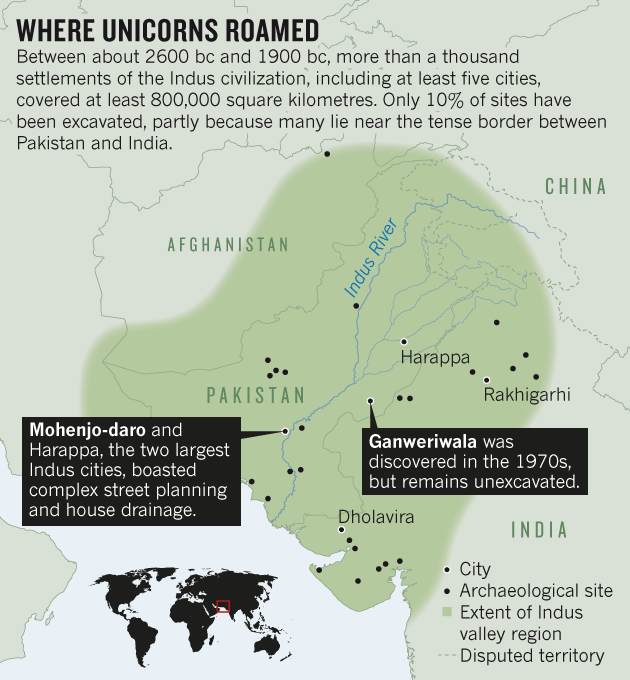
The Indus-Saraswati Valley civilisation reached its peak around 1,900 BCE. It had been flourishing there for over a millennium from about 3300 BCE. But various proto-Harappan cultures had existed in those fertile plains for almost 4,000 years before that (from about 7,000BCE). At their peak they occupied the entire Indus -Saraswati Valley and stretched as far as the Indo-Gangetic plain. At its peak there were some 1,000 settlements and at least 5 “great” cities that we now know of; Mohenjo-Daro, Harappa, Ganweriwala, Rakhigarhi and Dholavira. None of these are truly coastal and it is not improbable that one or perhaps two “great” coastal cities are now submerged and waiting to be discovered. Only about 10% of the known sites have been investigated and the Indus Valley script – which I call Harappan for convenience – has yet to deciphered.

Where Unicorns roamed - graphic by Nature

Where Unicorns roamed – graphic by Nature

But by about 1,000 BCE the glories of the civilisation had disappeared; not swept away in one fell swoop by some marauding invaders or by some great pestilence or some cataclysmic natural catastrophe, but gradually as cities and settlements were abandoned and the population gradually thinned out and reduced to a shadow of its heyday. Coming out of the ice-age around 20,000 years ago, sea-levels were almost 100m lower than today. By 7,000 BCE (9,000 years ago) sea levels were already about 30m lower than at present and were rising fast at around 8-10 m/millennium. The settlements in the region were either on the coast or followed the course of the great rivers. It was a 300 – 500 year process of desertification which saw the Saraswati dry up and the creation of the Thar desert.

Saraswati and Thar Desert

Saraswati and Thar Desert

Where they all went is mainly conjecture but it is likely that they “followed the water”. Some of the sources of the Saraswati would have diverted to flow into the Ganges. That would have taken some people westwards, back along the coast towards the then fertile Persian Gulf, some eastwards across the Indo-Gangetic plain and some southwards along the coast of the Indian subcontinent. Quite possibly some reached the Bay of Bengal and others reached south India and the Indian Ocean. But they did not move into empty spaces. The Indian subcontinent had been continuously settled from the times of homo erectus but by the time of the Toba eruption 74,000 years ago homo erectus had already been replaced by homo sapiens. So when the Harappans moved in, modern humans were already there, but not in large numbers. The earlier settlers probably included the few survivors of a pre-Toba wave of expansion who were then absorbed by later settlers – probably many arrival instances – over some 50,000 years.

Where the Harappans probably went

Where the Harappans probably went

In my narrative it is the Harappans and their language which provided the nucleus for, and eventually became, the family of Dravidian languages. In fact it is probable that some of the roots of what became Hinduism came also with them. I would even suggest that the specialisation of functions (administrators, priests, traders, craftsmen and labour) that must have existed in the meticulously planned, water-resourceful, trading cities of the Indus-Saraswati Valley led to the foundation of guilds and a stratified society. That probably laid the foundations of the caste system which, in its perverted form, currently disgraces the subcontinent.

Andrew Robinson looks at the state of the decipherment of the Harappan script in Nature.

Nature 526, 499–501 (22 October 2015) doi:10.1038/526499a.

Cracking the Indus script

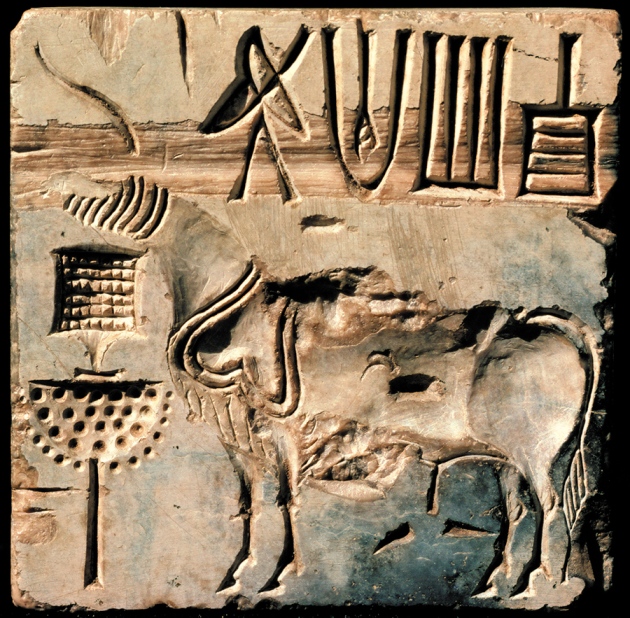
Indus unicorn on a roughly 4,000-year-old sealstone, found at the Mohenjo-daro site. photo – Robert Harding/Corbis

The Indus civilization flourished for half a millennium from about 2600 bc to 1900 bc. Then it mysteriously declined and vanished from view. It remained invisible for almost 4,000 years until its ruins were discovered by accident in the 1920s by British and Indian archaeologists. Following almost a century of excavation, it is today regarded as a civilization worthy of comparison with those of ancient Egypt and Mesopotamia, as the beginning of Indian civilization and possibly as the origin of Hinduism. 

More than a thousand Indus settlements covered at least 800,000 square kilometres of what is now Pakistan and northwestern India. It was the most extensive urban culture of its period, with a population of perhaps 1 million and a vigorous maritime export trade to the Gulf and cities such as Ur in Mesopotamia, where objects inscribed with Indus signs have been discovered. Astonishingly, the culture has left no archaeological evidence of armies or warfare.

Most Indus settlements were villages; some were towns, and at least five were substantial cities …  boasted street planning and house drainage worthy of the twentieth century ad. They hosted the world’s first known toilets, along with complex stone weights, elaborately drilled gemstone necklaces and exquisitely carved seal stones featuring one of the world’s stubbornly undeciphered scripts. …

The Indus script is made up of partially pictographic signs and human and animal motifs including a puzzling ‘unicorn’. ….. 

Whatever their differences, all Indus researchers agree that there is no consensus on the meaning of the script. There are three main problems. First, no firm information is available about its underlying language. Was this an ancestor of Sanskrit or Dravidian, or of some other Indian language family, such as Munda, or was it a language that has disappeared? Linear B was deciphered because the tablets turned out to be in an archaic form of Greek; Mayan glyphs because Mayan languages are still spoken. Second, no names of Indus rulers or personages are known from myths or historical records: no equivalents of Rameses or Ptolemy, who were known to hieroglyphic decipherers from records of ancient Egypt available in Greek. ……

……. Nevertheless, almost every researcher accepts that the script contains too many signs to be either an alphabet or a syllabary (in which signs represent syllables), like Linear B. It is probably a logo-syllabic script — such as Sumerian cuneiform or Mayan glyphs — that is, a mixture of hundreds of logographic signs representing words and concepts, such as &, £ and %, and a much smaller subset representing syllables.

As for the language, the balance of evidence favours a proto-Dravidian language, not Sanskrit. Many scholars have proposed plausible Dravidian meanings for a few groups of characters based on Old Tamil, although none of these ‘translations’ has gained universal acceptance. ……… A minority of researchers query whether the Indus script was capable of expressing a spoken language, mainly because of the brevity of inscriptions. ……. This theory seems unlikely, for various reasons. Notably, sequential ordering and an agreed direction of writing are universal features of writing systems. Such rules are not crucial in symbolic systems. Moreover, the Indus civilization must have been well aware through its trade links of how cuneiform functioned as a full writing system. ……….

What the Harappans wrote and spoke was not Dravidian itself, but it was very likely a proto-Dravidian language, which, with many other influences from what already existed in the South Indian regions they moved into, became the family of Dravidian languages existing today. And it could explain why a Dravidian language can be found today in what is Afghanistan.

Dravidian language subgroups - map Wikipedia

Dravidian language subgroups – map Wikipedia


Idioms of the world unite

October 1, 2015

Idioms cannot always be translated literally across languages.
Some idioms of the world created by Matt Lindley:

Idioms of the WorldSource – HotelClub


How Swedish beer turned Norwegian into Danish

August 31, 2015

Thirty years ago when I first learned Swedish we had a couple of Danish/Swedish projects ongoing. I observed that at meetings between Danes and Swedes each spoke their own language. I thought they were all being very considerate and polite when they switched to English whenever I joined a meeting. But then I realised that I was being invited to meetings where I had no part to play and had nothing to say. Just so that the Danes and Swedes could switch to English and have some little chance of understanding each other.

But I had not realised that Norwegian became Danish because of all that Swedish beer!!!!

( from a slightly biased Norsk perspective)

Norwegian + Swedish beer = Danish

It may be small but Pluto is still a planet

July 13, 2015

It orbits the Sun. It has five moons. It is the tenth most massive object orbiting the Sun. It is not that Pluto is not a planet, but that there are many more planets than the “big ten”. The asteroid belt and the Kuiper belt objects are all also planets. Inventing new definitions and calling them “dwarf planets” or “planetoids” doesn’t change the fundamentals.

The International Astronomical Union (IAU) defines a planet thus:

A planet is a celestial body which:

  1. is in orbit around a Star,
  2. has sufficient mass to assume hydrostatic equilibrium (a nearly round shape), and
  3. has “cleared the neighbourhood” around its orbit.

Calling Pluto a “dwarf planet” rather than a “planet” has nothing to do with its properties or the properties of the Sun. It is not even a matter of language or semantics. It is merely for the convenience of a bunch of lazy astronomers who were afraid of having too many planets to classify.

Ultimately it is just a matter of usage. For me any celestial body orbiting another is and remains a planetary body. And every body which orbits the Sun directly (and not by virtue of orbiting a planetary body first) is a planet. Every asteroid is a planet of the Sun. Jupiters moons remain planets of Jupiter. And that makes Pluto a planet. New planets may well have been found in the Kuiper belt – but Pluto remains a planet for me, in spite of the failings of the IAU.

Twerking is pretty old-fashioned and Bostonians could be “massholes”

June 25, 2015

The Oxford English Dictionary has added 500 new words

Press ReleaseToday the Oxford English Dictionary (OED) announces its latest update, ushering in nearly 500 new words and over 900 newly revised and updated words. There are also over 2400 new senses of existing words added. This confirms the OED’s place as one of the largest and longest-running language research projects in the world. 

The new words include masshole, hot mess, twerk, fo’shizzle, sext, stanky, twitterati, meh.

I particularly like

massholeA term of contempt for a native or inhabitant of the state of Massachusetts

Miley Cyrus may have thought she was being original and innovative with her “twerks” but it turns out that she was being pretty old-fashioned with a move which dates back to 1820 and came into dance in the 1990s.

The use of twerk to describe a type of dancing which emphasizes the performer’s posterior has its roots in the early 1990s in the New Orleans ‘bounce’ music scene, but the word itself seems to originate from more than 170 years before that.

It was in use in English as a noun by 1820 (originally spelled ‘twirk’) referring to ‘a twisting or jerking movement; a twitch’. Its use as a verb emerged a couple of decades later, in 1848, and the ‘twerk’ spelling had come about by 1901. The precise origin of the word is uncertain, but it may be a blend of twist or twitch and jerk, with influence from the noun quirk and from work (v.) in reference to the dance.

Keepers of language such as the OED always do – and must – lag usage. But it is wrong to think of the OED as any kind of arbiter of what is “right” or “wrong”. Usage always overrides any judgement of “correctness”. The keepers of language only record what was considered acceptable usage at a certain point in time. In fact I am inclined to the view that there is no such thing as bad spelling or bad grammar. There is only bad or good usage. The only real criterion is whether the meaning intended to be conveyed was conveyed.