Archive for the ‘Language’ Category

Beyond infinity must come nothing – not even nothingness

May 26, 2015

An exercise in triviality.

I have been exercised of late by the use of “infinite” as an adjective and came to the conclusion that “infinite” should only be used to describe the unboundedness of things capable of being counted or measured (quantifiable or countable things). So, I reason, the number of terms in a numerical series, or physical things, or length or mass or time could be described as being “infinite”, because they could also be “finite”.  The use of “infinite” to describe something qualitative which could never be finite was therefore illogical. (Not “wrong” but illogical because I take the position that no usage is ever “wrong” if it communicates what is intended to be communicated). But my “rule” is that “infinite” is usable only for things which must first be “finite”. Therefore “boundless” or “endless” should be more appropriate for non-quantifiable things. So “infinite sky” or “infinite space” would be better described as “endless sky” or “boundless space”. “Endless lines” not “infinite lines”, but “lines of infinite length”.

Georg Cantor even imparted qualities to “infinite”. Cantor described “cardinalities” of the infinite for different sizes of infinite sets. Of course, there are then an infinite number of cardinalities. He considered integers as being countably infinite, but he took the infinite set of real numbers – as being capable of being counted – but uncountable. But Cantor’s uncountable, various cardinalities of the infinite still apply only to quantitative things.

Early Indian mathematics distinguished between endless and innumerable and tried to classify infinites by considering loose bounds and rigid bounds:

…… two basic types of infinite numbers are distinguished. ……. a distinction was made between asaṃkhyāta (“countless, innumerable”) and ananta (“endless, unlimited”), between rigidly bounded and loosely bounded infinities.

In the hierarchy of words therefore I take “boundless” to be applicable to all things whereas I take “infinite” to apply only to quantifiable things.

But what happens now to “infinity” as a noun?

As a noun we give “infinity” many meanings. First as the quality or state of endlessness (limitlessness, boundlessness) and second as the number which is larger than any other and always larger than anything conceivable (). We therefore refer to the infinity of space or the infinity of meaning or the infinity of the stars. And in mathematics, is treated as a number (albeit with rather special properties) and can be used in mathematical operations as a number. But there is a third meaning or usage. We also use “at infinity” or “to infinity” as if it were a place. “Parallel lines meet at infinity”, we say in plane geometry. In calculus we speak of “limits at infinity”. We speak of points, planes and lines “at infinity” in projective geometry. The universe ends “at infinity”.

OED:

infinity (n.) late 14c., from Old French infinité. “infinity; large number or quantity” (13c.), from Latin infinitatem (nominative infinitas) “boundlessness, endlessness,” from infinitus boundless, unlimited” (see infinite). Infinitas was used as a loan-translation of Greek apeiria “infinity,” from apeiros “endless.”

infinite (adj.)late 14c., “eternal, limitless,” also “extremely great in number,” from Old French infinit “endless, boundless,” and directly from Latin infinitus “unbounded, unlimited,” from in “not, opposite of” (see in- (1)) + finitus “defining, definite,” from finis “end” (see finish (v.)). The noun meaning “that which is infinite” is from 1580s.

To be finite is the opposite of being infinite. Infinity as a number, ∞, has mathematical zero as an inverse but when considered to be one end (?) of an endless series has -∞ at the other end. But what happens “at infinity”, where parallel lines meet and the universe comes to end. Most of the universe consists of apparently empty space, interspersed with sub-universes, galaxies, stars and star systems. But this space is not nothing. The space between electrons orbiting around the nucleus of an atom is not nothing either. These spaces may not contain matter but they still have attributes and properties. Gravity waves and magnetic waves can traverse them. Light – whether a wave or not – crosses them. Time exists within them. And with light traversing and a time interval, distance must follow. Space, therefore, has dimensions. And since we infer that some magic mass we call dark matter, and some magic energy called dark energy, abound, space also permits/allows/has dark energy and dark matter.

An infinite universe extends “to infinity”. Obviously it has to be nothing which lies beyond. And it is the properties or attributes of this “nothingness” which boggle the mind.

Clearly “empty” space does not serve as an illustration of the nothingness beyond. (It is not space I am told but space-time, where we can observe space as time passes but cannot observe time as space passes). A vacuum, anywhere, is void of matter but otherwise has the attributes of space and does not serve either. Even the Buddhist concept of emptiness, shunyata (Sanskrit where shunya = zero), is not entirely devoid of thought. We cannot say that light does not traverse nothingness because opacity to light would be an attribute. So would the non-passage of gravity waves through nothing also be an attribute. Time does not pass within nothingness. Time, in fact, cannot exist. Dimensions are undefined. No energy, no mass and not even any magic dark energy. No Laws of Nature. Nothingness cannot be imparted with any attributes or properties since then it would no longer be nothing. In fact, nothingness – by its very nature – must be incapable of being demonstrated, illustrated or even conceptualised.

Tom Mason commented on my previous post:

The universe is as it is, there is no boundary no edge. Also the so called expansion (or maybe it’s contraction) of our universe is not real — it is just a readily seen quirk due to the passage of time varying across the universe. The variation that is evident with the universe’s apparent smallness of its beginning and the apparent largeness of now.

And so I end with a circular and trivial argument and I have no better perception of nothingness:

“Nothing” is no thing – neither physical nor abstract. It cannot be conceptualised without becoming some thing. It has no properties and no attributes. No thing is nothing. Therefore nothing is no thing.

Except that nothing can exist beyond infinity and this nothing cannot even contain nothingness.
Runes and elvish in the Valley of the Älv

May 21, 2015

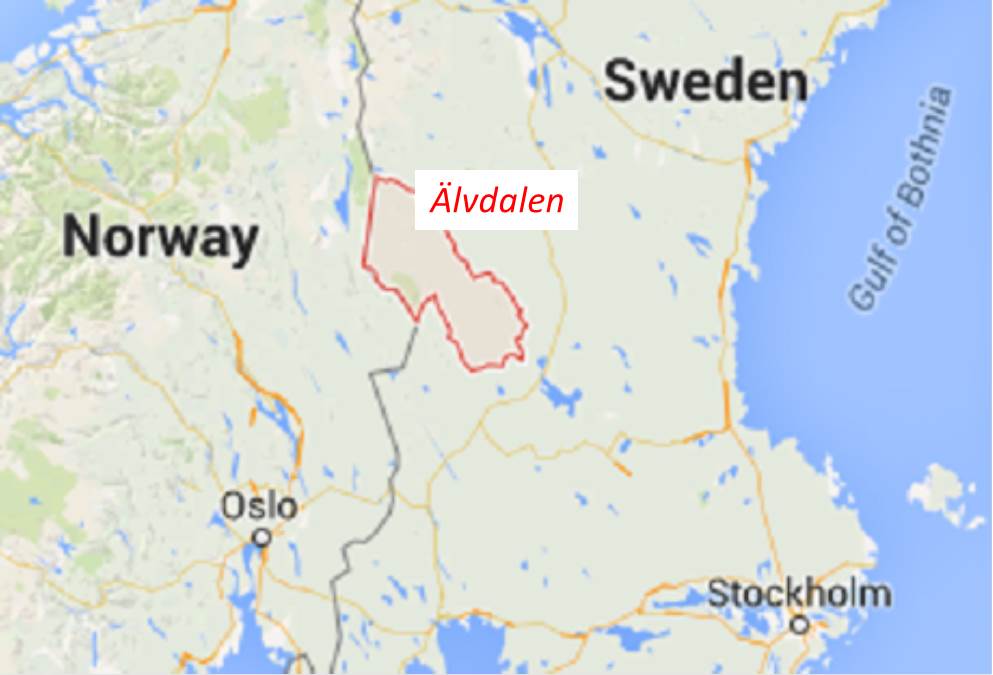
“Älv” in Swedish means “river”. But the origin of “elf” in English is the old English “ælf”. So when it is found that in Älvdalen, runes were used just 100 years ago and they still speak their own ancient Norse language, Elfdalian, it is difficult not to conjure up visions of Legolas and Elrond and of Galadriel in Lothlórien.

ScienceNordic: Elfdalian (älvdalska in Swedish and övdalsk in the language itself) sounds like something you would more likely encounter in Tolkien’s Lord of the Rings rather than in a remote Swedish forest. But the small town of Älvdalen, which gives the language its name, is not an Elven outpost. It is one of the last strongholds of an ancient tongue that preserves much of Old Norse, the language of the Vikings. …. has preserved linguistic features that are to be found nowhere else in Scandinavia, and that had already disappeared from Old Norse by 1200AD. ….

Because of its relative isolation, Elfdalian evolved in an entirely different direction than the modern Scandinavian languages. Its sounds, grammar and vocabulary differ radically from Swedish. So, while speakers of Swedish, Danish and Norwegian can easily understand each other in simple conversations, Elfdalian is completely unintelligible to Swedes who are not from the area.

Only about 2,500 people still speak Elfdalian but it is now being taught again in primary schools in the region.

Älvdalen is a municipality in Sweden and the name actually means River Valley. It is isolated from the rest of Sweden by its mountains, forests and lakes.

Älvdalen

ScienceNordic: “Älvdalen lies extremely deep within the Swedish forests and mountains. You can get there by boat up the river, Dalälven — a journey of more than 100 kilometres — and getting there and back used to be quite an expedition. So people in the area weren’t particularly mobile and were able to preserve this very special culture, considered in Sweden to be extremely traditional and old fashioned,”

The runic script was the dominant written language in Denmark and the rest of Scandinavia until the advent of Christianity in the ninth and tenth century introduced the Latin alphabet.

By the 15th century the Latin alphabet had almost wiped out the use of runes – but not in Älvdalen. Here, the Swedish linguist Henrik Rosenkvist recently saw a letter dated 1906 written partly in runes.

“The runes we see in Älvdalen are probably the most recent use of the script we know of. Runes otherwise died out in the Middle Ages so their use in so recent times is exceptional,” says Rosenkvist who speaks and studies the unique language spoken in Älvdalen.

The runes of Älvdalen — dalrunerne — are reminiscent of those used on runes stones in Denmark but there are a number of differences. Dalrunerne developed over time, influenced partially by the Latin alphabet. Here are the runes as they looked in the period leading up to the 20th century. (Illustration: Tasnu Arakun/Wikimedia Commons)

Nielsen agrees. “The use of runes in Scandinavia gradually ceased during the 15th century. There are the odd areas of Gotland in Sweden and in Iceland where the rune tradition survived until the 17th century, but in Älvdalen their use was widespread until the early 20th century,” he says.

According to Nielsen the runes in Älvdalen were most commonly found on houses and inscribed in furniture. In addition to this, they were also engraved into ’message blades’ which were sticks of wood that were circulated among the farms in the area. “The people who herded the cattle up in the mountains would write messages to each other in runes,” says Nielsen.

Tolkien took much of his inspiration for his elves (and fairies) from a mixture of Norse and Celtic mythologies and medieval writings. But his elves and their love of ships and their writing are straight out of Norse mythology. In that sense the real world Älvdalen is probably as close to  the enchanted – but fictional – forests of Lothlórien as it is possible to get.

Representing laughter

May 15, 2015

“ho ho”; a guffaw, an insincere or forced laugh

“ho ho ho”; Santa, a jolly laugh, boisterous amusement

“ho hum”; incredulity, not laughter

“ha ha”; a sarcastic laugh

“ha” = “Aha!”

“ha ha ha”; genuine amusement, open-mouthed laugh

“he he” or “tee hee”; giggling, surreptitious laughter, laugh with hand covering mouth

“he he he”; teenage laugh

“heh heh”; chuckle, laugh from the side of the mouth

“haw haw”; slapstick laughter, slapping of thighs

“hi hi”; sneer

“hi hi hi”, cackle

“hee haw”; a donkey braying

Swedish names in English for pronunciation by an American

April 30, 2015

An American friend was complaining that pronouncing Swedish names correctly was a pain – and he used Göteborg, Göran, Håkan and Norrköping as his “evidence”.

I bet him that I could write all Swedish names phonetically in English such that he would have no choice – even in his deep South drawl – but to pronounce them correctly. We enlisted another friend to be judge. He was – unlike me – a native Swedish speaker whose own name caused some problems for Americans – Jönsson.

I think I won more than a whiskey or two that night.

A few examples below. It seems to be possible also with Hindi words rendered phonetically in English for pronunciation by an American (even one from Boston). And getting someone with a Boston twang to even pronounce English correctly is an achievement in itself.

Swedish Name Rendered phonetically in English
Göteborg Yette-bor-ye
Göran Yo-rahn
Håkan Ho-kahn
Jönsson Yuhn-sson
Norrköping Nor-scher-ping
Östergötland Oester-yert-land
Kjell Schell
Agneta Ahg-nyet-a


After all, the essence of justice lies in being able to discriminate

March 31, 2015

I was recently accused of discrimination.

It is a pity – linguistically – that the word “discrimination” is used as – and generally taken to be – “unjust discrimination”.

A discerning person, a person of judgement is one with the ability to discriminate. Discernment, discrimination and judgement all weigh something against some value scale. The value scale comes first. To judge or discriminate, whether for music or literature or taste or behaviour, first requires some standard value scale against which to compare.

Without being able to compare and discern differences and then make judgements which necessarily require discrimination, we could not achieve justice. Some discrimination may be considered to be unjust. Other discrimination may correct an injustice. The same action may be unjust to the one while being just to another. The same action resulting from discrimination may be considered just by some and unjust by others.

Virtually all human behaviour is based on discrimination. We choose one food over another, make friends with some and not with others, listen to jazz but not to punk-rock or kill some people but not others. We discriminate whenever we give “more” care to a sick person or an old person or a child. And that is just. We discriminate when we don’t give one of Usain Bolt’s competitors a head start. We discriminate with different tax rates for different people. Nobel prizes are awarded subsequent to discrimination. We discriminate when we prefer anything or anyone. But we don’t take that to be unjust. Without discrimination there would be no appreciation (or contempt).

Those without values cannot judge or discern or discriminate. A person with sensibilities is one with values. Nearly all behaviour discriminates. The issue is not the discrimination, but where the subsequent actions lie on the scale of being just. And that scale of justness (rather than justice) too is a value scale.

The ability to discriminate is what tells us where we are on our (or somebody elses) scale of justness. It is what makes us sapient. In a world without discrimination there would be no values, no good or bad, or just or unjust.

And so when I was accused of discrimination, I took it as a compliment.

Discriminating (adj): discerning, selective, judicious, refined, cultivated, cultured, sophisticated, sensible, enlightened, sensitive, subtle, nuanced, critical, perceptive, insightful, perspicacious, penetrating, astute, shrewd, ingenious, clever, intelligent, sharp, wise, erudite, aware, knowing, sagacious, sapient.


How English has become the language of science

March 31, 2015

Michael D Gordin is a historian at Princeton University and explains how English has become the language of modern science:

how did science come to speak only english

……. contemporary science is monoglot: everyone uses English almost to the exclusion of other languages. A century ago, the majority of researchers in Western science knew at least some English, but they also read, wrote and spoke in French and German, and sometimes in other ‘minor’ languages, such as the newly emergent Russian or the rapidly fading Italian. …..

Often, scientists or humanists assume that English science replaced monoglot German, preceded by French and then by Latin in a ribbon that unfurls back to the dawn of Western science, which they understand to have been conducted in monoglot Greek. Understanding the history of science as a chain of monolingual transfers has a certain superficial appeal, but it isn’t true. Never was. ….. we can observe two basic linguistic regimes in Western science: the polyglot and the monoglot. The latter is quite new, emerging just in the 1920s and vanquishing the centuries-old multilingual regime only in the 1970s. Science speaks English, but the first generation who grew up within that monoglot system are still alive. ….

In the 15th century in western Europe, natural philosophy and natural history – the two domains of learning that would, by the 19th century, come to be known as ‘science’ – were both fundamentally polyglot enterprises. This is the case despite the fact that the language of learning in the High Middle Ages and the Renaissance was Latin.

But Latin had been preceded by Greek and Arabic.

The translation of works in canonical natural philosophy from Arabic into Latin helped birth the revival of learning in the West. Learning, learned people knew, was a multilingual enterprise. …..

This system started to break down in the 17th century, in the midst of, and as an essential part of, what was once dubbed ‘the scientific revolution’. Galileo Galilei published his discovery of the moons of Jupiter in the Latin Sidereus Nuncius of 1610, but his later major works were in Italian. As he aimed for a more local audience for patronage and support, he switched languages. Newton’s Principia (1687) appeared in Latin, but his Opticks of 1704 was English (Latin translation 1706). ….

……..

Something obviously changed. We now live in the Esperantists’ dreamworld, but the universal language of natural science is English, a language that is the native tongue of some very powerful nation states and as a consequence not at all neutral. What happened to the polyglot system of science? It broke. More accurately, it was broken. When the Great War erupted in summer 1914 between the Central Powers (principally, Germany and Austria-Hungary) and the Triple Entente (Britain, France, Russia), among the first casualties were the ideals of beneficent internationalism. German scientists joined other intellectuals in extolling Germany’s war aims. French and British scientists took note.

After the war, the International Research Council, formed under the aegis of the victorious Entente – now including the US but excluding Russia, which had descended into the maelstrom of the Bolshevik Revolution – initiated a boycott of scientists from the Central Powers. New international institutions for science were erected in the early 1920s locking out the defeated Germanophone scientists. This exclusion lit a long-delay fuse that, in the coming decades, would contribute to the death of German as a leading scientific language. Three languages had, for part of Europe, diminished to two. Germans responded to their predicament by reinvigorating their commitment to their native language. The multilingual system was beginning to crack, but it was the Americans who would shatter it. .

…….

Read the entire article.

A monoglot system in a polyglot world may seem unsustainable and Gordin argues that even without the Anglophone nations, inertia would keep English in its pre-eminent position for science.

it takes a lot of energy to maintain a monoglot system on such a scale, with enormous resources poured into language training and translation in non-Anglophone countries. And, second, if the Anglophone nations were to vanish tomorrow, English would still be a significant language of science, simply because of the vast inertia of what already exists.

But I suspect it is not just a simple matter of monoglot versus polyglot. Using India as an example of a polyglot nation, one of the most important unifying factors is that at second language level, India is actually monoglot and the language is an “Indian” English. The internet age has I think led to the world – at second language level – being monoglot – and that language is an internet English which is still evolving and very rapidly at that.

Esperanto failed because it never reached a critical mass of users. Dialects appear because a critical mass of practitioners of a particular usage exists. What is correct grammar and correct spelling and even correct meaning lags, and doesn’t lead, usage. Languages evolve and change as users and usage changes – not because of edicts from the keepers of language. If the French want French to survive for ever, they need to ensure that the number of users expands (with whatever changes that may bring), rather than preventing the assimilation of anglicisms. A “protected”, “correct” language with an ever decreasing number of users will become extinct. Changes appear in spite of the inertia and resistance of the language keepers. And languages die when change stops and users decline and usage withers. Demographics trumps any “goodness” of language.

This new, still-changing, 140-character-focused, English will be with us for a long time yet – and not just in science.

A phrase for Cosby? – “a darker shade of black”

November 22, 2014

The richness of a language lies not only in the number of words it commands but also in the manner in which they can be modified or combined to convey some nuance of meaning and which nuance is then understood as intended.  The modification of or combining of words can be by following existing rules or current conventions of usage and even by the breaking of current conventions. A new modification or word combination only becomes part of the language if

  1. the intended meaning is successfully conveyed, and
  2. the usage of the new word(s)/usage spreads.

Thus while reading about the collapse of the House of Cosby as story follows story about his predatory behaviour with younger girls, the words of one of my favourite songs from the 60s came to mind – Procol Harum’s “A whiter shade of pale”  which was a thinly disguised song about a drunken seduction.

And so it was that later,
As the miller told his tale,
That her face, at first just ghostly,
Turned a whiter shade of pale.

What the word combination “a whiter shade of pale” conveys depends on how it is interpreted in the recipient’s mind. Part of the impact of this song at that time lay in the strange and psychedelic pictures that that particular phrase conjured up. And it triggered for me the thought that Bill Cosby’s past behaviour was proving to be “a darker shade of black”.

And so it was that later,
As the facade began to crack,
that the soul of William Cosby,
showed as a darker shade of black.

Both these phrases use the powerful linguistic trick of invoking something impossible – a state beyond some absolute limit.  The listener/reader gets the point. (Strictly it ought to be “a paler shade of white” since paler than white should be impossible while whiter than pale is not). Other variants of the same linguistic form could be:

  • a blacker shade of dark
  • better than the best
  • worse than the worst
  • greater than the infinite
  • harder than diamond
  • softer than a feather
  • faster than lightning
  • stronger than steel
  • over the top
  • under the bottom
  • hotter than hell
  • colder than space
  • before the beginning
  • after the end
  • rounder than a sphere …….

Equally powerful is the use of antonyms, with one as an adjective for another but which serves to emphasise rather than negate some characteristic.

  • Infinitely small
  • Expanding infinity
  • The living dead
  • An evil goodness
  • A brilliant darkness
  • Surreptitious refulgence
  • A tumultuous lethargy
  • Brawny erudition
  • A restive calm
  • Relaxed turbulence
  • Solicitous indifference
  • An awakening ignorance
  • A concentrated diffusion
  • A historical future
  • A caring predator
  • Robust fragility
  • Enlightened disillusion …..

In the case of Bill Cosby, he is now being engulfed by his past and is surrounded by an expanding halo of an aggressive, licentious and debauched history.

More speech gives fewer malignant breast tumours!

October 25, 2014

Who would have thought the ability to develop speech may be linked to the malignancy of breast cancer cells.

A new paper in Cell Stem Cell apparently shows that “silencing the Speech Gene FOXP2 Causes Breast Cancer Cells to Metastasize”Forkhead box protein P2 (FOXP2) is a protein that in humans is encoded by the FOXP2 gene and which is thought to enable speech and language development in the brain. It is also known to affect tissue development. While Neanderthals had the physical capability for speech it is not known if they had the FOXP2 gene. The new paper reports that suppressing the FOXP2 gene leads to more breast cancer cells turning malignant.

Perhaps the ability to talk is a survival factor for women?

The number of genes may be finite and limited but they are expert not only at multi-tasking but also in working in very many different “teams” with other genes.

Beth Israel Press Release:

It is an intricate network of activity that enables breast cancer cells to move from the primary breast tumor and set up new growths in other parts of the body, a process known as metastasis.

Now a research team led by investigators at Beth Israel Deaconess Medical Center (BIDMC) has identified an unexpected link between a transcription factor known to regulate speech and language development and metastatic colonization of breast cancer.

Currently described online in Cell Stem Cell, the new findings demonstrate that, when silenced, the FOXP2 transcription factor, otherwise known as the speech gene, endows breast cancer cells with a number of malignant traits and properties that enable them to survive – and thrive. …

…….. FOXP2 has primarily been implicated in regulating speech and language development and several reports have described functions for this protein in developmental neurogenesis. Additional reports have also linked FOXP2 to tissue development, such as the lung.

“We were curious and wanted to find out the business of FOXP2 in breast cancer,” he adds. “Surprisingly, we found that its suppression in the tumor cells was sufficient to expand cancer stem cell traits and caused the cancer cells to metastasize much more vigorously.”

These findings agreed with similar results in which the authors determined that miR-199a upregulation and FOXP2 repression are prominent features of aggressive clinical breast cancers and represent independent prognostic parameters for overall patient survival.

“We are one step closer to understanding how cells in the tumor microenvironment, such as MSCs, promote the malignancy of neighboring cancer cells,” says Karnoub. “We’re now more closely investigating FOXP2’s potential role as a metastasis suppressor that needs to be downregulated for metastasis to take place.”


“Undiscovery” is the discovery that something “discovered” was not

October 18, 2014

Some Saturday trivia.

A “discovery” is an observation of something new, something (animal, mineral or abstract) which had not been observed before.

But what is an “undiscovery”?

Something “undiscovered” is “undetected”. It may or may not exist. If it does not exist it is something which is “undiscoverable” and always will be until it exists – if ever. But something which exists may also be “undiscoverable” with available techniques of observation but that is not to say that it will always be “undiscovered”.

With a “discovery” it is always implied that the “discovery” is subject to the limits of observation available at the time of the “discovery”. “Scientific discovery” is very rarely just observations and in these days requires much interpretation of the observations. The interpretation – in turn – is subject to the limits of knowledge and language and philosophy available (where I take mathematics to be another language and concepts of the cosmos or the micro-cosmos as philosophies). A “discovery” is not necessarily for ever. A “discovery” may be of something transient as of a state which exists for a period of time and then does not. A “discovery” could be a false claim or in error, in which case the supposed “discovery” was no discovery after all.

The “discovery” of an error is just another “discovery”.  Does that make the “supposed discovery” an “undiscovery”? When, in 2012,  it was discovered that Sandy Island in the Coral Sea and shown on many maps, did not exist and had not existed, it was described as the “undiscovery of Sandy Island”.

Which begs the question whether the discovery of something thought to exist, but which does not exist, could be an “undiscovery”?

As in the past with the undiscovery of the Sun’s motion around the Earth, or the undiscovery of phlogiston, or the undiscovery of the aether.

And as we are currently discovering, the undiscovery of man-made global warming, the undiscoveries of the catastrophic dinosaur or Neanderthal extinctions and the undiscovery of the ozone hole.

And yet to come is the possible discoveries of the  undiscoveries of the Big Bang, dark matter, dark energy and the graviton.

Gravitation could just as well be called “magical attraction”

October 1, 2014

We don’t know how the four fundamental forces of nature are communicated. We explain the actions at a distance they give rise to by defining new words. We might as well just use the word “magic”.

We may like to think of ourselves as being very modern, very scientific, very rational without having – or needing – any recourse to mystical powers. Yet there is much where we don’t know what we don’t know. We use the forces  of gravitation and magnetism and can even calculate their magnitude but are no closer to knowing why they exist and how they are communicated. We have theories as to why they exist and how they work but these theories require that we define new, abstract/imaginary concepts of space-time and curvature of space. Gravitation fields and electromagnetic fields cause motion at a distance but where we don’t know how the forces bringing about such motion are communicated. We have no idea why gravity fields apparently propagate at (or, some say, greater than) the speed of light. We invent particles with magical properties but without any real understanding why such magical properties may exist. But our invocation of curvature  in space or virtual photons or up-quarks or down-quarks is no different to the ancients invoking magic and communicated through the aether. The rubber sheet analogy for curved spacetime is flawed in that it only works because gravity magic already exists and keeps the bodies attached to the top of the stretched rubber sheet.

Wherever we have forces acting at a distance we can just as well use the word “magic” instead of any of the other words we imagine. Inventing a massless graviton is merely invoking magic. We could just as well refer to gravitation as attraction magic and electromagnetic interaction as electromagic. And all the various magics are just natural.

For example, here is the Wikipedia entry for Gravitation where the words gravitation, gravity and other fundamental forces have been replaced by “magic” or “magical forces”.

Attraction magic is a natural phenomenon by which all physical bodies attract each other. Magical attraction gives weight to physical objects and causes them to fall toward the ground when dropped.

In modern physics, attraction magic is most accurately described by the general theory of relativity (proposed by Einstein) which describes attraction magic as a consequence of the curvature of spacetime. For most situations magical attraction is well approximated by Newton’s law of universal attraction magic, which postulates that the magical attraction force of two bodies of mass is directly proportional to the product of their masses and inversely proportional to the square of the distance between them.

In pursuit of a theory of everything, the merging of general relativity and quantum mechanics (or quantum field theory) into a more general theory of quantum magical attraction has become an area of active research. It is hypothesised that the magical attraction force is mediated by a massless spin-2 particle called the graviton, and that magical attraction would have separated from the electromagic force during the grand unification epoch.

Magical attraction is the weakest of the four fundamental magic forces of nature. The attraction magical force is approximately 10−38  times the strength of the strong magic force (i.e., magical attraction is 38 orders of magnitude weaker), 10−36  times the strength of the electromagical force, and 10−29  times the strength of the weak magic force. As a consequence, magical attraction has a negligible influence on the behavior of sub-atomic particles, and plays no role in determining the internal properties of everyday matter. On the other hand, magical attraction is the dominant force at the macroscopic scale, that is the cause of the formation, shape, and trajectory (orbit) of astronomical bodies, including those of asteroids, comets, planets, stars, and galaxies. It is responsible for causing the Earth and the other planets to orbit the Sun; for causing the Moon to orbit the Earth; for the formation of tides; for natural convection, by which fluid flow occurs under the influence of a density gradient and magical attraction; for heating the interiors of forming stars and planets to very high temperatures; for solar system, galaxy, stellar formation and evolution; and for various other phenomena observed on Earth and throughout the universe. This is the case for several reasons: magical attraction is the only force acting on all particles with mass; it has an infinite range; it is always attractive and never repulsive; and it cannot be absorbed, transformed, or shielded against. Even though electromagic is far stronger than magical attraction, electromagic is not relevant to astronomical objects, since such bodies have an equal number of protons and electrons that cancel out (i.e., a net electromagic charge of zero).

Sounds fine and sufficiently unintelligible/magical to me.

Physics still contains a lot of magic.