Archive for the ‘Medicine’ Category

Wind turbine vibrations causing development deformities in foals?

September 26, 2013

This is from a Masters thesis at the Veterinary Medicine Faculty of the Universidade Tecnica de Lisboa by Teresa Margarida Pereira Costa e Curto. The study reports the findings from a stud where 11 foals developed flexural deformities of the front limbs, after they were born. (Acquired flexural deformity of the distal interphalangeal joint). In 2008, wind turbines were installed adjacent to the property and grazing paddocks. Since this date, a good number of foals and yearlings have developed deformities.  The hypothesis is that ground vibrations induced by the wind turbines are enhancing bone growth in young foals but without a corresponding enhancement of the muscle-tendon growth leading to the deformation.

From Turn180:

The study was performed by Teresa Margarida Pereira Costa e Curto,  ADVISOR: Dr. Maria da Conceição da Cunha and Vasconcelos Peleteiro CO-ADVISOR: Dr. Maria Luisa Jorge Mendes

The above image shows the same foal at 3 and 6 months of age

Final deformity

Radiological examination of front limbs

In this stud farm, the owner has been breeding normal and physically sound horses since 2000. There were no changes in diet, exercise or any other significant alteration in management. Until in 2008, wind turbines were installed adjacent to the property and grazing paddocks. Since this date, a good number of foals and yearlings have developed deformities.

The subjects of the study were:
-11 Lusitano horses. Age between 0 and 48 months old.
-6 males and 5 females
-9 were born at the stud farm,  2 were acquired from a different breeder.

Measurements of ground vibration were made at different distances from the wind turbines, with the same equipment that is used to detect seismic vibrations (earthquakes). The results of these measurements, showed ground vibration at different frequencies.
Research has shown that vibration effects bone metabolism.

Cellular Mechanotransduction is the mechanism by which cells convert mechanical signals into biochemical responses. Based on the mechanical effects on cells it was proposed in this research project that the ground vibrations were responsible for a increased bone growth which was not accompanied by the muscle-tendon unit growth leading to the development of these flexural deformities.

Note

The above research project was based solely on this case study. Therefore, further research is necessary in order to validate these preliminary findings and hypothesis. Regarding the sound that the wind turbines produce, measurements were taken and studies have demonstrated some cellular damage is caused by low frequency noise.

RESEARCH TITLE:             Acquired flexural deformity of the distal interphalangic joint in foals

ABSTRACT
Since 2008, a high prevalence of front limb acquired flexural deformities was observed in a Lusitano stud farm. This work aims to evaluate this problem by reporting the results from tissue alterations in the affected animals as well as environmental conditions and management changes, which could have led to this observation. A total of eleven affected animals were studied. In these, a complete physical and orthopaedic examination were performed specifically the determination of the angle between the dorsal hoof wall and the floor. Radiographic examination, CT imaging, determination of the thickness of the cortical bone of the third metacarpian and histopathology of some tissues collected in biopsy and necropsy were done in a subset of affected foals.

All the animals had been supplemented with balanced commercial diet for equine. To investigate a possible genetic cause, two foals from distinct bloodlines were brought to the stud. These also developed the deformities after 6 months. Two of the affected foals were placed in a
pasture away from the initial one and two others were admitted at the Faculty of Veterinary Medicine of Lisbon. In those animals, except for one that had to be euthanized for humane reasons, an improvement was observed on their condition, with partial recovery of the deformity.
Histopathology was performed from (i) the tendon obtained by surgical desmotomy in one foal, (ii) tendon biopsies were performed in three foals and (iii) from the tissue of one foal during necropsy. Histologically the most significant alterations were the dissociation of myofibrils of the smooth muscle. This was predominantly seen in the small intestine but also in the walls of small capillary vessels, including those of the tendon vasculature. The flexural deformities have a complex and multifactorial etiopathogeny. They occur due to uncoupling of the longitudinal development of the bone and its adjacent soft tissues, but also from shortening of the tendon-muscle unit in response to pain.
In the case series presented here, there was no obvious cause for the development of this problem, therefore we hypothesised that unusual environmental conditions might have played an important role in the development of this condition, especially those introduced in recent years.


University of Queensland asks for a paper to be retracted and returns a grant!

September 3, 2013

An unusual event in the academic world. Commendable and exemplary – I think.

The University of Queensland (not to be confused with the Queensland University of Technology – QUT – which has also recently been in the news) has taken the unusual step of asking a major journal to retract a paper published by a former staff member and has returned a grant from an NGO thought to have been awarded on the basis of the discredited paper.

The University Press Release ;

The University of Queensland (UQ) is investigating events that have led to the retraction of a paper published in an academic journal. 

As a result of its investigation to date, UQ has asked the journal that published the paper to retract it on the grounds that: “no primary data can be located, and no evidence has been found that the study described in the article was conducted.” 

A former UQ staff member from the Centre for Neurogenic Communication Disorders Research was corresponding author on the paper. 

Published online in October 2011 in the European Journal of Neurology, the paper was titledTreatment of articulatory dysfunction in Parkinson’s disease using repetitive transcranial magnetic stimulation

The journal has agreed to the retraction. 

The paper in question seems to be this one:

B. E. Murdoch(1), M. L. Ng(2) and C. H. S. Barwood(1), Treatment of articulatory dysfunction in Parkinson’s disease using repetitive transcranial magnetic stimulation,  European Journal of Neurology, 19: 340–347. doi: 10.1111/j.1468-1331.2011.03524.x

The paper has been cited 8 times.

Author Information

  1. Centre for Neurogenic Communication Disorders Research, School of Health and Rehabilitation Sciences, The University of Queensland, St. Lucia, Qld, Australia
  2. Speech Science Laboratory, Division of Speech and Hearing Sciences, The University of Hong Kong, Hong Kong, China

*B. E. Murdoch, School of Health and Rehabilitation Sciences, The University of Queensland, St. Lucia, Qld 4072, Australia

ABC News reports:

The University of Queensland says a Parkinson’s disease study published by a former staff member may not have actually been carried out.

The university released a statement today saying that “no primary data can be located, and no evidence has been found that the study described in the article was conducted.”

UQ has asked the academic journal that published the research to retract the article, and the journal has agreed. The university said Professor Bruce Murdoch, a former staff member from the university’s Centre for Neurogenic Communication Disorders Research, was one of the authors of the article.

… The investigation is continuing and the Crime and Misconduct Commission has been informed, the statement said.

UQ has also returned a $20,000 grant from “a non-government organisation” because it fears the money was allocated on the basis of information in the article.

It said there was no National Health and Medical Research Council (NHMRC) funding for the paper.

“By having the paper retracted, the university enables the global scientific community to learn that the research reported in the paper has no place in the body of scientific knowledge and so cannot be used as a basis for further research,” the statement said.

Vatican — duping or duped about VSEL stem cells?

July 29, 2013

Vatican theologians have a long history of going to extraordinary lengths and convolutions to align theology with every new scientific advance. It has not been unknown for theologians to try and massage the facts and to direct new research along theologically “acceptable” paths.

The Vatican – and other religious organisations – consider the use of adult stem cells to be ethically quite acceptable whereas they consider the use of embryonic stem cells to be unethical since it involves the “murder” of the embryos. And they have put their weight behind VSEL (very small embryonic-like) stem cells. But they have gone overboard in promoting the possible benefits of the use of adult stem cells even to the extent of holding conferences about the potential benefits. But many researchers are appalled by theology overriding science and holding out false hopes.

Nature: April 2013

The Second International Vatican Adult Stem Cell meeting, held on 11–13 April in Vatican City, was a shamelessly choreographed performance. Sick children were paraded for television, sharing the stage with stem-cell companies and scientists desperate to hawk a message that their therapies must be speeded to clinical use. ….

A kilometre away at the Italian senate, meanwhile, parliamentarians further eroded protection for vulnerable patients targeted by stem-cell companies. On 10 April, they amended an already controversial ministerial decree (see Nature 495, 418–419; 2013) with a clause that would redefine stem-cell therapy as tissue transplantation, thereby releasing it from any regulatory oversight. If the second parliamentary chamber endorses this amendment, Italy will be out of step with the rules of the European Union and the US Food and Drug Administration, both of which define stem cells modified outside the body as medicines.

Many scientists around the world were appalled by the events in Rome, and rightly so. It is wrong to exploit the desperation of the disabled and the terminally ill and to raise false hopes of quick fixes, as some at the Vatican meeting tried to do. It is also wrong to try to use such patients as experimental animals by bypassing regulatory agencies, as the Italian parliament seems to want to do. ….

Now it seems that the Vatican has either been duped about very small embryonic-like stem cells or has been involved in perpetuating the myth that these cells even exist and offer an alternative.

RawStory:

Scientists at Stanford University School of Medicine issued a report this month that said a type of stem-cell alternative approved by the Vatican and other theologians has turned out to be a myth. According to an essay by bioethicist Arthur Caplan, Dr. Irving Weissman and his team have concluded that so-called very small embryonic-like (VSEL) stem cells are at best a laboratory error and at worst a deliberate fraud perpetrated on the scientific and religious communities.

In 2011, the Vatican called a press conference to present Polish stem cell biologist Mariusz Z. Ratajczak, who claimed that he had discovered heretofore unknown stem cells present in adult cells. These tiny cells, he claimed, could perform the same tasks as embryonic stem cells, including tissue regeneration and the miraculous capacity that embryonic stem cells have to mimic other types of cell tissue. Moreover, these VSEL cells, said Ratajczak, could be harvested from adult cells without harming human embryos or relying on them for cell material.

“The theologians,” wrote Caplan, “were delighted.” They believed that the new technology could halt what they see as the murder of unborn children. The Vatican took the unprecedented step of investing heavily in NeoStem, a company claiming to specialize in VSEL research and production, in hopes that the new technology would render the destruction of embryos for stem cells obsolete. ….. The trouble is, the cells don’t exist. At least, according to Weissman, who said that his team not only hasn’t been able to make VSELs perform their tissue-regenerative miracles in the laboratory, they can’t find them at all. …

….. Rüdiger Alt, head of research at Vita 34, an umbilical cord blood bank in Leipzig, Germany — whose team also failed to get results from Ratajczak’s methods — told the journal Nature, “Weissman’s evidence is a clincher — it is the end of the road for VSELs.”

Bioethicist Caplan wrote that supporters of VSEL research “say their peers just don’t have the techniques down for finding them. But it is just as likely that in their hope to find a solution to stem cell research acceptable to the Roman Catholic Church and other religious groups they have let themselves find something that is just not there.”

He concluded, “Until someone other then those tied to the power of VSELS for religious or business reasons can find them, be wary of any claims about their power to heal.”

Canada used indigenous children to “study” malnutrition

July 28, 2013

Yet another depressing story of how, in the name of “science”, the “establishment” made use of less “worthy” populations to carry out medical experiments.

This time in Canada from 1942 -1952.

There was no difference of principle and only one of degree between the medical experiments carried out in Nazi Germany and those carried out on native or disadvantaged populations in Australia, Canada, and the USA (among many other countries).

We may like to think that it does not happen any more. I am not so sure. The real story of Haiti and its cholera and the use of cheap, untested vaccines is yet to be told Similarly, some of the stories about the intentional “creation” of new strains of influenza and the subsequent discovery and dissemination of new vaccines for their cure may never ever become public.

Mosby, I. Social History 46, 145–172 (2013). Administering Colonial Science: Nutrition Research and Human Biomedical Experimentation in Aboriginal Communities and Residential Schools, 1942–1952

Abstract: Between 1942 and 1952, some of Canada’s leading nutrition experts, in cooperation with various federal departments, conducted an unprecedented series of nutritional studies of Aboriginal communities and residential schools. The most ambitious and perhaps best known of these was the 1947–1948 James Bay Survey of the Attawapiskat and Rupert’s House Cree First Nations. Less well known were two separate long-term studies that went so far as to include controlled experiments conducted, apparently without the subjects’ informed consent or knowledge, on malnourished Aboriginal populations in Northern Manitoba and, later, in six Indian residential schools. This article explores these studies and experiments, in part to provide a narrative record of a largely unexamined episode of exploitation and neglect by the Canadian government. At the same time, it situates these studies within the context of broader federal policies governing the lives of Aboriginal peoples, a shifting Canadian consensus concerning the science of nutrition, and changing attitudes towards the ethics of biomedical experimentation on human beings during a period that encompassed, among other things, the establishment of the Nuremberg Code of experimental research ethics.

Nature also reports:

Canadian government scientists used malnourished native populations as unwitting subjects in experiments conducted in the 1940s and 1950s to test nutritional interventions. The tests, many of which involved children at state-funded residential schools, had been largely forgotten until they were described earlier this month in the journal Social History by Ian Mosby, who studies the history of food and nutrition at the University of Guelph in Canada.

The work began in 1942, when government scientists visited several native communities in northern Manitoba and discovered widespread hunger and malnutrition. “Their immediate response was to study the problem by testing nutritional supplements,” says Mosby. From a group of 300 malnourished people selected for the tests, 125 were given vitamin supplements, and the rest served as ‘untreated’ controls. ….

Nancy Walton, a medical ethicist at Ryerson University in Toronto, Ontario, and former chairwoman of the university’s research-ethics board, says that such a project would never be allowed today, “but in the context of that time, it’s unfortunately not surprising”. Awareness of the need for informed consent in human studies was growing — informed consent was a central tenet of the Nuremberg Code, developed in the late 1940s — but the idea had not yet been adopted around the world.

“It’s not just bad ethics, it’s bad science,” Walton says of the Canadian government research. “They didn’t appear to try and prove or disprove any hypothesis that I can see, or make any statistical correlations.”

Indeed, says Mosby, very little of value came out of the research. He found no evidence that the northern Manitoba study was completed or published. The school experiments were presented at conferences and published, but they led to no important advances in nutritional science or improvements in conditions at the schools. “They mostly just confirmed what they already knew,” Mosby says. ….


Transylvanian Hypothesis lives again — Now lunar cycles found to affect sleep

July 26, 2013

Moon sickness is becoming all the rage. Hot on the heels of the report that cardiac surgery results are affected by the phases of the moon comes this study showing that lunar cycles do – in fact – also affect sleep. Our bodies it seems also dance to a lunar rythm and maybe it is time to revive the Transylvanian Hypothesis and revisit all the myths and legends about the effects of the moon (werewolves, induced lunacy, epileptic fits and even lunar effects on general practice consultancy rates!)

A new paper in Current Biology

Christian Cajochen, Songül Altanay-Ekici, Mirjam Münch, Sylvia Frey, Vera Knoblauch, Anna Wirz-Justice. Evidence that the Lunar Cycle Influences Human Sleep. Current Biology, 2013; DOI: 10.1016/j.cub.2013.06.029

from planetsforkids

EurekAlert: 

Many people complain about poor sleep around the full moon, and now a report appearing in Current Biology, a Cell Press publication, on July 25 offers some of the first convincing scientific evidence to suggest that this really is true. The findings add to evidence that humans—despite the comforts of our civilized world—still respond to the geophysical rhythms of the moon, driven by a circalunar clock.

“The lunar cycle seems to influence human sleep, even when one does not ‘see’ the moon and is not aware of the actual moon phase,” says Christian Cajochen of the Psychiatric Hospital of the University of Basel.

In the new study, the researchers studied 33 volunteers in two age groups in the lab while they slept. Their brain patterns were monitored while sleeping, along with eye movements and hormone secretions.

The data show that around the full moon, brain activity related to deep sleep dropped by 30 percent. People also took five minutes longer to fall asleep, and they slept for twenty minutes less time overall. Study participants felt as though their sleep was poorer when the moon was full, and they showed diminished levels of melatonin, a hormone known to regulate sleep and wake cycles.

“This is the first reliable evidence that a lunar rhythm can modulate sleep structure in humans when measured under the highly controlled conditions of a circadian laboratory study protocol without time cues,” the researchers say.

Cajochen adds that this circalunar rhythm might be a relic from a past in which the moon could have synchronized human behaviors for reproductive or other purposes, much as it does in other animals. Today, the moon’s hold over us is usually masked by the influence of electrical lighting and other aspects of modern life.

The researchers say it would be interesting to look more deeply into the anatomical location of the circalunar clock and its molecular and neuronal underpinnings. And, they say, it could turn out that the moon has power over other aspects of our behavior as well, such as our cognitive performance and our moods.


Yoghurt and Spice

July 26, 2013

Bowel disease found to be twice as common in Western Europe than in Eastern Europe.

Of course they don’t know why it should be  that “Crohn’s disease (CD) and ulcerative colitis (UC) are. twice as common in Western Europe as in Eastern Europe”.

I think it’s because there’s much more yoghurt in the Eastern European diet and not enough spice in the Western European diet!

Yoghurt and spice chicken image- health.com

 ScienceNordic  reports: 

A huge study with data from ten million people points towards a previously undescribed tendency. The bowel diseases Crohn’s disease (CD) and ulcerative colitis (UC) are twice as common in Western Europe as in Eastern Europe. The international study was headed by a group of researchers at the Digestive Disease Centre, Copenhagen University Hospital, Herlev, Denmark.

The researchers gathered data about CD and UC patients from 31 intestinal health centres from more than 20 countries throughout Europe. The centres covered a total of some ten million people.
”The whole point of setting up a project such as this one is that we want everyone to take part. We have approached as many of the relevant institutions as we could,” he says.

The reason why Burisch decided to focus on the incidence of these two diseases was that the number of patients started to increase in Eastern Europe, including Hungary and Croatia. …..

…. It turned out that the diseases were twice as common in the West as in the East. ….. 

An obvious reason for this difference could be that Western Europeans are generally better at examining and diagnosing, which means that there may well be a significant number of undiagnosed patients in Eastern Europe. ”But the Eastern European centres that we looked at were good at diagnosing. In fact, they appeared to be more in line with international guidelines than we are [in Western Europe].”

An alternative explanation is that the immune system can become lazy as the living standards improve.

”In Western Europe we have high standards of hygiene and we consume lots of controlled and processed foods, which may confuse and dull our immune system,” says the researcher, pointing out that the search for an explanation is still at the speculative stage. …

And since it is in the speculative stage I suggest it is due to more yoghurt in the East and not enough spice in the West!

Female X chromosome contributes to male sperm production

July 22, 2013

Human females have two of the same kind of sex chromosome (XX) while males have two distinct sex chromosomes (XY).  Now new research indicates that the X chromosome may contribute heavily to sperm production in males — which sounds vaguely incestuous!!

But the news that females have always controlled and do control sperm production in males will not come as any great surprise to any teenager.

Jacob L Mueller, Helen Skaletsky, Laura G Brown, Sara Zaghlul, Susan Rock, Tina Graves, Katherine Auger, Wesley C Warren, Richard K Wilson and David C Page. Independent specialization of the human and mouse X chromosomes for the male germ lineNature Genetics, 2013; DOI:10.1038/ng.2705

We compared the human and mouse X chromosomes to systematically test Ohno’s law, which states that the gene content of X chromosomes is conserved across placental mammals. First, we improved the accuracy of the human X-chromosome reference sequence through single-haplotype sequencing of ampliconic regions. The new sequence closed gaps in the reference sequence, corrected previously misassembled regions and identified new palindromic amplicons. Our subsequent analysis led us to conclude that the evolution of human and mouse X chromosomes was bimodal. In accord with Ohno’s law, 94–95% of X-linked single-copy genes are shared by humans and mice; most are expressed in both sexes. Notably, most X-ampliconic genes are exceptions to Ohno’s law: only 31% of human and 22% of mouse X-ampliconic genes had orthologs in the other species. X-ampliconic genes are expressed predominantly in testicular germ cells, and many were independently acquired since divergence from the common ancestor of humans and mice, specializing portions of their X chromosomes for sperm production.

PhysOrg writes:

Painstaking new analysis of the genetic sequence of the X chromosome—long perceived as the “female” counterpart to the male-associated Y chromosome—reveals that large portions of the X have evolved to play a specialized role in sperm production.

This surprising finding, reported by Whitehead Institute scientists in a paper published online this week in the journal Nature Genetics, is paired with another unexpected outcome: despite its reputation as the most stable chromosome of the genome, the X has actually been undergoing relatively swift change. Taken together, these results suggest that it’s time to reexamine the biological and medical importance of the X chromosome.

“We view this as the double life of the X chromosome,” says Whitehead Institute Director David Page, whose lab conducted this latest research.

“The X is the most famous, most intensely studied chromosome in all of . And the story of the X has been the story of X-linked recessive diseases, such as , and Duchenne’s muscular dystrophy,” Page adds. “But there’s another side to the X, a side that is rapidly evolving and seems to be attuned to the reproductive needs of males.”
Read more at: http://phys.org/news/2013-07-sex-chromosome-shocker-female-key.html#jCp


On birth rates, abortions and “eugenics by default”

July 20, 2013

Selective breeding works.

Humans have applied it – and very successfully – for plants and animals since antiquity.

There is nothing “wrong” conceptually with eugenics for the selective breeding of humans. But the Nazis – and not only the Nazis – brought all of eugenics into disrepute by the manner in which they tried to apply the concept.  Because of the Nazis and the coercive treatment of some minorities in Europe and of the Aborigines in Australia where forced sterilisation, forced abortions, genocide, euthanasia and mass murder were used to try and control the traits of future generations, eugenics has come to be inextricably associated with the methods used. Even in more recent times genocide, mass rapes and mass murder have been evident even if not openly for the purpose of controlling the genetic characteristics of the survivors.

I note that evolution by “natural selection” does not intentionally select for any particular traits. Surviving traits are due to the deselection of individuals who have not the wherewithal to survive until reproduction. Natural Selection in that sense is not pro-active and evolution is merely the result of changing environments which causes individuals of a species who cannot cope with the change to perish. Evolution has no direction of its own and is just the result of who survives an environmental change. It is not not some great force which “selects” or  leads a species into a desired future. Species fail when the available spread of traits and characteristics among the existing individuals of that species is not sufficient to generate some individuals who can survive the environmental change. Natural Selection is therefore not an intentional selection process but represents the survivors of change. Of course, not all traits have a direct influence on survival. All “collateral” traits are carried along – coincidentally and unintentionally –  with those traits which do actually help survival in any particular environment. But as conditions change what was once a collateral trait may become one which assists in survival.

As breeding techniques go, “Natural Selection” relies on a wide variation of traits throwing up viable individuals able to cope no matter how the environment changes, while “Artificial Selection” chooses particular traits to promote but runs the risk of unwanted collateral traits showing up (as with some bulldogs unable to breathe or with the development of killer bees). Natural selection is the shot-gun to the rifle of artificial selection. The shot gun usually succeeds to hit the target but may not provide a “kill”. But the rifle usually kills but it could easily miss or even kill the wrong target!

Of all the babies conceived today about 1% are conceived by “artificial” means (IVF or surrogacy) and include a measure of genetic selection. Even the other 99% include a measure of partner selection and – though very indirectly – a small measure of genetic selection. A significant portion (perhaps around 20%?) are through “arranged” marriages where some due diligence accompanies the “arrangement”. Such due diligence tends to focus on economic and social checks but does inherently contain some “genetic selection” (for example by excluding partners with histories of mental or other illnesses in their families). If eugenics was only about deliberate breeding programs seeking particular traits then we would not be very far down the eugenics road. But more importantly around 20-25% of babies conceived are aborted and represent a genetic deselection. As a result, a form of “eugenics by default” is already being applied today.

(The rights and wrongs of abortion is another discussion which – in my opinion – is both needless and tainted. Abortion, I think, is entirely a matter for the pregnant female and her medical advisors. I cannot see how anybody else – male or female – can presume to impose the having or not having of an abortion on any pregnant person. Even the male sperm donor does not, I think,  warrant any decisive role in what another person should or should not do. No society requires that a female should get its approval for conceiving or having a child (with the exception of China’s one-child policy). Why then should not having a child require such approval? While society may justifiably seek to impose rules about infanticide, abortion – by any definition – is not the same as infanticide. Until the umbilical is severed, a foetus is essentially parasitic, totally dependent upon its host- mother and not – in my way of thinking – an independent entity. I cannot and do not have much respect for the Pope or other religious mullahs who would determine if I should shave or not or if a woman may or may not have an abortion).

Consider our species as we breed today.

In general the parents of children being conceived today share a geographical habitat. Apart from the necessity – so far – of the parents having to meet physically, it is geographical proximity which I think has dominated throughout history. Victors of war, conquerors, immigrants, emigres and wanderers have all succumbed to the lures of the local population within a few generations. In consequence, partners often share similar social and religious and ethnic backgrounds. But the geographical proximity takes precedence. Apart from isolated instances (Ancient Greece, the Egypt of the Pharaohs, the persecution of the Roma, European Royalty, Nazi Germany and the caste-system on the Indian sub-continent), selective breeding solely for promoting or destroying specific genetic traits has never been the primary goal of child-bearing. Even restrictive tribes where marrying outside the “community” (some Jews and Parsis for example) is discouraged have been and still are more concerned about not diluting inherited wealth than any desire to promote specific genetic traits.

But it is my contention that we are in fact – directly and indirectly –  exercising an increasing amount of genetic control in the selection and deselection of our offspring . So much so that we already have “eugenics by default” being applied to a significant degree in the children being born today.

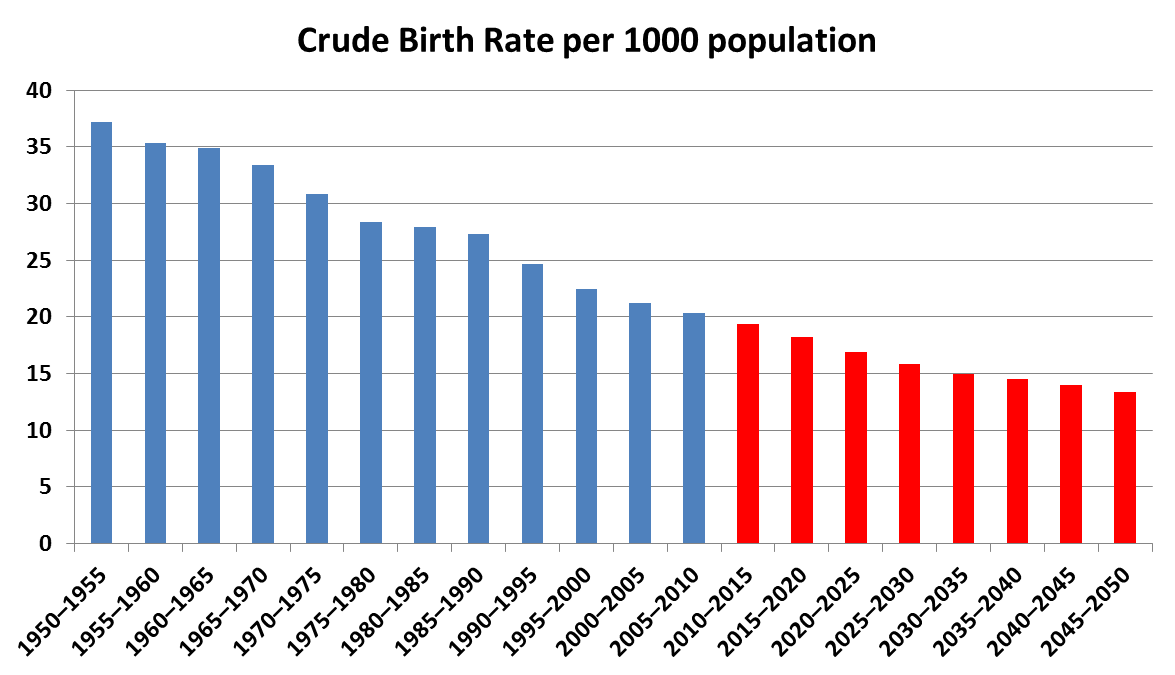
Currently the global birth rate is around 20 per 1000 of population (2%), having been around 37 in 1950 and projected to reduce to around 14 (1.4%) by 2050.

Crude birth rate actual and forecast UN data

Crude birth rate actual and forecast: UN data

Of these the number conceived by artificial means (IVF and surrogacy) is probably around 1% (around 0.2 births per 1000 of population). For example for around 2% of live births in the UK in 2010 , conception was by IVF. In Europe this is probably around 1.5% and worldwide it is still less than 1%. But this number is increasing and could more than double by 2050 as IVF spreads into Asia and Africa. By 2050 it could well be that for around 3% of all live births, conception has been by “artificial” means and that there will be a much greater degree of genetic screening applied.

Abortion rates increased sharply after the 1950’s as the medical procedures developed to make this a routine procedure. Done properly it is a relatively risk-free procedure though there are still many “unsafe” abortions in the developing and religiously repressive countries. Since 1995 abortion rates worldwide have actually decreased from about 35 per 1000 women of child-bearing age to about 28 today.  These numbers would indicate that the number of abortions taking place today is around 20-25% of the number of live births.

http://www.economist.com/blogs/graphicdetail/2012/01/daily-chart-7

Global abortion rates: graphic Economist

Global abortion rates: graphic Economist

So of every 100 babies conceived around 25% are deselected by abortion and 75 proceed to birth. Only 1 of these 75 would have been conceived by “artificial” means. The genetic deselection by abortion is both direct and indirect. The detection of genetic defects in the foetus often leads to abortion and this proportion can be expected to increase as techniques for the early identification of defects or the propensity for developing a debilitating disease are perfected. In many cases abortion is to safeguard the health of the mother and does not – at least directly – involve any deselection for genetic reasons. In many countries – especially India – abortions are often carried out to avoid a girl child and this is a direct genetic deselection. It seems to apply particularly for a first child. The majority of abortions today are probably for convenience. But if the “maternal instinct” is in any way a genetic charateristic, then even such abortions would tend to be deselection in favour of those who do have the instinct.

The trends I think are fairly clear. The proportion of “artificial births” is increasing and the element of genetic selection by screening for desired charateristics in such cases is on the increase. The number of abortions after conception would seem to be on its way to some “stable” level of perhaps 25% of all conceptions. The genetic content of the decision to abort however is also increasing and it is likely that the frequency of births where genetic disorders exist or where the propensity for debilitating disease is high will decrease sharply as genetic screening techniques develop further.

It is still a long way off to humans breeding for specific charateristics but even what is being practised now is the start of eugenics in all but name. And it is not difficult to imagine that eugenics – without any hint of coercion – but where parents or the mothers-to-be select for certain characteristics or deselect (by abortion) to avoid others in their children-to-be will be de rigueur.


Lunatic science? Cardiac surgery gives better results during a waning full moon!

July 17, 2013

It is not the 1st of April so presumably this “lunatic science” about the effects of a waning full moon on improved results after surgery  – taking “lunatic” in its proper sense of moon-sick  – is not just fantasy!

The message is clear. Schedule any cardiac surgery you may need during a waning full moon! But it does go against previous “lunatic belief” expressed by a UK politician as recently as 2009. Tredinnick, a Conservative MP,  is a supporter of astrology especially the use of it in medical practice!

 In October 2009, British politician David Tredinnick asserted that during a full moon “[s]urgeons will not operate because blood clotting is not effective and the police have to put more people on the street.”.

The belief that there is correlation between specific stages of the Earth’s lunar cycle and behavior in animals including human beings that cannot simply be explained by variation in light levels. There is no scientific reason to expect this to be the case and, in spite of numerous studies, no significant lunar effect on human behaviour has been established. Scholars debunking the effect sometimes refer to it as the Transylvanian hypothesis or the Transylvanian effect to emphasise its fanciful nature – Wikipedia

One wonders of course whether the effects of the full moon are affecting the surgeons or the patients.

This “study” – not funded- from the Rhode Island Hospital has just been published:

J. H. Shuhaiber, J. L. Fava, T. Shin, N. Dobrilovic, A. Ehsan, A. Bert, F. Sellke. The influence of seasons and lunar cycle on hospital outcomes following ascending aortic dissection repairInteractive CardioVascular and Thoracic Surgery, 2013; DOI: 10.1093/icvts/ivt299

Franke Sellke

Franke Sellke

EurekAlert: 

Waning and full moon cycles impact length of stay, mortality

PROVIDENCE, R.I. – If you need cardiac surgery in the future, aortic dissection in particular, reach for the moon. Or at least try to schedule your surgery around its cycle. According to a study at Rhode Island Hospital, acute aortic dissection (AAD) repair performed in the waning full moon appears to reduce the odds of death, and a full moon was associated with shorter length of stay (LOS). The study is published online in advance of print in the journal Interactive Cardiovascular and Thoracic Surgery.

The purpose of the study was to assess the effect of natural time variations of both the season and the lunar cycle phase on hospital survival and length of stay (number of days a patient is in the hospital) following acute aortic dissection repair.

(more…)

IVF with multiple births leads to small increased risk of mental retardation

July 3, 2013

A new paper describing a Swedish study:

Sandin S et al. Autism and mental retardation among offspring born after in vitro fertilization. JAMA 2013 Jul 3; 310:75. (http://dx.doi.org/10.1001/jama.2013.7222)

NewswiseIn a study that included more than 2.5 million children born in Sweden, compared with spontaneous conception, any in vitro fertilization (IVF) treatment was not associated with autistic disorder but was associated with a small but statistically significantly increased risk of mental retardation, according to a study in the July 3 issue of JAMA. The authors note that the prevalence of these disorders was low, and the increase in absolute risk associated with IVF was small. …..

…… A total of 2,541,125 children were alive at 1.5 years of age and had complete data on all the covariates; 30,959 (1.2 percent) were born following an IVF procedure. Autistic disorder was diagnosed in 103 of 6,959 children (1.5 percent) and mental retardation in 180 of 15,830 children (1.1 percent) who were born after an IVF procedure. Cases had an average follow-up time of 10 years, median (midpoint) 14 years.

Analysis of the data indicated that compared with spontaneous conception, any IVF treatment was not associated with autistic disorder but was associated with a small but statistically significantly increased risk of mental retardation, although when restricted to singletons (single births), the risk for mental retardation was no longer statistically significant. “However, the results demonstrated an association between autistic disorder and mental retardation and specific IVF procedures with ICSI related to paternal origin of infertility compared with IVF without ICSI,” the authors write.

“The prevalence of these disorders was low, and the increase in absolute risk associated with IVF was small. These associations should be assessed in other populations.”