Archive for the ‘Middle East’ Category

Saudi Arabia undermines Vienna peace process by holding conference of Sunni, anti-Assad groups

December 8, 2015

It is called a “Peace Conference”. It is being hosted and held by Saudi Arabia and only Sunni groups are invited. The Kurds are not invited and, of course, there isn’t a Shia in sight. The Sunni groups include those who are allied with Al Qaida and members of the Fee Syrian Army and including groups within the FSA which do channel funds and weapons to ISIS. The theory that ISIS and Al Qaida are not present is a fantasy. The intention is to unify the anti-Assad, Sunni forces.

Suadi is just stirring the waters to ensure that no Russian/Assad/Iran end-game can easily succeed.

Iran is not amused.

David Cameron is gratified because if he counts all these disparate groups together, and adds in the Kurds and maybe a few hundred Turkmen also, he might get to a number which is the same order of magnitude as 70,000 “boots on the ground”. (i.e. >7,000 and < 700,000).

NewsweekA Syrian opposition meeting due to begin in Saudi Arabia on Tuesday marks the most serious effort yet to unify President Bashar al-Assad’s fragmented enemies, a step seen as vital to peace talks sought by world powers but which has riled Iran.

While the outlook for the political track recently launched in Vienna appears bleak – international divisions over Assad persist and the war in Syria has escalated – the Riyadh meeting offers the prospect of forging a more united opposition better able to negotiate with the government. …….. 

The participants invited to Riyadh include powerful Islamist factions Islam Army and Ahrar al-Sham – a group whose founders had links to al Qaeda. Ahrar al-Sham still fights alongside the Nusra Front, al Qaeda’s Syrian wing, while espousing a nationalist agenda.

Islam Army said in a statement that its commander, Zahran Alloush, would not attend because the group had lost control of the road he had been planning to use to exit the area in the Damascus suburbs where the group is based. Members of Islam Army’s political office will attend instead, it said.

A dozen Free Syrian Army rebel groups will also attend, including groups vetted by the United States that have received foreign military aid. They include recipients of U.S.-made anti-tank missiles supplied to rebels in larger quantities since Russia intervened militarily on Assad’s side on Sept. 30.

A Saudi end-game which has all these Sunni groups assuming power can only lead to the dissolution of Syria (and maybe that is a good thing). But it will also lead to a break up of Iraq. It will establish a Kurdistan, a Shia- ruled territory and a desperately fractured Sunni area with a bunch of squabbling groups.

And ISIS will still be around.

Two months of Russian air strikes on ISIS more effective than 14 months of US efforts

December 2, 2015

If the Russian supported advances of the Syrian government continue at the present rate, the US-led coalition and the rebels they support may not have too much to say when a Syria, sans ISIS, is carved up. The Russians, regime Syrians, the Kurds and Iran will settle it among themselves. Now this may just be the Russian / Syrian propaganda line, but I suspect that there is some truth in it. Yesterday it was announced that the rebels (mainly al Nusra) would be evacuated from Homs under UN supervision as the Syrian government forces would cease their siege and take over.

I note that the US is now talking about US boots on the ground to support the “good” rebels and this is, I think, a response to a fear of being left out and left behind. Certainly the difference in effectiveness of one month two months of Russian air strikes – with a strategy –  compared to 14 months of US and coalition air strikes, but without a strategy, seems quite remarkable.

Sky:

Bashar al Assad has said US-led coalition bombing in Syria helped Islamic State to expand and recruit fighters.

….. But he praised military action by his ally Russia, which has been accused of targeting moderate rebels as well as jihadists.

Mr Assad said: “Since the beginning of that (US-led) coalition, if you want to talk about facts, not opinion, since the beginning of that coalition, ISIS (Islamic State group) has expanded and the recruiting from around the world has increased.

“While since the participation of Russia in the same fight, so-called against terrorism, ISIS has been shrinking. And al-Nusra (Nusra Front) of course and the other terrorist groups. So this is reality. The facts are telling.”

Asked what it would take to end Syria’s four-year civil war, which has killed more than 200,000 people, Mr Assad said: “When those countries that I mentioned – France, UK, US, Saudi Arabia, Qatar and some other – stop supporting those terrorists.

“(the next) day the situation will be better and in a few months we will have full peace in Syria, definitely. If they stop.”

The US, UK, and other Western powers fighting Islamic State have demanded that Mr Assad steps down and have backed rebel groups fighting his forces.

Meanwhile the Syrian president has referred to all his opponents as “terrorists” and accused world leaders pushing for his departure of “supporting terrorists”.

The Syrian leader is backed by Russia and Iran and he praised Vladimir Putin for launching a bombing campaign backing Assad’s forces in September.

In a wide-ranging interview with Czech TV, Mr Assad also said: 

:: On The Migration Crisis:

“The feeling is very sad. Especially if you think about every person of those Syrians who left Syria has sad story behind him. It reflects the hardship of the Syrians during the crisis. From this (rational) way of looking at the situation, it’s a loss. Every one of those is a human resources that left Syria. So that will undermine. Undermine your society and your country. Definitely. But at the end we have to deal with the reasons.”

:: On Turkey Downing A Russian Jet:

“I think it has shown the real intention of Erodgan (Turkish President, Recep Tayyip Erdogan) who, let’s say, lost his nerve because the Russian intervention has changed the balance on the ground. So the failure of Erdogan in Syria, the failure of his terrorist groups means his political demise.”

:: On Relations With The West:

“If you look at the relation with the West, in 2005 I was the killer. In 2008 and after I was a peacemaker. Then in 2011 I became the vulture. Now, there’s some positive change – of course shy kind of change, not the explicit one.” ……..

I think the Russian air strikes have caught the US and, especially, Turkey, flat-footed. The shooting down of the Russian jet by Turkey seems to have been born out of a frustration at the targeting of the lucrative oil trade between Turkish middle-men and ISIS (and Erdogan’s son is said to be a key player here), but perhaps more importantly at the success of the Kurds.

G20 meets in Turkey today – but will Saudi and Turkish (and EU) support for ISIS be confronted?

November 15, 2015

The agenda of the G20 meeting starting in Turkey today will be dominated by Paris – and so it should.

The G20 is made up of 19 countries and the EU: Argentina, Australia, Brazil, Canada, China, France, Germany, India, Indonesia, Italy, Japan, Mexico, Russia, Saudi Arabia, South Africa, South Korea, Turkey, the United Kingdom, the United States of America and the European Union.

129 people died in Paris on Friday night and another 90 are still in critical condition. At least two of the terrorists had posed as refugees passing through Turkey and Greece just about a month ago. One more has now been identified as a known, 29 year old, “radicalised” French citizen.

The G20 is intended primarily as an economic forum, but Paris and Syria and ISIS can be expected to dominate. But I am not sure that any discussions about ISIS will be open enough or sufficiently meaningful in addressing root causes. To do that the agenda would have to include,

  1. the tacit support for ISIS from Turkey and Saudi Arabia, and
  2. the funding and growth of ISIS caused by the EU and US support of anti-Assad  rebels, and
  3. the misguided “multiculturalism” in the EU which – among other things – allows Saudi funded, radicalising mosques and madrassas all across Europe, and
  4. the EU “soft” policies which have now probably allowed at least hundreds of terrorists to be sneaked into Europe as “refugees”.

Both Saudi Arabia and Turkey are members of the G20, but their support for ISIS, not officially perhaps, but indirectly and by inaction and by default, will not, I think, be confronted directly. Turkey is a Nato member and is “protected” from criticism of its excesses. Criticism of Saudi Arabia is always muted from those countries dependent on oil imports or defence exports.

A great deal of ISIS financing is from private Saudi sources but surely not without the knowledge of the Saudi authorities. The official Saudi support is ostensibly for groups of Sunni rebels who are opposed to Assad and who are also said to be opposed – sometimes very mildly – to ISIS. Moreover some of these groups are no more than conduits to ISIS and al Qaida. Saudi Arabia’s primary aim seems to be to support anti-Shia groups and opposition to ISIS is only secondary. If ISIS was the only Sunni group available to oppose the Shia forces then Saudi Arabia would make sure they were supported.

Prince Bandar bin Sultan, once the powerful Saudi ambassador in Washington and head of Saudi intelligence until a few months ago, had a revealing and ominous conversation with the head of the British Secret Intelligence Service, MI6, Sir Richard Dearlove. Prince Bandar told him: “The time is not far off in the Middle East, Richard, when it will be literally ‘God help the Shia’. More than a billion Sunnis have simply had enough of them.”

Saudi Arabia, Qatar and the other Sunni Gulf States, all want the Shia to be wiped off the face of the Earth and if that means supporting the murderous psychopaths of ISIS – well, the end justifies the means.

In the case of Turkey, it is also an overwhelming desire to prevent any Kurdish state which rules their actions. Turkish hatred of a Kurdistan is on a par with the Saudi hatred of the Shia. They are also against terrorism, provided that the Kurds are first defined as terrorists. And ISIS, as an enemy of their Kurdish enemies, is often their friend. Turkey sees Kurdish successes in Northern Iraq and parts of Syria as ominous and are quite happy to bomb Kurds in or close to Turkey, even if it helps ISIS to gain territory.

Greater Kurdistan dreams map from Jon Davis via Quora

Greater Kurdistan dreams map from Jon Davis via Quora

Turkey will not take actions against ISIS if there is any chance that Kurds may gain an advantage.

I don’t expect the G20 meeting to get more than empty statements from Turkey and Saudi Arabia. Obama will order a few more air strikes. The EU is now a dithering and fractured entity. In fact the EU is now part of the problem and European countries (France, UK, Germany …) will need to act independently to oppose and attack the growth of ISIS. The G20 meeting in Antalya will get no commitments

  1. from Turkey to attack ISIS even if it helps the Kurds, or
  2. from Saudi Arabia to shut off all private funding for ISIS, or
  3. even to withdraw official Saudi support from Sunni groups who “leak” funds to ISIS, or
  4. from the EU to stop the funding from the Middle East of radicalising mosques and madrassas in Europe, or
  5. from the EU to winnow out the terrorists and criminals from among the influx of “refugees”

Sunni Muslims across the world need to pay more than lip-service to opposing the barbarism of ISIS. The Shia are already opposed to all things Sunni. But far too many Sunnis – by inaction – allow their own fanatics to prosper. They allow their fanatic imams to continue preaching their brand of hatred. They turn a blind eye to their radicalised sons and daughters. They too harbour dreams of the establishment of a new Islamic (Sunni, of course) Caliphate and have secret sympathies for the objectives of those “fighting” or murdering for this dream.

I am afraid that Sunnis anywhere (and for me that means all over Europe and the Middle East, Africa and even India, Bangladesh, Malaysia and Indonesia) who do not declare themselves – by word and action – to be against the Islamic Caliphate must be taken to be supporters of, and sympathisers with, ISIS.

Saudi Arabia gets away with it again — but why?

October 21, 2015

That Saudi Arabia uses barbaric, medieval methods within Saudi Arabia is almost a cliche. But why they command an almost fawning behaviour by other countries can only be partly explained by the power of their money. Values, it seems, are subverted by Saudi oil money.

Without financing from parties in Saudi Arabia, ISIS could not sustain itself. The madrassas and mosques where feeble-minded, muslim kids are radicalised in Europe and in Asia, are financed to a large extent from Saudi Arabia. The 9/11 terrorists were mainly Saudis. Bin Laden was Saudi.

Dissolute and decadent Saudi and Gulf tourists run riot in Europe, driving recklessly, drinking heavily, cooking, littering and smoking shisha in public parks. All with an impunity as if they had a de facto diplomatic immunity – which of course they seem to have. Even the Saudi King and an entourage of 1,000 were allowed to take over a whole beach in France in spite of local protests. The French acquiesced to the King’s demand that female police officers be removed.

Saudi Arabia would collapse without its expat workers and foreign labour. Their medieval treatment of foreigners is a scandal but is tolerated because they pay well. How on earth did Saudi Arabia get elected as the Chair of UN Human Rights Council Panel?

In the last few weeks the arrogant and decadent behaviour of the Saudis at home and abroad has been on show.

  1. The incompetence of the Saudi authorities led to the death of at least 2177 people at the Hajj stampede, not the 769 that Saudi Arabia admits to (as if that was not bad enough).
  2. Two Nepali women working as maids for a Saudi diplomat were were held captive by his family and used for “entertainment” for their Saudi friends. They were starved and sexually abused by them and other Saudi guests. When the girls were eventually released and the diplomat charged, he just claimed immunity and was whisked back to Saudi Arabia.
  3. The US authorities allowed a Saudi prince to flee rape charges even though he had no immunity. Majed Abdulaziz Al-Saud was arrested but fled while on bail. “Arrested on suspicion of false imprisonment, sexual assault and battery, a Saudi prince has also recently been accused of attacking at least three women and holding them captive for several days. Immediately upon posting bail, the prince reportedly emptied his $37 million mansion and fled the country on a private jet to avoid civil litigation and criminal charges. …. Although the prince is a royal member of the House of Saud, the U.S. State Department eventually confirmed that Al-Saud does not have any diplomatic immunity”.

Is it just oil money that leads the US and European governments to put up with the atrocious behaviour that would lead to calls for regime change in other countries? Of course the US sees Saudi as a balance for Iran in the region. But if the US is serious about its so-called war on terror, the sources of most of the financing of islamic terror organisations lie in Saudi Arabia. King Salman is showing signs of dementia and the country is actually being run by his son – but not very competently. Mohammed bin Salman is just 29 and has never had experience of being anything more than an aide. The incompetence on show has led to one of the grandsons of the founder of Saudi Arabia making public his concerns about the way the country is being run.

A senior Saudi prince has launched an unprecedented call for change in the country’s leadership, as it faces its biggest challenge in years in the form of war, plummeting oil prices and criticism of its management of Mecca, scene of last week’s hajj tragedy. 

The prince, one of the grandsons of the state’s founder, Abdulaziz Ibn Saud,  ……. (but) who is not named for security reasons, wrote two letters earlier this month calling for the king to be removed.

And all of Europe and the US continue to indulge them. Low oil prices for the next decade will – perhaps – reduce some of the Saudi excesses, but there is something more than just oil money at play.

I suspect it is the delusion in US and Europe that they can manage the inevitable restructuring of nations in the Middle East that must come. At some time Iraq has to split three-ways between Sunni, Shia and Kurd. And now it looks inevitable that Syria must also split in some similar manner, with a Sunni part of Syria perhaps merged with a Sunni part of Iraq.

Ralph Peters’ scenario for the Middle East


Is the US now tacitly accepting the Russian strategy?

October 9, 2015

The US has abandoned its fiasco of a $500 million program for the training of “moderate rebels” who could then have provided the physical presence in Syria for getting rid of ISIS (and Assad). So while the rhetoric against the Russian line continues, it seems apparent that the US is not prepared to work directly for the removal of Assad any more. They seem to have reluctantly accepted that Assad need to stay for some indefinite transition period. But that is precisely the path that the Russians are trying to follow. So even if the US has not exactly thrown the “moderate rebels” under a bus, it seems that they are not going to go very far out of their way to support them with more than some arms and some money.

The US may not have completely abdicated, but seems to be taking a political back seat. Regime change is on hold. They may well content themselves – like any good back-seat driver – with criticising the competence of, and the direction being taken by, the Russian driver.

There is a risk now that Saudi Arabia, and the Gulf states will start throwing large sums of money into Syria. Ostensibly it will be for Sunni rebel groups, but much will end up with ISIS and other extreme groups. Iraq of course has joined Iran, Hezbollah and the Assad regime in the Russian coalition.

BBC:

The US is to end its efforts to train new Syrian rebel forces and says it will shift to providing equipment and weapons to existing forces.

Its $500m (£326m) programme was heavily criticised after it emerged that US-trained rebels had handed vehicles and ammunition over to extremists. ……. 

Quoting an anonymous US Department of Defense source, the New York Times reported that the US would no longer recruit Syrian rebels to go through its training programmes in Jordan, Qatar, Saudi Arabia or the United Arab Emirates.

Instead, it would establish a smaller training centre in Turkey, where “enablers” – mostly leaders of opposition groups – would be taught operational manoeuvres like how to call in airstrikes, the newspaper said. 

The failure of the programme underscores the wider problem of the inability to create large and effective moderate forces on the ground. It will also have wider repercussions since the programme helped to coordinate support activities between the Americans, the Gulf states, Turkey, and Jordan. The risk now is that those countries may push on with more separate initiatives backing individual client groups.

The end-game is not certain but the Russian end-game is the only one around.

US/Nato lack of strategy being shown up by the Russians

October 8, 2015

The US started its regime change efforts in Syria 4 years ago, in 2011,  with the financing, training and encouragement of selected “moderate rebels”. They have no doubt weakened Assad but have also been instrumental in creating ISIS.

The US and Nato have been taking great pains to avoid providing any support to Assad’s regime, and only providing support to their favoured “moderate rebel” groups. Even though it has always been the fanatic groups who have muscled the “moderate rebels” out of the way whenever they have achieved any gains. US and Nato have had no clear strategy. They have attempted regime change with no idea of what is to come afterwards. They have not been able to even contemplate any plausible end-game scenario, because the “moderate rebels” they support are too fractured and diverse in themselves to form any clear alternative to the regime.

By contrast, the Russians have an end-game in view though it is not clear if that can be achieved. But it does at least provide a clear direction and a focus which is lacking in the US/Nato approach.

  1. rendering ISIS and al-Nusra and Al Qaida and other fanatics impotent, even if it means supporting Assad,
  2. a managed withdrawal of Assad, with the regime still in place but without leaving any power vacuum
  3. a political settlement between the regime (sans Assad) and the other “moderate rebels”

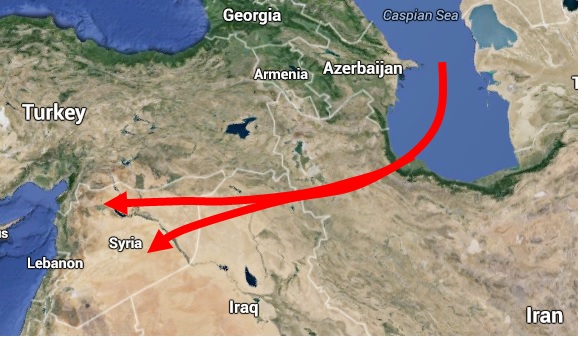
Needless to say, the US and NATO are not amused, though they have no alternatives to suggest when they criticise the Russian cruise-missile strikes from the Caspian Sea. These missiles flew over Iran and Iraq and the strikes were clearly coordinated with them.

4 Russian warships launch 26 missiles against ISIS from Caspian Sea

4 Russian warships launch 26 missiles against ISIS from Caspian Sea

RT:

“Four missile ships launched 26 cruise missiles at 11 targets. According to objective control data, all the targets were destroyed. No civilian objects sustained damage.”

Frigate Dagestan image shipspotting.com

The missiles flew some 1,500 km before reaching their targets. …. Four warships of the Caspian fleet were involved in the missile attacks, the Gepard-class frigate Dagestan and the Buyan-M-class corvettes Grad Sviyazhsk, Uglich and Veliky Ustyug. They fired cruise missiles from the Kalibr NK (Klub) VLS launchers. The missiles used are capable of hitting a target within 3 meters at a range of up to 2,500 km.

Nato countries and the US are highly indignant at these attacks and the Russian violations of Turkish air space, which I suspect, were deliberate and were meant to test limits even if they had no hostile intent.

Nato defence ministers are promising to support Turkey and the Baltic States as if they were directly being threatened by Russia. But that, I think, is because they have no strategy of their own. The US also does not like the Russian strategy but has none of its own.

BBC:

A US-led coalition has been carrying out air strikes against IS in both Syria and Iraq for months. But Western countries support rebels who have been fighting to oust Mr Assad since 2011. ….

But US Defence Secretary Ash Carter said coalition forces fighting IS in Syria would not co-operate with Russia. “We believe Russia has the wrong strategy,” he said. “They continue to hit targets that are not IS.”

Protesting too much, I think.

The problem for the US is that the boots on the ground to defeat ISIS are not going to come from their pet “moderate rebels”. They can only come from the Assad regime, Hezbollah, Iran and Iraq (along with a thousand or two Russian “advisors”).


Whose boots will prevail in Syria?

October 5, 2015

It does not require rocket science to see that ISIS will only, can only, be defeated finally by boots on the ground.

The US and its partners assumed that “moderate rebels” in Syria would provide the boots on the ground to take over, once they had managed to get rid of Assad. But the assumption that the “moderate rebels” formed any sort of cohesive group which could bring stability has proven to be grossly wrong. They are so splintered and fractured and cover such a wide range of objectives that they can only ensure instability. The further assumption that the rag-tag being supplied with weapons and money to effect regime change, did not also include radical and fanatic Sunnis and Wahabis has been at best, incompetent, and at worst, disastrous. The Russians are, it seems, making a different calculation.

Any scenario which pictures the defeat of ISIS will require that their followers are left with no physical or political space to occupy and control. And that is going to require that their space is then occupied by someone else. Air attacks by the US led coalition or by Russia can only prepare the way, but without a real physical presence the effects of such air attacks can only be temporary. Without filling up the space with some form of political stability, any political vacuum will always provide room for the fanatics.

Of a Syrian population of about 23 million, 9 million are displaced and are refugees within Syria or abroad. Around 3 million are estimated to have left Syria. Around 75% of the Syrian population were Sunni muslims, 12% were Alawites (a secretive branch of Shia Muslims) and about 8% were Christians. Assad is of course an Alawite. As Shias the regime is supported by the Hezbollah from Lebanon and from Iran’s Shia (90% of Iran’s population are Shia and about 9% are Sunni). If Assad were to step down, but was replaced by another Alawite, then the Alawites, many of the Christians and even some of the moderate Sunnis, could probably live with a regime which provided stability. The fly in the ointment is financial support for the various Sunni and Wahabi rebel groups in Syria (including the hard-line terrorist groups such as Al Qaida, al-Nusra and ISIS) which comes mainly from Saudi Arabia and the Gulf States. US support for rebel groups in Syria has, under Saudi influence, often supported the Sunni line. ISIS cannot be politically suffocated as long as its external financing continues.

Even with a defeated ISIS, sympathisers will still remain. But they will not be in control. A “defeat” can only mean that they no longer have any control over any settlements within which they might still exist, and that they have no safe havens within which to hole-up. That cannot happen unless control over all geographical areas effectively lies with some body – or bodies – that reject the fundamental claims of the Islamic State.

The mutual hatred between ISIS and Shia Muslims is a key factor. No Sunni rebel group fighting against Assad is not without some sympathy for ISIS. This virtually disqualifies any of the current rebel groups being supported by the US coalition, from being capable of supplying the political control needed to squeeze out ISIS. Certainly the US and its coalition partners are not going to supply the physical presence on the ground. The Russians are not going to send in troops beyond military advisors to Assad either.

So who does that leave? Whose boots on the ground are going to prevail?

The Russian calculation seems to be that the regime (later without Assad) together with Hezbollah, Iraqi Shias and some Iranian presence will be sufficient to defeat ISIS and squeeze them out. It is not impossible, but the Saudis will not take kindly to that. That would be seen as an unacceptable blow to the Sunni ego.

And then whether such an end-game is allowed to stand will depend upon whether the US is prepared to satisfy the Saudis by challenging the Russians (and the Iranians and Hezbollah) in their support of the Assad regime. I suspect that the Russians are calculating that Obama will only keep shifting his red line rather than actually cross it. As long as the Russians keep the eventual stepping down of Assad as being inherent in their plans, Obama will, reluctantly, go along.

It seems a highly dangerous path to this end-game where the regime (without Assad) but with help from Hezbollah and Shias from Iraq and Iran supply the boots on the ground to get rid of ISIS. But at least it is an end-game which is not impossible. And it seems to be the only one available. The US and their European partners seem not to have thought very far beyond the removal of Assad.


Five millennia of the Middle East

May 25, 2015

From Maps of War

5,000 years of the Middle East in 90 seconds

http://www.mapsofwar.com/images/EMPIRE17.swf

Turkey watches – while ISIS advances against Kurds

October 7, 2014

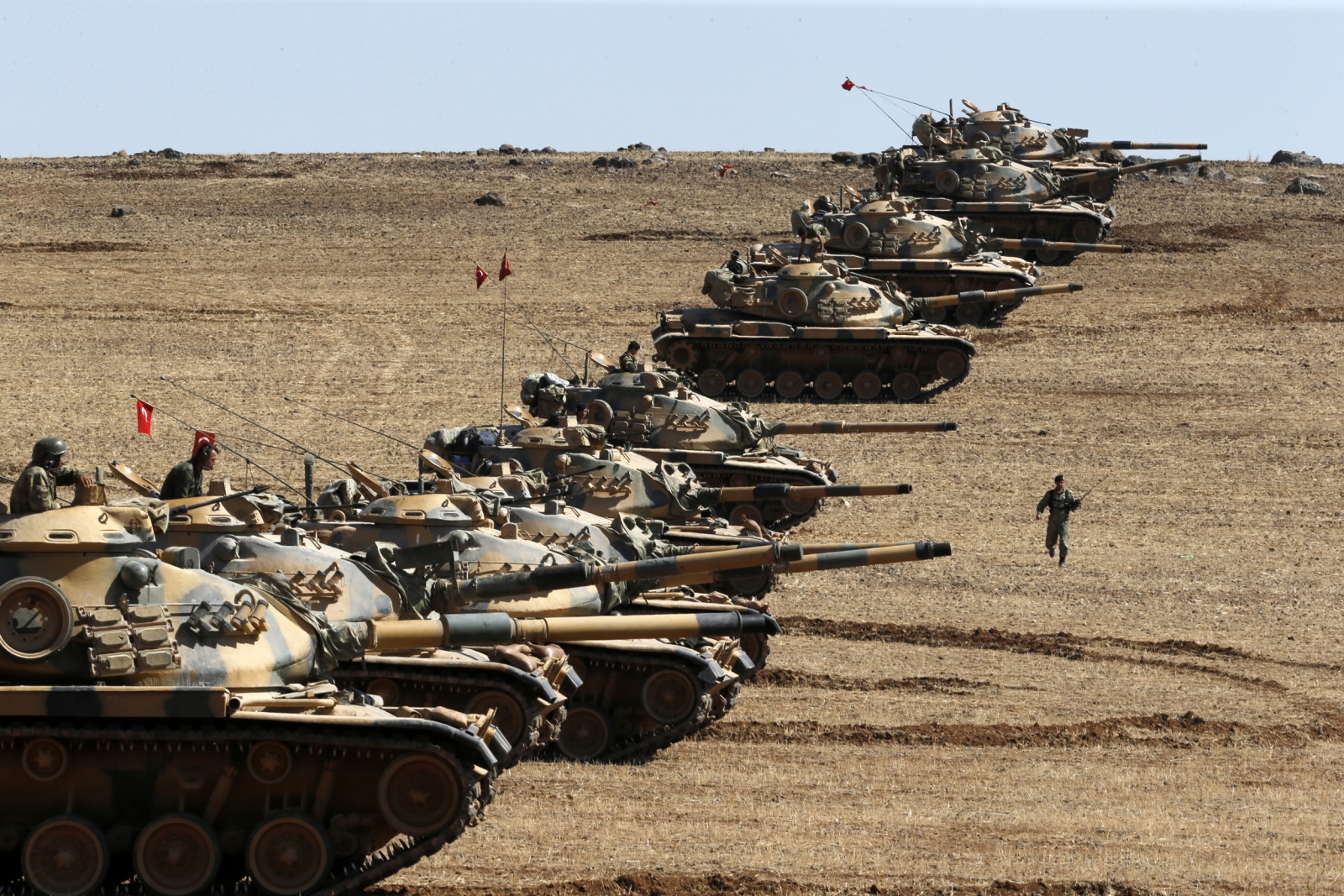
The US is bombing ISIS positions in Syria. But when ISIS advances against the Kurds in the border town of Kobani, Turkey – although a NATO ally – is content to watch. An enemy of the Kurds is almost a friend!!

Turkish tanks on the Syrian border near Kobani – image ibtimes

Of course nothing is simple in the Middle East.

But sometimes it seems to me that anything that weakens the Kurds is considered a “good thing” by the Turkish government. I have the feeling that even Turkey’s membership of NATO is subordinate to their goal of containing the Kurds and preventing the growth of a Kurdistan which stretches across part of present day Turkey. A “Great Kurdistan” as Ralph Peters’ map shows (from this analysis) is Turkey’s nightmare.

Great Kurdistan a Turkish nightmare – graphic Ralph Peters

For Turkey it is a choice between evils. They could well perceive that an ISIS Caliphate may be less of a geographic threat than a Great Kurdistan.

Caliphate claimed by ISIS – graphic zerohedge.com

The many ISIS advances also cast doubt on whether the US air strikes will be anywhere near as effective as Obama hopes and has proclaimed.

Our objective is clear:  We will degrade, and ultimately destroy, ISIL through a comprehensive and sustained counterterrorism strategy.

At Kobani, ISIS advances are not even being contained – let alone degraded and destroyed.

Obama is now waiting to be rescued by Iran

June 16, 2014

A week ago only Middle East experts knew much about ISIS. And in less than a week the possible break up of Iraq has becomes more than just a distant reality and is now a “work in progress”. Republicans are blaming Obama for the failure of reaching an agreement with al Maliki and the premature withdrawal of troop. Democrats blame Bush Jr. and Cheney and the neo-cons for duping the US and the world in justifying the 2003 invasion. And they are – of course – both right. The initial invasion “broke”Iraq but Obama is the one who has refused to fix it or even to provide the glue with which to fix it.

Over the weekend the mayhem continued in Iraq as the blood-letting by ISIS plunges to new depths.

Twenty three years after the First Gulf war, George Bush Sr. has returned – reincarnated as an aircraft carrier. In an unusual burst of activity President Obama sent the US navy to the Gulf as NBC reports – “The USS George H.W. Bush — accompanied by the guided-missile cruiser USS Philippine Sea and the guided-missile destroyer USS Truxtun — was ordered to the Persian Gulf Saturday to protect American lives and interests in the region.” The ships arrived on Sunday. The size of the fleet makes one suspect the preparation of an evacuation of Baghdad (shades of Saigon!) rather than any significant military opposition to ISIS. Some staff are already being evacuated from the US Embassy.

President Obama continues to contemplate his dwindling options. Tony Blair is still living in his own deluded fantasies. Blair jets around as a Middle East Peace envoy and is now calling for more bombings and more bloodshed to try and defend his own blood-drenched legacy. But Obama may get help from an unlikely source:

Al JazeeraIran’s president held out the prospect of working with the U.S. in a bid to stabilize strife-torn Iraq on Saturday, but denied reports that troops had already been sent across the border to bolster its failing neighbor’s counter-insurgency efforts.

Hassan Rouhani, a pragmatist who is presiding over a nascent thaw in Iran’s relations with the West, said if Washington was willing to confront “terrorist groups in Iraq and elsewhere,” then Tehran would contemplate cooperating with its traditional foe over Iraq.

Echoing comments made by President Barack Obama on Friday, Rouhani added that Tehran was unlikely to send forces to Iraq but stood ready to provide help within the framework of international law. Baghdad has not as yet requested such assistance, he added.

The BBC reports that the US and Iran may hold talks about possible cooperation later this week. And this gives Obama the perfect excuse to continue with his “do-nothing” policy as he waits to be rescued by Iran.

BBCWashington is considering direct talks with Iran on the security situation in Iraq, a US official has told the BBC. The move comes as US President Barack Obama weighs up options on action to take in Iraq.

Meanwhile, the US condemned as “horrifying” photos posted online by Sunni militants that appear to show fighters massacring Iraqi soldiers. In the scenes, the soldiers are shown being led away and lying in trenches before and after their “execution”.

But this mending of fences between the US and Iran will not go down very well in Israel. Netanyahu will now be under pressure from his hawks to carry out pre-emptive strikes on Iran’s nuclear facilities before the rapprochement goes too far.