The sum of all wisdom is the summation across the population, of the integrals over time of the second values derivative of knowledge.

Not the philosophy of mathematics but the mathematics of philosophy!
The sum of all wisdom is the summation across the population, of the integrals over time of the second values derivative of knowledge.
Not the philosophy of mathematics but the mathematics of philosophy!

I got into a discussion/argument a few days ago about how the health services available were dependent upon wealth and about the need for “equality”. The motion was that “everybody should be equally entitled to the best care available”. But I couldn’t quite get my point across that the search for “equality of treatment” was itself based on a fundamental inequality. The fact that some people were sick and some were not, irrespective of wealth, was the underlying inequality. Provision of health services was, inherently, the unequal provision of resources to some (the sick) and therefore, the denial of those resources to others (the healthy). An unequal allocation of resources (more to the sick, less to the healthy) was being used to correct for the underlying inequality. It was “affirmative action” to help the sick. Admirable no doubt, but not an exercise of “equality”. In fact it was a manifestation of “unequal treatment” in the name of correcting a perceived “inequality”. All forms of “reservations” and “affirmative action” use discrimination against some to try and correct for some other perceived disadvantage of others. Campaigns for “equality” are nearly always about meting out unequal treatment to some to compensate for a perceived disadvantage in others.
They are all exercises in inequality rather than a pursuit of equality.
Concepts of equality are not real. They are merely “feel-good” excuses, a panacea for perceived injustices and a stick to beat political opponents with. All the various “forms” of equality are mirages. Absolute equality – of any kind – is a convenient myth. You cannot have both diversity and equality. “Different but equal” is a fine catch phrase but is a contradiction in terms. Difference IS unequal.
Justice and equality are quite different things. Justice demands inequality.
(I note in passing that “freedoms”, like equalities, are also convenient myths. The so called four fundamental freedoms (of speech, of worship, from want and from fear) are political nonsense. In virtually every human society “freedom of speech” is actually nothing more than “freedom of allowed speech”. “Freedom of my worship” has become the “freedom to impose my worship” and is the cause of more atrocities and barbarism than any other. Freedom from want denies the fundamental driver of human development – to want. Freedom from fear is an empty platitude. Humans are capable of feeling fear because it, like pain, is a necessary requirement for survival. Elimination of fear or pain would require genetic manipulation and that would also eliminate happiness and pleasure.)
Yesterday the women’s 10,000 m world record was broken by Almaz Ayana of Ethiopia (a fantastic run). The runners all started at the same time (equality). The finish was completely unequal with almost two laps between the winner and the last to finish. Ayana’s unequal advantages (nature and nurture) took her to the finish almost half a lap ahead of her nearest rival. For true “equality”, she should have had a handicap. With proper “affirmative action” maybe all the runners could have finished at the same time. But that would have been unjust. (Why is there no campaign for “gender equality” in the Olympics 10,000 m? I suppose for the same reason that flyweight boxers are not required to fight against the heavyweights.) The Olympics is a celebration of inequality.
The fundamental truth is that what is just is all about being unequal. Justness consists of “getting what is deserved”. The loose use of “equality” actually moves us away from what is just. We need to dump the deification of equality and focus on what is just.

Primum non nocere – First, do no harm!
It is sometimes expressed aa “Above all, do no harm” or “Primarily, do no harm”. It used to be part of the Hippocratic oath for physicians as “… abstain from doing harm”. It is a phrase which is used mostly in a medical or psychological context but it seems to me it should rightly be a Prime Directive for virtually all human activity.
All human systems of law exist to make proper redress when a claim is made. For a claim to be made against anyone or any body of people, there must first be liability. Without liability there is no claim to be made. If no harm is done there is no liability. If this is the Prime Directive for all human kind, and if there is full compliance, it follows that having a system for handling claims and and redress becomes unnecessary. Note also that without harm being done, the question of ethical dilemmas does not arise. Generally law tells us what not to do and ethics tells us what to do. Legal and ethical dilemmas only arise because what law or ethics tell us to do can cause harm to someone. And as soon as harm is done, there is liability and there is a claim.
Not everything legal is ethical and not everything illegal is unethical. But we get a confluence of ethics and law if both adopt doing no harm as the foundation on which their structures are built.
If we must have religions, why cannot every religion have that as its prime Directive or Commandment number Zero? It ought to be the underlying tenet of every political party, of every association of people, of every corporate body, of every advocacy group or – even – of every charity. It ought to be the default codicil to every exhortation to action and to every purpose. “Seek happiness but first, do no harm” or “Make a difference, but first, do no harm” or “Make your fortune but first, do no harm”.
Of course it will be rationalised and circumscribed. “First, Do no harm” will nearly always become “Do no unnecessary harm” and you could argue that the concept of the use of force not being disproportionate to the task in hand is just that. In fact the concept of “being proportional” lies at the heart of our concepts of justice and fairness and “balance”. Even in war we require that harm be kept to a minimin. “Collateral damage” is to be minimised. Using disproportionate force is frowned upon. Attacking unarmed, non-combatants is not the done thing.
The practical reality is that human activities do, in fact, do harm to others. But that does not preclude any human activity from starting with “First, do no harm”.
Related:
John Henry Boetcker’s (1873 – 1962) 10 cannots were first published in 1916. Some of his ten are often attributed in error to Abraham Lincoln. And they are just as valid today as they were then. They are more widely applicable today and especially for all the developing countries who need – above all – to ensure sufficient growth to fulfill the aspirations of their billions.
As I grew up, the concept of “space” was of an area devoid of matter (and we had not heard about “dark matter” then). The science fiction I was addicted to usually used terms such as the vacuum of space, or the cold emptiness of space or the void of space. But the concept was of physical space with our conventional, and comfortable, 3-dimensions. Space was always something things could move into. The known laws of physics applied there, if there was something there to be applied to. It was to be the exciting, new frontier for the expansion of human thoughts and in due course of humans and the human spirit.
Somewhere along the way, the insight developed that being devoid of matter did not mean being devoid of properties. I think it must have been in my pre-thermodynamics days, that it occurred to me that the lack of matter must still leave the space with dimensions. Distance must still be measurable across the empty space. Gravity must, logically, still apply between masses on either side of empty space and therefore the space must also have the ability to propagate the force across it. Presumably it also had the ability to allow light to traverse it. Then, as I first encountered thermodynamics, I began to think of temperature as the energy level of vibrating atoms and molecules and realised that the coldness of space was meaningless in the absence of any particles. I grappled with the concept of absolute zero on the temperature scale and came to the conclusion that without matter first existing, temperature was an undefined property. Cold space was just plain wrong if temperature was not defined.
Then along came my awareness of Einstein and his space-time (which he himself compared with the aether). There was no longer anything which could be called empty space. The universe was, without any doubt, expanding. But then I had to grapple with whether the universe was expanding into a space (or space-time) already extant, or which created its own space as it went along its merry, expansive way. That still left the question: What was there before the universe expanded into the new when-and-where of the space-time it was creating? The expanding universe is itself mind-blowing, since it applies to galaxies but not apparently to our bodies, or even to bodies within the solar system. That led me to wonder about the nature of the expansion of the universe itself. It is observed (inferred) by astronomers and physicists, but only from within the universe. Would an observer external to the universe, if such an observer could exist, also observe that the universe was expanding? Of course, that leads to the question of the nature of the space to be occupied by such an external observer, and the properties which that space or space-time or space-time-magic continuum might have? Or was the universe, by definition, such that nothing – and no thing – could be external to it? What would expansion in our space-time mean to an observer who transcended our dimensions? Could a fish in its pond conceive of the empty space beyond the water surface?
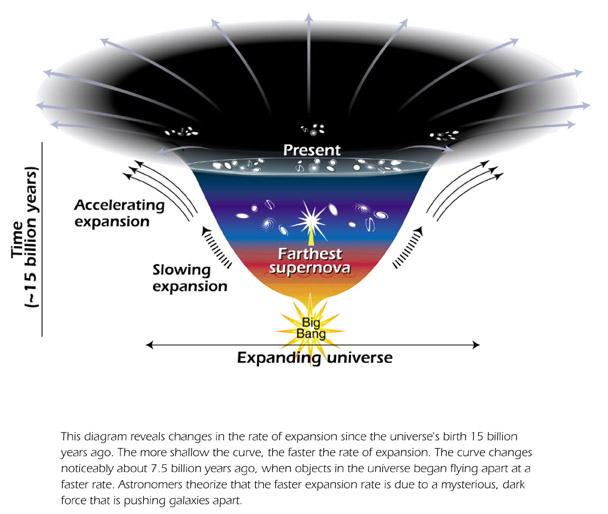
Expanding Universe – hubblesite.org
Now the expansion of the universe is not proceeding as it should with the known forces and energy-levels that exist. The expansion of the Universe is apparently accelerating. It is not slowing due to gravity as it should. Therefore dark matter and dark energy must exist. To fit the theories, the universe is apparently made up of 68% dark energy, 27% dark matter and just 5% of normal matter that we can observe. But this only leads to more questions. If 95% of the known universe is of unknown, magical stuff, then how representative of anything is what we infer from the 5% we can observe?
It is easy to draw a picture of an expanding universe on a piece of paper. But note that the “space” on the paper outside the universe is not labelled. It is just “empty space” and merely the backdrop for the diagram. The moment we imbue space or space-time with any properties, we inevitably define also the conception of the non-existence of those properties. And I still have difficulty getting my head around this M-space (magic space) which is truly empty and which is devoid of all matter and all possible properties, attributes or characteristics. M-space then must be the ultimate void, the magical non-thing, which is the backdrop for the universe.
But my real problem is that I cannot even conceive of M-space without giving it some property – even if only the property of having no properties or that it is not of this universe. Which only leaves Magic as the backdrop for everything.
It has always bothered me that time apparently only began 13.8 billion years ago with the Big Bang. I find it equally as difficult (or easy) to conceive of 20 billion years ago as 13.8 billion years ago. But even 13.9 billion years ago is disallowed by the Big Bang, which is a very unsatisfactory state of affairs. I need time to go back indefinitely long.
And so I distinguish between perceived time and ℜeal time. ℜeal time, of course is magical. It is only by definition that we take the passage of time to be constant. Of course this is just perceived time. And we perceive time only as a consequence of change. But ℜeal time does not have to elapse at a constant rate.
The Big Bang does not, apparently, mathematically permit of a time older than 13.8 billion years. Magical ℜeal time, of course, goes back to infinitely long ago. All can be resolved merely by accepting that ℜeal time elapsed at zero rate at the Big Bang and then gradually built up to the rate of elapse we are subject to now.
“One second is the time that elapses during 9,192,631,770 (9.192631770 x 10 9 ) cycles of the radiation produced by the transition between two levels of the cesium 133 atom”.
At the Big Bang, even change had to get started. All change, all motion, all vibrations, all oscillations and all radiation had to start from zero. The atoms and the elements had to come into being. Cesium had to have come much later. These cycles of these oscillations of even the very first atoms may be regular now. But they would all have had to start somewhere (somewhen) and start from zero. The speed of oscillation had to build up from nothing (implying an infinite period) to that applying today. Which means that close to the Big Bang as atoms were ratcheting up their oscillations, the period between cycles would have been longer, starting infinitely long and reducing rapidly (in apparent time) to what is observed today. Closer to the Big Bang, ℜeal time, as opposed to apparent time, would have elapsed more slowly and the period between cycles of all radiation would have had to start from infinity. The very speed of time would have been slower.
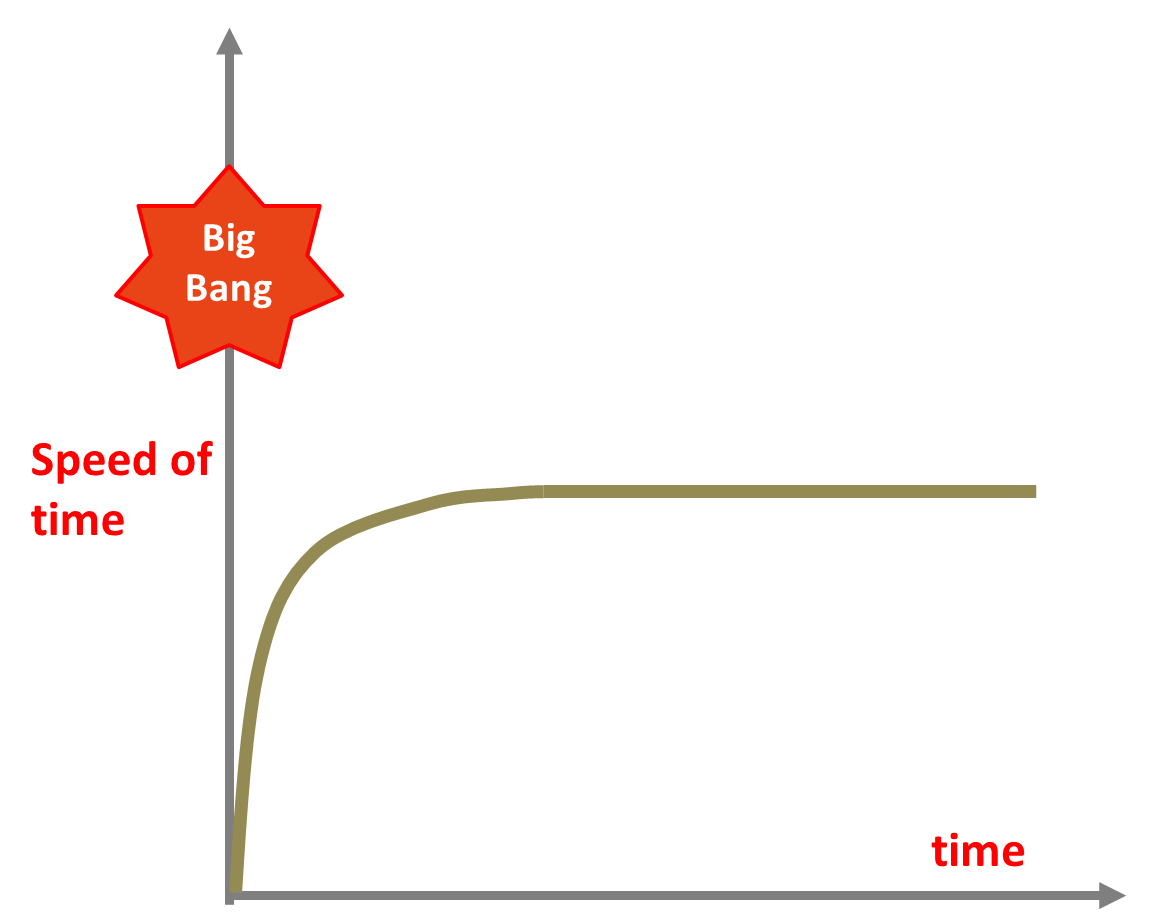
At the Big Bang, the speed of ℜeal time would have been zero. A perceived picosecond of elapsed time would actually have been after the elapse of many, many trillions of ℜeal time years. The perceived age of the universe of 13.8 billion years of perceived time would have been infinitely long ago in ℜeal time.
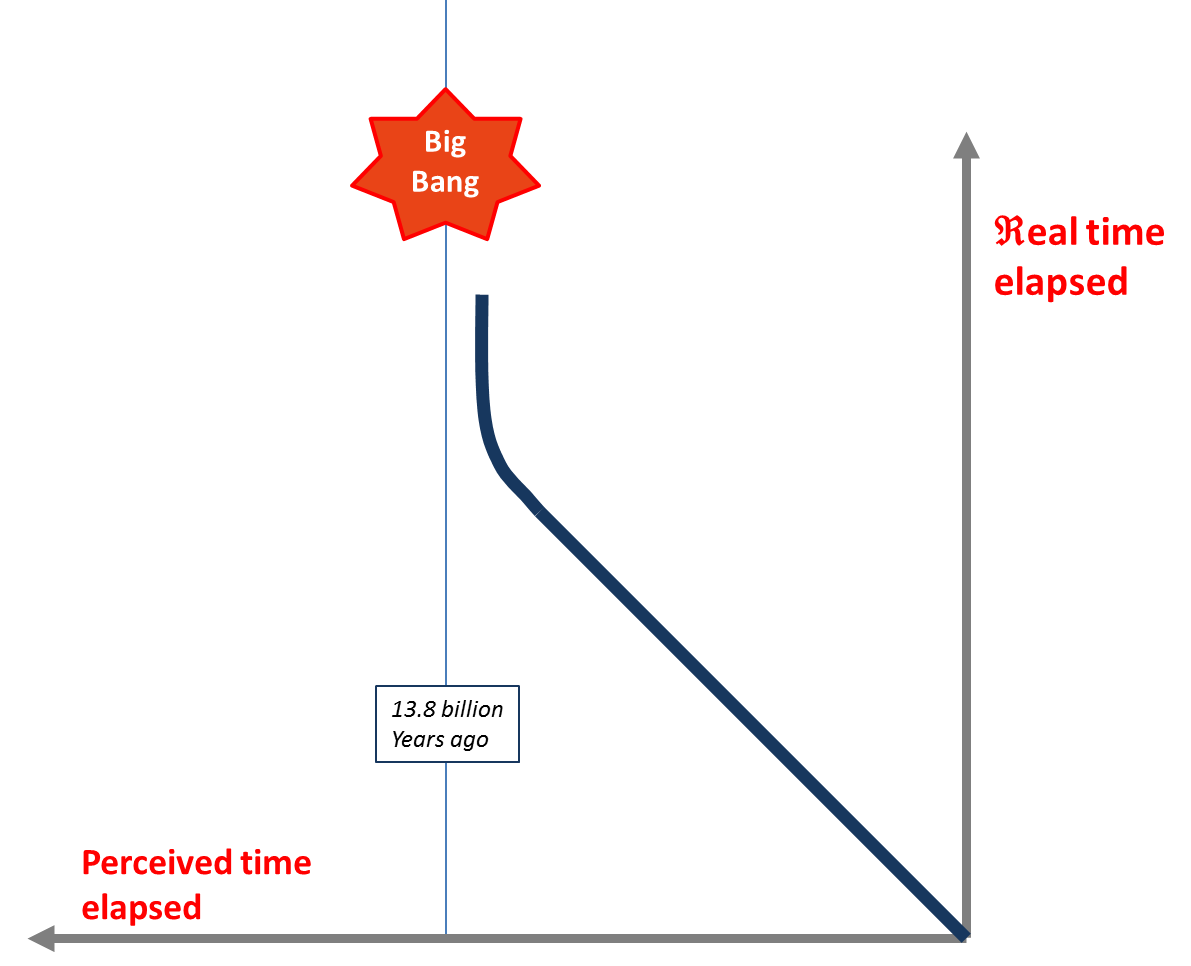
Real time
The death of the Universe will then see ℜeal time either slowing down again for an imploding Universe (or time speeding up for the reverse).
The Big Bang inherently requires an inconstant time.

 The k2p blog