Archive for the ‘Physics’ Category

If space is not empty, what is? The ultimate void?

October 30, 2015

As I grew up, the concept of “space” was of an area devoid of matter (and we had not heard about “dark matter” then). The science fiction I was addicted to usually used terms such as the vacuum of space, or the cold emptiness of space or the void of space. But the concept was of physical space with our conventional, and comfortable,  3-dimensions. Space was always something things could move into. The known laws of physics applied there, if there was something there to be applied to. It was to be the exciting, new frontier for the expansion of human thoughts and in due course of humans and the human spirit.

Somewhere along the way, the insight developed that being devoid of matter did not mean being devoid of properties. I think it must have been in my pre-thermodynamics days, that it occurred to me that the lack of matter must still leave the space with dimensions. Distance must still be measurable across the empty space. Gravity must, logically, still apply between masses on either side of empty space and therefore the space must also have the ability to propagate the force across it. Presumably it also had the ability to allow light to traverse it. Then, as I first encountered thermodynamics, I began to think of temperature as the energy level of vibrating atoms and molecules and realised that the coldness of space was meaningless in the absence of any particles. I grappled with the concept of absolute zero on the temperature scale and came to the conclusion that without matter first existing, temperature was an undefined property. Cold space was just plain wrong if temperature was not defined.

Then along came my awareness of Einstein and his space-time (which he himself compared with the aether). There was no longer anything which could be called empty space. The universe was, without any doubt, expanding. But then I had to grapple with whether the universe was expanding into a space (or space-time) already extant, or which created its own space as it went along its merry, expansive way. That still left the question: What was there before the universe expanded into the new when-and-where of the space-time it was creating? The expanding universe is itself mind-blowing, since it applies to galaxies but not apparently to our bodies, or even to bodies within the solar system. That led me to wonder about the nature of the expansion of the universe itself. It is observed (inferred) by astronomers and physicists, but only from within the universe. Would an observer external to the universe, if such an observer could exist, also observe that the universe was expanding? Of course, that leads to the question of the nature of the space to be occupied by such an external observer, and the properties which that space or space-time or space-time-magic continuum might have? Or was the universe, by definition, such that nothing – and no thing – could be external to it? What would expansion in our space-time mean to an observer who transcended our dimensions? Could a fish in its pond conceive of the empty space beyond the water surface?
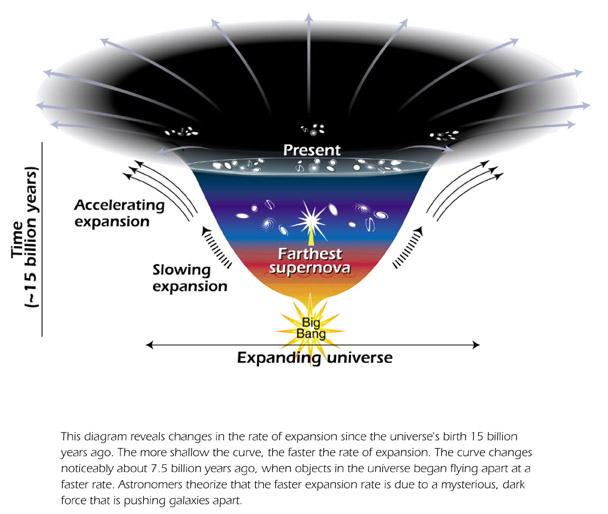
Expanding Universe - hubblesite.org

Expanding Universe – hubblesite.org

Now the expansion of the universe is not proceeding as it should with the known forces and energy-levels that exist. The expansion of the Universe is apparently accelerating. It is not slowing due to gravity as it should. Therefore dark matter and dark energy must exist. To fit the theories, the universe is apparently made up of 68% dark energy, 27% dark matter and just 5% of normal matter that we can observe. But this only leads to more questions. If 95% of the known universe is of unknown, magical stuff, then how representative of anything is what we infer from the 5% we can observe?

It is easy to draw a picture of an expanding universe on a piece of paper. But note that the “space” on the paper outside the universe is not labelled. It is just “empty space” and merely the backdrop for the diagram. The moment we imbue space or space-time with any properties, we inevitably define also the conception of the non-existence of those properties. And I still have difficulty getting my head around this M-space (magic space) which is truly empty and which is devoid of all matter and all possible properties, attributes or characteristics. M-space then must be the ultimate void, the magical non-thing, which is the backdrop for the universe.

But my real problem is that I cannot even conceive of M-space without giving it some property – even if only the property of having no properties or that it is not of this universe. Which only leaves Magic as the backdrop for everything.
A loss of elegance in the nature of matter

October 17, 2015

Physics is losing the elegance it once had.

I suppose I am just old-fashioned but I learnt that simpler was better and more elegant – whether in mathematics or science or engineering or literature or poetry.  Shorter reports rather than longer ones, simpler language if more precise, lighter machines rather than heavier ones, elegant physical structures rather than complex ones. No waste, no extraneous fuss. Necessary and sufficient was the ideal.

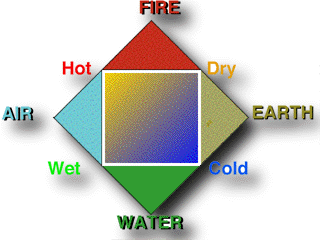
In the ancient world, all things were made up of fire, water, air and earth. It was a simple. elegant and powerful model to explain the world of matter.


Matter a la Aristotle

Matter a la Aristotle (image honolulu.hawaii.edu)

Then in the modern world, 2,500 years later, when over 100 different elements had been discovered, and where each element was built up of unique, fundamental atoms, an even simpler, more elegant and powerful model was discovered/developed. All atoms of all elements were found to be built up from just 3 elementary particles; the proton, the neutron and the electron.

Rutherford-Bohr atom

Rutherford-Bohr atom

It has been downhill from that peak of elegance ever since.

Physics has become a Big Science where billion dollar sledgehammers are used to crack little nuts. Pieces of nut and shell go flying everywhere and each little fragment is considered a new elementary particle. The Rutherford-Bohr model still applies, but its elementary particles are no longer considered elementary. Particles with mass and charge are given constituent particles, one having mass and no charge, and one having charge and no mass. Unexplainable forces between particles are assigned special particles to carry the force. Particles which don’t exist, but may have existed, are defined and “discovered”. Errors in theoretical models are explained away by assigning appropriate properties to old particles or defining new particles. Every new particle leaves a new slime trail across the painting. It is as if a bunch of savages are doodling upon a masterpiece. The scribbling is ugly and hides the masterpiece underneath, but it does not mean that the masterpiece is not there.

Atom in the standard model 1 - CPEPweb

Atom in the standard model 1 – (image CPEPweb.org)

Atom in the standard model 2 - CPEPweb

Atom in the standard model 2 – (image CPEPweb.org)

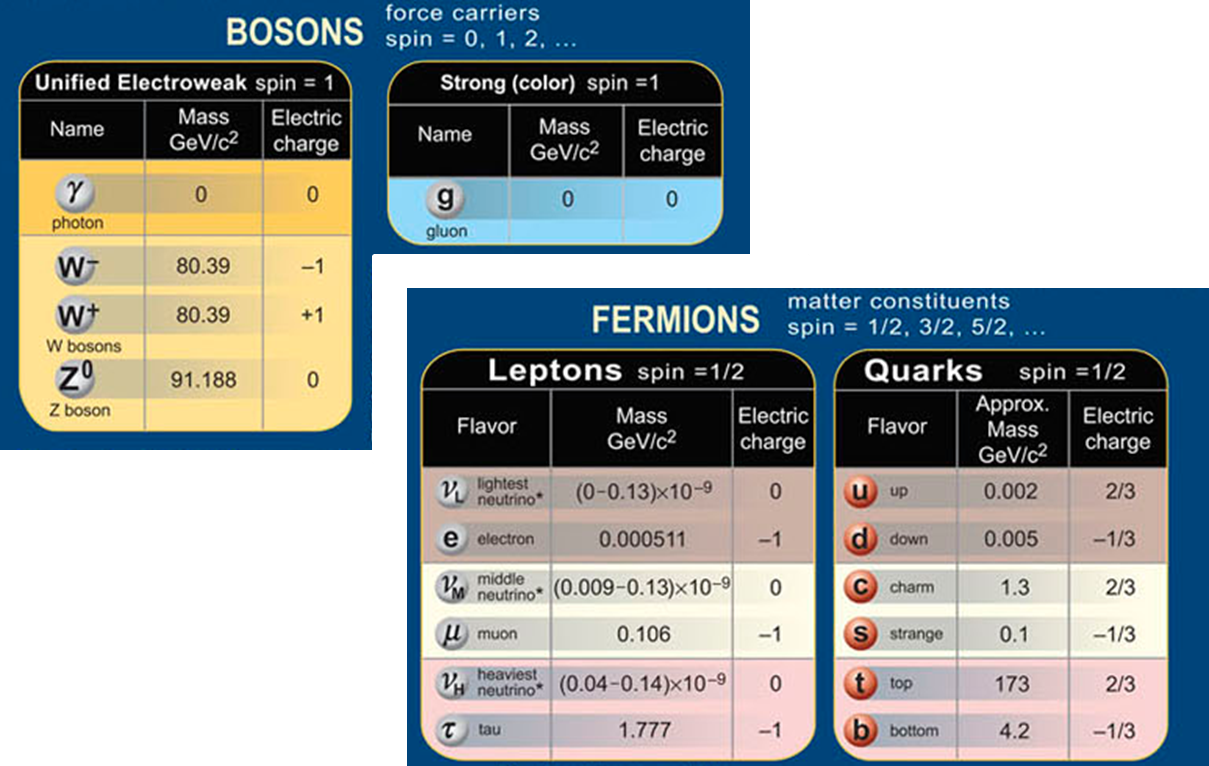
The “standard model” does not quite fit observations so new theories of dark energy and dark matter are postulated (actually just invented as fudge factors) and further unknown particles are defined. The number of elementary particle have proliferated and are still increasing. The “standard model” of physics now includes at least 61 elementary particles (48 fermions and 13 bosons). Even the ancient civilisations knew better than to try and build with too many “standard” bricks. Where did simplicity go? Just the quarks can be red, blue or green. They can be up, down, charm, strange, top or bottom quarks. For every type of quark there is an antiquark. Electrons, muons and taus have each their corresponding neutrinos. And they all have their anti-particles. Gluons come in eight colour combinations. There are four electroweak bosons and there ought to be only one higgs boson. But who knows? CERN could find some more. I note that fat and thin or warm and cool types of particles have yet to be defined. Matter and antimatter particles on meeting each other, produce a burst of energy as they are annihilated. If forces are communicated by particles, gravity by gravitons and light by photons then perhaps all energy transmission can give rise to a whole new family of elementary particles.

The 61 particles still do not include the graviton or sparticles or any other unknown, invisible, magic particles that may go to making up dark matter and dark energy. Some of the dark matter may be stealthy dark matter and some may be phantom dark matter. One might think that when dark matter goes phantom, it ought to become visible, but that would be far too simple.  The level of complexity and apparent chaos is increasing. Every new particle discovered requires more money and Bigger Science to find the next postulated elementary particle.

When CERN claimed to have found the God Particle – the higgs boson – they still added the caveat that it was just one kind of the higgs boson and there could be more as yet unknown ones to come. So the ultimate elementary particle was certainly not the end of the road. Good grief! The end of the road can never be found. That might end the funding. And after all, even if the God Particle has been found, who created God? Guess how much all that is going to cost?

Forbes: The Large Hadron Collider took about a decade to construct, for a total cost of about $4.75 billion. There are several different experiments going on at the LHC, including the CMS and ATLAS Detectors which discovered the Higgs boson. CERN contributes about 20% of the cost of those experiments, which is a total of about $5.5 billion a year. The remainder of the funding for those experiments is provided by international collaborations. Computing power is also a significant part of the cost of running CERN – about $286 million annually. Electricity costs alone for the LHC run about $23.5 million per year. The total operating budget of the LHC runs to about $1 billion per year.

The Large Hadron Collider was first turned on in August of 2008, then stopped for repairs in September until November 2009. Taking all of those costs into consideration, the total cost of finding the Higgs boson ran to about $13.25 billion.

I am not a physicist, so maybe all this cost for the sledgehammer approach is worthwhile. I don’t comprehend the “standard model” but I can’t help feeling that many of the current “discoveries” in physics are primarily concerned with getting further funding. So when the CERN public relations machine goes into overdrive and issues breathtaking prose about awesome new finds, I tend to reach for the salt. A “standard model” it may be, but simple it is not and elegance is a long, long way away.

“Simple” and “elegant” are value judgements. I look forward to the time when physics and physicists simplify their house(s) of magic and fantasy and return to those values. And preferably with some elegance and without the sledgehammers of Large Hadron Colliders and supercomputers.

Great fleas have little fleas upon their backs to bite ’em,

And little fleas have lesser fleas, and so ad infinitum

But for the structure of matter, 61+ elementary particles is not just inelegant. It is becoming downright ugly.


Physics invokes magical “stealthy dark matter”

September 25, 2015

Physics is just a branch of the ultimate science – that of “Magic”. All the fundamental unknowns of physics are given special names (in lieu of explanation) and are assumed to have just those properties (often fantastical) which allow theoretical models of cosmology to maintain some credibility and come close to matching observations.

“Spacetime”, “gravitation”, “dark matter”, “dark energy” and even “phantom dark matter” can all just be termed “the mellifluous aether”, “magical attraction”, “magic matter”, “magic energy”, and “even more magic energy” without any loss of whatever rigour exists in Physics.

The methodology is quite simple.

First, invent a theory to explain what we don’t know. Then do some fancy maths to back up the theory. Whenever the theory fails, define a magic particle or event or property which brings credibility back to the theory. Spend vast amounts of money on Big Science experiments to find the magic particle or event or property. Find something other than the magic particle or property or event that was predicted. Claim that what was found was a special case of the magic “thing” that was predicted and due to some new magic particle or event or property. Demand more money to do more and bigger Big Science experiments. Magic demands more magic. And so an ad infinitum.

But magic demands more magic – deeper and more profound.

And so we have a new theory of stealthy dark matter to explain why it is undetectable.

Thomas Appelquist et al, Direct Detection of Stealth Dark Matter through Electromagnetic Polarizability. Physical Review Letters, 2015

Press Release: Lawrence Livermore National Laboratory (LLNL) scientists have come up with a new theory that may identify why dark matter has evaded direct detection in Earth-based experiments.

A group of national particle physicists known as the Lattice Strong Dynamics Collaboration, led by a Lawrence Livermore National Laboratory team, has combined theoretical and computational physics techniques and used the Laboratory’s massively parallel 2-petaflop Vulcan supercomputer to devise a new model of dark matter. It identifies it as naturally “stealthy” ( like its namesake aircraft, difficult to detect) today, but would have been easy to see via interactions with ordinary matter in the extremely high-temperature plasma conditions that pervaded the early universe. ……. 

Dark matter makes up 83 percent of all matter in the universe and does not interact directly with electromagnetic or strong and weak nuclear forces. Light does not bounce off of it, and ordinary matter goes through it with only the feeblest of interactions. Essentially invisible, it has been termed dark matter, yet its interactions with gravity produce striking effects on the movement of galaxies and galactic clusters, leaving little doubt of its existence. …….. 

The key to stealth dark matter’s split personality is its compositeness and the miracle of confinement. Like quarks in a neutron, at high temperatures these electrically charged constituents interact with nearly everything. But at lower temperatures they bind together to form an electrically neutral composite particle. Unlike a neutron, which is bound by the ordinary strong interaction of quantum chromodynamics (QCD), the stealthy neutron would have to be bound by a new and yet-unobserved strong interaction, a dark form of QCD. …..

But there is something more than a little circular in the argument that “its interactions with gravity produce striking effects on the movement of galaxies and galactic clusters, leaving little doubt of its existence”.

This is just magical mumbo jumbo. (Not that there is anything wrong with the magical incantations of physicists which are just as valid as any magical incantation by a shaman or a High Priest).

Universetoday.com: Various universe evolution scenarios. A universe with too much density collapses in on itself, a critical density universe stays static, while a universe with not enough density keeps expanding at a steady (coasting) rate. However, today’s cosmology puts emphasis upon the cosmological constant, which gives an accelerating expansion. Does this mean that density is irrelevant? Credit: NASA.

The universe is accelerating instead of slowing down therefore “dark energy must exist”. Because objects moving very fast in some clusters of galaxies do not escape the clusters, it becomes necessary to invent magical “dark matter” exercising gravitational effects. The gravitation/speed anomaly is used to postulate that dark matter exists, but actually all it says is that gravitation theory alone is insufficient to explain the observations. We cannot detect dark matter so we generate theories for why it must be “phantom” or “stealthy” now. We infer it and its properties because the magic invoked to explain gravitation (relativity and spacetime) is not upto the task.

Note (diagram above) that all theories about the shape of the Universe have it surrounded by an infinite, unbounded, unknown, unknowable space of Deep, Dark Something. Let’s call it Magic.

Physics appears to come first in the hierarchy of Science. But Magic probably comes before Physics. Perhaps the most fundamental law of the Universe is actually the Conservation of Magic (and energy and mass and the curvature of spacetime are merely facets of Magic). Before the Big Bang there was first a critical accumulation of Magic which caused the Big Bang. And the quantity of magic gives the cosmological constant because of the Deep, Dark Magic underlying simple Magic …….

Physics/Magic posts:

  1.  The fundamentals of physics are just magic
  2. Magic is to physics as Heineken is to the human body
  3. Physics and cosmology are more magical than alchemy as dark energy goes phantom
  4. Gravitation could just as well be called “magical attraction”
  5. Dark energy and dark matter are just fudge factors for cosmic models that don’t work
  6. Physics came first and then came chemistry and later biology

Magic is to physics as Heineken is to the human body

September 10, 2015

Magic already fills all the spaces that physics cannot reach.

Take spacetime (you can just as well call it the mellifluous aether which carries gravitational waves from the sun to the distant reaches of the solar system where other beers cannot reach).

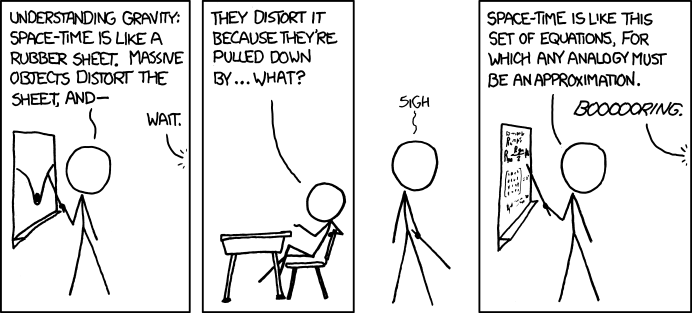
The stretched rubber-sheet analogy to explain spacetime and gravity is just that – an analogy. And not a very good one as xkcd has so well illustrated.

spacetime magic — by xkcd

“Spacetime” is a label for any mathematical model which combines space and time into a continuum. It is just a model. But why that model should apply is magic.

Spacetime is just an imagined structure of the universe and is imbued with mathematically-defined properties such that “spacetime is distorted by the mass of bodies which exist within it and these distortions, in turn, affect the motion of those masses”. A somewhat circular argument which does not explain the “why” or the “how” beyond “it must be so, because it is so”.

Spacetime does not explain the existence of gravity. It merely shifts the need for magic to explain magical attraction (labelled gravity) to another place where physics cannot reach. In a universe where motion is not independent of time, and where the very duration of time can vary as a consequence of motion, even the magnitude of the 3 physical dimensions become variables subject to the observer and his motion. Not to mention that mass can be energy and some of both can be dark. Neither mass nor energy nor momentum can any longer be conserved, because phantom dark energy can be called upon and injected into the equations whenever it is needed to explain the unexplainable. And to have a “phantom” class of undetectable, unobservable dark energy which is doubly undetectable, does seem to go over the top. Rather than just put dark energy and dark matter, and even phantom dark energy into the category of magic, intrepid physicists have invented new classes of  unknown, unobservable, undetectable, sub-atomic particles. Some have charm and some have spin. Some have properties which are as yet undefined but will be sufficient to the explanation required to be constructed. Why not just call them “magic particles”?

Physics no longer goes for the parsimonious explanation. Big Physics seems nowadays to be based on introducing complexities wherever possible rather than looking for the least complicated explanation which is sufficient to the explanation. For every ultimate, fundamental particle that is “found”, but found wanting, two further magic particles have to be invoked.

Of course, there is a Grand Unified Theory which explains electromagnetic, weak, and strong interactions and naturally there is a Theory of Everything which even explains gravity. It is quite simple and sufficient to the purpose. It is called Magic and it occupies all the spaces that Physics cannot reach.

It is time for a Heineken. Now if I could only remember the right spell and the right incantation to go with it, ………


The fundamentals of physics are just magic

September 1, 2015

Physicists would like to think that they deal in reality and are cold, rational, objective observers of the physical universe we live in. But deep, deep down, they just rely on magic. The Universe is nothing but a place of pervasive magic. Gravity is just a magical attraction. Spacetime is just an attractiferous aether. Physicists are thus practitioners of magic and may even be able to use the forces of magic, but they have no inkling as to why the magical forces exist.

Replace

  1. “gravity” or “gravitation” by “magical attraction”
  2. “spacetime” by “the attractiferous aether”
  3. “electromagnetic” by “electromagical”
  4. the “strong force” by the “strong magic force”
  5. the “weak force” by the “weak magic force”

and the Wikipedia entry for Gravity then reads as follows:

Magical attraction is a natural phenomenon by which all things are brought towards one another – irrespective of size, i.e. stars, planets, galaxies and even light and sub-atomic particles. Magical attraction has an infinite range, and it cannot be absorbed, transformed, or shielded against. Magical attraction is responsible for the formation of structures within the universe (namely by creating spheres of hydrogen, igniting them with enough pressure to form stars and then grouping them together into galaxies), as without magical attraction, the universe would be composed only of equally spaced particles. On Earth, magical attraction is commonly recognized in the form of weight where physical objects are harder to pick-up and carry the ‘heavier’ they are.

Magical attraction is most accurately described by the general theory of relativity (proposed by Albert Einstein in 1915) which describes the force of magical attraction, not as a force, but as a consequence of the curvature of the attractiferous aether caused by the uneven distribution of mass/energy; and resulting in time dilation, where time lapses more slowly under strong magical attraction. However, for most applications, magical attraction is well approximated by Newton’s law of Universal Magical Attraction, which postulates that magical attraction is a force where two bodies of mass are directly drawn to each other according to a mathematical relationship, where the attractive magical force is proportional to the product of their masses and inversely proportional to the square of the distance between them. This is considered to occur over an infinite range, such that all bodies (with mass) in the universe are drawn to each other no matter how far they are apart.

Magical attraction is the weakest of the four fundamental magical interactions of nature. The force of magical attraction is approximately 10−38 times the strength of the strong magic force (i.e. gravity is 38 orders of magnitude weaker), 10−36 times the strength of the electromagical force, and 10−29 times the strength of the weak magic force. As a consequence, magical attraction has a negligible influence on the behavior of sub-atomic particles, and plays no role in determining the internal properties of everyday matter (but see quantum magical attraction). On the other hand, magical attraction is the dominant force at the macroscopic scale, that is the cause of the formation, shape, and trajectory (orbit) of astronomical bodies, including those of asteroids,comets, planets, stars, and galaxies. It is responsible for causing the Earth and the other planets to orbit the Sun; for causing the Moon to orbit the Earth; for the formation of tides; for natural convection, by which fluid flow occurs under the influence of a density gradient and magical attraction; for heating the interiors of forming stars and planets to very high temperatures; for solar system, galaxy, stellar formation and evolution; and for various other phenomena observed on Earth and throughout the universe.

In pursuit of a theory of everything magical, the merging of general relativity and quantum mechanics (or quantum field theory) into a more general theory of quantum magical attraction has become an area of research.

Of course it is still not clear if magic is a continuous thing or composed of discrete magical quanta. One theory has it that all things are connected by invisible, undetectable magical strings and it is the elastic nature of these strings which gives rise to the forces of magical attraction.

The reality is that the Universe came into being by magic and the fundamental forces which have governed, and still govern, are all magical. If there ever was a Big Bang it was a magical event. And every sunrise and sunset which occurs is just due to the magical forces of attraction which apply. We live in a world of magic. Magic is normal.

Physics and cosmology are more magical than alchemy as dark energy goes phantom

July 3, 2015

The methodology is quite simple. First, invent a theory to explain what we don’t know. Then do some fancy maths to back up the theory. Whenever the theory fails, define a magic particle or event or property which brings credibility back to the theory. Spend vast amounts of money on Big Science experiments to find the magic particle or event or property. Find something other than the magic particle or property or event that was predicted. Claim that what was found was a special case of the magic “thing” that was predicted and due to some new magic particle or event or property. Demand more money to do more and bigger Big Science experiments. Magic demands more magic. And so an ad infinitum.

And so came the 4 magic forces of nature which cannot be explained – Gravity, Electromagnetism, the Strong Force and the Weak Force. The magic forces exist and can be calculated but they cannot be explained. Universal magic that just is. One of the characteristics of modern physics is that magical things are given names in lieu of explanations. Then came the Standard Model of Particle Physics and new magic particles named the Higgs Boson to be found by the very expensive Large Hadron Collider. Some data is interpreted as having found a form of the Higgs boson – but that leaves other magic particles and the true Higgs Boson still to be found. (The same data could also be used – probably with more certainty – to predict the next winner of the Triple Crown or even the next President of the United States). Finding the missing magic particles will naturally require more money, more physicists, more cosmologists and more mathematicians. More and Bigger Science.

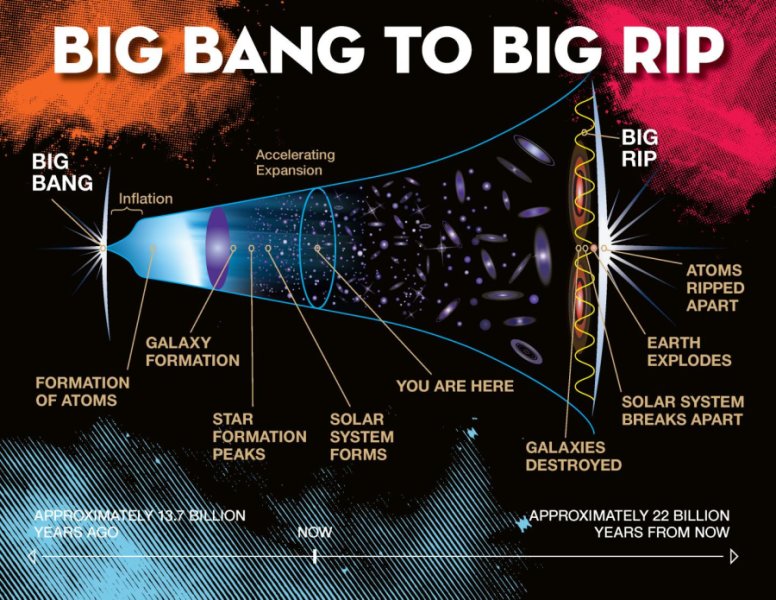
Cosmology has not been far behind in inventing magical events and magical “things”. A magical Big Bang was to be followed by a mysterious Big Crunch or possibly a fantastical Big Freeze. Now comes another speculative paper and another Magical Event – the Big Rip. We know that the magical expansion of the universe is fuelled by magical dark energy. And we know, of course, that dark energy is simply that which causes the universe to expand. And so the Big Rip may be due to deeper magic which gives phantom dark energy. It is only a matter of time before we find that even phantom dark energy can be further classified into that which spins clockwise or that which is tall.

But not to worry. The Ripping end to the Universe is still 22 billion years away. Maybe the United Nations could pass a resolution condemning this future event. And then establish an International Panel on Universe Change to put a stop to this development.

Marcelo M. Disconzi, Thomas W. Kephart, Robert J. Scherrer. New approach to cosmological bulk viscosity. Physical Review D, 2015; 91 (4) DOI: 10.1103/PhysRevD.91.043532

A time line of the universe from Big Bang to Big Rip. Credit: Jeremy Teaford, Vanderbilt University

A time line of the universe from Big Bang to Big Rip.
Credit: Jeremy Teaford, Vanderbilt University

Vanderbilt Press Release: …… for decades cosmologists have had trouble reconciling the classic notion of viscosity based on the laws of thermodynamics with Einstein’s general theory of relativity. However, a team from Vanderbilt University has come up with a fundamentally new mathematical formulation of the problem that appears to bridge this long-standing gap.

The new math has some significant implications for the ultimate fate of the universe. It tends to favor one of the more radical scenarios that cosmologists have come up with known as the “Big Rip.” It may also shed new light on the basic nature of dark energy.

The new approach was developed by Assistant Professor of Mathematics Marcelo Disconzi in collaboration with physics professors Thomas Kephart and Robert Scherrer and is described in a paper published earlier this year in the journal Physical Review D.

……… In the 1990s, the physics community was shocked when astronomical measurements showed that the universe is expanding at an ever-accelerating rate. To explain this unpredicted acceleration, they were forced to hypothesize the existence of an unknown form of repulsive energy that is spread throughout the universe. Because they knew so little about it, they labeled it “dark energy.” 

Most dark energy theories to date have not taken cosmic viscosity into account, despite the fact that it has a repulsive effect strikingly similar to that of dark energy. “It is possible, but not very likely, that viscosity could account for all the acceleration that has been attributed to dark energy,” said Disconzi. “It is more likely that a significant fraction of the acceleration could be due to this more prosaic cause. As a result, viscosity may act as an important constraint on the properties of dark energy.”

Another interesting result involves the ultimate fate of the universe. Since the discovery of the universe’s run-away expansion, cosmologists have come up with a number of dramatic scenarios of what it could mean for the future.

One scenario, dubbed the “Big Freeze,” predicts that after 100 trillion years or so the universe will have grown so vast that the supplies of gas will become too thin for stars to form. As a result, existing stars will gradually burn out, leaving only black holes which, in turn, slowly evaporate away as space itself gets colder and colder.

An even more radical scenario is the “Big Rip.” It is predicated on a type of “phantom” dark energy that gets stronger over time. In this case, the expansion rate of the universe becomes so great that in 22 billion years or so material objects begin to fall apart and individual atoms disassemble themselves into unbound elementary particles and radiation.

As if invisible and undetectable dark energy is not magic enough, we must now postulate that there is a particular kind of this dark energy which is phantom dark energy. It is magic squared and of course the derivative is two-magic. This is not Space Opera, it is Cosmic Opera.

It is perhaps not so surprising that the more we know the more we don’t know and so modern physics and cosmology need much more magic to explain all we don’t know than alchemy ever did.

Lockheed-Martin and compact fusion – a long way away but more credible than the E-Cat cold-fusion hype

October 21, 2014

Andrea Rossi and his E-Cat cold fusion claims still smell like a fraud. It has been hyped for over 4 years now with little to show. I am somewhat surprised that there are still a few gullible academics and journalists around who keep the circus going.

The Lockheed-Martin development of a compact fusion reactor has a long way to go but I find it much more credible. I could consider betting some money on the compact fusion reactor but would not touch the E-Cat with a very, very, long barge pole.

Th availability of a fusion reactor of any kind would revolutionise the availability of electrical energy but always subject to cost. Mere availability would not be enough to cause a paradigm shift. The availability of gas (natural gas, shale gas and gas from methane hydrates) now extends to about 1,000 years. The use of gas turbine combined-cycle power plants, which have a 2 year construction period, will provide the cost benchmark for electricity production. Where fusion might place in the power generation mix will depend on its operating cost but the level to which it may penetrate will depend on the capital cost and the construction time.

A compact reactor as envisaged by Lockheed- Martin however would be a game changer not only for electricity generation but also for desalination, electrical vehicles and even space travel. The beauty of “compact” if achieved is that it “automatically” leads to low-cost and modular construction.

The probablity of success in the time-frame envisagesd is still low. It is a high risk development and it will not be cheap. But the potential reward is immense.

Some of the characteristics of their high-beta, compact reactor are:

  • The device is cylindrical and 2×2×4 meters in size.
  • The magnetic field increases the farther out that the plasma goes, which pushes the plasma back in.
  • It also has very few open field lines (very few paths for the plasma to leak out; uses a cylinder, not a Tokamak ring).
  • Very good arch curvature of the field lines.
  • The system has a beta of about 1.
  • This system uses deuterium and tritium.
  • The system heats the plasma using radio waves.

L-M Press Release: 

PALMDALE, Calif., Oct. 15, 2014 – The Lockheed Martin [NYSE: LMT] Skunk Works® team is working on a new compact fusion reactor (CFR) that can be developed and deployed in as little as ten years. Currently, there are several patents pending that cover their approach.

While fusion itself is not new, the Skunk Works has built on more than 60 years of fusion research and investment to develop an approach that offers a significant reduction in size compared to mainstream efforts.

“Our compact fusion concept combines several alternative magnetic confinement approaches, taking the best parts of each, and offers a 90 percent size reduction over previous concepts,” said Tom McGuire, compact fusion lead for the Skunk Works’ Revolutionary Technology Programs. “The smaller size will allow us to design, build and test the CFR in less than a year.”

After completing several of these design-build-test cycles, the team anticipates being able to produce a prototype in five years. As they gain confidence and progress technically with each experiment, they will also be searching for partners to help further the technology.


Physics Nobel goes blue

October 7, 2014

LEDsuperbright.com

The Royal Swedish Academy of Sciences has decided to award the Nobel Prize in Physics for 2014 to

Isamu Akasaki
Meijo University, Nagoya, Japan and Nagoya University, Japan

Hiroshi Amano
Nagoya University, Japan

and

Shuji Nakamura
University of California, Santa Barbara, CA, USA

“for the invention of efficient blue light-emitting diodes which has enabled bright and energy-saving white light sources”

PRESS RELEASE

Gravitation could just as well be called “magical attraction”

October 1, 2014

We don’t know how the four fundamental forces of nature are communicated. We explain the actions at a distance they give rise to by defining new words. We might as well just use the word “magic”.

We may like to think of ourselves as being very modern, very scientific, very rational without having – or needing – any recourse to mystical powers. Yet there is much where we don’t know what we don’t know. We use the forces  of gravitation and magnetism and can even calculate their magnitude but are no closer to knowing why they exist and how they are communicated. We have theories as to why they exist and how they work but these theories require that we define new, abstract/imaginary concepts of space-time and curvature of space. Gravitation fields and electromagnetic fields cause motion at a distance but where we don’t know how the forces bringing about such motion are communicated. We have no idea why gravity fields apparently propagate at (or, some say, greater than) the speed of light. We invent particles with magical properties but without any real understanding why such magical properties may exist. But our invocation of curvature  in space or virtual photons or up-quarks or down-quarks is no different to the ancients invoking magic and communicated through the aether. The rubber sheet analogy for curved spacetime is flawed in that it only works because gravity magic already exists and keeps the bodies attached to the top of the stretched rubber sheet.

Wherever we have forces acting at a distance we can just as well use the word “magic” instead of any of the other words we imagine. Inventing a massless graviton is merely invoking magic. We could just as well refer to gravitation as attraction magic and electromagnetic interaction as electromagic. And all the various magics are just natural.

For example, here is the Wikipedia entry for Gravitation where the words gravitation, gravity and other fundamental forces have been replaced by “magic” or “magical forces”.

Attraction magic is a natural phenomenon by which all physical bodies attract each other. Magical attraction gives weight to physical objects and causes them to fall toward the ground when dropped.

In modern physics, attraction magic is most accurately described by the general theory of relativity (proposed by Einstein) which describes attraction magic as a consequence of the curvature of spacetime. For most situations magical attraction is well approximated by Newton’s law of universal attraction magic, which postulates that the magical attraction force of two bodies of mass is directly proportional to the product of their masses and inversely proportional to the square of the distance between them.

In pursuit of a theory of everything, the merging of general relativity and quantum mechanics (or quantum field theory) into a more general theory of quantum magical attraction has become an area of active research. It is hypothesised that the magical attraction force is mediated by a massless spin-2 particle called the graviton, and that magical attraction would have separated from the electromagic force during the grand unification epoch.

Magical attraction is the weakest of the four fundamental magic forces of nature. The attraction magical force is approximately 10−38  times the strength of the strong magic force (i.e., magical attraction is 38 orders of magnitude weaker), 10−36  times the strength of the electromagical force, and 10−29  times the strength of the weak magic force. As a consequence, magical attraction has a negligible influence on the behavior of sub-atomic particles, and plays no role in determining the internal properties of everyday matter. On the other hand, magical attraction is the dominant force at the macroscopic scale, that is the cause of the formation, shape, and trajectory (orbit) of astronomical bodies, including those of asteroids, comets, planets, stars, and galaxies. It is responsible for causing the Earth and the other planets to orbit the Sun; for causing the Moon to orbit the Earth; for the formation of tides; for natural convection, by which fluid flow occurs under the influence of a density gradient and magical attraction; for heating the interiors of forming stars and planets to very high temperatures; for solar system, galaxy, stellar formation and evolution; and for various other phenomena observed on Earth and throughout the universe. This is the case for several reasons: magical attraction is the only force acting on all particles with mass; it has an infinite range; it is always attractive and never repulsive; and it cannot be absorbed, transformed, or shielded against. Even though electromagic is far stronger than magical attraction, electromagic is not relevant to astronomical objects, since such bodies have an equal number of protons and electrons that cancel out (i.e., a net electromagic charge of zero).

Sounds fine and sufficiently unintelligible/magical to me.

Physics still contains a lot of magic.

No black holes, no Big Bang would leave the universe without a beginning

September 30, 2014

There is now a mathematical proof that black holes cannot exist. Event horizons and singularities then also cannot exist. Without singularities being possible there could have been no Big Bang. And without a Big Bang, the “age” of the universe has no meaning. Where does that leave time? and space-time?

(And without a Big Bang I will have to revisit my view of stasis since my own little speculation is that while time periods – Δt – can be conceived of, time itself – t- is nothing other than an axis of change connecting states of stasis.)

Black Hole star eater – National Geographic

If the mathematics holds up then not only science but also science fiction will have to look for new concepts of space and space-time and pathways to different universes and worm-holes and warp-speeds.

PhysOrg: … By merging two seemingly conflicting theories, Laura Mersini-Houghton, a physics professor at UNC-Chapel Hill in the College of Arts and Sciences, has proven, mathematically, that can never come into being in the first place. The work not only forces scientists to reimagine the fabric of space-time, but also rethink the origins of the universe. ……

The reason black holes are so bizarre is that it pits two fundamental theories of the universe against each other. Einstein’s theory of gravity predicts the formation of black holes but a fundamental law of quantum theory states that no information from the universe can ever disappear. Efforts to combine these two theories lead to mathematical nonsense, and became known as the information loss paradox.

In 1974, Stephen Hawking used quantum mechanics to show that black holes emit radiation. Since then, scientists have detected fingerprints in the cosmos that are consistent with this radiation, identifying an ever-increasing list of the universe’s black holes.

But now Mersini-Houghton describes an entirely new scenario. She and Hawking both agree that as a star collapses under its own gravity, it produces Hawking radiation. However, in her new work, Mersini-Houghton shows that by giving off this radiation, the star also sheds mass. So much so that as it shrinks it no longer has the density to become a black hole.

Before a black hole can form, the dying star swells one last time and then explodes. A singularity never forms and neither does an . The take home message of her work is clear: there is no such thing as a black hole.

….. Many physicists and astronomers believe that our originated from a singularity that began expanding with the Big Bang. However, if singularities do not exist, then physicists have to rethink their ideas of the Big Bang and whether it ever happened.